BY
MANHAR
15AE60R18
SEMINAR ON
SUPERCHARGER
Content..
Supercharger , the engine booster.
Why supercharger ?
How it works ?
Working diagram of supercharger.
Classification of supercharger.
Roots supercharger.
Twin-Screw Supercharger.
Centrifugal Supercharger.
Drives used in Supercharger.
Supercharger, An edge over turbocharger
Conclusion.
Supercharger,
The Engine Booster
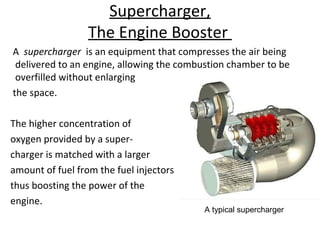
A supercharger is an equipment that compresses the air being
delivered to an engine, allowing the combustion chamber to be
overfilled without enlarging
the space.
The higher concentration of
oxygen provided by a super-
charger is matched with a larger
amount of fuel from the fuel injectors
thus boosting the power of the
engine.
A typical supercharger
Why Supercharger ?
 Increases the power of an engine.
 Increases the torque produced.
 An efficiently working supercharger can achieve the same
speed in one third time.
 Necessary in aero-planes as they have less oxygen at high
altitudes.
 Ensures complete combustion of the fuel.
 Reduces pollution to some extent.
Principle of working
“More fuel + More air = Bigger explosion = Greater horsepower”.
NOTE:
• But we cannot simply pump more fuel into the engine.
• The chemically correct mixture – (15 : 1 :: air : fuel) – is essential for an
engine to operate perfectly.
• Thus superchargers provides more air by compressing air above
atmospheric pressure , hence providing more fuel into the charge & would
make for a more powerful explosion .
• Thus: Increased Power , Torque and Speed is achieved.
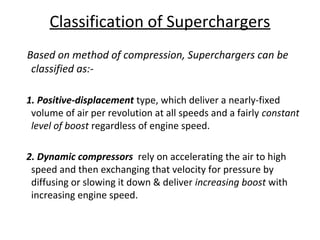
Classification of Superchargers
Based on method of compression, Superchargers can be
classified as:-
1. Positive-displacement type, which deliver a nearly-fixed
volume of air per revolution at all speeds and a fairly constant
level of boost regardless of engine speed.
2. Dynamic compressors rely on accelerating the air to high
speed and then exchanging that velocity for pressure by
diffusing or slowing it down & deliver increasing boost with
increasing engine speed.
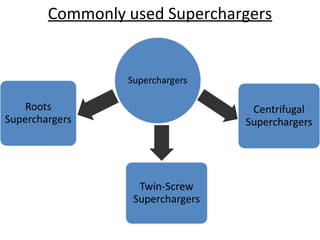
Commonly used Superchargers
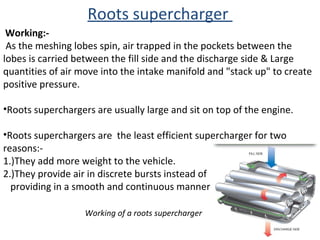
As the meshing lobes spin, air trapped in the pockets between the
lobes is carried between the fill side and the discharge side & Large
quantities of air move into the intake manifold and "stack up" to create
positive pressure.
•Roots superchargers are usually large and sit on top of the engine.
•Roots superchargers are the least efficient supercharger for two
reasons:-
1.)They add more weight to the vehicle.
2.)They provide air in discrete bursts instead of
providing in a smooth and continuous manner.
Working of a roots supercharger
Roots supercharger
Working:-
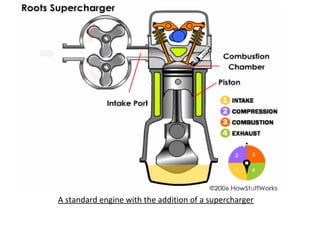
A standard engine with the addition of a supercharger
Twin-Screw Supercharger
A twin-screw supercharger operates by pulling air through a pair
of meshing lobes that resemble a set of worm gears.
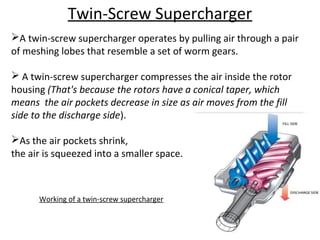
 A twin-screw supercharger compresses the air inside the rotor
housing (That's because the rotors have a conical taper, which
means the air pockets decrease in size as air moves from the fill
side to the discharge side).
As the air pockets shrink,
the air is squeezed into a smaller space.
Working of a twin-screw supercharger
• Thus twin-screw superchargers are more efficient compared to
roots
supercharger.
• They cost more because the screw-type rotors require more
precision in the manufacturing process.
• They also make a lot of noise.
• The compressed air exiting the discharge outlet creates a whine or
whistle that must be checked with noise suppression techniques.
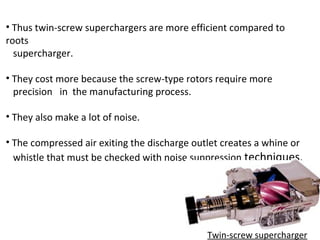
Twin-screw supercharger
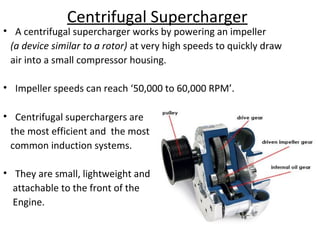
Centrifugal Supercharger
• A centrifugal supercharger works by powering an impeller
(a device similar to a rotor) at very high speeds to quickly draw
air into a small compressor housing.
• Impeller speeds can reach ‘50,000 to 60,000 RPM’.
• Centrifugal superchargers are
the most efficient and the most
common induction systems.
• They are small, lightweight and
attachable to the front of the
Engine.
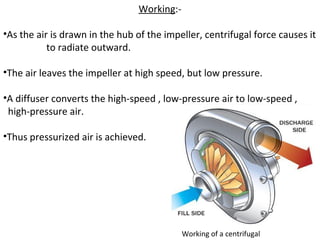
Working:-
•As the air is drawn in the hub of the impeller, centrifugal force causes it
to radiate outward.
•The air leaves the impeller at high speed, but low pressure.
•A diffuser converts the high-speed , low-pressure air to low-speed ,
high-pressure air.
•Thus pressurized air is achieved.
Working of a centrifugal
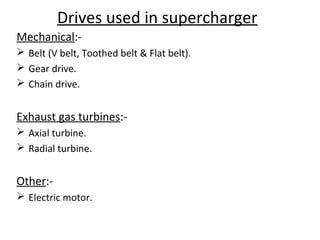
Drives used in supercharger
Mechanical:-
 Belt (V belt, Toothed belt & Flat belt).
 Gear drive.
 Chain drive.
Exhaust gas turbines:-
 Axial turbine.
 Radial turbine.
Other:-
 Electric motor.
Supercharger, An edge over turbocharger
• Superchargers do not suffer lag:- Superchargers have no lag
time because they are driven directly by the crankshaft,
whereas Turbochargers suffer from lag because it takes a few
moments before the exhaust gases reach a velocity that is
sufficient to drive the impeller/turbine.
• Modification of the exhaust system:- Installing a turbocharger
requires extensive modification of the exhaust system, but
superchargers can be bolted to the top or side of the engine ,
that makes them cheaper to install and easier to service and
maintain.
Shutdown procedure:-
No special shutdown procedure is required with superchargers as
they are not lubricated by engine oil . They can be shut down
normally. Turbochargers must idle for about 30 seconds or so
prior to shutdown so the lubricating oil has a chance to cool
down.
Conclusion
• Despite their disadvantages, superchargers are still the most cost-
effective way to increase horsepower.
• Superchargers can result in power increase of 50 to 100 percent,
making them great for racing, towing heavy loads or just adding
excitement to the typical driving experience.
• It is a must use component in an airplanes.
References:
[1]www.superchargerpros.com
[2]auto.howstuffworks.com/supercharger5.htm
[3]wikipedia.org/wiki/Supercharger
[4]www.youtube.com
THANK YOU!

Supercharger ppt

  • 1.
  • 2.
    Content.. Supercharger , theengine booster. Why supercharger ? How it works ? Working diagram of supercharger. Classification of supercharger. Roots supercharger. Twin-Screw Supercharger. Centrifugal Supercharger. Drives used in Supercharger. Supercharger, An edge over turbocharger Conclusion.
  • 3.
    Supercharger, The Engine Booster Asupercharger is an equipment that compresses the air being delivered to an engine, allowing the combustion chamber to be overfilled without enlarging the space. The higher concentration of oxygen provided by a super- charger is matched with a larger amount of fuel from the fuel injectors thus boosting the power of the engine. A typical supercharger
  • 4.
    Why Supercharger ? Increases the power of an engine.  Increases the torque produced.  An efficiently working supercharger can achieve the same speed in one third time.  Necessary in aero-planes as they have less oxygen at high altitudes.  Ensures complete combustion of the fuel.  Reduces pollution to some extent.
  • 5.
    Principle of working “Morefuel + More air = Bigger explosion = Greater horsepower”. NOTE: • But we cannot simply pump more fuel into the engine. • The chemically correct mixture – (15 : 1 :: air : fuel) – is essential for an engine to operate perfectly. • Thus superchargers provides more air by compressing air above atmospheric pressure , hence providing more fuel into the charge & would make for a more powerful explosion . • Thus: Increased Power , Torque and Speed is achieved.
  • 6.
    Classification of Superchargers Basedon method of compression, Superchargers can be classified as:- 1. Positive-displacement type, which deliver a nearly-fixed volume of air per revolution at all speeds and a fairly constant level of boost regardless of engine speed. 2. Dynamic compressors rely on accelerating the air to high speed and then exchanging that velocity for pressure by diffusing or slowing it down & deliver increasing boost with increasing engine speed.
  • 7.
  • 8.
    As the meshinglobes spin, air trapped in the pockets between the lobes is carried between the fill side and the discharge side & Large quantities of air move into the intake manifold and "stack up" to create positive pressure. •Roots superchargers are usually large and sit on top of the engine. •Roots superchargers are the least efficient supercharger for two reasons:- 1.)They add more weight to the vehicle. 2.)They provide air in discrete bursts instead of providing in a smooth and continuous manner. Working of a roots supercharger Roots supercharger Working:-
  • 9.
    A standard enginewith the addition of a supercharger
  • 10.
    Twin-Screw Supercharger A twin-screwsupercharger operates by pulling air through a pair of meshing lobes that resemble a set of worm gears.  A twin-screw supercharger compresses the air inside the rotor housing (That's because the rotors have a conical taper, which means the air pockets decrease in size as air moves from the fill side to the discharge side). As the air pockets shrink, the air is squeezed into a smaller space. Working of a twin-screw supercharger
  • 11.
    • Thus twin-screwsuperchargers are more efficient compared to roots supercharger. • They cost more because the screw-type rotors require more precision in the manufacturing process. • They also make a lot of noise. • The compressed air exiting the discharge outlet creates a whine or whistle that must be checked with noise suppression techniques. Twin-screw supercharger
  • 12.
    Centrifugal Supercharger • Acentrifugal supercharger works by powering an impeller (a device similar to a rotor) at very high speeds to quickly draw air into a small compressor housing. • Impeller speeds can reach ‘50,000 to 60,000 RPM’. • Centrifugal superchargers are the most efficient and the most common induction systems. • They are small, lightweight and attachable to the front of the Engine.
  • 13.
    Working:- •As the airis drawn in the hub of the impeller, centrifugal force causes it to radiate outward. •The air leaves the impeller at high speed, but low pressure. •A diffuser converts the high-speed , low-pressure air to low-speed , high-pressure air. •Thus pressurized air is achieved. Working of a centrifugal
  • 14.
    Drives used insupercharger Mechanical:-  Belt (V belt, Toothed belt & Flat belt).  Gear drive.  Chain drive. Exhaust gas turbines:-  Axial turbine.  Radial turbine. Other:-  Electric motor.
  • 15.
    Supercharger, An edgeover turbocharger • Superchargers do not suffer lag:- Superchargers have no lag time because they are driven directly by the crankshaft, whereas Turbochargers suffer from lag because it takes a few moments before the exhaust gases reach a velocity that is sufficient to drive the impeller/turbine. • Modification of the exhaust system:- Installing a turbocharger requires extensive modification of the exhaust system, but superchargers can be bolted to the top or side of the engine , that makes them cheaper to install and easier to service and maintain.
  • 16.
    Shutdown procedure:- No specialshutdown procedure is required with superchargers as they are not lubricated by engine oil . They can be shut down normally. Turbochargers must idle for about 30 seconds or so prior to shutdown so the lubricating oil has a chance to cool down.
  • 17.
    Conclusion • Despite theirdisadvantages, superchargers are still the most cost- effective way to increase horsepower. • Superchargers can result in power increase of 50 to 100 percent, making them great for racing, towing heavy loads or just adding excitement to the typical driving experience. • It is a must use component in an airplanes.
  • 18.
  • 19.