Supercharging and
Turbocharging
Submitted to :- By:-
Dr. Manjula Das Ghatak 1. Jummo ngomle
2. Ankit raj
3. Ashok meena
4. Rahul Meena
• Need for supercharging
• Effect of supercharging
• Types of Supercharger
• Method of supercharging
• Thermodynamic analysis of supercharging engine
• Turbo charging methods
Content
Introduction
3
Principal aim of an engine designer:
Improving power output and reducing exhaust emissions
at the same time.
To improve power output we can resort to 4 ways
1. Increasing amount of air inducted
2. Extent of utilization of air inducted
3. Increasing speed of engine
4. Increasing quantity of fuel admitted.
Why supercharging?
1. More power less exhaust emission .
2. Feasible solution to high altitude problems .
3. Vital for marine and racing automobile
where weight and space are important .
4. Increases volumetric efficiency, performance
, reduces knocking, overheating or failure of
some part.
4
Supercharging effect on parameters
1. Power output
power output increases without an increase in weight and size of the engine .
2. Fuel consumption
Due to better fuel distribution , improved combustion and increased mechanical efficiency fuel
consumption {brake specific} is less.
3. Mechanical efficiency
Due to increase in intake pressure gas load increases and large bearing and heavier
components which results in increase in friction losses . but these losses are less than power
gained due to supercharging .
4. Volumetric efficiency
Volumetric efficiency increases with increase in intake pressure . Volumetric efficiency of a
supercharged engine is 100-110% .
5
Types of supercharger
• Supercharger is a pressure-boosting device which supplies air (or mixture) at a higher
pressure.
• A centrifugal or axial flow or displacement type compressor is normally used.
• There are three types of superchargers.
1. Centrifugal type
2. Root's type
3. Vane type
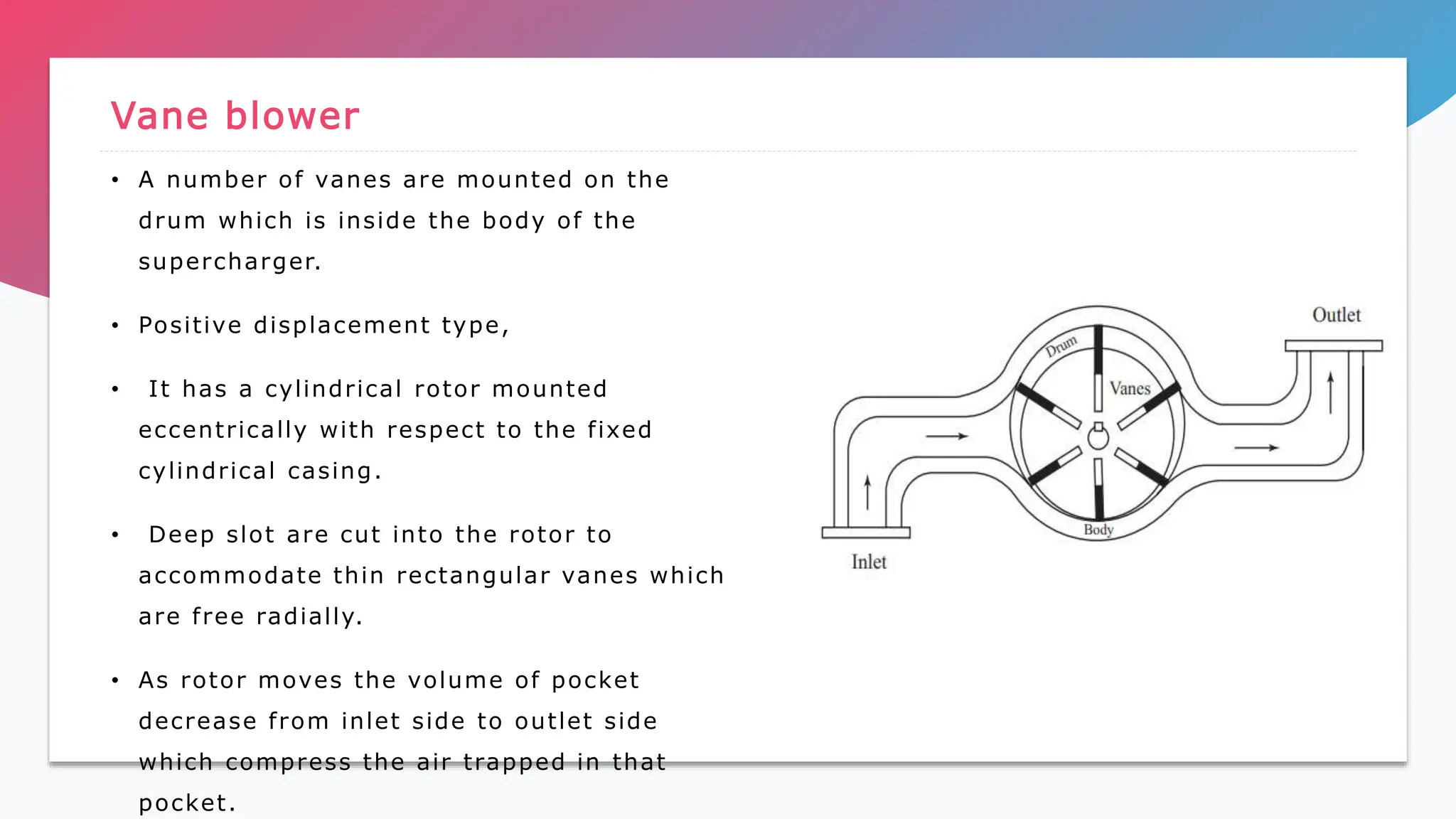
Vane blower
• A number of vanes are mounted on the
drum which is inside the body of the
supercharger.
• Positive displacement type,
• It has a cylindrical rotor mounted
eccentrically with respect to the fixed
cylindrical casing.
• Deep slot are cut into the rotor to
accommodate thin rectangular vanes which
are free radially.
• As rotor moves the volume of pocket
decrease from inlet side to outlet side
which compress the air trapped in that
pocket.
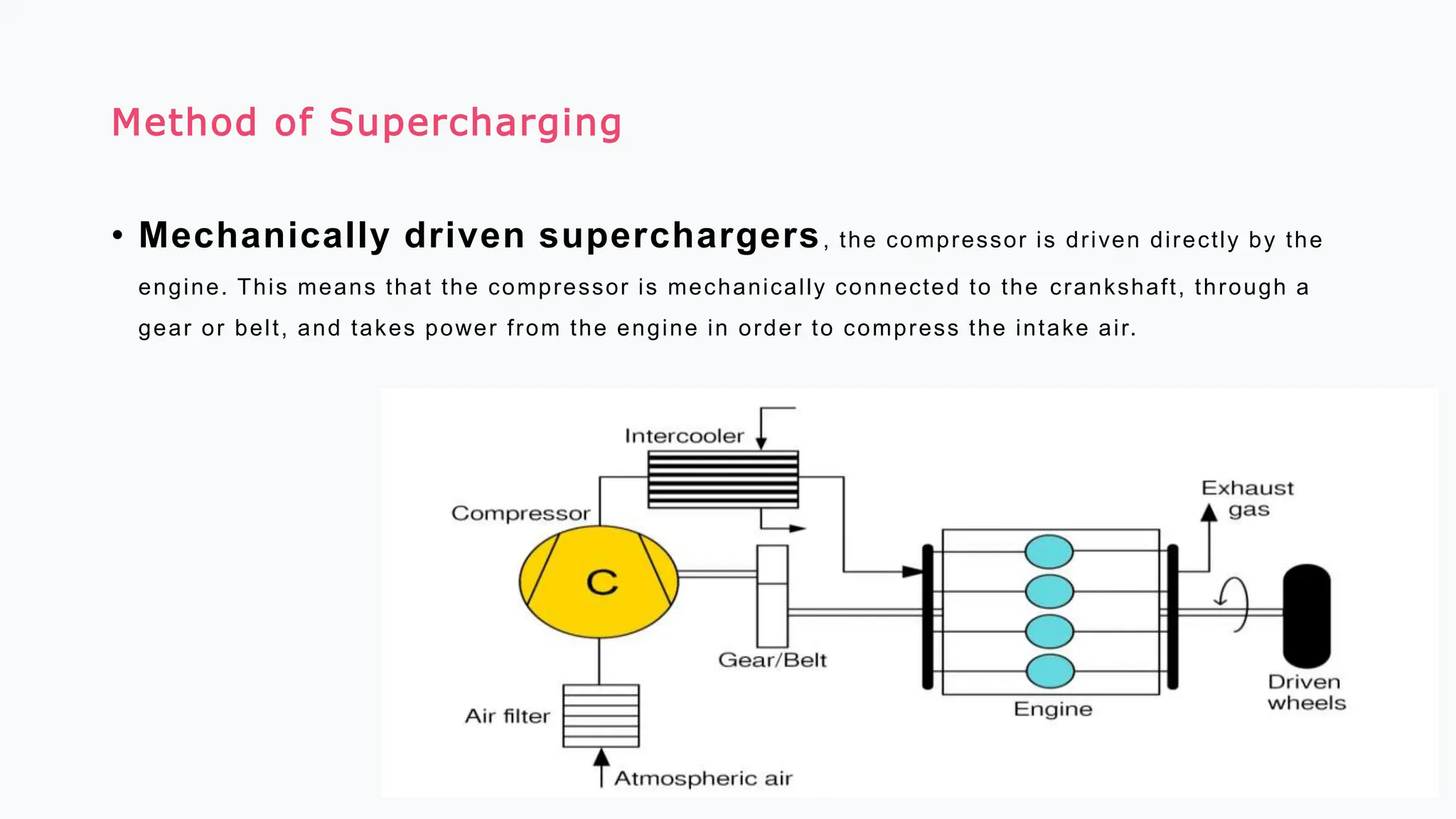
Method of Supercharging
• Mechanically driven superchargers, the compressor is driven directly by the
engine. This means that the compressor is mechanically connected to the crankshaft, through a
gear or belt, and takes power from the engine in order to compress the intake air.
P-V diagram of SUPERCHARGED ENGINE:
Net Work given by supercharged engine.
Wsc = Engine work output + Gas Exchange work – Supercharged
work
Otto cycle engine and mechanically driven supercharged otto cycle engine are
shown in fig.
Otto cycle engine supercharged otto cycle engine
efficiency of supercharged engine will decrease with increase in
supercharging pressure.
Power required of supercharged engine :
• Consider air enter in to the supercharged engine;
• p1 & p2 pressure of air at entrance and exist
• U1 &U2 internal energy at inlet and exist
• W is the work output
• Heat loss Q=0
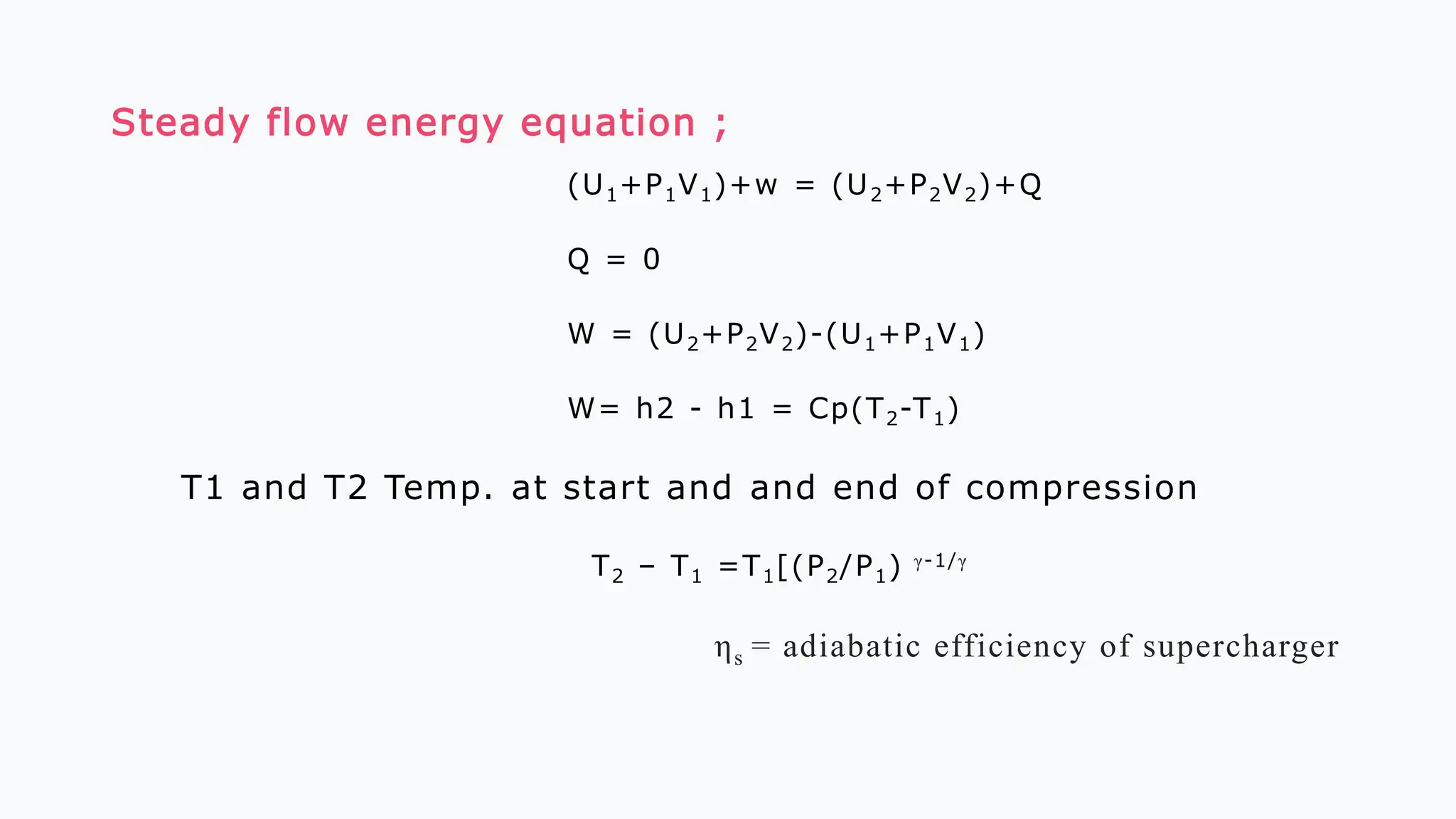
Steady flow energy equation ;
(U1+P1V1)+w = (U2+P2V2)+Q
Q = 0
W = (U2+P2V2)-(U1+P1V1)
W= h2 - h1 = Cp(T2-T1)
T1 and T2 Temp. at start and and end of compression
T2 – T1 =T1[(P2/P1) γ-1/γ
ηs = adiabatic efficiency of supercharger
Workdone / kg of air :
W = Cp(T2-T1)
W = CpT1[(P2/P1)
γ-1/γ -1 ] ×1/ ηS
Power required to drive the supercharger;
P = ma
W = maCpT1[(p2/p1) γ-1/γ -1 ] ×1/ ηs
ma is the amount of air /second supplied by the supercharger
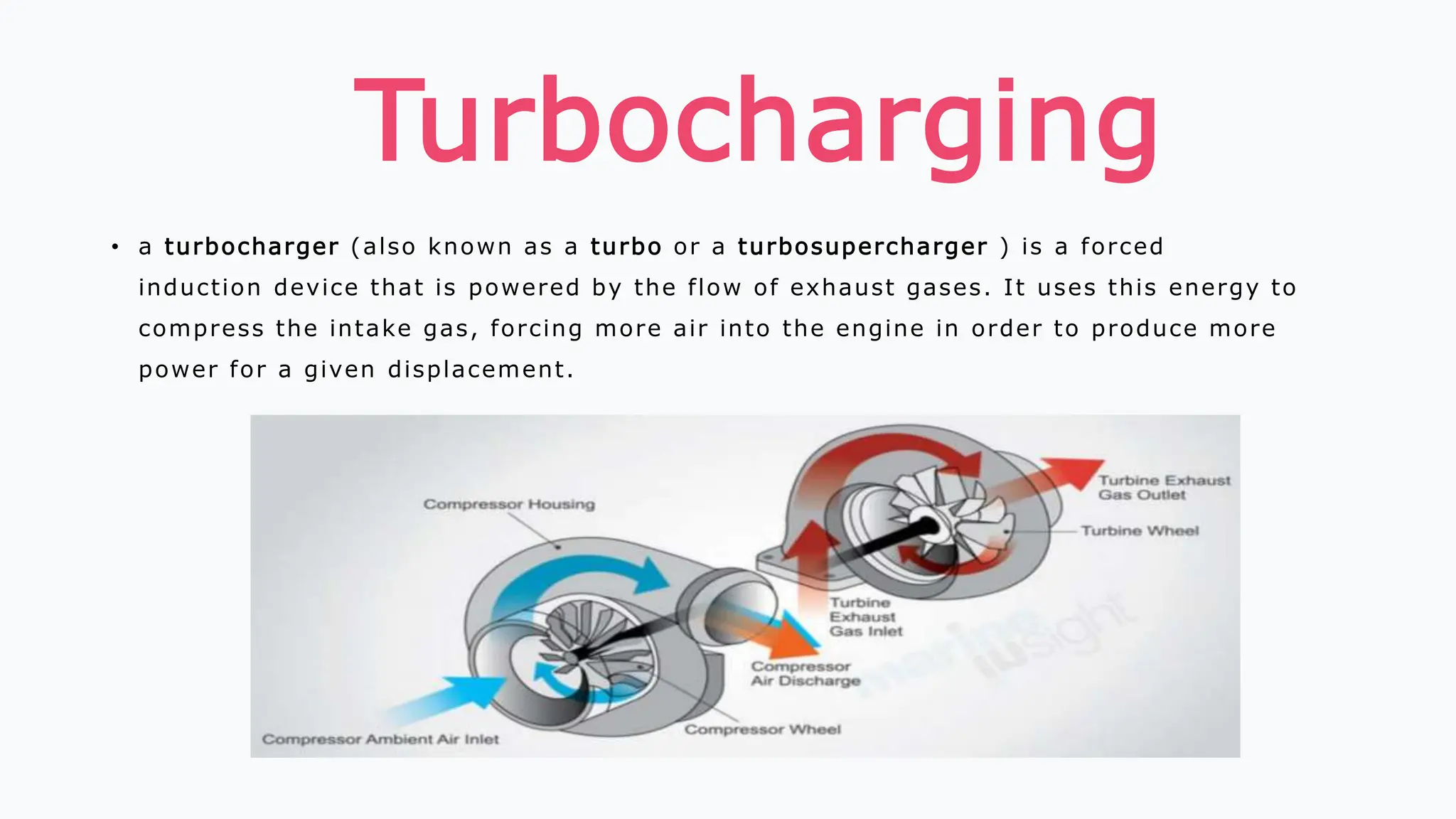
Turbocharging
• a turbocharger (also known as a turbo or a turbosupercharger ) is a forced
induction device that is powered by the flow of exhaust gases. It uses this energy to
compress the intake gas, forcing more air into the engine in order to produce more
power for a given displacement.
Turbo charging methods
1)Constant Pressure
2)Pulse turbo charging (buchi)
3)Pulse converter
Constant pressure
• constant pressure turbocharging, the exhaust ports from all cylinders are
connected to a single exhaust manifold whose volume is sufficiently large
to ensure that its pressure is virtually constant. The unsteady exhaust flow
processes at the cylinders are damped into a steady flow at the turbine.
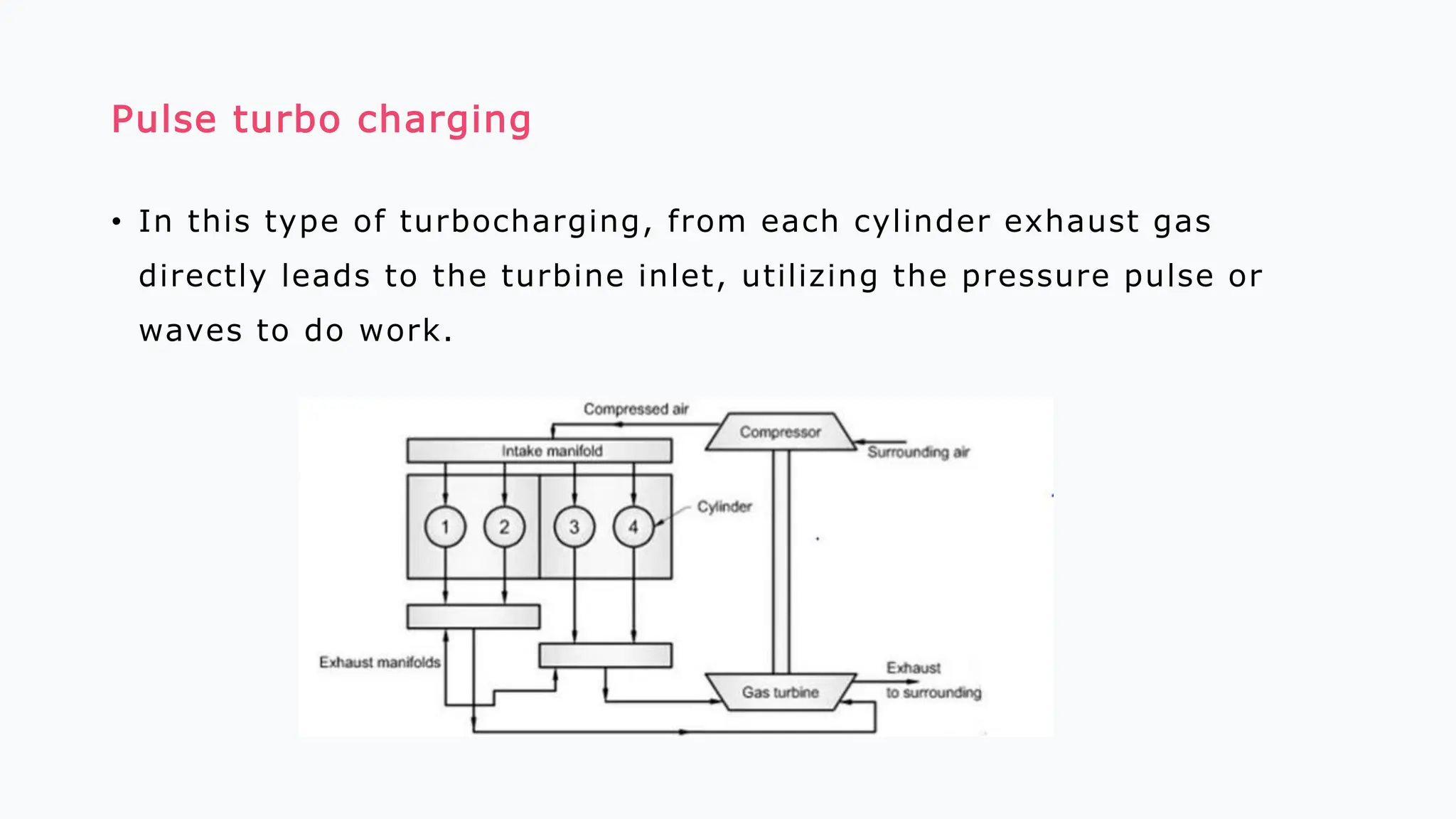
Pulse turbo charging
• In this type of turbocharging, from each cylinder exhaust gas
directly leads to the turbine inlet, utilizing the pressure pulse or
waves to do work.
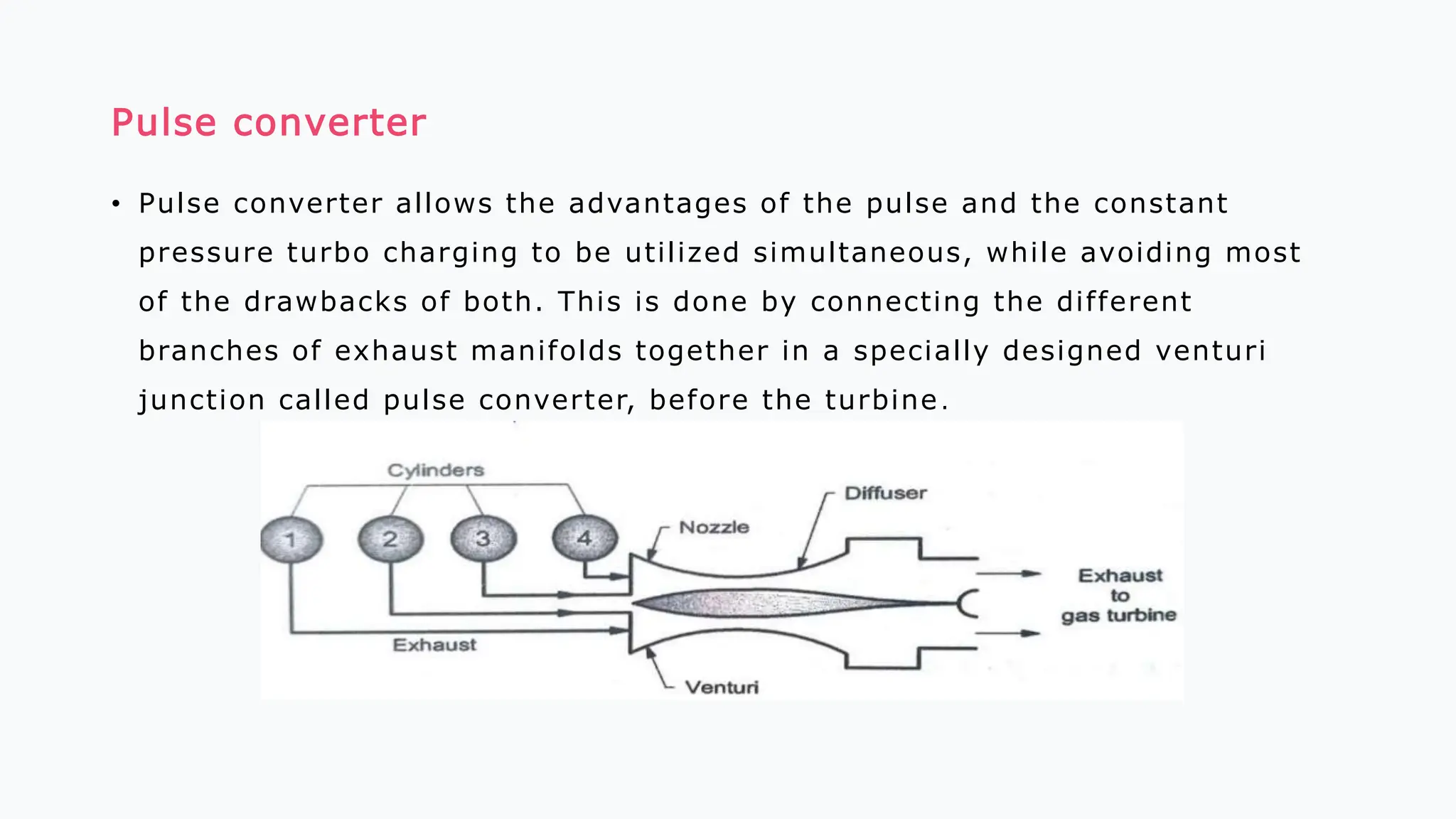
Pulse converter
• Pulse converter allows the advantages of the pulse and the constant
pressure turbo charging to be utilized simultaneous, while avoiding most
of the drawbacks of both. This is done by connecting the different
branches of exhaust manifolds together in a specially designed venturi
junction called pulse converter, before the turbine.
THANK YOU

Supercharging_and_Turbocharging_PPT_17_last_one[1].pptx

  • 1.
    Supercharging and Turbocharging Submitted to:- By:- Dr. Manjula Das Ghatak 1. Jummo ngomle 2. Ankit raj 3. Ashok meena 4. Rahul Meena
  • 2.
    • Need forsupercharging • Effect of supercharging • Types of Supercharger • Method of supercharging • Thermodynamic analysis of supercharging engine • Turbo charging methods Content
  • 3.
    Introduction 3 Principal aim ofan engine designer: Improving power output and reducing exhaust emissions at the same time. To improve power output we can resort to 4 ways 1. Increasing amount of air inducted 2. Extent of utilization of air inducted 3. Increasing speed of engine 4. Increasing quantity of fuel admitted.
  • 4.
    Why supercharging? 1. Morepower less exhaust emission . 2. Feasible solution to high altitude problems . 3. Vital for marine and racing automobile where weight and space are important . 4. Increases volumetric efficiency, performance , reduces knocking, overheating or failure of some part. 4
  • 5.
    Supercharging effect onparameters 1. Power output power output increases without an increase in weight and size of the engine . 2. Fuel consumption Due to better fuel distribution , improved combustion and increased mechanical efficiency fuel consumption {brake specific} is less. 3. Mechanical efficiency Due to increase in intake pressure gas load increases and large bearing and heavier components which results in increase in friction losses . but these losses are less than power gained due to supercharging . 4. Volumetric efficiency Volumetric efficiency increases with increase in intake pressure . Volumetric efficiency of a supercharged engine is 100-110% . 5
  • 6.
    Types of supercharger •Supercharger is a pressure-boosting device which supplies air (or mixture) at a higher pressure. • A centrifugal or axial flow or displacement type compressor is normally used. • There are three types of superchargers. 1. Centrifugal type 2. Root's type 3. Vane type
  • 8.
    Vane blower • Anumber of vanes are mounted on the drum which is inside the body of the supercharger. • Positive displacement type, • It has a cylindrical rotor mounted eccentrically with respect to the fixed cylindrical casing. • Deep slot are cut into the rotor to accommodate thin rectangular vanes which are free radially. • As rotor moves the volume of pocket decrease from inlet side to outlet side which compress the air trapped in that pocket.
  • 9.
    Method of Supercharging •Mechanically driven superchargers, the compressor is driven directly by the engine. This means that the compressor is mechanically connected to the crankshaft, through a gear or belt, and takes power from the engine in order to compress the intake air.
  • 10.
    P-V diagram ofSUPERCHARGED ENGINE: Net Work given by supercharged engine. Wsc = Engine work output + Gas Exchange work – Supercharged work Otto cycle engine and mechanically driven supercharged otto cycle engine are shown in fig. Otto cycle engine supercharged otto cycle engine
  • 11.
    efficiency of superchargedengine will decrease with increase in supercharging pressure. Power required of supercharged engine : • Consider air enter in to the supercharged engine; • p1 & p2 pressure of air at entrance and exist • U1 &U2 internal energy at inlet and exist • W is the work output • Heat loss Q=0
  • 12.
    Steady flow energyequation ; (U1+P1V1)+w = (U2+P2V2)+Q Q = 0 W = (U2+P2V2)-(U1+P1V1) W= h2 - h1 = Cp(T2-T1) T1 and T2 Temp. at start and and end of compression T2 – T1 =T1[(P2/P1) γ-1/γ ηs = adiabatic efficiency of supercharger
  • 13.
    Workdone / kgof air : W = Cp(T2-T1) W = CpT1[(P2/P1) γ-1/γ -1 ] ×1/ ηS Power required to drive the supercharger; P = ma W = maCpT1[(p2/p1) γ-1/γ -1 ] ×1/ ηs ma is the amount of air /second supplied by the supercharger
  • 14.
    Turbocharging • a turbocharger(also known as a turbo or a turbosupercharger ) is a forced induction device that is powered by the flow of exhaust gases. It uses this energy to compress the intake gas, forcing more air into the engine in order to produce more power for a given displacement.
  • 16.
    Turbo charging methods 1)ConstantPressure 2)Pulse turbo charging (buchi) 3)Pulse converter
  • 17.
    Constant pressure • constantpressure turbocharging, the exhaust ports from all cylinders are connected to a single exhaust manifold whose volume is sufficiently large to ensure that its pressure is virtually constant. The unsteady exhaust flow processes at the cylinders are damped into a steady flow at the turbine.
  • 18.
    Pulse turbo charging •In this type of turbocharging, from each cylinder exhaust gas directly leads to the turbine inlet, utilizing the pressure pulse or waves to do work.
  • 19.
    Pulse converter • Pulseconverter allows the advantages of the pulse and the constant pressure turbo charging to be utilized simultaneous, while avoiding most of the drawbacks of both. This is done by connecting the different branches of exhaust manifolds together in a specially designed venturi junction called pulse converter, before the turbine.
  • 20.