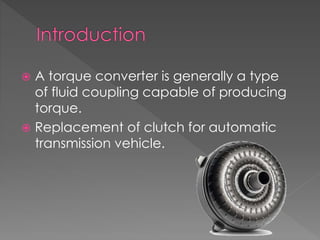
 A torque converter is generally a type
of fluid coupling capable of producing
torque.
 Replacement of clutch for automatic
transmission vehicle.
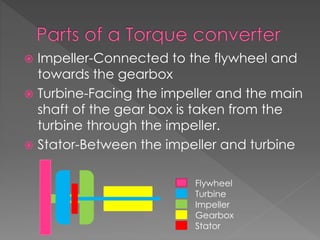
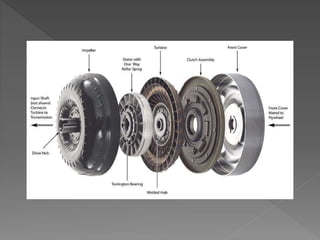
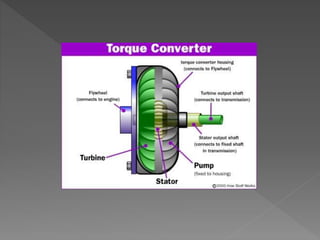
 Impeller-Connected to the flywheel and
towards the gearbox
 Turbine-Facing the impeller and the main
shaft of the gear box is taken from the
turbine through the impeller.
 Stator-Between the impeller and turbine
Flywheel
Turbine
Impeller
Gearbox
Stator
 Stall-The prime mover is applying power to
the impeller but the turbine cannot rotate.
 Acceleration- The load is accelerating but
there still is a relatively large difference
between impeller and turbine speed. Under
this condition, the converter will produce
torque multiplication
 Coupling- The torque converter is behaving
in a manner similar to a simple fluid
coupling.
 Overheating-Continuous high levels of slippage resulting in
damage to the seals that retain fluid inside the converter.
 Stator clutch seizure- The inner and outer elements of the one
way stator clutch become permanently locked together,
thus preventing the stator from rotating during the coupling
phase.
 Stator clutch breakage- A very abrupt application of power
can cause shock loading of the stator clutch, resulting in
breakage.
 Blade deformation and fragmentation- If subjected to abrupt
loading or excessive heating of the converter, pump and/or
turbine blades may be deformed.
 Balloning-Operating a torque converter at very high
RPM may cause the shape of the converter's housing to be
physically distorted due to internal pressure.
Torque converter

Torque converter

  • 2.
     A torqueconverter is generally a type of fluid coupling capable of producing torque.  Replacement of clutch for automatic transmission vehicle.
  • 3.
     Impeller-Connected tothe flywheel and towards the gearbox  Turbine-Facing the impeller and the main shaft of the gear box is taken from the turbine through the impeller.  Stator-Between the impeller and turbine Flywheel Turbine Impeller Gearbox Stator
  • 6.
     Stall-The primemover is applying power to the impeller but the turbine cannot rotate.  Acceleration- The load is accelerating but there still is a relatively large difference between impeller and turbine speed. Under this condition, the converter will produce torque multiplication  Coupling- The torque converter is behaving in a manner similar to a simple fluid coupling.
  • 7.
     Overheating-Continuous highlevels of slippage resulting in damage to the seals that retain fluid inside the converter.  Stator clutch seizure- The inner and outer elements of the one way stator clutch become permanently locked together, thus preventing the stator from rotating during the coupling phase.  Stator clutch breakage- A very abrupt application of power can cause shock loading of the stator clutch, resulting in breakage.  Blade deformation and fragmentation- If subjected to abrupt loading or excessive heating of the converter, pump and/or turbine blades may be deformed.  Balloning-Operating a torque converter at very high RPM may cause the shape of the converter's housing to be physically distorted due to internal pressure.