TISSUES AND ORGANS
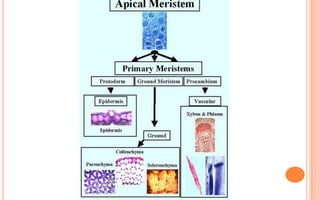
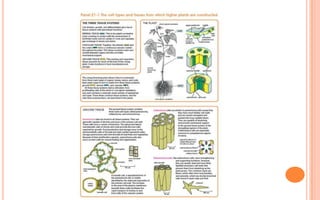
PLANT TISSUES
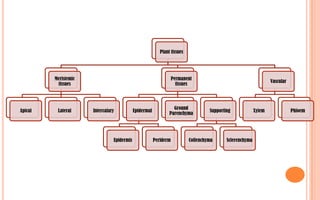
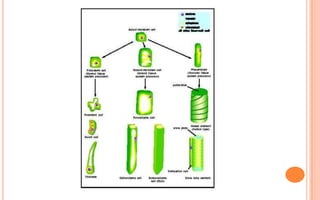
Plant tissues


         Meristemic                                                Permanent
                                                                                                                   Vascular
          tissues                                                    tissues


                                                                  Ground
Apical    Lateral     Intercalary           Epidermal                               Supporting             Xylem              Phloem
                                                                Parenchyma


                                Epidermis               Periderm           Collenchyma      Sclerenchyma
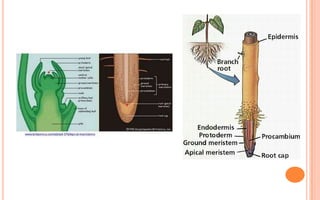
MERISTEMIC TISSUES
 Small
 Living tissues

 Unspecialised

 Dividing - Mitosis

 Large nuclei, Dense cytoplasm with small vacuoles

 Become specialized when matured

 Embryonic meristem do not stop dividing throughout
  the entire lifespan
 Only found in certain areas
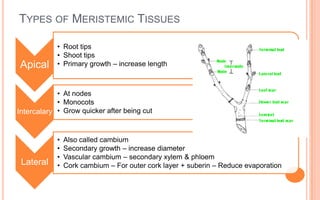
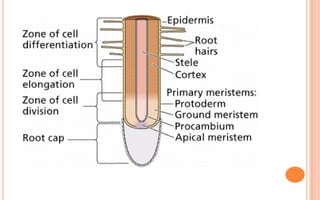
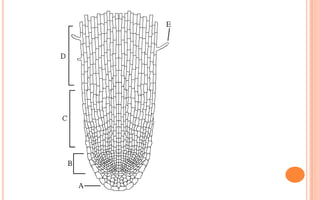
TYPES OF MERISTEMIC TISSUES

            • Root tips
            • Shoot tips
Apical      • Primary growth – increase length


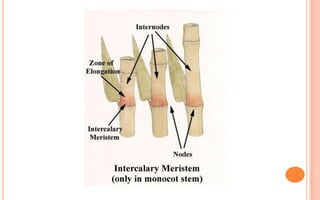
            • At nodes
            • Monocots
Intercalary • Grow quicker after being cut


            •   Also called cambium
            •   Secondary growth – increase diameter
            •   Vascular cambium – secondary xylem & phloem
 Lateral    •   Cork cambium – For outer cork layer + suberin – Reduce evaporation
GROUND TISSUES
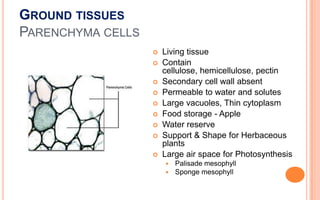
PARENCHYMA CELLS
                      Living tissue
                      Contain
                       cellulose, hemicellulose, pectin
                      Secondary cell wall absent
                      Permeable to water and solutes
                      Large vacuoles, Thin cytoplasm
                      Food storage - Apple
                      Water reserve
                      Support & Shape for Herbaceous
                       plants
                      Large air space for Photosynthesis
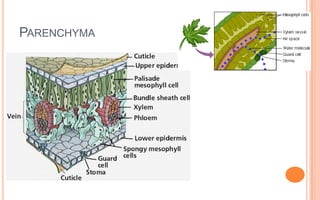
                          Palisade mesophyll
                          Sponge mesophyll
PARENCHYMA
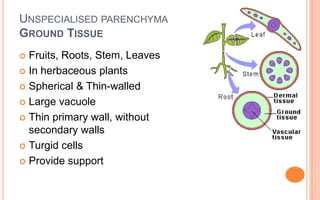
UNSPECIALISED PARENCHYMA
GROUND TISSUE
 Fruits, Roots, Stem, Leaves
 In herbaceous plants

 Spherical & Thin-walled

 Large vacuole

 Thin primary wall, without
  secondary walls
 Turgid cells

 Provide support
SPECIALISED PARENCHYMA CELLS
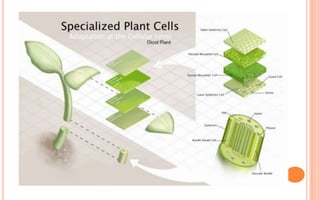
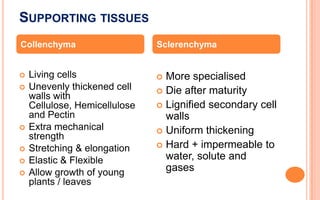
Epidermis                   Mesophyll cells
 Elongated and flattened
                             Palisade mesophyll
 Secrete cutin - Waxy
  cuticle                          Compact cells with
 Protective barrier                chloroplast
       Water loss             Spongy mesophyll
       Bacteria
                                   Loose cells with fewer
                                    chloroplast
   Form stomata
       Gaseous exchange
       Transparent layer
SPECIALISED PARENCHYMA CELLS
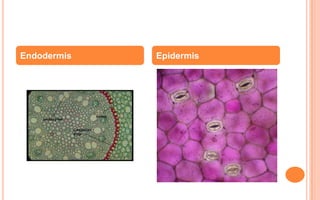
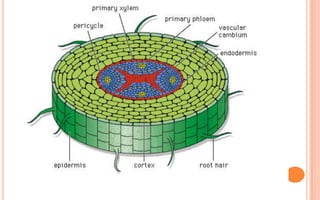
   Endodermis
     Selective barrier Between outer cortex and inner
      pericycle
     Forming Casparian strip in the roots to prevent
      apoplastic movement of water (suberin)
   Pericycle
       Secondary growth of roots
   Aerenchyma
     Oxygen reserve
     Buoyancy for Hydrophytes
Endodermis   Epidermis
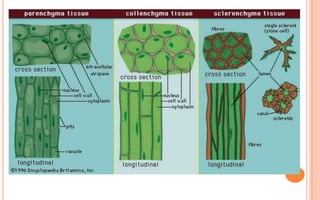
SUPPORTING TISSUES
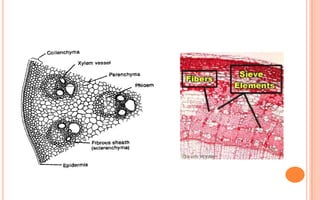
Collenchyma                    Sclerenchyma


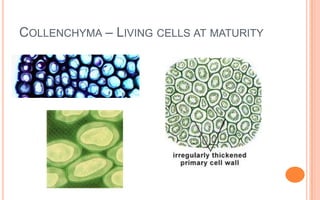
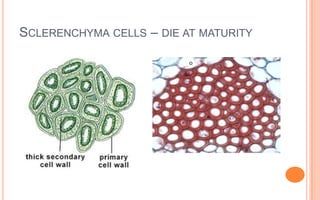
   Living cells                More specialised
   Unevenly thickened cell     Die after maturity
    walls with
    Cellulose, Hemicellulose    Lignified secondary cell
    and Pectin                   walls
   Extra mechanical            Uniform thickening
    strength
   Stretching & elongation     Hard + impermeable to

   Elastic & Flexible           water, solute and
   Allow growth of young        gases
    plants / leaves
COLLENCHYMA – LIVING CELLS AT MATURITY
SCLERENCHYMA CELLS – DIE AT MATURITY
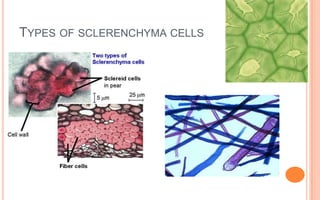
TYPES OF SCLERENCHYMA CELLS
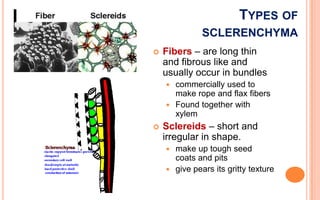
TYPES OF
              SCLERENCHYMA
   Fibers – are long thin
    and fibrous like and
    usually occur in bundles
     commercially used to
      make rope and flax fibers
     Found together with
      xylem
   Sclereids – short and
    irregular in shape.
     make up tough seed
      coats and pits
     give pears its gritty texture
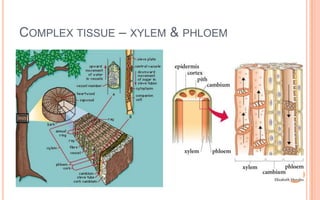
COMPLEX TISSUE – XYLEM & PHLOEM
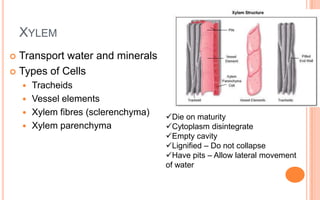
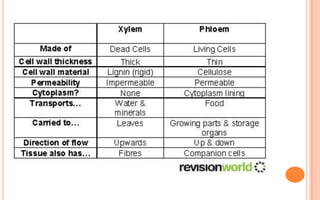
XYLEM
 Transport water and minerals
 Types of Cells
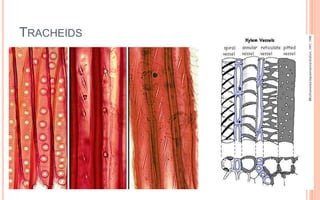
     Tracheids
     Vessel elements
     Xylem fibres (sclerenchyma)
                                    Die on maturity
     Xylem parenchyma              Cytoplasm disintegrate
                                    Empty cavity
                                    Lignified – Do not collapse
                                    Have pits – Allow lateral movement
                                    of water
XYLEM
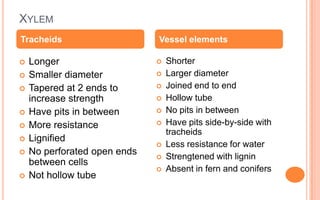
Tracheids                     Vessel elements

   Longer                       Shorter
   Smaller diameter             Larger diameter
   Tapered at 2 ends to         Joined end to end
    increase strength            Hollow tube
   Have pits in between         No pits in between
   More resistance              Have pits side-by-side with
                                  tracheids
   Lignified
                                 Less resistance for water
   No perforated open ends      Strengtened with lignin
    between cells
                                 Absent in fern and conifers
   Not hollow tube
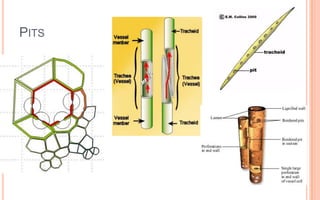
PITS
TRACHEIDS
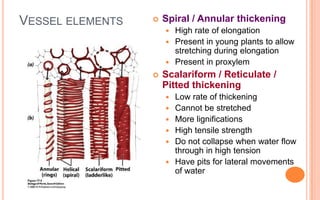
VESSEL ELEMENTS      Spiral / Annular thickening
                       High rate of elongation
                       Present in young plants to allow
                        stretching during elongation
                       Present in proxylem
                     Scalariform / Reticulate /
                      Pitted thickening
                         Low rate of thickening
                         Cannot be stretched
                         More lignifications
                         High tensile strength
                         Do not collapse when water flow
                          through in high tension
                         Have pits for lateral movements
                          of water
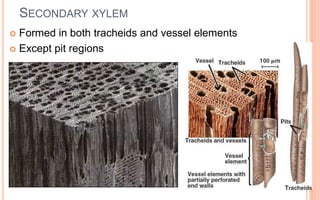
SECONDARY XYLEM
 Formed in both tracheids and vessel elements
 Except pit regions
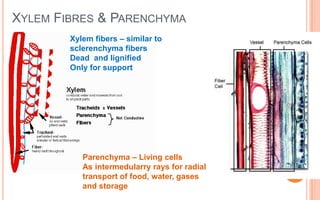
XYLEM FIBRES & PARENCHYMA
        Xylem fibers – similar to
        sclerenchyma fibers
        Dead and lignified
        Only for support


           Parenchyma – Living cells
           As intermedularry rays for radial
           transport of food, water, gases
           and storage
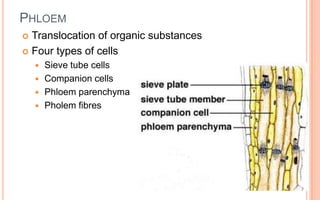
PHLOEM
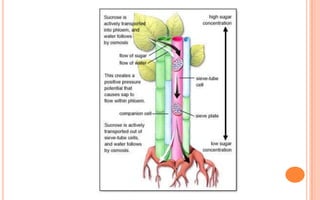
 Translocation of organic substances
 Four types of cells
     Sieve tube cells
     Companion cells
     Phloem parenchyma
     Pholem fibres
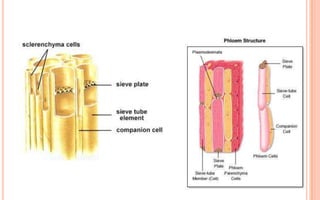
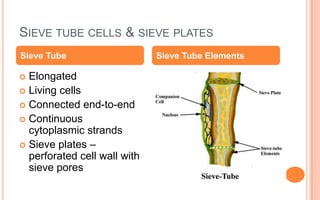
SIEVE TUBE CELLS & SIEVE PLATES
Sieve Tube                    Sieve Tube Elements

 Elongated                    Mature sieve tube
 Living cells                 Nucleus disintegrates
 Connected end-to-end
                               Cytoplasm remains
 Continuous
  cytoplasmic strands
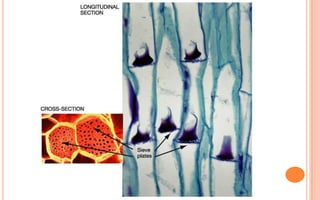
 Sieve plates –
  perforated cell wall with
  sieve pores
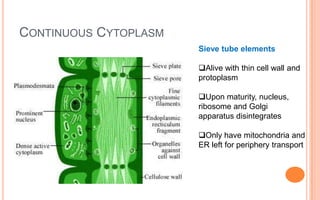
CONTINUOUS CYTOPLASM
                       Sieve tube elements

                       Alive with thin cell wall and
                       protoplasm

                       Upon maturity, nucleus,
                       ribosome and Golgi
                       apparatus disintegrates

                       Only have mitochondria and
                       ER left for periphery transport
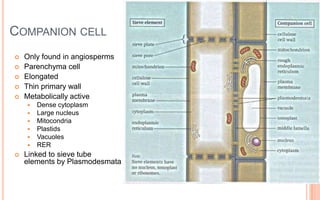
COMPANION CELL
   Only found in angiosperms
   Parenchyma cell
   Elongated
   Thin primary wall
   Metabolically active
     Dense cytoplasm
     Large nucleus
     Mitocondria
     Plastids
     Vacuoles
     RER
   Linked to sieve tube
    elements by Plasmodesmata
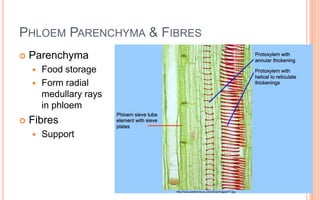
PHLOEM PARENCHYMA & FIBRES
   Parenchyma
     Food storage
     Form radial
      medullary rays
      in phloem
   Fibres
       Support
STPM Form 6 Biology Plant Tissues and Organs