Recall Transport Mechanism Passive vs. Active Plant Transport Tissues Xylem Phloem
Transport Mechanisms Passive transport Passive Diffusion Facilitated Diffusion Osmosis  Active transport Bulk transport
Plant Transport Tissues Xylem Vessel elements Tracheids  Phloem Sieve tube member Companion cells
Problem of Terrestrial Plants Ancestral plants: transport is through diffusion Modern plants: transport from roots to shoots Long distance transport Figure 36.1
Transport in Plants Three scales of plant transport Intracellular Epidermal cells Short distance: cell-to-cell At the levels of tissues and organs Long distance: xylem and phloem
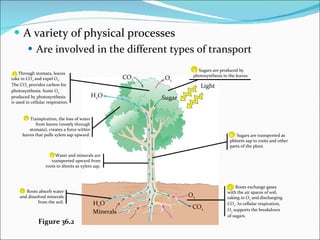
A variety of physical processes Are involved in the different types of transport Minerals H 2 O CO 2 O 2 CO 2 O 2 H 2 O Sugar Light Sugars are transported as phloem sap to roots and other parts of the plant. Figure 36.2 Sugars are produced by photosynthesis in the leaves. 5 6 Through stomata, leaves  take in CO 2  and expel O 2 .  The CO 2  provides carbon for photosynthesis. Some O 2   produced by photosynthesis  is used in cellular respiration. 4 Transpiration, the loss of water from leaves (mostly through stomata), creates a force within leaves that pulls xylem sap upward. 3 Water and minerals are transported upward from roots to shoots as xylem sap. 2 Roots absorb water and dissolved minerals from the soil. 1 Roots exchange gases  with the air spaces of soil,  taking in O 2  and discharging  CO 2 . In cellular respiration,  O 2  supports the breakdown  of sugars. 7
Effects of Differences in Water Potential To survive Plants must balance water uptake and loss Osmosis Determines the net uptake or water loss by a cell Is affected by solute concentration and pressure
Water potential Is a measurement that combines the effects of solute concentration and pressure Determines the direction of movement of water Water Flows from regions of high water potential to regions of low water potential Both pressure and solute concentrations affect water potential
Water potential Affects uptake and loss of water by plant cells If a flaccid cell is placed in an environment with a higher solute concentration The cell will lose water and become plasmolyzed Figure 36.6a 0.4  M  sucrose solution: Initial flaccid cell: Plasmolyzed cell at osmotic equilibrium with its surroundings  P   =  0  S   = 0.7  P   =  0  S   = 0.9  P   =  0  S   = 0.9    =   0.9 MPa    = 0.7 MPa    =   0.9 MPa
If the same flaccid cell is placed in a solution with a lower solute concentration The cell will gain water and become turgid Distilled water: Initial flaccid cell: Turgid cell at osmotic equilibrium with its surroundings  P   =  0  S   = 0.7  P   =  0  S   =  0  P   =  0.7  S   = 0.7 Figure 36.6b    = 0.7 MPa    = 0 MPa    = 0 MPa
How water moves Plasmodesmata Symplast apoplast
Bulk Flow in Long-Distance Transport In bulk flow Movement of fluid in the xylem and phloem is driven by pressure differences at opposite ends of the xylem vessels and sieve tubes
The xylem sap and phloem sap Xylem sap Root pressure Transpiration-cohesion-tension mechanism Phloem sap Pressure Flow Theory Translocation

Plant transport ppt

  • 1.
  • 2.
    Recall Transport MechanismPassive vs. Active Plant Transport Tissues Xylem Phloem
  • 3.
    Transport Mechanisms Passivetransport Passive Diffusion Facilitated Diffusion Osmosis Active transport Bulk transport
  • 4.
    Plant Transport TissuesXylem Vessel elements Tracheids Phloem Sieve tube member Companion cells
  • 5.
    Problem of TerrestrialPlants Ancestral plants: transport is through diffusion Modern plants: transport from roots to shoots Long distance transport Figure 36.1
  • 6.
    Transport in PlantsThree scales of plant transport Intracellular Epidermal cells Short distance: cell-to-cell At the levels of tissues and organs Long distance: xylem and phloem
  • 7.
    A variety ofphysical processes Are involved in the different types of transport Minerals H 2 O CO 2 O 2 CO 2 O 2 H 2 O Sugar Light Sugars are transported as phloem sap to roots and other parts of the plant. Figure 36.2 Sugars are produced by photosynthesis in the leaves. 5 6 Through stomata, leaves take in CO 2 and expel O 2 . The CO 2 provides carbon for photosynthesis. Some O 2 produced by photosynthesis is used in cellular respiration. 4 Transpiration, the loss of water from leaves (mostly through stomata), creates a force within leaves that pulls xylem sap upward. 3 Water and minerals are transported upward from roots to shoots as xylem sap. 2 Roots absorb water and dissolved minerals from the soil. 1 Roots exchange gases with the air spaces of soil, taking in O 2 and discharging CO 2 . In cellular respiration, O 2 supports the breakdown of sugars. 7
  • 8.
    Effects of Differencesin Water Potential To survive Plants must balance water uptake and loss Osmosis Determines the net uptake or water loss by a cell Is affected by solute concentration and pressure
  • 9.
    Water potential Isa measurement that combines the effects of solute concentration and pressure Determines the direction of movement of water Water Flows from regions of high water potential to regions of low water potential Both pressure and solute concentrations affect water potential
  • 10.
    Water potential Affectsuptake and loss of water by plant cells If a flaccid cell is placed in an environment with a higher solute concentration The cell will lose water and become plasmolyzed Figure 36.6a 0.4 M sucrose solution: Initial flaccid cell: Plasmolyzed cell at osmotic equilibrium with its surroundings  P = 0  S = 0.7  P = 0  S = 0.9  P = 0  S = 0.9  =  0.9 MPa  = 0.7 MPa  =  0.9 MPa
  • 11.
    If the sameflaccid cell is placed in a solution with a lower solute concentration The cell will gain water and become turgid Distilled water: Initial flaccid cell: Turgid cell at osmotic equilibrium with its surroundings  P = 0  S = 0.7  P = 0  S = 0  P = 0.7  S = 0.7 Figure 36.6b  = 0.7 MPa  = 0 MPa  = 0 MPa
  • 12.
    How water movesPlasmodesmata Symplast apoplast
  • 13.
    Bulk Flow inLong-Distance Transport In bulk flow Movement of fluid in the xylem and phloem is driven by pressure differences at opposite ends of the xylem vessels and sieve tubes
  • 14.
    The xylem sapand phloem sap Xylem sap Root pressure Transpiration-cohesion-tension mechanism Phloem sap Pressure Flow Theory Translocation