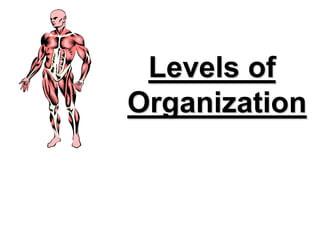
Levels of
Organization
28.1 Levels of Organization
KEY CONCEPT
The human body and other
organisms have five levels of
organization.
28.1 Levels of Organization
A. Levels of Structural Organization
Atom
Molecule
Cell
Tissue
Organ
Organ System
Organism
28.1 Levels of Organization
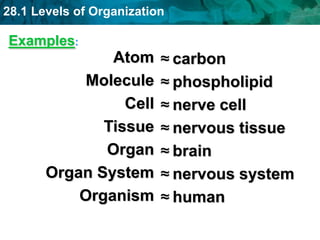
Examples:
≈ carbon
≈ phospholipid
≈ nerve cell
≈ nervous tissue
≈ brain
≈ nervous system
≈ human
Atom
Molecule
Cell
Tissue
Organ
Organ System
Organism
28.1 Levels of Organization
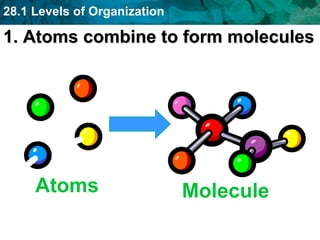
1. Atoms combine to form molecules
Atoms Molecule
28.1 Levels of Organization
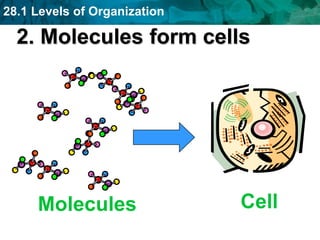
2. Molecules form cells
Molecules Cell
28.1 Levels of Organization
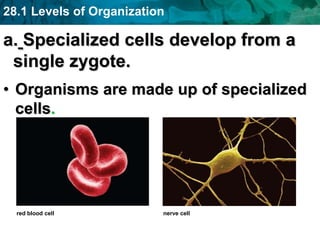
a. Specialized cells develop from a
single zygote.
• Organisms are made up of specialized
cells.
red blood cell nerve cell
28.1 Levels of Organization
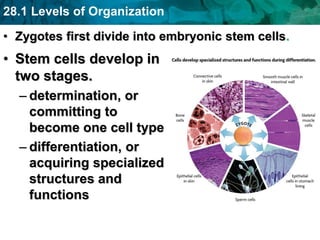
• Zygotes first divide into embryonic stem cells.
• Stem cells develop in
two stages.
– determination, or
committing to
become one cell type
– differentiation, or
acquiring specialized
structures and
functions
28.1 Levels of Organization
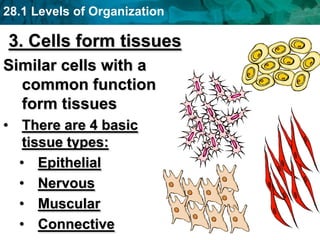
3. Cells form tissues
Similar cells with a
common function
form tissues
• There are 4 basic
tissue types:
• Epithelial
• Nervous
• Muscular
• Connective
28.1 Levels of Organization
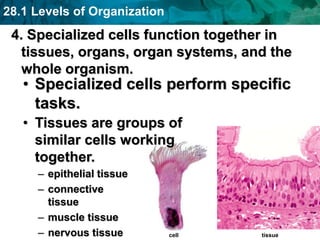
cell
4. Specialized cells function together in
tissues, organs, organ systems, and the
whole organism.
• Specialized cells perform specific
tasks.
• Tissues are groups of
similar cells working
together.
tissue
– epithelial tissue
– connective
tissue
– muscle tissue
– nervous tissue
28.1 Levels of Organization
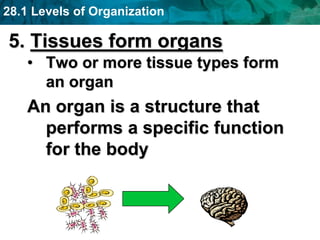
5. Tissues form organs
• Two or more tissue types form
an organ
An organ is a structure that
performs a specific function
for the body
28.1 Levels of Organization
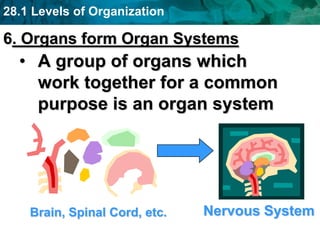
6. Organs form Organ Systems
• A group of organs which
work together for a common
purpose is an organ system
Brain, Spinal Cord, etc. Nervous System
28.1 Levels of Organization
B. Body Systems
1. Integumentary System
Skin is the only organ
 Protects from injury
 Regulates body temperature
 Receptors for temperature, pain,
and pressure
28.1 Levels of Organization
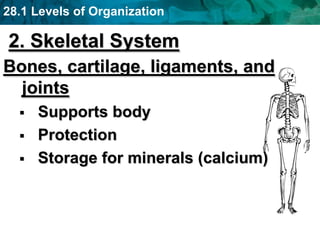
2. Skeletal System
Bones, cartilage, ligaments, and
joints
 Supports body
 Protection
 Storage for minerals (calcium)
28.1 Levels of Organization
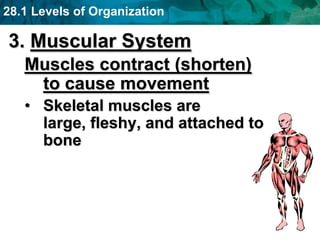
3. Muscular System
Muscles contract (shorten)
to cause movement
• Skeletal muscles are
large, fleshy, and attached to
bone
28.1 Levels of Organization
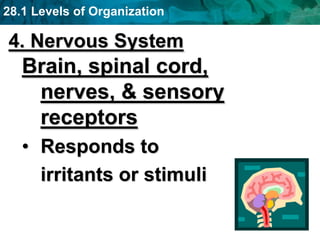
4. Nervous System
Brain, spinal cord,
nerves, & sensory
receptors
• Responds to
irritants or stimuli
28.1 Levels of Organization
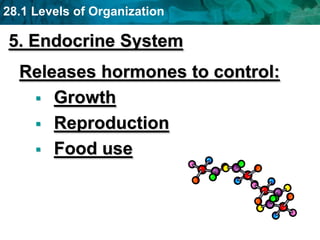
5. Endocrine System
Releases hormones to control:
 Growth
 Reproduction
 Food use
28.1 Levels of Organization
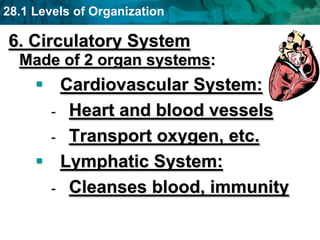
6. Circulatory System
Made of 2 organ systems:
 Cardiovascular System:
- Heart and blood vessels
- Transport oxygen, etc.
 Lymphatic System:
- Cleanses blood, immunity
28.1 Levels of Organization
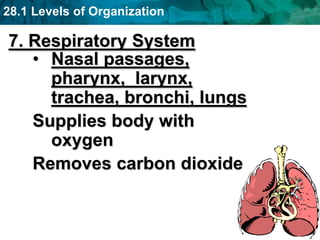
7. Respiratory System
• Nasal passages,
pharynx, larynx,
trachea, bronchi, lungs
Supplies body with
oxygen
Removes carbon dioxide
28.1 Levels of Organization
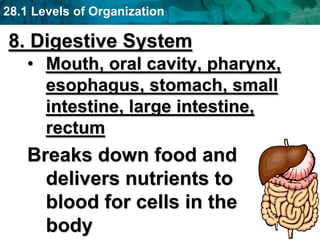
8. Digestive System
• Mouth, oral cavity, pharynx,
esophagus, stomach, small
intestine, large intestine,
rectum
Breaks down food and
delivers nutrients to
blood for cells in the
body
28.1 Levels of Organization
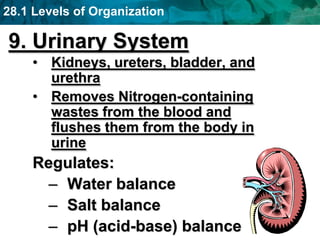
9. Urinary System
• Kidneys, ureters, bladder, and
urethra
• Removes Nitrogen-containing
wastes from the blood and
flushes them from the body in
urine
Regulates:
– Water balance
– Salt balance
– pH (acid-base) balance
28.1 Levels of Organization
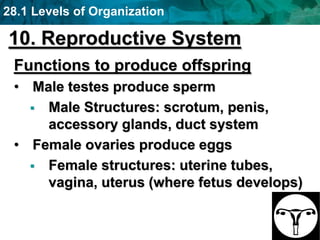
10. Reproductive System
Functions to produce offspring
• Male testes produce sperm
 Male Structures: scrotum, penis,
accessory glands, duct system
• Female ovaries produce eggs
 Female structures: uterine tubes,
vagina, uterus (where fetus develops)
28.1 Levels of Organization
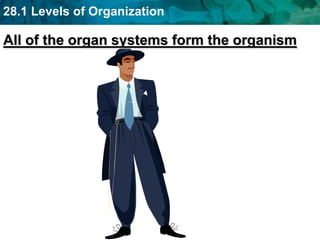
All of the organ systems form the organism

Nscu 302 wk 7 1

  • 1.
  • 2.
    28.1 Levels ofOrganization KEY CONCEPT The human body and other organisms have five levels of organization.
  • 3.
    28.1 Levels ofOrganization A. Levels of Structural Organization Atom Molecule Cell Tissue Organ Organ System Organism
  • 4.
    28.1 Levels ofOrganization Examples: ≈ carbon ≈ phospholipid ≈ nerve cell ≈ nervous tissue ≈ brain ≈ nervous system ≈ human Atom Molecule Cell Tissue Organ Organ System Organism
  • 5.
    28.1 Levels ofOrganization 1. Atoms combine to form molecules Atoms Molecule
  • 6.
    28.1 Levels ofOrganization 2. Molecules form cells Molecules Cell
  • 7.
    28.1 Levels ofOrganization a. Specialized cells develop from a single zygote. • Organisms are made up of specialized cells. red blood cell nerve cell
  • 8.
    28.1 Levels ofOrganization • Zygotes first divide into embryonic stem cells. • Stem cells develop in two stages. – determination, or committing to become one cell type – differentiation, or acquiring specialized structures and functions
  • 9.
    28.1 Levels ofOrganization 3. Cells form tissues Similar cells with a common function form tissues • There are 4 basic tissue types: • Epithelial • Nervous • Muscular • Connective
  • 10.
    28.1 Levels ofOrganization cell 4. Specialized cells function together in tissues, organs, organ systems, and the whole organism. • Specialized cells perform specific tasks. • Tissues are groups of similar cells working together. tissue – epithelial tissue – connective tissue – muscle tissue – nervous tissue
  • 11.
    28.1 Levels ofOrganization 5. Tissues form organs • Two or more tissue types form an organ An organ is a structure that performs a specific function for the body
  • 12.
    28.1 Levels ofOrganization 6. Organs form Organ Systems • A group of organs which work together for a common purpose is an organ system Brain, Spinal Cord, etc. Nervous System
  • 13.
    28.1 Levels ofOrganization B. Body Systems 1. Integumentary System Skin is the only organ  Protects from injury  Regulates body temperature  Receptors for temperature, pain, and pressure
  • 14.
    28.1 Levels ofOrganization 2. Skeletal System Bones, cartilage, ligaments, and joints  Supports body  Protection  Storage for minerals (calcium)
  • 15.
    28.1 Levels ofOrganization 3. Muscular System Muscles contract (shorten) to cause movement • Skeletal muscles are large, fleshy, and attached to bone
  • 16.
    28.1 Levels ofOrganization 4. Nervous System Brain, spinal cord, nerves, & sensory receptors • Responds to irritants or stimuli
  • 17.
    28.1 Levels ofOrganization 5. Endocrine System Releases hormones to control:  Growth  Reproduction  Food use
  • 18.
    28.1 Levels ofOrganization 6. Circulatory System Made of 2 organ systems:  Cardiovascular System: - Heart and blood vessels - Transport oxygen, etc.  Lymphatic System: - Cleanses blood, immunity
  • 19.
    28.1 Levels ofOrganization 7. Respiratory System • Nasal passages, pharynx, larynx, trachea, bronchi, lungs Supplies body with oxygen Removes carbon dioxide
  • 20.
    28.1 Levels ofOrganization 8. Digestive System • Mouth, oral cavity, pharynx, esophagus, stomach, small intestine, large intestine, rectum Breaks down food and delivers nutrients to blood for cells in the body
  • 21.
    28.1 Levels ofOrganization 9. Urinary System • Kidneys, ureters, bladder, and urethra • Removes Nitrogen-containing wastes from the blood and flushes them from the body in urine Regulates: – Water balance – Salt balance – pH (acid-base) balance
  • 22.
    28.1 Levels ofOrganization 10. Reproductive System Functions to produce offspring • Male testes produce sperm  Male Structures: scrotum, penis, accessory glands, duct system • Female ovaries produce eggs  Female structures: uterine tubes, vagina, uterus (where fetus develops)
  • 23.
    28.1 Levels ofOrganization All of the organ systems form the organism