March 28, 2005


                 Plant Tissues

                   Chapter 26


                                 Jin Hoe Huh
Angiosperms – flowering plants
• The angiosperms are seed-bearing
  vascular plants
• In terms of distribution and diversity,
  they are the most successful plants on
  Earth
• The structure and function of this plant
  group help explain its success
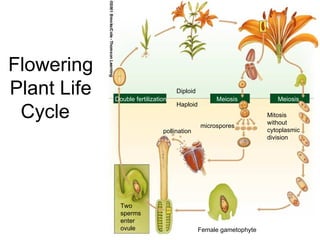
Flowering
Plant Life   Double fertilization
                                    Diploid
                                                   Meiosis            Meiosis

 Cycle
                                    Haploid
                                                                   Mitosis
                                                                   without
                                              microspores
                               pollination                         cytoplasmic
                                                                   division


               Two
               sperms
               enter
               ovule                          Female gametophyte
Plant Life Histories
• Annuals complete life cycle in one
 growing season
• Biennials live for two seasons; flowers
 form in second season
• Perennials grow and produce seeds
 year after year
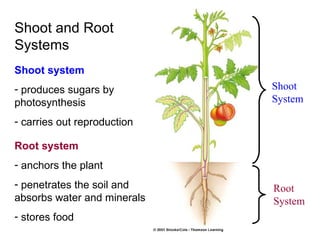
Shoot and Root
Systems
Shoot system
- produces sugars by         Shoot
photosynthesis               System

- carries out reproduction

Root system
- anchors the plant
- penetrates the soil and    Root
absorbs water and minerals   System
- stores food
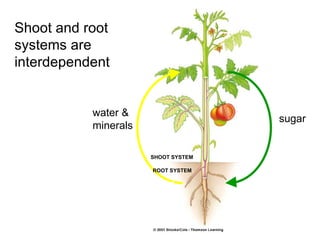
Shoot and root
systems are
interdependent


           water &
                                     sugar
           minerals

                      SHOOT SYSTEM

                      ROOT SYSTEM
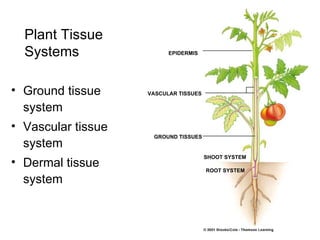
Plant Tissue
  Systems                 EPIDERMIS


• Ground tissue     VASCULAR TISSUES

  system
• Vascular tissue
                     GROUND TISSUES
  system
                                       SHOOT SYSTEM
• Dermal tissue
                                       ROOT SYSTEM

  system
Meristems – Where Tissues Originate

• Regions where cell divisions produce
  plant growth
• Apical meristems
  – Lengthen stems and roots
  – Responsible for primary growth
• Lateral meristems
  – Increase width of stems
  – Responsible for secondary growth
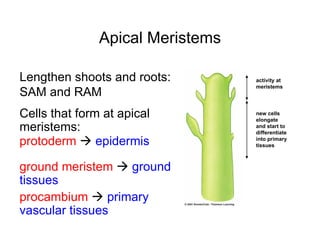
Apical Meristems

Lengthen shoots and roots:        activity at
                                  meristems
SAM and RAM
Cells that form at apical         new cells
                                  elongate
meristems:                        and start to
                                  differentiate

protoderm  epidermis             into primary
                                  tissues


ground meristem  ground
tissues
procambium  primary
vascular tissues
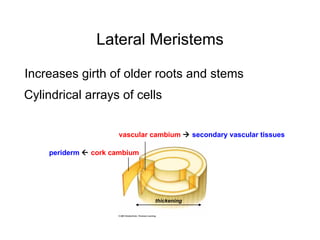
Lateral Meristems

Increases girth of older roots and stems
Cylindrical arrays of cells


                     vascular cambium  secondary vascular tissues

    periderm  cork cambium


                              thickening
Simple Tissues
Made up of only one
     type of cell

    Parenchyma
   Collenchyma
   Sclerenchyma
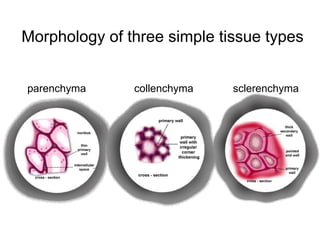
Morphology of three simple tissue types


parenchyma     collenchyma   sclerenchyma
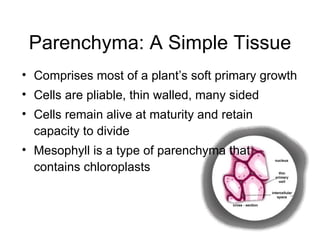
Parenchyma: A Simple Tissue
• Comprises most of a plant’s soft primary growth
• Cells are pliable, thin walled, many sided
• Cells remain alive at maturity and retain
  capacity to divide
• Mesophyll is a type of parenchyma that
  contains chloroplasts
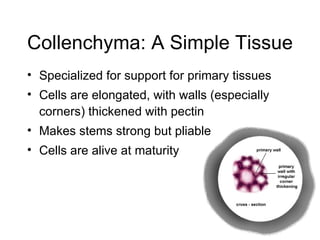
Collenchyma: A Simple Tissue
• Specialized for support for primary tissues
• Cells are elongated, with walls (especially
  corners) thickened with pectin
• Makes stems strong but pliable
• Cells are alive at maturity
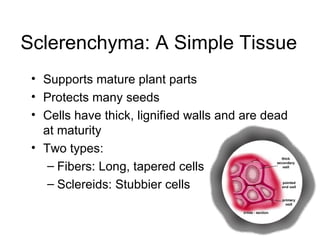
Sclerenchyma: A Simple Tissue
 • Supports mature plant parts
 • Protects many seeds
 • Cells have thick, lignified walls and are dead
   at maturity
 • Two types:
    – Fibers: Long, tapered cells
    – Sclereids: Stubbier cells
Complex Tissues
Composed of a mix of cell types


            Xylem
           Phloem
          Epidermis
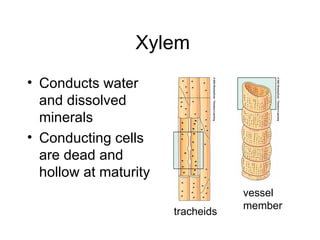
Xylem
• Conducts water
  and dissolved
  minerals
• Conducting cells
  are dead and
  hollow at maturity
                                   vessel
                                   member
                       tracheids
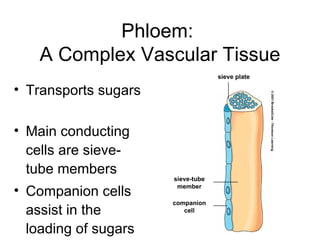
Phloem:
    A Complex Vascular Tissue
                                   sieve plate

• Transports sugars

• Main conducting
  cells are sieve-
  tube members
                      sieve-tube

• Companion cells      member

                      companion
  assist in the          cell


  loading of sugars
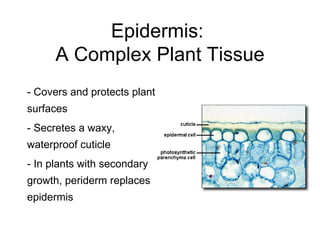
Epidermis:
      A Complex Plant Tissue
- Covers and protects plant
surfaces
- Secretes a waxy,
waterproof cuticle
- In plants with secondary
growth, periderm replaces
epidermis
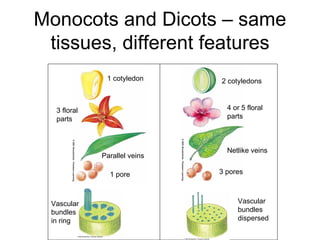
Monocots and Dicots – same
 tissues, different features
              1 cotyledon     2 cotyledons


  3 floral                      4 or 5 floral
  parts                         parts


                                Netlike veins
             Parallel veins

               1 pore         3 pores


 Vascular                          Vascular
 bundles                           bundles
 in ring                           dispersed
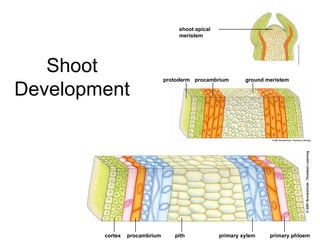
shoot apical
                                    meristem


   Shoot                       protoderm procambrium        ground meristem

Development


        cortex   procambrium      pith             primary xylem    primary phloem
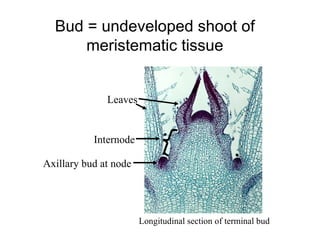
Bud = undeveloped shoot of
      meristematic tissue


              Leaves


           Internode

Axillary bud at node


                       Longitudinal section of terminal bud
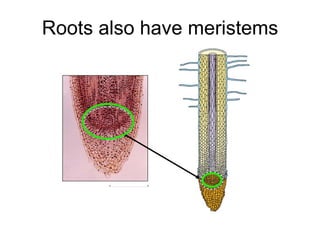
Roots also have meristems
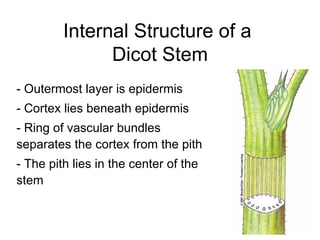
Internal Structure of a
               Dicot Stem
- Outermost layer is epidermis
- Cortex lies beneath epidermis
- Ring of vascular bundles
separates the cortex from the pith
- The pith lies in the center of the
stem
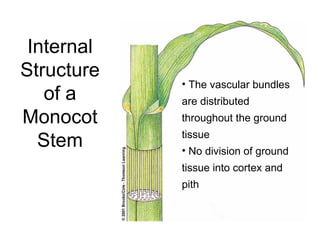
Internal
Structure
            • The vascular bundles
   of a     are distributed
Monocot     throughout the ground
            tissue
  Stem      • No division of ground
            tissue into cortex and
            pith
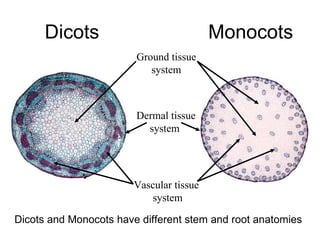
Dicots                              Monocots
                        Ground tissue
                           system


                        Dermal tissue
                          system


                        Vascular tissue
                           system

Dicots and Monocots have different stem and root anatomies
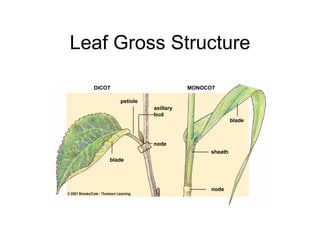
Leaf Gross Structure

  DICOT                        MONOCOT

          petiole
                    axillary
                    bud
                                              blade


                    node
                                     sheath
      blade


                                     node
Adapted for Photosynthesis
• Leaves are usually thin
  – High surface area-to-volume ratio
  – Promotes diffusion of carbon dioxide in,
    oxygen out
• Leaves are arranged to capture sunlight
  – Are held perpendicular to rays of sun
  – Arrange so they don’t shade one another
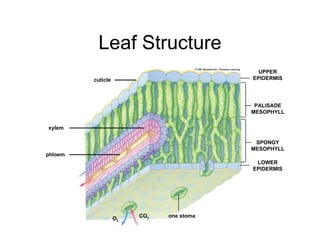
Leaf Structure
                                            UPPER
         cuticle                          EPIDERMIS


                                           PALISADE
                                          MESOPHYLL

xylem

                                           SPONGY
                                          MESOPHYLL
phloem
                                           LOWER
                                          EPIDERMIS


                   O2   CO2   one stoma
Mesophyll:
Photosynthetic Tissue
• A type of parenchyma tissue
• Cells have chloroplasts
• Two layers in dicots
  – Palisade mesophyll
  – Spongy mesophyll
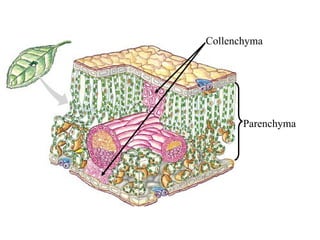
Collenchyma


       Parenchyma
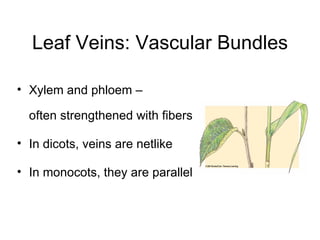
Leaf Veins: Vascular Bundles

• Xylem and phloem –

  often strengthened with fibers

• In dicots, veins are netlike

• In monocots, they are parallel
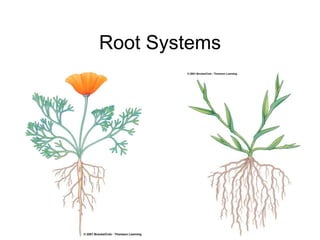
Root Systems
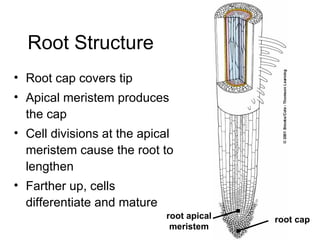
Root Structure
• Root cap covers tip
• Apical meristem produces
  the cap
• Cell divisions at the apical
  meristem cause the root to
  lengthen
• Farther up, cells
  differentiate and mature
                             root apical   root cap
                              meristem
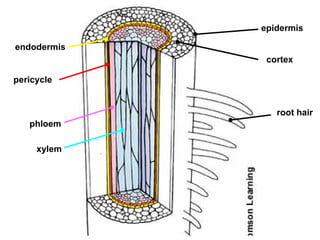
Internal Structure of a Root

• Outermost layer is epidermis
• Root cortex is beneath the epidermis
• Endodermis, then pericycle surround
  the vascular cylinder
• In some plants, there is a central pith
epidermis

endodermis
              cortex

pericycle


                root hair
   phloem

     xylem
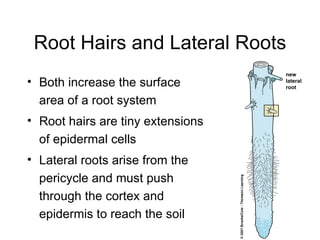
Root Hairs and Lateral Roots
                                   new
• Both increase the surface        lateral
                                   root

  area of a root system
• Root hairs are tiny extensions
  of epidermal cells
• Lateral roots arise from the
  pericycle and must push
  through the cortex and
  epidermis to reach the soil
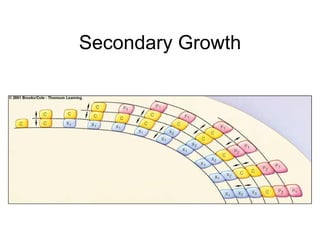
Secondary Growth
• Occurs in perennials
• A ring of vascular cambium produces
 secondary xylem and phloem
• Wood is the accumulation of these
 secondary tissues, especially xylem
Secondary Growth
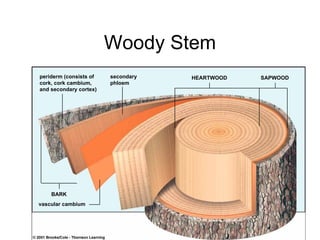
Woody Stem
periderm (consists of   secondary   HEARTWOOD   SAPWOOD
cork, cork cambium,     phloem
and secondary cortex)


    BARK
vascular cambium
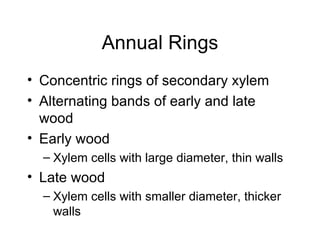
Annual Rings
• Concentric rings of secondary xylem
• Alternating bands of early and late
  wood
• Early wood
  – Xylem cells with large diameter, thin walls
• Late wood
  – Xylem cells with smaller diameter, thicker
    walls
Types of Wood
• Hardwood (oak, hickory)
  – Dicot wood
  – Xylem composed of vessels, tracheids,
    and fibers
• Softwood (pine, redwood)
  – Gymnosperm wood
  – Xylem composed mostly of tracheids
  – Grows more quickly

Cdocumentsandsettingsayetmydocumentsplantmorpholabactivitiesch26 091129203156-phpapp01

  • 1.
    March 28, 2005 Plant Tissues Chapter 26 Jin Hoe Huh
  • 2.
    Angiosperms – floweringplants • The angiosperms are seed-bearing vascular plants • In terms of distribution and diversity, they are the most successful plants on Earth • The structure and function of this plant group help explain its success
  • 3.
    Flowering Plant Life Double fertilization Diploid Meiosis Meiosis Cycle Haploid Mitosis without microspores pollination cytoplasmic division Two sperms enter ovule Female gametophyte
  • 4.
    Plant Life Histories •Annuals complete life cycle in one growing season • Biennials live for two seasons; flowers form in second season • Perennials grow and produce seeds year after year
  • 5.
    Shoot and Root Systems Shootsystem - produces sugars by Shoot photosynthesis System - carries out reproduction Root system - anchors the plant - penetrates the soil and Root absorbs water and minerals System - stores food
  • 6.
    Shoot and root systemsare interdependent water & sugar minerals SHOOT SYSTEM ROOT SYSTEM
  • 7.
    Plant Tissue Systems EPIDERMIS • Ground tissue VASCULAR TISSUES system • Vascular tissue GROUND TISSUES system SHOOT SYSTEM • Dermal tissue ROOT SYSTEM system
  • 8.
    Meristems – WhereTissues Originate • Regions where cell divisions produce plant growth • Apical meristems – Lengthen stems and roots – Responsible for primary growth • Lateral meristems – Increase width of stems – Responsible for secondary growth
  • 9.
    Apical Meristems Lengthen shootsand roots: activity at meristems SAM and RAM Cells that form at apical new cells elongate meristems: and start to differentiate protoderm  epidermis into primary tissues ground meristem  ground tissues procambium  primary vascular tissues
  • 10.
    Lateral Meristems Increases girthof older roots and stems Cylindrical arrays of cells vascular cambium  secondary vascular tissues periderm  cork cambium thickening
  • 11.
    Simple Tissues Made upof only one type of cell Parenchyma Collenchyma Sclerenchyma
  • 12.
    Morphology of threesimple tissue types parenchyma collenchyma sclerenchyma
  • 13.
    Parenchyma: A SimpleTissue • Comprises most of a plant’s soft primary growth • Cells are pliable, thin walled, many sided • Cells remain alive at maturity and retain capacity to divide • Mesophyll is a type of parenchyma that contains chloroplasts
  • 14.
    Collenchyma: A SimpleTissue • Specialized for support for primary tissues • Cells are elongated, with walls (especially corners) thickened with pectin • Makes stems strong but pliable • Cells are alive at maturity
  • 15.
    Sclerenchyma: A SimpleTissue • Supports mature plant parts • Protects many seeds • Cells have thick, lignified walls and are dead at maturity • Two types: – Fibers: Long, tapered cells – Sclereids: Stubbier cells
  • 16.
    Complex Tissues Composed ofa mix of cell types Xylem Phloem Epidermis
  • 17.
    Xylem • Conducts water and dissolved minerals • Conducting cells are dead and hollow at maturity vessel member tracheids
  • 18.
    Phloem: A Complex Vascular Tissue sieve plate • Transports sugars • Main conducting cells are sieve- tube members sieve-tube • Companion cells member companion assist in the cell loading of sugars
  • 19.
    Epidermis: A Complex Plant Tissue - Covers and protects plant surfaces - Secretes a waxy, waterproof cuticle - In plants with secondary growth, periderm replaces epidermis
  • 20.
    Monocots and Dicots– same tissues, different features 1 cotyledon 2 cotyledons 3 floral 4 or 5 floral parts parts Netlike veins Parallel veins 1 pore 3 pores Vascular Vascular bundles bundles in ring dispersed
  • 21.
    shoot apical meristem Shoot protoderm procambrium ground meristem Development cortex procambrium pith primary xylem primary phloem
  • 22.
    Bud = undevelopedshoot of meristematic tissue Leaves Internode Axillary bud at node Longitudinal section of terminal bud
  • 23.
    Roots also havemeristems
  • 24.
    Internal Structure ofa Dicot Stem - Outermost layer is epidermis - Cortex lies beneath epidermis - Ring of vascular bundles separates the cortex from the pith - The pith lies in the center of the stem
  • 25.
    Internal Structure • The vascular bundles of a are distributed Monocot throughout the ground tissue Stem • No division of ground tissue into cortex and pith
  • 26.
    Dicots Monocots Ground tissue system Dermal tissue system Vascular tissue system Dicots and Monocots have different stem and root anatomies
  • 27.
    Leaf Gross Structure DICOT MONOCOT petiole axillary bud blade node sheath blade node
  • 28.
    Adapted for Photosynthesis •Leaves are usually thin – High surface area-to-volume ratio – Promotes diffusion of carbon dioxide in, oxygen out • Leaves are arranged to capture sunlight – Are held perpendicular to rays of sun – Arrange so they don’t shade one another
  • 29.
    Leaf Structure UPPER cuticle EPIDERMIS PALISADE MESOPHYLL xylem SPONGY MESOPHYLL phloem LOWER EPIDERMIS O2 CO2 one stoma
  • 30.
    Mesophyll: Photosynthetic Tissue • Atype of parenchyma tissue • Cells have chloroplasts • Two layers in dicots – Palisade mesophyll – Spongy mesophyll
  • 31.
    Collenchyma Parenchyma
  • 32.
    Leaf Veins: VascularBundles • Xylem and phloem – often strengthened with fibers • In dicots, veins are netlike • In monocots, they are parallel
  • 33.
  • 34.
    Root Structure • Rootcap covers tip • Apical meristem produces the cap • Cell divisions at the apical meristem cause the root to lengthen • Farther up, cells differentiate and mature root apical root cap meristem
  • 35.
    Internal Structure ofa Root • Outermost layer is epidermis • Root cortex is beneath the epidermis • Endodermis, then pericycle surround the vascular cylinder • In some plants, there is a central pith
  • 36.
    epidermis endodermis cortex pericycle root hair phloem xylem
  • 37.
    Root Hairs andLateral Roots new • Both increase the surface lateral root area of a root system • Root hairs are tiny extensions of epidermal cells • Lateral roots arise from the pericycle and must push through the cortex and epidermis to reach the soil
  • 38.
    Secondary Growth • Occursin perennials • A ring of vascular cambium produces secondary xylem and phloem • Wood is the accumulation of these secondary tissues, especially xylem
  • 39.
  • 40.
    Woody Stem periderm (consistsof secondary HEARTWOOD SAPWOOD cork, cork cambium, phloem and secondary cortex) BARK vascular cambium
  • 41.
    Annual Rings • Concentricrings of secondary xylem • Alternating bands of early and late wood • Early wood – Xylem cells with large diameter, thin walls • Late wood – Xylem cells with smaller diameter, thicker walls
  • 42.
    Types of Wood •Hardwood (oak, hickory) – Dicot wood – Xylem composed of vessels, tracheids, and fibers • Softwood (pine, redwood) – Gymnosperm wood – Xylem composed mostly of tracheids – Grows more quickly