PLANT TISSUE
Simple tissue
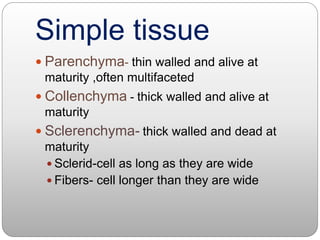
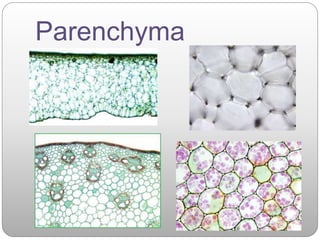
 Parenchyma- thin walled and alive at
maturity ,often multifaceted
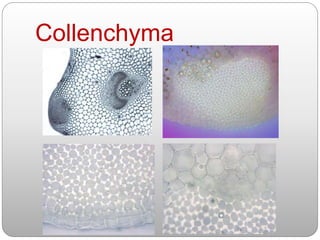
 Collenchyma - thick walled and alive at
maturity
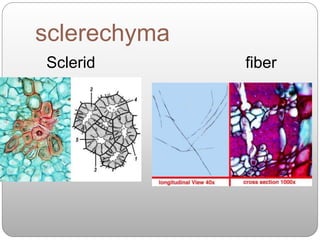
 Sclerenchyma- thick walled and dead at
maturity
 Sclerid-cell as long as they are wide
 Fibers- cell longer than they are wide
Parenchyma
Collenchyma
sclerechyma
Sclerid fiber
Complex tissue
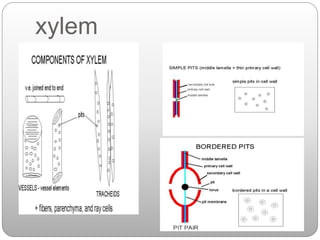
 Xylem – water conducting tissue;
parenchyma, fibers, vessels and/or
tracheids, and ray cells.
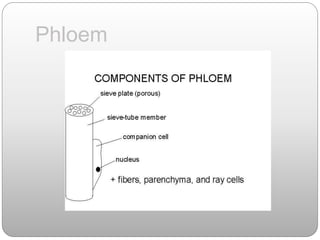
 Phloem - food conducting tissue; sieve-
tube members (no nucleus at maturity,
cytoplasm present), companion cells,
fibers, parenchyma, and ray cells. In
flowering plants, sieve-tube members and
companion cells arise from the same
mother cell.
.
xylem
Function
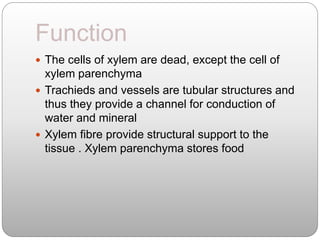
 The cells of xylem are dead, except the cell of
xylem parenchyma
 Trachieds and vessels are tubular structures and
thus they provide a channel for conduction of
water and mineral
 Xylem fibre provide structural support to the
tissue . Xylem parenchyma stores food
Phloem
Function
 Sieve tubes are tubular cell with
perforated walls
 Sieve tubes are the conducting
elements of phloem
 Phloem is responsible for translocation
of food in plants
 The transport of food in phloem is a two
way movement
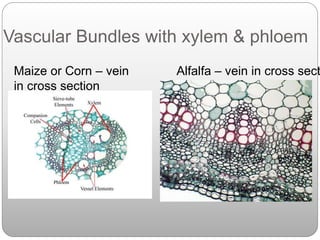
Vascular Bundles with xylem & phloem
Maize or Corn – vein
in cross section
Alfalfa – vein in cross sect