Prokaryotic Cells Vs. Eukaryotic Cells R. Miller 7 th  Grade Science Teacher KIPP WAYS Academy
Now that we have learned how living things are organized what’s next? We will learn more about the lowest level of organization: cells What is the first thing that we need to know about cells? All cells fall into one of the two major classifications of either prokaryotic or eukaryotic.
 
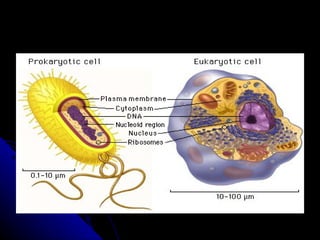
What’s the difference between prokaryotes and eukaryotes? Prokaryotic cells  were here first and for billions of years were the only form of life on Earth. All  prokaryotic  organisms are  unicellular Eukaryotic cells  appeared on earth long after  prokaryotic cells  but they are much more advanced.  Eukaryotic  organisms unlike  prokaryotic  can be  unicellular  or  multicellular .
 
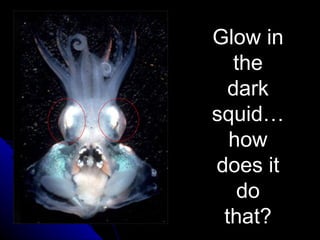
Glow in the dark squid… how does it do that?
Vibrio fischeri Glow in the dark bacteria Helps it survive in the ocean Lives in fish and other marine life
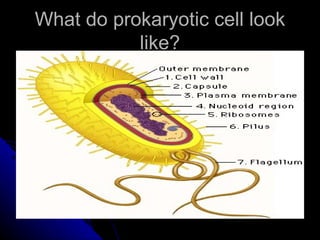
Let’s Take a Look at the Characteristics of Prokaryotes Prokaryotes are the simplest type of cell.  Oldest type of cell appeared about four billion years ago. Prokaryotes are the largest group of organisms  Prokaryotes unicellular organisms that are found in all environments.
Let’s Take a Look at the Characteristics of Prokaryotes Prokaryotes  do not have a nuclear membrane . Their circular shaped genetic material dispersed throughout cytoplasm. Prokaryotes do not have membrane-bound organelles . Prokaryotes have a simple internal structure.  Prokaryotes are smaller in size when compared to Eukaryotes.
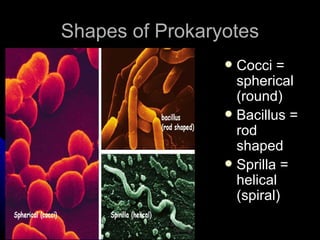
Shapes of Prokaryotes Cocci = spherical (round) Bacillus = (rod shaped) Spirilla = helical (spiral)
What do prokaryotic cell look like?
Now let’s take a look at the characteristics of eukaryotes Eukaryotic cells appeared approximately one billion years ago  Eukaryotes are generally more advanced than prokaryotes  Nuclear membrane surrounds linear genetic material (DNA)
Is there more? Yes!!! Unlike prokaryotes, eukaryotes have several different parts. Prokaryote’s organelles have coverings known as  membranes. Eukaryotes  have a complex internal structure. Eukaryotes are larger than prokaryotes in size .
What do eukaryotic cells look like? Mitochondria Nucleus Golgi Complex Endoplasmic Reticulum Cell Membrane Cytoplasm
How do the differences line up? Prokaryotes Organelles lack a membrane Ribosomes are the only organelles Genetic material floats in the cytoplasm (DNA and RNA) Eukaryotes Organelles covered by a membrane Multiple organelles including ribosomes Membrane covered Genetic material
How do the differences line up? Prokaryotes Circular DNA Unicellular Cells are smaller in size Has larger number of organisms Eukaryotes Linear DNA May be multicellular or unicellular Cells are larger in size Has smaller number of organisms
How do the differences line up? Prokaryotes Appeared 4 billion years ago Eukaryotes Appeared 1 billion years ago
How do the similarities line up? Lets See!!! Both types of cells have cell membranes (outer covering of the cell) Both types of cells have ribosomes Both types of cells have DNA Both types of cells have a liquid environment known as the cytoplasm
Your turn: Make a Venn Diagram outlining the similarities and differences between prokaryotes and eukaryotes You may use your book and/or consult your teammate

Prokaryotes Vs Eukaryotes

  • 1.
    Prokaryotic Cells Vs.Eukaryotic Cells R. Miller 7 th Grade Science Teacher KIPP WAYS Academy
  • 2.
    Now that wehave learned how living things are organized what’s next? We will learn more about the lowest level of organization: cells What is the first thing that we need to know about cells? All cells fall into one of the two major classifications of either prokaryotic or eukaryotic.
  • 3.
  • 4.
    What’s the differencebetween prokaryotes and eukaryotes? Prokaryotic cells were here first and for billions of years were the only form of life on Earth. All prokaryotic organisms are unicellular Eukaryotic cells appeared on earth long after prokaryotic cells but they are much more advanced. Eukaryotic organisms unlike prokaryotic can be unicellular or multicellular .
  • 5.
  • 6.
    Glow in thedark squid… how does it do that?
  • 7.
    Vibrio fischeri Glowin the dark bacteria Helps it survive in the ocean Lives in fish and other marine life
  • 8.
    Let’s Take aLook at the Characteristics of Prokaryotes Prokaryotes are the simplest type of cell. Oldest type of cell appeared about four billion years ago. Prokaryotes are the largest group of organisms Prokaryotes unicellular organisms that are found in all environments.
  • 9.
    Let’s Take aLook at the Characteristics of Prokaryotes Prokaryotes do not have a nuclear membrane . Their circular shaped genetic material dispersed throughout cytoplasm. Prokaryotes do not have membrane-bound organelles . Prokaryotes have a simple internal structure. Prokaryotes are smaller in size when compared to Eukaryotes.
  • 10.
    Shapes of ProkaryotesCocci = spherical (round) Bacillus = (rod shaped) Spirilla = helical (spiral)
  • 11.
    What do prokaryoticcell look like?
  • 12.
    Now let’s takea look at the characteristics of eukaryotes Eukaryotic cells appeared approximately one billion years ago Eukaryotes are generally more advanced than prokaryotes Nuclear membrane surrounds linear genetic material (DNA)
  • 13.
    Is there more?Yes!!! Unlike prokaryotes, eukaryotes have several different parts. Prokaryote’s organelles have coverings known as membranes. Eukaryotes have a complex internal structure. Eukaryotes are larger than prokaryotes in size .
  • 14.
    What do eukaryoticcells look like? Mitochondria Nucleus Golgi Complex Endoplasmic Reticulum Cell Membrane Cytoplasm
  • 15.
    How do thedifferences line up? Prokaryotes Organelles lack a membrane Ribosomes are the only organelles Genetic material floats in the cytoplasm (DNA and RNA) Eukaryotes Organelles covered by a membrane Multiple organelles including ribosomes Membrane covered Genetic material
  • 16.
    How do thedifferences line up? Prokaryotes Circular DNA Unicellular Cells are smaller in size Has larger number of organisms Eukaryotes Linear DNA May be multicellular or unicellular Cells are larger in size Has smaller number of organisms
  • 17.
    How do thedifferences line up? Prokaryotes Appeared 4 billion years ago Eukaryotes Appeared 1 billion years ago
  • 18.
    How do thesimilarities line up? Lets See!!! Both types of cells have cell membranes (outer covering of the cell) Both types of cells have ribosomes Both types of cells have DNA Both types of cells have a liquid environment known as the cytoplasm
  • 19.
    Your turn: Makea Venn Diagram outlining the similarities and differences between prokaryotes and eukaryotes You may use your book and/or consult your teammate