Step by Step Iris Clip
Dr Rahul Achlerkar
Dr Vijay Shetty
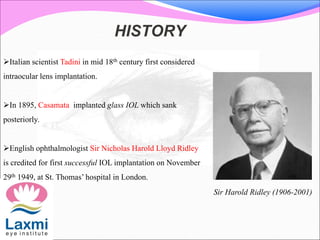
HISTORY
Italian scientist Tadini in mid 18th century first considered
intraocular lens implantation.
In 1895, Casamata implanted glass IOL which sank
posteriorly.
English ophthalmologist Sir Nicholas Harold Lloyd Ridley
is credited for first successful IOL implantation on November
29th 1949, at St. Thomas’ hospital in London.
Sir Harold Ridley (1906-2001)
EVOLUTION AND DEVELOPMENT
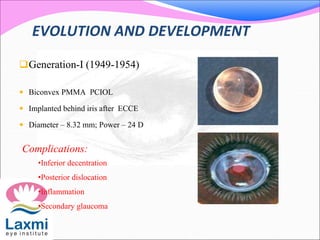
Generation-I (1949-1954)
 Biconvex PMMA PCIOL
 Implanted behind iris after ECCE
 Diameter – 8.32 mm; Power – 24 D
Complications:
•Inferior decentration
•Posterior dislocation
•Inflammation
•Secondary glaucoma
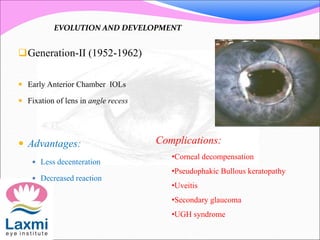
Generation-II (1952-1962)
 Early Anterior Chamber IOLs
 Fixation of lens in angle recess
 Advantages:
 Less decenteration
 Decreased reaction
Complications:
•Corneal decompensation
•Pseudophakic Bullous keratopathy
•Uveitis
•Secondary glaucoma
•UGH syndrome
EVOLUTION AND DEVELOPMENT
Generation-III (1953 – 1975)
 Iris supported or iris fixated IOLs
 Advantages:
 It is away from angle structures hence
rate of complications like secondary
glaucoma is less.
 Rate of dislocation is less.
 Less contact with corneal endothelium
hence lesser damage to it.
•Complications:
•Iris chaffing
•Pupillary distortion
•Chronic inflammation
•CME
•Distortion on pupillary dilatation
•Endothelial decompensation
EVOLUTION AND DEVELOPMENT
Why the Iris?
 Iris is the ”toughest” tissue within the eye
 The iris is a resilient tissue.
 Pigmented tissue in nature is usually associated with being “tough”
Iris
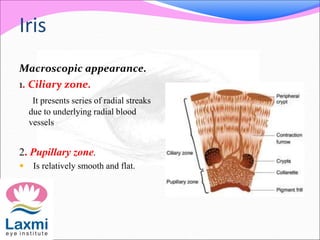
Macroscopic appearance.
1. Ciliary zone.
It presents series of radial streaks
due to underlying radial blood
vessels
2. Pupillary zone.
 Is relatively smooth and flat.
The Iris consists of
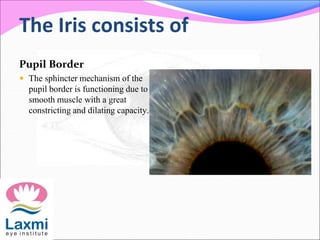
Pupil Border
 The sphincter mechanism of the
pupil border is functioning due to a
smooth muscle with a great
constricting and dilating capacity.
Anatomy of the Iris
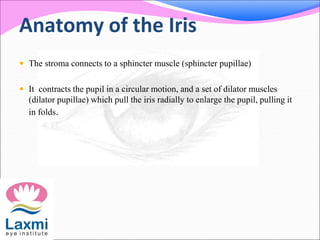
 The stroma connects to a sphincter muscle (sphincter pupillae)
 It contracts the pupil in a circular motion, and a set of dilator muscles
(dilator pupillae) which pull the iris radially to enlarge the pupil, pulling it
in folds.
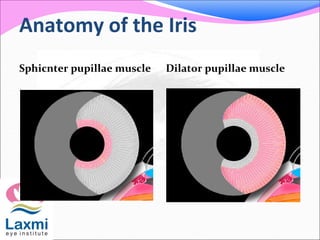
Anatomy of the Iris
Sphicnter pupillae muscle Dilator pupillae muscle
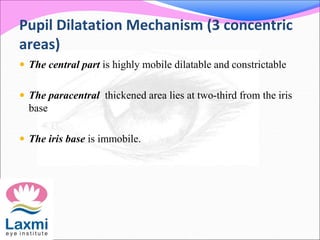
Pupil Dilatation Mechanism (3 concentric
areas)
 The central part is highly mobile dilatable and constrictable
 The paracentral thickened area lies at two-third from the iris
base
 The iris base is immobile.
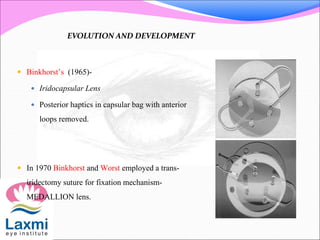
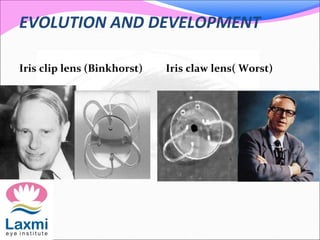
 Binkhorst’s (1965)-
 Iridocapsular Lens
 Posterior haptics in capsular bag with anterior
loops removed.
 In 1970 Binkhorst and Worst employed a trans-
iridectomy suture for fixation mechanism-
MEDALLION lens.
EVOLUTION AND DEVELOPMENT
Iris clip lens (Binkhorst) Iris claw lens( Worst)
Discovery of the Iris Claw principle
 Using an early model, the Slotted Medallion lens, Jan Worst
sometimes observed that some iris tissue was caught in the slot
of his lens.
 This clasping of iris tissue proved to be a serendipitously
discovered new possibility for stable fixation of the IOL.
 Once the efficacy of this additional fixation method had been
proven in a number of cases additional iris stitching seemed no
longer necessary.
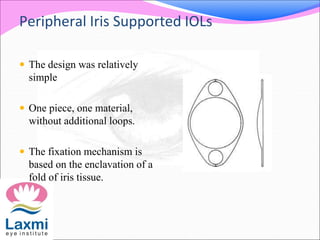
Peripheral Iris Supported IOLs
 The design was relatively
simple
 One piece, one material,
without additional loops.
 The fixation mechanism is
based on the enclavation of a
fold of iris tissue.
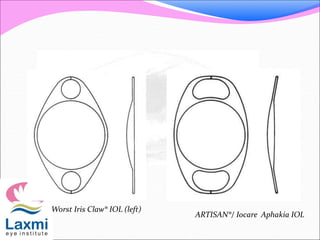
 In 1997 an improved vaulted design of the ARTISAN®
Aphakia Lens was introduced with a number of new
characteristics.
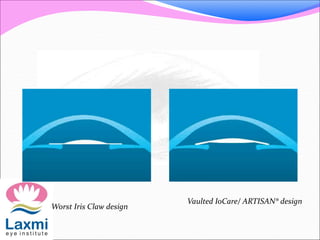
 The lens configuration was made vaulted to create distance to
the iris
 Enclavation was made easier by using a lens with a larger and
oval aperture between optic and haptics than the original
circular shape.
Worst Iris Claw® IOL (left)
ARTISAN®/ Iocare Aphakia IOL
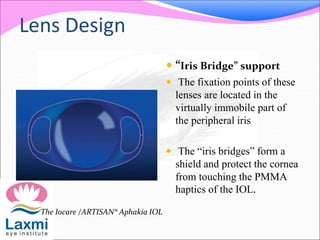
Lens Design
 “Iris Bridge” support
 The fixation points of these
lenses are located in the
virtually immobile part of
the peripheral iris
 The “iris bridges” form a
shield and protect the cornea
from touching the PMMA
haptics of the IOL.
The Iocare /ARTISAN® Aphakia IOL
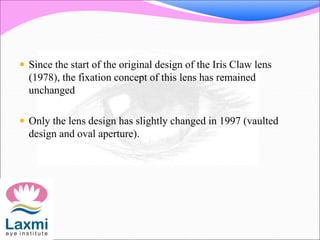
 Since the start of the original design of the Iris Claw lens
(1978), the fixation concept of this lens has remained
unchanged
 Only the lens design has slightly changed in 1997 (vaulted
design and oval aperture).
Worst Iris Claw design
Vaulted IoCare/ ARTISAN® design
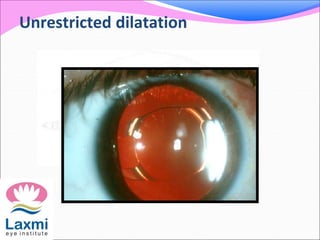
Unrestricted dilatation
 The haptics (fixation arms) attach to the midperipheral virtually
immobile iris stroma, thus allowing the pupil unrestricted
ability to dilate &constrict
 Fluorescein angiographic studies by Strobel1 and Izak2 have
shown no leakage of the iris vessels at the enclavation sites.
 Only a few cases of iris atrophy in the area of the fixation have
been reported in the literature
Unrestricted dilatation
Lens Manufacturing
 Compression Molding Technology
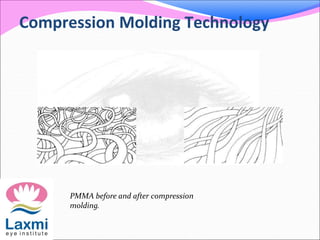
During the compression molding process the molecular
structure of PMMA is enhanced by redistributing the molecules
into longer chains, resulting in a much stronger material.
Compression Molding Technology
PMMA before and after compression
molding.
Extreme flexibility of the haptics
 Compression Molding Technology gives a high tensile
strength, combined with flexibility of the lens haptics.
 The risk of fracture is minimal.
Proprietary Tumbling Process
 The proprietary tumbling process gives a special surface
treatment to IOLs.
 An ultra smoothness of the IOL is the result.
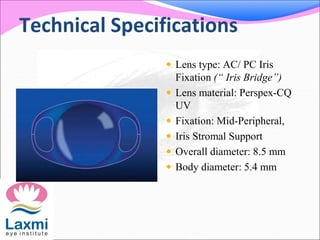
Technical Specifications
 Lens type: AC/ PC Iris
Fixation (“ Iris Bridge”)
 Lens material: Perspex-CQ
UV
 Fixation: Mid-Peripheral,
 Iris Stromal Support
 Overall diameter: 8.5 mm
 Body diameter: 5.4 mm
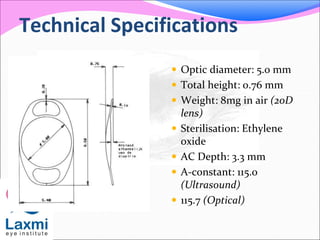
Technical Specifications
 Optic diameter: 5.0 mm
 Total height: 0.76 mm
 Weight: 8mg in air (20D
lens)
 Sterilisation: Ethylene
oxide
 AC Depth: 3.3 mm
 A-constant: 115.0
(Ultrasound)
 115.7 (Optical)
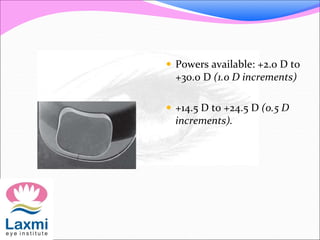
 Powers available: +2.0 D to
+30.0 D (1.0 D increments)
 +14.5 D to +24.5 D (0.5 D
increments).
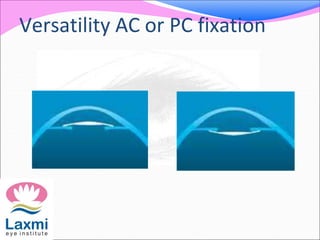
Versatility AC or PC fixation
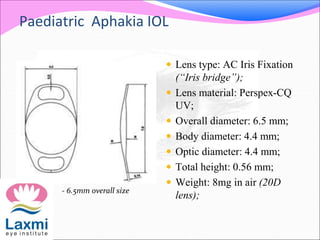
Paediatric Aphakia IOL
 Lens type: AC Iris Fixation
(“Iris bridge”);
 Lens material: Perspex-CQ
UV;
 Overall diameter: 6.5 mm;
 Body diameter: 4.4 mm;
 Optic diameter: 4.4 mm;
 Total height: 0.56 mm;
 Weight: 8mg in air (20D
lens);
- 6.5mm overall size
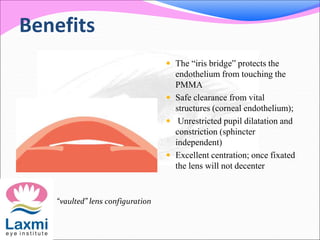
Benefits
 The “iris bridge” protects the
endothelium from touching the
PMMA
 Safe clearance from vital
structures (corneal endothelium);
 Unrestricted pupil dilatation and
constriction (sphincter
independent)
 Excellent centration; once fixated
the lens will not decenter
“vaulted” lens configuration
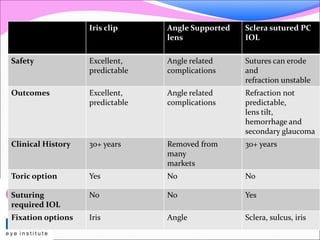
Iris clip Angle Supported
lens
Sclera sutured PC
IOL
Safety Excellent,
predictable
Angle related
complications
Sutures can erode
and
refraction unstable
Outcomes Excellent,
predictable
Angle related
complications
Refraction not
predictable,
lens tilt,
hemorrhage and
secondary glaucoma
Clinical History 30+ years Removed from
many
markets
30+ years
Toric option Yes No No
Suturing
required IOL
No No Yes
Fixation options Iris Angle Sclera, sulcus, iris
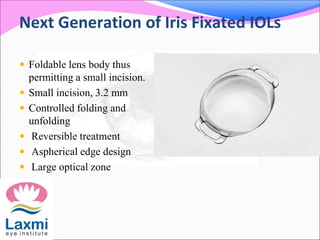
Next Generation of Iris Fixated IOLs
 Foldable lens body thus
permitting a small incision.
 Small incision, 3.2 mm
 Controlled folding and
unfolding
 Reversible treatment
 Aspherical edge design
 Large optical zone
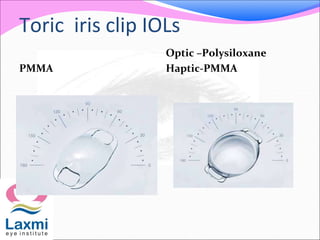
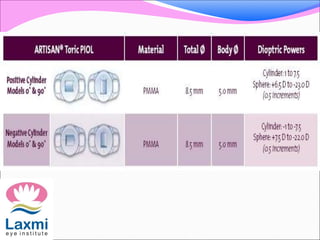
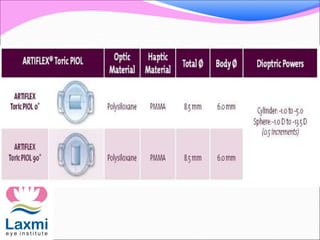
Toric iris clip IOLs
PMMA
Optic –Polysiloxane
Haptic-PMMA
Other Indications
 Iris fixated Custom-made IOLs include lenses for the
treatment of unique ocular conditions like
 Coloboma,
 Diplopia
 There are two categories of Custom-made lenses:
 Iris Reconstruction IOLs (made of coloured & clear PMMA)
 Pupil Occluder for Diplopia Correction (made of black
PMMA).
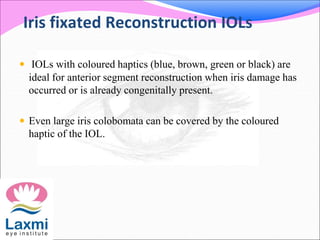
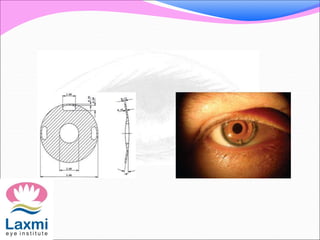
Iris fixated Reconstruction IOLs
 IOLs with coloured haptics (blue, brown, green or black) are
ideal for anterior segment reconstruction when iris damage has
occurred or is already congenitally present.
 Even large iris colobomata can be covered by the coloured
haptic of the IOL.
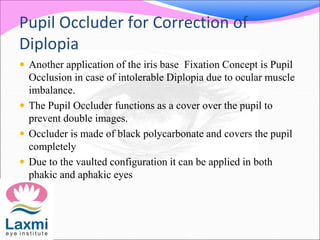
Pupil Occluder for Correction of
Diplopia
 Another application of the iris base Fixation Concept is Pupil
Occlusion in case of intolerable Diplopia due to ocular muscle
imbalance.
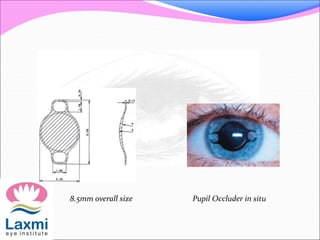
 The Pupil Occluder functions as a cover over the pupil to
prevent double images.
 Occluder is made of black polycarbonate and covers the pupil
completely
 Due to the vaulted configuration it can be applied in both
phakic and aphakic eyes
8.5mm overall size Pupil Occluder in situ
The main features are:
 Minimal risk surgery
 The anatomy of the iris and its specific features allow surgery
with minimal risks. Fixation is performed to the iris periphery.
 Pressure free iris fixation
 No iris atrophy when the recommended surgical technique is
used
indications
 Senile cataract with severe zonular dialysis
 Traumatic cataract
 Congenital or juvenile cataract with subluxation
 Secondary implantation after aphakia.
Contraindications
 Recurrent or chronic iritis
 Rubella cataract
 Retina and optic nerve defects;
 Corneal distrophy (except in preparation for penetrating
keratoplasty)
 Acute inflammation
 Severe iris atrophy
 Uncontrolled chronic glaucoma
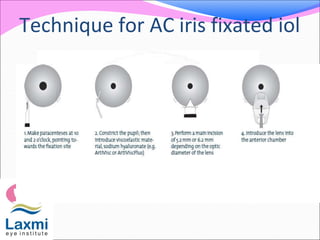
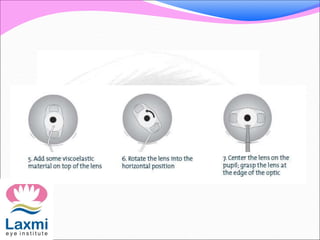
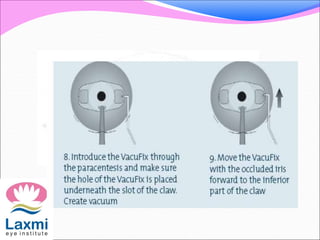
Technique for AC iris fixated iol
Video of AC iris clip IOL
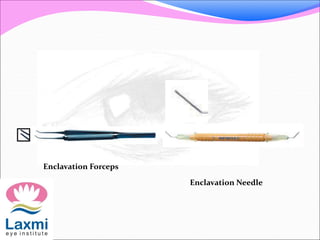
Enclavation Forceps
Enclavation Needle
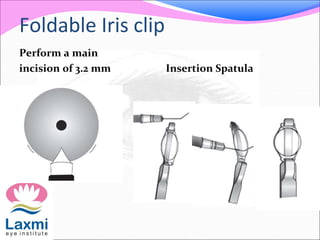
Foldable Iris clip
Perform a main
incision of 3.2 mm Insertion Spatula
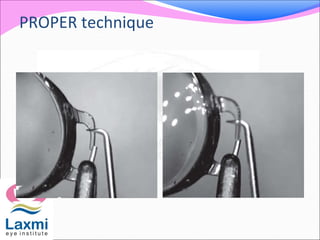
How to properly Enclavate the iris
Notice that the “claws” are perfectly aligned.
PROPER technique
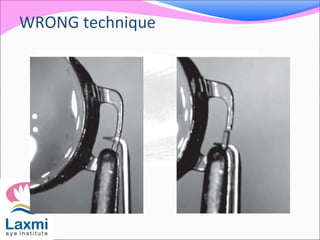
WRONG technique
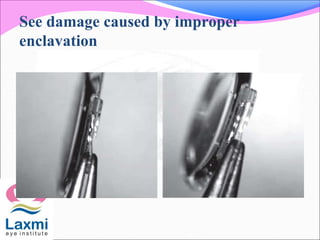
See damage caused by improper
enclavation
Peripheral iridectomy or iridotomy
 Although all Aphakia IOLs are vaulted ,it is highly
recommended to perform an iridectomy or iridotomy.
 The pigment layer needs to be perforated completely
 An iridectomy or iridotomy has to be made to avoid a postop
pupil block
 It can also be used to manage an unwanted iris prolapse.
Retropupillary Fixation Technique
 As recommended by A. Mohr, M.D.
 A technique is recommended with a 12 o’clock frown incision
(corneo-scleral 5.5mm)
 Authors from Bursa-Turkey use a scleral tunnel incision to
avoid the formation of postoperative astigmatism.
 The width of the incision should be 5.5 mm.
Do not constrict the pupil
 Leave the pupil at a minimum size of approximately 3mm to
allow the lens to reach the retropupillary position through the
pupil.
use of high viscosity viscoelastic
 Inject a small amount of viscoelastic from the periphery of the
eye, but never directly into the pupillary area
Implantation of the iol
 The IOL will be inserted into the anterior chamber with the
convex side downwards (upside down) holding it in the
forceps.
 With a manipulator, the IOL will be brought into the horizontal
position from 3 o’clock to 9 o’clock.
iol fixation on the iris
 After the IOL has been brought behind the iris and the pupil is
constricted, the IOL will be lifted and tilted slightly in order to
show the contour of the“claws” through the iris stroma.
 A fine spatula is inserted and exerts gentle pressure on the
slotted centre of the lens haptic, the “claw”.
 The same manoeuvre is now repeated on the other side.
 The IOL is now retropupillary fixated.
VIDEO OF RETROFIXTED IRIS
CLIP
Peripheral iridectomy
 It is not absolutely essential and strictly recommended to
perform an iridectomy
 removal of all viscoelastic
Carefully remove all of the viscoelastic to avoid a high pressure.
 Suturing
Close the incision with sutures.
VIDEO PUPILOPLATY
INTRA operative problems
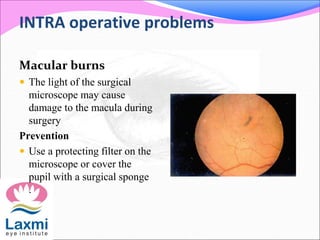
Macular burns
 The light of the surgical
microscope may cause
damage to the macula during
surgery
Prevention
 Use a protecting filter on the
microscope or cover the
pupil with a surgical sponge
.
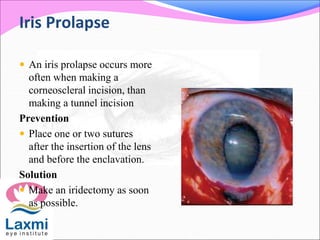
Iris Prolapse
 An iris prolapse occurs more
often when making a
corneoscleral incision, than
making a tunnel incision
Prevention
 Place one or two sutures
after the insertion of the lens
and before the enclavation.
Solution
 Make an iridectomy as soon
as possible.
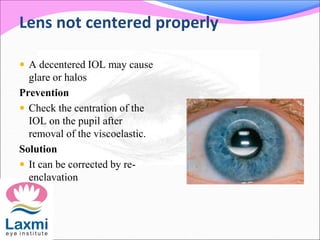
Lens not centered properly
 A decentered IOL may cause
glare or halos
Prevention
 Check the centration of the
IOL on the pupil after
removal of the viscoelastic.
Solution
 It can be corrected by re-
enclavation
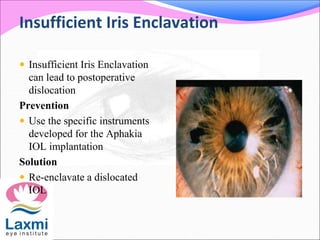
Insufficient Iris Enclavation
 Insufficient Iris Enclavation
can lead to postoperative
dislocation
Prevention
 Use the specific instruments
developed for the Aphakia
IOL implantation
Solution
 Re-enclavate a dislocated
IOL
Subluxation
 After ocular trauma or spontaneously, luxation of one of the
claws can occur, leading to subluxation of the IOL
 when a too small amount of iris tissue is enclavated, The IOL
has to be reenclavated
 immediately to minimize endothelial damage.
Secondary surgical interventions
Lens repositioning
 Is necessary after lens decentration and in cases in which a
preventive repositioning was performed
 in subjects with too small amounts of enclavated iris tissue.
Lens replacement
 An IOL can be removed and replaced by a new Aphakia IOL.
Articles of Interest
Long-term follow-up of the corneal endothelium after
artisan lens implantation for unilateral traumatic and
unilateral congenital cataract in children: two case
series.
Odenthal MT, Sminia ML, Prick LJ, Gortzak-Moorstein N, Volker -Dieben HJ. Cornea 2006;
25(10):1173-7.
RESULTS: Endothelial cell loss 10.5 yrs after iris fixated IOL
implantation for traumatic cataract was substantial & related to the
length corneal scar of original trauma . In children operated for
congenital cataract , no difference was found in CECD in operated &
unoperated eyes after 9.5 yrs after artisan iols
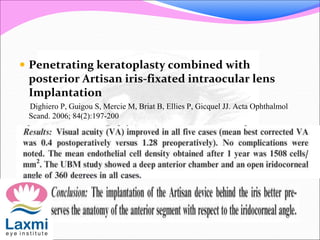
 Penetrating keratoplasty combined with
posterior Artisan iris-fixated intraocular lens
Implantation
Dighiero P, Guigou S, Mercie M, Briat B, Ellies P, Gicquel JJ. Acta Ophthalmol
Scand. 2006; 84(2):197-200
Dr Vijay Shetty
Dr Suhas Haldipurkar
Dr Shweta Rao
Dr Maninder Singh Setia
A RETROSPECTIVE ANALYSIS OF IOL POWER
CALCULATION AND POSTOPERATIVE RESULTS OF
IRIS CLIP IOL
WOC 2011
Abu Dhabi
AIM
• To study the post operative visual outcome in retrofixed
iris clip IOLs with respect to uncorrected visual acuity and
best corrected visual acuity
• To study the refractive outcome in iris clip IOLs using IOL
master and various formulae
• To study the prevalance of PXF, Trauma, Marfan’s
syndrome, retinal tears, cystoids macular oedema and
retinal detachment in patients who underwent iris clip
IOL
CONCLUSION
 Retrofixed iris clip IOL is a relatively a safe procedure in
eyes with no capsular support. Trauma, PXF and Marfan’s
syndrome were associated in 41%, 14% and 14%
respectively .IOL was required in 5/26 (19%). Similar IOL
refixation was noted in both horizontal and vertical
fixation.CME: 2/26, Uveitis: 1/27, Retinal Hole: 1/27 in our
population,
 Hoffer Q formula predicted the IOL power most
accurately for iris clip IOLs consistently in eyes with
varied axial length followed by Holladay and SRK T.
Books
 1. Cataract and IOL
Daljit Singh, Jan Worst, Ravijit Singh, Indu R. Singh. 1993
Chapter 20: Iris Claw Lens, page 82-97
 2. A Colour Atlas of Lens Implantation
Chapter 13: Iris-fixated lenses, evolution and application – Jan
Worst, page 79-87
 3. Iris Claw Lens or Lobster Claw Lens of Worst
Alpar JJ / Fechner PV, 1986
Step by step IRIS clip

Step by step IRIS clip

  • 1.
    Step by StepIris Clip Dr Rahul Achlerkar Dr Vijay Shetty
  • 2.
    HISTORY Italian scientist Tadiniin mid 18th century first considered intraocular lens implantation. In 1895, Casamata implanted glass IOL which sank posteriorly. English ophthalmologist Sir Nicholas Harold Lloyd Ridley is credited for first successful IOL implantation on November 29th 1949, at St. Thomas’ hospital in London. Sir Harold Ridley (1906-2001)
  • 3.
    EVOLUTION AND DEVELOPMENT Generation-I(1949-1954)  Biconvex PMMA PCIOL  Implanted behind iris after ECCE  Diameter – 8.32 mm; Power – 24 D Complications: •Inferior decentration •Posterior dislocation •Inflammation •Secondary glaucoma
  • 4.
    Generation-II (1952-1962)  EarlyAnterior Chamber IOLs  Fixation of lens in angle recess  Advantages:  Less decenteration  Decreased reaction Complications: •Corneal decompensation •Pseudophakic Bullous keratopathy •Uveitis •Secondary glaucoma •UGH syndrome EVOLUTION AND DEVELOPMENT
  • 5.
    Generation-III (1953 –1975)  Iris supported or iris fixated IOLs  Advantages:  It is away from angle structures hence rate of complications like secondary glaucoma is less.  Rate of dislocation is less.  Less contact with corneal endothelium hence lesser damage to it. •Complications: •Iris chaffing •Pupillary distortion •Chronic inflammation •CME •Distortion on pupillary dilatation •Endothelial decompensation EVOLUTION AND DEVELOPMENT
  • 6.
    Why the Iris? Iris is the ”toughest” tissue within the eye  The iris is a resilient tissue.  Pigmented tissue in nature is usually associated with being “tough”
  • 7.
    Iris Macroscopic appearance. 1. Ciliaryzone. It presents series of radial streaks due to underlying radial blood vessels 2. Pupillary zone.  Is relatively smooth and flat.
  • 8.
    The Iris consistsof Pupil Border  The sphincter mechanism of the pupil border is functioning due to a smooth muscle with a great constricting and dilating capacity.
  • 9.
    Anatomy of theIris  The stroma connects to a sphincter muscle (sphincter pupillae)  It contracts the pupil in a circular motion, and a set of dilator muscles (dilator pupillae) which pull the iris radially to enlarge the pupil, pulling it in folds.
  • 10.
    Anatomy of theIris Sphicnter pupillae muscle Dilator pupillae muscle
  • 11.
    Pupil Dilatation Mechanism(3 concentric areas)  The central part is highly mobile dilatable and constrictable  The paracentral thickened area lies at two-third from the iris base  The iris base is immobile.
  • 12.
     Binkhorst’s (1965)- Iridocapsular Lens  Posterior haptics in capsular bag with anterior loops removed.  In 1970 Binkhorst and Worst employed a trans- iridectomy suture for fixation mechanism- MEDALLION lens. EVOLUTION AND DEVELOPMENT
  • 13.
    EVOLUTION AND DEVELOPMENT Irisclip lens (Binkhorst) Iris claw lens( Worst)
  • 14.
    Discovery of theIris Claw principle  Using an early model, the Slotted Medallion lens, Jan Worst sometimes observed that some iris tissue was caught in the slot of his lens.  This clasping of iris tissue proved to be a serendipitously discovered new possibility for stable fixation of the IOL.  Once the efficacy of this additional fixation method had been proven in a number of cases additional iris stitching seemed no longer necessary.
  • 15.
    Peripheral Iris SupportedIOLs  The design was relatively simple  One piece, one material, without additional loops.  The fixation mechanism is based on the enclavation of a fold of iris tissue.
  • 16.
     In 1997an improved vaulted design of the ARTISAN® Aphakia Lens was introduced with a number of new characteristics.  The lens configuration was made vaulted to create distance to the iris  Enclavation was made easier by using a lens with a larger and oval aperture between optic and haptics than the original circular shape.
  • 17.
    Worst Iris Claw®IOL (left) ARTISAN®/ Iocare Aphakia IOL
  • 18.
    Lens Design  “IrisBridge” support  The fixation points of these lenses are located in the virtually immobile part of the peripheral iris  The “iris bridges” form a shield and protect the cornea from touching the PMMA haptics of the IOL. The Iocare /ARTISAN® Aphakia IOL
  • 19.
     Since thestart of the original design of the Iris Claw lens (1978), the fixation concept of this lens has remained unchanged  Only the lens design has slightly changed in 1997 (vaulted design and oval aperture).
  • 20.
    Worst Iris Clawdesign Vaulted IoCare/ ARTISAN® design
  • 21.
    Unrestricted dilatation  Thehaptics (fixation arms) attach to the midperipheral virtually immobile iris stroma, thus allowing the pupil unrestricted ability to dilate &constrict  Fluorescein angiographic studies by Strobel1 and Izak2 have shown no leakage of the iris vessels at the enclavation sites.  Only a few cases of iris atrophy in the area of the fixation have been reported in the literature
  • 22.
  • 23.
    Lens Manufacturing  CompressionMolding Technology During the compression molding process the molecular structure of PMMA is enhanced by redistributing the molecules into longer chains, resulting in a much stronger material.
  • 24.
    Compression Molding Technology PMMAbefore and after compression molding.
  • 25.
    Extreme flexibility ofthe haptics  Compression Molding Technology gives a high tensile strength, combined with flexibility of the lens haptics.  The risk of fracture is minimal. Proprietary Tumbling Process  The proprietary tumbling process gives a special surface treatment to IOLs.  An ultra smoothness of the IOL is the result.
  • 26.
    Technical Specifications  Lenstype: AC/ PC Iris Fixation (“ Iris Bridge”)  Lens material: Perspex-CQ UV  Fixation: Mid-Peripheral,  Iris Stromal Support  Overall diameter: 8.5 mm  Body diameter: 5.4 mm
  • 27.
    Technical Specifications  Opticdiameter: 5.0 mm  Total height: 0.76 mm  Weight: 8mg in air (20D lens)  Sterilisation: Ethylene oxide  AC Depth: 3.3 mm  A-constant: 115.0 (Ultrasound)  115.7 (Optical)
  • 30.
     Powers available:+2.0 D to +30.0 D (1.0 D increments)  +14.5 D to +24.5 D (0.5 D increments).
  • 31.
    Versatility AC orPC fixation
  • 32.
    Paediatric Aphakia IOL Lens type: AC Iris Fixation (“Iris bridge”);  Lens material: Perspex-CQ UV;  Overall diameter: 6.5 mm;  Body diameter: 4.4 mm;  Optic diameter: 4.4 mm;  Total height: 0.56 mm;  Weight: 8mg in air (20D lens); - 6.5mm overall size
  • 33.
    Benefits  The “irisbridge” protects the endothelium from touching the PMMA  Safe clearance from vital structures (corneal endothelium);  Unrestricted pupil dilatation and constriction (sphincter independent)  Excellent centration; once fixated the lens will not decenter “vaulted” lens configuration
  • 34.
    Iris clip AngleSupported lens Sclera sutured PC IOL Safety Excellent, predictable Angle related complications Sutures can erode and refraction unstable Outcomes Excellent, predictable Angle related complications Refraction not predictable, lens tilt, hemorrhage and secondary glaucoma Clinical History 30+ years Removed from many markets 30+ years Toric option Yes No No Suturing required IOL No No Yes Fixation options Iris Angle Sclera, sulcus, iris
  • 35.
    Next Generation ofIris Fixated IOLs  Foldable lens body thus permitting a small incision.  Small incision, 3.2 mm  Controlled folding and unfolding  Reversible treatment  Aspherical edge design  Large optical zone
  • 36.
    Toric iris clipIOLs PMMA Optic –Polysiloxane Haptic-PMMA
  • 39.
    Other Indications  Irisfixated Custom-made IOLs include lenses for the treatment of unique ocular conditions like  Coloboma,  Diplopia  There are two categories of Custom-made lenses:  Iris Reconstruction IOLs (made of coloured & clear PMMA)  Pupil Occluder for Diplopia Correction (made of black PMMA).
  • 40.
    Iris fixated ReconstructionIOLs  IOLs with coloured haptics (blue, brown, green or black) are ideal for anterior segment reconstruction when iris damage has occurred or is already congenitally present.  Even large iris colobomata can be covered by the coloured haptic of the IOL.
  • 42.
    Pupil Occluder forCorrection of Diplopia  Another application of the iris base Fixation Concept is Pupil Occlusion in case of intolerable Diplopia due to ocular muscle imbalance.  The Pupil Occluder functions as a cover over the pupil to prevent double images.  Occluder is made of black polycarbonate and covers the pupil completely  Due to the vaulted configuration it can be applied in both phakic and aphakic eyes
  • 43.
    8.5mm overall sizePupil Occluder in situ
  • 44.
    The main featuresare:  Minimal risk surgery  The anatomy of the iris and its specific features allow surgery with minimal risks. Fixation is performed to the iris periphery.  Pressure free iris fixation  No iris atrophy when the recommended surgical technique is used
  • 45.
    indications  Senile cataractwith severe zonular dialysis  Traumatic cataract  Congenital or juvenile cataract with subluxation  Secondary implantation after aphakia.
  • 46.
    Contraindications  Recurrent orchronic iritis  Rubella cataract  Retina and optic nerve defects;  Corneal distrophy (except in preparation for penetrating keratoplasty)  Acute inflammation  Severe iris atrophy  Uncontrolled chronic glaucoma
  • 47.
    Technique for ACiris fixated iol
  • 50.
    Video of ACiris clip IOL
  • 51.
  • 52.
    Foldable Iris clip Performa main incision of 3.2 mm Insertion Spatula
  • 53.
    How to properlyEnclavate the iris Notice that the “claws” are perfectly aligned.
  • 54.
  • 55.
  • 56.
    See damage causedby improper enclavation
  • 57.
    Peripheral iridectomy oriridotomy  Although all Aphakia IOLs are vaulted ,it is highly recommended to perform an iridectomy or iridotomy.  The pigment layer needs to be perforated completely  An iridectomy or iridotomy has to be made to avoid a postop pupil block  It can also be used to manage an unwanted iris prolapse.
  • 58.
    Retropupillary Fixation Technique As recommended by A. Mohr, M.D.  A technique is recommended with a 12 o’clock frown incision (corneo-scleral 5.5mm)  Authors from Bursa-Turkey use a scleral tunnel incision to avoid the formation of postoperative astigmatism.  The width of the incision should be 5.5 mm.
  • 59.
    Do not constrictthe pupil  Leave the pupil at a minimum size of approximately 3mm to allow the lens to reach the retropupillary position through the pupil. use of high viscosity viscoelastic  Inject a small amount of viscoelastic from the periphery of the eye, but never directly into the pupillary area
  • 60.
    Implantation of theiol  The IOL will be inserted into the anterior chamber with the convex side downwards (upside down) holding it in the forceps.  With a manipulator, the IOL will be brought into the horizontal position from 3 o’clock to 9 o’clock.
  • 61.
    iol fixation onthe iris  After the IOL has been brought behind the iris and the pupil is constricted, the IOL will be lifted and tilted slightly in order to show the contour of the“claws” through the iris stroma.  A fine spatula is inserted and exerts gentle pressure on the slotted centre of the lens haptic, the “claw”.  The same manoeuvre is now repeated on the other side.  The IOL is now retropupillary fixated.
  • 62.
  • 63.
    Peripheral iridectomy  Itis not absolutely essential and strictly recommended to perform an iridectomy  removal of all viscoelastic Carefully remove all of the viscoelastic to avoid a high pressure.  Suturing Close the incision with sutures.
  • 64.
  • 65.
    INTRA operative problems Macularburns  The light of the surgical microscope may cause damage to the macula during surgery Prevention  Use a protecting filter on the microscope or cover the pupil with a surgical sponge .
  • 66.
    Iris Prolapse  Aniris prolapse occurs more often when making a corneoscleral incision, than making a tunnel incision Prevention  Place one or two sutures after the insertion of the lens and before the enclavation. Solution  Make an iridectomy as soon as possible.
  • 67.
    Lens not centeredproperly  A decentered IOL may cause glare or halos Prevention  Check the centration of the IOL on the pupil after removal of the viscoelastic. Solution  It can be corrected by re- enclavation
  • 68.
    Insufficient Iris Enclavation Insufficient Iris Enclavation can lead to postoperative dislocation Prevention  Use the specific instruments developed for the Aphakia IOL implantation Solution  Re-enclavate a dislocated IOL
  • 69.
    Subluxation  After oculartrauma or spontaneously, luxation of one of the claws can occur, leading to subluxation of the IOL  when a too small amount of iris tissue is enclavated, The IOL has to be reenclavated  immediately to minimize endothelial damage.
  • 70.
    Secondary surgical interventions Lensrepositioning  Is necessary after lens decentration and in cases in which a preventive repositioning was performed  in subjects with too small amounts of enclavated iris tissue. Lens replacement  An IOL can be removed and replaced by a new Aphakia IOL.
  • 71.
    Articles of Interest Long-termfollow-up of the corneal endothelium after artisan lens implantation for unilateral traumatic and unilateral congenital cataract in children: two case series. Odenthal MT, Sminia ML, Prick LJ, Gortzak-Moorstein N, Volker -Dieben HJ. Cornea 2006; 25(10):1173-7. RESULTS: Endothelial cell loss 10.5 yrs after iris fixated IOL implantation for traumatic cataract was substantial & related to the length corneal scar of original trauma . In children operated for congenital cataract , no difference was found in CECD in operated & unoperated eyes after 9.5 yrs after artisan iols
  • 72.
     Penetrating keratoplastycombined with posterior Artisan iris-fixated intraocular lens Implantation Dighiero P, Guigou S, Mercie M, Briat B, Ellies P, Gicquel JJ. Acta Ophthalmol Scand. 2006; 84(2):197-200
  • 73.
    Dr Vijay Shetty DrSuhas Haldipurkar Dr Shweta Rao Dr Maninder Singh Setia A RETROSPECTIVE ANALYSIS OF IOL POWER CALCULATION AND POSTOPERATIVE RESULTS OF IRIS CLIP IOL WOC 2011 Abu Dhabi
  • 74.
    AIM • To studythe post operative visual outcome in retrofixed iris clip IOLs with respect to uncorrected visual acuity and best corrected visual acuity • To study the refractive outcome in iris clip IOLs using IOL master and various formulae • To study the prevalance of PXF, Trauma, Marfan’s syndrome, retinal tears, cystoids macular oedema and retinal detachment in patients who underwent iris clip IOL
  • 75.
    CONCLUSION  Retrofixed irisclip IOL is a relatively a safe procedure in eyes with no capsular support. Trauma, PXF and Marfan’s syndrome were associated in 41%, 14% and 14% respectively .IOL was required in 5/26 (19%). Similar IOL refixation was noted in both horizontal and vertical fixation.CME: 2/26, Uveitis: 1/27, Retinal Hole: 1/27 in our population,  Hoffer Q formula predicted the IOL power most accurately for iris clip IOLs consistently in eyes with varied axial length followed by Holladay and SRK T.
  • 76.
    Books  1. Cataractand IOL Daljit Singh, Jan Worst, Ravijit Singh, Indu R. Singh. 1993 Chapter 20: Iris Claw Lens, page 82-97  2. A Colour Atlas of Lens Implantation Chapter 13: Iris-fixated lenses, evolution and application – Jan Worst, page 79-87  3. Iris Claw Lens or Lobster Claw Lens of Worst Alpar JJ / Fechner PV, 1986