MACULAR HOLE
Dr samarth mishra
INTRODUCTION
• Defect of foveal retina involving its full
thickness from the ILM to the outer segment
of the photoreceptor layer
• Knapp (1869) – 1st described
• Oglive (1900) – 1st coined
• 1970- 80% idiopathic
- 10% trauma
DEMOGRAPHIC
• Prev.-worldwide 3.3 / 1000 (>55 yrs)
- India 1.7 / 1000 (>67 yrs)
• F>M
• Fellow eye (12%)
• Risk – CVD, HTN, H/O Hysterectomy
ETIOLOGY
• Idiopathic
• Vitreous synersis
• Post. Vitreous separation
• CME
• Trauma
– contusion injury (6% ), accidental laser injury , lightening
• Progressive high myopia (foveal schisis)
– foveal schisis and/or lamellar holes (31%)
• Preceding rhegmatogenous retinal detachment
- successfully repaired rhegmatogenous retinal detachment
(<1%)
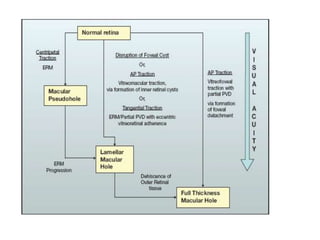
PATHOGENESIS
• Lister (1924) –vitreous as pathogenesis
• Gass (1988)
– Viteomacular traction theory
Focal shrinkage of foveal vitreous cortex
↓
Intraretinal foveolar cyst formation
↓
Unroofing of the cyst
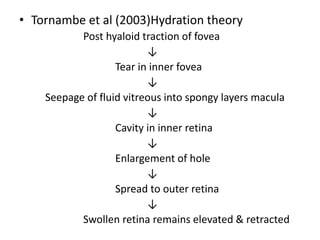
• Tornambe et al (2003)Hydration theory
Post hyaloid traction of fovea
↓
Tear in inner fovea
↓
Seepage of fluid vitreous into spongy layers macula
↓
Cavity in inner retina
↓
Enlargement of hole
↓
Spread to outer retina
↓
Swollen retina remains elevated & retracted
• Retinal / choroidal ischaemia theory
– RPE dysfunction & possible intraretinal fluid
accumulation in the fovea
• Involutional retinal thinning
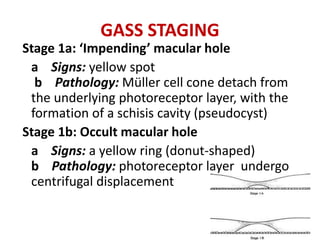
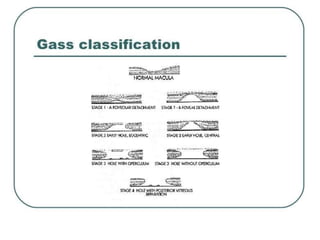
GASS STAGING
Stage 1a: ‘Impending’ macular hole
a Signs: yellow spot
b Pathology: Müller cell cone detach from
the underlying photoreceptor layer, with the
formation of a schisis cavity (pseudocyst)
Stage 1b: Occult macular hole
a Signs: a yellow ring (donut-shaped)
b Pathology: photoreceptor layer undergo
centrifugal displacement
Stage 2: Small full-thickness hole
a Signs: < 400 µm , central, slightly eccentric
or crescent-shaped.
b Pathology: dehiscence seen in the roof
of the schitic cavity, pseudo-operculum
Stage 3: Full-size macular hole
a Signs:
- > 400 µm
- red base with yellow-white dots
- surrounding grey cuff of subretinal fluid
b Pathology: avulsion of the roof of the cyst
with an operculum and persistent parafoveal
attachment of the vitreous cortex.
Stage 4: Full-size macular hole with complete
PVD
a Signs: as above
b Pathology:PVD is complete (Weiss ring)
CLINICAL FEATURES
• VA
– Depends according to the size, location, and the
stage of the macular hole
– Stage I – metamorphosia ,6/9 to 6/12
– Stage II – small & eccentric 6/9 to 6/12 or central
– Stage III & IV – 6/24 to 2/60
DIAGNOSTIC TECHNIQUES
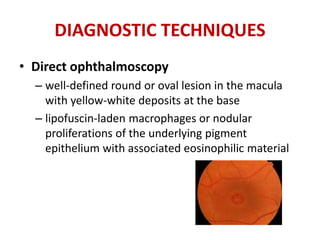
• Direct ophthalmoscopy
– well-defined round or oval lesion in the macula
with yellow-white deposits at the base
– lipofuscin-laden macrophages or nodular
proliferations of the underlying pigment
epithelium with associated eosinophilic material
• Biomicroscopic (slit lamp) examination
– A round excavation with well-defined borders interrupting
the beam of the slit lamp can be observed.
– An overlying semitranslucent tissue (pseudo-operculum)
– surrrounding cuff of subretinal fluid
– Cystic changes of the retina at the margins of the hole
– Fine crinkling of the inner retinal surface (ERM)
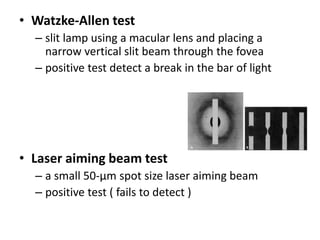
• Watzke-Allen test
– slit lamp using a macular lens and placing a
narrow vertical slit beam through the fovea
– positive test detect a break in the bar of light
• Laser aiming beam test
– a small 50-µm spot size laser aiming beam
– positive test ( fails to detect )
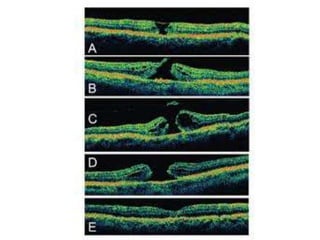
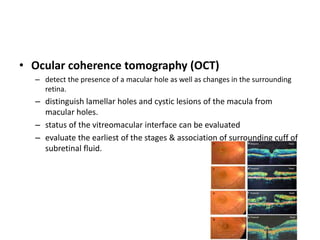
• Ocular coherence tomography (OCT)
– detect the presence of a macular hole as well as changes in the surrounding
retina.
– distinguish lamellar holes and cystic lesions of the macula from
macular holes.
– status of the vitreomacular interface can be evaluated
– evaluate the earliest of the stages & association of surrounding cuff of
subretinal fluid.
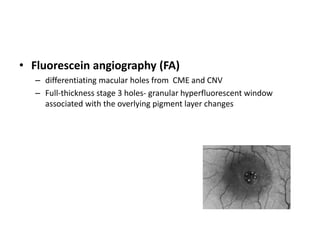
• Fluorescein angiography (FA)
– differentiating macular holes from CME and CNV
– Full-thickness stage 3 holes- granular hyperfluorescent window
associated with the overlying pigment layer changes
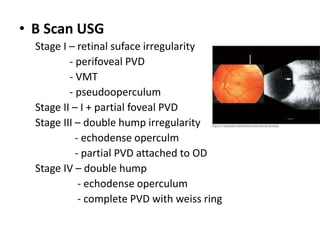
• B Scan USG
Stage I – retinal suface irregularity
- perifoveal PVD
- VMT
- pseudooperculum
Stage II – I + partial foveal PVD
Stage III – double hump irregularity
- echodense operculm
- partial PVD attached to OD
Stage IV – double hump
- echodense operculum
- complete PVD with weiss ring
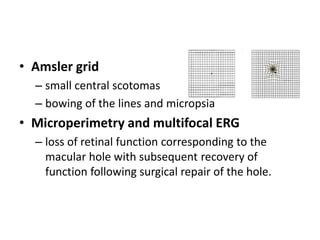
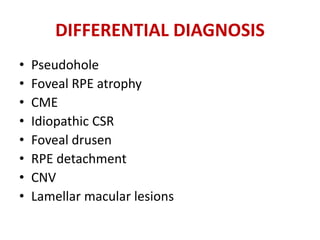
• Amsler grid
– small central scotomas
– bowing of the lines and micropsia
• Microperimetry and multifocal ERG
– loss of retinal function corresponding to the
macular hole with subsequent recovery of
function following surgical repair of the hole.
DIFFERENTIAL DIAGNOSIS
• Pseudohole
• Foveal RPE atrophy
• CME
• Idiopathic CSR
• Foveal drusen
• RPE detachment
• CNV
• Lamellar macular lesions
MANAGEMENT
• NO MEDICAL t/t
• Autologous plasmin
– Idiopathic and traumatic macular holes
– Intravitreal injection of plasmin
– October 2012, ocriplasmin (Jetrea) was approved by
the USFDA for the treatment of vitreomacular
adhesion
– Recombinant proteolytic enzyme
– MIVI-TRUST study group
– Activity against fibronectin and laminin
– Randomized, double-blind study, 652 eyes with
vitreomacular adhesion were treated with an
intravitreal injection of ocriplasmin
– 40.6% of treated eyes compared to 10.6% in the
placebo group ]
SURGICAL CARE
• Indications
– stage 2 or higher full-thickness macular hole
– Stage 1 holes and lamellar holes are managed
conservatively
• Contraindications
– Coexisting choroidal rupture
– Traumatic RPE rupture
– Chronic cystoid macular edema
– Optic nerve disorders
• Gonver & Machemer (1982)- 1st
recommended surg. Procedure
• Kelly & Wendel (1991)
– 1st demonstrated
– 58% ASR & 42% VI of 2 lines
– Mechanism is relief of traction, stimulation of
fibroglial proliferation
• Time of surgery
– Best <1yr
– Chronic holes (1-5yrs) esp if fellow eye has
progressive macular / ON pathology
PROCEDURE
1. PPV / Delamination of cortical vitreous
– standard 3-port (ie, 25 gauge, 23 gauge, 20 gauge)
– Anterior and middle vitreous is removed
– Relieved either by removing perimacular vitreous
/ combining it with complete PVD
– Soft tipped silicon cannula / vitrectomy cutter
– Fish –strike sign / bending of silicon cannula
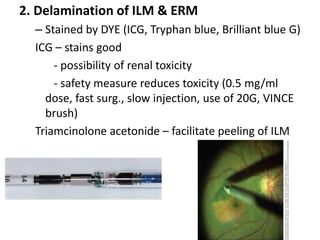
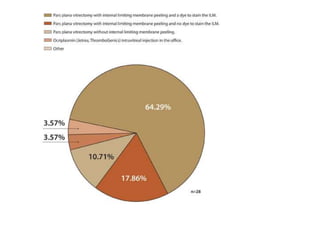
2. Delamination of ILM & ERM
– Stained by DYE (ICG, Tryphan blue, Brilliant blue G)
ICG – stains good
- possibility of renal toxicity
- safety measure reduces toxicity (0.5 mg/ml
dose, fast surg., slow injection, use of 20G, VINCE
brush)
Triamcinolone acetonide – facilitate peeling of ILM
3. Adjuvant
– Bovine TGF-b, recombinant TGFb, autologous
serum, plasmin
– “chemovitrectomy”
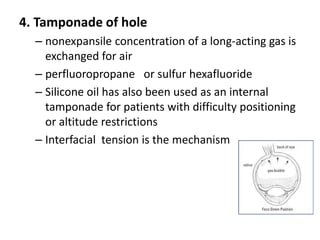
4. Tamponade of hole
– nonexpansile concentration of a long-acting gas is
exchanged for air
– perfluoropropane or sulfur hexafluoride
– Silicone oil has also been used as an internal
tamponade for patients with difficulty positioning
or altitude restrictions
– Interfacial tension is the mechanism
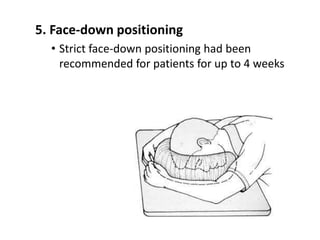
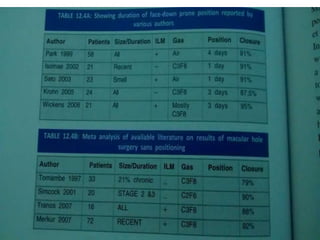
5. Face-down positioning
• Strict face-down positioning had been
recommended for patients for up to 4 weeks
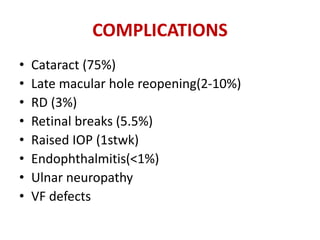
COMPLICATIONS
• Cataract (75%)
• Late macular hole reopening(2-10%)
• RD (3%)
• Retinal breaks (5.5%)
• Raised IOP (1stwk)
• Endophthalmitis(<1%)
• Ulnar neuropathy
• VF defects
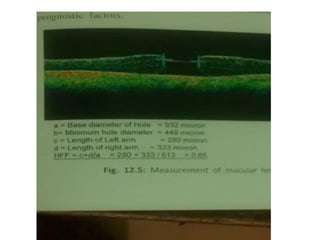
PROGNOSIS
• Depends on:
– Preop VA & duration
– Preop minimum hole diameter & base diameter
– Larger size & longer duration outcome is adversly
affected
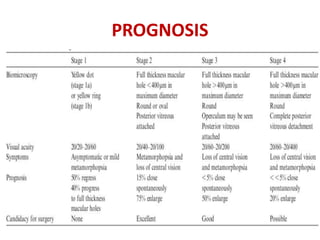
PROGNOSIS
• Visual prognosis depends on the type of
closure
– U-pattern : normal foveal contour
– V-pattern : steep foveal contour
– W-pattern : foveal defect of neurosensory retina
U>V>W
REOPERATION
• Failed primary surg.
– 1-15% cases
-↓use of adjuvents, ILM peel
• Late reopening
– 2-10% cases
– ↑axial length, pseudophakia, ERM
• Procedure –
– Rpt PPV
– PPV+ILM peel
– PPV+ILM peel + DYE
– Operate FAE with laser to RPE
– Use longer acting gas
– Stress on face down position
– Silicon oil tamponade
CURRENT T/T STATAGIES
• Almost all macular holes can achieve success
• ILM peel improves hole closure (85-95%)
• ILM peel slows visual recovery
• Use of dye staining facilitates complete peel
• Prone positioning duration decreased with ILM peel
• 1Wk gas adequate in most eyes
• Long term (5 yrs) results excellent 60% with6/12
• Morizane et al ( 10 patients with refractory macular
holes ) with autologous transplantation of ILM
• PHACOVITRECTOMY
CONCLUSION
• Significant cause of loss in central VA
• Becoming more common
• Increased surgical closure rate (58% -90%)
• Decreased complication rate
• VA & VF improve in majority of pts.
Macular hole

Macular hole

  • 1.
  • 2.
    INTRODUCTION • Defect offoveal retina involving its full thickness from the ILM to the outer segment of the photoreceptor layer • Knapp (1869) – 1st described • Oglive (1900) – 1st coined • 1970- 80% idiopathic - 10% trauma
  • 3.
    DEMOGRAPHIC • Prev.-worldwide 3.3/ 1000 (>55 yrs) - India 1.7 / 1000 (>67 yrs) • F>M • Fellow eye (12%) • Risk – CVD, HTN, H/O Hysterectomy
  • 4.
    ETIOLOGY • Idiopathic • Vitreoussynersis • Post. Vitreous separation • CME • Trauma – contusion injury (6% ), accidental laser injury , lightening • Progressive high myopia (foveal schisis) – foveal schisis and/or lamellar holes (31%) • Preceding rhegmatogenous retinal detachment - successfully repaired rhegmatogenous retinal detachment (<1%)
  • 5.
    PATHOGENESIS • Lister (1924)–vitreous as pathogenesis • Gass (1988) – Viteomacular traction theory Focal shrinkage of foveal vitreous cortex ↓ Intraretinal foveolar cyst formation ↓ Unroofing of the cyst
  • 6.
    • Tornambe etal (2003)Hydration theory Post hyaloid traction of fovea ↓ Tear in inner fovea ↓ Seepage of fluid vitreous into spongy layers macula ↓ Cavity in inner retina ↓ Enlargement of hole ↓ Spread to outer retina ↓ Swollen retina remains elevated & retracted
  • 7.
    • Retinal /choroidal ischaemia theory – RPE dysfunction & possible intraretinal fluid accumulation in the fovea • Involutional retinal thinning
  • 9.
    GASS STAGING Stage 1a:‘Impending’ macular hole a Signs: yellow spot b Pathology: Müller cell cone detach from the underlying photoreceptor layer, with the formation of a schisis cavity (pseudocyst) Stage 1b: Occult macular hole a Signs: a yellow ring (donut-shaped) b Pathology: photoreceptor layer undergo centrifugal displacement
  • 10.
    Stage 2: Smallfull-thickness hole a Signs: < 400 µm , central, slightly eccentric or crescent-shaped. b Pathology: dehiscence seen in the roof of the schitic cavity, pseudo-operculum
  • 11.
    Stage 3: Full-sizemacular hole a Signs: - > 400 µm - red base with yellow-white dots - surrounding grey cuff of subretinal fluid b Pathology: avulsion of the roof of the cyst with an operculum and persistent parafoveal attachment of the vitreous cortex.
  • 12.
    Stage 4: Full-sizemacular hole with complete PVD a Signs: as above b Pathology:PVD is complete (Weiss ring)
  • 15.
    CLINICAL FEATURES • VA –Depends according to the size, location, and the stage of the macular hole – Stage I – metamorphosia ,6/9 to 6/12 – Stage II – small & eccentric 6/9 to 6/12 or central – Stage III & IV – 6/24 to 2/60
  • 16.
    DIAGNOSTIC TECHNIQUES • Directophthalmoscopy – well-defined round or oval lesion in the macula with yellow-white deposits at the base – lipofuscin-laden macrophages or nodular proliferations of the underlying pigment epithelium with associated eosinophilic material
  • 17.
    • Biomicroscopic (slitlamp) examination – A round excavation with well-defined borders interrupting the beam of the slit lamp can be observed. – An overlying semitranslucent tissue (pseudo-operculum) – surrrounding cuff of subretinal fluid – Cystic changes of the retina at the margins of the hole – Fine crinkling of the inner retinal surface (ERM)
  • 18.
    • Watzke-Allen test –slit lamp using a macular lens and placing a narrow vertical slit beam through the fovea – positive test detect a break in the bar of light • Laser aiming beam test – a small 50-µm spot size laser aiming beam – positive test ( fails to detect )
  • 19.
    • Ocular coherencetomography (OCT) – detect the presence of a macular hole as well as changes in the surrounding retina. – distinguish lamellar holes and cystic lesions of the macula from macular holes. – status of the vitreomacular interface can be evaluated – evaluate the earliest of the stages & association of surrounding cuff of subretinal fluid.
  • 20.
    • Fluorescein angiography(FA) – differentiating macular holes from CME and CNV – Full-thickness stage 3 holes- granular hyperfluorescent window associated with the overlying pigment layer changes
  • 21.
    • B ScanUSG Stage I – retinal suface irregularity - perifoveal PVD - VMT - pseudooperculum Stage II – I + partial foveal PVD Stage III – double hump irregularity - echodense operculm - partial PVD attached to OD Stage IV – double hump - echodense operculum - complete PVD with weiss ring
  • 22.
    • Amsler grid –small central scotomas – bowing of the lines and micropsia • Microperimetry and multifocal ERG – loss of retinal function corresponding to the macular hole with subsequent recovery of function following surgical repair of the hole.
  • 23.
    DIFFERENTIAL DIAGNOSIS • Pseudohole •Foveal RPE atrophy • CME • Idiopathic CSR • Foveal drusen • RPE detachment • CNV • Lamellar macular lesions
  • 24.
    MANAGEMENT • NO MEDICALt/t • Autologous plasmin – Idiopathic and traumatic macular holes – Intravitreal injection of plasmin – October 2012, ocriplasmin (Jetrea) was approved by the USFDA for the treatment of vitreomacular adhesion – Recombinant proteolytic enzyme – MIVI-TRUST study group – Activity against fibronectin and laminin – Randomized, double-blind study, 652 eyes with vitreomacular adhesion were treated with an intravitreal injection of ocriplasmin – 40.6% of treated eyes compared to 10.6% in the placebo group ]
  • 25.
    SURGICAL CARE • Indications –stage 2 or higher full-thickness macular hole – Stage 1 holes and lamellar holes are managed conservatively • Contraindications – Coexisting choroidal rupture – Traumatic RPE rupture – Chronic cystoid macular edema – Optic nerve disorders
  • 26.
    • Gonver &Machemer (1982)- 1st recommended surg. Procedure • Kelly & Wendel (1991) – 1st demonstrated – 58% ASR & 42% VI of 2 lines – Mechanism is relief of traction, stimulation of fibroglial proliferation • Time of surgery – Best <1yr – Chronic holes (1-5yrs) esp if fellow eye has progressive macular / ON pathology
  • 27.
    PROCEDURE 1. PPV /Delamination of cortical vitreous – standard 3-port (ie, 25 gauge, 23 gauge, 20 gauge) – Anterior and middle vitreous is removed – Relieved either by removing perimacular vitreous / combining it with complete PVD – Soft tipped silicon cannula / vitrectomy cutter – Fish –strike sign / bending of silicon cannula
  • 28.
    2. Delamination ofILM & ERM – Stained by DYE (ICG, Tryphan blue, Brilliant blue G) ICG – stains good - possibility of renal toxicity - safety measure reduces toxicity (0.5 mg/ml dose, fast surg., slow injection, use of 20G, VINCE brush) Triamcinolone acetonide – facilitate peeling of ILM
  • 30.
    3. Adjuvant – BovineTGF-b, recombinant TGFb, autologous serum, plasmin – “chemovitrectomy”
  • 31.
    4. Tamponade ofhole – nonexpansile concentration of a long-acting gas is exchanged for air – perfluoropropane or sulfur hexafluoride – Silicone oil has also been used as an internal tamponade for patients with difficulty positioning or altitude restrictions – Interfacial tension is the mechanism
  • 32.
    5. Face-down positioning •Strict face-down positioning had been recommended for patients for up to 4 weeks
  • 34.
    COMPLICATIONS • Cataract (75%) •Late macular hole reopening(2-10%) • RD (3%) • Retinal breaks (5.5%) • Raised IOP (1stwk) • Endophthalmitis(<1%) • Ulnar neuropathy • VF defects
  • 35.
    PROGNOSIS • Depends on: –Preop VA & duration – Preop minimum hole diameter & base diameter – Larger size & longer duration outcome is adversly affected
  • 37.
  • 38.
    • Visual prognosisdepends on the type of closure – U-pattern : normal foveal contour – V-pattern : steep foveal contour – W-pattern : foveal defect of neurosensory retina U>V>W
  • 39.
    REOPERATION • Failed primarysurg. – 1-15% cases -↓use of adjuvents, ILM peel • Late reopening – 2-10% cases – ↑axial length, pseudophakia, ERM • Procedure – – Rpt PPV – PPV+ILM peel – PPV+ILM peel + DYE – Operate FAE with laser to RPE – Use longer acting gas – Stress on face down position – Silicon oil tamponade
  • 40.
    CURRENT T/T STATAGIES •Almost all macular holes can achieve success • ILM peel improves hole closure (85-95%) • ILM peel slows visual recovery • Use of dye staining facilitates complete peel • Prone positioning duration decreased with ILM peel • 1Wk gas adequate in most eyes • Long term (5 yrs) results excellent 60% with6/12 • Morizane et al ( 10 patients with refractory macular holes ) with autologous transplantation of ILM • PHACOVITRECTOMY
  • 41.
    CONCLUSION • Significant causeof loss in central VA • Becoming more common • Increased surgical closure rate (58% -90%) • Decreased complication rate • VA & VF improve in majority of pts.