PRESENTATION ON
IRIS SCANNER
TECHNOLOGY
BY
SHAMS
CONTENT
 Introduction
 What the IRIS?
 Why IRIS?
 History of IRIS Recognition
 Applications
 Methods of IRIS recognition system
IRIS pattern - Comparison
 Advantages
 Disadvantages
 Conclusion
 References
IRIS SCANNER TECHNOLOGY
IRIS Recognition is Fast Developing to be a Fool Proof
And Fast Identification Technique. It is a classic
Biometrics Application that is in an Advanced stage of
Research all Over the world.
INTRODUCTION
IRIS SCANNER TECHNOLOGY
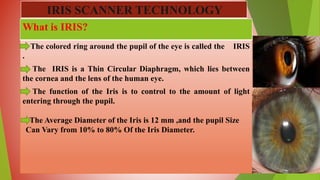
The colored ring around the pupil of the eye is called the IRIS
.
The IRIS is a Thin Circular Diaphragm, which lies between
the cornea and the lens of the human eye.
The function of the Iris is to control to the amount of light
entering through the pupil.
The Average Diameter of the Iris is 12 mm ,and the pupil Size
Can Vary from 10% to 80% Of the Iris Diameter.
What is IRIS?
IRIS SCANNER TECHNOLOGY
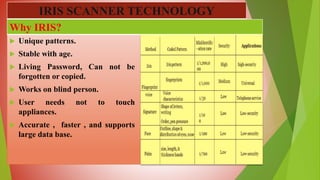
 Unique patterns.
 Stable with age.
 Living Password, Can not be
forgotten or copied.
 Works on blind person.
 User needs not to touch
appliances.
 Accurate , faster , and supports
large data base.
Why IRIS?
IRIS SCANNER TECHNOLOGY
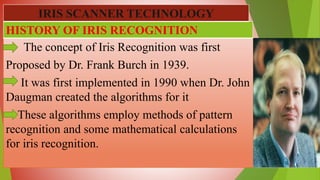
The concept of Iris Recognition was first
Proposed by Dr. Frank Burch in 1939.
It was first implemented in 1990 when Dr. John
Daugman created the algorithms for it
These algorithms employ methods of pattern
recognition and some mathematical calculations
for iris recognition.
HISTORY OF IRIS RECOGNITION
IRIS SCANNER TECHNOLOGY
Step 1: Capturing the image of the eye using a camera.
Step 2: Differentiating the outline of the iris and the sclera, and the pupil from the
iris.
sclera
iris
pupil
Step 3: Encoding the image using demodulation (also removes reflections, intrusion
of eye lid lashes, contact lens outline etc.,). Code is 256 bytes.
Technique:
IRIS SCANNER TECHNOLOGY
 ATMs
 Computer login: The iris as a living password.
 National Border Controls
 Driving licenses and other personal certificates.
 benefits authentication.
 birth certificates, tracking missing.
 Credit-card authentication.
 Anti-terrorism (e.g.:— suspect Screening at airports)
 Secure financial transaction (e-commerce, banking).
 Internet security, control of access to privileged
information.
APPLICATION
IRIS SCANNER TECHNOLOGY
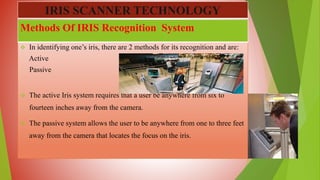
 In identifying one’s iris, there are 2 methods for its recognition and are:
Active
Passive
 The active Iris system requires that a user be anywhere from six to
fourteen inches away from the camera.
 The passive system allows the user to be anywhere from one to three feet
away from the camera that locates the focus on the iris.
Methods Of IRIS Recognition System
IRIS SCANNER TECHNOLOGY
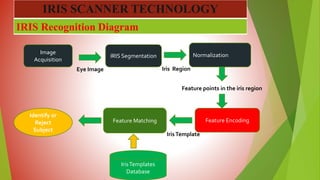
IRIS Recognition Diagram
Image
Acquisition
IRIS Segmentation Normalization
Feature EncodingFeature Matching
Identify or
Reject
Subject
IrisTemplates
Database
Eye Image Iris Region
Feature points in the iris region
IrisTemplate
IRIS SCANNER TECHNOLOGY
Test of Statistical Independence
Compare the iris codes (256*8=2048 bits) of the eyes using the
following formula.
[Code A (XOR) Code B] AND Mask AAND Mask B
H.D= ---------------------------------------------------------------------------------------------------------------------
Mask AAND Mask B
This is called Hamming Distance (H.D).
Iris pattern - Comparison
IRIS SCANNER TECHNOLOGY
 Highly protected, internal organ of the eye
 Externally visible, patterns imaged from a distance
 Iris patterns possess a high degree of randomness
 Patterns apparently stable throughout life
 Encoding and decision-making are tractable
Advantages
IRIS SCANNER TECHNOLOGY
 Small target to acquire from a distance
 Moving target…within another…on yet another
 Located behind a curved, wet, reflecting surface
 Obscured by eyelashes, lenses, reflections
 Illumination should not be visible or bright
Disadvantages of the Iris for Identification
IRIS SCANNER TECHNOLOGY
 Highly accurate but easy
 Fast
 Needs some developments
 Experiments are going on
 Will become day to day technology very soon
conclusion
IRIS SCANNER TECHNOLOGY
www.google.com
www.Wikipedia.com
http://www.cl.cam.ac.uk
References
IRIS SCANNER TECHNOLOGY
Iris scanner technology

Iris scanner technology

  • 1.
  • 2.
    CONTENT  Introduction  Whatthe IRIS?  Why IRIS?  History of IRIS Recognition  Applications  Methods of IRIS recognition system IRIS pattern - Comparison  Advantages  Disadvantages  Conclusion  References IRIS SCANNER TECHNOLOGY
  • 3.
    IRIS Recognition isFast Developing to be a Fool Proof And Fast Identification Technique. It is a classic Biometrics Application that is in an Advanced stage of Research all Over the world. INTRODUCTION IRIS SCANNER TECHNOLOGY
  • 4.
    The colored ringaround the pupil of the eye is called the IRIS . The IRIS is a Thin Circular Diaphragm, which lies between the cornea and the lens of the human eye. The function of the Iris is to control to the amount of light entering through the pupil. The Average Diameter of the Iris is 12 mm ,and the pupil Size Can Vary from 10% to 80% Of the Iris Diameter. What is IRIS? IRIS SCANNER TECHNOLOGY
  • 5.
     Unique patterns. Stable with age.  Living Password, Can not be forgotten or copied.  Works on blind person.  User needs not to touch appliances.  Accurate , faster , and supports large data base. Why IRIS? IRIS SCANNER TECHNOLOGY
  • 6.
    The concept ofIris Recognition was first Proposed by Dr. Frank Burch in 1939. It was first implemented in 1990 when Dr. John Daugman created the algorithms for it These algorithms employ methods of pattern recognition and some mathematical calculations for iris recognition. HISTORY OF IRIS RECOGNITION IRIS SCANNER TECHNOLOGY
  • 7.
    Step 1: Capturingthe image of the eye using a camera. Step 2: Differentiating the outline of the iris and the sclera, and the pupil from the iris. sclera iris pupil Step 3: Encoding the image using demodulation (also removes reflections, intrusion of eye lid lashes, contact lens outline etc.,). Code is 256 bytes. Technique: IRIS SCANNER TECHNOLOGY
  • 8.
     ATMs  Computerlogin: The iris as a living password.  National Border Controls  Driving licenses and other personal certificates.  benefits authentication.  birth certificates, tracking missing.  Credit-card authentication.  Anti-terrorism (e.g.:— suspect Screening at airports)  Secure financial transaction (e-commerce, banking).  Internet security, control of access to privileged information. APPLICATION IRIS SCANNER TECHNOLOGY
  • 9.
     In identifyingone’s iris, there are 2 methods for its recognition and are: Active Passive  The active Iris system requires that a user be anywhere from six to fourteen inches away from the camera.  The passive system allows the user to be anywhere from one to three feet away from the camera that locates the focus on the iris. Methods Of IRIS Recognition System IRIS SCANNER TECHNOLOGY
  • 10.
    IRIS Recognition Diagram Image Acquisition IRISSegmentation Normalization Feature EncodingFeature Matching Identify or Reject Subject IrisTemplates Database Eye Image Iris Region Feature points in the iris region IrisTemplate IRIS SCANNER TECHNOLOGY
  • 11.
    Test of StatisticalIndependence Compare the iris codes (256*8=2048 bits) of the eyes using the following formula. [Code A (XOR) Code B] AND Mask AAND Mask B H.D= --------------------------------------------------------------------------------------------------------------------- Mask AAND Mask B This is called Hamming Distance (H.D). Iris pattern - Comparison IRIS SCANNER TECHNOLOGY
  • 12.
     Highly protected,internal organ of the eye  Externally visible, patterns imaged from a distance  Iris patterns possess a high degree of randomness  Patterns apparently stable throughout life  Encoding and decision-making are tractable Advantages IRIS SCANNER TECHNOLOGY
  • 13.
     Small targetto acquire from a distance  Moving target…within another…on yet another  Located behind a curved, wet, reflecting surface  Obscured by eyelashes, lenses, reflections  Illumination should not be visible or bright Disadvantages of the Iris for Identification IRIS SCANNER TECHNOLOGY
  • 14.
     Highly accuratebut easy  Fast  Needs some developments  Experiments are going on  Will become day to day technology very soon conclusion IRIS SCANNER TECHNOLOGY
  • 15.