
NON-PENETRATING
GLAUCOMA SURGERY
Mohamed ELShafie
Assistant lecturer of ophthalmology
Kafr ELShiekh university
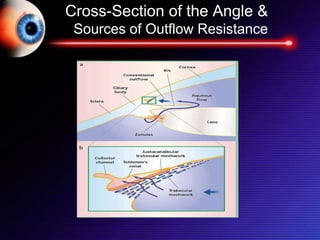
Cross-Section of the Angle &
Sources of Outflow Resistance
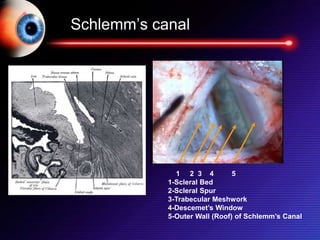
Schlemm’s canal
1 2 3 4 5
1-Scleral Bed
2-Scleral Spur
3-Trabecular Meshwork
4-Descemet’s Window
5-Outer Wall (Roof) of Schlemm’s Canal
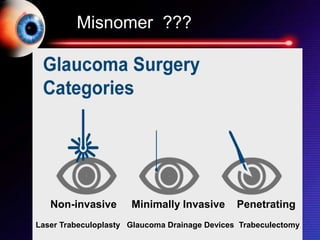
Non-invasive Minimally Invasive Penetrating
Laser Trabeculoplasty Glaucoma Drainage Devices Trabeculectomy
Misnomer ???
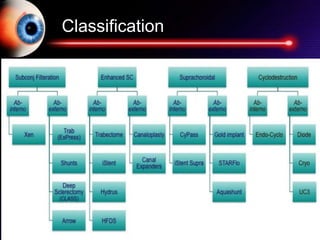
Classification
NON-PENETRATING GLAUCOMA SURGERY
• Facilitate the passage of aqueous humor through the
trabeculum and Schlemm's canal bypassing the the juxta-
canalicular meshwork which is the site of highest resistance
to aqueous outflow without opening the anterior
chamber and decompressing the eye.
1.All open-angle glaucomas (especially if):
Early surgical intervention required.
Monocular patient.
Large diurnal fluctuations .
2.High risk of choroidal effusions or hemorrhages.
3.High risk of postoperative hypotony.
4.Uveitic glaucoma without extensive PAS.
Indications
1.Trabecular meshwork obstructed:
Extensive synicheal angle closure
Neovascular glaucoma.
Occludable angle.
2.Altered anatomy:
Thin sclera.
Significant limbal scarring.
3. Post laser trabeculoplasty.
4.Angle recession glaucoma.
Contraindications:
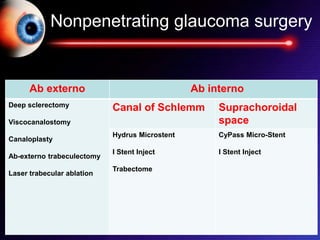
Ab externo Ab interno
Deep sclerectomy
Viscocanalostomy
Canaloplasty
Ab-externo trabeculectomy
Laser trabecular ablation
Canal of Schlemm Suprachoroidal
space
Hydrus Microstent
I Stent Inject
Trabectome
CyPass Micro-Stent
I Stent Inject
Nonpenetrating glaucoma surgery
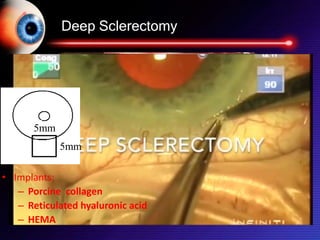
Deep Sclerectomy
5mm
5mm
• Implants:
– Porcine collagen
– Reticulated hyaluronic acid
– HEMA
1. Conversion to trabeculectomy because of penetration
through trabecular meshwork.
2. Scleral ectasia.
3. Hypotony.
4. Hyphema.
5. Serous choroidal detachment.
6. Vitreous hemorrhage.
7. Late anterior chamber bleeding during gonioscopy.
8. manually dissecting deep corneo-scleral lamellae: perforation
into anterior chamber or insufficient tissue removal
Complications
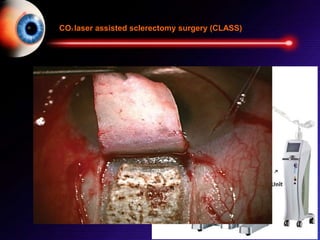
CO2 laser assisted sclerectomy surgery (CLASS)
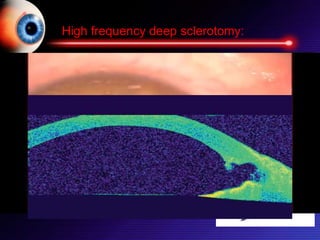
High frequency deep sclerotomy:
High-Frequency Diathermic Probe
-Tip penetrates up to 1mm into
sclera through trabecular meshwork
and Schlemm canal
- Forms deep sclerotomy (0.3 mm high
and 0.6 mm width)
Procedure repeated 6 times
within one quadrant
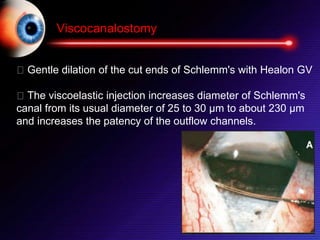
Viscocanalostomy
Gentle dilation of the cut ends of Schlemm's with Healon GV
The viscoelastic injection increases diameter of Schlemm's
canal from its usual diameter of 25 to 30 µm to about 230 µm
and increases the patency of the outflow channels.
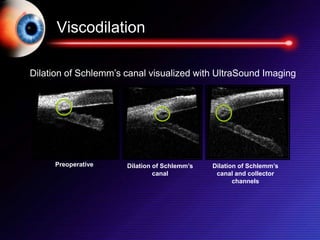
Viscodilation
Preoperative Dilation of Schlemm’s
canal
Dilation of Schlemm’s
canal and collector
channels
Dilation of Schlemm’s canal visualized with UltraSound Imaging
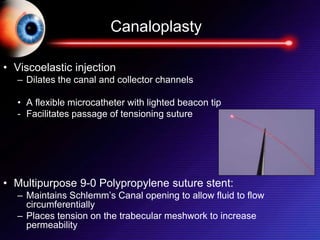
Canaloplasty
• Viscoelastic injection
– Dilates the canal and collector channels
• A flexible microcatheter with lighted beacon tip
- Facilitates passage of tensioning suture
• Multipurpose 9-0 Polypropylene suture stent:
– Maintains Schlemm’s Canal opening to allow fluid to flow
circumferentially
– Places tension on the trabecular meshwork to increase
permeability
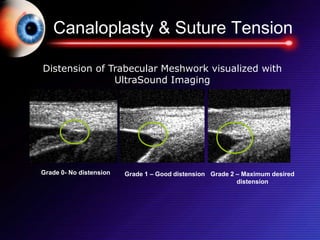
Canaloplasty & Suture Tension
Grade 0- No distension Grade 1 – Good distension Grade 2 – Maximum desired
distension
Distension of Trabecular Meshwork visualized with
UltraSound Imaging
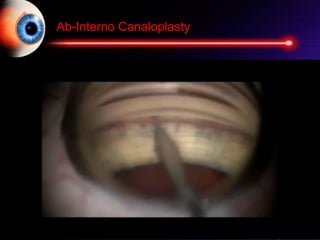
Ab-Interno Canaloplasty
Ab-externo trabeculectomy:
Removal of the diseased endothelial layer of Schlemm’s
canal and the Juxtacanalicular Trabecular Meshwork using
a diamond microdrill.
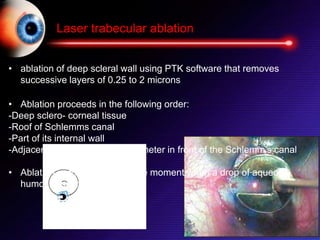
Laser trabecular ablation
• ablation of deep scleral wall using PTK software that removes
successive layers of 0.25 to 2 microns
• Ablation proceeds in the following order:
-Deep sclero- corneal tissue
-Roof of Schlemms canal
-Part of its internal wall
-Adjacent corneal stroma 1 millimeter in front of the Schlemm’s canal
• Ablation is continued up to the moment when a drop of aqueous
humor appears
Thank You
Mohamed ELShafie

Nonpenetrating glaucoma surgery

  • 1.
    NON-PENETRATING GLAUCOMA SURGERY Mohamed ELShafie Assistantlecturer of ophthalmology Kafr ELShiekh university
  • 2.
    Cross-Section of theAngle & Sources of Outflow Resistance
  • 3.
    Schlemm’s canal 1 23 4 5 1-Scleral Bed 2-Scleral Spur 3-Trabecular Meshwork 4-Descemet’s Window 5-Outer Wall (Roof) of Schlemm’s Canal
  • 4.
    Non-invasive Minimally InvasivePenetrating Laser Trabeculoplasty Glaucoma Drainage Devices Trabeculectomy Misnomer ???
  • 5.
  • 6.
    NON-PENETRATING GLAUCOMA SURGERY •Facilitate the passage of aqueous humor through the trabeculum and Schlemm's canal bypassing the the juxta- canalicular meshwork which is the site of highest resistance to aqueous outflow without opening the anterior chamber and decompressing the eye.
  • 7.
    1.All open-angle glaucomas(especially if): Early surgical intervention required. Monocular patient. Large diurnal fluctuations . 2.High risk of choroidal effusions or hemorrhages. 3.High risk of postoperative hypotony. 4.Uveitic glaucoma without extensive PAS. Indications
  • 8.
    1.Trabecular meshwork obstructed: Extensivesynicheal angle closure Neovascular glaucoma. Occludable angle. 2.Altered anatomy: Thin sclera. Significant limbal scarring. 3. Post laser trabeculoplasty. 4.Angle recession glaucoma. Contraindications:
  • 9.
    Ab externo Abinterno Deep sclerectomy Viscocanalostomy Canaloplasty Ab-externo trabeculectomy Laser trabecular ablation Canal of Schlemm Suprachoroidal space Hydrus Microstent I Stent Inject Trabectome CyPass Micro-Stent I Stent Inject Nonpenetrating glaucoma surgery
  • 10.
    Deep Sclerectomy 5mm 5mm • Implants: –Porcine collagen – Reticulated hyaluronic acid – HEMA
  • 11.
    1. Conversion totrabeculectomy because of penetration through trabecular meshwork. 2. Scleral ectasia. 3. Hypotony. 4. Hyphema. 5. Serous choroidal detachment. 6. Vitreous hemorrhage. 7. Late anterior chamber bleeding during gonioscopy. 8. manually dissecting deep corneo-scleral lamellae: perforation into anterior chamber or insufficient tissue removal Complications
  • 12.
    CO2 laser assistedsclerectomy surgery (CLASS)
  • 13.
    High frequency deepsclerotomy: High-Frequency Diathermic Probe -Tip penetrates up to 1mm into sclera through trabecular meshwork and Schlemm canal - Forms deep sclerotomy (0.3 mm high and 0.6 mm width) Procedure repeated 6 times within one quadrant
  • 14.
    Viscocanalostomy Gentle dilation ofthe cut ends of Schlemm's with Healon GV The viscoelastic injection increases diameter of Schlemm's canal from its usual diameter of 25 to 30 µm to about 230 µm and increases the patency of the outflow channels.
  • 15.
    Viscodilation Preoperative Dilation ofSchlemm’s canal Dilation of Schlemm’s canal and collector channels Dilation of Schlemm’s canal visualized with UltraSound Imaging
  • 16.
    Canaloplasty • Viscoelastic injection –Dilates the canal and collector channels • A flexible microcatheter with lighted beacon tip - Facilitates passage of tensioning suture • Multipurpose 9-0 Polypropylene suture stent: – Maintains Schlemm’s Canal opening to allow fluid to flow circumferentially – Places tension on the trabecular meshwork to increase permeability
  • 18.
    Canaloplasty & SutureTension Grade 0- No distension Grade 1 – Good distension Grade 2 – Maximum desired distension Distension of Trabecular Meshwork visualized with UltraSound Imaging
  • 19.
  • 20.
    Ab-externo trabeculectomy: Removal ofthe diseased endothelial layer of Schlemm’s canal and the Juxtacanalicular Trabecular Meshwork using a diamond microdrill.
  • 21.
    Laser trabecular ablation •ablation of deep scleral wall using PTK software that removes successive layers of 0.25 to 2 microns • Ablation proceeds in the following order: -Deep sclero- corneal tissue -Roof of Schlemms canal -Part of its internal wall -Adjacent corneal stroma 1 millimeter in front of the Schlemm’s canal • Ablation is continued up to the moment when a drop of aqueous humor appears
  • 22.

Editor's Notes

  • #5  Shunt Enhance Ablate
  • #13 Easy learned and simple surgical procedure to perform, safe and effective in the short and intermediate CO2 laser facilitate deep sclerectomy. coagulation of bleeding vessels, photo‑ablation of dry tissues, absorption of the laser energy by percolating aqueous humor