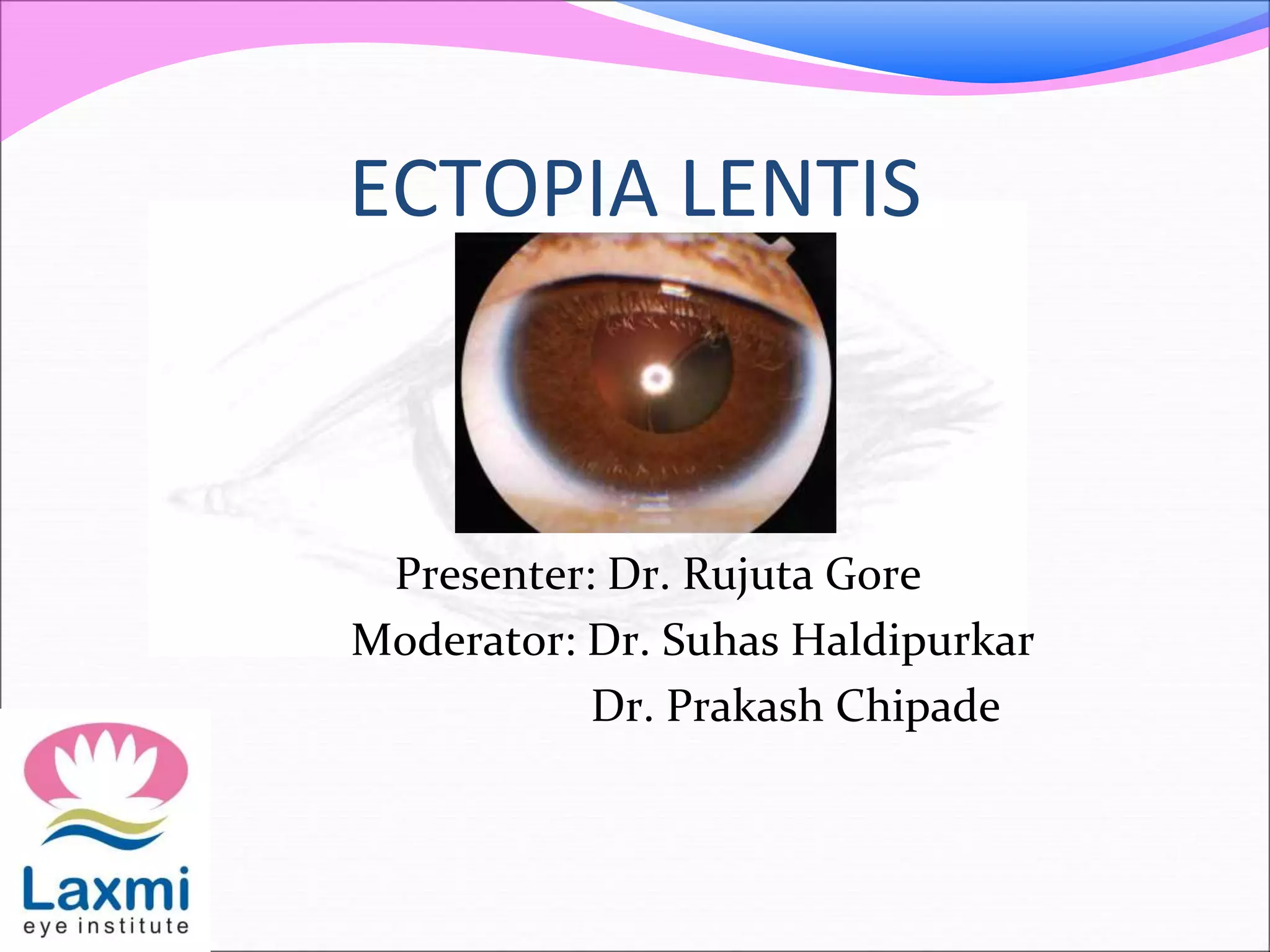
ECTOPIA LENTIS
Presenter: Dr. Rujuta Gore
Moderator: Dr. Suhas Haldipurkar
Dr. Prakash Chipade
Introduction
 Ectopia lentis is defined as displacement or malposition of
the crystalline lens of the eye
 Berryat described the first reported case of lens dislocation
in 1749, and Stellwag subsequently coined the term
“ectopia lentis” in 1856
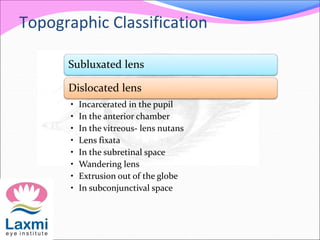
Topographic Classification
Subluxated lens
Dislocated lens
• Incarcerated in the pupil
• In the anterior chamber
• In the vitreous- lens nutans
• Lens fixata
• In the subretinal space
• Wandering lens
• Extrusion out of the globe
• In subconjunctival space
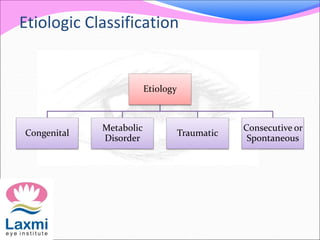
Etiologic Classification
Etiology
Congenital
Metabolic
Disorder
Traumatic
Consecutive or
Spontaneous
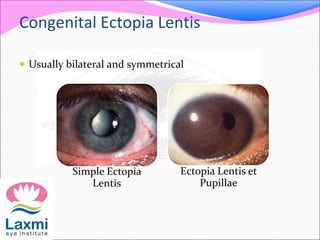
Congenital Ectopia Lentis
 Usually bilateral and symmetrical
Simple Ectopia
Lentis
Ectopia Lentis et
Pupillae
Congenital Ectopia Lentis
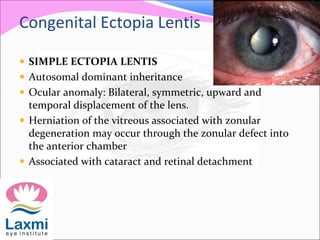
 SIMPLE ECTOPIA LENTIS
 Autosomal dominant inheritance
 Ocular anomaly: Bilateral, symmetric, upward and
temporal displacement of the lens.
 Herniation of the vitreous associated with zonular
degeneration may occur through the zonular defect into
the anterior chamber
 Associated with cataract and retinal detachment
Congenital Ectopia Lentis
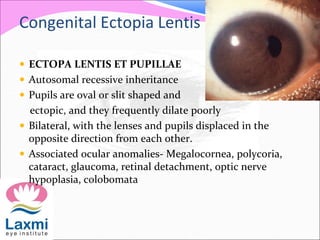
 ECTOPA LENTIS ET PUPILLAE
 Autosomal recessive inheritance
 Pupils are oval or slit shaped and
ectopic, and they frequently dilate poorly
 Bilateral, with the lenses and pupils displaced in the
opposite direction from each other.
 Associated ocular anomalies- Megalocornea, polycoria,
cataract, glaucoma, retinal detachment, optic nerve
hypoplasia, colobomata
 Pathogenesis of ectopia lentis et pupillae:
 Mesodermal- persistent remnants of tunica vasculosa
lentis mechanically interfere with the development of
zonules
 Neuroectodermal- Maldevelopment of the pigmentary
epithelium of the iris, hypoplasia of the dilator muscle
Metabolic Disorders
 MARFAN SYNDROME
 Prevalence of approximately 5 per 100,000
 Autosomal dominant condition characterized by skeletal,
cardiovascular, and ocular anomalies.
 Several point mutations involving the fibrillin gene on
chromosomes 15 and 21 - relate to incompetent zonular
fibers
MARFAN SYNDROME
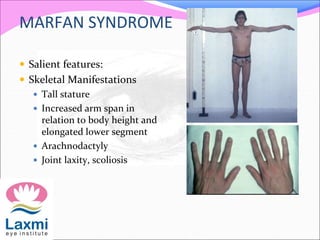
 Salient features:
 Skeletal Manifestations
 Tall stature
 Increased arm span in
relation to body height and
elongated lower segment
 Arachnodactyly
 Joint laxity, scoliosis
MARFAN SYNDROME
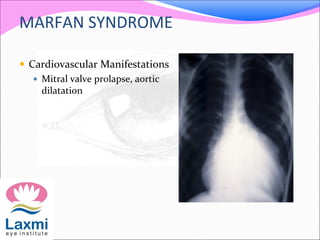
 Cardiovascular Manifestations
 Mitral valve prolapse, aortic
dilatation
MARFAN SYNDROME
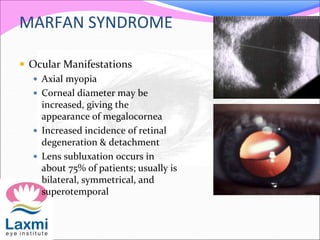
 Ocular Manifestations
 Axial myopia
 Corneal diameter may be
increased, giving the
appearance of megalocornea
 Increased incidence of retinal
degeneration & detachment
 Lens subluxation occurs in
about 75% of patients; usually is
bilateral, symmetrical, and
superotemporal
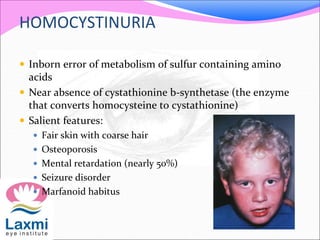
HOMOCYSTINURIA
 Inborn error of metabolism of sulfur containing amino
acids
 Near absence of cystathionine b-synthetase (the enzyme
that converts homocysteine to cystathionine)
 Salient features:
 Fair skin with coarse hair
 Osteoporosis
 Mental retardation (nearly 50%)
 Seizure disorder
 Marfanoid habitus
HOMOCYSTINURIA
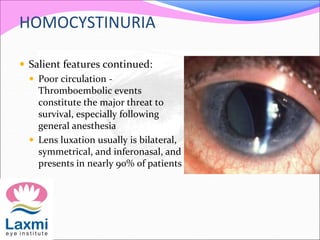
 Salient features continued:
 Poor circulation -
Thromboembolic events
constitute the major threat to
survival, especially following
general anesthesia
 Lens luxation usually is bilateral,
symmetrical, and inferonasal, and
presents in nearly 90% of patients
WEIL-MARCHESANI SYNDROME
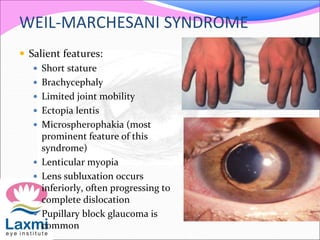
 Salient features:
 Short stature
 Brachycephaly
 Limited joint mobility
 Ectopia lentis
 Microspherophakia (most
prominent feature of this
syndrome)
 Lenticular myopia
 Lens subluxation occurs
inferiorly, often progressing to
complete dislocation
 Pupillary block glaucoma is
common
SULFITE OXIDASE DEFICIENCY
 Defect in sulfur metabolism
 Salient features:
 Progressive CNS abnormalities that develop within the first
year of life
 Ectopia lentis.
HYPERLYSINEMIA
 Autosomal recessive enzymatic defect of amino acid
metabolism
 Characterized by mental retardation and lens dislocation.
Rare Systemic Associations
 Ehlers-Danlos syndrome
 Crouzon disease
 Refsum syndrome
 Kniest syndrome
 Mandibulofacial dysostosis
 Sturge-Weber syndrome
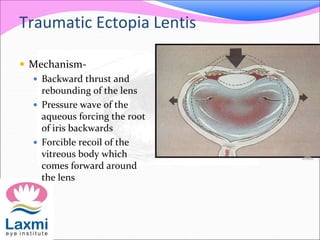
Traumatic Ectopia Lentis
 Mechanism-
 Backward thrust and
rebounding of the lens
 Pressure wave of the
aqueous forcing the root
of iris backwards
 Forcible recoil of the
vitreous body which
comes forward around
the lens
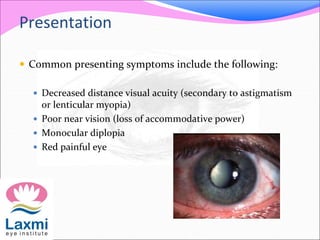
Consecutive/Spontaneous
Ectopia Lentis
 Mechanical stretching
 Buphthalmos
 High myopia
 Staphyloma
 Intraocular Tumors
 Inflammatory
 Destruction of zonules
 Hypermature cataract
 Cyclitic adhesions
 Vitreous traction bands
Presentation
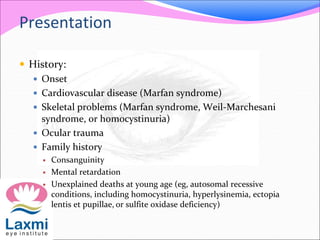
 Common presenting symptoms include the following:
 Decreased distance visual acuity (secondary to astigmatism
or lenticular myopia)
 Poor near vision (loss of accommodative power)
 Monocular diplopia
 Red painful eye
Presentation
 History:
 Onset
 Cardiovascular disease (Marfan syndrome)
 Skeletal problems (Marfan syndrome, Weil-Marchesani
syndrome, or homocystinuria)
 Ocular trauma
 Family history
 Consanguinity
 Mental retardation
 Unexplained deaths at young age (eg, autosomal recessive
conditions, including homocystinuria, hyperlysinemia, ectopia
lentis et pupillae, or sulfite oxidase deficiency)
Ocular Examination
 Visual Acuity
 Ectopia lentis is potentially visually debilitating.
 Visual acuity varies with the degree of malpositioning of
the lens.
 Amblyopia is a common cause of decreased vision in
congenital ectopia lentis.
Ocular Examination
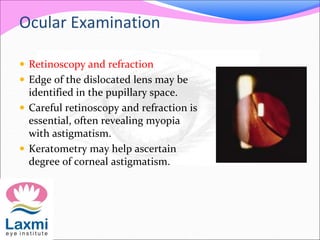
 Retinoscopy and refraction
 Edge of the dislocated lens may be
identified in the pupillary space.
 Careful retinoscopy and refraction is
essential, often revealing myopia
with astigmatism.
 Keratometry may help ascertain
degree of corneal astigmatism.
Ocular Examination
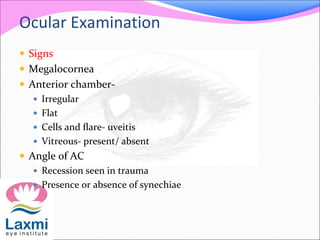
 Signs
 Megalocornea
 Anterior chamber-
 Irregular
 Flat
 Cells and flare- uveitis
 Vitreous- present/ absent
 Angle of AC
 Recession seen in trauma
 Presence or absence of synechiae
Ocular Examination
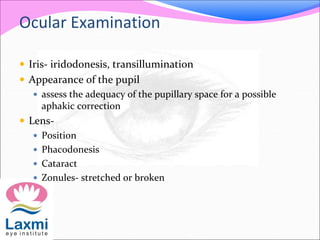
 Iris- iridodonesis, transillumination
 Appearance of the pupil
 assess the adequacy of the pupillary space for a possible
aphakic correction
 Lens-
 Position
 Phacodonesis
 Cataract
 Zonules- stretched or broken
Ocular Examination
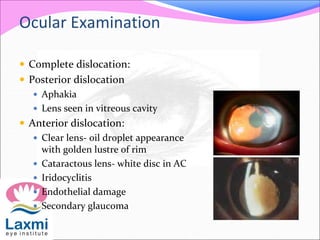
 Complete dislocation:
 Posterior dislocation
 Aphakia
 Lens seen in vitreous cavity
 Anterior dislocation:
 Clear lens- oil droplet appearance
with golden lustre of rim
 Cataractous lens- white disc in AC
 Iridocyclitis
 Endothelial damage
 Secondary glaucoma
Ocular Examination
 Raised intraocular pressure
 Causes of glaucoma in ectopia lentis include the following:
 (1) pupillary block
 (2) phacoanaphylaxis or phacolytic
 (3) posttraumatic angle recession
 (4) poorly developed angle structures
 Dilated fundus examination: Rule out retinal detachment
Ocular Associations
 Persistent pupillary
membrane
 Aniridia
 Rieger’s syndrome
 Dominantly inherited
blepharoptosis
 High myopia
 Congenital
glaucoma/buphthalmos
 Pseudoexfoliation
 Retinitis pigmentosa
 Hypermature cataract
 Intraocular tumor
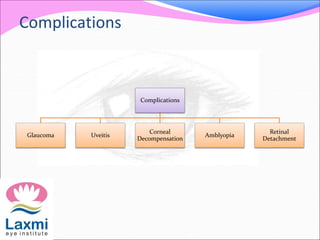
Complications
Complications
Glaucoma Uveitis
Corneal
Decompensation
Amblyopia
Retinal
Detachment
Workup
 Cardiac evaluation for Marfan syndrome
 Serum and urine levels of homocysteine or methionine for
homocystinuria
 Axial length measurement
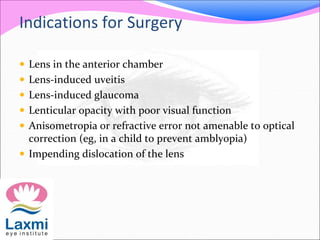
Indications for Surgery
 Lens in the anterior chamber
 Lens-induced uveitis
 Lens-induced glaucoma
 Lenticular opacity with poor visual function
 Anisometropia or refractive error not amenable to optical
correction (eg, in a child to prevent amblyopia)
 Impending dislocation of the lens
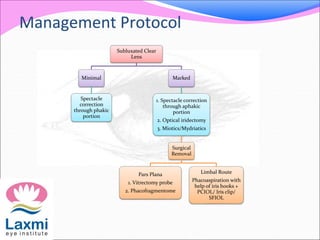
Management Protocol
Subluxated Clear
Lens
Minimal
Spectacle
correction
through phakic
portion
Marked
1. Spectacle correction
through aphakic
portion
2. Optical iridectomy
3. Miotics/Mydriatics
Surgical
Removal
Pars Plana
1. Vitrectomy probe
2. Phacofragmentome
Limbal Route
Phacoaspiration with
help of iris hooks +
PCIOL/ Iris clip/
SFIOL
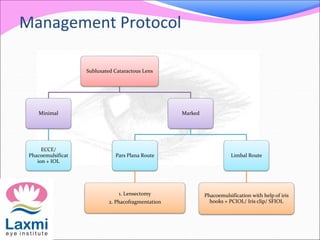
Management Protocol
Subluxated Cataractous Lens
Minimal
ECCE/
Phacoemulsificat
ion + IOL
Marked
Pars Plana Route
1. Lensectomy
2. Phacofragmentation
Limbal Route
Phacoemulsification with help of iris
hooks + PCIOL/ Iris clip/ SFIOL
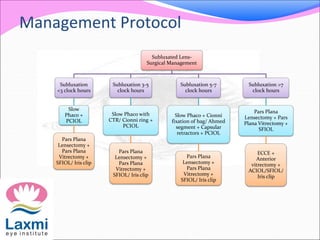
Management Protocol
Subluxated Lens-
Surgical Management
Subluxation
<3 clock hours
Slow
Phaco +
PCIOL
Pars Plana
Lensectomy +
Pars Plana
Vitrectomy +
SFIOL/ Iris clip
Subluxation 3-5
clock hours
Slow Phaco with
CTR/ Cionni ring +
PCIOL
Pars Plana
Lensectomy +
Pars Plana
Vitrectomy +
SFIOL/ Iris clip
Subluxation 5-7
clock hours
Slow Phaco + Cionni
fixation of bag/ Ahmed
segment + Capsular
retractors + PCIOL
Pars Plana
Lensectomy +
Pars Plana
Vitrectomy +
SFIOL/ Iris clip
Subluxation >7
clock hours
Pars Plana
Lensectomy + Pars
Plana Vitrectomy +
SFIOL
ECCE +
Anterior
vitrectomy +
ACIOL/SFIOL/
Iris clip
Management Protocol
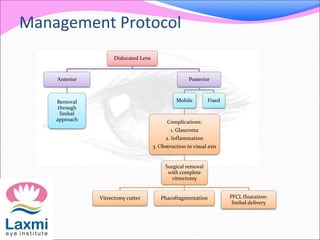
Dislocated Lens
Anterior
Removal
through
limbal
approach
Posterior
Mobile
Complications:
1. Glaucoma
2. Inflammation
3. Obstruction in visual axis
Surgical removal
with complete
vitrectomy
Vitrectomy cutter Phacofragmentation PFCL floatation-
limbal delivery
Fixed
Management of Subluxated lens in
Children
 Treatment of aphakia in children is a challenge
 Spectacle correction is not suitable for unilateral aphakia due
to anisokenia
 Contact lens - keratitis, corneal neovascularization,
noncompliance, frequent lens change and cost
 Surgical methods - implantation of ACIOL/SFIOL
 ACIOL not preferred in the pediatric age group (corneal
decompensation, glaucoma and retinal detachments)
 Recently published studies reported late dislocation of IOL
due to breakage of polypropylene sutures SFIOL, especially
in young patients
Vote BJ, Tranos P, Bunce C, Charteris DG, Da Cruz L. Long-term outcome of combined pars plana vitrectomy and
scleral fixated sutured posterior chamber intraocular lens implantation. Am J Ophthalmol. 2006 Feb; 141(2):308-312.
Assia EI, Nemet A, Sachs D. Bilateral spontaneous subluxation of scleral-fixated intraocular lenses. J Cataract
Refract Surg. 2002 Dec; 28(12):2214-6.
Management of Subluxated lens in
Children
 Phacoaspiraton with the help of CTR is a safe and
predictable procedure in subluxated lens in children
 Elimination of PCO still remains a challenge
 Long-term follow-up to observe any change in the stability
of capsular bag-zonular complex is necessary
Pranab Das, Jagat Ram, Gagandeep Singh Brar, and Mangat R Dogra. Results of intraocular lens implantation with
capsular tension ring in subluxated crystalline or cataractous lenses in children. Indian J Ophthalmol. 2009 Nov-
Dec; 57(6): 431–436.
Management of Subluxated lens in
Children
 Key points to successful CTR implantation
 To use high-viscosity visco-elastic material
 Making the incision at a meridian with intact zonules
 To avoid damaging zonular fibers with the movement of the
phacotip
 Perform slow-motion phacoemulsification
 Low flow rate, low vacuum, and low bottle height
Devices used in Surgery
 Capsular Tension Ring
 Indications:
 Missing or damaged zonules
 Lens subluxation
 Pseudoexfoliation
 High myopia
 Marfan Syndrome
 Mechanism:
 Circular expansion of capsular bag
 Stable conditions during surgery
 Improves IOL centration
 Reduced risk of capsular fibrosis
 Resists capsular Shrinkage
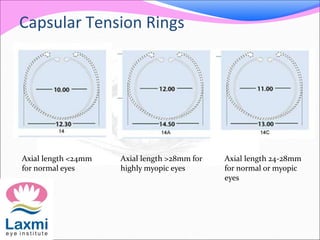
Capsular Tension Rings
Axial length <24mm
for normal eyes
Axial length >28mm for
highly myopic eyes
Axial length 24-28mm
for normal or myopic
eyes
Video: How to implant CTR
Devices used in Surgery
 Cionni Ring
 Indications:
 Missing or damaged zonules larger than 4 clock hours
 Lens subluxation
 Pseudoexfoliation
 High myopia
 Marfan Syndrome
 Mechanism:
 Similar to CTR
 Additionally corrects capsular bag decentration
Devices used in Surgery
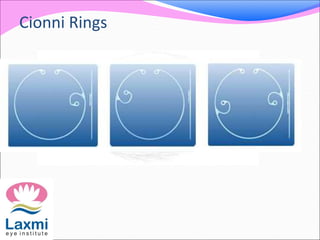
 Cionni Ring
 Designed for scleral fixation with suture
 One or two hooks extending from the ring, an eyelet
located on the hook located behind the iris just in front of
anterior capsule
 The sutured eyelet anchors the ring to sclera in the area of
missing zonules
 Most frequent complication - posterior capsule
opacification (PCO) -20%
Vasavada AR, Praveen MR, Vasavada VA, Yeh RY, Srivastava S, Koul A, Trivedi RH. Cionni ring and in-the-bag
intraocular lens implantation for subluxated lenses: a prospective case series. Am J Ophthalmol. 2012
Jun;153(6):1144-53.
Irit Bahar, Igor Kaiserman, David Rootman. Cionni endocapsular ring implantation in Marfan's Syndrome. Br J
Ophthalmol. 2007 November; 91(11): 1477–1480.
Cionni Rings
Video: How to implant Cionni Ring
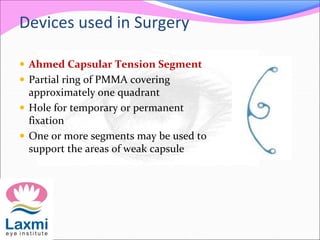
 Ahmed Capsular Tension Segment
 Partial ring of PMMA covering
approximately one quadrant
 Hole for temporary or permanent
fixation
 One or more segments may be used to
support the areas of weak capsule
Devices used in Surgery
 Ahmed Capsular Tension Segment
 Advantages:
 May be used intraoperatively, secured by an iris hook
 May be fixated to the sclera for permanent support
 Stabilizes conditions during cataract surgery
 Stripping cortex out from under and around the CTS is easy
 Improves IOL centration
Video: How to implant Ahmed
Capsular Tension segment
Devices used in Surgery
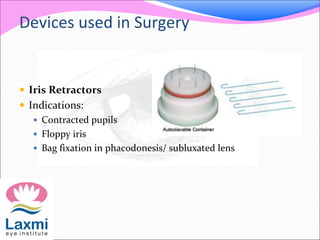
 Iris Retractors
 Indications:
 Contracted pupils
 Floppy iris
 Bag fixation in phacodonesis/ subluxated lens
Video: Use of iris hooks
Associated Management
 Co-management with the patient's pediatrician or
internist is essential
 Appropriate genetic counselling
 All relatives with potential risk should be examined
Ectopia lentis edit

Ectopia lentis edit

  • 1.
    ECTOPIA LENTIS Presenter: Dr.Rujuta Gore Moderator: Dr. Suhas Haldipurkar Dr. Prakash Chipade
  • 2.
    Introduction  Ectopia lentisis defined as displacement or malposition of the crystalline lens of the eye  Berryat described the first reported case of lens dislocation in 1749, and Stellwag subsequently coined the term “ectopia lentis” in 1856
  • 3.
    Topographic Classification Subluxated lens Dislocatedlens • Incarcerated in the pupil • In the anterior chamber • In the vitreous- lens nutans • Lens fixata • In the subretinal space • Wandering lens • Extrusion out of the globe • In subconjunctival space
  • 4.
  • 5.
    Congenital Ectopia Lentis Usually bilateral and symmetrical Simple Ectopia Lentis Ectopia Lentis et Pupillae
  • 6.
    Congenital Ectopia Lentis SIMPLE ECTOPIA LENTIS  Autosomal dominant inheritance  Ocular anomaly: Bilateral, symmetric, upward and temporal displacement of the lens.  Herniation of the vitreous associated with zonular degeneration may occur through the zonular defect into the anterior chamber  Associated with cataract and retinal detachment
  • 7.
    Congenital Ectopia Lentis ECTOPA LENTIS ET PUPILLAE  Autosomal recessive inheritance  Pupils are oval or slit shaped and ectopic, and they frequently dilate poorly  Bilateral, with the lenses and pupils displaced in the opposite direction from each other.  Associated ocular anomalies- Megalocornea, polycoria, cataract, glaucoma, retinal detachment, optic nerve hypoplasia, colobomata
  • 8.
     Pathogenesis ofectopia lentis et pupillae:  Mesodermal- persistent remnants of tunica vasculosa lentis mechanically interfere with the development of zonules  Neuroectodermal- Maldevelopment of the pigmentary epithelium of the iris, hypoplasia of the dilator muscle
  • 9.
    Metabolic Disorders  MARFANSYNDROME  Prevalence of approximately 5 per 100,000  Autosomal dominant condition characterized by skeletal, cardiovascular, and ocular anomalies.  Several point mutations involving the fibrillin gene on chromosomes 15 and 21 - relate to incompetent zonular fibers
  • 10.
    MARFAN SYNDROME  Salientfeatures:  Skeletal Manifestations  Tall stature  Increased arm span in relation to body height and elongated lower segment  Arachnodactyly  Joint laxity, scoliosis
  • 11.
    MARFAN SYNDROME  CardiovascularManifestations  Mitral valve prolapse, aortic dilatation
  • 12.
    MARFAN SYNDROME  OcularManifestations  Axial myopia  Corneal diameter may be increased, giving the appearance of megalocornea  Increased incidence of retinal degeneration & detachment  Lens subluxation occurs in about 75% of patients; usually is bilateral, symmetrical, and superotemporal
  • 13.
    HOMOCYSTINURIA  Inborn errorof metabolism of sulfur containing amino acids  Near absence of cystathionine b-synthetase (the enzyme that converts homocysteine to cystathionine)  Salient features:  Fair skin with coarse hair  Osteoporosis  Mental retardation (nearly 50%)  Seizure disorder  Marfanoid habitus
  • 14.
    HOMOCYSTINURIA  Salient featurescontinued:  Poor circulation - Thromboembolic events constitute the major threat to survival, especially following general anesthesia  Lens luxation usually is bilateral, symmetrical, and inferonasal, and presents in nearly 90% of patients
  • 15.
    WEIL-MARCHESANI SYNDROME  Salientfeatures:  Short stature  Brachycephaly  Limited joint mobility  Ectopia lentis  Microspherophakia (most prominent feature of this syndrome)  Lenticular myopia  Lens subluxation occurs inferiorly, often progressing to complete dislocation  Pupillary block glaucoma is common
  • 16.
    SULFITE OXIDASE DEFICIENCY Defect in sulfur metabolism  Salient features:  Progressive CNS abnormalities that develop within the first year of life  Ectopia lentis.
  • 17.
    HYPERLYSINEMIA  Autosomal recessiveenzymatic defect of amino acid metabolism  Characterized by mental retardation and lens dislocation.
  • 18.
    Rare Systemic Associations Ehlers-Danlos syndrome  Crouzon disease  Refsum syndrome  Kniest syndrome  Mandibulofacial dysostosis  Sturge-Weber syndrome
  • 19.
    Traumatic Ectopia Lentis Mechanism-  Backward thrust and rebounding of the lens  Pressure wave of the aqueous forcing the root of iris backwards  Forcible recoil of the vitreous body which comes forward around the lens
  • 20.
    Consecutive/Spontaneous Ectopia Lentis  Mechanicalstretching  Buphthalmos  High myopia  Staphyloma  Intraocular Tumors  Inflammatory  Destruction of zonules  Hypermature cataract  Cyclitic adhesions  Vitreous traction bands
  • 21.
    Presentation  Common presentingsymptoms include the following:  Decreased distance visual acuity (secondary to astigmatism or lenticular myopia)  Poor near vision (loss of accommodative power)  Monocular diplopia  Red painful eye
  • 22.
    Presentation  History:  Onset Cardiovascular disease (Marfan syndrome)  Skeletal problems (Marfan syndrome, Weil-Marchesani syndrome, or homocystinuria)  Ocular trauma  Family history  Consanguinity  Mental retardation  Unexplained deaths at young age (eg, autosomal recessive conditions, including homocystinuria, hyperlysinemia, ectopia lentis et pupillae, or sulfite oxidase deficiency)
  • 23.
    Ocular Examination  VisualAcuity  Ectopia lentis is potentially visually debilitating.  Visual acuity varies with the degree of malpositioning of the lens.  Amblyopia is a common cause of decreased vision in congenital ectopia lentis.
  • 24.
    Ocular Examination  Retinoscopyand refraction  Edge of the dislocated lens may be identified in the pupillary space.  Careful retinoscopy and refraction is essential, often revealing myopia with astigmatism.  Keratometry may help ascertain degree of corneal astigmatism.
  • 25.
    Ocular Examination  Signs Megalocornea  Anterior chamber-  Irregular  Flat  Cells and flare- uveitis  Vitreous- present/ absent  Angle of AC  Recession seen in trauma  Presence or absence of synechiae
  • 26.
    Ocular Examination  Iris-iridodonesis, transillumination  Appearance of the pupil  assess the adequacy of the pupillary space for a possible aphakic correction  Lens-  Position  Phacodonesis  Cataract  Zonules- stretched or broken
  • 27.
    Ocular Examination  Completedislocation:  Posterior dislocation  Aphakia  Lens seen in vitreous cavity  Anterior dislocation:  Clear lens- oil droplet appearance with golden lustre of rim  Cataractous lens- white disc in AC  Iridocyclitis  Endothelial damage  Secondary glaucoma
  • 28.
    Ocular Examination  Raisedintraocular pressure  Causes of glaucoma in ectopia lentis include the following:  (1) pupillary block  (2) phacoanaphylaxis or phacolytic  (3) posttraumatic angle recession  (4) poorly developed angle structures  Dilated fundus examination: Rule out retinal detachment
  • 29.
    Ocular Associations  Persistentpupillary membrane  Aniridia  Rieger’s syndrome  Dominantly inherited blepharoptosis  High myopia  Congenital glaucoma/buphthalmos  Pseudoexfoliation  Retinitis pigmentosa  Hypermature cataract  Intraocular tumor
  • 30.
  • 31.
    Workup  Cardiac evaluationfor Marfan syndrome  Serum and urine levels of homocysteine or methionine for homocystinuria  Axial length measurement
  • 32.
    Indications for Surgery Lens in the anterior chamber  Lens-induced uveitis  Lens-induced glaucoma  Lenticular opacity with poor visual function  Anisometropia or refractive error not amenable to optical correction (eg, in a child to prevent amblyopia)  Impending dislocation of the lens
  • 33.
    Management Protocol Subluxated Clear Lens Minimal Spectacle correction throughphakic portion Marked 1. Spectacle correction through aphakic portion 2. Optical iridectomy 3. Miotics/Mydriatics Surgical Removal Pars Plana 1. Vitrectomy probe 2. Phacofragmentome Limbal Route Phacoaspiration with help of iris hooks + PCIOL/ Iris clip/ SFIOL
  • 34.
    Management Protocol Subluxated CataractousLens Minimal ECCE/ Phacoemulsificat ion + IOL Marked Pars Plana Route 1. Lensectomy 2. Phacofragmentation Limbal Route Phacoemulsification with help of iris hooks + PCIOL/ Iris clip/ SFIOL
  • 35.
    Management Protocol Subluxated Lens- SurgicalManagement Subluxation <3 clock hours Slow Phaco + PCIOL Pars Plana Lensectomy + Pars Plana Vitrectomy + SFIOL/ Iris clip Subluxation 3-5 clock hours Slow Phaco with CTR/ Cionni ring + PCIOL Pars Plana Lensectomy + Pars Plana Vitrectomy + SFIOL/ Iris clip Subluxation 5-7 clock hours Slow Phaco + Cionni fixation of bag/ Ahmed segment + Capsular retractors + PCIOL Pars Plana Lensectomy + Pars Plana Vitrectomy + SFIOL/ Iris clip Subluxation >7 clock hours Pars Plana Lensectomy + Pars Plana Vitrectomy + SFIOL ECCE + Anterior vitrectomy + ACIOL/SFIOL/ Iris clip
  • 36.
    Management Protocol Dislocated Lens Anterior Removal through limbal approach Posterior Mobile Complications: 1.Glaucoma 2. Inflammation 3. Obstruction in visual axis Surgical removal with complete vitrectomy Vitrectomy cutter Phacofragmentation PFCL floatation- limbal delivery Fixed
  • 37.
    Management of Subluxatedlens in Children  Treatment of aphakia in children is a challenge  Spectacle correction is not suitable for unilateral aphakia due to anisokenia  Contact lens - keratitis, corneal neovascularization, noncompliance, frequent lens change and cost  Surgical methods - implantation of ACIOL/SFIOL  ACIOL not preferred in the pediatric age group (corneal decompensation, glaucoma and retinal detachments)  Recently published studies reported late dislocation of IOL due to breakage of polypropylene sutures SFIOL, especially in young patients Vote BJ, Tranos P, Bunce C, Charteris DG, Da Cruz L. Long-term outcome of combined pars plana vitrectomy and scleral fixated sutured posterior chamber intraocular lens implantation. Am J Ophthalmol. 2006 Feb; 141(2):308-312. Assia EI, Nemet A, Sachs D. Bilateral spontaneous subluxation of scleral-fixated intraocular lenses. J Cataract Refract Surg. 2002 Dec; 28(12):2214-6.
  • 38.
    Management of Subluxatedlens in Children  Phacoaspiraton with the help of CTR is a safe and predictable procedure in subluxated lens in children  Elimination of PCO still remains a challenge  Long-term follow-up to observe any change in the stability of capsular bag-zonular complex is necessary Pranab Das, Jagat Ram, Gagandeep Singh Brar, and Mangat R Dogra. Results of intraocular lens implantation with capsular tension ring in subluxated crystalline or cataractous lenses in children. Indian J Ophthalmol. 2009 Nov- Dec; 57(6): 431–436.
  • 39.
    Management of Subluxatedlens in Children  Key points to successful CTR implantation  To use high-viscosity visco-elastic material  Making the incision at a meridian with intact zonules  To avoid damaging zonular fibers with the movement of the phacotip  Perform slow-motion phacoemulsification  Low flow rate, low vacuum, and low bottle height
  • 40.
    Devices used inSurgery  Capsular Tension Ring  Indications:  Missing or damaged zonules  Lens subluxation  Pseudoexfoliation  High myopia  Marfan Syndrome  Mechanism:  Circular expansion of capsular bag  Stable conditions during surgery  Improves IOL centration  Reduced risk of capsular fibrosis  Resists capsular Shrinkage
  • 41.
    Capsular Tension Rings Axiallength <24mm for normal eyes Axial length >28mm for highly myopic eyes Axial length 24-28mm for normal or myopic eyes
  • 42.
    Video: How toimplant CTR
  • 43.
    Devices used inSurgery  Cionni Ring  Indications:  Missing or damaged zonules larger than 4 clock hours  Lens subluxation  Pseudoexfoliation  High myopia  Marfan Syndrome  Mechanism:  Similar to CTR  Additionally corrects capsular bag decentration
  • 44.
    Devices used inSurgery  Cionni Ring  Designed for scleral fixation with suture  One or two hooks extending from the ring, an eyelet located on the hook located behind the iris just in front of anterior capsule  The sutured eyelet anchors the ring to sclera in the area of missing zonules  Most frequent complication - posterior capsule opacification (PCO) -20% Vasavada AR, Praveen MR, Vasavada VA, Yeh RY, Srivastava S, Koul A, Trivedi RH. Cionni ring and in-the-bag intraocular lens implantation for subluxated lenses: a prospective case series. Am J Ophthalmol. 2012 Jun;153(6):1144-53. Irit Bahar, Igor Kaiserman, David Rootman. Cionni endocapsular ring implantation in Marfan's Syndrome. Br J Ophthalmol. 2007 November; 91(11): 1477–1480.
  • 45.
  • 46.
    Video: How toimplant Cionni Ring
  • 47.
     Ahmed CapsularTension Segment  Partial ring of PMMA covering approximately one quadrant  Hole for temporary or permanent fixation  One or more segments may be used to support the areas of weak capsule Devices used in Surgery
  • 48.
    Devices used inSurgery  Ahmed Capsular Tension Segment  Advantages:  May be used intraoperatively, secured by an iris hook  May be fixated to the sclera for permanent support  Stabilizes conditions during cataract surgery  Stripping cortex out from under and around the CTS is easy  Improves IOL centration
  • 49.
    Video: How toimplant Ahmed Capsular Tension segment
  • 50.
    Devices used inSurgery  Iris Retractors  Indications:  Contracted pupils  Floppy iris  Bag fixation in phacodonesis/ subluxated lens
  • 51.
    Video: Use ofiris hooks
  • 52.
    Associated Management  Co-managementwith the patient's pediatrician or internist is essential  Appropriate genetic counselling  All relatives with potential risk should be examined

Editor's Notes

  • #3 The lens is considered dislocated when it lies completely outside the lens patellar fossa, in the anterior chamber, free-floating in the vitreous, or directly on the retina. The lens is described as subluxated when it is partially displaced but contained within the lens space
  • #39 Subluxation was 3-7 clock hours. 90deg to 210deg
  • #44 Capsular tension ring (CTR) implantation may be the solution for zonular weakness but does not correct capsular bag decentration
  • #45 Capsular tension ring (CTR) implantation may be the solution for zonular weakness but does not correct capsular bag decentration