What is IOL?
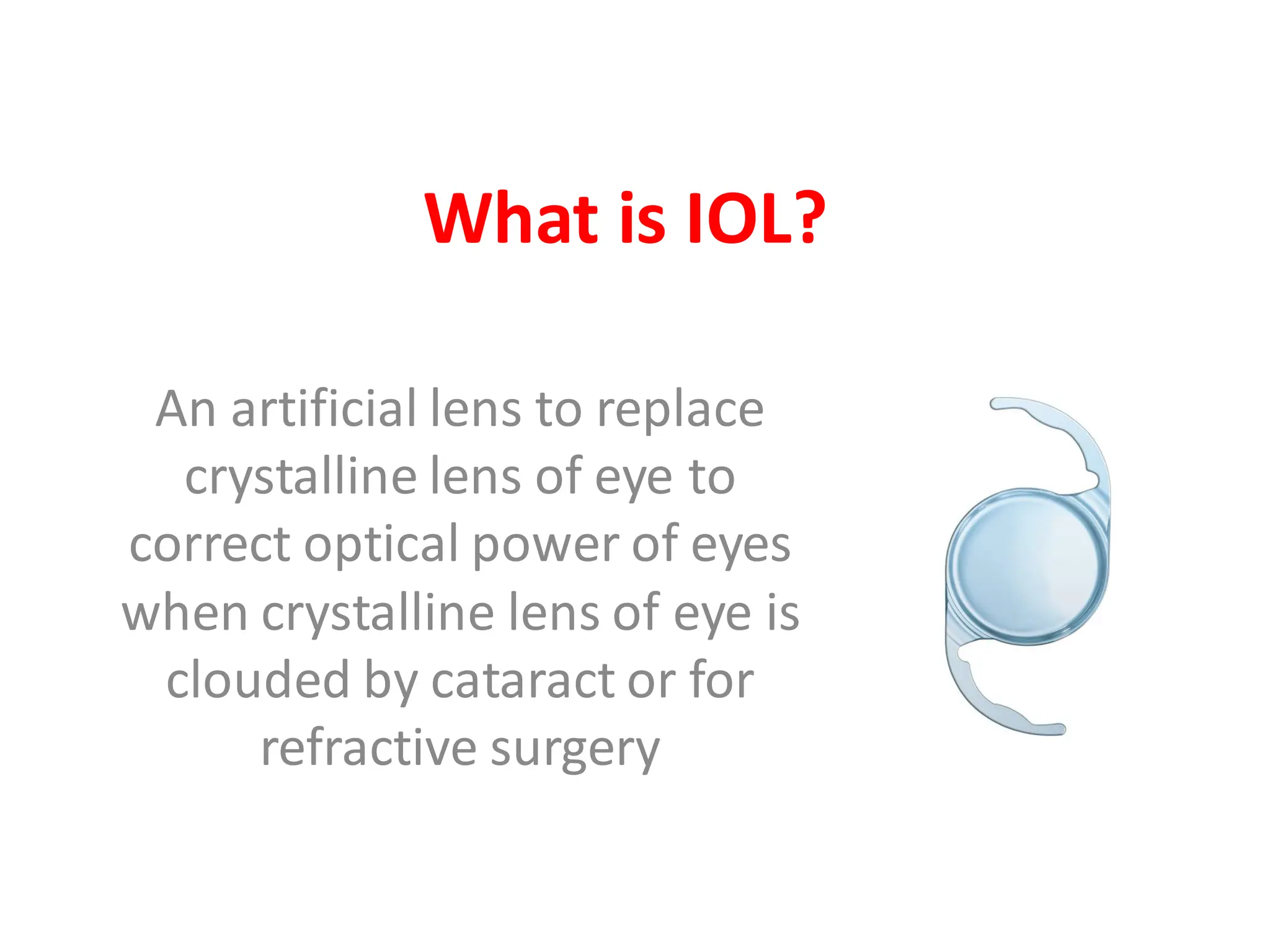
An artificial lens to replace
crystalline lens of eye to
correct optical power of eyes
when crystalline lens of eye is
clouded by cataract or for
refractive surgery
Parts of an IOL
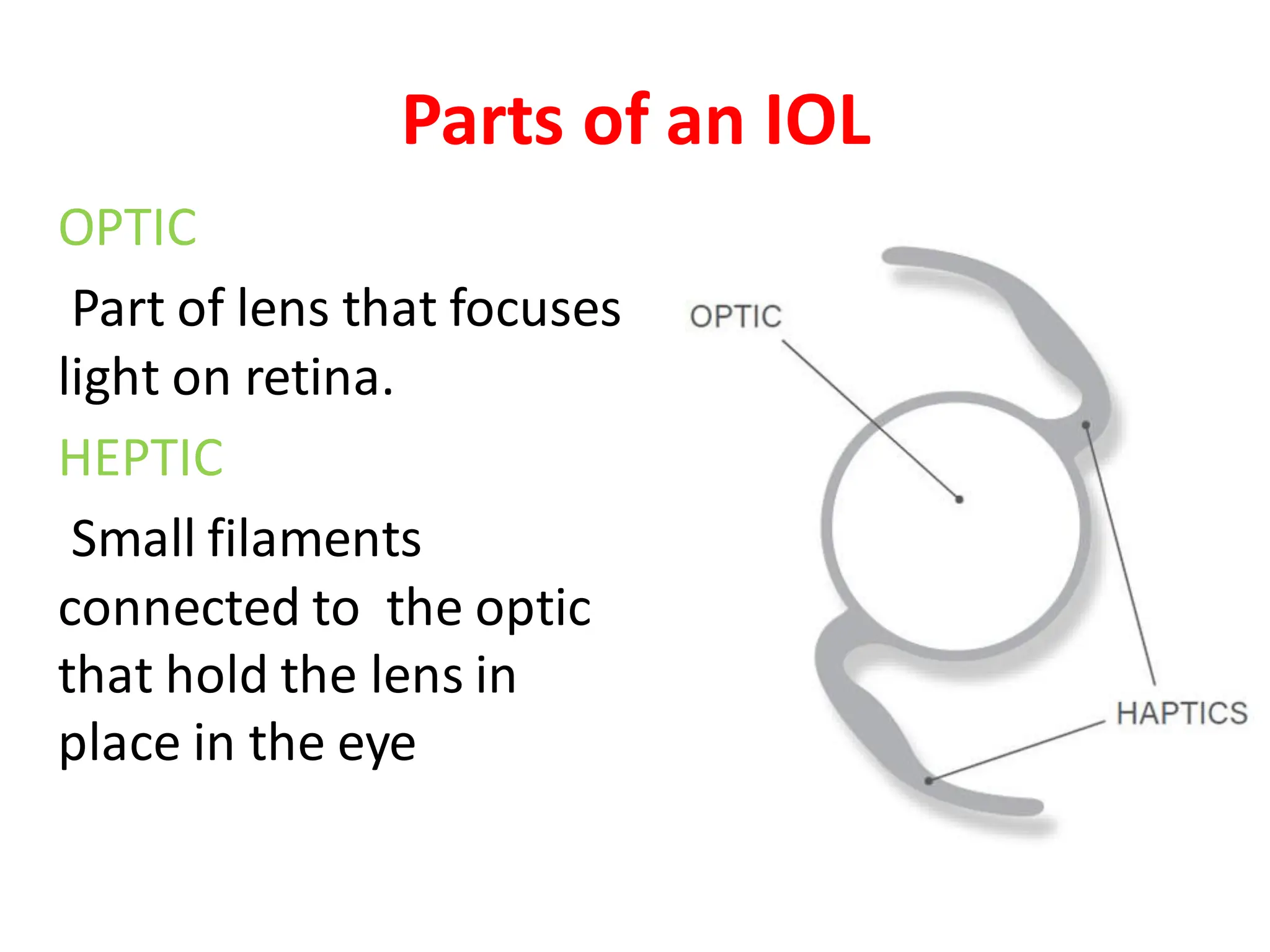
OPTIC
Part of lens that focuses
light on retina.
HEPTIC
Small filaments
connected to the optic
that hold the lens in
place in the eye
History of IOL
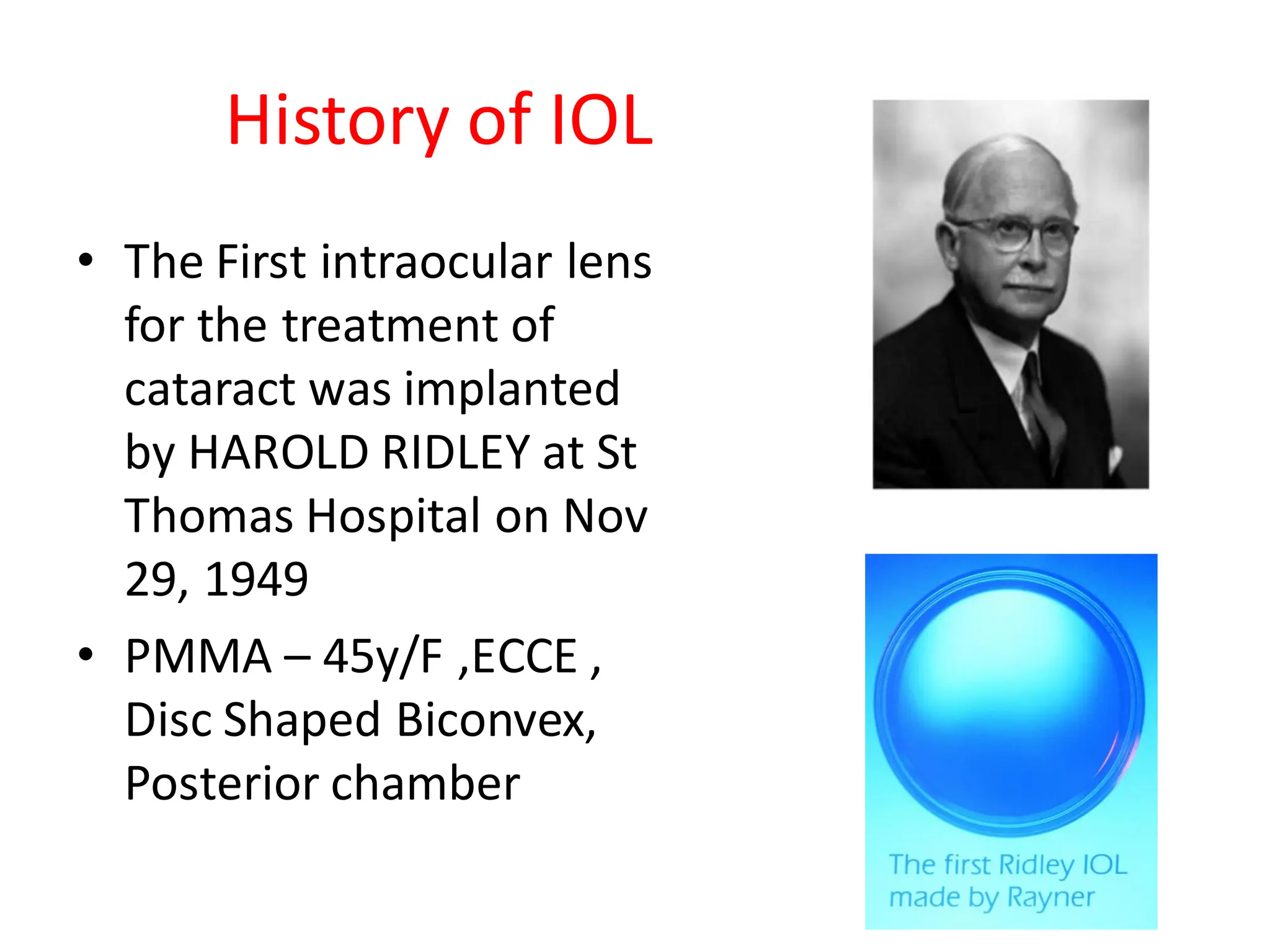
• The First intraocular lens
for the treatment of
cataract was implanted
by HAROLD RIDLEY at St
Thomas Hospital on Nov
29, 1949
• PMMA – 45y/F ,ECCE ,
Disc Shaped Biconvex,
Posterior chamber
EVOLUTION OF IOLs
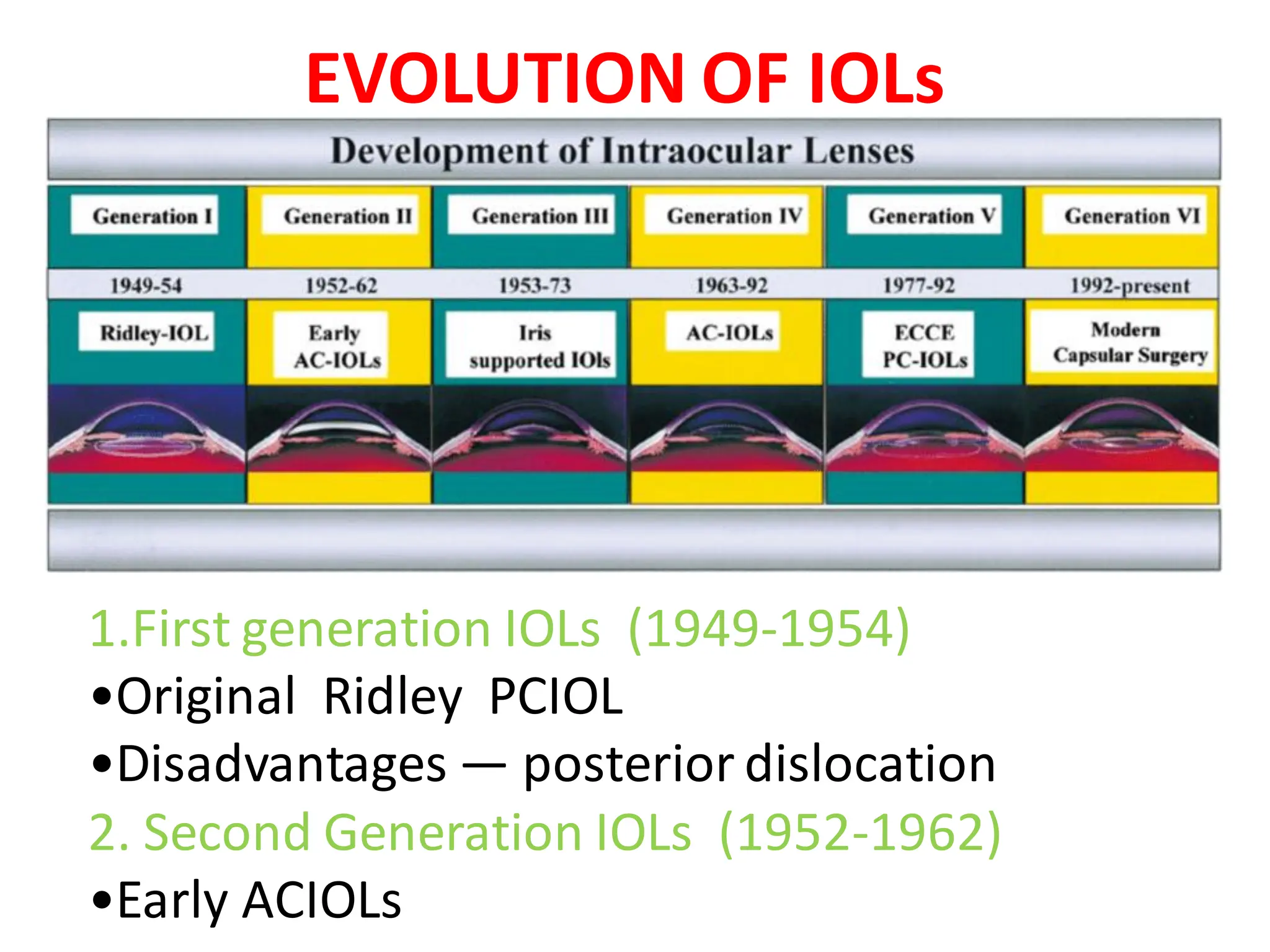
1.First generation IOLs (1949-1954)
•Original Ridley PCIOL
•Disadvantages — posterior dislocation
2. Second Generation IOLs (1952-1962)
•Early ACIOLs
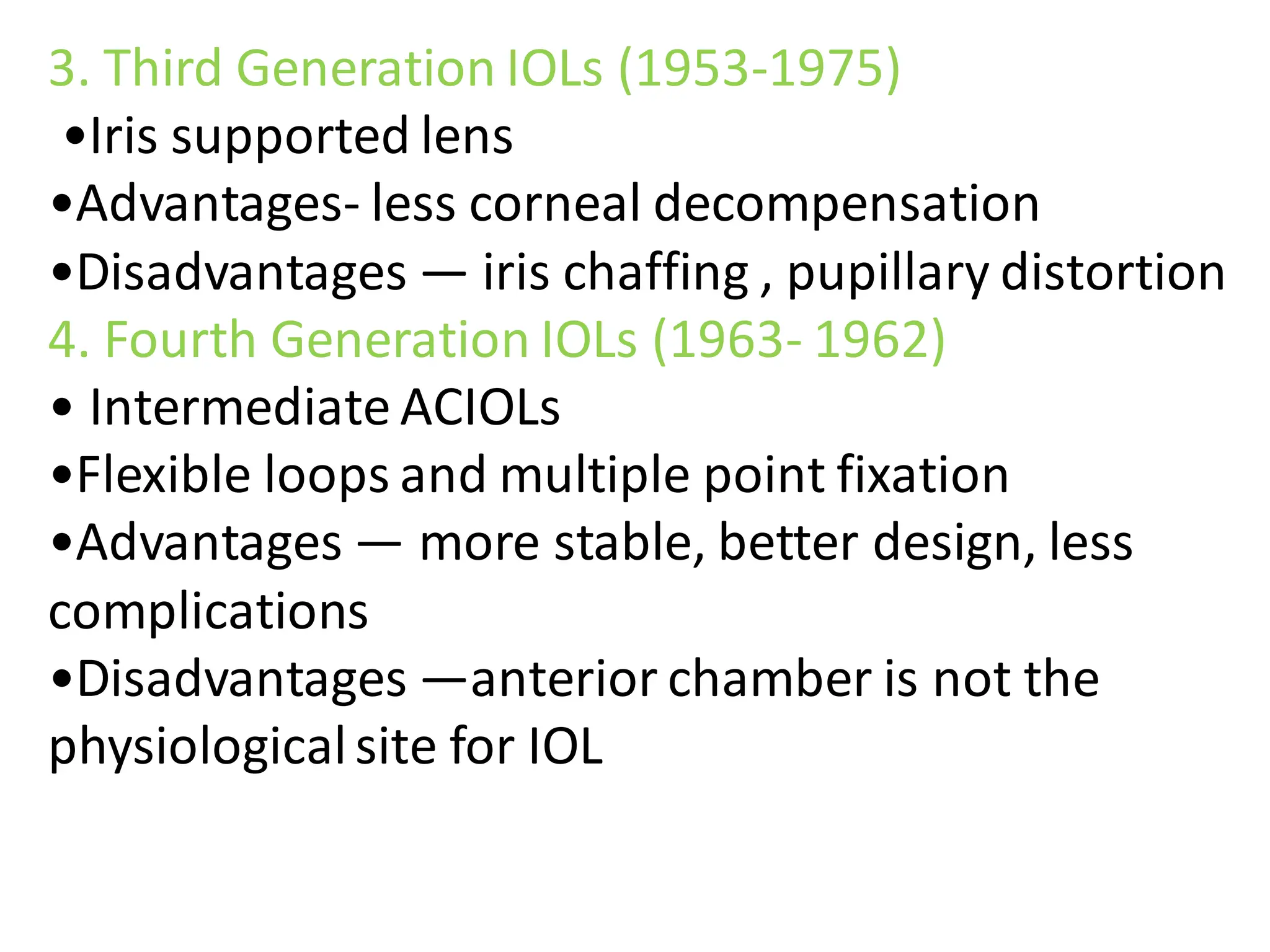
3. Third Generation IOLs (1953-1975)
•Iris supported lens
•Advantages- less corneal decompensation
•Disadvantages — iris chaffing , pupillary distortion
4. Fourth Generation IOLs (1963- 1962)
• Intermediate ACIOLs
•Flexible loops and multiple point fixation
•Advantages — more stable, better design, less
complications
•Disadvantages —anterior chamber is not the
physiologicalsite for IOL
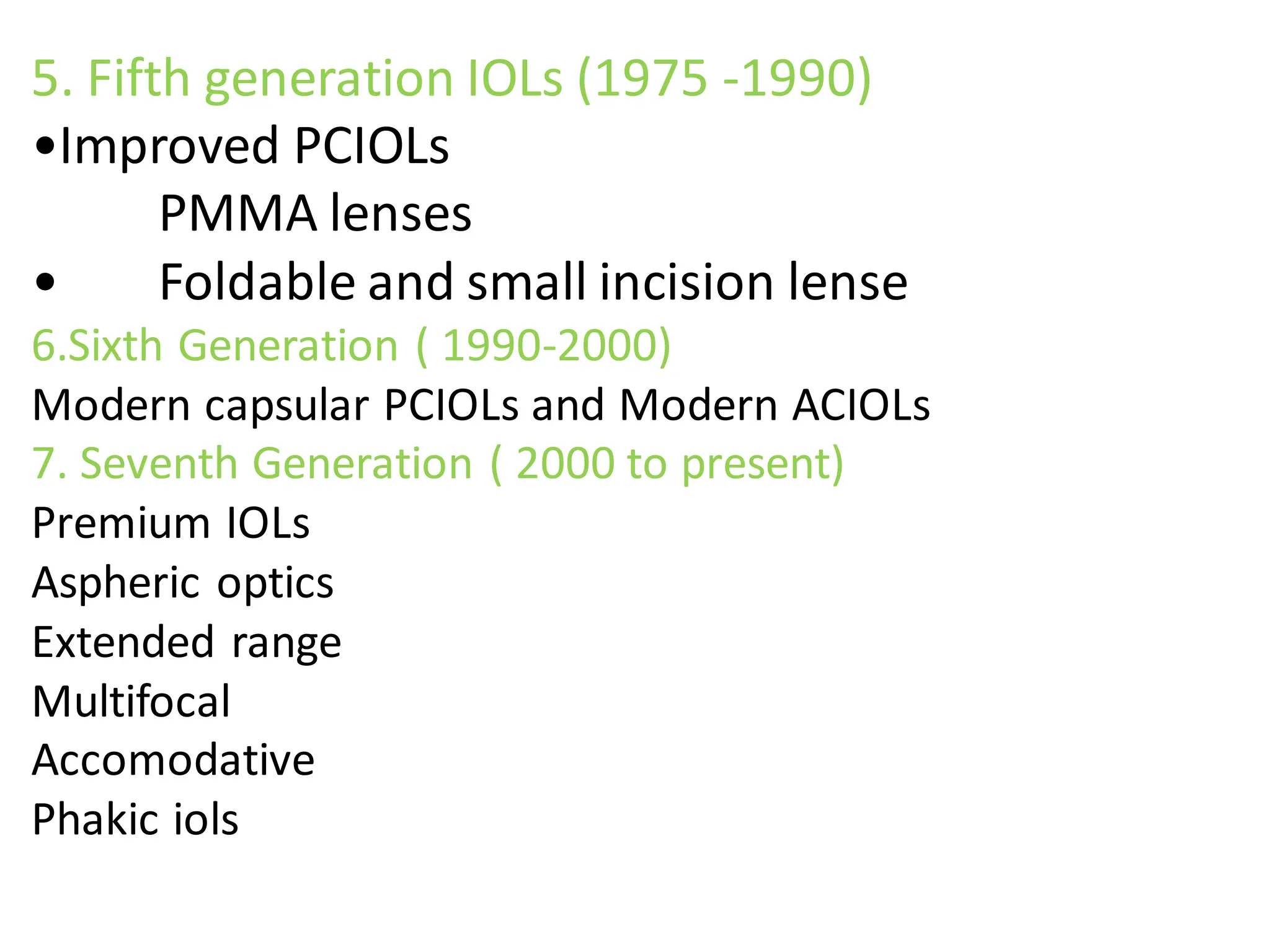
5. Fifth generation IOLs (1975 -1990)
•Improved PCIOLs
PMMA lenses
• Foldable and small incision lense
6.Sixth Generation ( 1990-2000)
Modern capsular PCIOLs and Modern ACIOLs
7. Seventh Generation ( 2000 to present)
Premium IOLs
Aspheric optics
Extended range
Multifocal
Accomodative
Phakic iols
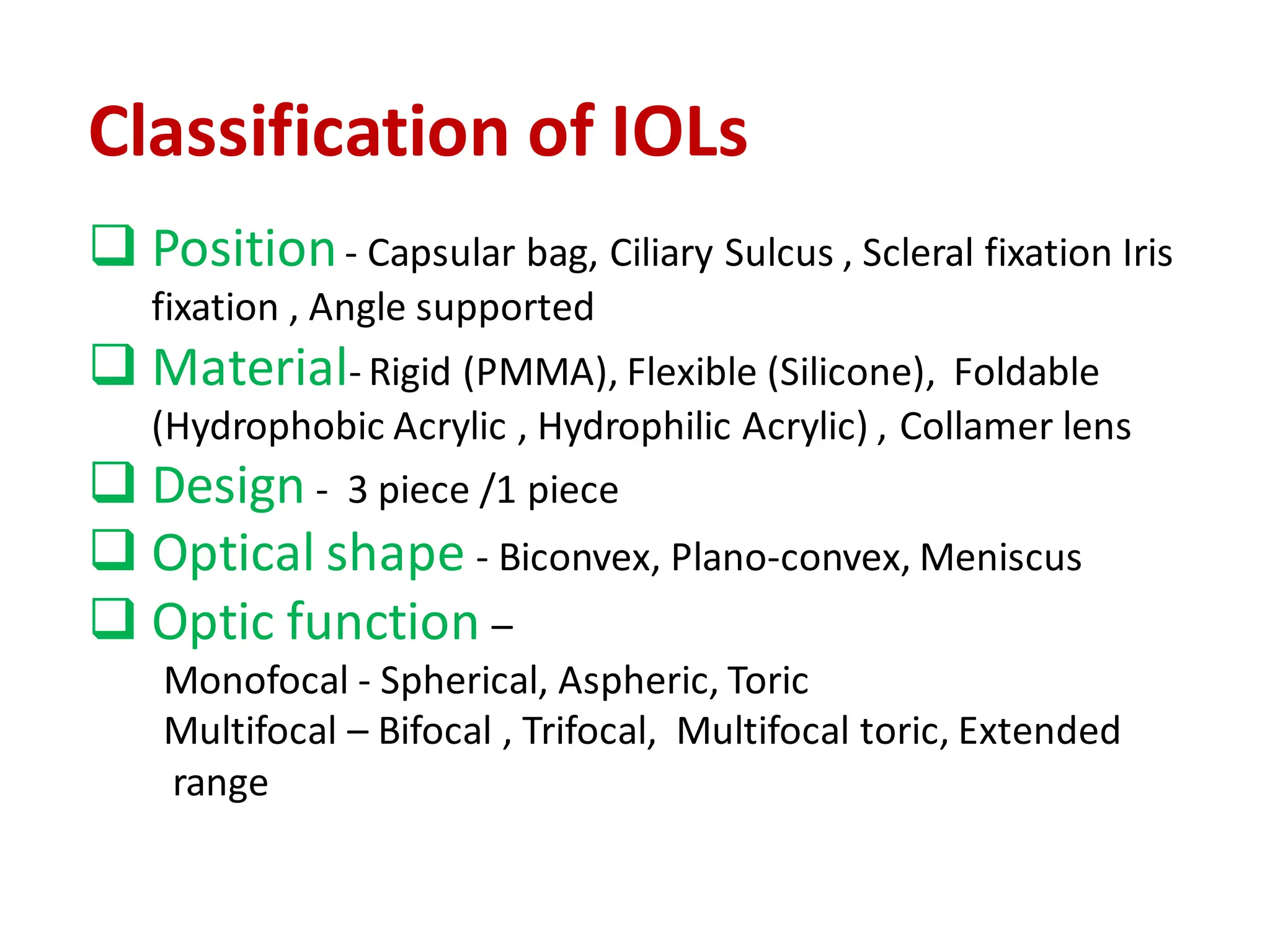
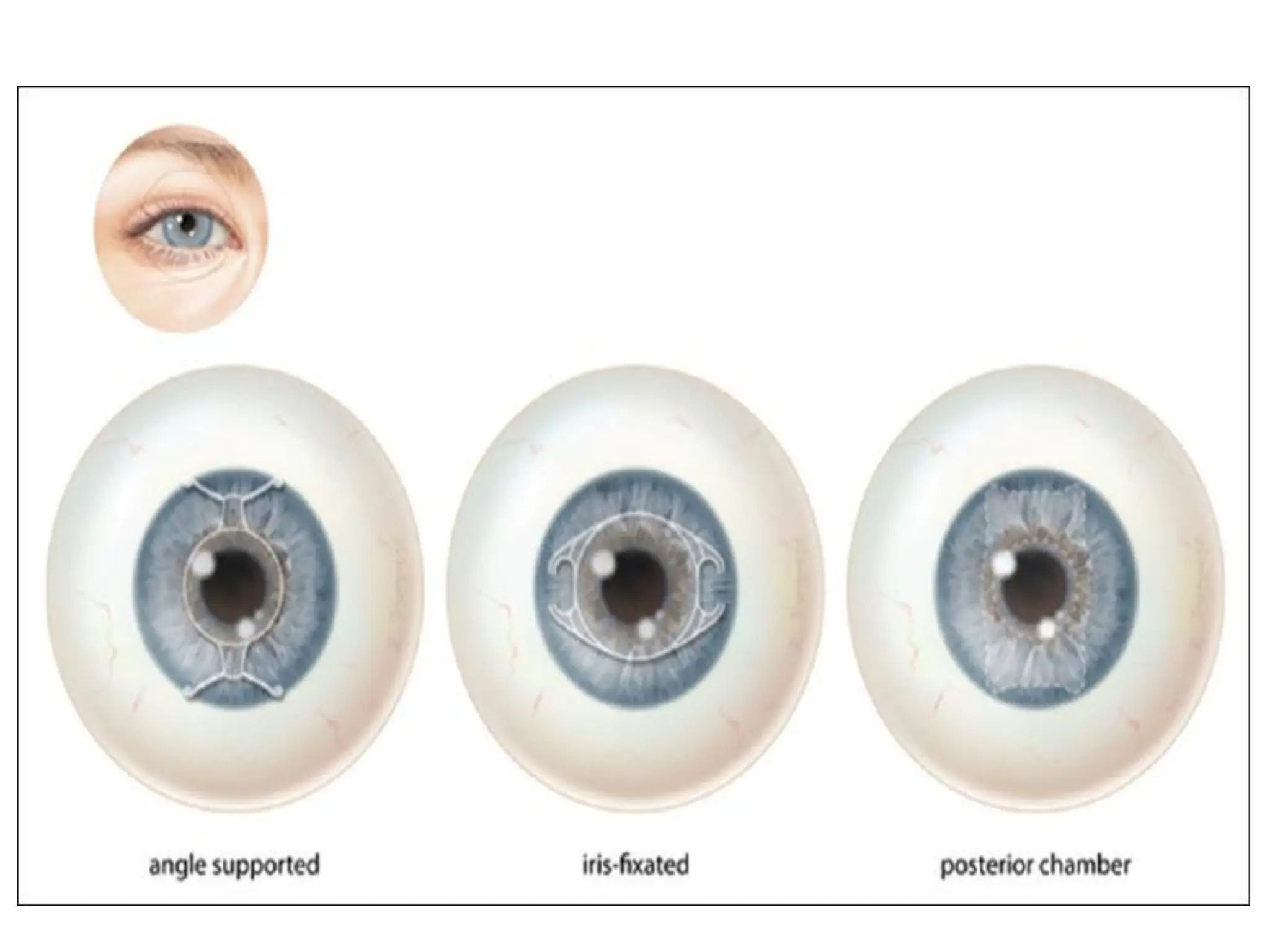
Classification of IOLs
❑ Position- Capsular bag, Ciliary Sulcus , Scleral fixation Iris
fixation , Angle supported
❑ Material- Rigid (PMMA), Flexible (Silicone), Foldable
(Hydrophobic Acrylic , Hydrophilic Acrylic) , Collamer lens
❑ Design - 3 piece /1 piece
❑ Optical shape - Biconvex, Plano-convex, Meniscus
❑ Optic function –
Monofocal - Spherical, Aspheric, Toric
Multifocal – Bifocal , Trifocal, Multifocal toric, Extended
range
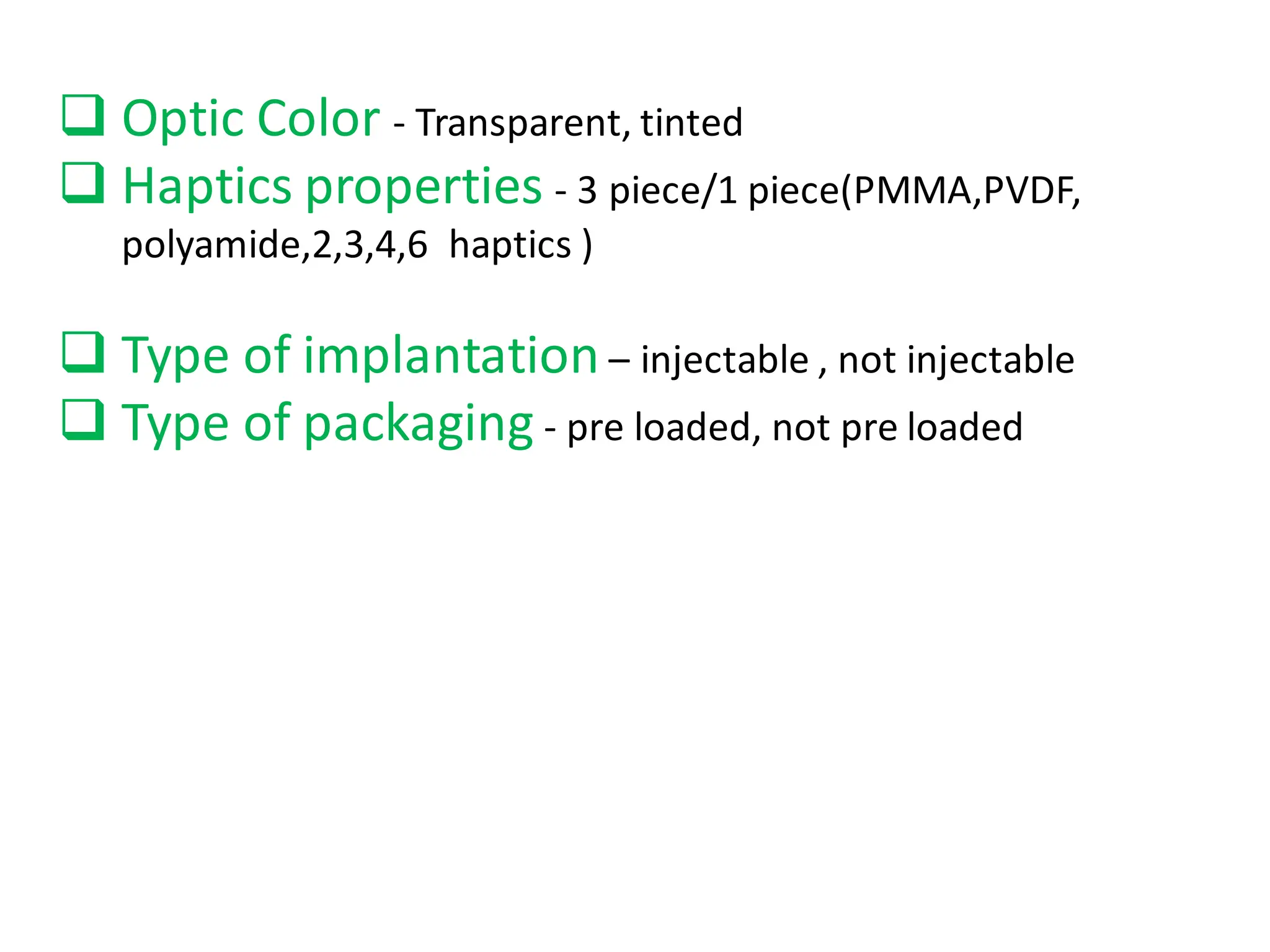
❑ Optic Color - Transparent, tinted
❑ Haptics properties - 3 piece/1 piece(PMMA,PVDF,
polyamide,2,3,4,6 haptics )
❑ Type of implantation – injectable , not injectable
❑ Type of packaging - pre loaded, not pre loaded
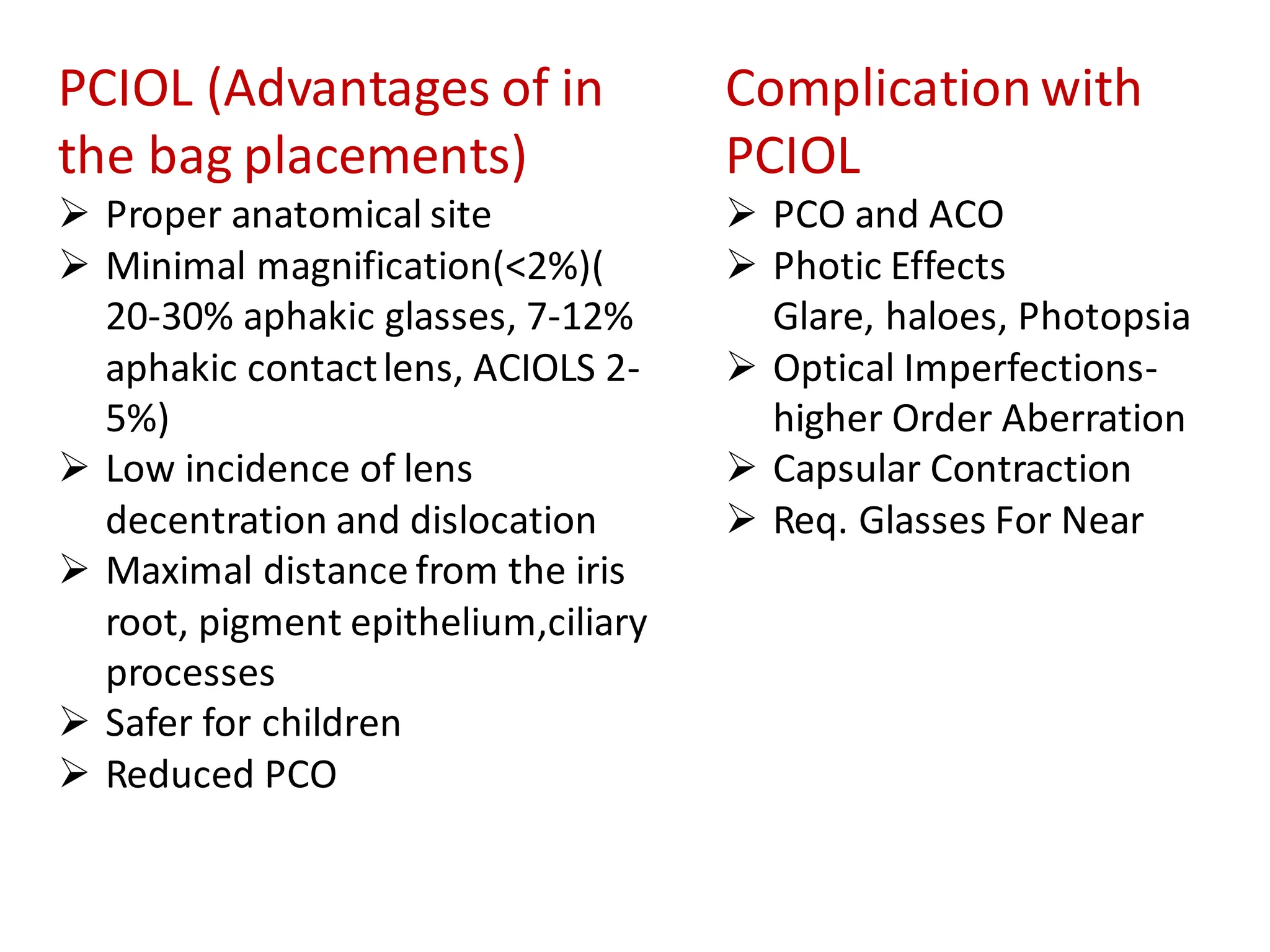
PCIOL (Advantages of in
the bag placements)
➢ Proper anatomical site
➢ Minimal magnification(<2%)(
20-30% aphakic glasses, 7-12%
aphakic contactlens, ACIOLS 2-
5%)
➢ Low incidence of lens
decentration and dislocation
➢ Maximal distance from the iris
root, pigment epithelium,ciliary
processes
➢ Safer for children
➢ Reduced PCO
Complicationwith
PCIOL
➢ PCO and ACO
➢ Photic Effects
Glare, haloes, Photopsia
➢ Optical Imperfections-
higher Order Aberration
➢ Capsular Contraction
➢ Req. Glasses For Near
PREVENTION OF COMPLICATION BY
I. MATERIAL
II. DESIGN
III.ASPHERICITY
IV.FOCAL POINTS
V.ACCOMMODATION
Material used must be biocompatible, optically clear,
lightweight, durable, moldable, capable of being
sterilized, resistant to forceps and folding marks, resilient
to the stresses of implantation, able to withstand Nd:YAG
laser capsulotomy, and inert in the eye through the rest
of the patient’s lifetime.
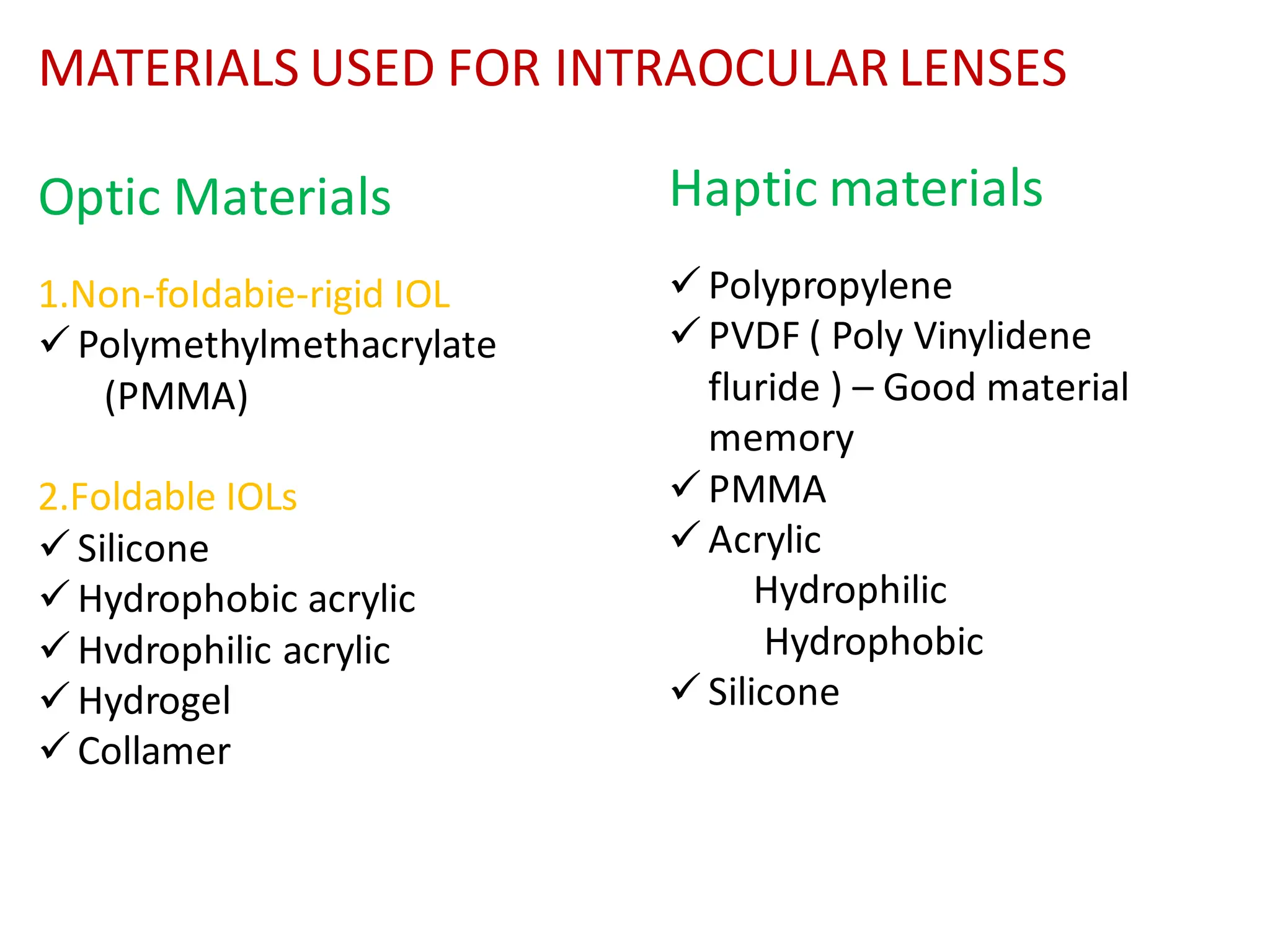
Optic Materials
1.Non-foIdabie-rigid IOL
✓ Polymethylmethacrylate
(PMMA)
2.Foldable IOLs
✓ Silicone
✓ Hydrophobic acrylic
✓ Hvdrophilic acrylic
✓ Hydrogel
✓ Collamer
MATERIALS USED FOR INTRAOCULAR LENSES
Haptic materials
✓ Polypropylene
✓ PVDF ( Poly Vinylidene
fluride ) – Good material
memory
✓ PMMA
✓ Acrylic
Hydrophilic
Hydrophobic
✓ Silicone
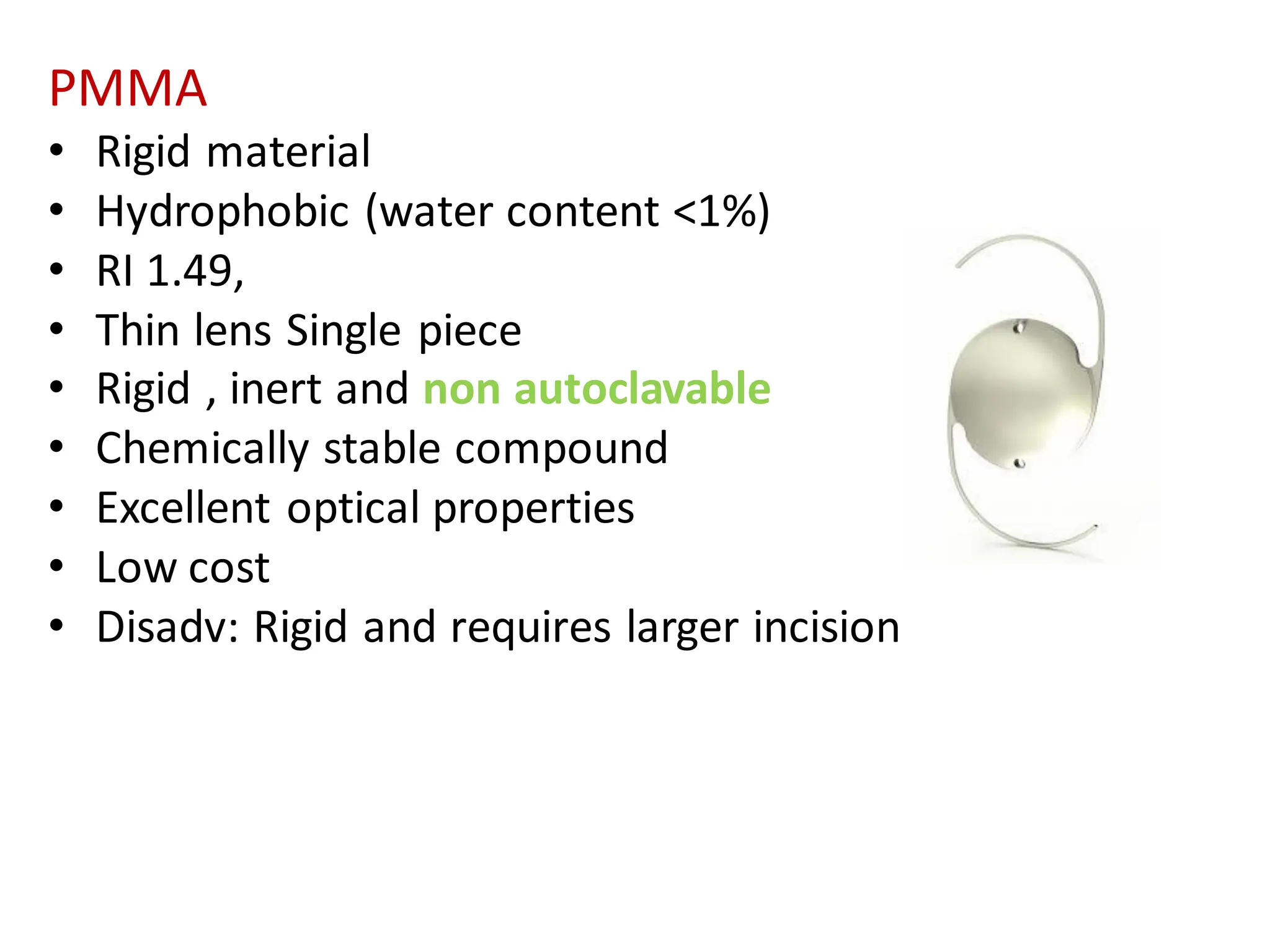
PMMA
• Rigid material
• Hydrophobic (water content <1%)
• RI 1.49,
• Thin lens Single piece
• Rigid , inert and non autoclavable
• Chemically stable compound
• Excellent optical properties
• Low cost
• Disadv: Rigid and requires larger incision
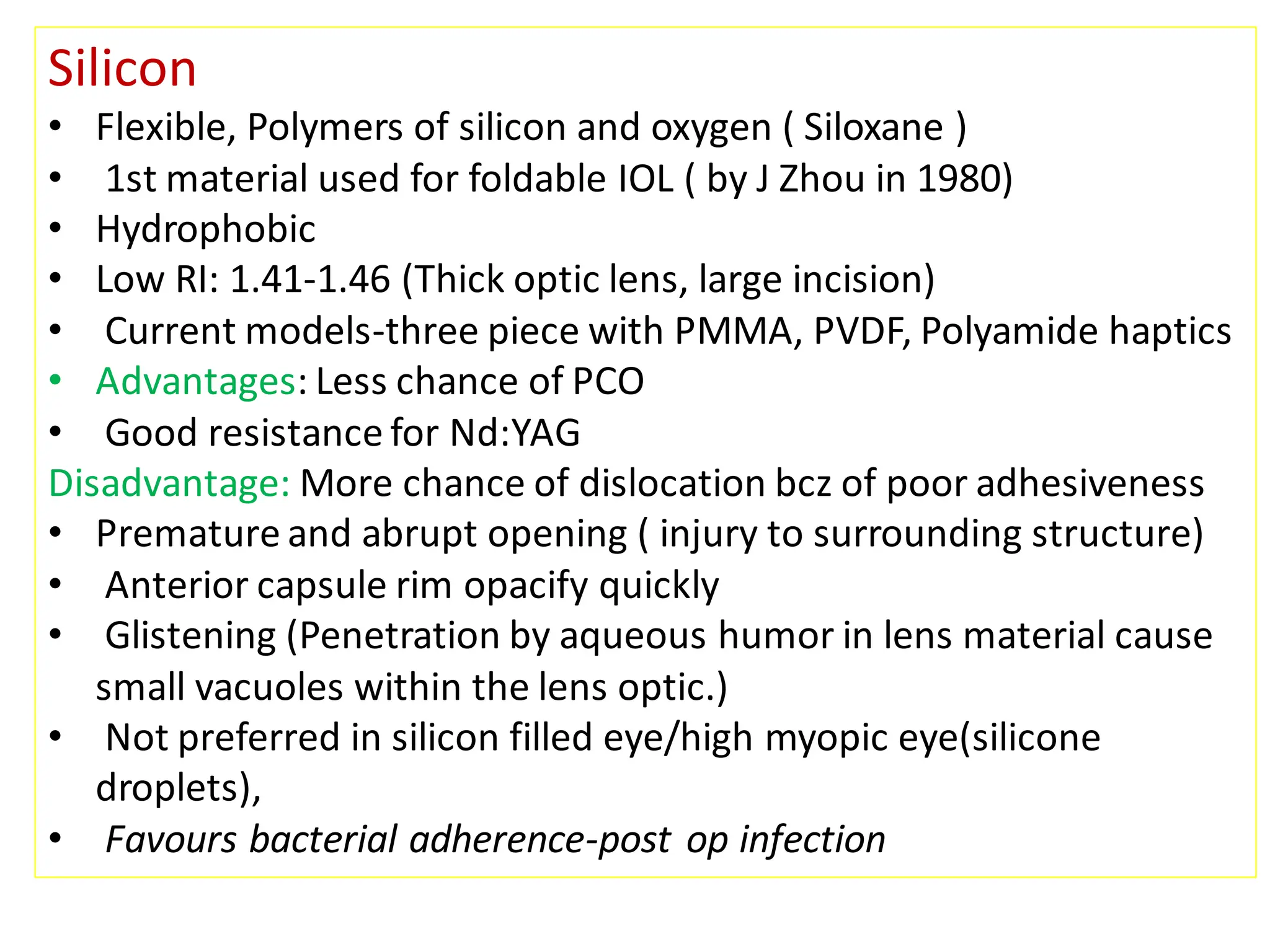
Silicon
• Flexible, Polymers of silicon and oxygen ( Siloxane )
• 1st material used for foldable IOL ( by J Zhou in 1980)
• Hydrophobic
• Low RI: 1.41-1.46 (Thick optic lens, large incision)
• Current models-three piece with PMMA, PVDF, Polyamide haptics
• Advantages: Less chance of PCO
• Good resistance for Nd:YAG
Disadvantage: More chance of dislocation bcz of poor adhesiveness
• Premature and abrupt opening ( injury to surrounding structure)
• Anterior capsule rim opacify quickly
• Glistening (Penetration by aqueous humor in lens material cause
small vacuoles within the lens optic.)
• Not preferred in silicon filled eye/high myopic eye(silicone
droplets),
• Favours bacterial adherence-post op infection
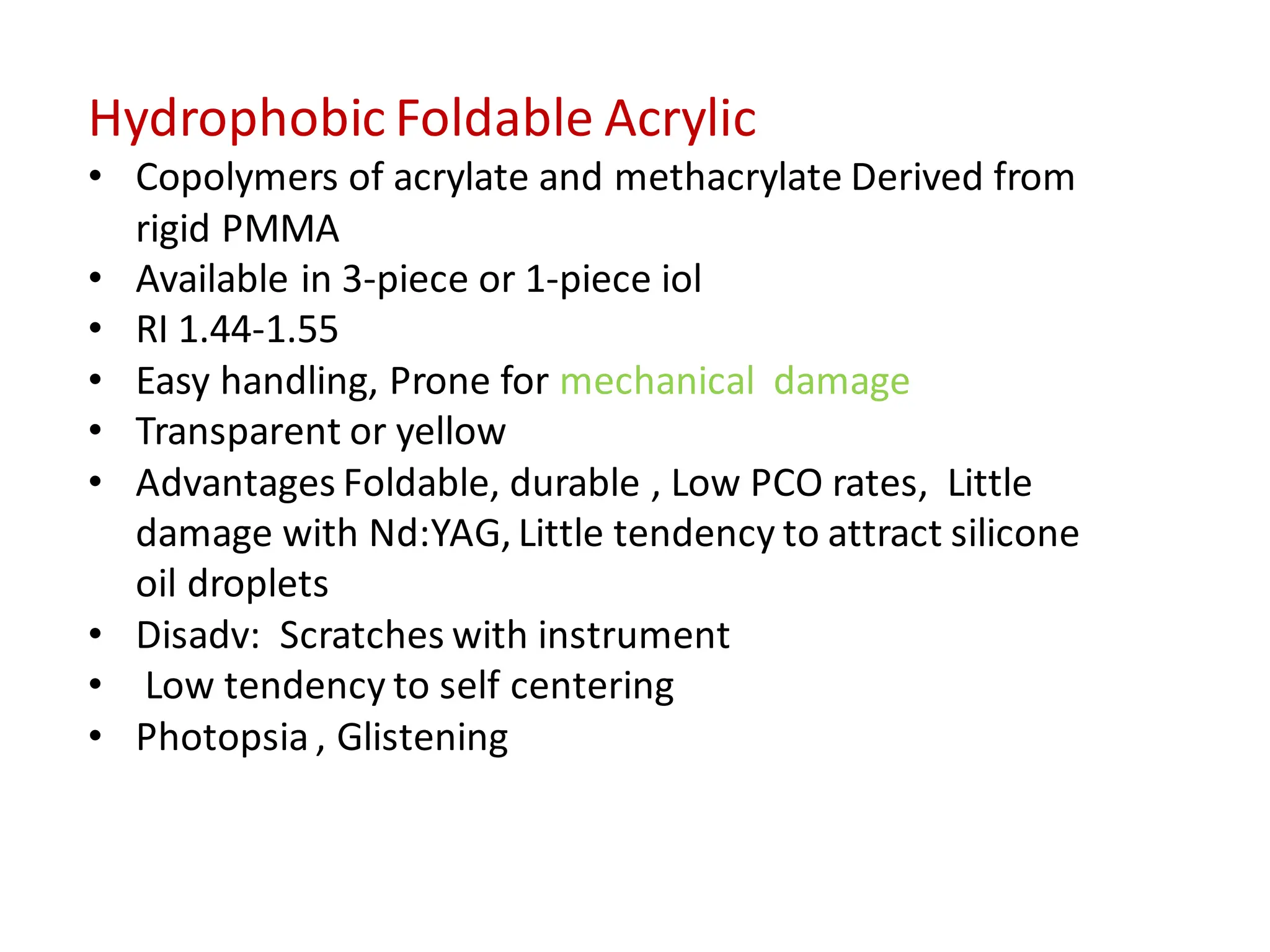
Hydrophobic Foldable Acrylic
• Copolymers of acrylate and methacrylate Derived from
rigid PMMA
• Available in 3-piece or 1-piece iol
• RI 1.44-1.55
• Easy handling, Prone for mechanical damage
• Transparent or yellow
• Advantages Foldable, durable , Low PCO rates, Little
damage with Nd:YAG, Little tendency to attract silicone
oil droplets
• Disadv: Scratches with instrument
• Low tendency to self centering
• Photopsia , Glistening
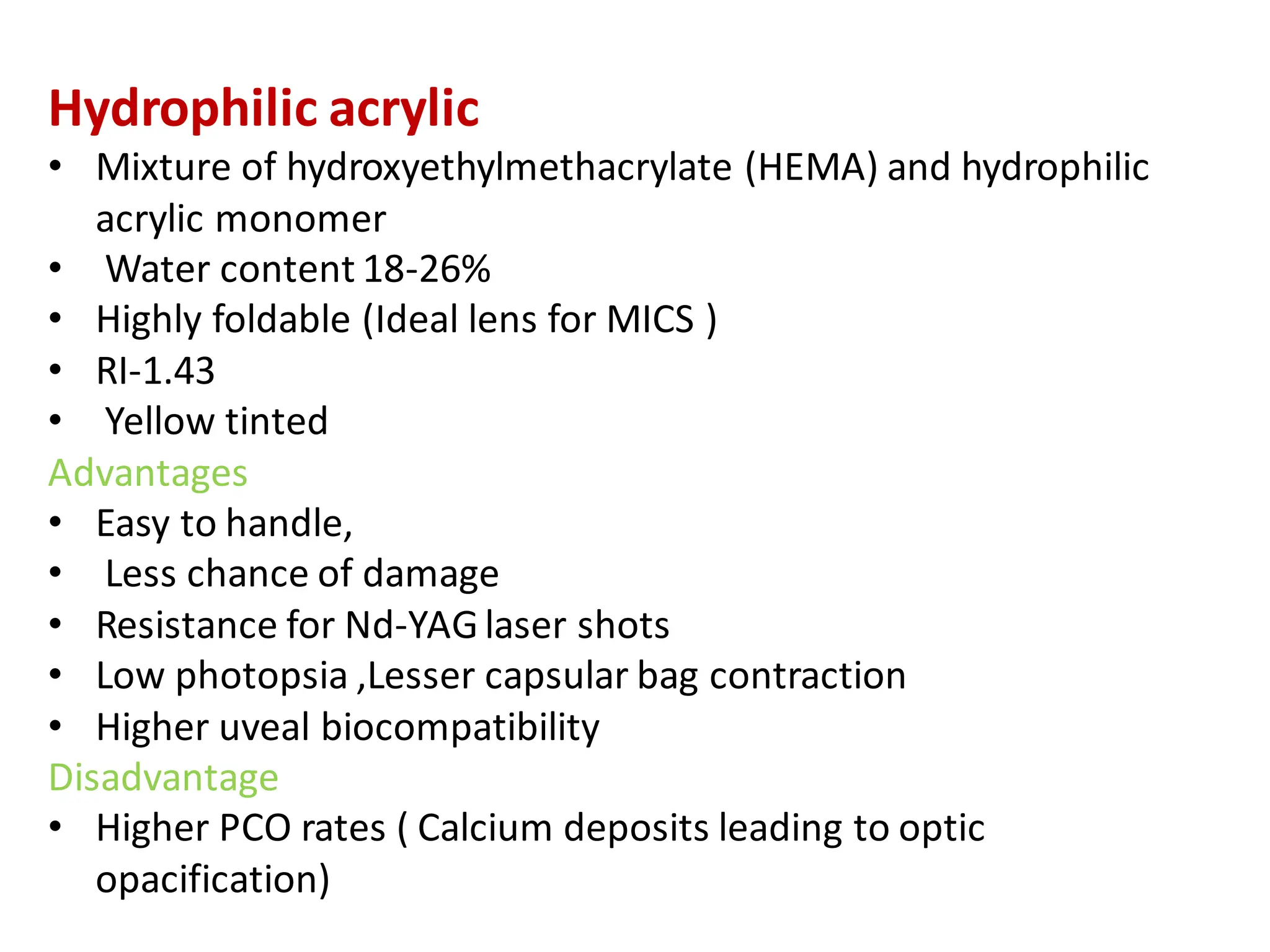
Hydrophilic acrylic
• Mixture of hydroxyethylmethacrylate (HEMA) and hydrophilic
acrylic monomer
• Water content 18-26%
• Highly foldable (Ideal lens for MICS )
• RI-1.43
• Yellow tinted
Advantages
• Easy to handle,
• Less chance of damage
• Resistance for Nd-YAGlaser shots
• Low photopsia ,Lesser capsular bag contraction
• Higher uveal biocompatibility
Disadvantage
• Higher PCO rates ( Calcium deposits leading to optic
opacification)
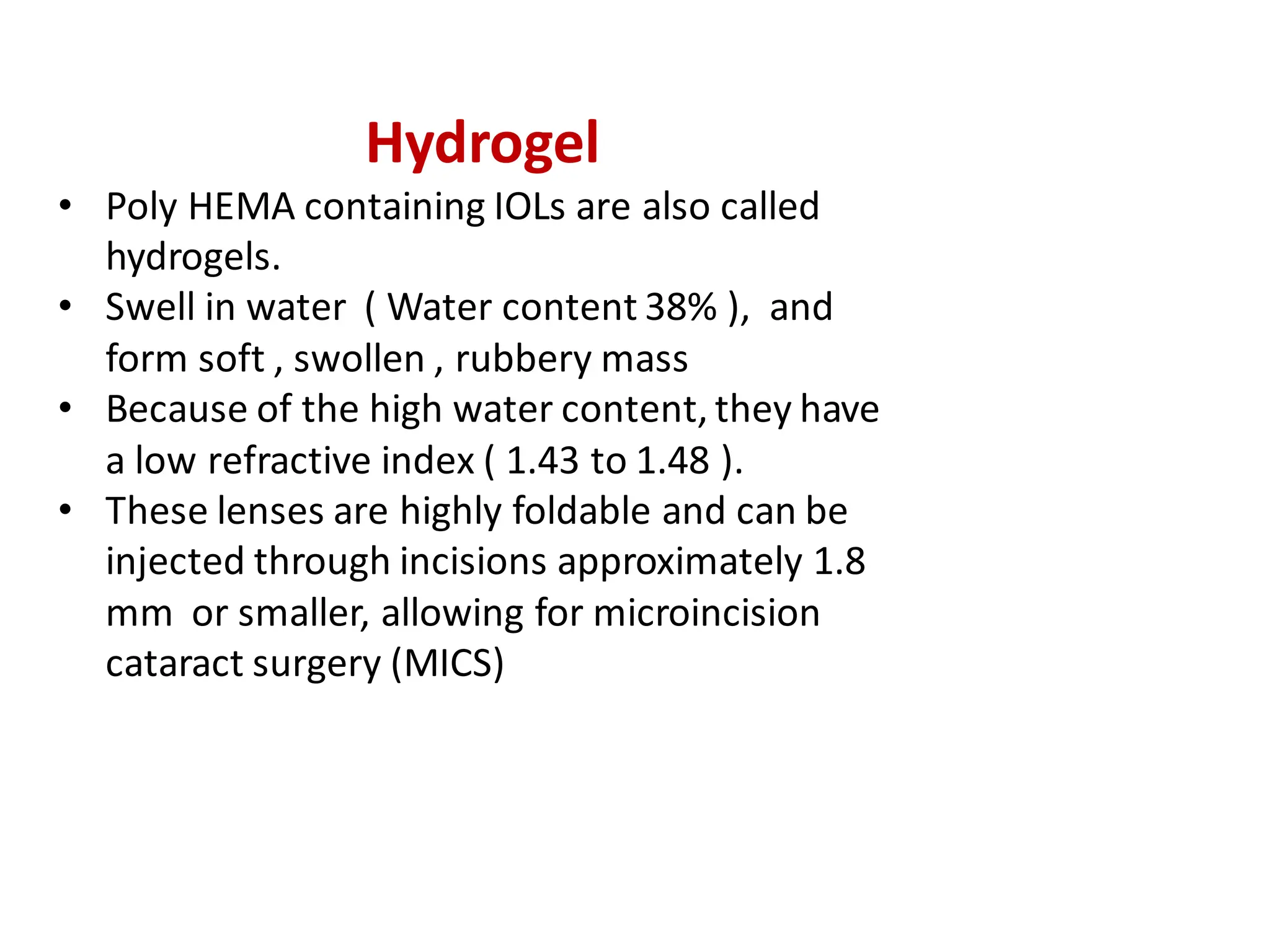
Hydrogel
• Poly HEMA containing IOLs are also called
hydrogels.
• Swell in water ( Water content 38% ), and
form soft , swollen , rubbery mass
• Because of the high water content, they have
a low refractive index ( 1.43 to 1.48 ).
• These lenses are highly foldable and can be
injected through incisions approximately 1.8
mm or smaller, allowing for microincision
cataract surgery (MICS)
Collamer
• Patented copolymer of hydrophilic
acrylic and porcine collagen .
• Hydroxyethyl methacrylate
copolymer with a UV absorbing
chromophore.
• Hydrophilic
• In theory, the porcine collagen
improves the biocompatibility of
the lens when implanted in
human eyes.
• Mainly used for Posterior
Chamber Phakic Intraocular lenses
[ implantable collamer lens (ICL)]
INTRAOCULAR LENS DESIGN
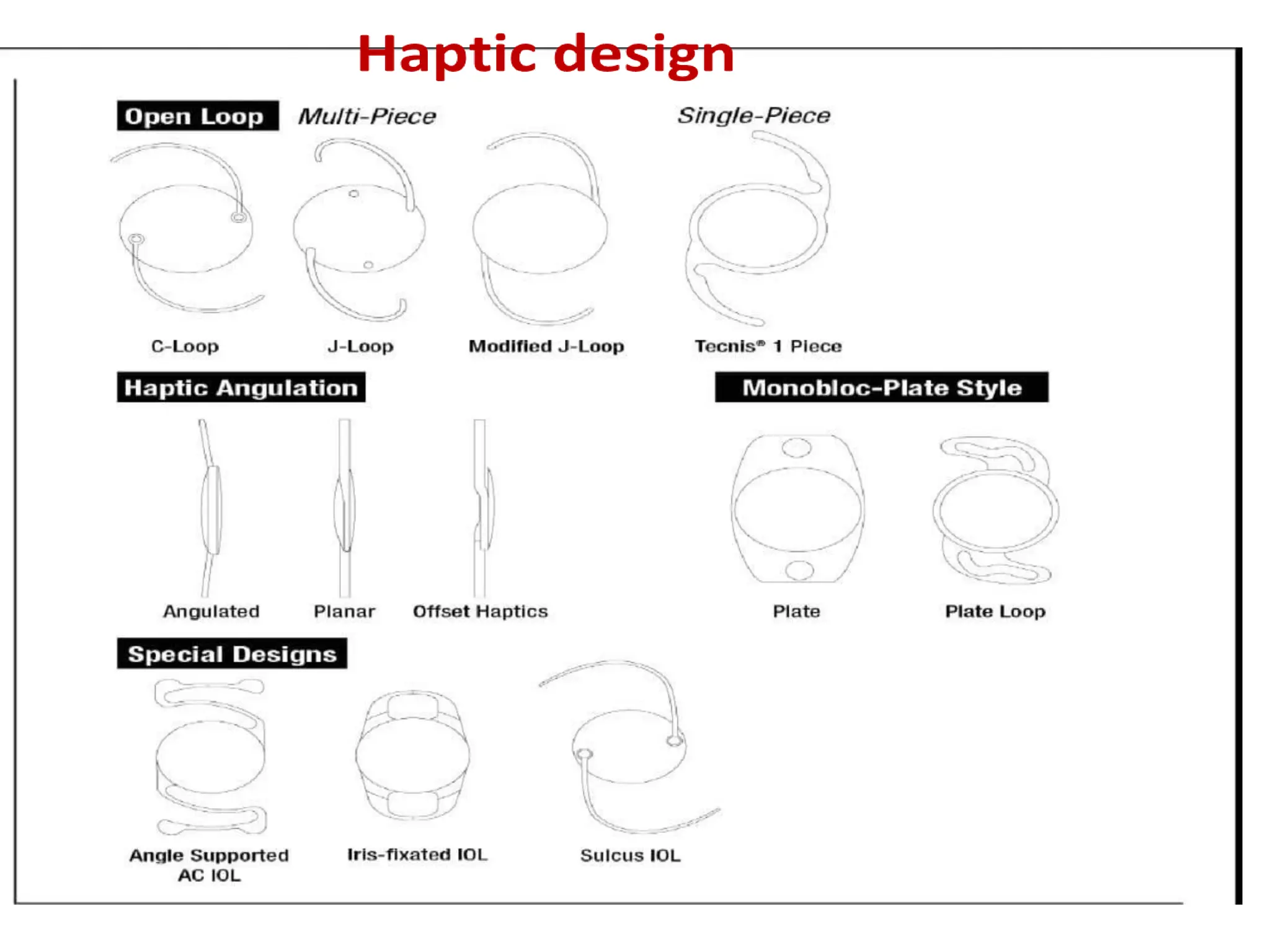
➢ Single piece / 3-piece
➢ Plate haptic / open loop haptics
➢ Angulated / planar haptics
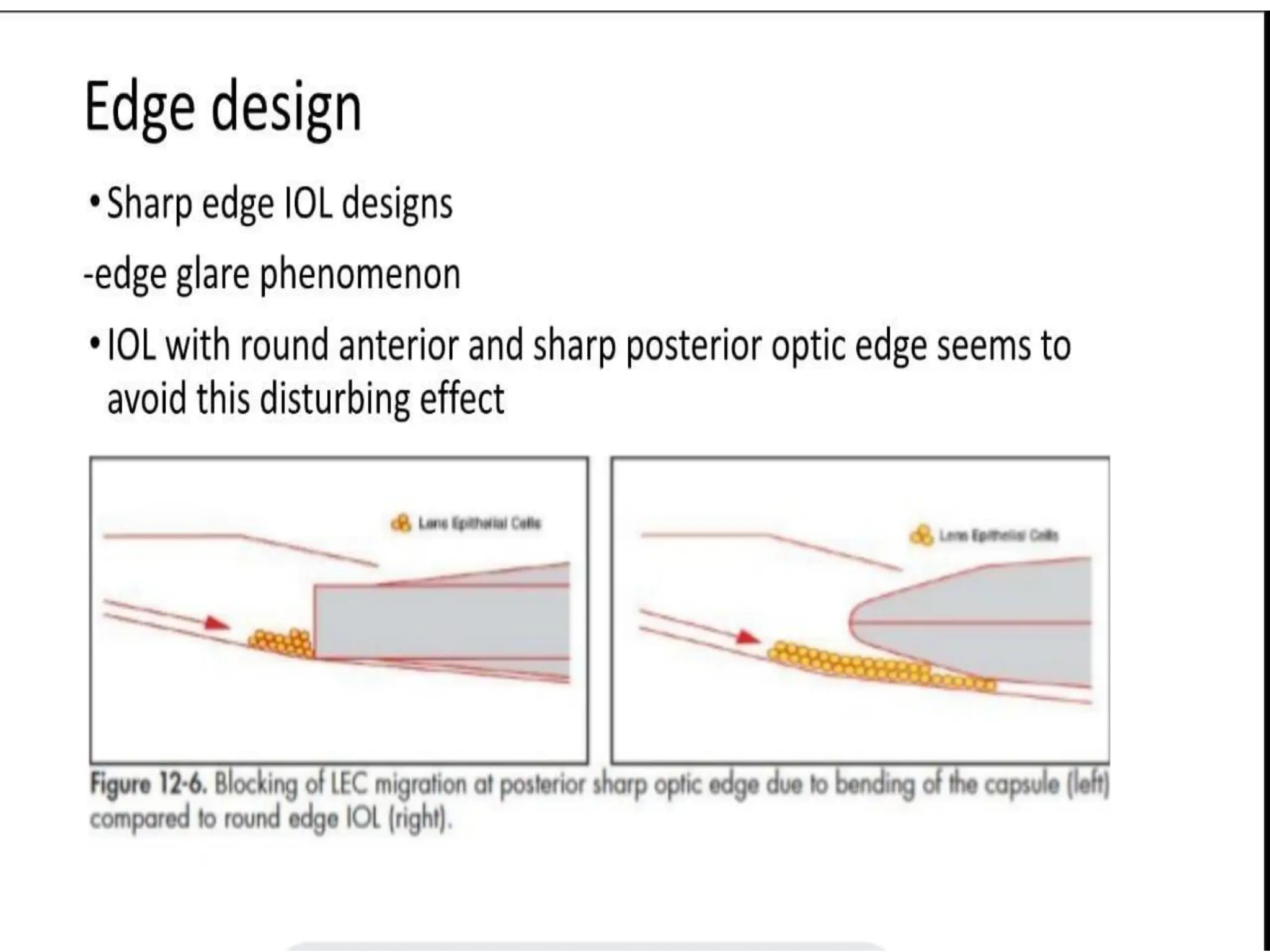
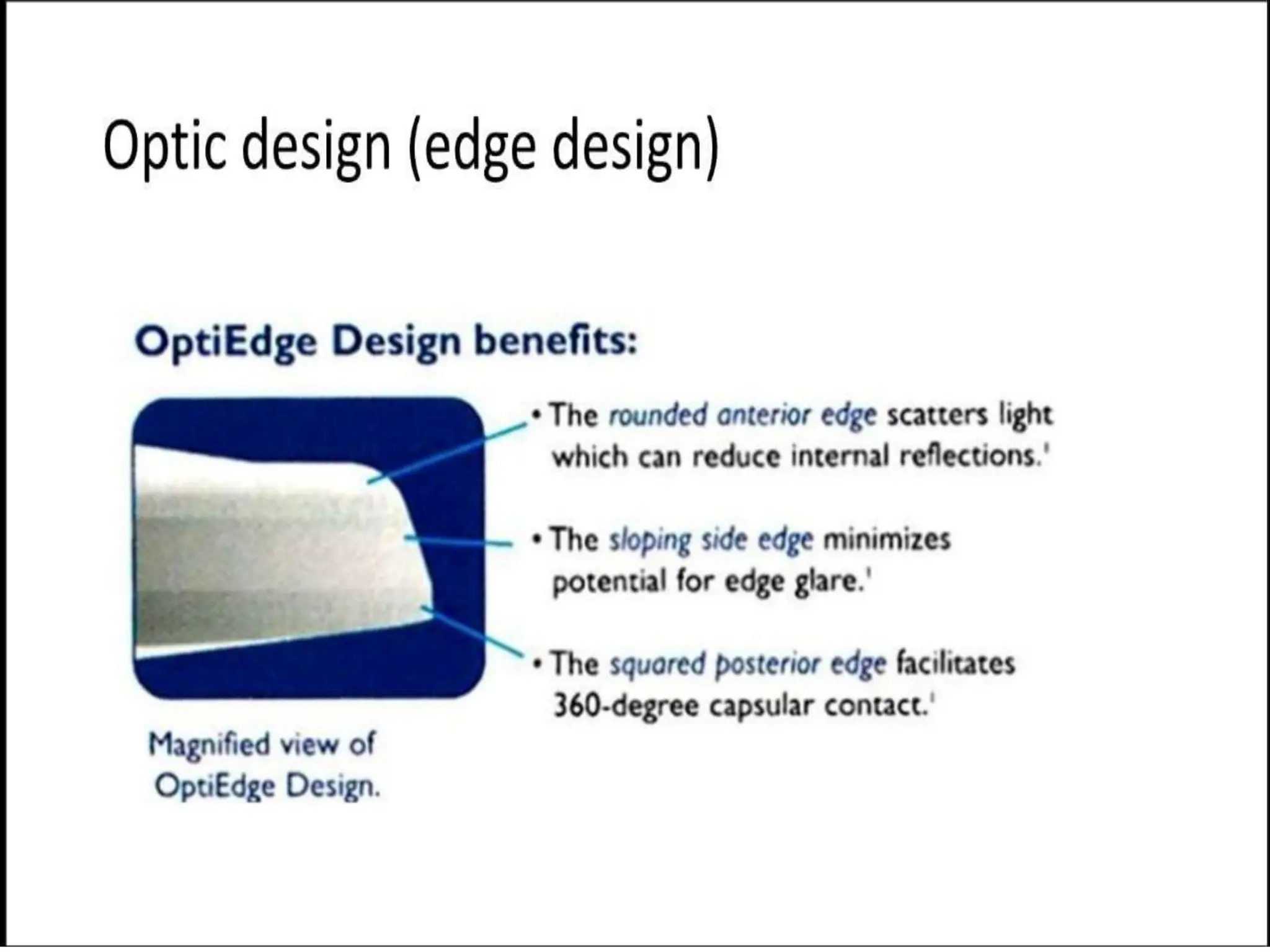
➢ Edge design
➢ Optic design
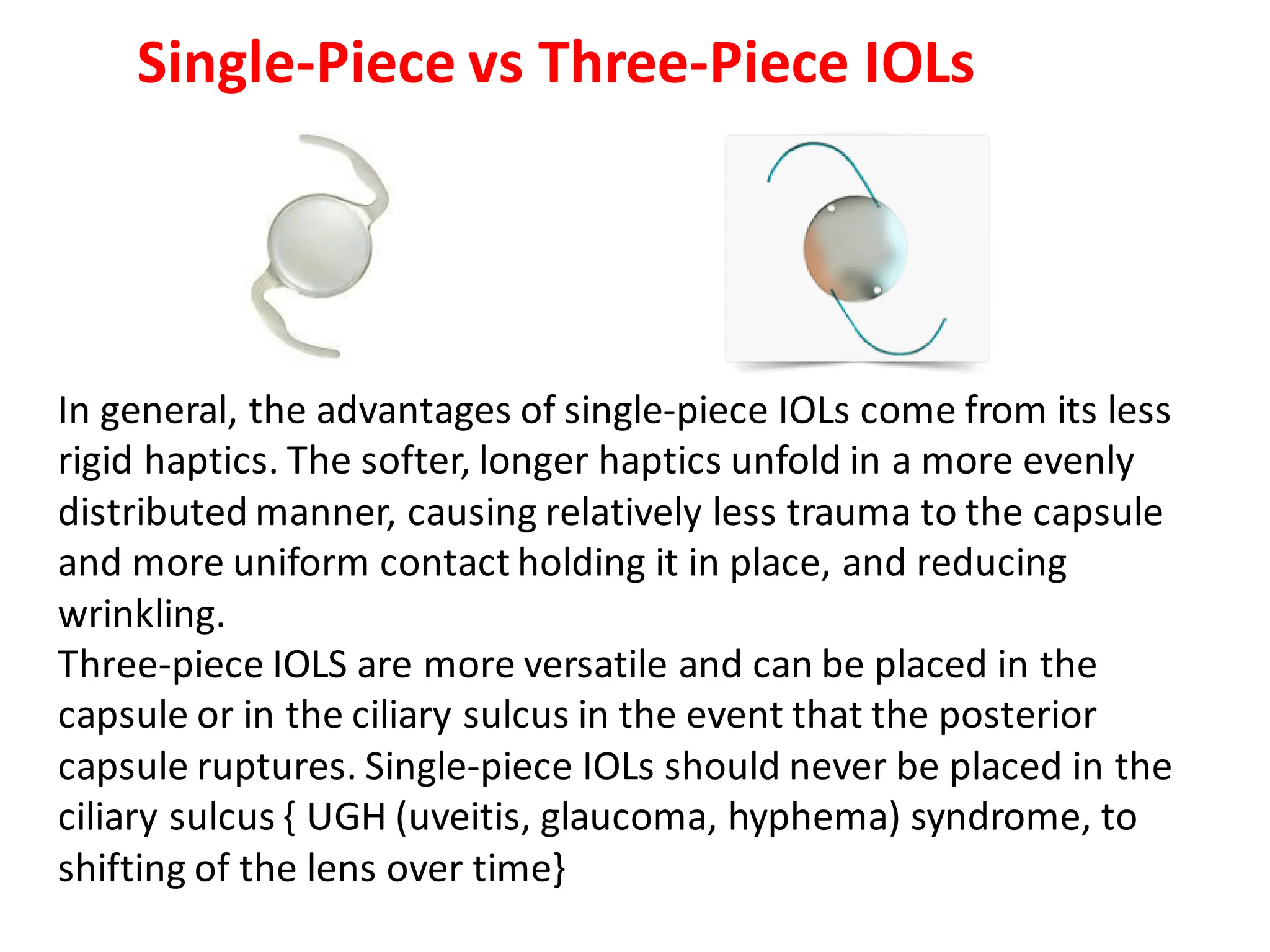
In general, the advantages of single-piece IOLs come from its less
rigid haptics. The softer, longer haptics unfold in a more evenly
distributed manner, causing relatively less trauma to the capsule
and more uniform contact holding it in place, and reducing
wrinkling.
Three-piece IOLS are more versatile and can be placed in the
capsule or in the ciliary sulcus in the event that the posterior
capsule ruptures. Single-piece IOLs should never be placed in the
ciliary sulcus { UGH (uveitis, glaucoma, hyphema) syndrome, to
shifting of the lens over time}
Single-Piece vs Three-Piece IOLs
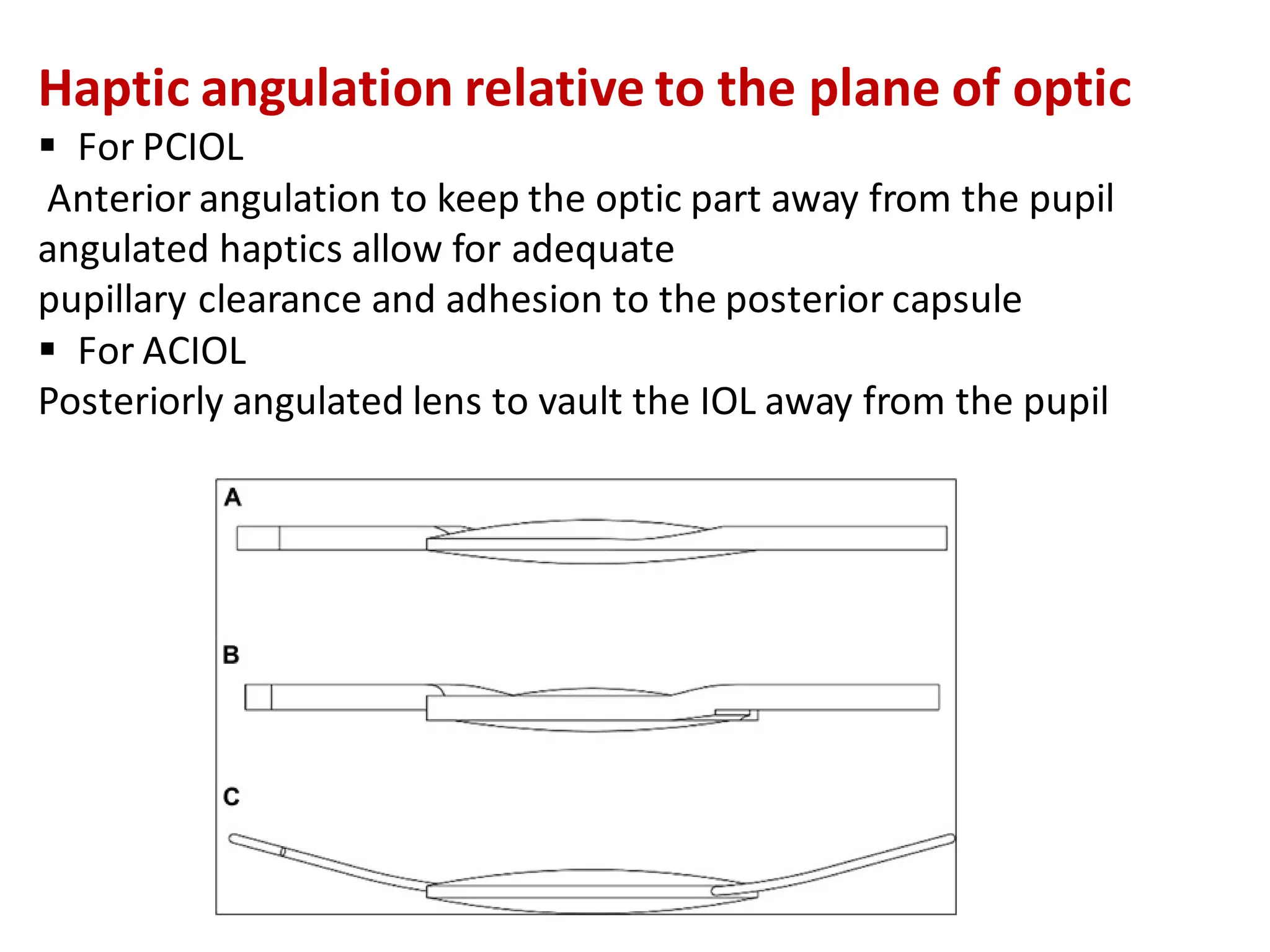
Haptic angulation relative to the plane of optic
▪ For PCIOL
Anterior angulation to keep the optic part away from the pupil
angulated haptics allow for adequate
pupillary clearance and adhesion to the posterior capsule
▪ For ACIOL
Posteriorly angulated lens to vault the IOL away from the pupil
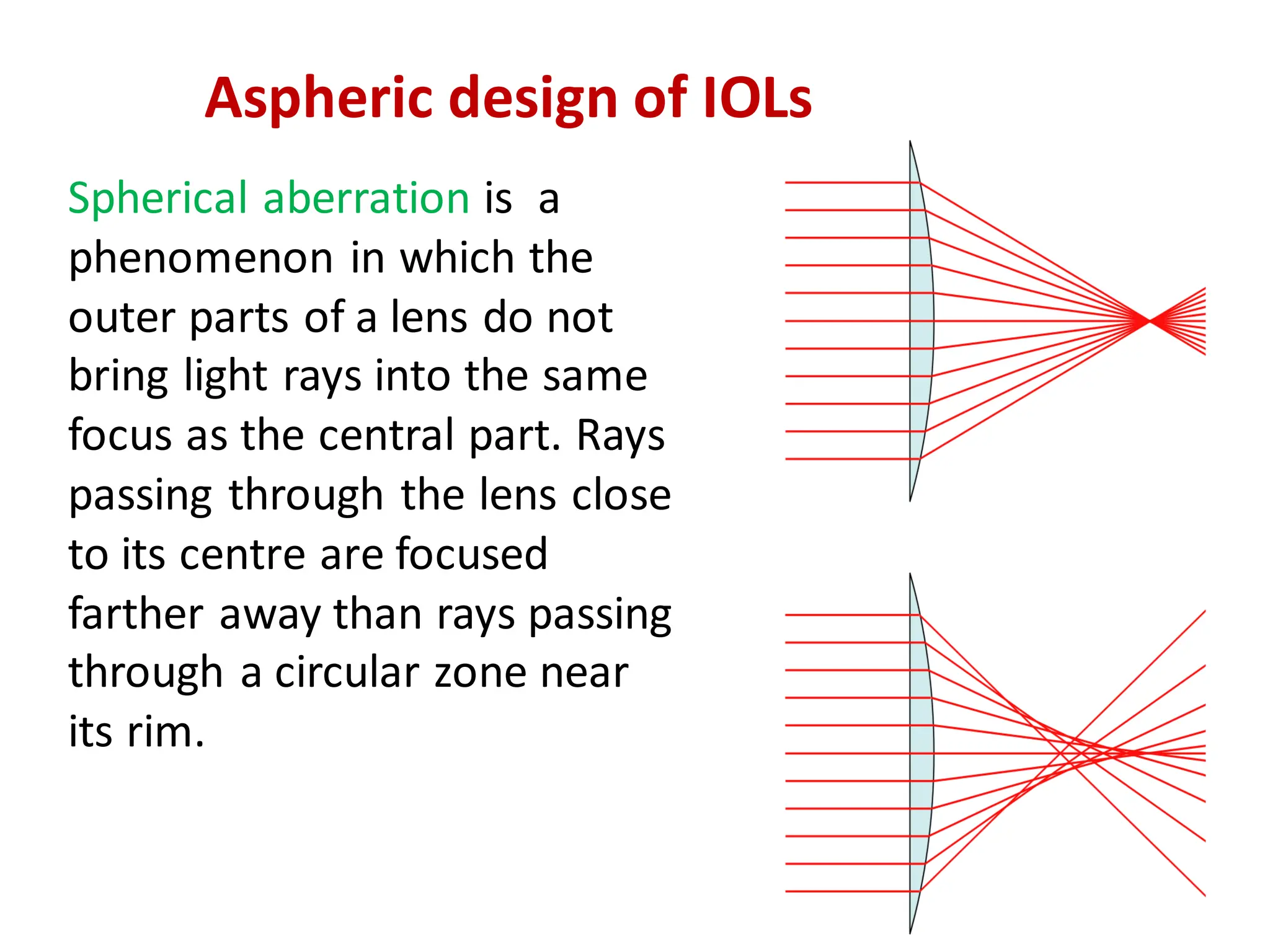
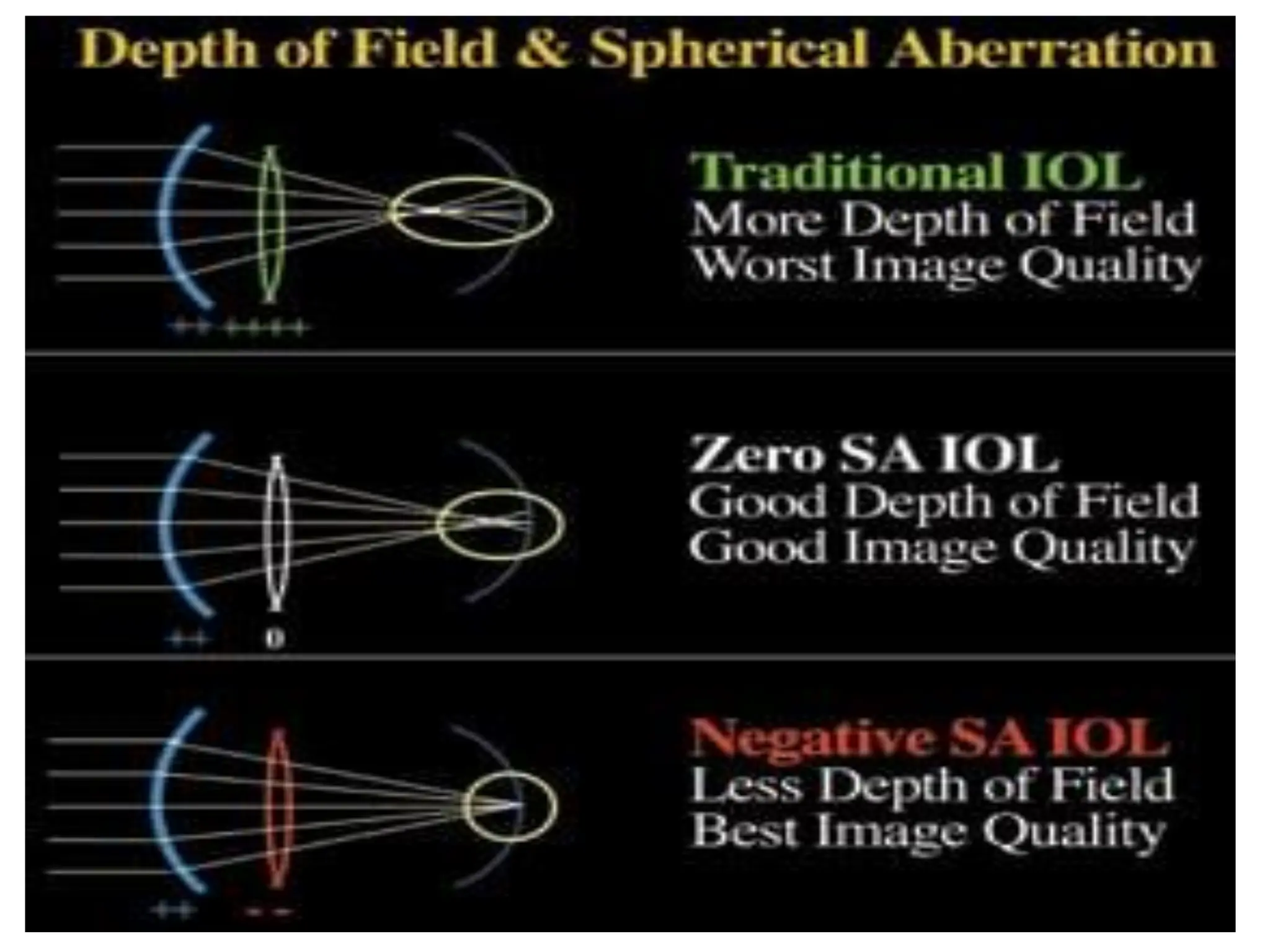
Aspheric design of IOLs
Spherical aberration is a
phenomenon in which the
outer parts of a lens do not
bring light rays into the same
focus as the central part. Rays
passing through the lens close
to its centre are focused
farther away than rays passing
through a circular zone near
its rim.
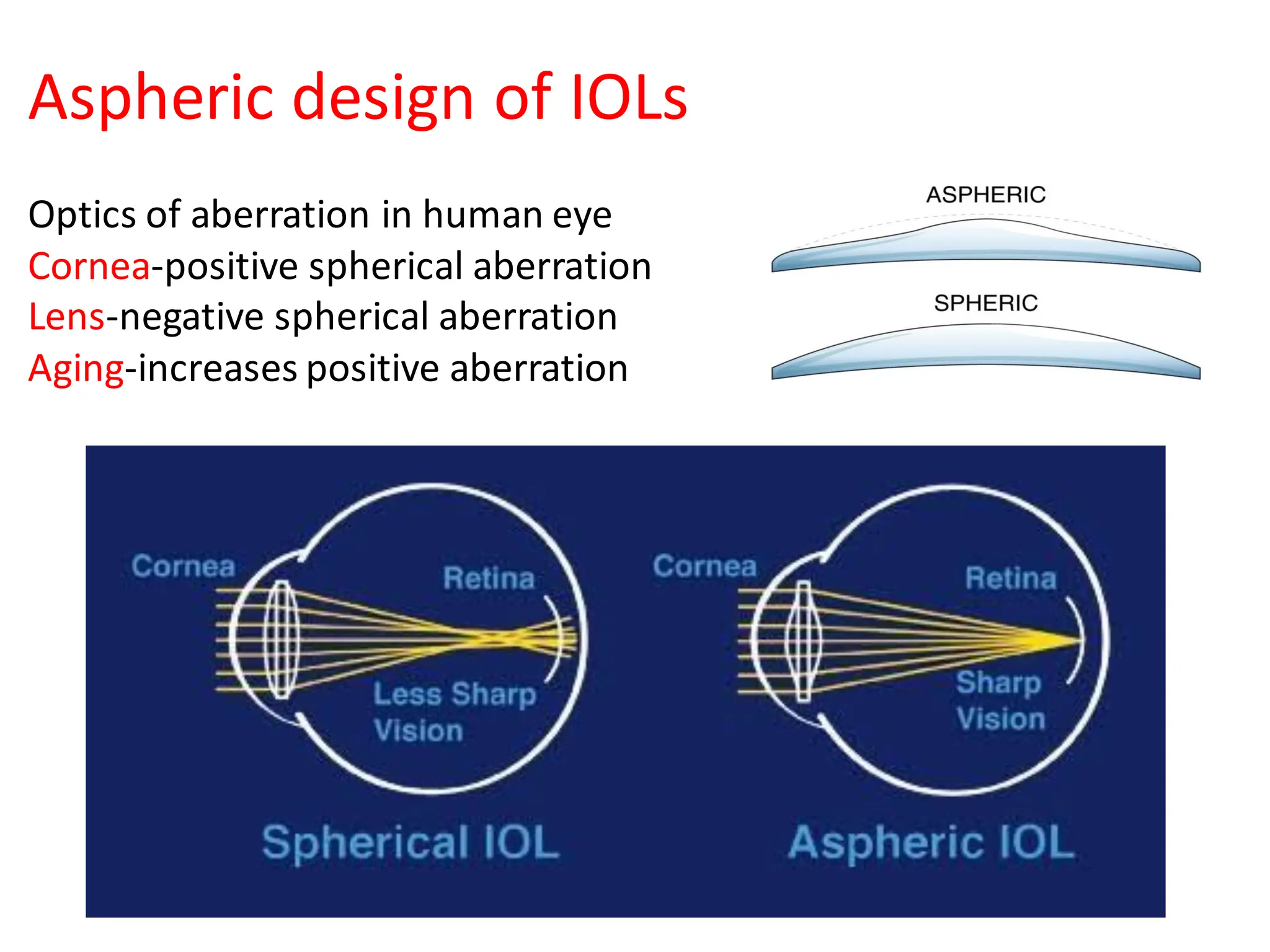
Aspheric design of IOLs
Optics of aberration in human eye
Cornea-positive spherical aberration
Lens-negative spherical aberration
Aging-increases positive aberration
Premium IOL
•Multifocal
•Accommadative
•Toric monofocal IOL
•Toric multifocal IOL
•Monovision
• IOLS which can separate incoming light into two or more foci, thus
resulting in multiple coexisting retinal images.
• At any given point, only one of the images (distance, intermediate
or near) is the sharpest, and hence selected by the brain for
visualisation. This concept is known as simultaneous vision.
• The visual system in any mammal is not known to be multifocal,
hence the implantation of these IOLS initiate a process of
neuroadaptation in the recipient's brain, and its best effect is seen
only after some days to weeks.
• The splitting of light to form multiple images leads to loss of
contrast for each image.
• However, despite these limitations, MFIOLS continue to be one of
the best technologies to provide spectacle independence for all
distances after cataract surgery.
MULTIFOCAL IOL
MULTIFOCAL IOL
• Concept by Hoffer
• Implanted by Pearce in 1986
• IOL with 2 or more focal points
MFIOL can be classified in two ways:
II. Based on optical design and Mechanism of action
1. Refractive
2. Diffractive
3. Apodized Diffractive
I. Based on focality
1. Bifocal creating a focus for distance as well as near vision.
2. Trifocal IOLs have an additional focus for intermediate vision.
3. Extended Depth of Focus (EDOF) IOLS produces an elongated focus of
vision, which provides distance as well as an intermediate vision over a
range.
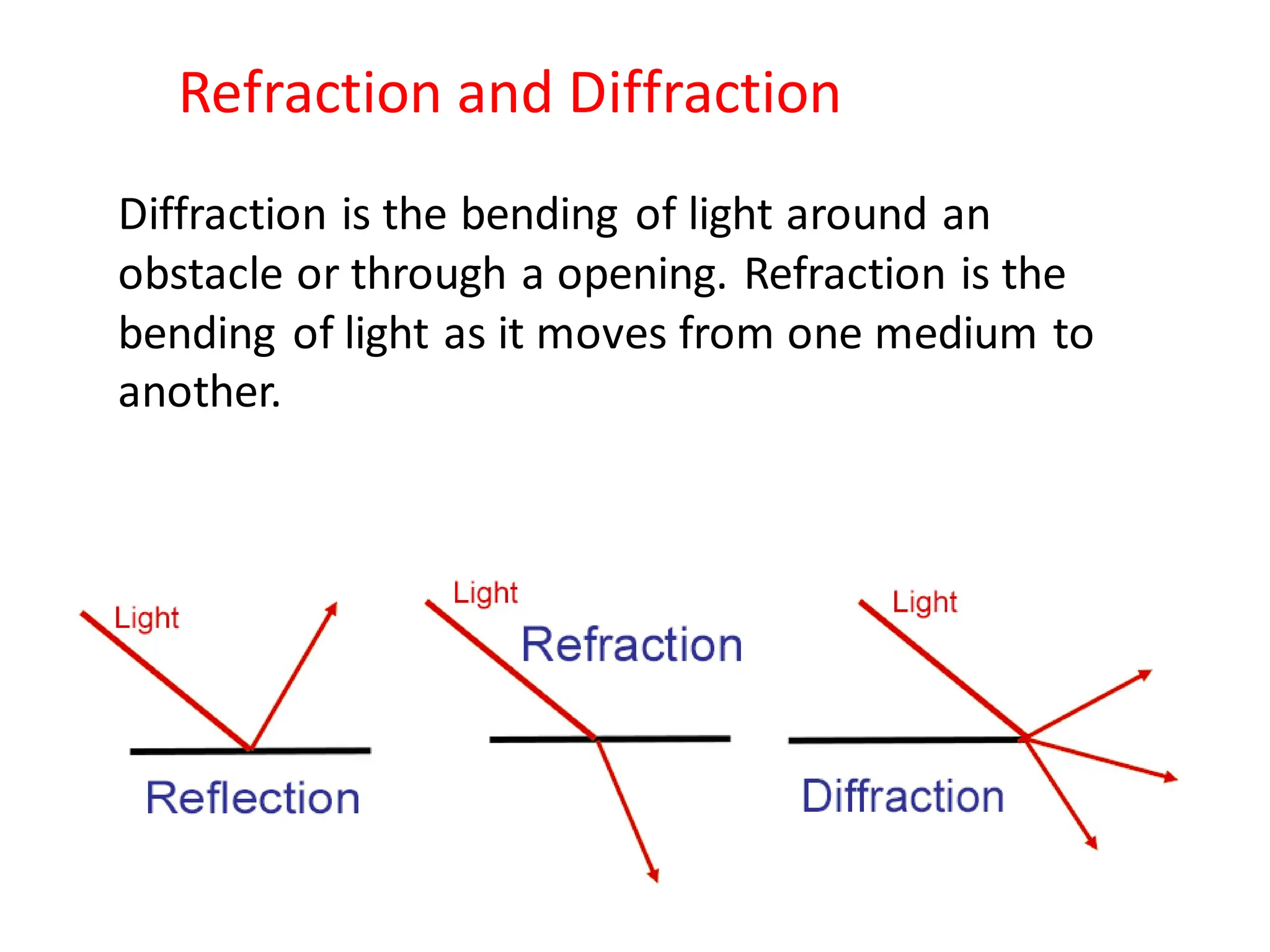
Diffraction is the bending of light around an
obstacle or through a opening. Refraction is the
bending of light as it moves from one medium to
another.
Refraction and Diffraction
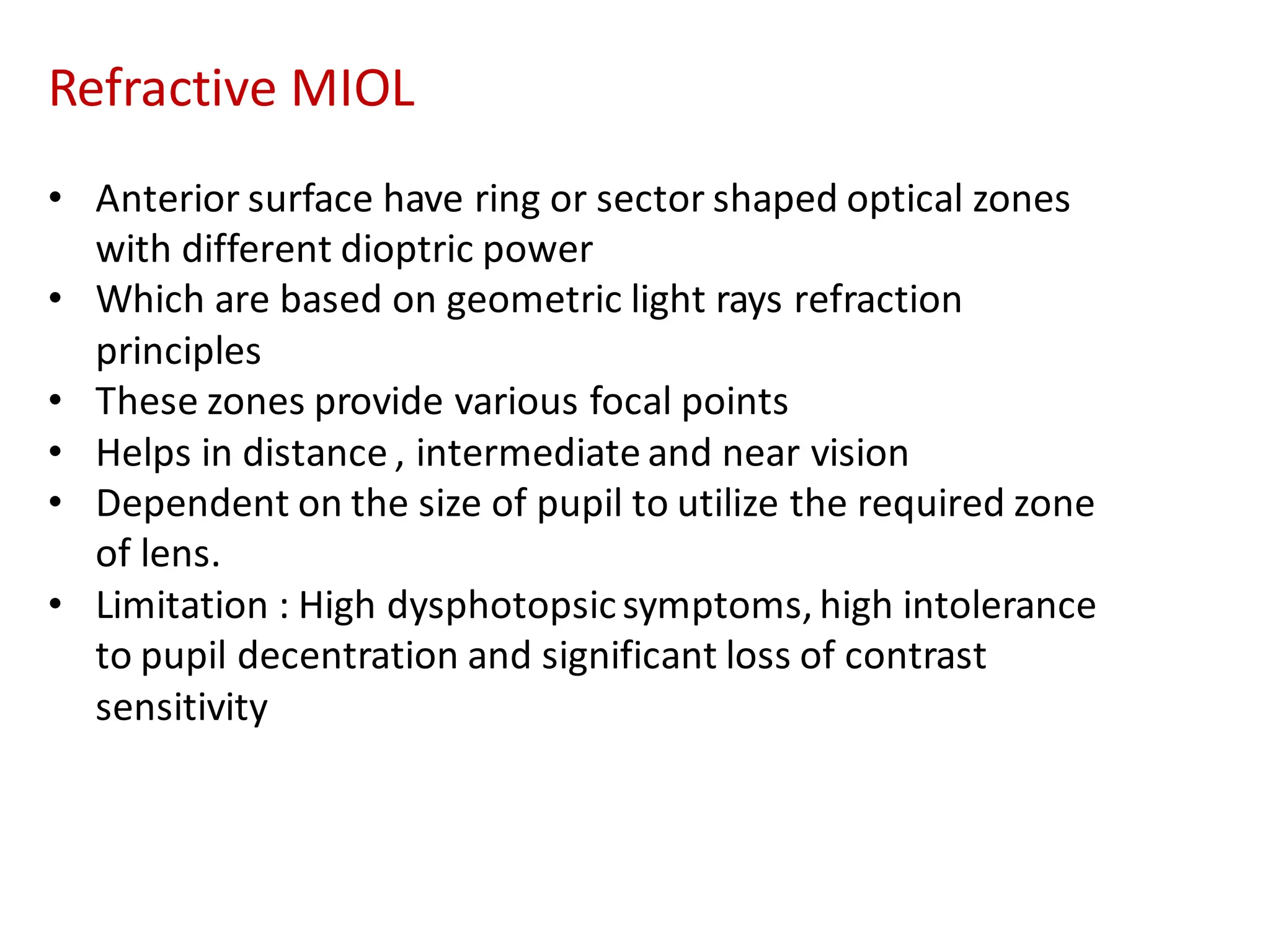
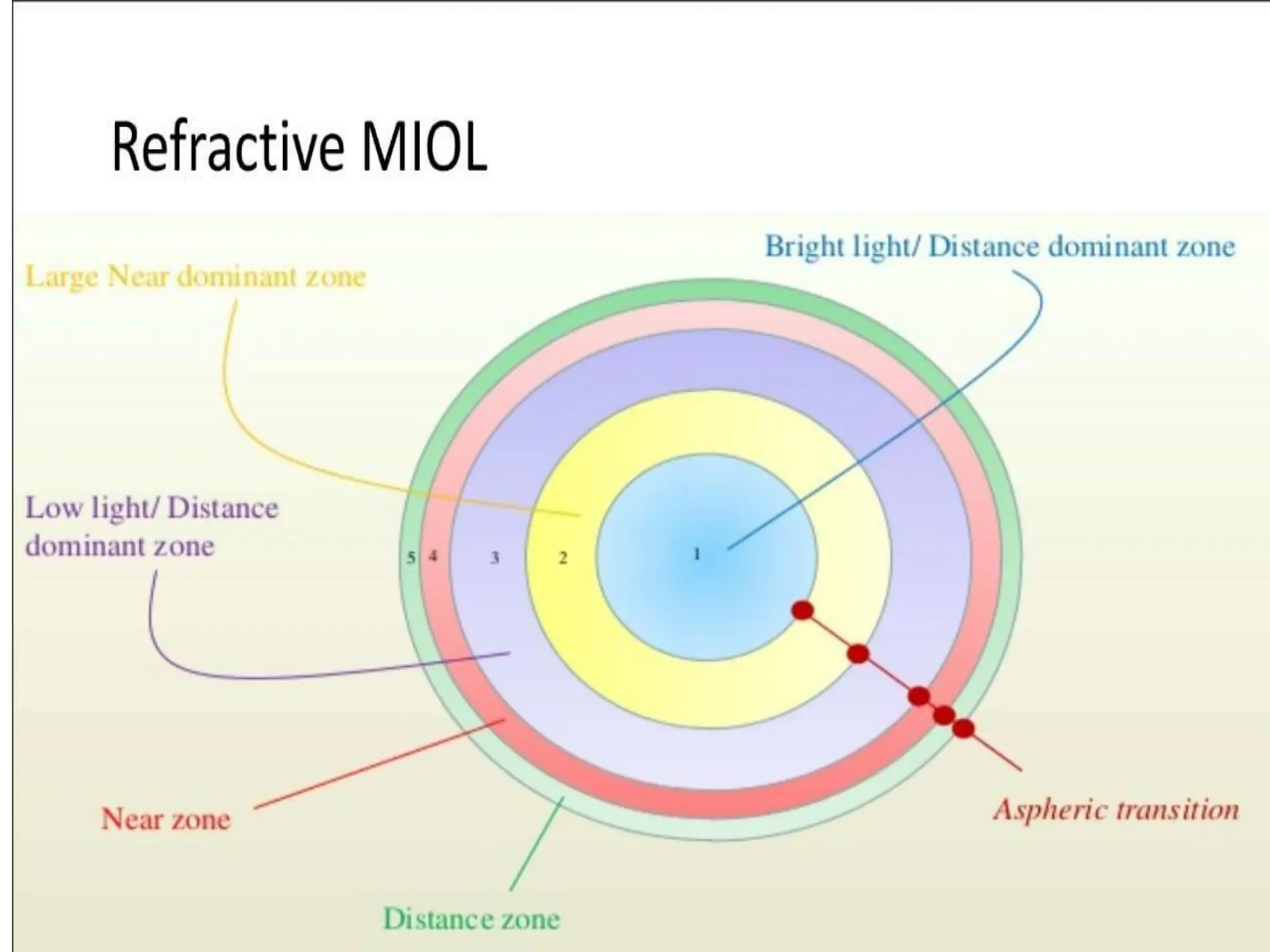
Refractive MIOL
• Anterior surface have ring or sector shaped optical zones
with different dioptric power
• Which are based on geometric light rays refraction
principles
• These zones provide various focal points
• Helps in distance , intermediate and near vision
• Dependent on the size of pupil to utilize the required zone
of lens.
• Limitation : High dysphotopsicsymptoms, high intolerance
to pupil decentration and significant loss of contrast
sensitivity
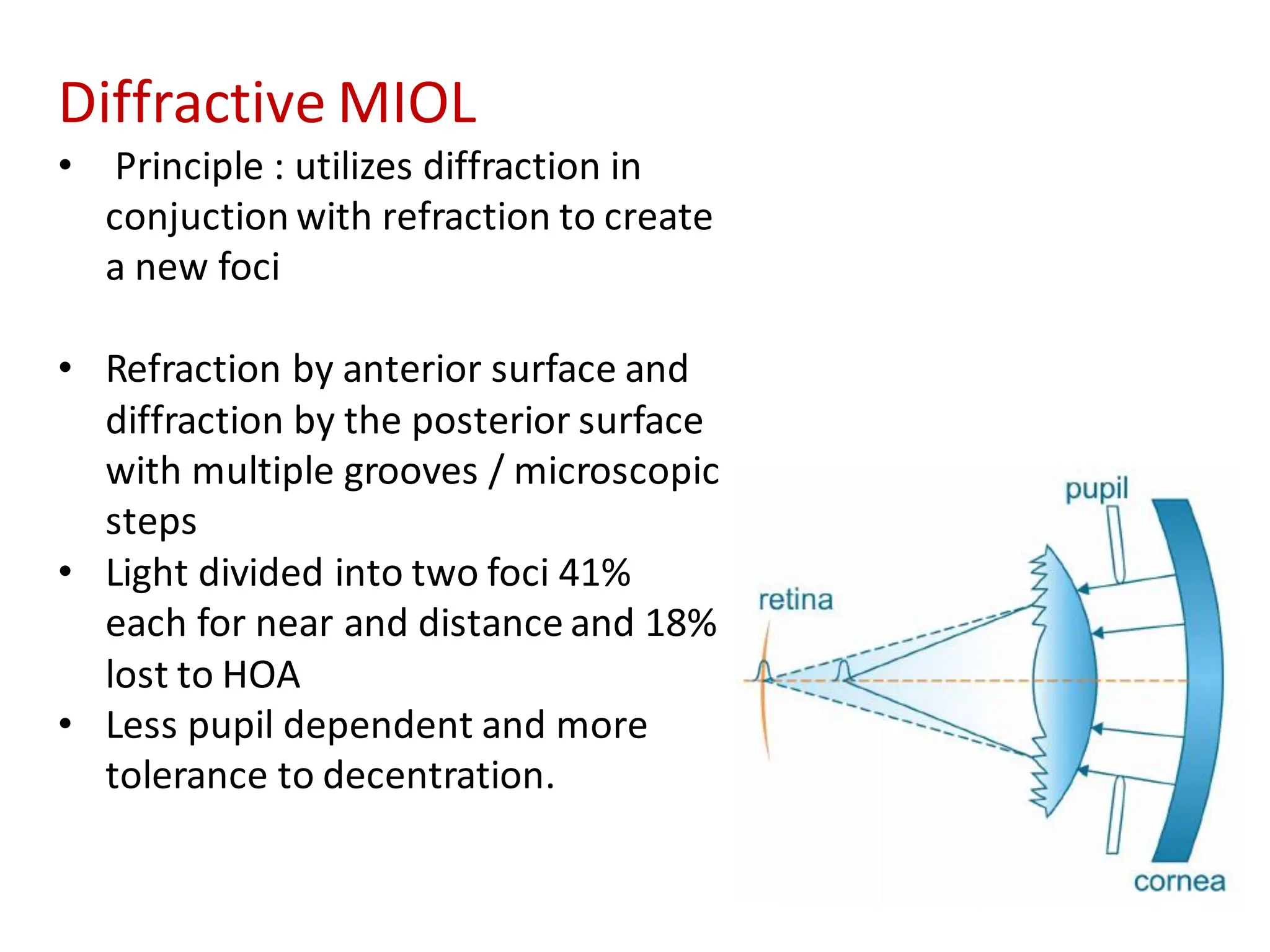
Diffractive MIOL
• Principle : utilizes diffraction in
conjuction with refraction to create
a new foci
• Refraction by anterior surface and
diffraction by the posterior surface
with multiple grooves / microscopic
steps
• Light divided into two foci 41%
each for near and distance and 18%
lost to HOA
• Less pupil dependent and more
tolerance to decentration.
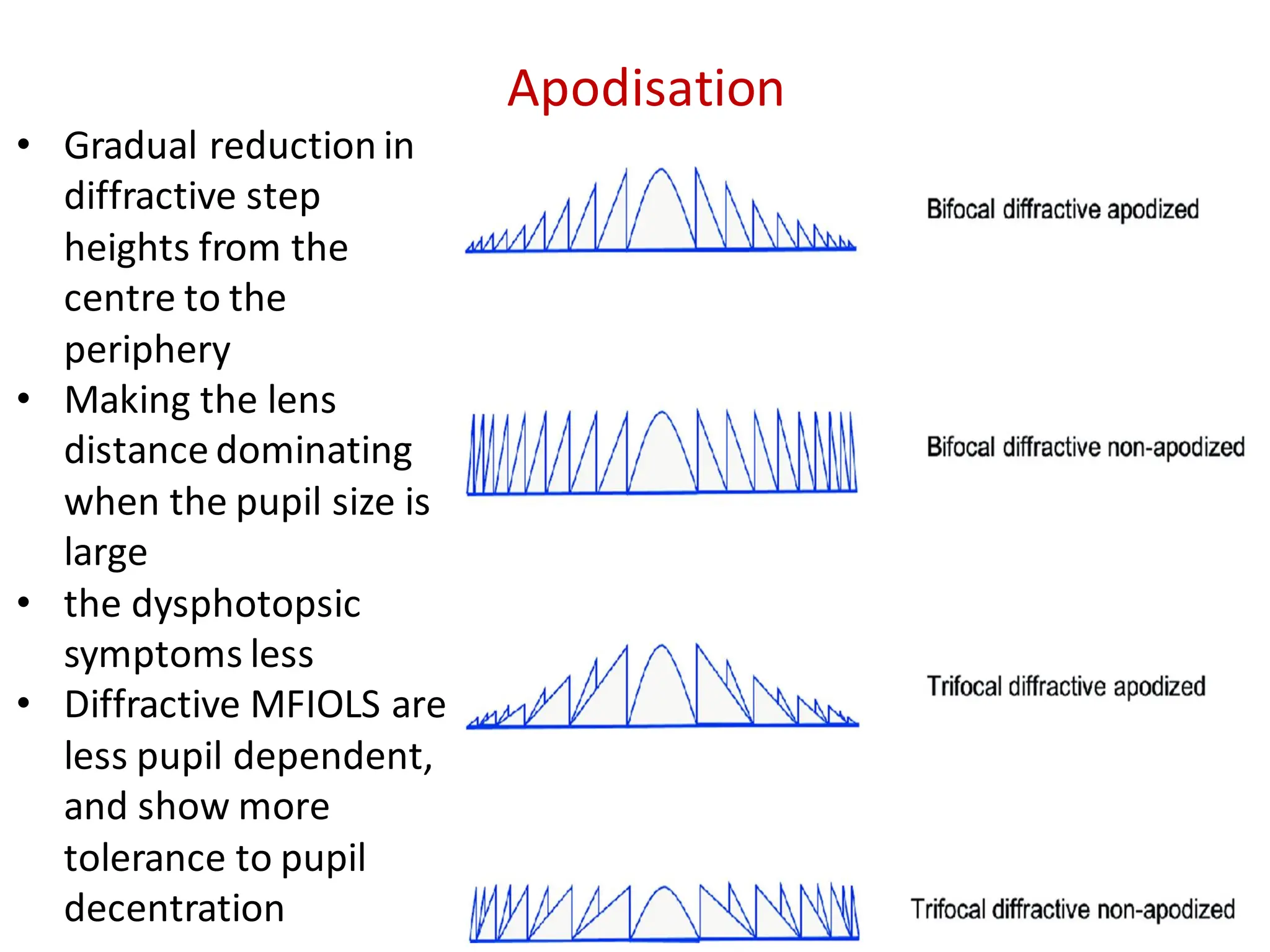
• Gradual reduction in
diffractive step
heights from the
centre to the
periphery
• Making the lens
distance dominating
when the pupil size is
large
• the dysphotopsic
symptoms less
• Diffractive MFIOLS are
less pupil dependent,
and show more
tolerance to pupil
decentration
Apodisation
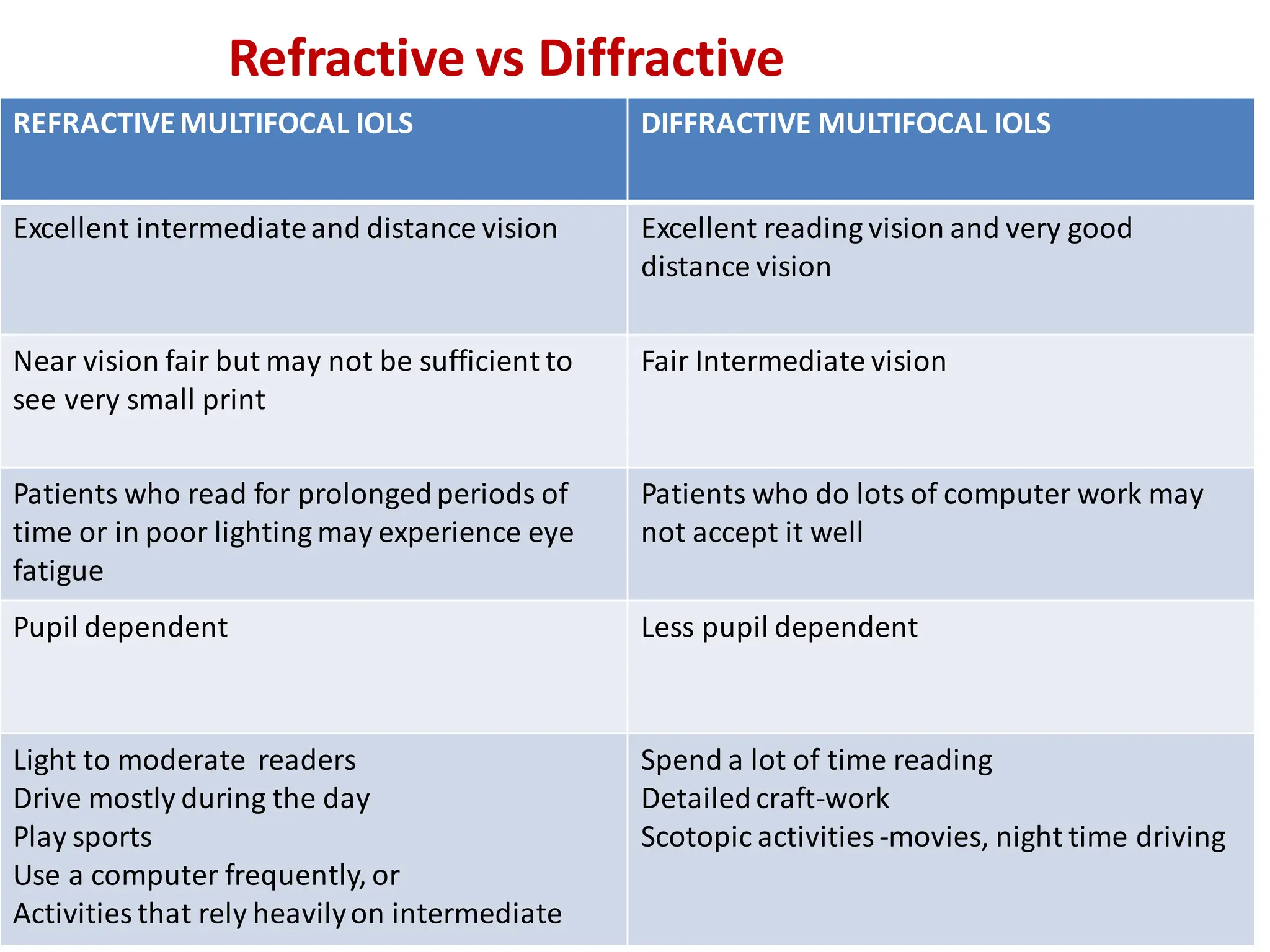
REFRACTIVEMULTIFOCAL IOLS DIFFRACTIVE MULTIFOCAL IOLS
Excellent intermediateand distance vision Excellent reading vision and very good
distance vision
Near vision fair but may not be sufficient to
see very small print
Fair Intermediate vision
Patients who read for prolongedperiods of
time or in poor lighting may experience eye
fatigue
Patients who do lots of computer work may
not accept it well
Pupil dependent Less pupil dependent
Light to moderate readers
Drive mostly during the day
Play sports
Use a computer frequently, or
Activities that rely heavilyon intermediate
Spend a lot of time reading
Detailedcraft-work
Scotopic activities -movies, night time driving
Refractive vs Diffractive
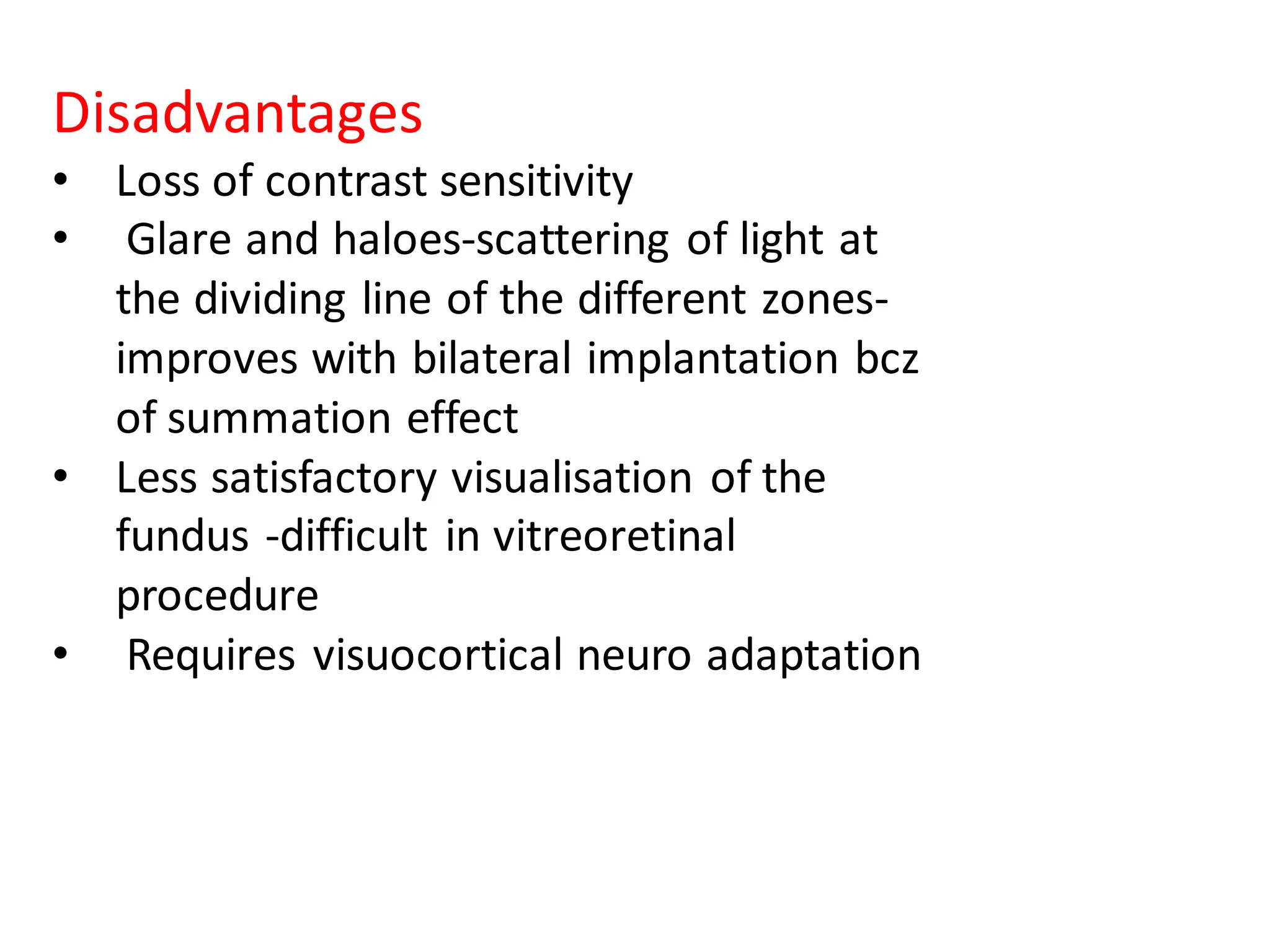
Disadvantages
• Loss of contrast sensitivity
• Glare and haloes-scattering of light at
the dividing line of the different zones-
improves with bilateral implantation bcz
of summation effect
• Less satisfactory visualisation of the
fundus -difficult in vitreoretinal
procedure
• Requires visuocortical neuro adaptation
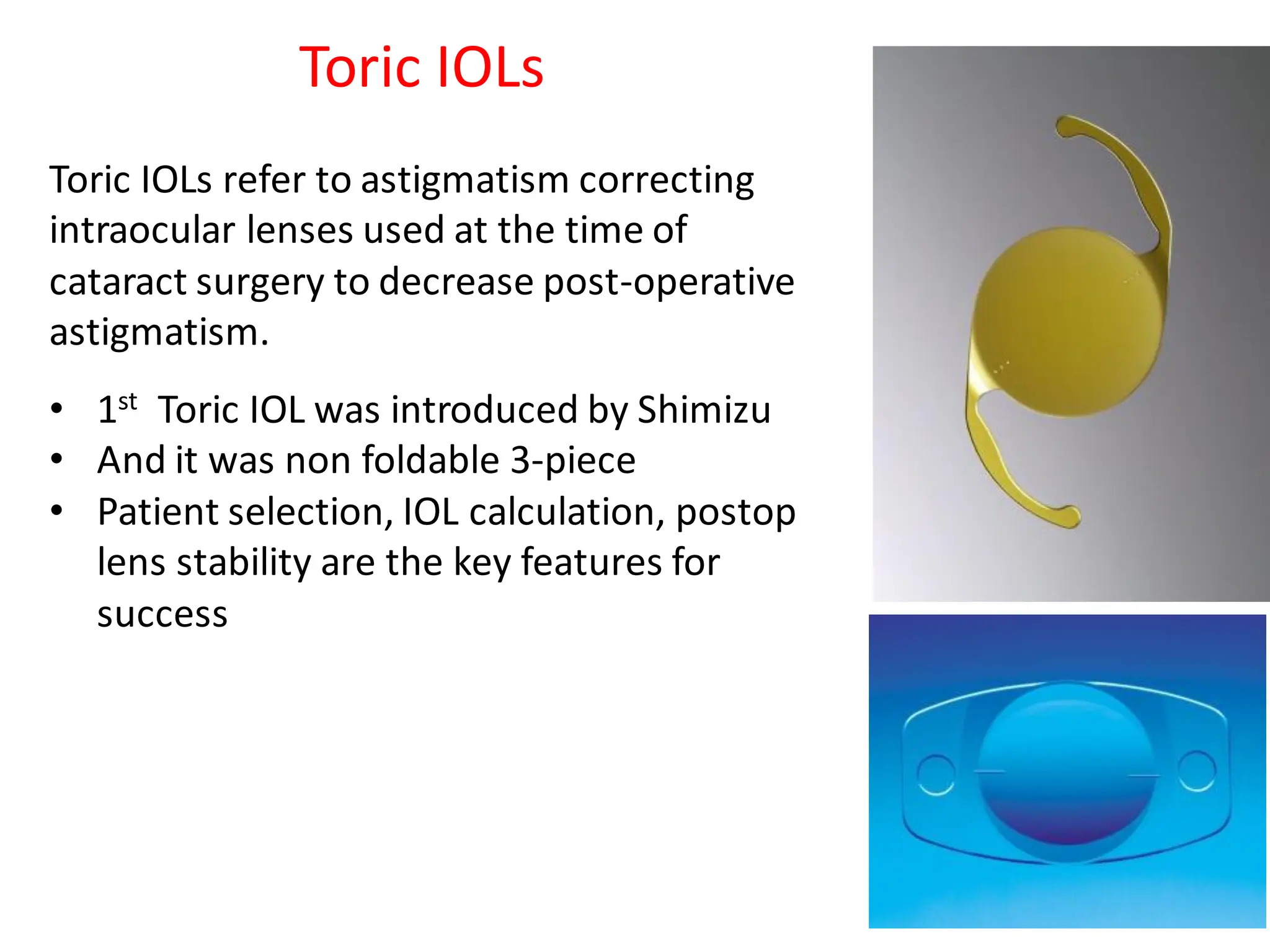
Toric IOLs refer to astigmatism correcting
intraocular lenses used at the time of
cataract surgery to decrease post-operative
astigmatism.
Toric IOLs
• 1st Toric IOL was introduced by Shimizu
• And it was non foldable 3-piece
• Patient selection, IOL calculation, postop
lens stability are the key features for
success
Advantages of Toric IOL
• Better results than monofocal iol and limbal
relaxing incision
• Average postoperative toric iol rotation <5‘
• Quality of visionn can be improved with bilateral
toric IOL implantation
• Multifocal Toric IOL can improve distance,
intermediate and near Vision (challenge is
preoperative assessments which is very crucial)
• Postoperative residual astigmatism <1D in 89% and
88% multifocal toric and toric IOL respectively
Disadvantage of Toric IOL
• Improper alignment or rotation of the IOL after
surgery may result in more residual astigmatism
than predicted.-
• Generally for every 1' of IOL rotation - 3.3% of
cylindrical power lost
• A complete loss of cylindrical power occurs can
occur with a rotation of >30
• Astigmatism more than 4D at corneal plane still
remains dificult to correct with toric iol.
• Irregular astigmatism can not be corrected
ACCOMMODATION
• It is a dioptric change in the power of the
eye
• Ciliary muscle contraction causes a
release in zonular tension at the equator,
which permits the capsule to mould the
young lens into an accommodated form to
focus the near
• Presbyopia, age related loss of
accommodation -gradual age related
stiffening of the lens
Accommodative IOLs
• Restoring the true, dynamic and
continuous range of focusing ability
of the eye
• Monovision , bifocal, multifocal
modalities does not restore active
change in power of the eye that
occurs during accommodation
• Accomodative IOLS restore true
accommodation to the presbyopic
eye and provide a range of clear
vision.
Accommodative IOLs
Restoration of Accommodation
• In Pseudophakic eyes engine that drives
accommodation ( ciliary muscles)
continues to remain functional so it can
be used to restore accomodation
Accommodative IOLs
• Single optic IOLS -designed to undergo
forward movement of the optic
• Dual optic IOLS -increased separation of
the two optics
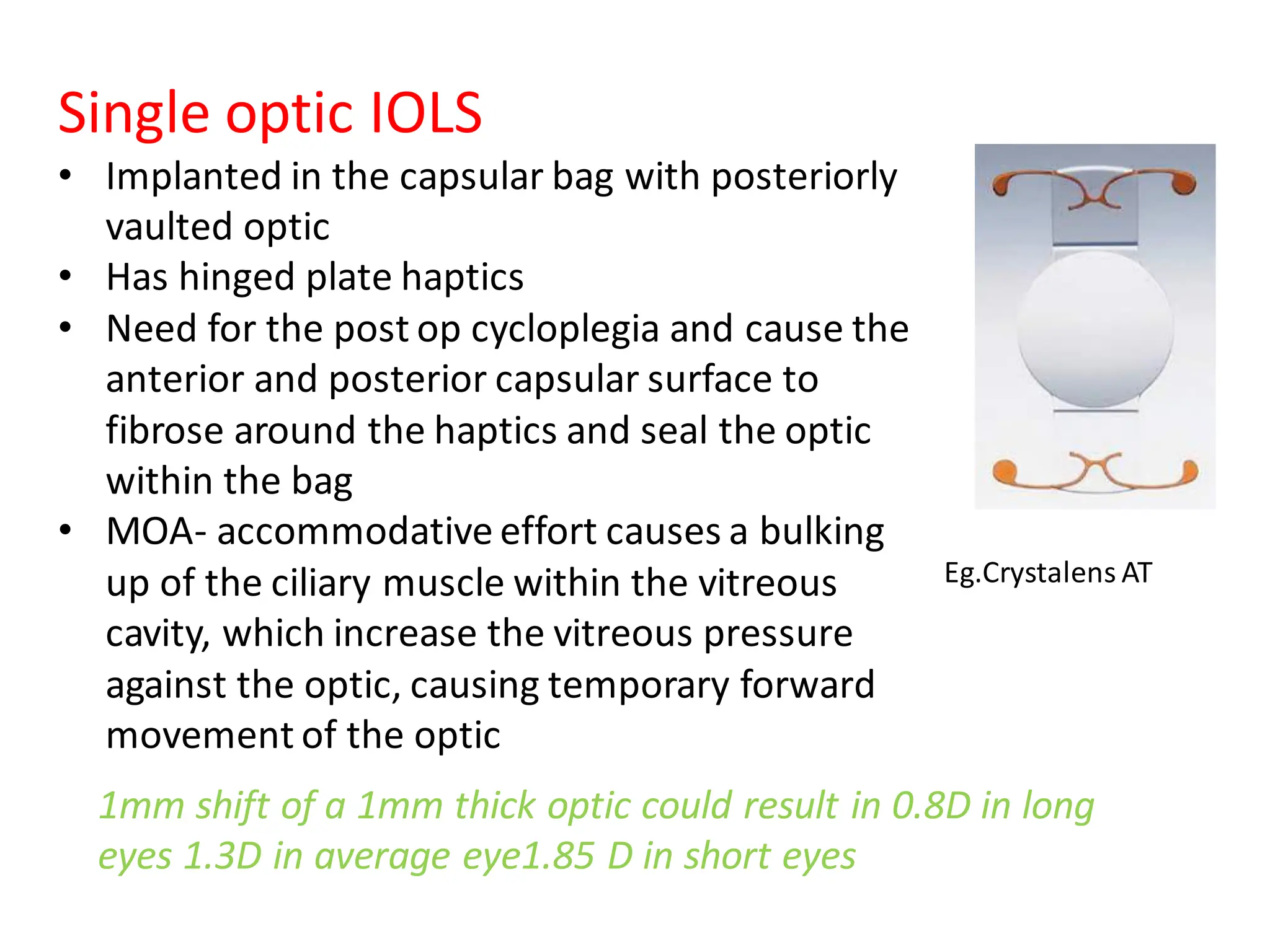
Single optic IOLS
• Implanted in the capsular bag with posteriorly
vaulted optic
• Has hinged plate haptics
• Need for the post op cycloplegia and cause the
anterior and posterior capsular surface to
fibrose around the haptics and seal the optic
within the bag
• MOA- accommodative effort causes a bulking
up of the ciliary muscle within the vitreous
cavity, which increase the vitreous pressure
against the optic, causing temporary forward
movement of the optic
Eg.Crystalens AT
1mm shift of a 1mm thick optic could result in 0.8D in long
eyes 1.3D in average eye1.85 D in short eyes
Open chamber iols that they fill the capsular bag but
retain a fluid space btw the two optics
• High +ve bi-convex anterior optic (approx. 32D)
and a weaker -ve meniscus concave optic
posterior(approx. -12D) joined by 'spring haptics‘
• Retain the natural dimensions of the capsular
bag in axial thickness and equatorial diameter
• 1mm separation produce 2.0 to 2.5D of
accommodation
• Eg. Sychrony dual optic Accommodative iol
(visiogen) and The AkkoLens Lumina
Dual Optic IOLS
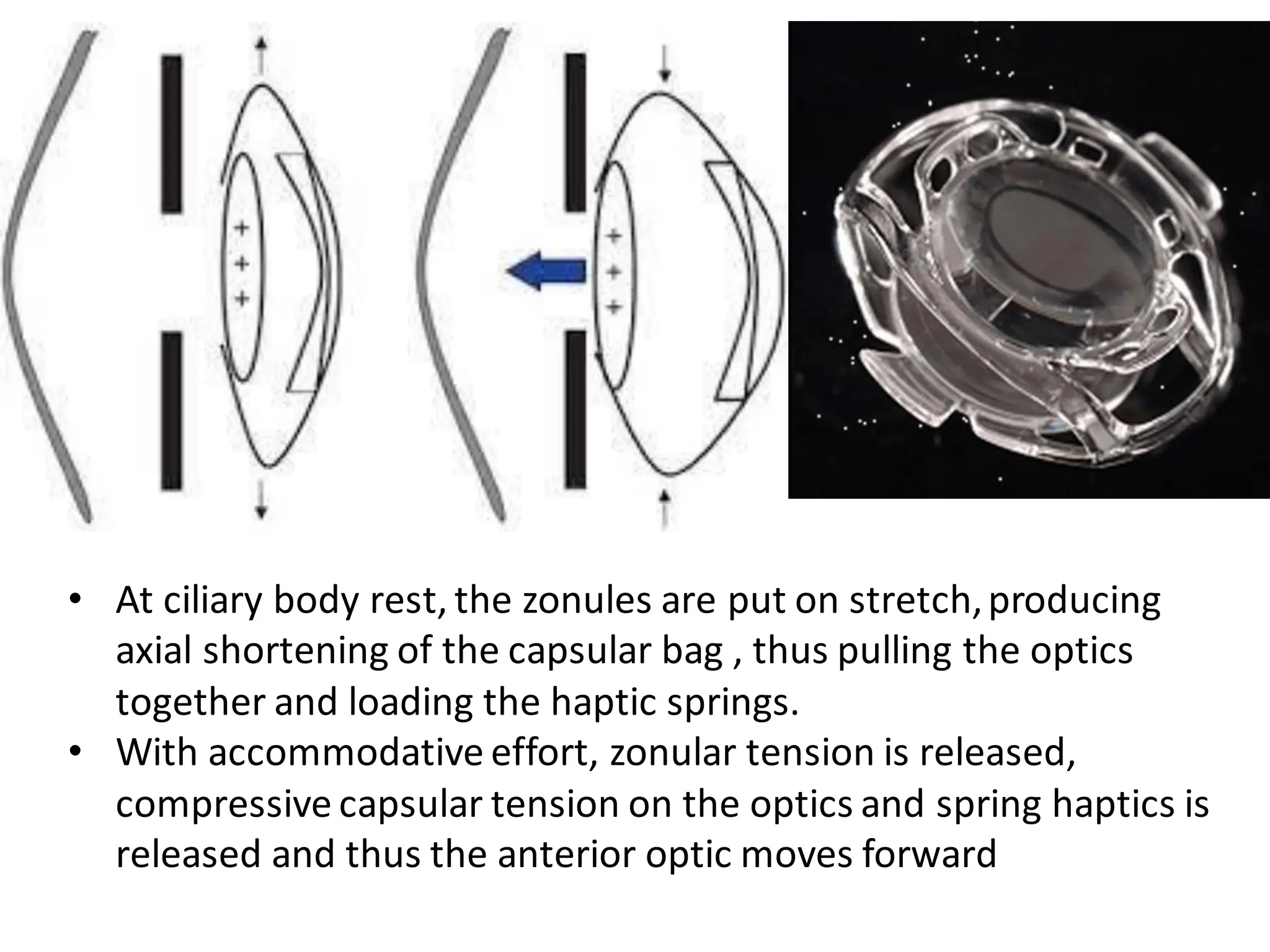
• At ciliary body rest, the zonules are put on stretch,producing
axial shortening of the capsular bag , thus pulling the optics
together and loading the haptic springs.
• With accommodative effort, zonular tension is released,
compressive capsular tension on the optics and spring haptics is
released and thus the anterior optic moves forward
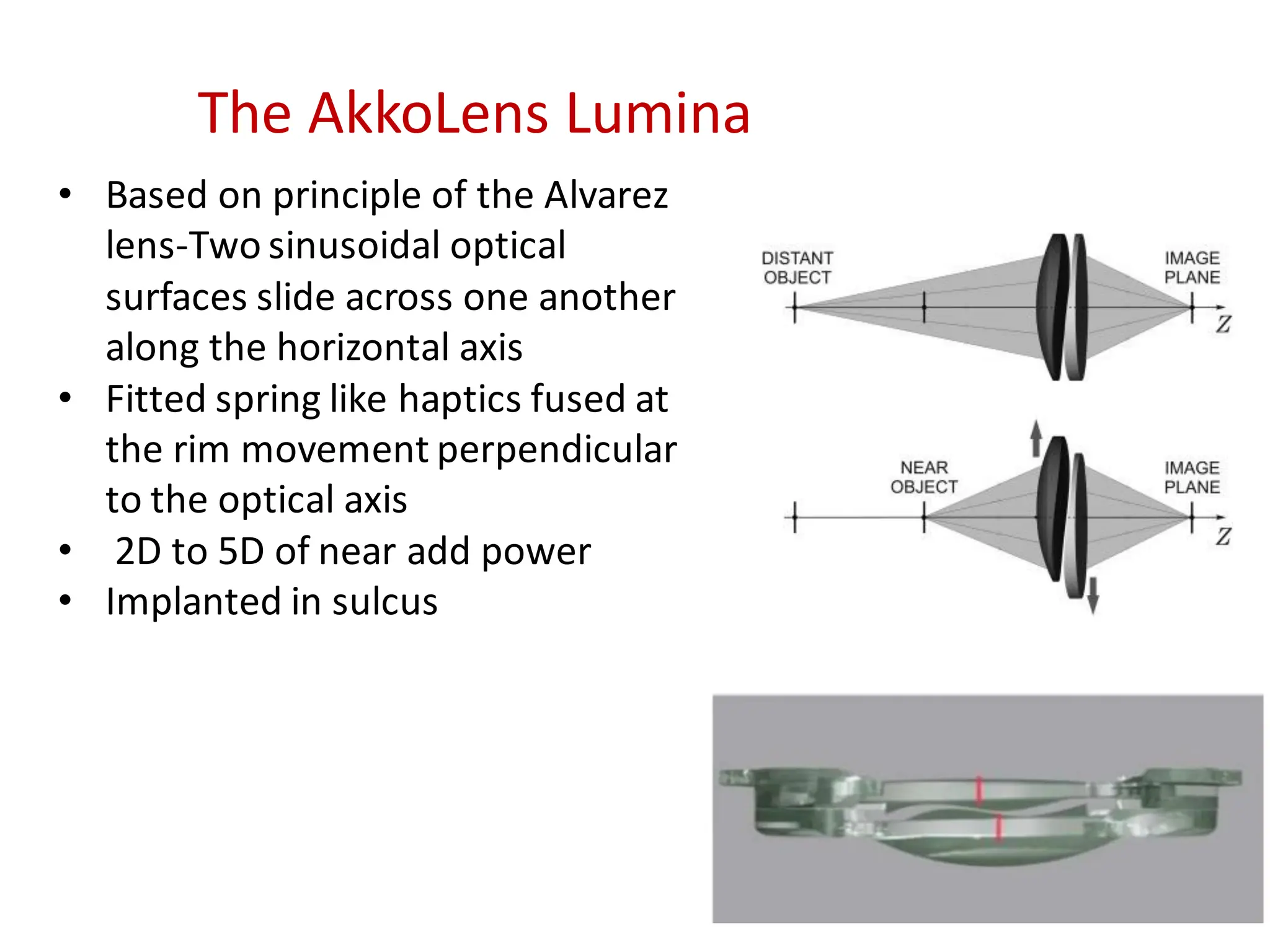
• Based on principle of the Alvarez
lens-Two sinusoidal optical
surfaces slide across one another
along the horizontal axis
• Fitted spring like haptics fused at
the rim movement perpendicular
to the optical axis
• 2D to 5D of near add power
• Implanted in sulcus
The AkkoLens Lumina
Curvature change IOLs
4 different designs are under development
1)PowerVision FluidVision IOL (Belmont, CA)
2)Medennium Smart Lens (Irvine, CA)
3)NuLens Accommodative IOL
4)Polymer refilling technique
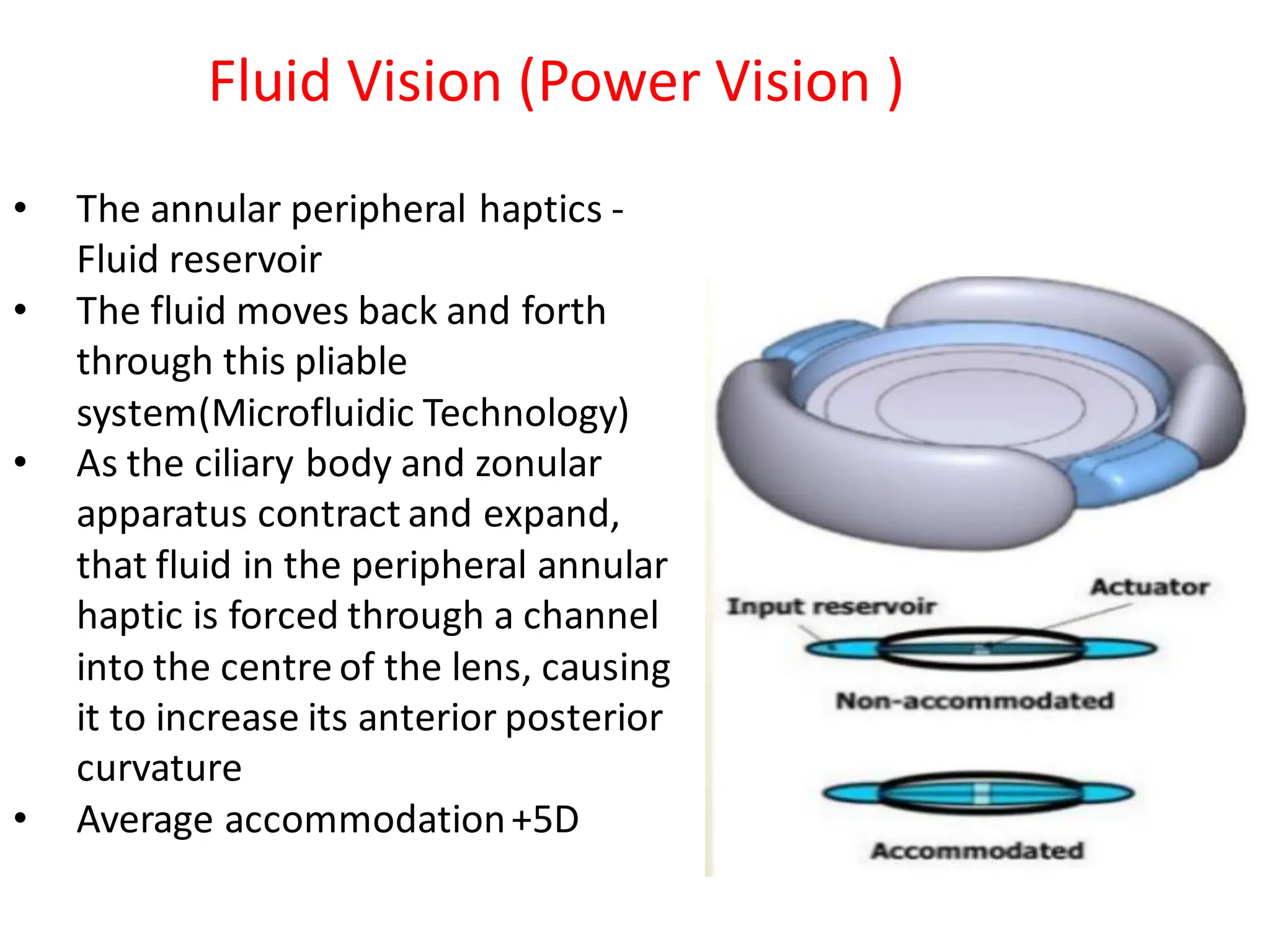
• The annular peripheral haptics -
Fluid reservoir
• The fluid moves back and forth
through this pliable
system(Microfluidic Technology)
• As the ciliary body and zonular
apparatus contract and expand,
that fluid in the peripheral annular
haptic is forced through a channel
into the centre of the lens, causing
it to increase its anterior posterior
curvature
• Average accommodation+5D
Fluid Vision (Power Vision )
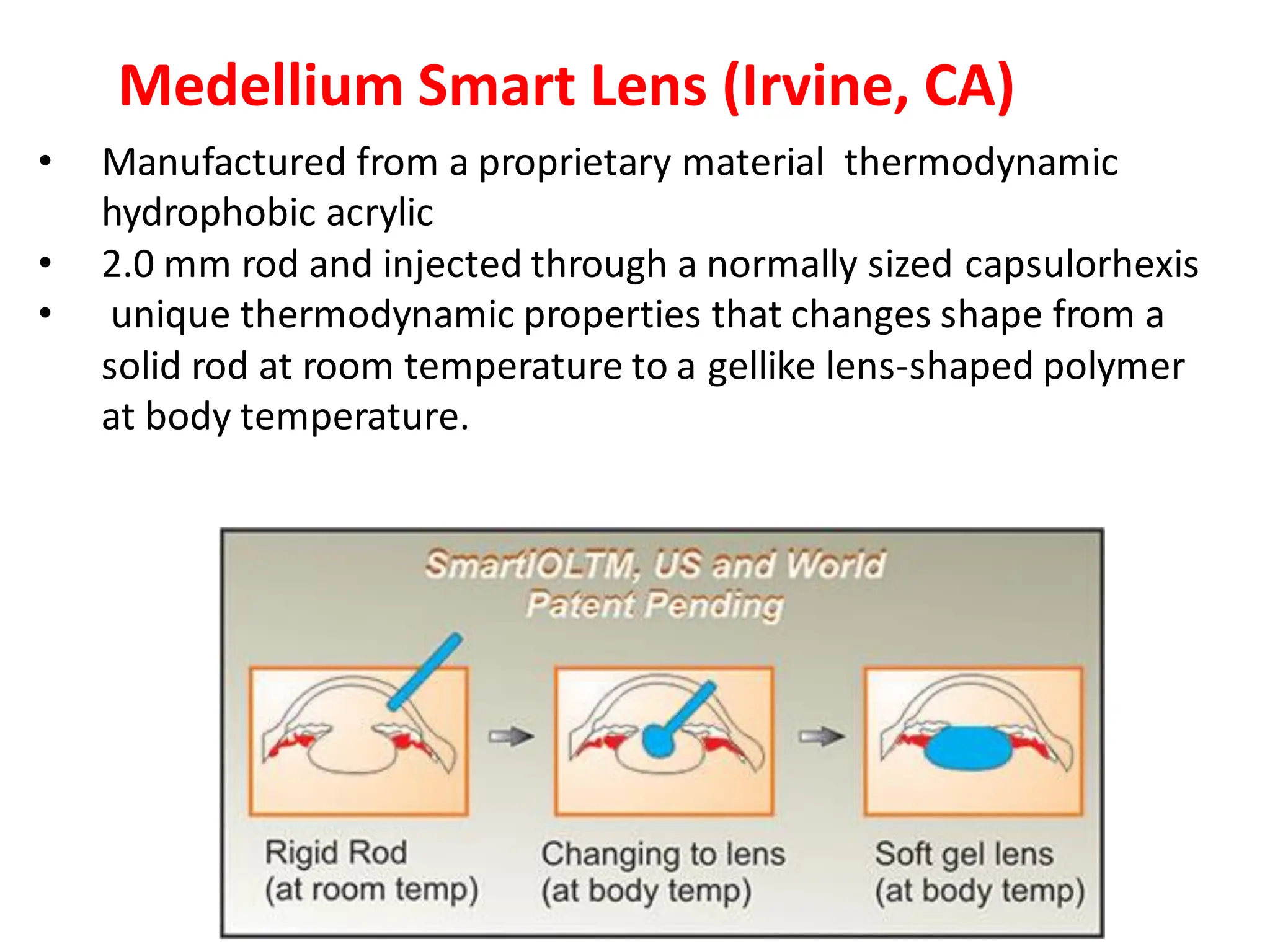
• Manufactured from a proprietary material thermodynamic
hydrophobic acrylic
• 2.0 mm rod and injected through a normally sized capsulorhexis
• unique thermodynamic properties that changes shape from a
solid rod at room temperature to a gellike lens-shaped polymer
at body temperature.
Medellium Smart Lens (Irvine, CA)
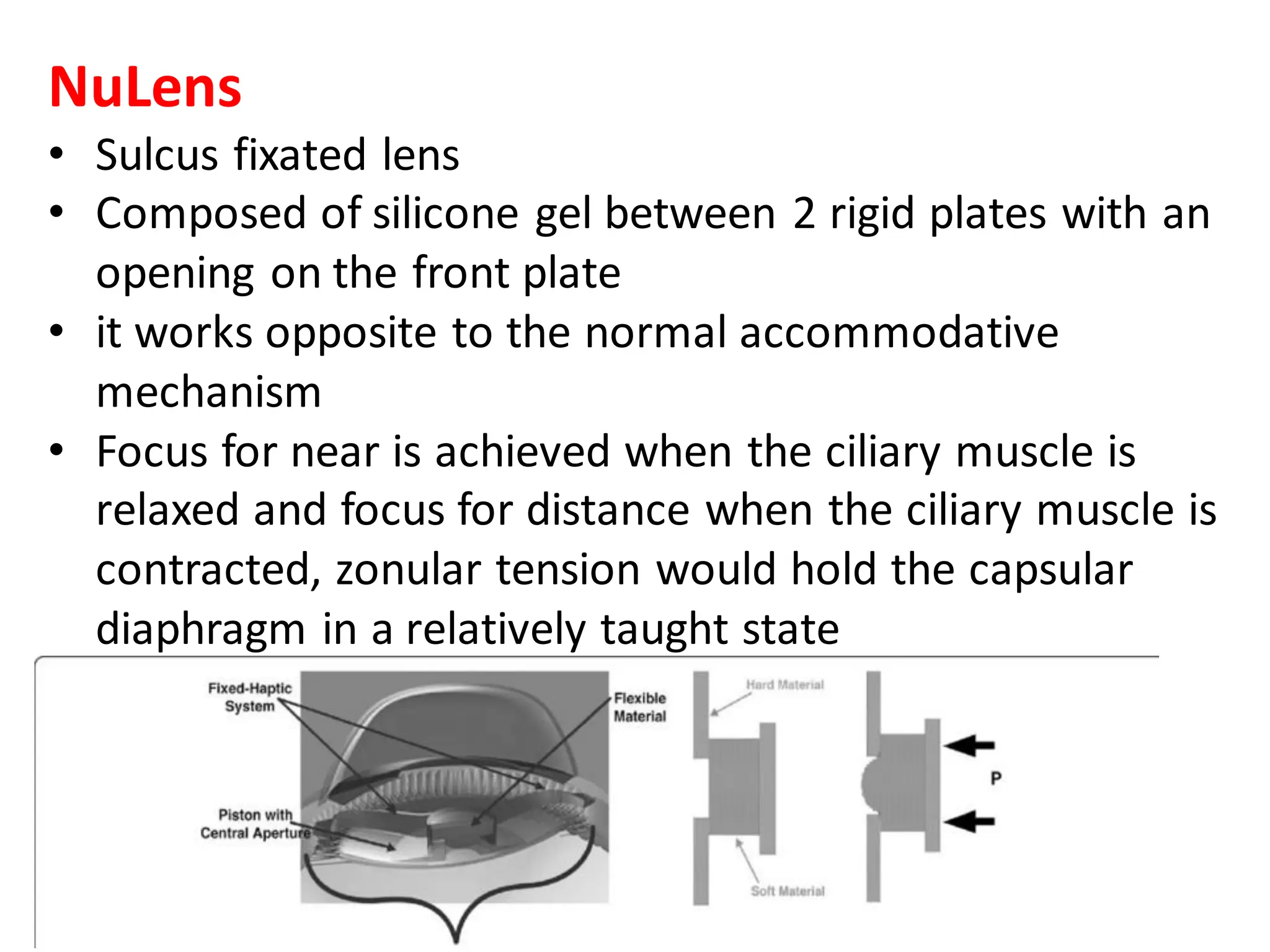
NuLens
• Sulcus fixated lens
• Composed of silicone gel between 2 rigid plates with an
opening on the front plate
• it works opposite to the normal accommodative
mechanism
• Focus for near is achieved when the ciliary muscle is
relaxed and focus for distance when the ciliary muscle is
contracted, zonular tension would hold the capsular
diaphragm in a relatively taught state
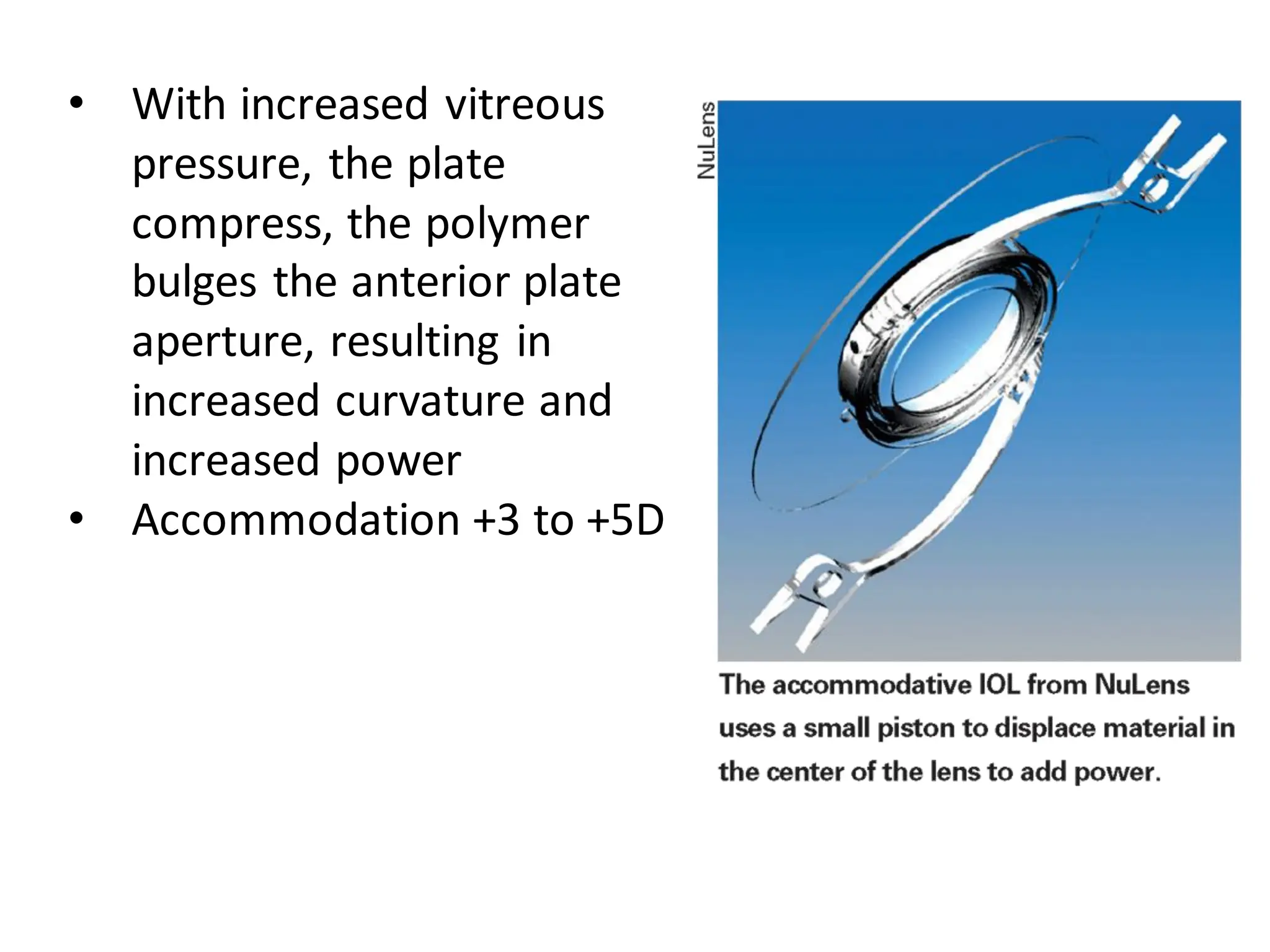
• With increased vitreous
pressure, the plate
compress, the polymer
bulges the anterior plate
aperture, resulting in
increased curvature and
increased power
• Accommodation +3 to +5D
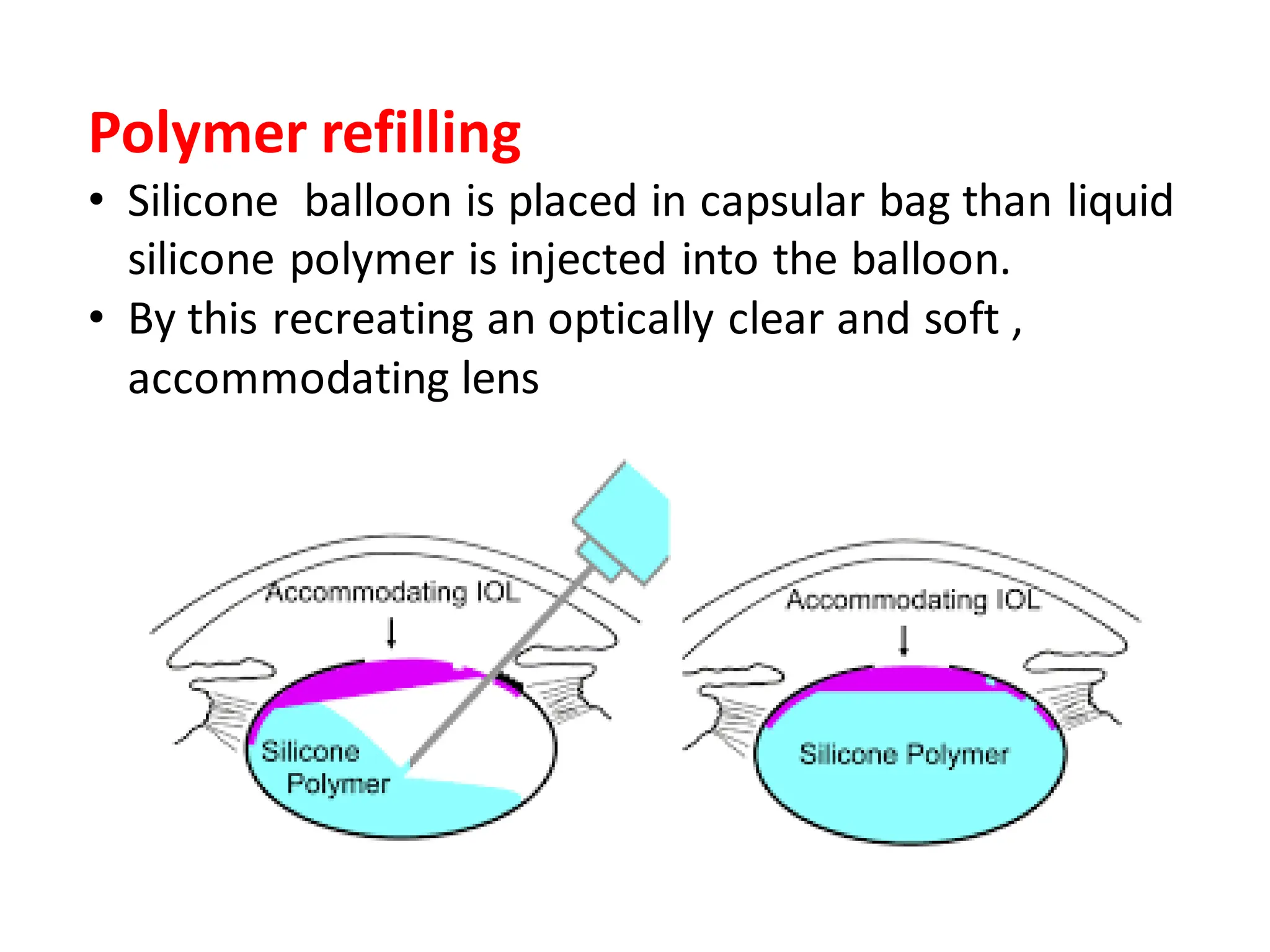
Polymer refilling
• Silicone balloon is placed in capsular bag than liquid
silicone polymer is injected into the balloon.
• By this recreating an optically clear and soft ,
accommodating lens
Disadvantages Accommodative IOLs
• Smaller optic-more aberrations
• Failure of accommodation due to-Fibrosis-
capsular opacification (anterior/posterior)
• The separation of dual optic and curvature change
determines the post op refraction
• Overfilling and underfilling in polymer refilling
• YAG capsulotomy is contraindicated in IOLs
• More ACO and PCO
• Cost
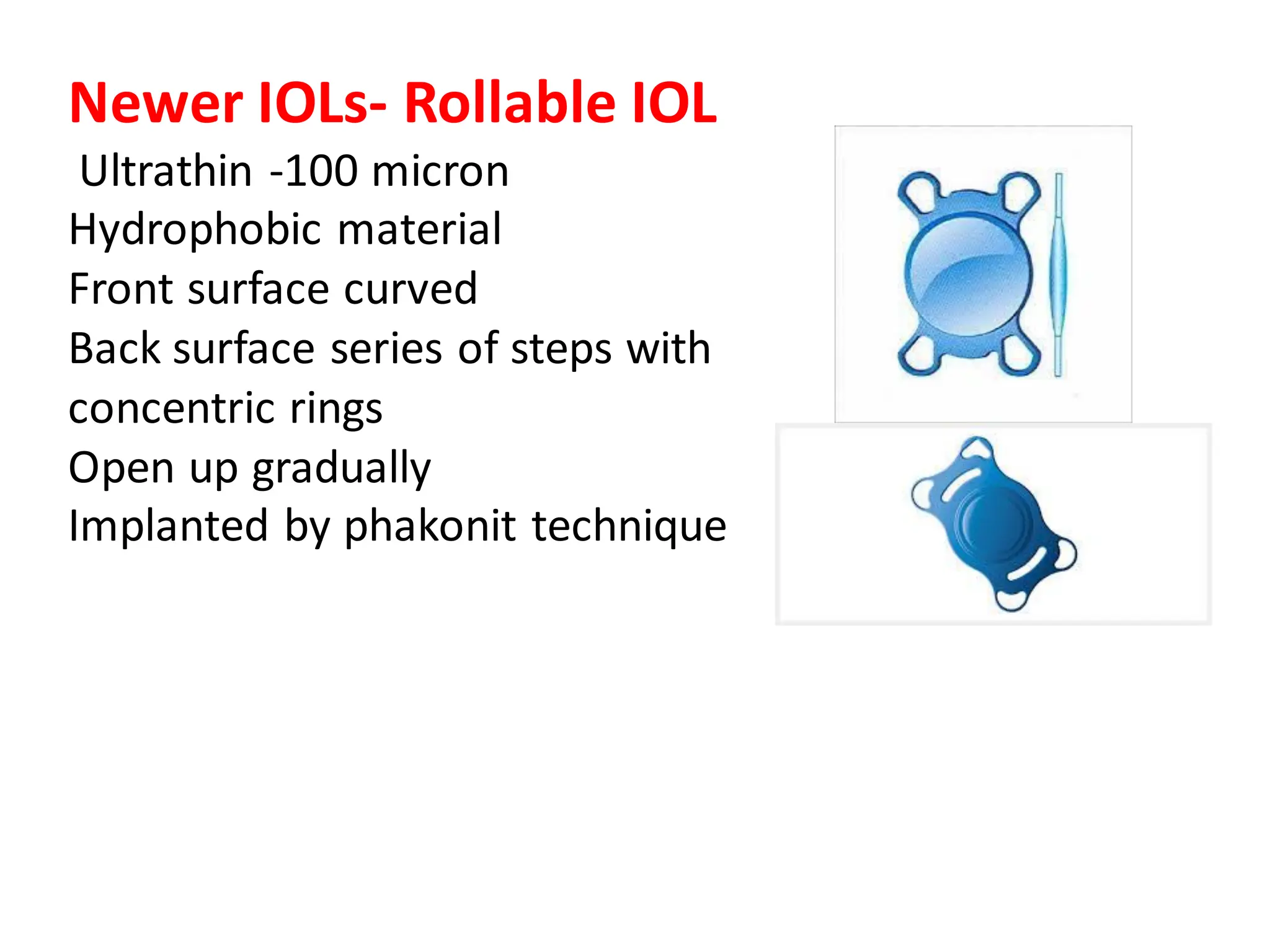
Newer IOLs- Rollable IOL
Ultrathin -100 micron
Hydrophobic material
Front surface curved
Back surface series of steps with
concentric rings
Open up gradually
Implanted by phakonit technique
IOL IMPLANTAION IN SPECIAL SITUATIONS.
❑ ABSENCE OF CAPSULARSUPPORT
• Scleral fixation (suture/glue)
• Iris fixated
• ACIOLS
❑ PEDIATRIC AGE GROUP
• Heparin coated
• Multifocal IOLS
❑ DRUG ELUTING IOLS
• Triamcinolone acetonide
• Dexamethsone
• Diclofenac sodium (0.2 mg/ml)
• Mitomicin C (0.2 mg/mL)
• Colchicine (12.5 mg/mL) and 5-fluorouracile (10 mg/ml)
• Anti-VEGF
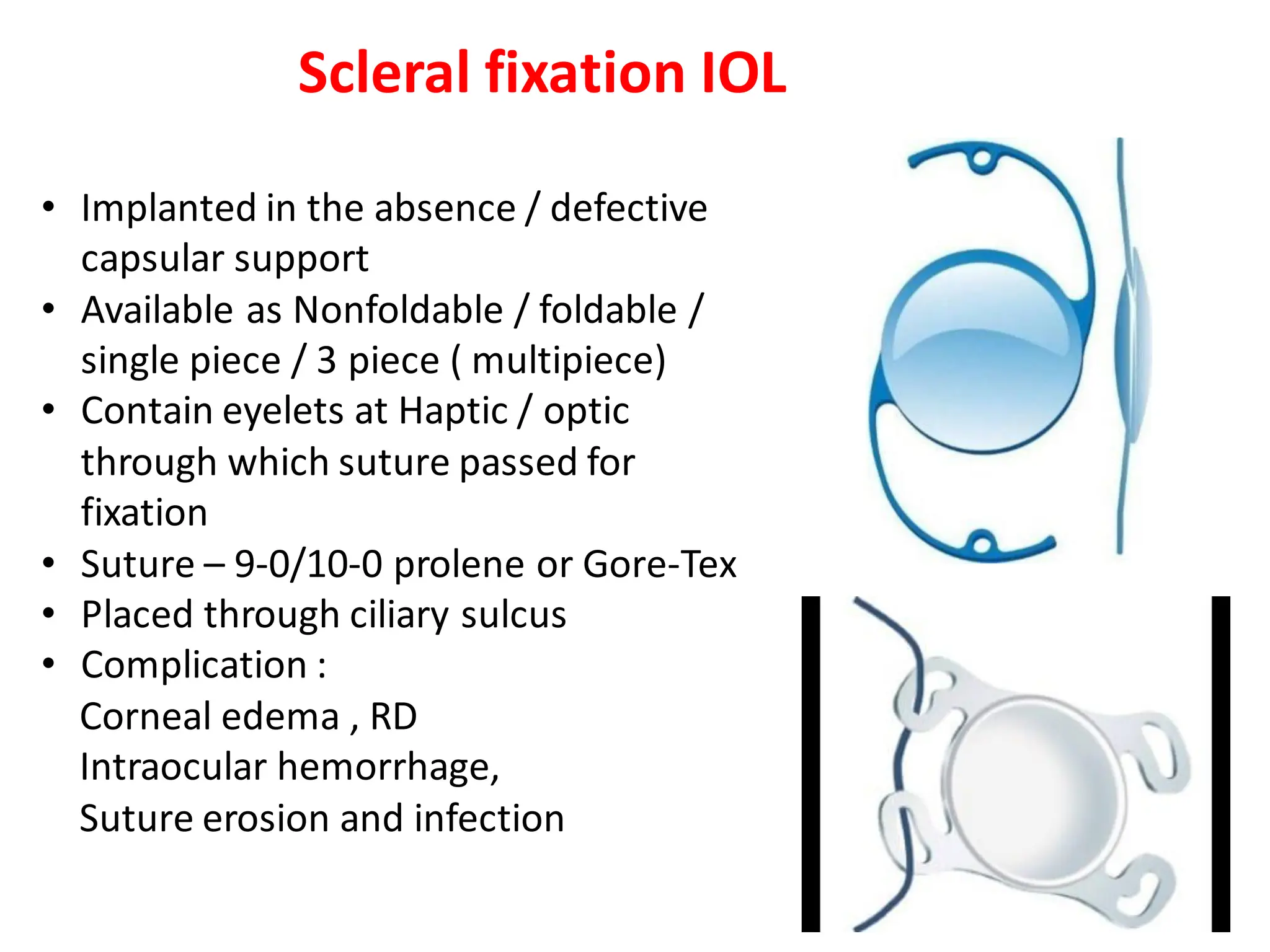
Scleral fixation IOL
• Implanted in the absence / defective
capsular support
• Available as Nonfoldable / foldable /
single piece / 3 piece ( multipiece)
• Contain eyelets at Haptic / optic
through which suture passed for
fixation
• Suture – 9-0/10-0 prolene or Gore-Tex
• Placed through ciliary sulcus
• Complication :
Corneal edema , RD
Intraocular hemorrhage,
Suture erosion and infection
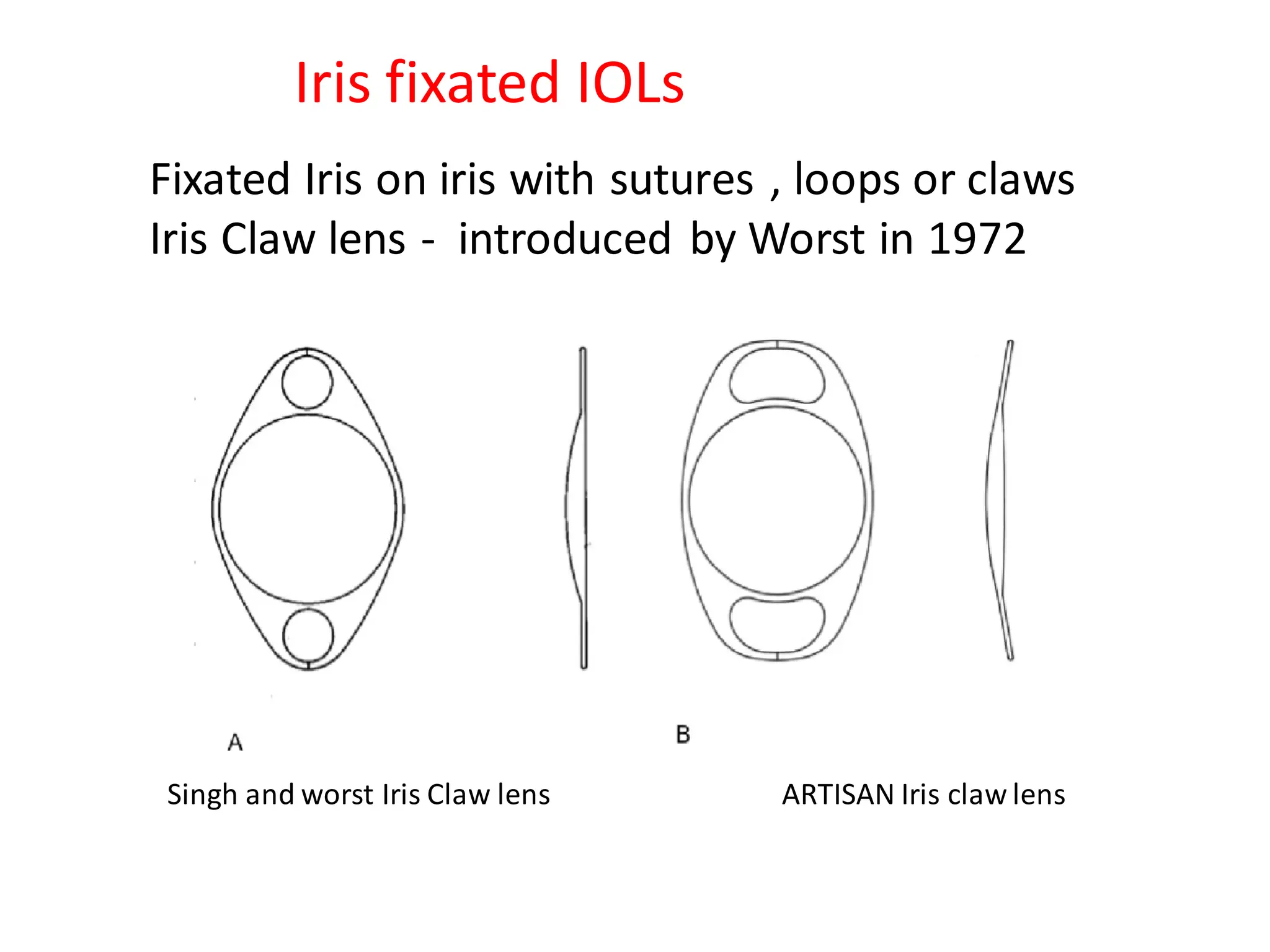
Iris fixated IOLs
Fixated Iris on iris with sutures , loops or claws
Iris Claw lens - introduced by Worst in 1972
Singh and worst Iris Claw lens ARTISAN Iris claw lens
Iris Claw lens
• Anterior iris or Retropupillary fixation ( AC or PC fixation )
• Two opposed claw haptics that Fixate on iris by
enclavation of midperipheral iris stroma where iris is
less vascularized, less reactive and virtually immobile .
• Allowing the pupil to unrestricted ability to dialate and
constrict
• Excellent centration
• Iris bridge protects the endothelium touching by PMMA
• Phakic iris claw are also used
• Indication :
• Zonular Dehiscence, subluxated lens, traumatic cataract,
large PCR , Secondary implantation after aphakia
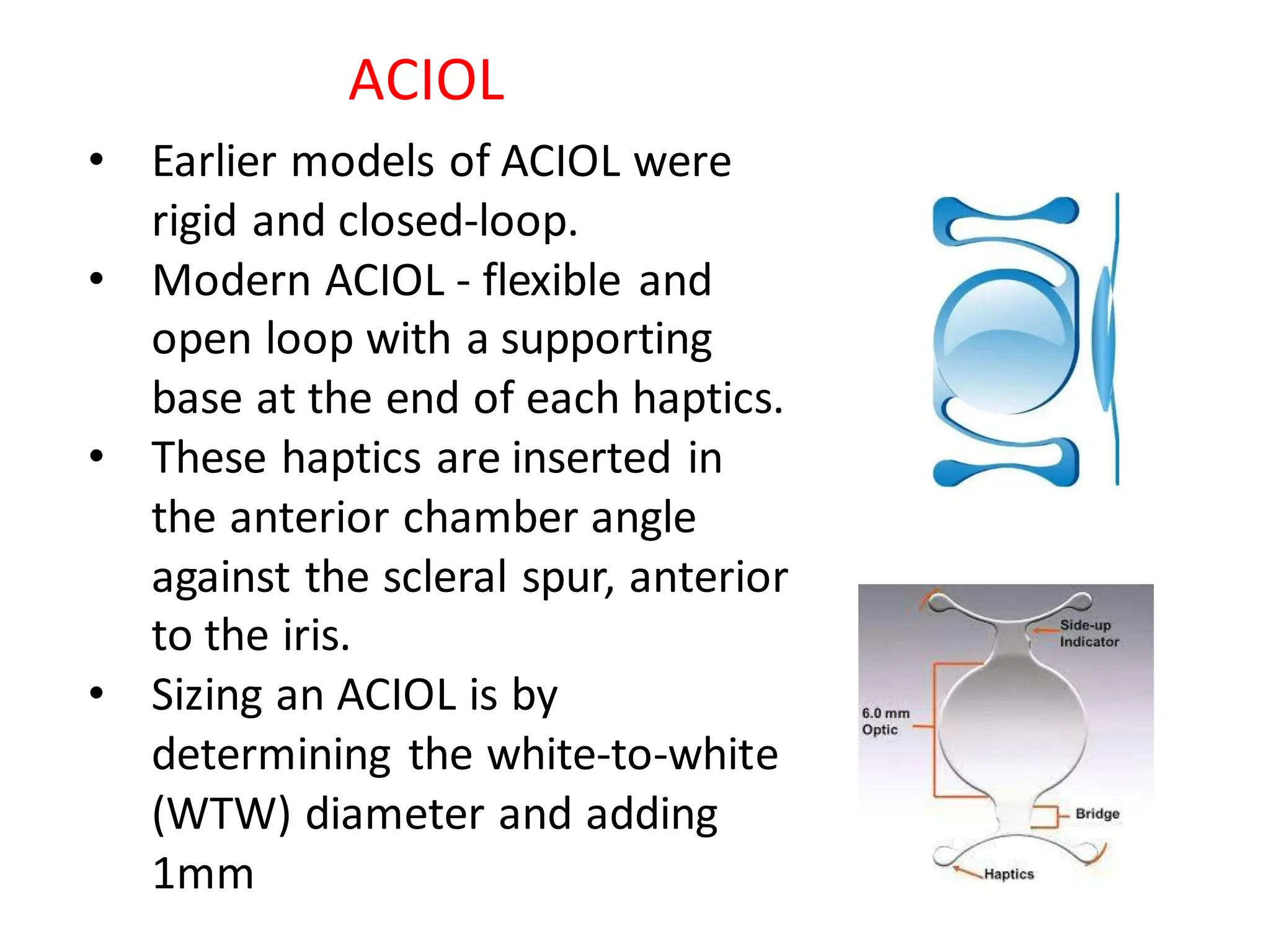
• Earlier models of ACIOL were
rigid and closed-loop.
• Modern ACIOL - flexible and
open loop with a supporting
base at the end of each haptics.
• These haptics are inserted in
the anterior chamber angle
against the scleral spur, anterior
to the iris.
• Sizing an ACIOL is by
determining the white-to-white
(WTW) diameter and adding
1mm
ACIOL
Indications
Absent capsular or zonular support with normal iris
anatomy and a deep anterior chamber.
Contraindications
Pre-existing corneal endothelial damage, iridocorneal
angle damage, shallow anterior chamber, or lack of
sufficient iris support.
Complications
Damage to the angle and iris, which can lead to
chronic inflammation, elevated intraocular pressure,
uveitis/glaucoma/hyphema syndrome, corneal
endothelial damage and corneal decompensation.
ACIOL
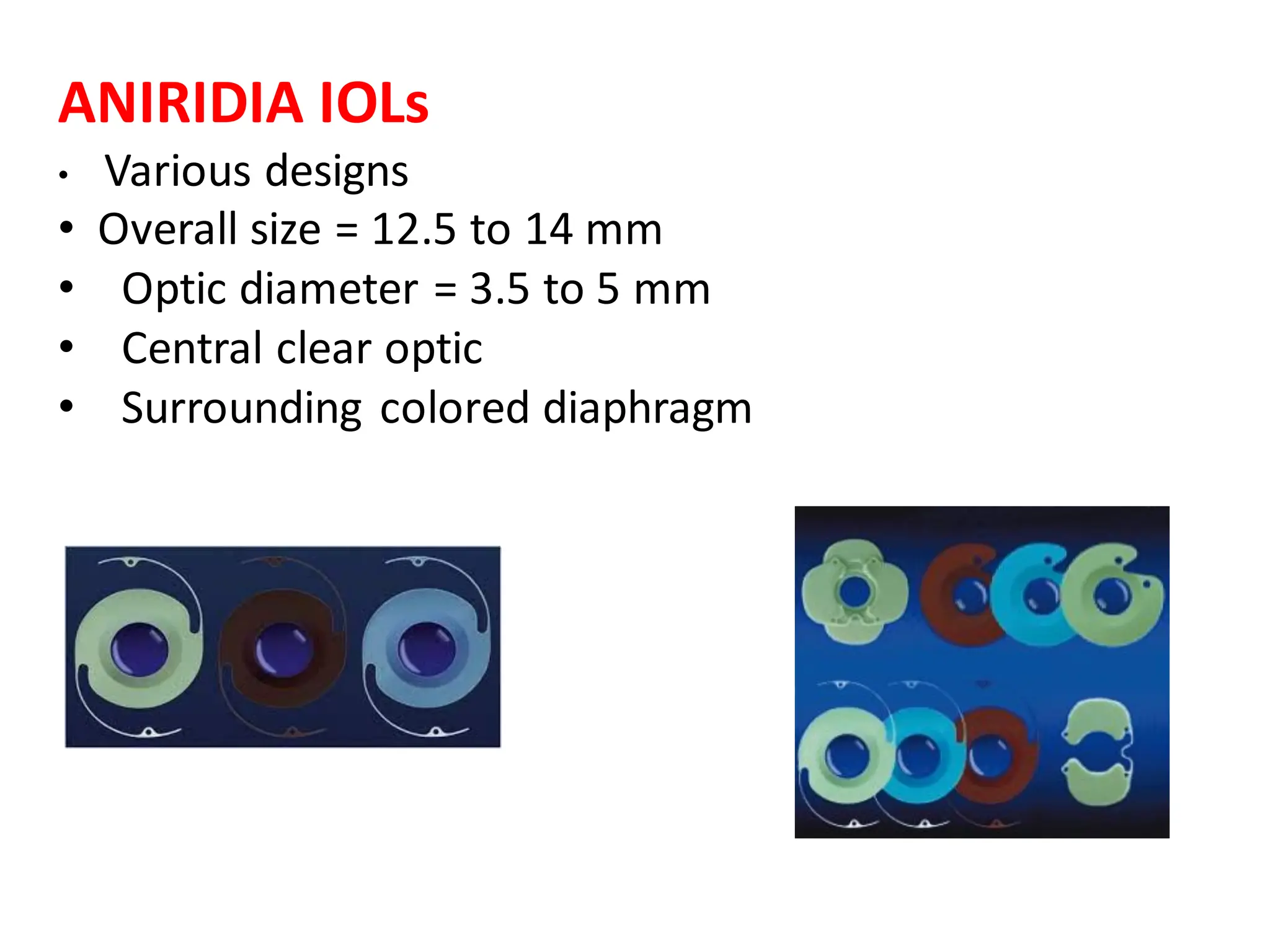
ANIRIDIA IOLs
• Various designs
• Overall size = 12.5 to 14 mm
• Optic diameter = 3.5 to 5 mm
• Central clear optic
• Surrounding colored diaphragm
PHAKIC IOLS
• Implantation of IOL without removing natural
crystalline lens.
• ADVANTAGE: Preserves natural accommodation
• Mostly used in Myopic eyes: -5 to -20 DS
• Also used in Hyperopic eyes
Concern in Hyperopes:
-More chances of endothelial damage
- Increased risk of angle closure glaucoma
• Life-long regular follow up required.
COMPLICATIONS:
Endothelial cell damage
Inflammation
Pigment dispersal
Elevated IOP , Cataract
Piggyback IOL
• An IOL that 'piggybacks' on existing IOL or
two IOLs are implanted simultaneously
• 1st IOL placed in the capsular bag
• 2nd IOL is placed in the bag or sulcus
Advantages
Easier to place 2nd IOL than to explant IOL and
replace it
-lesser risk
-more predictable
-can change in power
-by adding or explanting IOL
-Better image quality
-Increased depth of focus
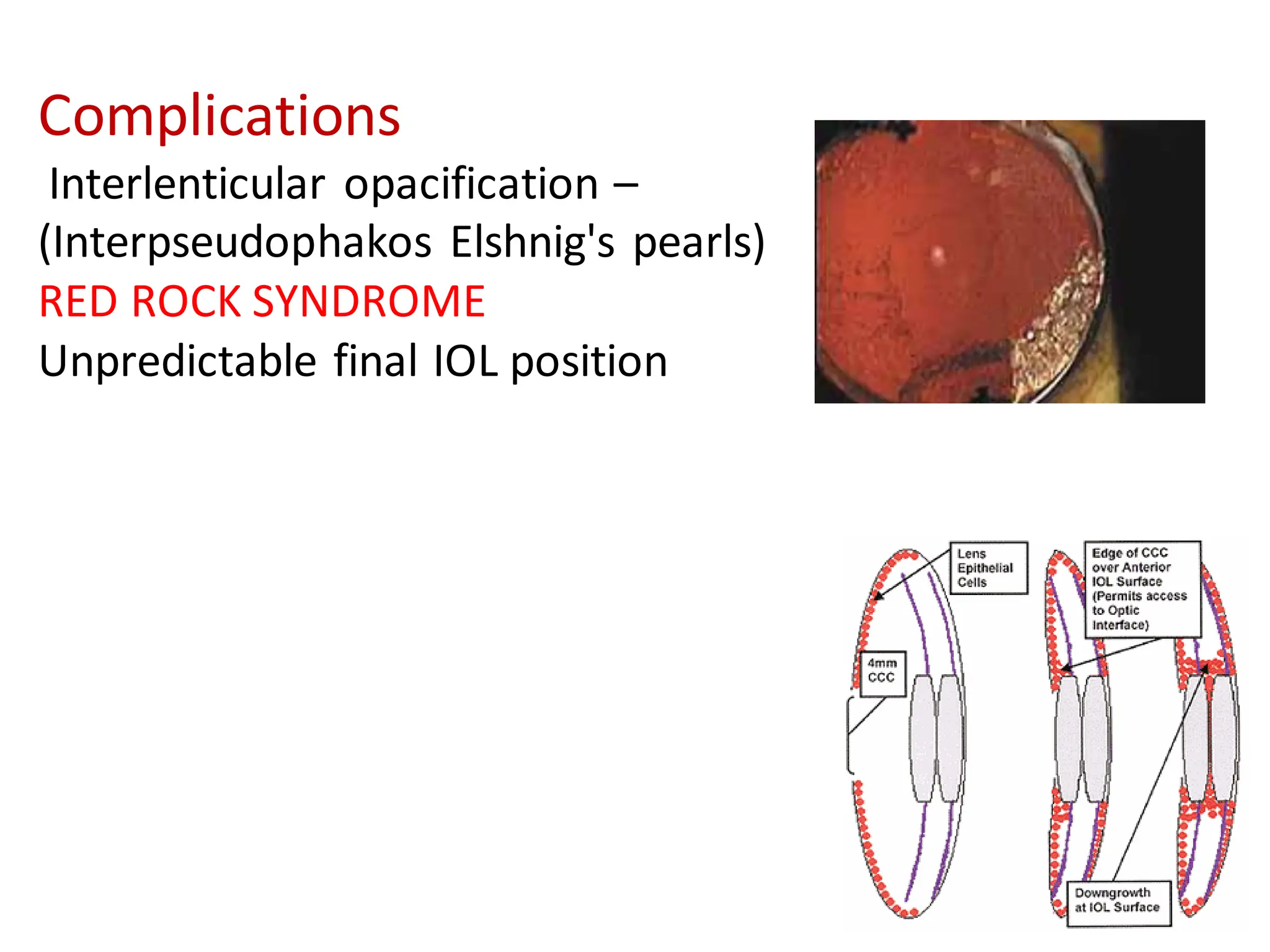
Complications
Interlenticular opacification –
(Interpseudophakos Elshnig's pearls)
RED ROCK SYNDROME
Unpredictable final IOL position
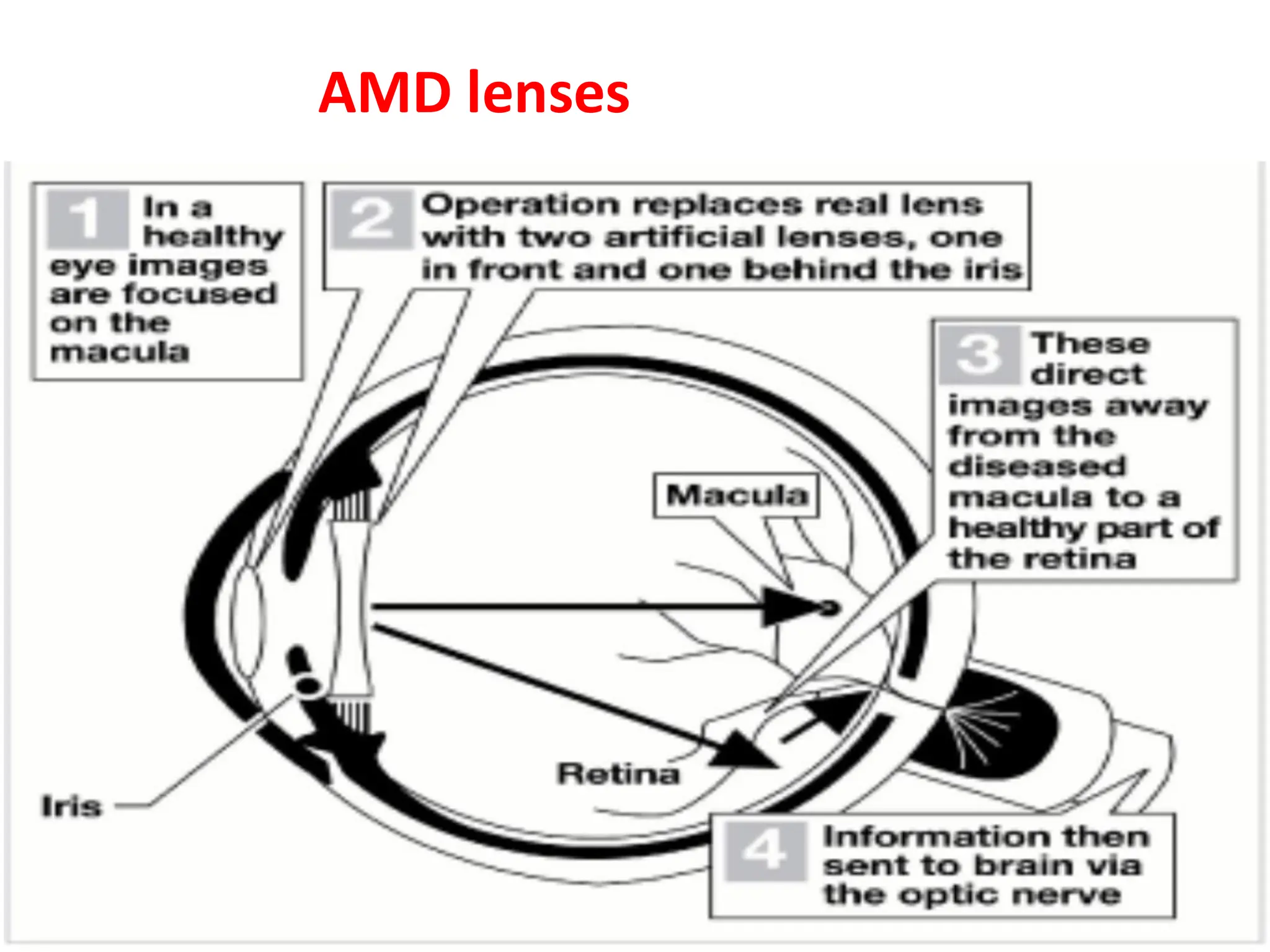
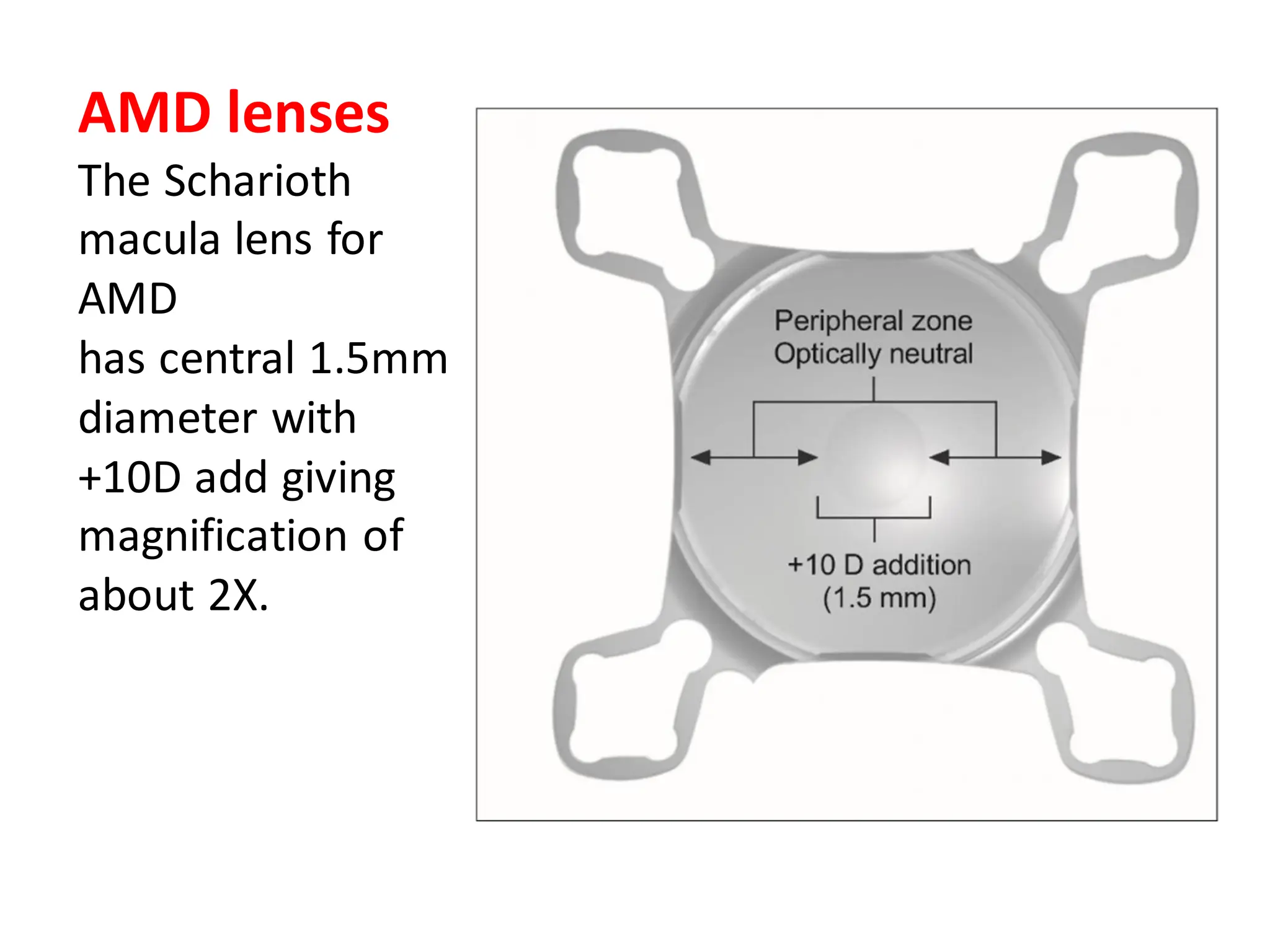
AMD lenses
AMD lenses
The Scharioth
macula lens for
AMD
has central 1.5mm
diameter with
+10D add giving
magnification of
about 2X.
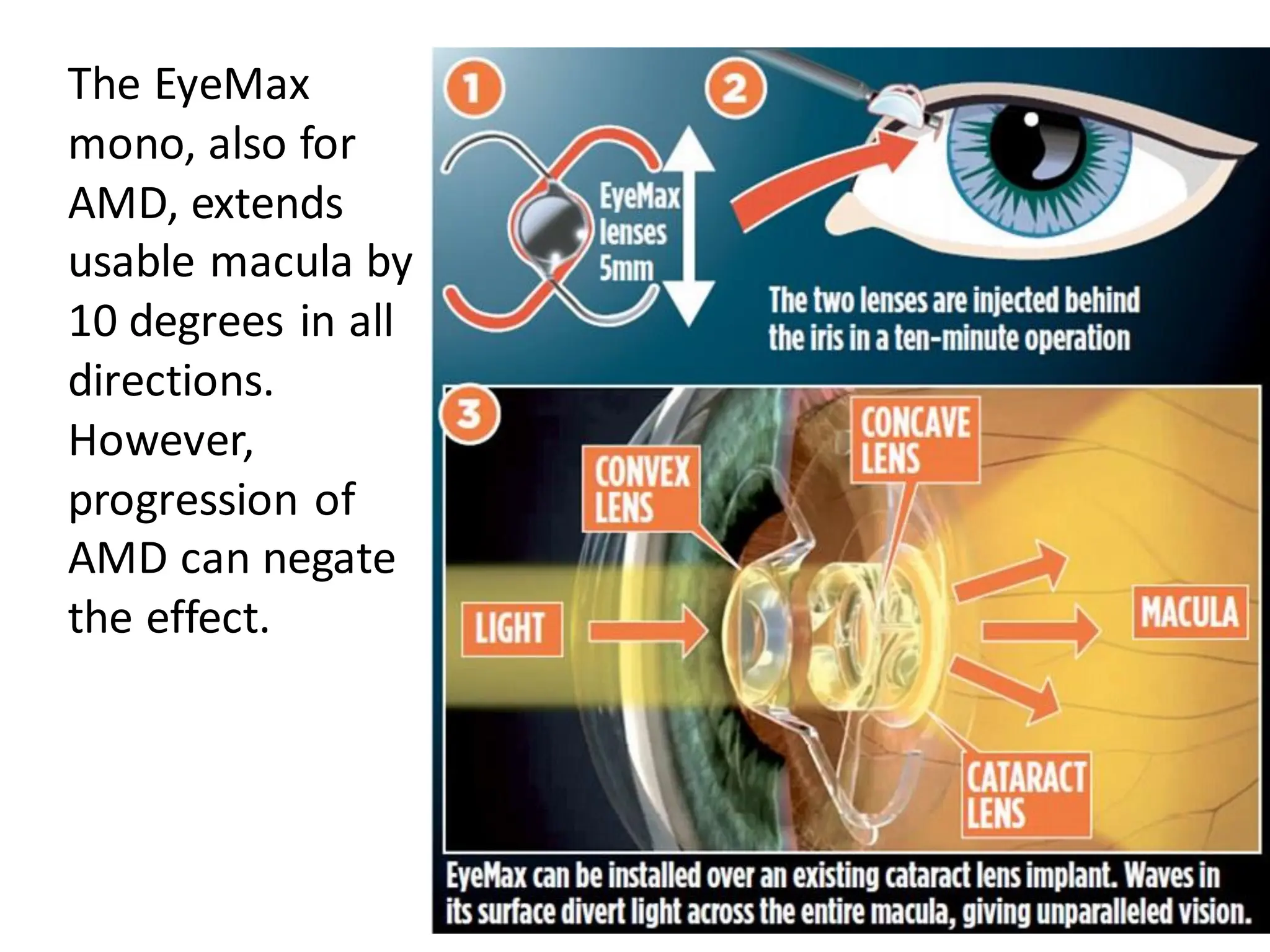
The EyeMax
mono, also for
AMD, extends
usable macula by
10 degrees in all
directions.
However,
progression of
AMD can negate
the effect.
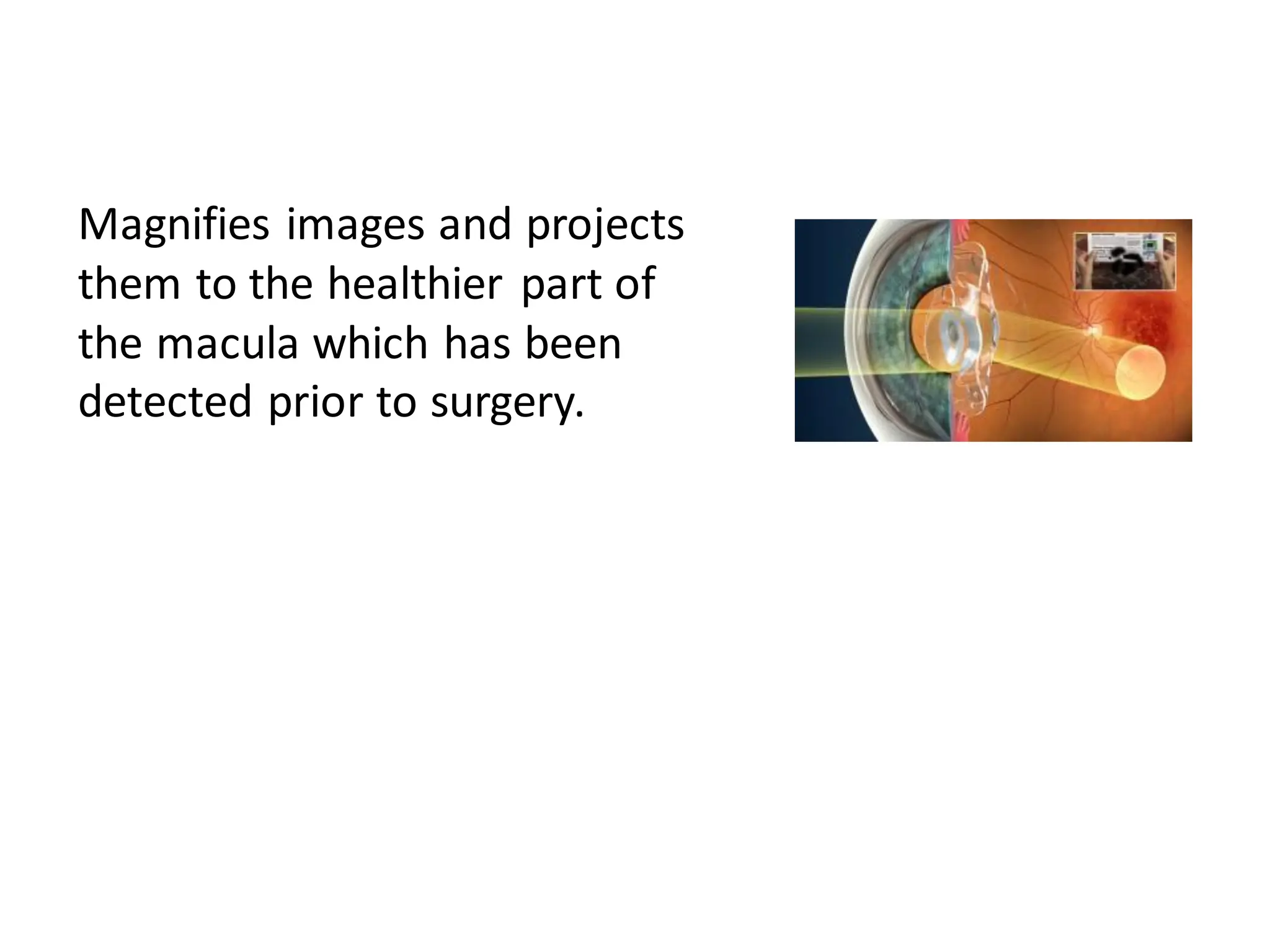
Magnifies images and projects
them to the healthier part of
the macula which has been
detected prior to surgery.
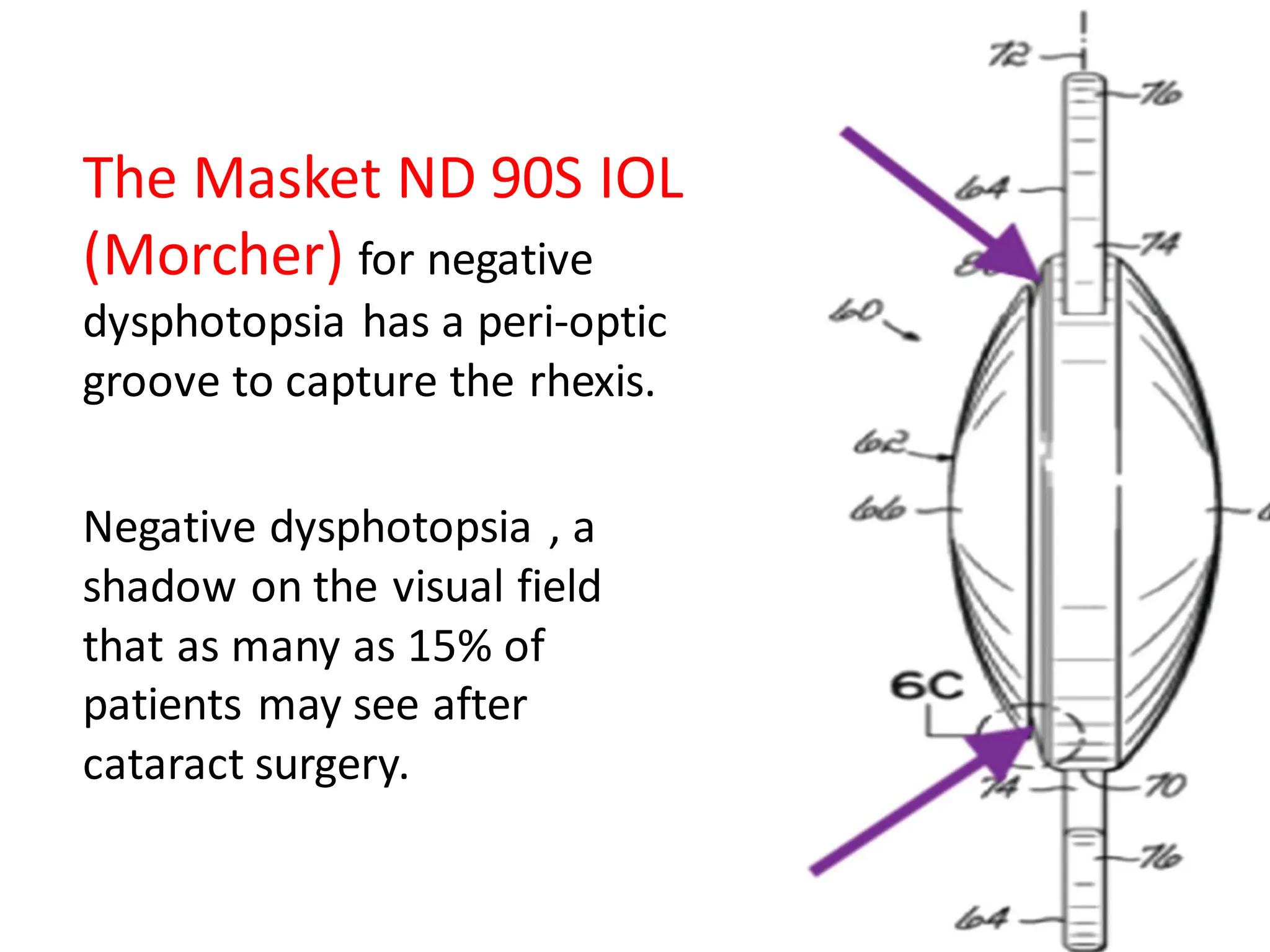
The Masket ND 90S IOL
(Morcher) for negative
dysphotopsia has a peri-optic
groove to capture the rhexis.
Negative dysphotopsia , a
shadow on the visual field
that as many as 15% of
patients may see after
cataract surgery.
RECENT ADVANCES AND THE FUTURE
❑ LIGHT ADJUSTABLE IOL
❑ TELESCOPIC IOLS
❑ SMART IOLs
❑ ELECTRONIC IOLs
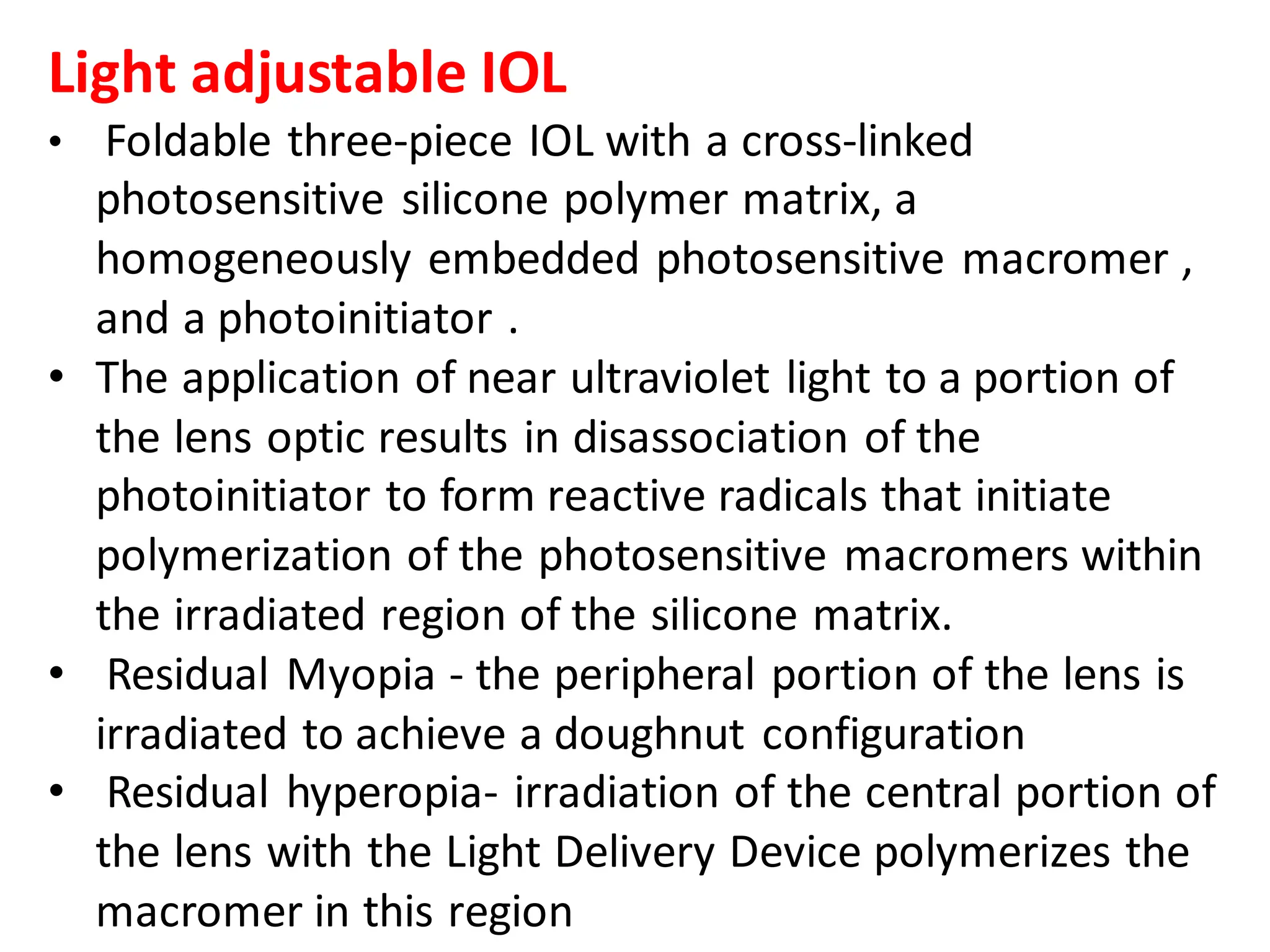
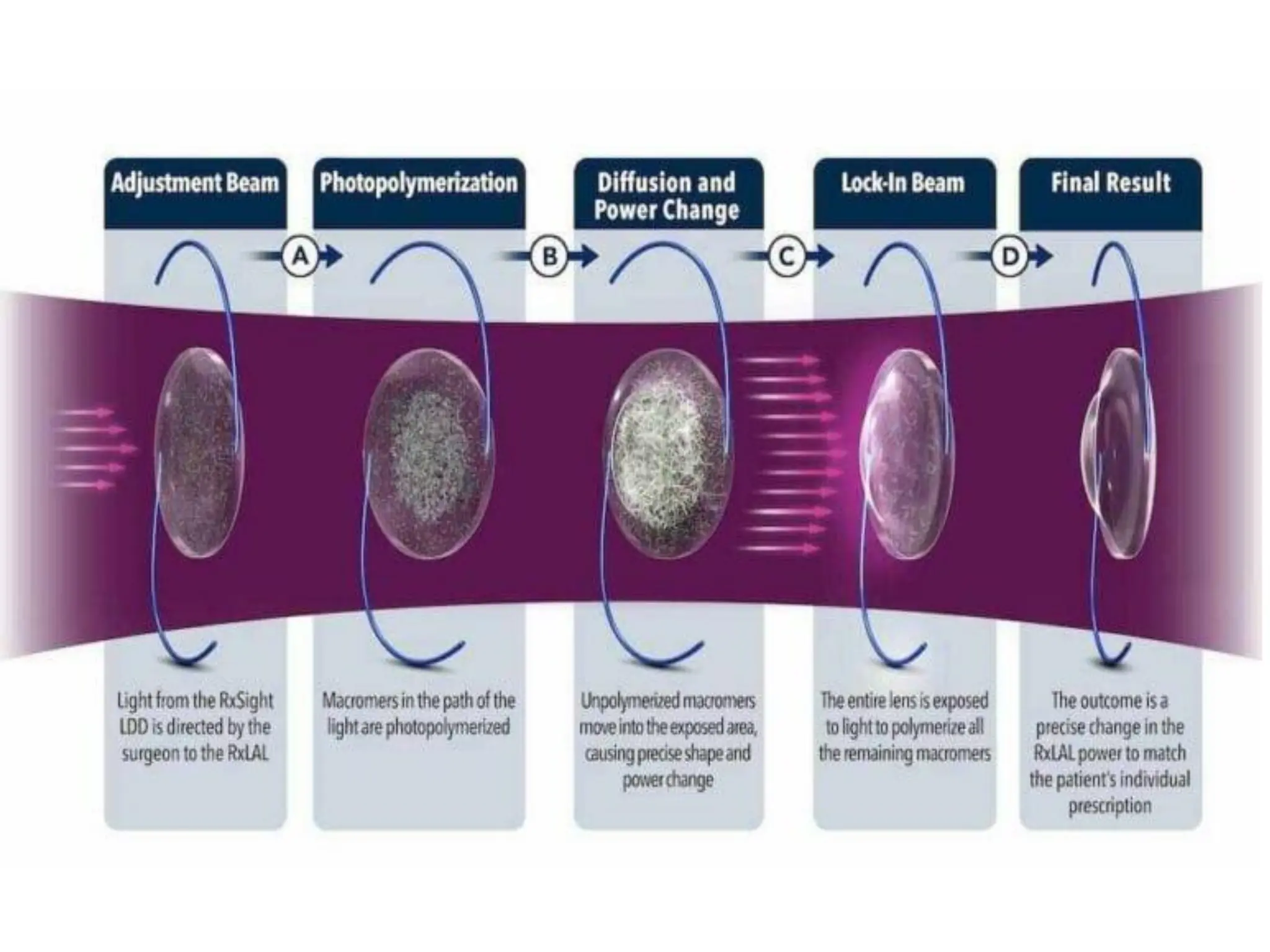
Light adjustable IOL
• Foldable three-piece IOL with a cross-linked
photosensitive silicone polymer matrix, a
homogeneously embedded photosensitive macromer ,
and a photoinitiator .
• The application of near ultraviolet light to a portion of
the lens optic results in disassociation of the
photoinitiator to form reactive radicals that initiate
polymerization of the photosensitive macromers within
the irradiated region of the silicone matrix.
• Residual Myopia - the peripheral portion of the lens is
irradiated to achieve a doughnut configuration
• Residual hyperopia- irradiation of the central portion of
the lens with the Light Delivery Device polymerizes the
macromer in this region
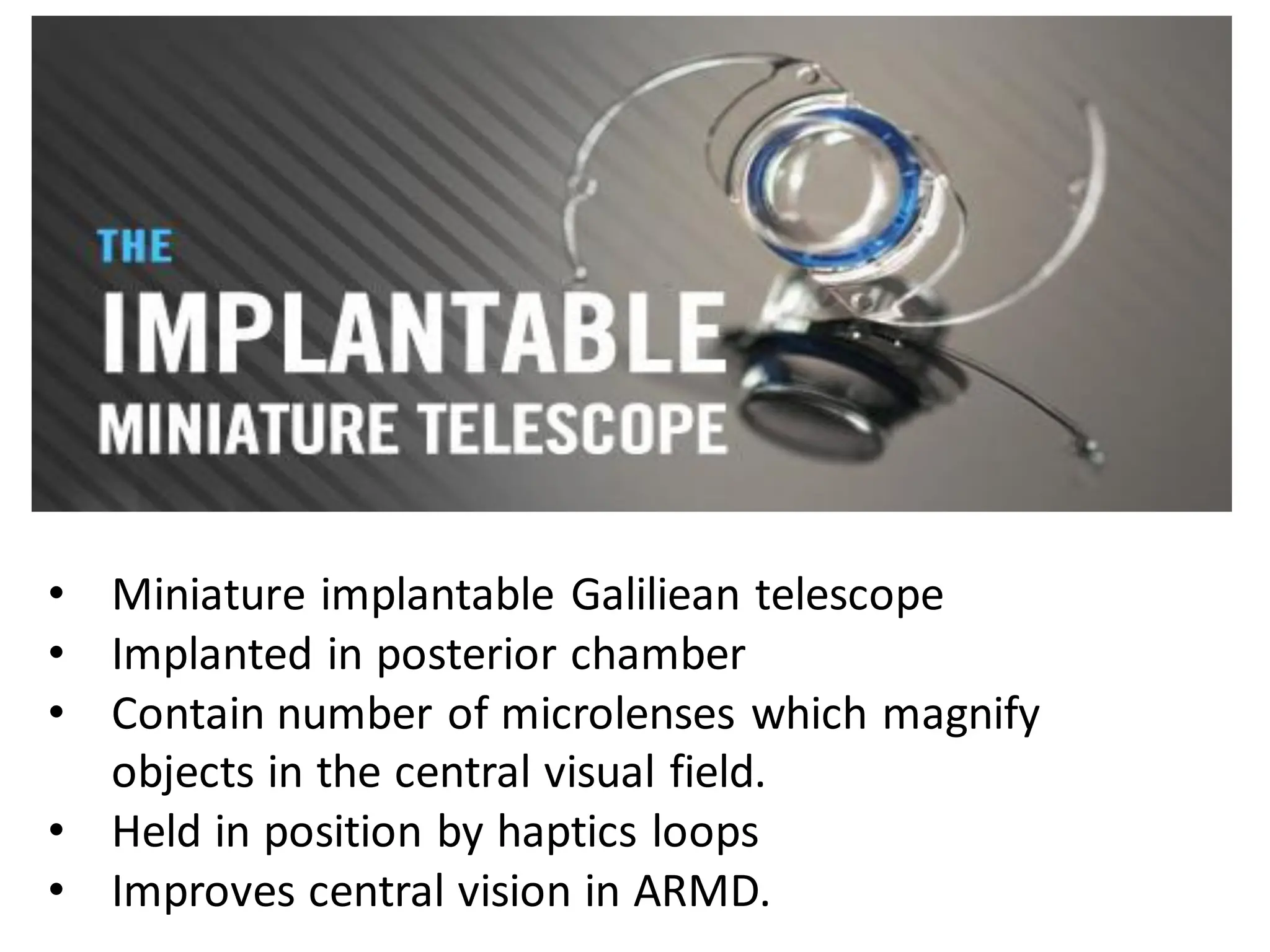
• Miniature implantable Galiliean telescope
• Implanted in posterior chamber
• Contain number of microlenses which magnify
objects in the central visual field.
• Held in position by haptics loops
• Improves central vision in ARMD.
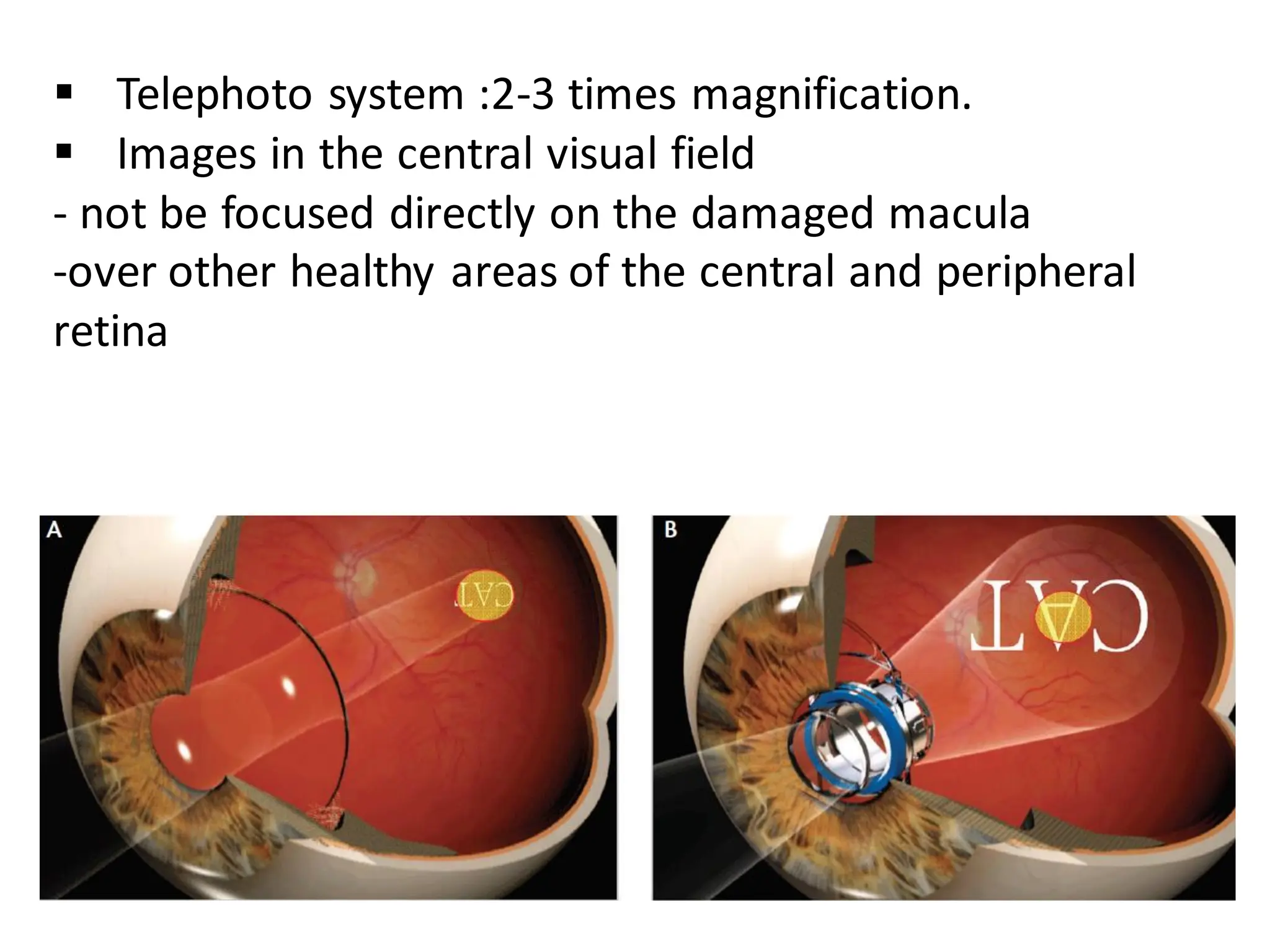
▪ Telephoto system :2-3 times magnification.
▪ Images in the central visual field
- not be focused directly on the damaged macula
-over other healthy areas of the central and peripheral
retina
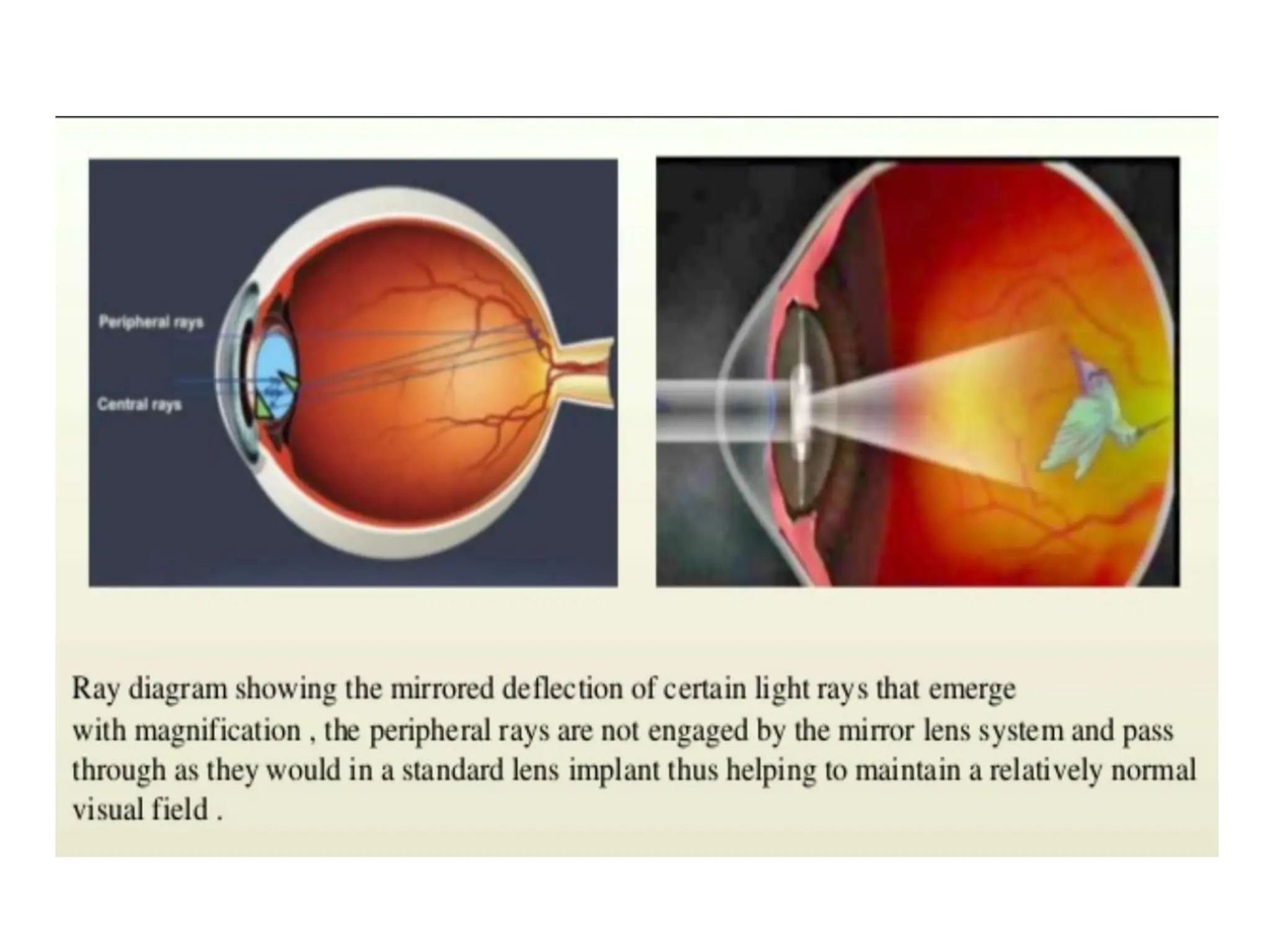
TELESCOPIC IOL
• Next generation of implantable miniature
telescopes.
• Uses mirrors rather than glass lenses
• 25 X magnification of central images
• The LMI (Lipshitz Macular Implant)
-optics is 6.5mm
- slightly thicker than a standard IOL
• Contains 2 miniature mirrors
-2.8 mm posterior doughnut shaped mirror that
reflects light anteriorly
-1.4 mm central retina-facing mirror which in
turn focuses the light on retina).
• Does not affect peripheral vision.
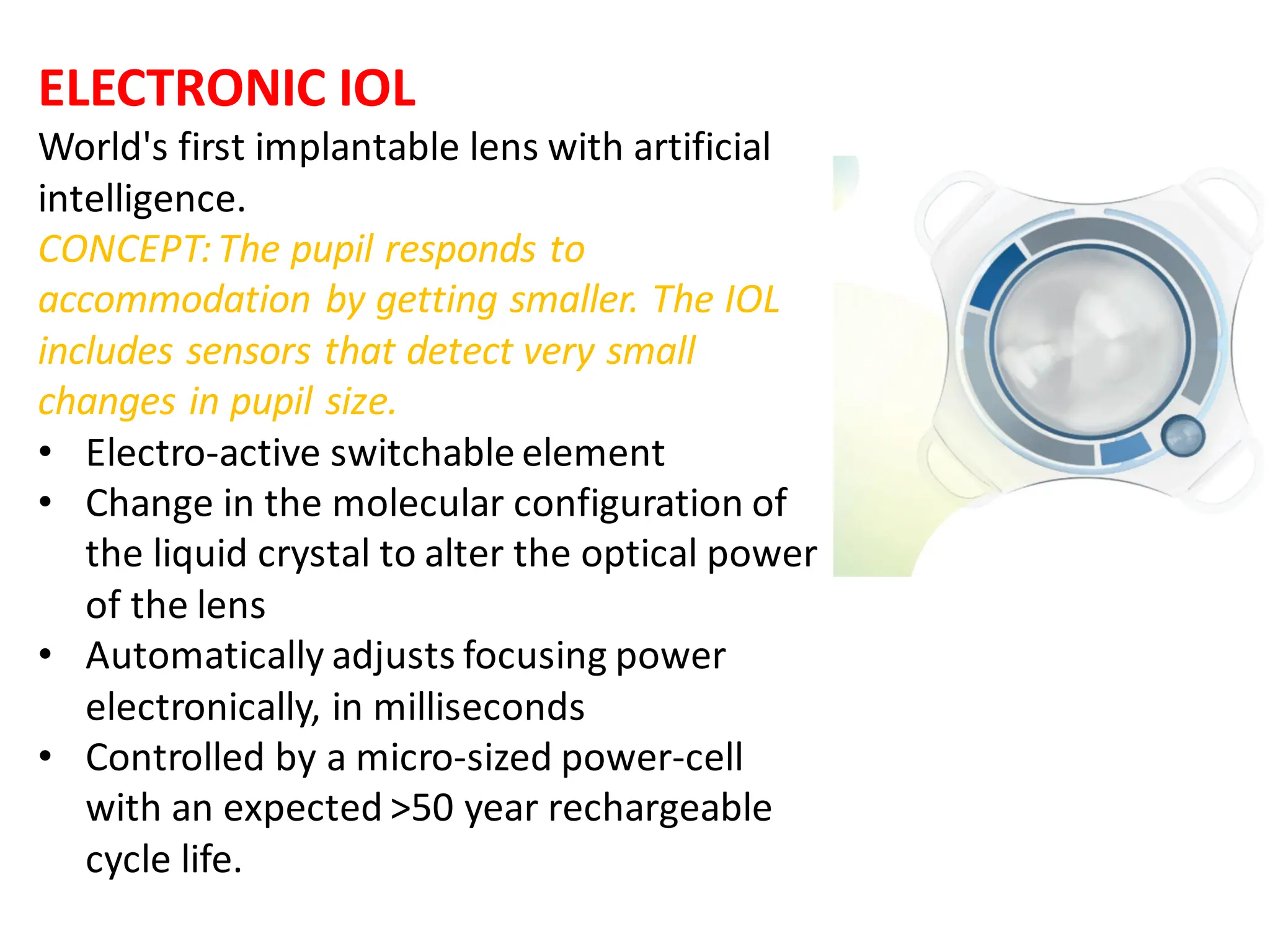
ELECTRONIC IOL
World's first implantable lens with artificial
intelligence.
CONCEPT:The pupil responds to
accommodation by getting smaller. The IOL
includes sensors that detect very small
changes in pupil size.
• Electro-active switchable element
• Change in the molecular configuration of
the liquid crystal to alter the optical power
of the lens
• Automatically adjusts focusing power
electronically, in milliseconds
• Controlled by a micro-sized power-cell
with an expected >50 year rechargeable
cycle life.
Referances
1. Postgraduate Ophthalmology 2nd edition by Zia Chaudhuri
and M Vanathi
2. Parsons Diseases of eye 23rd edition
3. E – ophtha
4. Eyewiki
5. AAO
6. Pubmed
7. Google
THANK YOU

Types of IOL and Microlentics-2.pdf iol p

  • 1.
    What is IOL? Anartificial lens to replace crystalline lens of eye to correct optical power of eyes when crystalline lens of eye is clouded by cataract or for refractive surgery
  • 2.
    Parts of anIOL OPTIC Part of lens that focuses light on retina. HEPTIC Small filaments connected to the optic that hold the lens in place in the eye
  • 3.
    History of IOL •The First intraocular lens for the treatment of cataract was implanted by HAROLD RIDLEY at St Thomas Hospital on Nov 29, 1949 • PMMA – 45y/F ,ECCE , Disc Shaped Biconvex, Posterior chamber
  • 4.
    EVOLUTION OF IOLs 1.Firstgeneration IOLs (1949-1954) •Original Ridley PCIOL •Disadvantages — posterior dislocation 2. Second Generation IOLs (1952-1962) •Early ACIOLs
  • 5.
    3. Third GenerationIOLs (1953-1975) •Iris supported lens •Advantages- less corneal decompensation •Disadvantages — iris chaffing , pupillary distortion 4. Fourth Generation IOLs (1963- 1962) • Intermediate ACIOLs •Flexible loops and multiple point fixation •Advantages — more stable, better design, less complications •Disadvantages —anterior chamber is not the physiologicalsite for IOL
  • 6.
    5. Fifth generationIOLs (1975 -1990) •Improved PCIOLs PMMA lenses • Foldable and small incision lense 6.Sixth Generation ( 1990-2000) Modern capsular PCIOLs and Modern ACIOLs 7. Seventh Generation ( 2000 to present) Premium IOLs Aspheric optics Extended range Multifocal Accomodative Phakic iols
  • 7.
    Classification of IOLs ❑Position- Capsular bag, Ciliary Sulcus , Scleral fixation Iris fixation , Angle supported ❑ Material- Rigid (PMMA), Flexible (Silicone), Foldable (Hydrophobic Acrylic , Hydrophilic Acrylic) , Collamer lens ❑ Design - 3 piece /1 piece ❑ Optical shape - Biconvex, Plano-convex, Meniscus ❑ Optic function – Monofocal - Spherical, Aspheric, Toric Multifocal – Bifocal , Trifocal, Multifocal toric, Extended range
  • 8.
    ❑ Optic Color- Transparent, tinted ❑ Haptics properties - 3 piece/1 piece(PMMA,PVDF, polyamide,2,3,4,6 haptics ) ❑ Type of implantation – injectable , not injectable ❑ Type of packaging - pre loaded, not pre loaded
  • 9.
    PCIOL (Advantages ofin the bag placements) ➢ Proper anatomical site ➢ Minimal magnification(<2%)( 20-30% aphakic glasses, 7-12% aphakic contactlens, ACIOLS 2- 5%) ➢ Low incidence of lens decentration and dislocation ➢ Maximal distance from the iris root, pigment epithelium,ciliary processes ➢ Safer for children ➢ Reduced PCO Complicationwith PCIOL ➢ PCO and ACO ➢ Photic Effects Glare, haloes, Photopsia ➢ Optical Imperfections- higher Order Aberration ➢ Capsular Contraction ➢ Req. Glasses For Near
  • 10.
    PREVENTION OF COMPLICATIONBY I. MATERIAL II. DESIGN III.ASPHERICITY IV.FOCAL POINTS V.ACCOMMODATION Material used must be biocompatible, optically clear, lightweight, durable, moldable, capable of being sterilized, resistant to forceps and folding marks, resilient to the stresses of implantation, able to withstand Nd:YAG laser capsulotomy, and inert in the eye through the rest of the patient’s lifetime.
  • 11.
    Optic Materials 1.Non-foIdabie-rigid IOL ✓Polymethylmethacrylate (PMMA) 2.Foldable IOLs ✓ Silicone ✓ Hydrophobic acrylic ✓ Hvdrophilic acrylic ✓ Hydrogel ✓ Collamer MATERIALS USED FOR INTRAOCULAR LENSES Haptic materials ✓ Polypropylene ✓ PVDF ( Poly Vinylidene fluride ) – Good material memory ✓ PMMA ✓ Acrylic Hydrophilic Hydrophobic ✓ Silicone
  • 12.
    PMMA • Rigid material •Hydrophobic (water content <1%) • RI 1.49, • Thin lens Single piece • Rigid , inert and non autoclavable • Chemically stable compound • Excellent optical properties • Low cost • Disadv: Rigid and requires larger incision
  • 13.
    Silicon • Flexible, Polymersof silicon and oxygen ( Siloxane ) • 1st material used for foldable IOL ( by J Zhou in 1980) • Hydrophobic • Low RI: 1.41-1.46 (Thick optic lens, large incision) • Current models-three piece with PMMA, PVDF, Polyamide haptics • Advantages: Less chance of PCO • Good resistance for Nd:YAG Disadvantage: More chance of dislocation bcz of poor adhesiveness • Premature and abrupt opening ( injury to surrounding structure) • Anterior capsule rim opacify quickly • Glistening (Penetration by aqueous humor in lens material cause small vacuoles within the lens optic.) • Not preferred in silicon filled eye/high myopic eye(silicone droplets), • Favours bacterial adherence-post op infection
  • 14.
    Hydrophobic Foldable Acrylic •Copolymers of acrylate and methacrylate Derived from rigid PMMA • Available in 3-piece or 1-piece iol • RI 1.44-1.55 • Easy handling, Prone for mechanical damage • Transparent or yellow • Advantages Foldable, durable , Low PCO rates, Little damage with Nd:YAG, Little tendency to attract silicone oil droplets • Disadv: Scratches with instrument • Low tendency to self centering • Photopsia , Glistening
  • 15.
    Hydrophilic acrylic • Mixtureof hydroxyethylmethacrylate (HEMA) and hydrophilic acrylic monomer • Water content 18-26% • Highly foldable (Ideal lens for MICS ) • RI-1.43 • Yellow tinted Advantages • Easy to handle, • Less chance of damage • Resistance for Nd-YAGlaser shots • Low photopsia ,Lesser capsular bag contraction • Higher uveal biocompatibility Disadvantage • Higher PCO rates ( Calcium deposits leading to optic opacification)
  • 16.
    Hydrogel • Poly HEMAcontaining IOLs are also called hydrogels. • Swell in water ( Water content 38% ), and form soft , swollen , rubbery mass • Because of the high water content, they have a low refractive index ( 1.43 to 1.48 ). • These lenses are highly foldable and can be injected through incisions approximately 1.8 mm or smaller, allowing for microincision cataract surgery (MICS)
  • 17.
    Collamer • Patented copolymerof hydrophilic acrylic and porcine collagen . • Hydroxyethyl methacrylate copolymer with a UV absorbing chromophore. • Hydrophilic • In theory, the porcine collagen improves the biocompatibility of the lens when implanted in human eyes. • Mainly used for Posterior Chamber Phakic Intraocular lenses [ implantable collamer lens (ICL)]
  • 18.
    INTRAOCULAR LENS DESIGN ➢Single piece / 3-piece ➢ Plate haptic / open loop haptics ➢ Angulated / planar haptics ➢ Edge design ➢ Optic design
  • 19.
    In general, theadvantages of single-piece IOLs come from its less rigid haptics. The softer, longer haptics unfold in a more evenly distributed manner, causing relatively less trauma to the capsule and more uniform contact holding it in place, and reducing wrinkling. Three-piece IOLS are more versatile and can be placed in the capsule or in the ciliary sulcus in the event that the posterior capsule ruptures. Single-piece IOLs should never be placed in the ciliary sulcus { UGH (uveitis, glaucoma, hyphema) syndrome, to shifting of the lens over time} Single-Piece vs Three-Piece IOLs
  • 21.
    Haptic angulation relativeto the plane of optic ▪ For PCIOL Anterior angulation to keep the optic part away from the pupil angulated haptics allow for adequate pupillary clearance and adhesion to the posterior capsule ▪ For ACIOL Posteriorly angulated lens to vault the IOL away from the pupil
  • 24.
    Aspheric design ofIOLs Spherical aberration is a phenomenon in which the outer parts of a lens do not bring light rays into the same focus as the central part. Rays passing through the lens close to its centre are focused farther away than rays passing through a circular zone near its rim.
  • 25.
    Aspheric design ofIOLs Optics of aberration in human eye Cornea-positive spherical aberration Lens-negative spherical aberration Aging-increases positive aberration
  • 27.
    Premium IOL •Multifocal •Accommadative •Toric monofocalIOL •Toric multifocal IOL •Monovision
  • 28.
    • IOLS whichcan separate incoming light into two or more foci, thus resulting in multiple coexisting retinal images. • At any given point, only one of the images (distance, intermediate or near) is the sharpest, and hence selected by the brain for visualisation. This concept is known as simultaneous vision. • The visual system in any mammal is not known to be multifocal, hence the implantation of these IOLS initiate a process of neuroadaptation in the recipient's brain, and its best effect is seen only after some days to weeks. • The splitting of light to form multiple images leads to loss of contrast for each image. • However, despite these limitations, MFIOLS continue to be one of the best technologies to provide spectacle independence for all distances after cataract surgery. MULTIFOCAL IOL
  • 29.
    MULTIFOCAL IOL • Conceptby Hoffer • Implanted by Pearce in 1986 • IOL with 2 or more focal points MFIOL can be classified in two ways: II. Based on optical design and Mechanism of action 1. Refractive 2. Diffractive 3. Apodized Diffractive I. Based on focality 1. Bifocal creating a focus for distance as well as near vision. 2. Trifocal IOLs have an additional focus for intermediate vision. 3. Extended Depth of Focus (EDOF) IOLS produces an elongated focus of vision, which provides distance as well as an intermediate vision over a range.
  • 30.
    Diffraction is thebending of light around an obstacle or through a opening. Refraction is the bending of light as it moves from one medium to another. Refraction and Diffraction
  • 31.
    Refractive MIOL • Anteriorsurface have ring or sector shaped optical zones with different dioptric power • Which are based on geometric light rays refraction principles • These zones provide various focal points • Helps in distance , intermediate and near vision • Dependent on the size of pupil to utilize the required zone of lens. • Limitation : High dysphotopsicsymptoms, high intolerance to pupil decentration and significant loss of contrast sensitivity
  • 33.
    Diffractive MIOL • Principle: utilizes diffraction in conjuction with refraction to create a new foci • Refraction by anterior surface and diffraction by the posterior surface with multiple grooves / microscopic steps • Light divided into two foci 41% each for near and distance and 18% lost to HOA • Less pupil dependent and more tolerance to decentration.
  • 34.
    • Gradual reductionin diffractive step heights from the centre to the periphery • Making the lens distance dominating when the pupil size is large • the dysphotopsic symptoms less • Diffractive MFIOLS are less pupil dependent, and show more tolerance to pupil decentration Apodisation
  • 35.
    REFRACTIVEMULTIFOCAL IOLS DIFFRACTIVEMULTIFOCAL IOLS Excellent intermediateand distance vision Excellent reading vision and very good distance vision Near vision fair but may not be sufficient to see very small print Fair Intermediate vision Patients who read for prolongedperiods of time or in poor lighting may experience eye fatigue Patients who do lots of computer work may not accept it well Pupil dependent Less pupil dependent Light to moderate readers Drive mostly during the day Play sports Use a computer frequently, or Activities that rely heavilyon intermediate Spend a lot of time reading Detailedcraft-work Scotopic activities -movies, night time driving Refractive vs Diffractive
  • 36.
    Disadvantages • Loss ofcontrast sensitivity • Glare and haloes-scattering of light at the dividing line of the different zones- improves with bilateral implantation bcz of summation effect • Less satisfactory visualisation of the fundus -difficult in vitreoretinal procedure • Requires visuocortical neuro adaptation
  • 37.
    Toric IOLs referto astigmatism correcting intraocular lenses used at the time of cataract surgery to decrease post-operative astigmatism. Toric IOLs • 1st Toric IOL was introduced by Shimizu • And it was non foldable 3-piece • Patient selection, IOL calculation, postop lens stability are the key features for success
  • 38.
    Advantages of ToricIOL • Better results than monofocal iol and limbal relaxing incision • Average postoperative toric iol rotation <5‘ • Quality of visionn can be improved with bilateral toric IOL implantation • Multifocal Toric IOL can improve distance, intermediate and near Vision (challenge is preoperative assessments which is very crucial) • Postoperative residual astigmatism <1D in 89% and 88% multifocal toric and toric IOL respectively
  • 39.
    Disadvantage of ToricIOL • Improper alignment or rotation of the IOL after surgery may result in more residual astigmatism than predicted.- • Generally for every 1' of IOL rotation - 3.3% of cylindrical power lost • A complete loss of cylindrical power occurs can occur with a rotation of >30 • Astigmatism more than 4D at corneal plane still remains dificult to correct with toric iol. • Irregular astigmatism can not be corrected
  • 40.
    ACCOMMODATION • It isa dioptric change in the power of the eye • Ciliary muscle contraction causes a release in zonular tension at the equator, which permits the capsule to mould the young lens into an accommodated form to focus the near • Presbyopia, age related loss of accommodation -gradual age related stiffening of the lens Accommodative IOLs
  • 41.
    • Restoring thetrue, dynamic and continuous range of focusing ability of the eye • Monovision , bifocal, multifocal modalities does not restore active change in power of the eye that occurs during accommodation • Accomodative IOLS restore true accommodation to the presbyopic eye and provide a range of clear vision. Accommodative IOLs
  • 42.
    Restoration of Accommodation •In Pseudophakic eyes engine that drives accommodation ( ciliary muscles) continues to remain functional so it can be used to restore accomodation Accommodative IOLs • Single optic IOLS -designed to undergo forward movement of the optic • Dual optic IOLS -increased separation of the two optics
  • 43.
    Single optic IOLS •Implanted in the capsular bag with posteriorly vaulted optic • Has hinged plate haptics • Need for the post op cycloplegia and cause the anterior and posterior capsular surface to fibrose around the haptics and seal the optic within the bag • MOA- accommodative effort causes a bulking up of the ciliary muscle within the vitreous cavity, which increase the vitreous pressure against the optic, causing temporary forward movement of the optic Eg.Crystalens AT 1mm shift of a 1mm thick optic could result in 0.8D in long eyes 1.3D in average eye1.85 D in short eyes
  • 44.
    Open chamber iolsthat they fill the capsular bag but retain a fluid space btw the two optics • High +ve bi-convex anterior optic (approx. 32D) and a weaker -ve meniscus concave optic posterior(approx. -12D) joined by 'spring haptics‘ • Retain the natural dimensions of the capsular bag in axial thickness and equatorial diameter • 1mm separation produce 2.0 to 2.5D of accommodation • Eg. Sychrony dual optic Accommodative iol (visiogen) and The AkkoLens Lumina Dual Optic IOLS
  • 45.
    • At ciliarybody rest, the zonules are put on stretch,producing axial shortening of the capsular bag , thus pulling the optics together and loading the haptic springs. • With accommodative effort, zonular tension is released, compressive capsular tension on the optics and spring haptics is released and thus the anterior optic moves forward
  • 46.
    • Based onprinciple of the Alvarez lens-Two sinusoidal optical surfaces slide across one another along the horizontal axis • Fitted spring like haptics fused at the rim movement perpendicular to the optical axis • 2D to 5D of near add power • Implanted in sulcus The AkkoLens Lumina
  • 47.
    Curvature change IOLs 4different designs are under development 1)PowerVision FluidVision IOL (Belmont, CA) 2)Medennium Smart Lens (Irvine, CA) 3)NuLens Accommodative IOL 4)Polymer refilling technique
  • 48.
    • The annularperipheral haptics - Fluid reservoir • The fluid moves back and forth through this pliable system(Microfluidic Technology) • As the ciliary body and zonular apparatus contract and expand, that fluid in the peripheral annular haptic is forced through a channel into the centre of the lens, causing it to increase its anterior posterior curvature • Average accommodation+5D Fluid Vision (Power Vision )
  • 49.
    • Manufactured froma proprietary material thermodynamic hydrophobic acrylic • 2.0 mm rod and injected through a normally sized capsulorhexis • unique thermodynamic properties that changes shape from a solid rod at room temperature to a gellike lens-shaped polymer at body temperature. Medellium Smart Lens (Irvine, CA)
  • 50.
    NuLens • Sulcus fixatedlens • Composed of silicone gel between 2 rigid plates with an opening on the front plate • it works opposite to the normal accommodative mechanism • Focus for near is achieved when the ciliary muscle is relaxed and focus for distance when the ciliary muscle is contracted, zonular tension would hold the capsular diaphragm in a relatively taught state
  • 51.
    • With increasedvitreous pressure, the plate compress, the polymer bulges the anterior plate aperture, resulting in increased curvature and increased power • Accommodation +3 to +5D
  • 52.
    Polymer refilling • Siliconeballoon is placed in capsular bag than liquid silicone polymer is injected into the balloon. • By this recreating an optically clear and soft , accommodating lens
  • 53.
    Disadvantages Accommodative IOLs •Smaller optic-more aberrations • Failure of accommodation due to-Fibrosis- capsular opacification (anterior/posterior) • The separation of dual optic and curvature change determines the post op refraction • Overfilling and underfilling in polymer refilling • YAG capsulotomy is contraindicated in IOLs • More ACO and PCO • Cost
  • 54.
    Newer IOLs- RollableIOL Ultrathin -100 micron Hydrophobic material Front surface curved Back surface series of steps with concentric rings Open up gradually Implanted by phakonit technique
  • 55.
    IOL IMPLANTAION INSPECIAL SITUATIONS. ❑ ABSENCE OF CAPSULARSUPPORT • Scleral fixation (suture/glue) • Iris fixated • ACIOLS ❑ PEDIATRIC AGE GROUP • Heparin coated • Multifocal IOLS ❑ DRUG ELUTING IOLS • Triamcinolone acetonide • Dexamethsone • Diclofenac sodium (0.2 mg/ml) • Mitomicin C (0.2 mg/mL) • Colchicine (12.5 mg/mL) and 5-fluorouracile (10 mg/ml) • Anti-VEGF
  • 56.
    Scleral fixation IOL •Implanted in the absence / defective capsular support • Available as Nonfoldable / foldable / single piece / 3 piece ( multipiece) • Contain eyelets at Haptic / optic through which suture passed for fixation • Suture – 9-0/10-0 prolene or Gore-Tex • Placed through ciliary sulcus • Complication : Corneal edema , RD Intraocular hemorrhage, Suture erosion and infection
  • 57.
    Iris fixated IOLs FixatedIris on iris with sutures , loops or claws Iris Claw lens - introduced by Worst in 1972 Singh and worst Iris Claw lens ARTISAN Iris claw lens
  • 58.
    Iris Claw lens •Anterior iris or Retropupillary fixation ( AC or PC fixation ) • Two opposed claw haptics that Fixate on iris by enclavation of midperipheral iris stroma where iris is less vascularized, less reactive and virtually immobile . • Allowing the pupil to unrestricted ability to dialate and constrict • Excellent centration • Iris bridge protects the endothelium touching by PMMA • Phakic iris claw are also used • Indication : • Zonular Dehiscence, subluxated lens, traumatic cataract, large PCR , Secondary implantation after aphakia
  • 59.
    • Earlier modelsof ACIOL were rigid and closed-loop. • Modern ACIOL - flexible and open loop with a supporting base at the end of each haptics. • These haptics are inserted in the anterior chamber angle against the scleral spur, anterior to the iris. • Sizing an ACIOL is by determining the white-to-white (WTW) diameter and adding 1mm ACIOL
  • 60.
    Indications Absent capsular orzonular support with normal iris anatomy and a deep anterior chamber. Contraindications Pre-existing corneal endothelial damage, iridocorneal angle damage, shallow anterior chamber, or lack of sufficient iris support. Complications Damage to the angle and iris, which can lead to chronic inflammation, elevated intraocular pressure, uveitis/glaucoma/hyphema syndrome, corneal endothelial damage and corneal decompensation. ACIOL
  • 61.
    ANIRIDIA IOLs • Variousdesigns • Overall size = 12.5 to 14 mm • Optic diameter = 3.5 to 5 mm • Central clear optic • Surrounding colored diaphragm
  • 62.
    PHAKIC IOLS • Implantationof IOL without removing natural crystalline lens. • ADVANTAGE: Preserves natural accommodation • Mostly used in Myopic eyes: -5 to -20 DS • Also used in Hyperopic eyes Concern in Hyperopes: -More chances of endothelial damage - Increased risk of angle closure glaucoma • Life-long regular follow up required. COMPLICATIONS: Endothelial cell damage Inflammation Pigment dispersal Elevated IOP , Cataract
  • 64.
    Piggyback IOL • AnIOL that 'piggybacks' on existing IOL or two IOLs are implanted simultaneously • 1st IOL placed in the capsular bag • 2nd IOL is placed in the bag or sulcus Advantages Easier to place 2nd IOL than to explant IOL and replace it -lesser risk -more predictable -can change in power -by adding or explanting IOL -Better image quality -Increased depth of focus
  • 65.
    Complications Interlenticular opacification – (InterpseudophakosElshnig's pearls) RED ROCK SYNDROME Unpredictable final IOL position
  • 66.
  • 67.
    AMD lenses The Scharioth maculalens for AMD has central 1.5mm diameter with +10D add giving magnification of about 2X.
  • 68.
    The EyeMax mono, alsofor AMD, extends usable macula by 10 degrees in all directions. However, progression of AMD can negate the effect.
  • 69.
    Magnifies images andprojects them to the healthier part of the macula which has been detected prior to surgery.
  • 70.
    The Masket ND90S IOL (Morcher) for negative dysphotopsia has a peri-optic groove to capture the rhexis. Negative dysphotopsia , a shadow on the visual field that as many as 15% of patients may see after cataract surgery.
  • 71.
    RECENT ADVANCES ANDTHE FUTURE ❑ LIGHT ADJUSTABLE IOL ❑ TELESCOPIC IOLS ❑ SMART IOLs ❑ ELECTRONIC IOLs
  • 72.
    Light adjustable IOL •Foldable three-piece IOL with a cross-linked photosensitive silicone polymer matrix, a homogeneously embedded photosensitive macromer , and a photoinitiator . • The application of near ultraviolet light to a portion of the lens optic results in disassociation of the photoinitiator to form reactive radicals that initiate polymerization of the photosensitive macromers within the irradiated region of the silicone matrix. • Residual Myopia - the peripheral portion of the lens is irradiated to achieve a doughnut configuration • Residual hyperopia- irradiation of the central portion of the lens with the Light Delivery Device polymerizes the macromer in this region
  • 74.
    • Miniature implantableGaliliean telescope • Implanted in posterior chamber • Contain number of microlenses which magnify objects in the central visual field. • Held in position by haptics loops • Improves central vision in ARMD.
  • 75.
    ▪ Telephoto system:2-3 times magnification. ▪ Images in the central visual field - not be focused directly on the damaged macula -over other healthy areas of the central and peripheral retina
  • 76.
    TELESCOPIC IOL • Nextgeneration of implantable miniature telescopes. • Uses mirrors rather than glass lenses • 25 X magnification of central images • The LMI (Lipshitz Macular Implant) -optics is 6.5mm - slightly thicker than a standard IOL • Contains 2 miniature mirrors -2.8 mm posterior doughnut shaped mirror that reflects light anteriorly -1.4 mm central retina-facing mirror which in turn focuses the light on retina). • Does not affect peripheral vision.
  • 78.
    ELECTRONIC IOL World's firstimplantable lens with artificial intelligence. CONCEPT:The pupil responds to accommodation by getting smaller. The IOL includes sensors that detect very small changes in pupil size. • Electro-active switchable element • Change in the molecular configuration of the liquid crystal to alter the optical power of the lens • Automatically adjusts focusing power electronically, in milliseconds • Controlled by a micro-sized power-cell with an expected >50 year rechargeable cycle life.
  • 79.
    Referances 1. Postgraduate Ophthalmology2nd edition by Zia Chaudhuri and M Vanathi 2. Parsons Diseases of eye 23rd edition 3. E – ophtha 4. Eyewiki 5. AAO 6. Pubmed 7. Google
  • 80.