PHAKIC IOLS
HISTORY
 1889 – clear lens extraction for correction of myopia
– Fukala in austria/germany : FUKALA SURGERY,
abandoned due to complications
 1950 – correcting myopia by placing a concave lens
into phakic eye
 1988 – baikoff : anterior chamber angle fixated IOL
 1991 – Artisan – iris claw lens
OPTIONS :
 Anterior chamber angle supported – Baikoff
 Anterior chamber iris fixated – Artisan/ Verisyse
 Posterior chamber IOL – ICL and PRL
INDICATIONS
 Myopia > -8D and hyperopia > +5D
 Severe astigmatism – toric models may be needed
 When photoablation is contraindicated – corneal
thickness <500µ
 Residual bed after LASIK <250µ.
 AC depth > 3.2 mm for ACIOLs and 2.8mm for
PCIOLs
 Endothelial cell count >2200/mm2
CONTRAINDICATIONS
 Low endothelial cell count and altered morphology
 Low AC depth
 Cataract
 Diabetic retinopathy
 Abnormal iris and angle
 Chronic uveitis
PATIENT SELECTION
 Informed consent from patient
 Pupil size
 Corneal evaluation
 Anterior chamber evaluation
 Patient counselling
PREOPERATIVE DIAGNOSTICS
 Unaided and BCVA
 Non contact confocal microscopy or specular
microscopy - Endothelial cell count
 UBM or ASOCT – AC depth
 Anterior and posterior segment evaluation
CURRENT MODELS OF IOLS
 Two additional P-IOLs are currently in Phase 3
of clinical trials with a view to FDA approval:
1. The Veriflex - foldable P-IOL for the anterior
chamber with iris fixation also known as Artiflex
(OPHTEC).
2. The phakic AcrySof IOL for the anterior chamber
with angle support
 The P-IOLs for anterior chamber and with angle
Support are the AcrySof and the Kelman Duet
IMPLANTABLE CONTACT LENS
 Available between -3.0 to -20.0 D and +1.50D to +20.0D
 ICL – STAAR model
 Single piece haptic design, made up of hydroxymethacrylate
copolymer
 Optic – 5.5mm diameter
 Myopia - anterior concave and posterior concave
 Hyperopia – anterior convex/posterior concave
 Optical zone 4.5 to 5.5mm
 Sizing of posterior chamber PIOL – white to white measurement
between 3 and 9’o clock hrs or by direct sulcus measurement
 Video
 Complications of posterior chamber phakic IOLs :
1. Cataract formation – most common
2. Pupillary block - Because of the PC phakic IOLs, the iris can
be pushed forward and narrow the anterior chamber angle, so a
pupillary block with acute glaucoma can appear - Prevented by
PI
3. ↑ IOP and pigment dispersion
4. Decentration and rotation of IOL – diplopia, glare and pigment
dispersion
IRIS SUPPORTED PHAKIC IOL
 Artisan phakic lens is an iris-supported IOL
 The lens haptics attach to the midperipheral,
immobile iris through a process called enclavation.
 In this technique, the surgeon draws small knuckles
of peripheral iris into the pincer-like haptics.
 Thus the optic lies just anterior to the iris plane.
 Patient selection :
 High myopia and high hyperopia
 Toric phakic IOLs for high myopia and hyperopia with
astigmatism
 >18 yrs of age with stabilized myopia or hyperopia
 Sizing of iris fixated PIOL – one size fits all since it is
fixed to midperipheral iris.
 Made up of PMMA with UV blocking
 Total length 8.5mm
 5mm optic - -3 to -23.5D
 6mm optic - -3 to -15.5D
COMPLICATIONS OF IRIS FIXATED AC IOL :
1. Endothelial cell loss
2. Chronic inflammation and uveitis
3. Astigmatism – iris claw is not foldable it requires an incision.
4. Intraocular lens rotation – less common
5. Pigment dispersion and lens deposits – less common
6. Glaucoma – less common, PI is mandatory to prevent
pupillary block
7. Cataract is less
 Baikoffs foldable AC phakic IOL :
COMPLICATIONS
 Anterior chamber angle supported phakic IOLs :
1. Endothelial damage
2. Pigment dispersion and lens deposits
3. Chronic inflammation and uveitis
4. Pupil ovalization and iris retraction
5. Intraocular lens rotation
6. Surgically induced astigmatism
7. Glaucoma
8. Glare and halo
ADVANTAGES OF PHAKIC IOLS
 Potential to treat large range of myopic, hyperopic
and astigmatic refractive error
 Allows the crystalline lens to retain its function
preserving accomodation
 Removable and exchangeable
 Results are stable
DISADVANTAGES
 Risk of intraocular procedure
 Nonfoldable models require large incisions that may
result in postop astigmatism
 High ametropic patients may require additional
photorefractive surgery
 Endothelial cell loss and cataract formation
 Pupil ovalization, chronic uveitis, pupillary block,
pigment dispersion
REFRACTIVE OUTCOME OF PHAKIC IOLS
 Refractive outcomes are very good
 Phakic IOL surgery is also reasonably safe.
 In this challenging set of eyes with high refractive
errors, the vast majority of patients do very well with
a significant portion gaining lines of BCVA
 Myopia -1 to -10 D
 Hyperopic +1 to +3D
 Astigmatism up to 3D
 corneal thickness atleast
250µ of posterior stroma
should be preserved
 Total corneal thickness
atleast 410µ after LASIK
 Myopia -10 to -22D
 Hyperopia +4 to +10D
 Astigmatism upto 3D
corrected with toric IOLs
 corrects the full range of
refractive errors
 Not associated with the
limitations of LASIK
LASIK PHAKIC IOLS
BIOPTICS
 Two different procedures in two different planes of
eye
 1st procedure – intraocular
 2nd procedure – LASIK, LASEK or PRK
 Indicated in patients with refractive errors that are
suboptimally treated with a single procedure
 Eg : high myopes, high hyperopes or with
significant astigmatism
FUTURE OF PHAKIC IOLS
 Artisan phakic toric intraocular lens : correction of
regular astigmatism in combination with myopia or
hyperopia
 Baush and lomb – testing a foldable version of
NuVita AC angle fixated PIOL
 Artiflex – foldable version of iris fixated AC PIOL
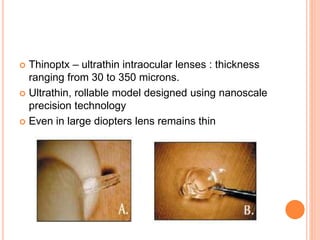
 Thinoptx – ultrathin intraocular lenses : thickness
ranging from 30 to 350 microns.
 Ultrathin, rollable model designed using nanoscale
precision technology
 Even in large diopters lens remains thin
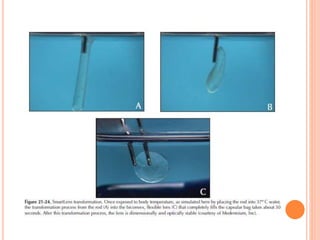
 Smart lens : made of a thermodynamic,
hydrophobic acrylic material.
 At body temperature, the biconvex lens is 9.5 mm
in diameter and from 2 to 4 mm thick
 The lens is highly flexible and completely elastic,
returning to its original shape when deforming
forces are released
THANK YOU

Phakic iols

  • 1.
  • 2.
    HISTORY  1889 –clear lens extraction for correction of myopia – Fukala in austria/germany : FUKALA SURGERY, abandoned due to complications  1950 – correcting myopia by placing a concave lens into phakic eye  1988 – baikoff : anterior chamber angle fixated IOL  1991 – Artisan – iris claw lens
  • 3.
    OPTIONS :  Anteriorchamber angle supported – Baikoff  Anterior chamber iris fixated – Artisan/ Verisyse  Posterior chamber IOL – ICL and PRL
  • 4.
    INDICATIONS  Myopia >-8D and hyperopia > +5D  Severe astigmatism – toric models may be needed  When photoablation is contraindicated – corneal thickness <500µ  Residual bed after LASIK <250µ.  AC depth > 3.2 mm for ACIOLs and 2.8mm for PCIOLs  Endothelial cell count >2200/mm2
  • 5.
    CONTRAINDICATIONS  Low endothelialcell count and altered morphology  Low AC depth  Cataract  Diabetic retinopathy  Abnormal iris and angle  Chronic uveitis
  • 6.
    PATIENT SELECTION  Informedconsent from patient  Pupil size  Corneal evaluation  Anterior chamber evaluation  Patient counselling
  • 7.
    PREOPERATIVE DIAGNOSTICS  Unaidedand BCVA  Non contact confocal microscopy or specular microscopy - Endothelial cell count  UBM or ASOCT – AC depth  Anterior and posterior segment evaluation
  • 8.
  • 9.
     Two additionalP-IOLs are currently in Phase 3 of clinical trials with a view to FDA approval: 1. The Veriflex - foldable P-IOL for the anterior chamber with iris fixation also known as Artiflex (OPHTEC). 2. The phakic AcrySof IOL for the anterior chamber with angle support  The P-IOLs for anterior chamber and with angle Support are the AcrySof and the Kelman Duet
  • 11.
    IMPLANTABLE CONTACT LENS Available between -3.0 to -20.0 D and +1.50D to +20.0D  ICL – STAAR model  Single piece haptic design, made up of hydroxymethacrylate copolymer  Optic – 5.5mm diameter  Myopia - anterior concave and posterior concave  Hyperopia – anterior convex/posterior concave  Optical zone 4.5 to 5.5mm  Sizing of posterior chamber PIOL – white to white measurement between 3 and 9’o clock hrs or by direct sulcus measurement
  • 12.
  • 13.
     Complications ofposterior chamber phakic IOLs : 1. Cataract formation – most common 2. Pupillary block - Because of the PC phakic IOLs, the iris can be pushed forward and narrow the anterior chamber angle, so a pupillary block with acute glaucoma can appear - Prevented by PI 3. ↑ IOP and pigment dispersion 4. Decentration and rotation of IOL – diplopia, glare and pigment dispersion
  • 14.
    IRIS SUPPORTED PHAKICIOL  Artisan phakic lens is an iris-supported IOL  The lens haptics attach to the midperipheral, immobile iris through a process called enclavation.  In this technique, the surgeon draws small knuckles of peripheral iris into the pincer-like haptics.  Thus the optic lies just anterior to the iris plane.
  • 15.
     Patient selection:  High myopia and high hyperopia  Toric phakic IOLs for high myopia and hyperopia with astigmatism  >18 yrs of age with stabilized myopia or hyperopia  Sizing of iris fixated PIOL – one size fits all since it is fixed to midperipheral iris.  Made up of PMMA with UV blocking  Total length 8.5mm  5mm optic - -3 to -23.5D  6mm optic - -3 to -15.5D
  • 17.
    COMPLICATIONS OF IRISFIXATED AC IOL : 1. Endothelial cell loss 2. Chronic inflammation and uveitis 3. Astigmatism – iris claw is not foldable it requires an incision. 4. Intraocular lens rotation – less common 5. Pigment dispersion and lens deposits – less common 6. Glaucoma – less common, PI is mandatory to prevent pupillary block 7. Cataract is less
  • 18.
     Baikoffs foldableAC phakic IOL :
  • 19.
    COMPLICATIONS  Anterior chamberangle supported phakic IOLs : 1. Endothelial damage 2. Pigment dispersion and lens deposits 3. Chronic inflammation and uveitis 4. Pupil ovalization and iris retraction 5. Intraocular lens rotation 6. Surgically induced astigmatism 7. Glaucoma 8. Glare and halo
  • 21.
    ADVANTAGES OF PHAKICIOLS  Potential to treat large range of myopic, hyperopic and astigmatic refractive error  Allows the crystalline lens to retain its function preserving accomodation  Removable and exchangeable  Results are stable
  • 22.
    DISADVANTAGES  Risk ofintraocular procedure  Nonfoldable models require large incisions that may result in postop astigmatism  High ametropic patients may require additional photorefractive surgery  Endothelial cell loss and cataract formation  Pupil ovalization, chronic uveitis, pupillary block, pigment dispersion
  • 23.
    REFRACTIVE OUTCOME OFPHAKIC IOLS  Refractive outcomes are very good  Phakic IOL surgery is also reasonably safe.  In this challenging set of eyes with high refractive errors, the vast majority of patients do very well with a significant portion gaining lines of BCVA
  • 24.
     Myopia -1to -10 D  Hyperopic +1 to +3D  Astigmatism up to 3D  corneal thickness atleast 250µ of posterior stroma should be preserved  Total corneal thickness atleast 410µ after LASIK  Myopia -10 to -22D  Hyperopia +4 to +10D  Astigmatism upto 3D corrected with toric IOLs  corrects the full range of refractive errors  Not associated with the limitations of LASIK LASIK PHAKIC IOLS
  • 26.
    BIOPTICS  Two differentprocedures in two different planes of eye  1st procedure – intraocular  2nd procedure – LASIK, LASEK or PRK  Indicated in patients with refractive errors that are suboptimally treated with a single procedure  Eg : high myopes, high hyperopes or with significant astigmatism
  • 27.
    FUTURE OF PHAKICIOLS  Artisan phakic toric intraocular lens : correction of regular astigmatism in combination with myopia or hyperopia  Baush and lomb – testing a foldable version of NuVita AC angle fixated PIOL  Artiflex – foldable version of iris fixated AC PIOL
  • 28.
     Thinoptx –ultrathin intraocular lenses : thickness ranging from 30 to 350 microns.  Ultrathin, rollable model designed using nanoscale precision technology  Even in large diopters lens remains thin
  • 29.
     Smart lens: made of a thermodynamic, hydrophobic acrylic material.  At body temperature, the biconvex lens is 9.5 mm in diameter and from 2 to 4 mm thick  The lens is highly flexible and completely elastic, returning to its original shape when deforming forces are released
  • 31.