PHAKIC IOL
BY
DR. ARINO JOHN
PG RESIDENT
Introduction `
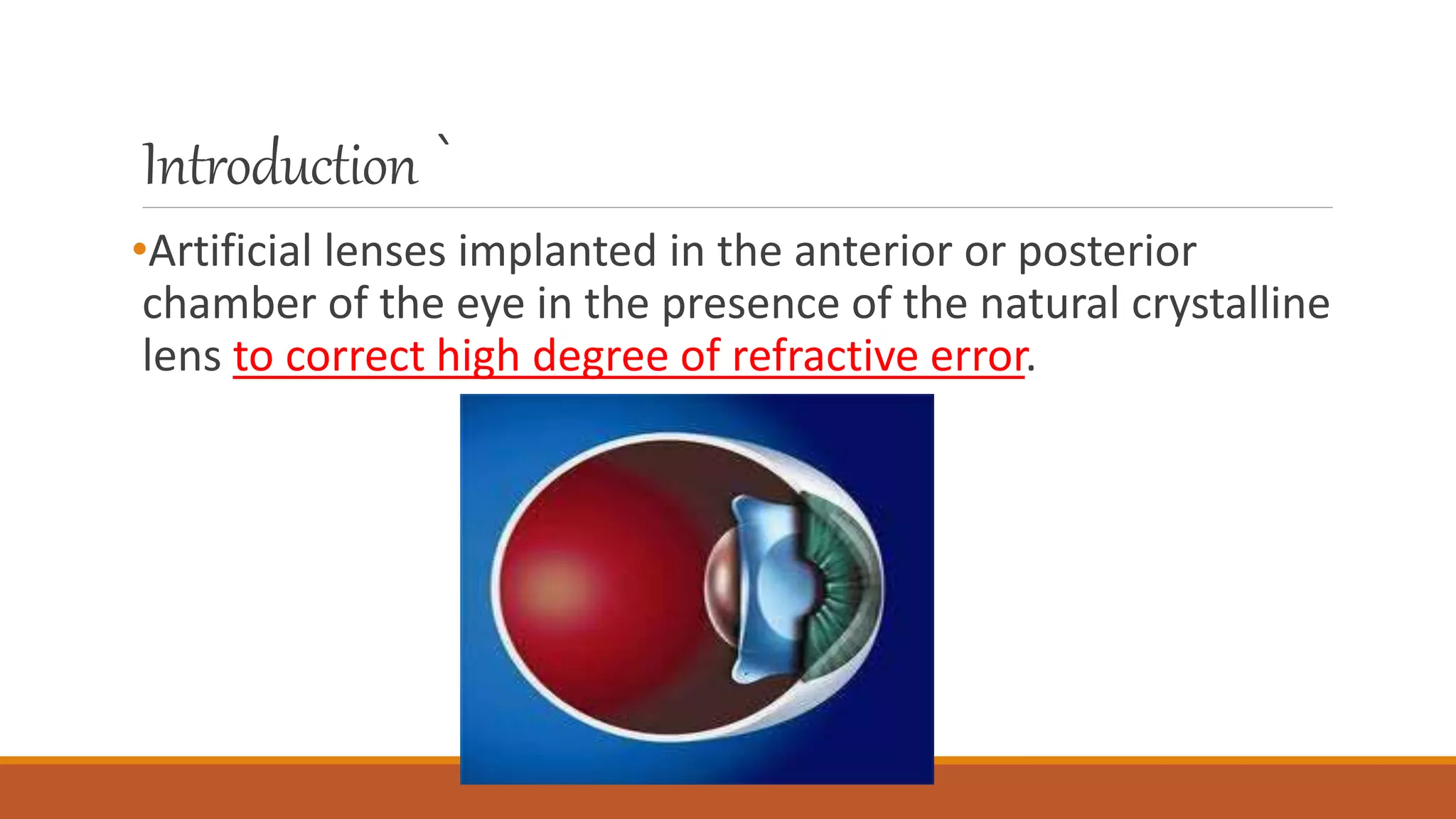
•Artificial lenses implanted in the anterior or posterior
chamber of the eye in the presence of the natural crystalline
lens to correct high degree of refractive error.
Classification
Angle supported
ACIOLs.
Iris fixated
ACIOLs
PCIOLs.
History
◦ Barraquer and Strampelli in the middle of the 20th century used an anterior chamber design
1950s
◦ correcting myopia by inserting a concave lens into the phakic eye
1988
◦ Baikoff : anterior chamber angle-fixed IOL
Mid 1980s
◦ Posterior chamber phakic IOLs : Fyodorov
1991
◦ Artisan-Worst iris claw lens
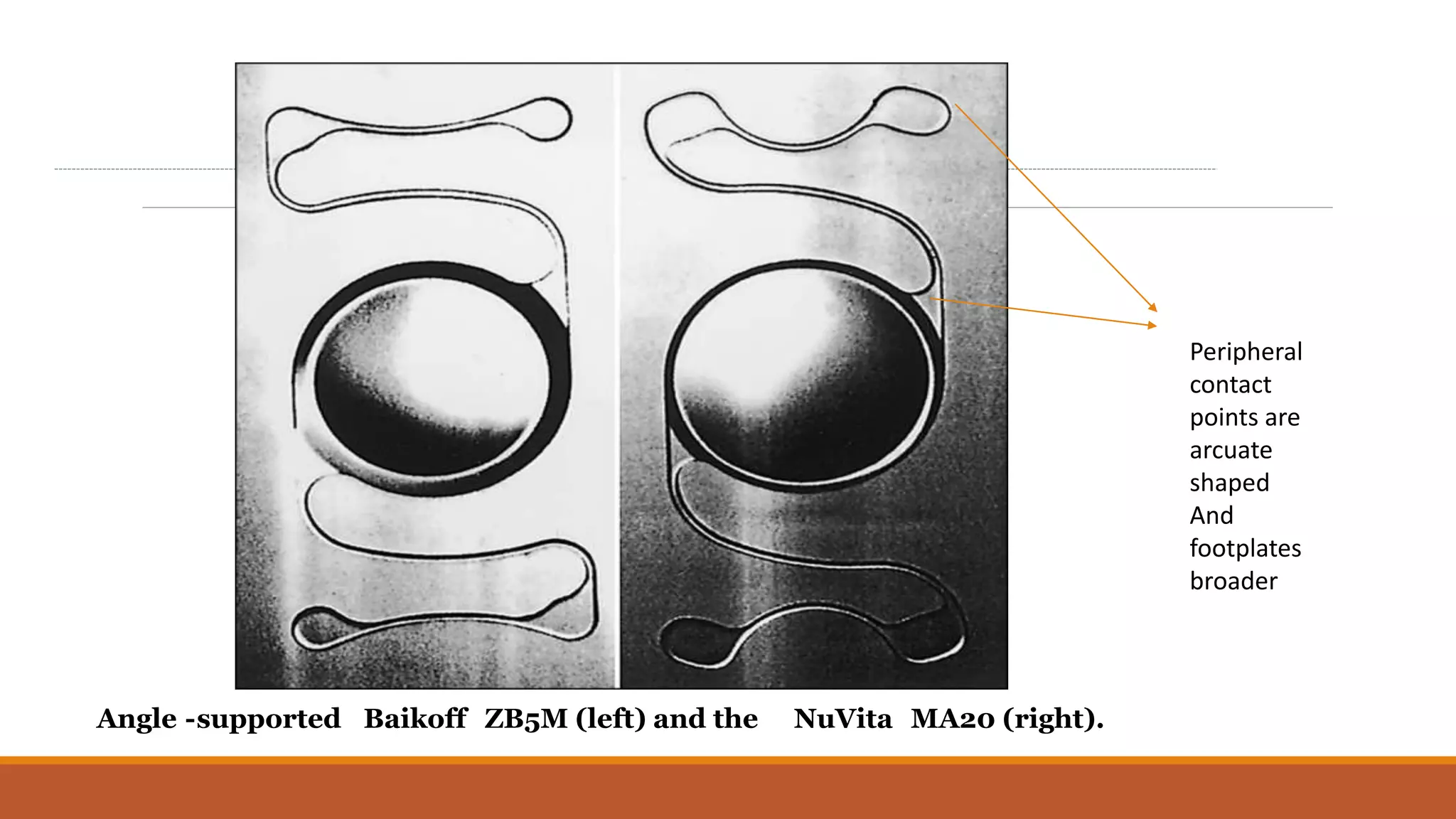
Angle -supported Baikoff ZB5M (left) and the NuVita MA20 (right).
Peripheral
contact
points are
arcuate
shaped
And
footplates
broader
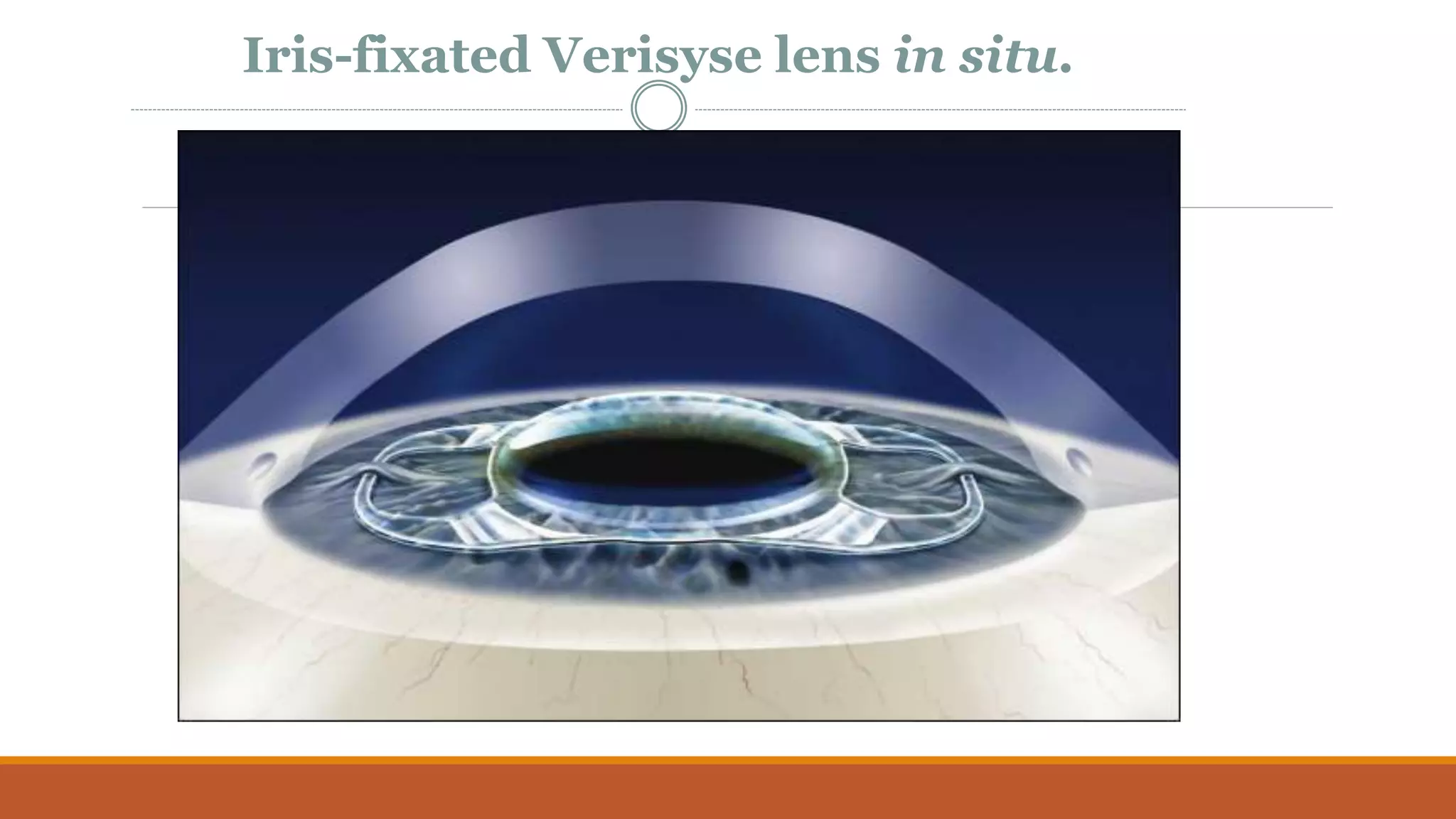
Iris-fixated Verisyse lens in situ.
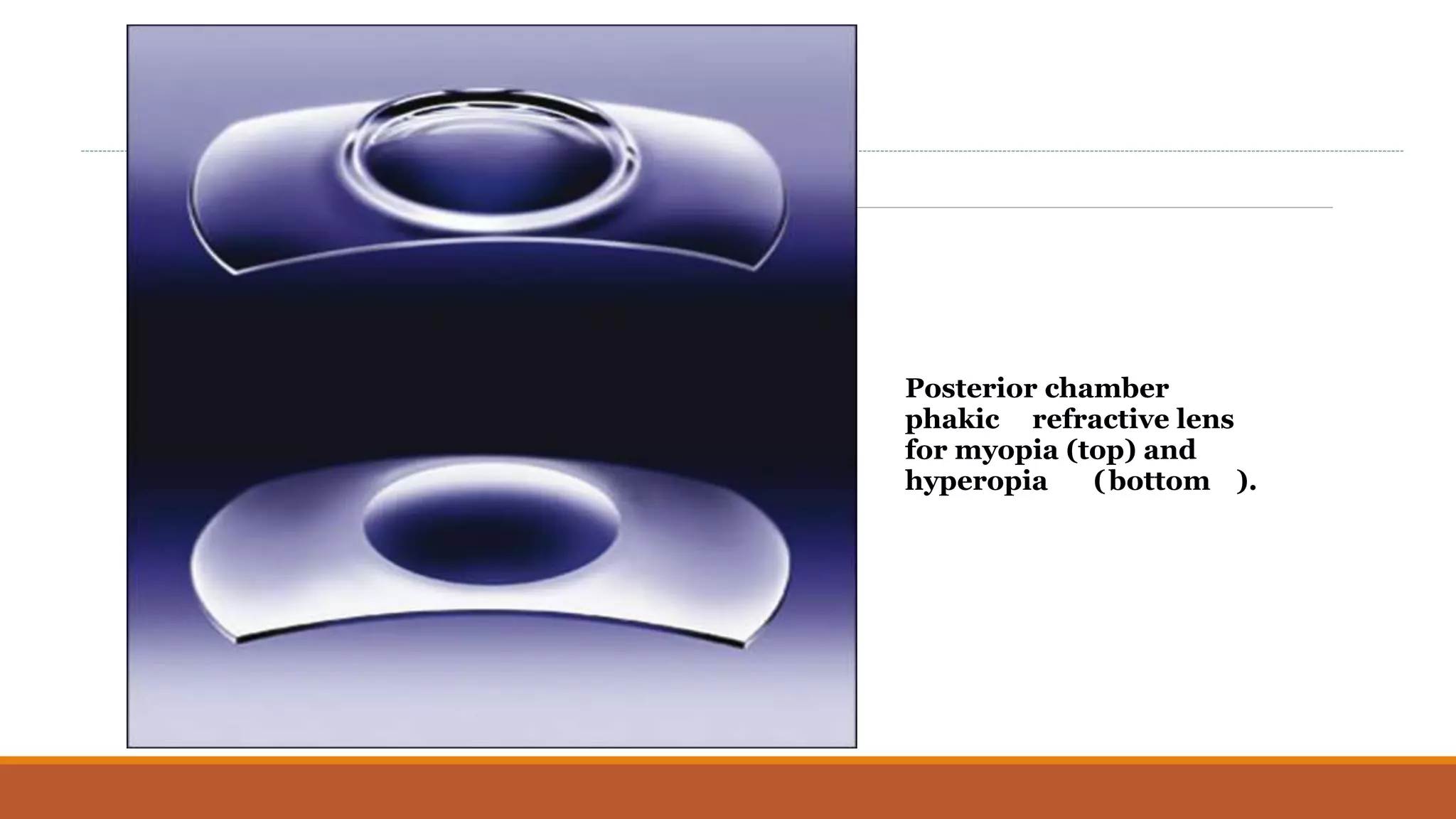
Posterior chamber
phakic refractive lens
for myopia (top) and
hyperopia (bottom ).
Posterior chamber sulcus supported implantable contact lens.
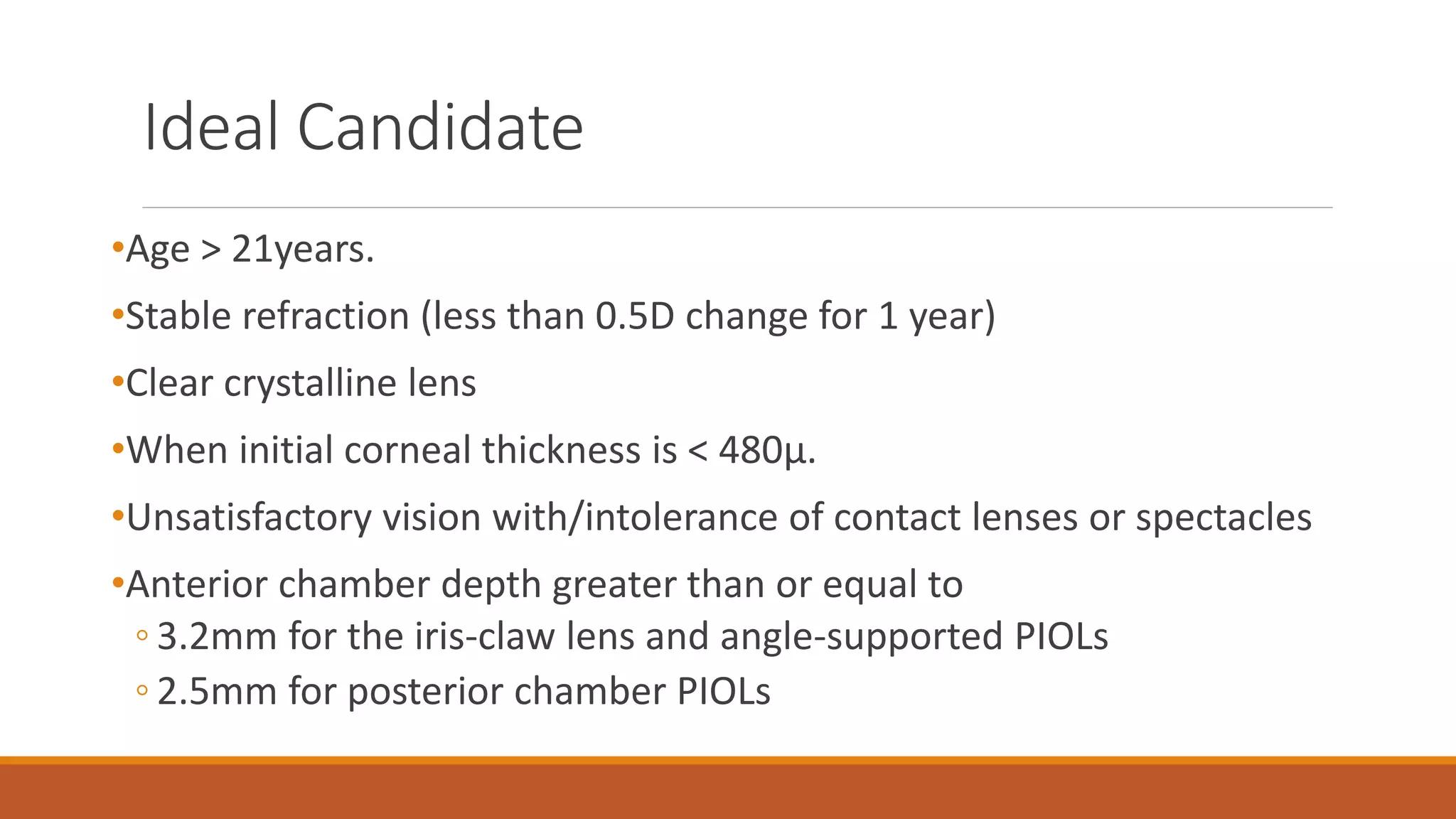
Ideal Candidate
•Age > 21years.
•Stable refraction (less than 0.5D change for 1 year)
•Clear crystalline lens
•When initial corneal thickness is < 480μ.
•Unsatisfactory vision with/intolerance of contact lenses or spectacles
•Anterior chamber depth greater than or equal to
◦ 3.2mm for the iris-claw lens and angle-supported PIOLs
◦ 2.5mm for posterior chamber PIOLs
•A minimum endothelial cell density of
◦ ≥3500 cells/mm2 at 21years of age
◦ ≥2800 cells/mm2 at 31years of age
◦ ≥2200 cells/mm2 at 41years of age
◦ ≥2000 cells/mm2 at 45years of age or more
•No ocular pathology ( glaucoma, uveitis, maculopathy, etc.)
•Stable keratoconus
•Post PK.
INVESTIGATIONS
oUnaided and best corrected VA
oAnterior and Posterior segment evaluation
oWhite-to-white (w-w) measurement
oHigh-frequency (50MHz) ultrasound biomicroscopy/AS-OCT
oCorneal endothelial cell count
Fig. 11.9 Pupil diameter
measurement using infrared
technologies (P2000, Procyon):
10 pictures in a 2-s sequence
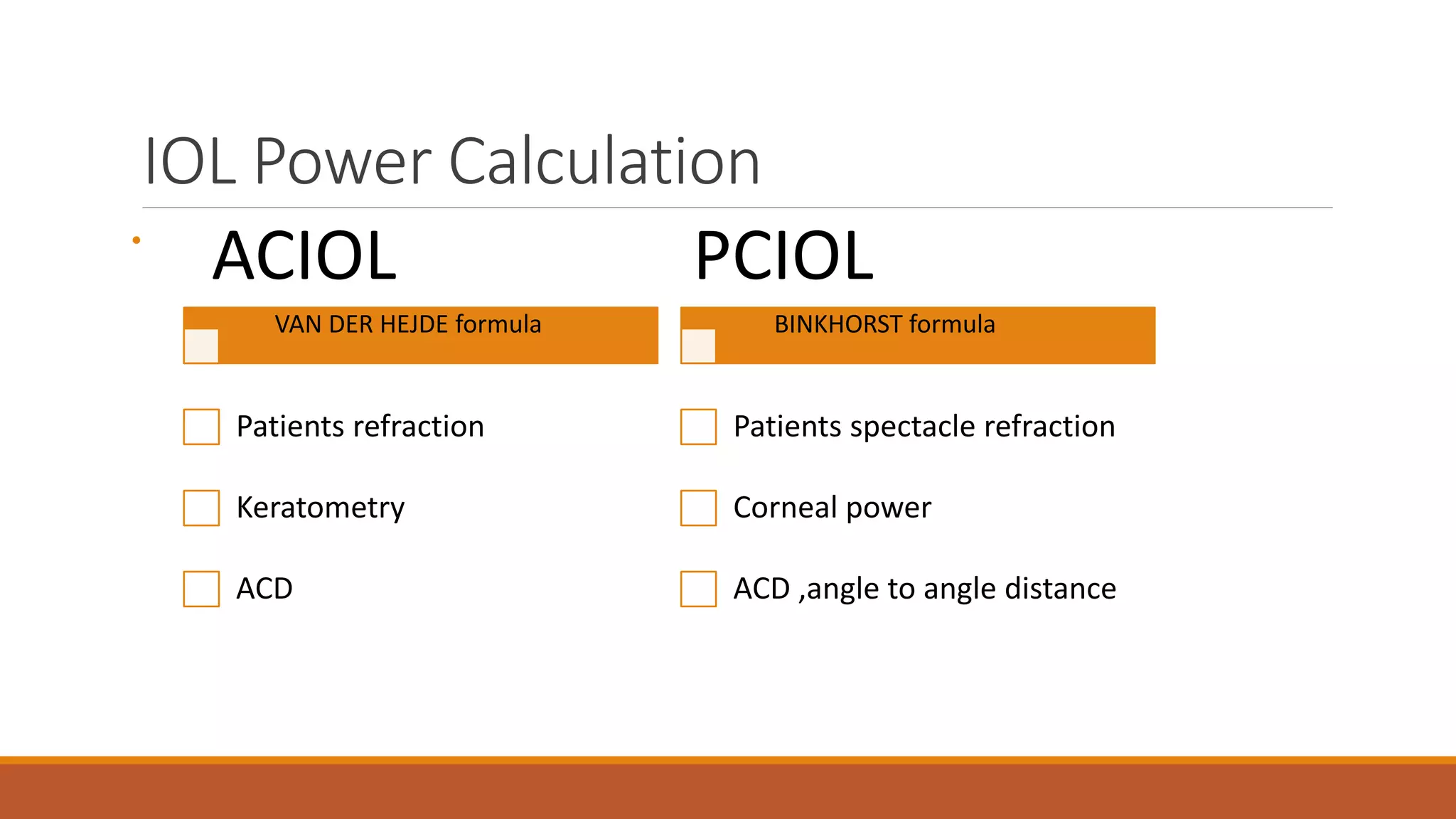
IOL Power Calculation
•
ACIOL
Patients refraction
Keratometry
ACD
PCIOL
Patients spectacle refraction
Corneal power
ACD ,angle to angle distance
VAN DER HEJDE formula BINKHORST formula
IOL power calculation
ACD and angle-to-angle distance are best-obtained using optical coherence tomography (OCT),
but can also be measured using ultrasound biomicroscopy (UBM) or Scheimpflug imaging.
ACD is measured from the corneal apex to the anterior surface of the crystalline lens, and is
use to calculate effective lens position (ELP) in PCIOLs by substracting the distance between the
pIOL and the crystalline lens from the ACD. The ELP is typically 0.8mm in the Artisan/Verisyse
lens.
White-to-white (WTW) measurement with an IOL-Master or calipers can be used to estimate
angle-to-angle distance.
Corneal power is calculated using keratometry or topography to measure the curvature of the
cornea.
AS -OCT
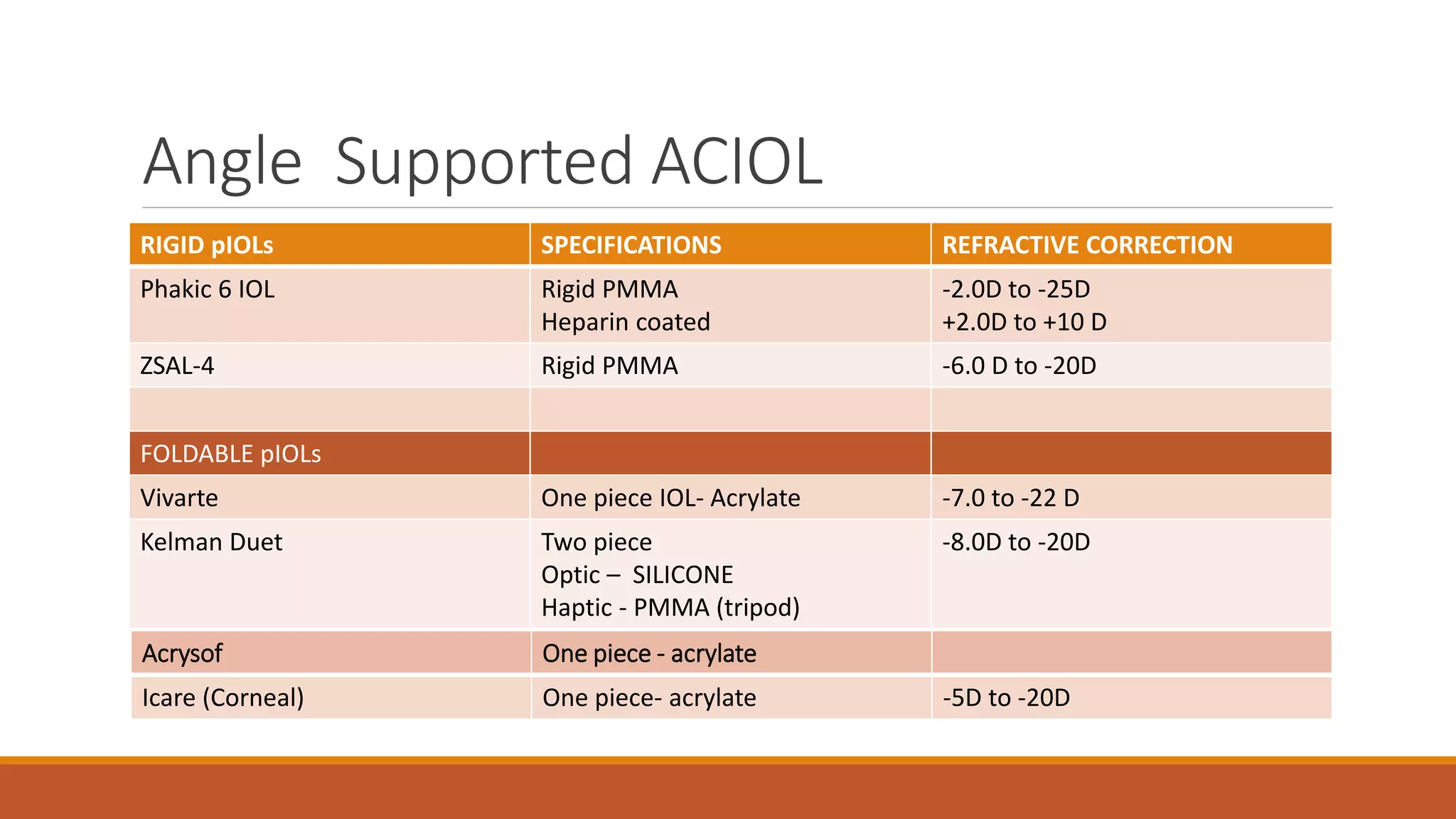
Angle Supported ACIOL
RIGID pIOLs SPECIFICATIONS REFRACTIVE CORRECTION
Phakic 6 IOL Rigid PMMA
Heparin coated
-2.0D to -25D
+2.0D to +10 D
ZSAL-4 Rigid PMMA -6.0 D to -20D
FOLDABLE pIOLs
Vivarte One piece IOL- Acrylate -7.0 to -22 D
Kelman Duet Two piece
Optic – SILICONE
Haptic - PMMA (tripod)
-8.0D to -20D
Acrysof One piece - acrylate
Icare (Corneal) One piece- acrylate -5D to -20D
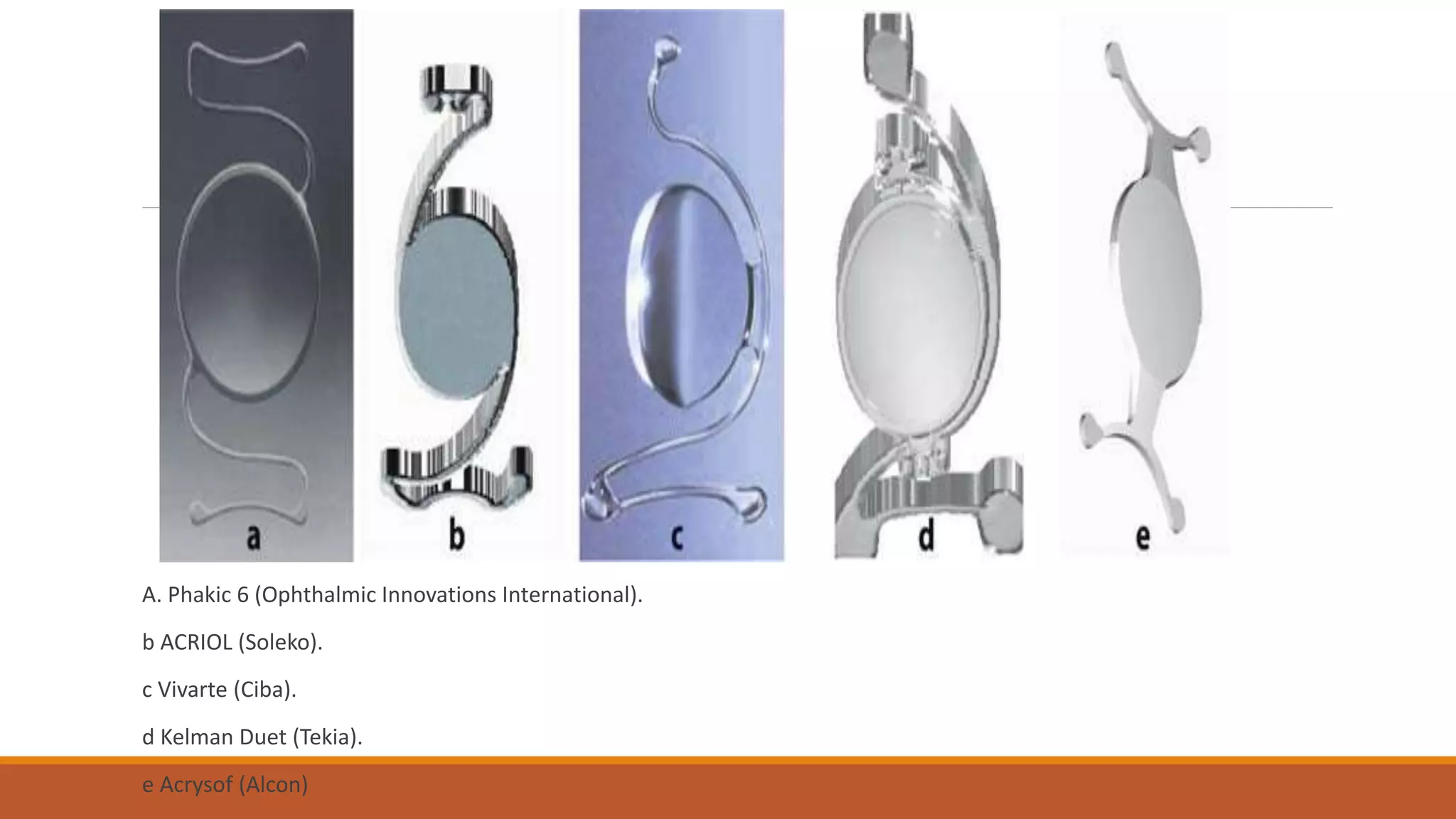
A. Phakic 6 (Ophthalmic Innovations International).
b ACRIOL (Soleko).
c Vivarte (Ciba).
d Kelman Duet (Tekia).
e Acrysof (Alcon)
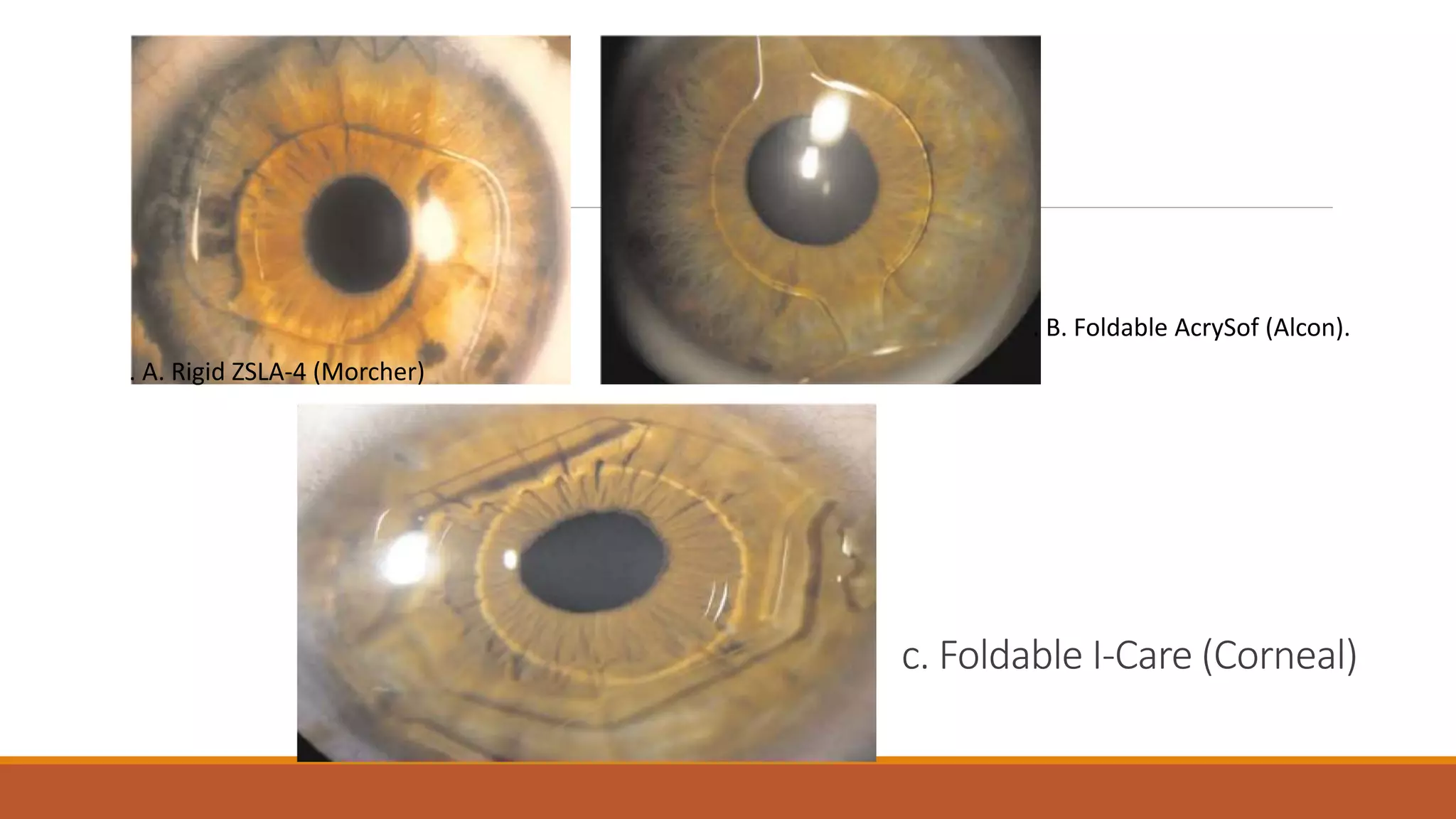
c. Foldable I-Care (Corneal)
. A. Rigid ZSLA-4 (Morcher)
. B. Foldable AcrySof (Alcon).
Foldable “two parts” (Silicone optic/PMMA haptics) Kelman-Duet lens (A).
The haptics are implanted initially through a small incision (B), then the optic
is injected (C). The complex optic-haptics is assembled inside the anterior
chamber (D).
Procedure
Topical pilocarpine
topical or peribulbar anesthesia
Incision
cohesive viscoelastic
lens is introduced , footplate is inserted in
the iridocorneal angle, second haptic is then
placed, lens is then rotated in place
peripheral iridectomy
incision is closed
Complications
Haloes and glare
Pupillary ovalization
Endothelial damage
Elevation of intraocular pressure
Uveitis
Cataract
Retinal detachment
Rarely - malignant glaucoma,
endophthalmitis
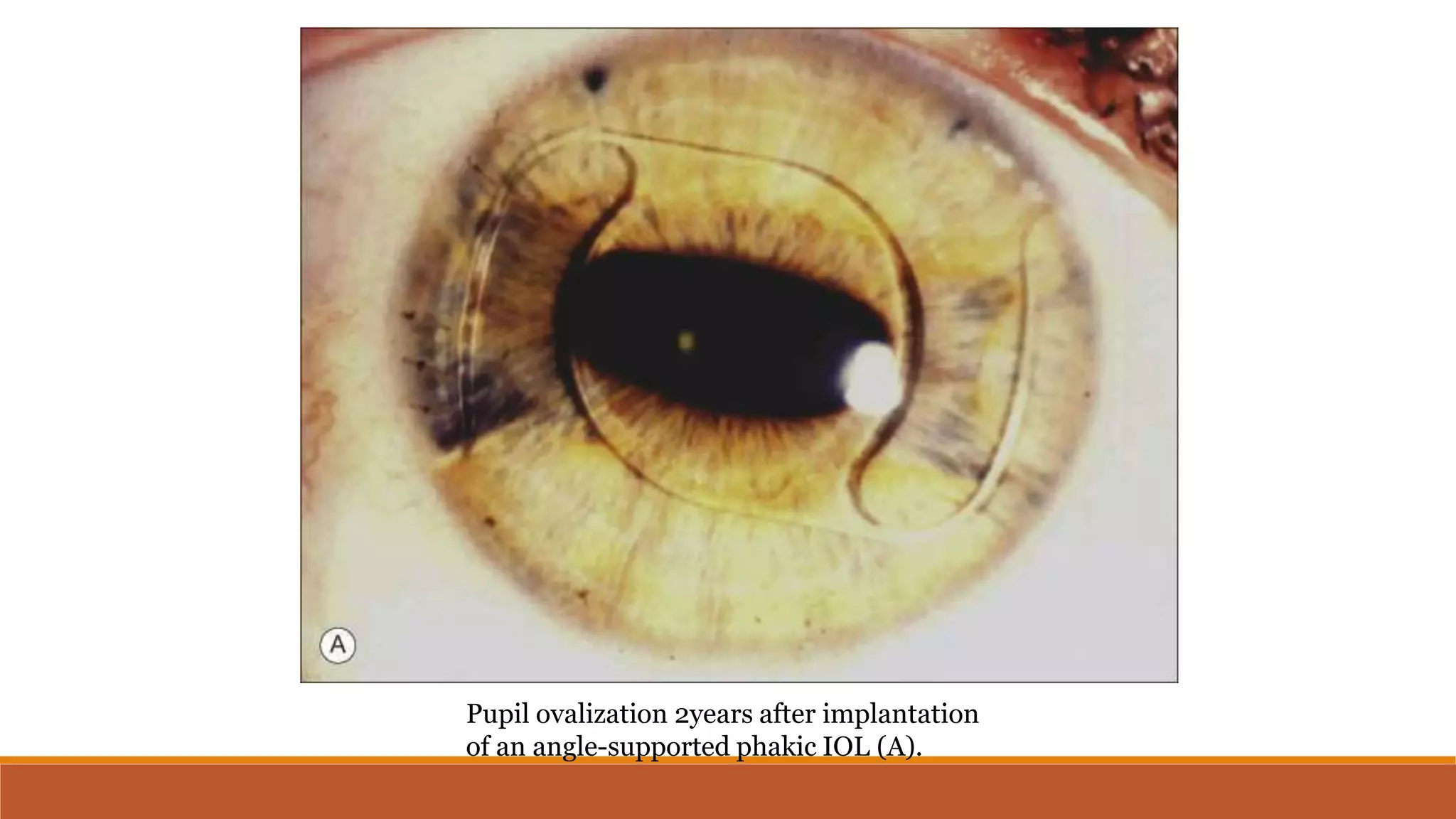
Pupil ovalization 2years after implantation
of an angle-supported phakic IOL (A).
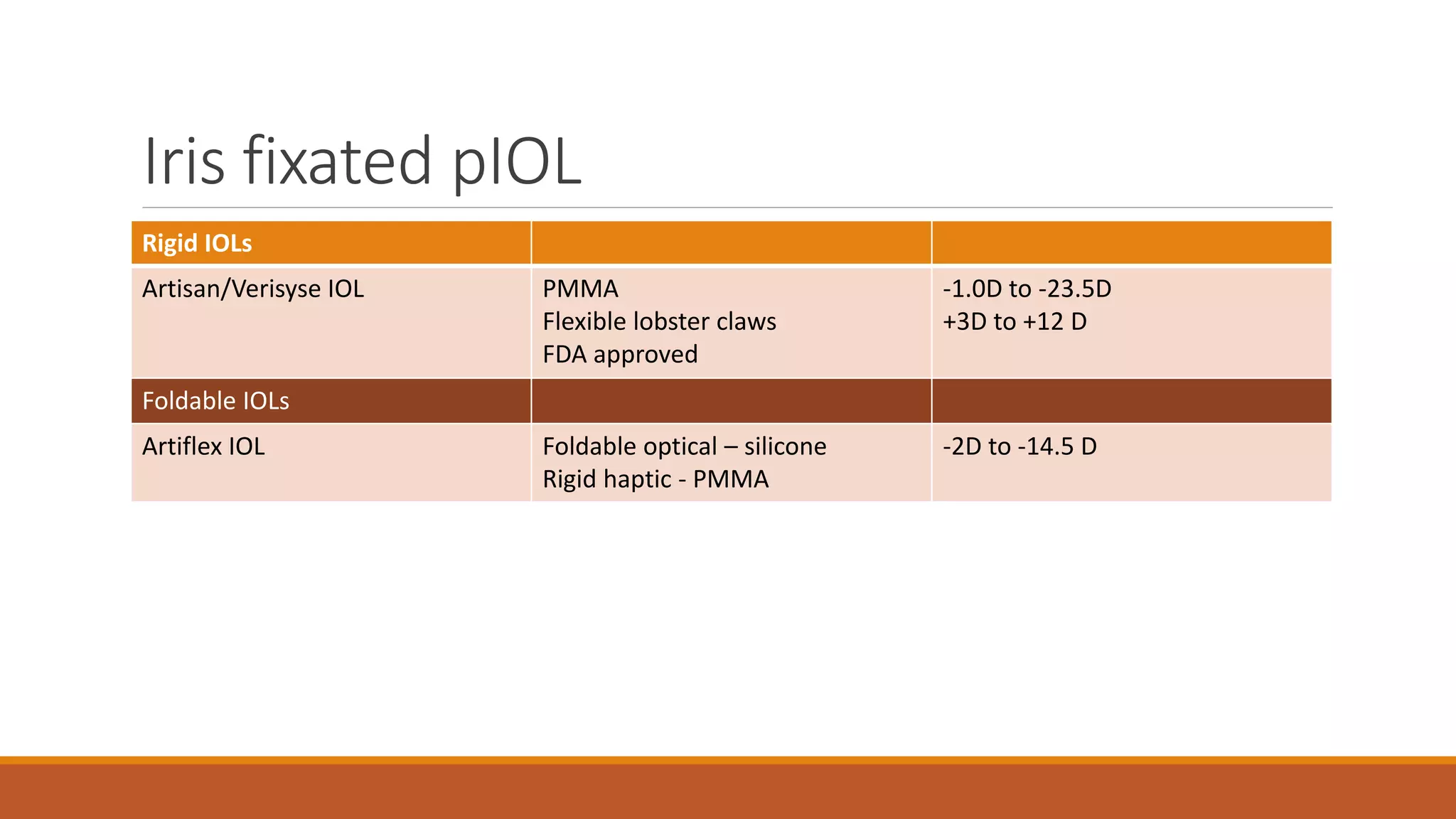
Iris fixated pIOL
Rigid IOLs
Artisan/Verisyse IOL PMMA
Flexible lobster claws
FDA approved
-1.0D to -23.5D
+3D to +12 D
Foldable IOLs
Artiflex IOL Foldable optical – silicone
Rigid haptic - PMMA
-2D to -14.5 D
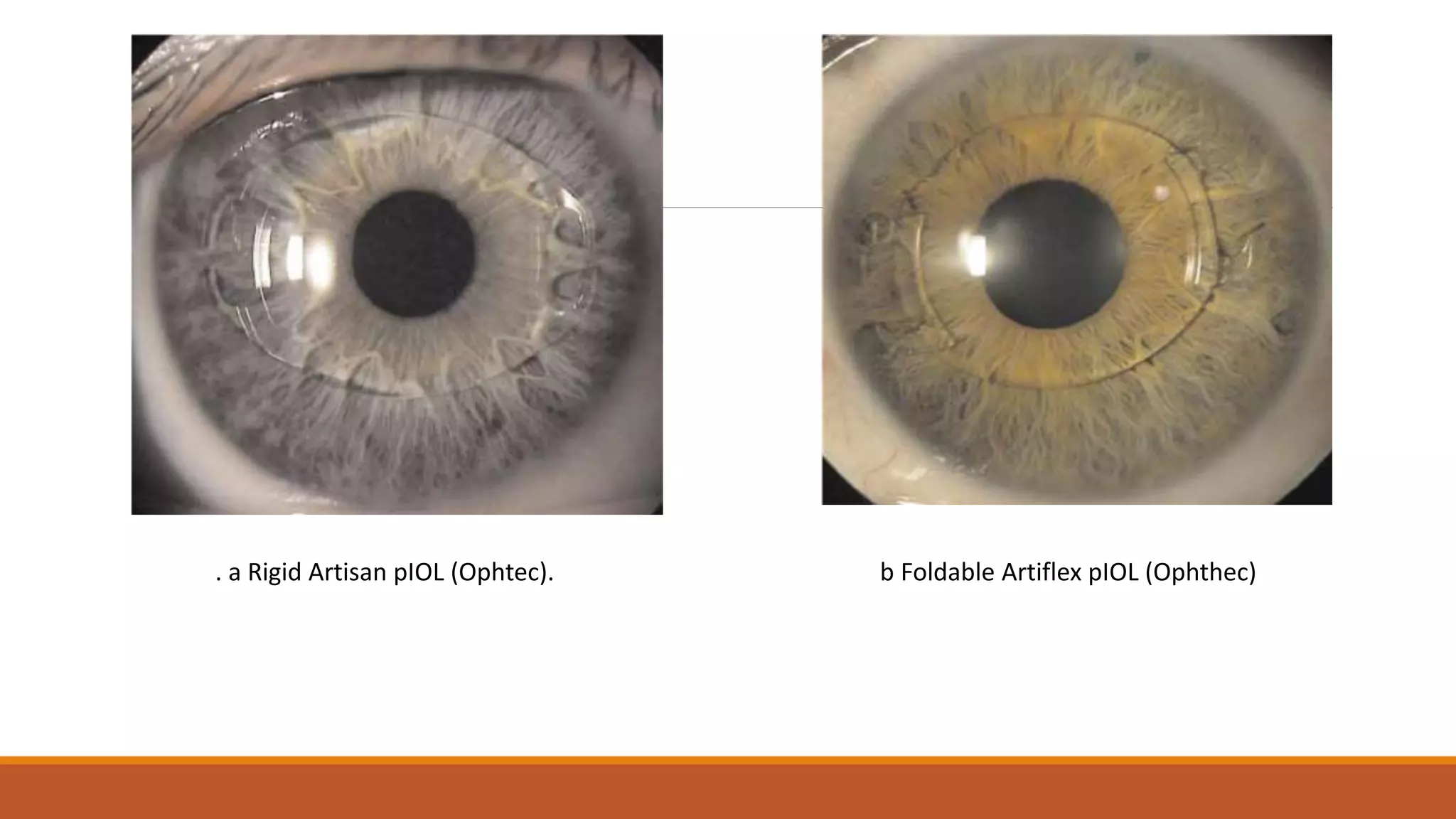
. a Rigid Artisan pIOL (Ophtec). b Foldable Artiflex pIOL (Ophthec)
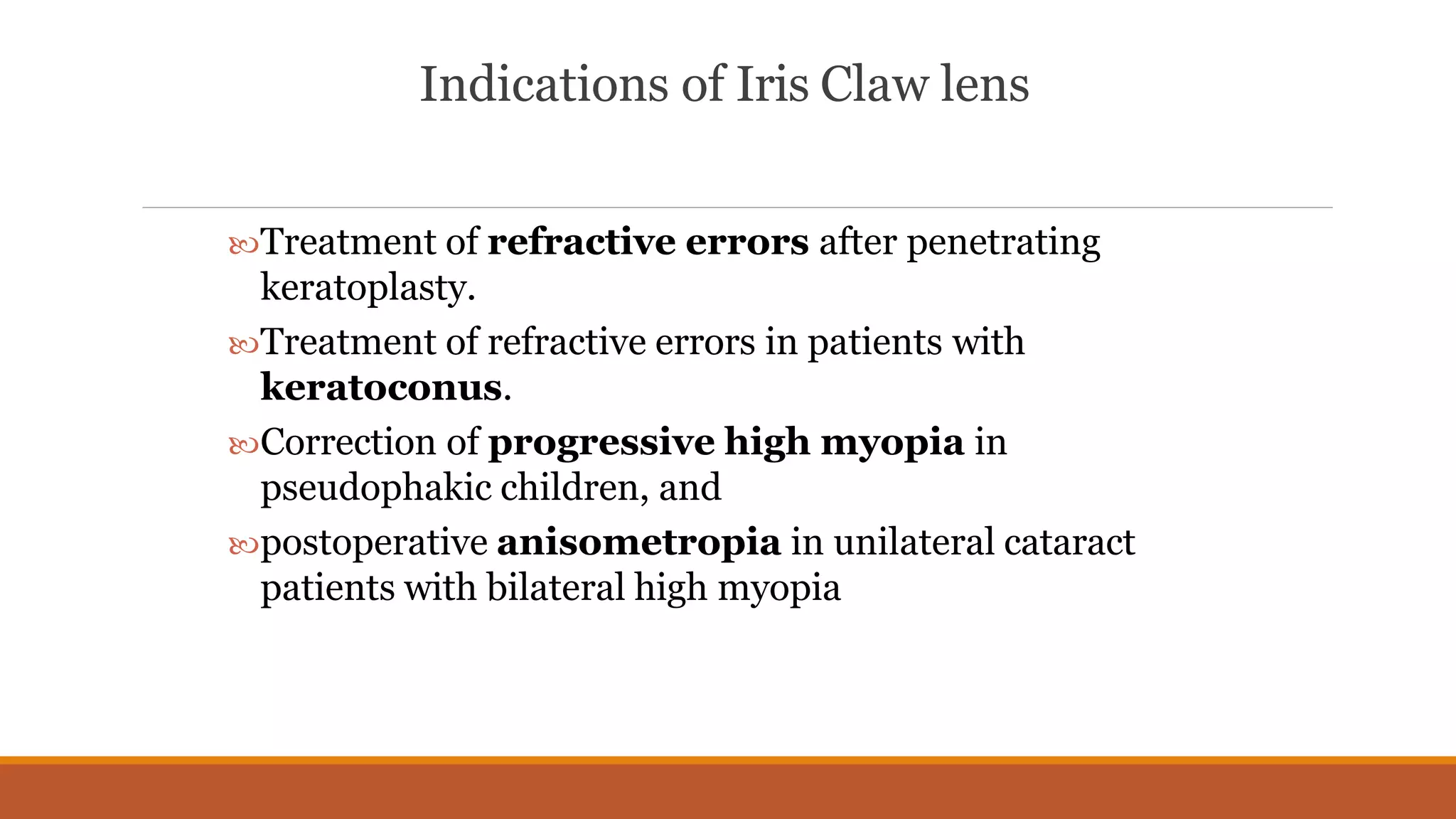
Indications of Iris Claw lens
Treatment of refractive errors after penetrating
keratoplasty.
Treatment of refractive errors in patients with
keratoconus.
Correction of progressive high myopia in
pseudophakic children, and
postoperative anisometropia in unilateral cataract
patients with bilateral high myopia
Procedure
topical pilocarpine
Topical / peribulbar anaesthesia
Incision, viscoelastics
IOL insertion
Enclavation
Closure of incision
VIDEO
Surgery
A corneal or scleral incision is made along with two paracentesis for lens
manipulation.
OVD is injected into the AC followed by the pIOL, which is then fixated into the
iris using an enclavation needle to hold the iris and an implantation forceps to
depress the claw into the iris. Centration of the lens over the pupil is essential,
and mild ovalization after the surgery is not uncommon due to the effect of the
miotic agent.
Intraoperative peripheral iridectomy (Vannas scissors) or
two preoperative neodymium:YAG (Nd:YAG) laser iridotomy 2 weeks before
should be done to prevent pupillary block.
The incision is large enough to require 10-0 nylon sutures.
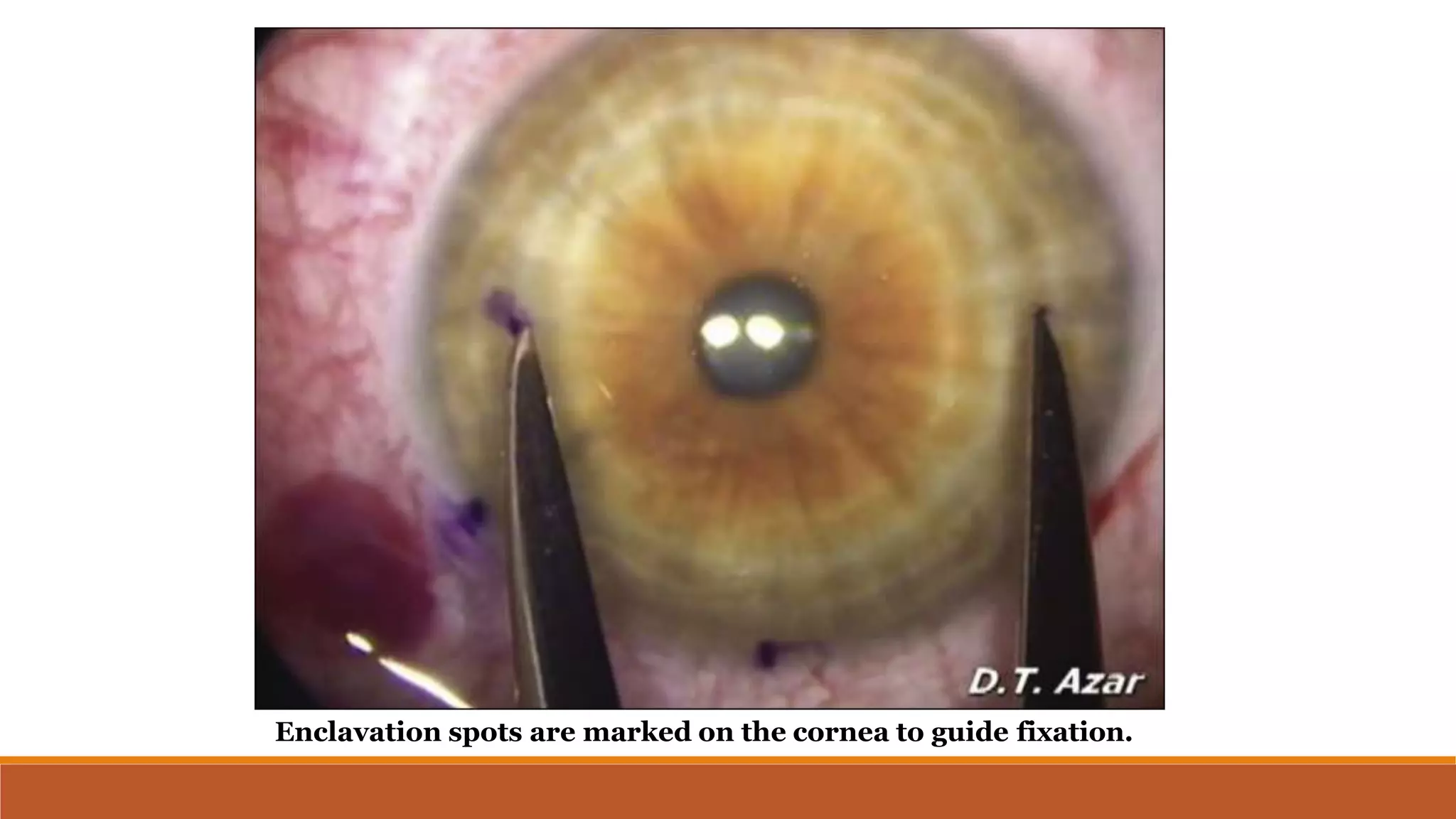
Enclavation spots are marked on the cornea to guide fixation.
The incision is enlarged to the appropriate size.
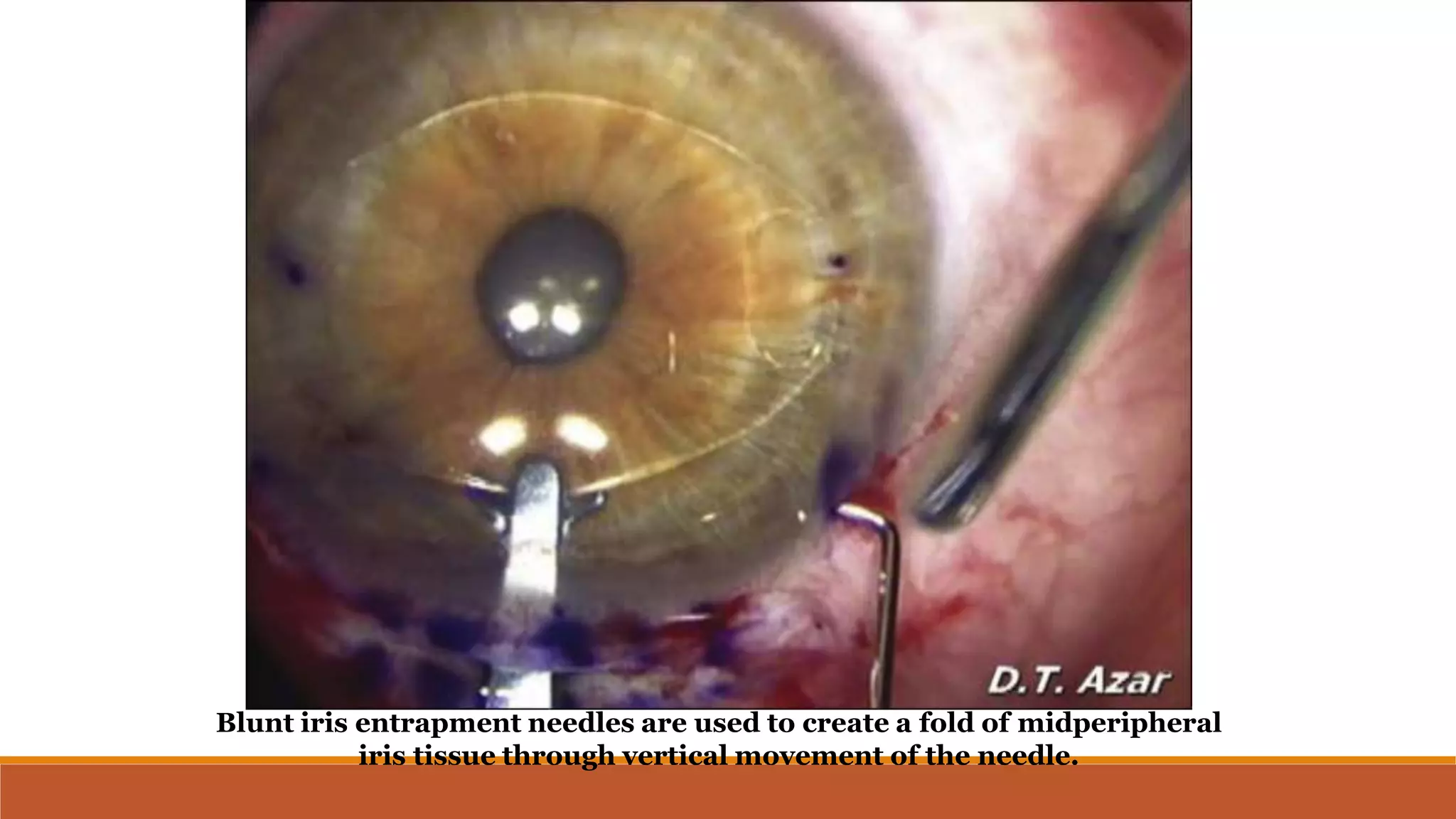
Blunt iris entrapment needles are used to create a fold of midperipheral
iris tissue through vertical movement of the needle.
B) The foldable Artiflex (Veryflex) lens is introduced vertically
with a special spatula through a clear corneal incision.
The foldable Artiflex (Veryflex) lens is introduced vertically with a special
spatula through a clear corneal incision.
Complications
Glare and haloes
Anterior chamber inflammation/pigment
dispersion
Endothelial cell loss
Glaucoma
Iris atrophy or dislocation
Cataract
hyphema, retinal detachment rarely
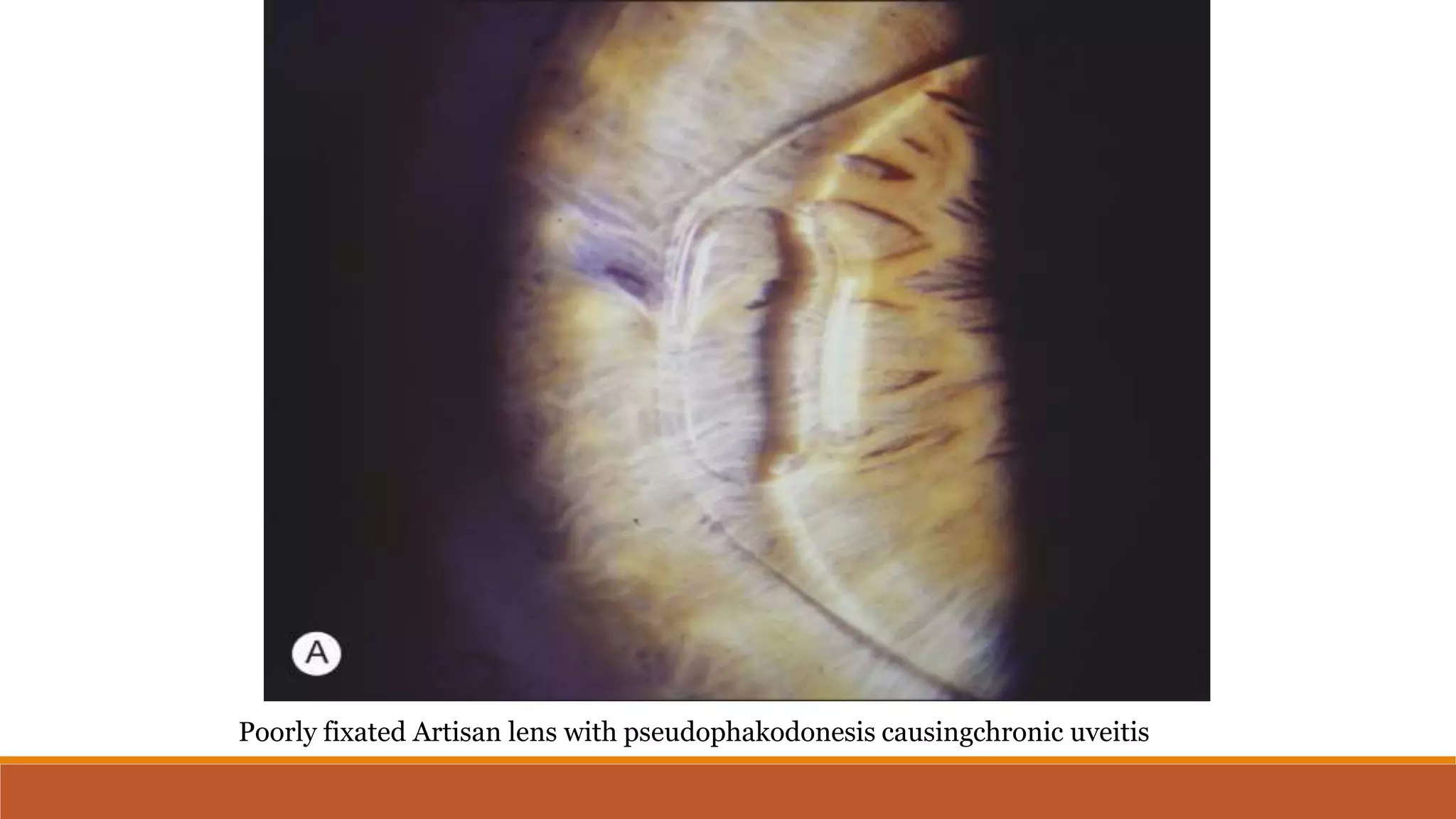
Poorly fixated Artisan lens with pseudophakodonesis causingchronic uveitis
Note the ciliary congestion
Artisan lens dislocation after blunt trauma
After relocation
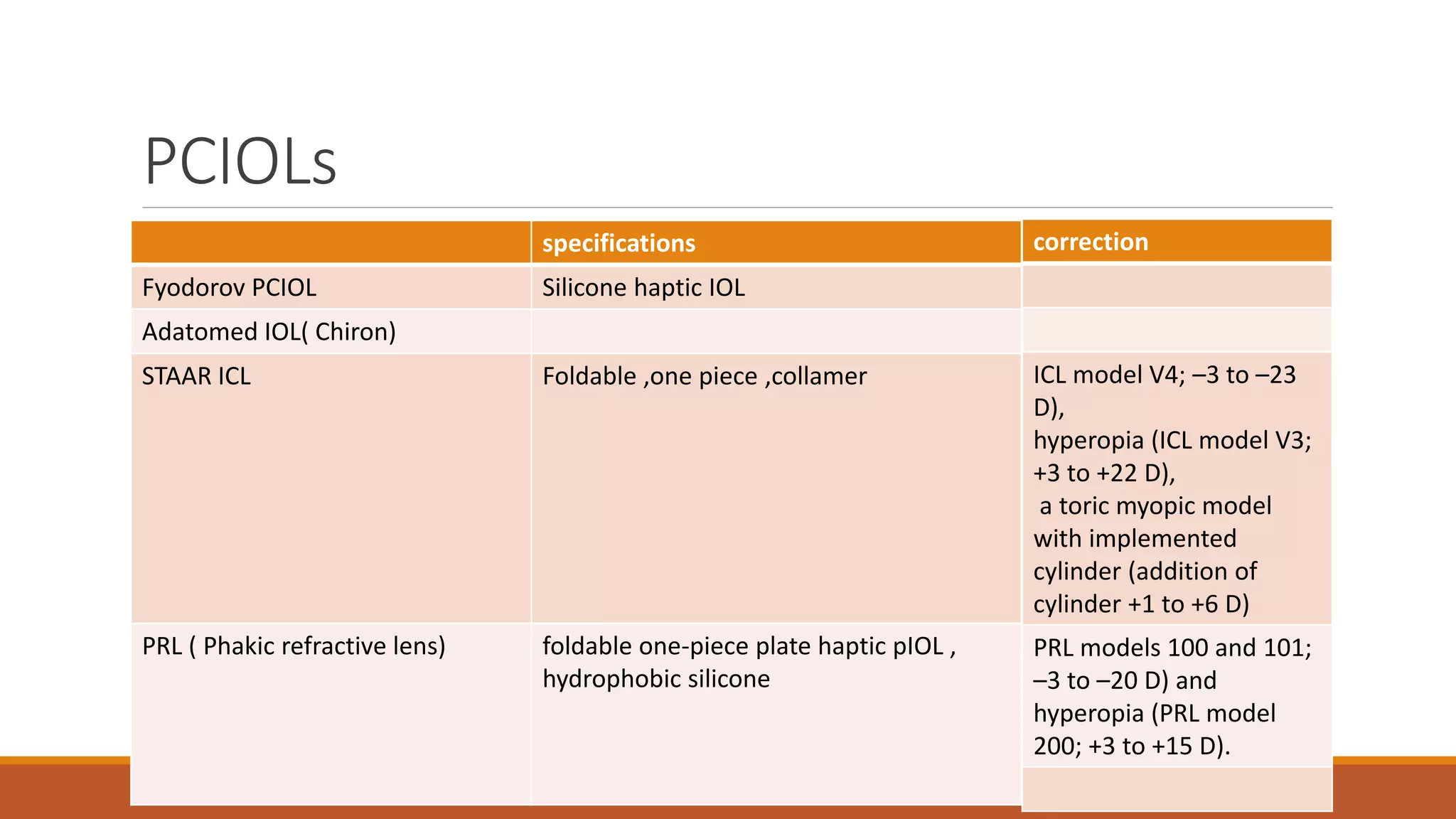
PCIOLs
specifications
Fyodorov PCIOL Silicone haptic IOL
Adatomed IOL( Chiron)
STAAR ICL Foldable ,one piece ,collamer
PRL ( Phakic refractive lens) foldable one-piece plate haptic pIOL ,
hydrophobic silicone
correction
ICL model V4; –3 to –23
D),
hyperopia (ICL model V3;
+3 to +22 D),
a toric myopic model
with implemented
cylinder (addition of
cylinder +1 to +6 D)
PRL models 100 and 101;
–3 to –20 D) and
hyperopia (PRL model
200; +3 to +15 D).
INDICATIONS of Phakic TICL
 correction of moderate to high myopia in patients with thin corneas.
Hyperopia
High myopic astigmatism
Stable keratoconus
Post radial keratotomy
Post penetrating keratoplasty.
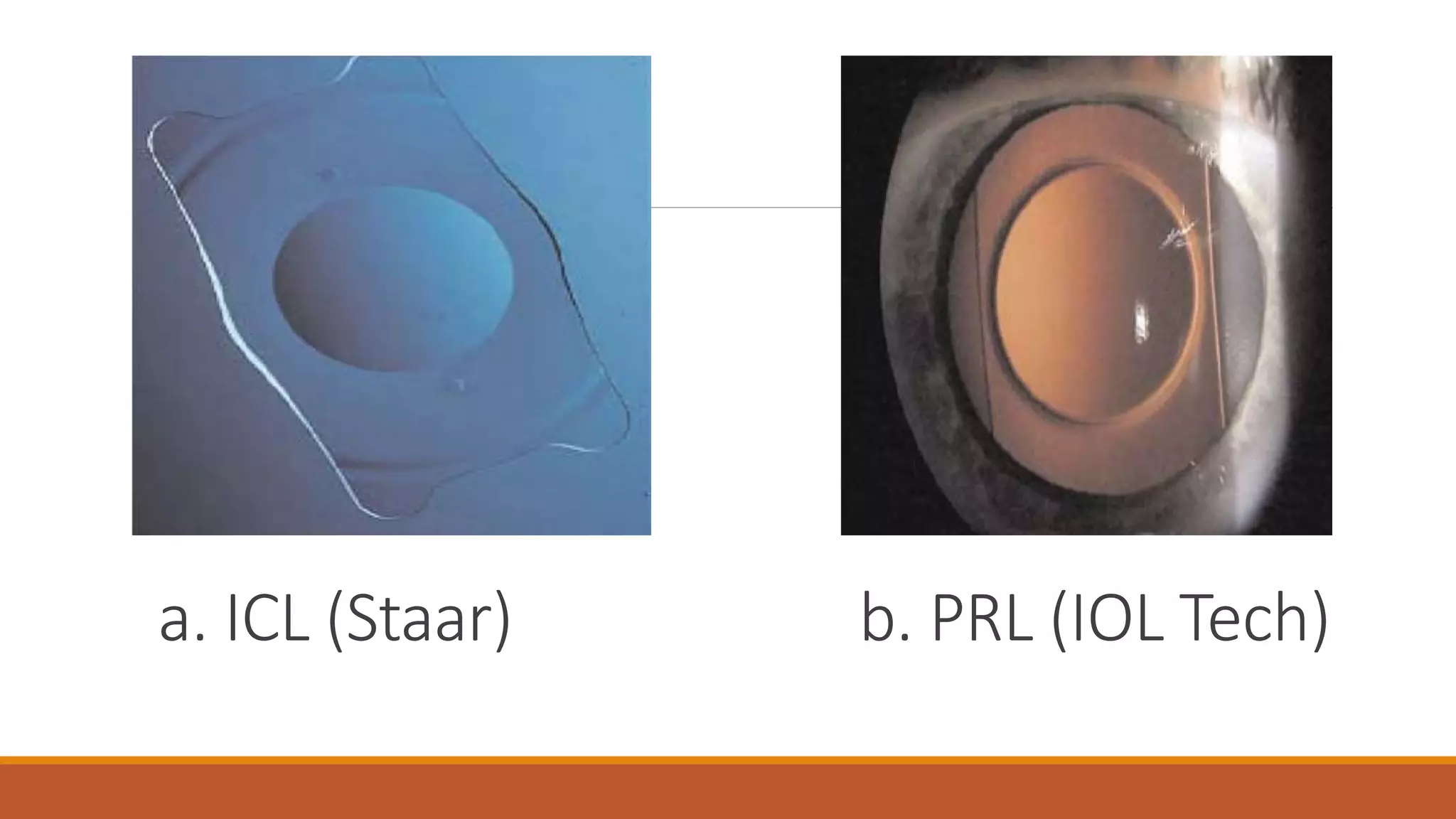
a. ICL (Staar) b. PRL (IOL Tech)
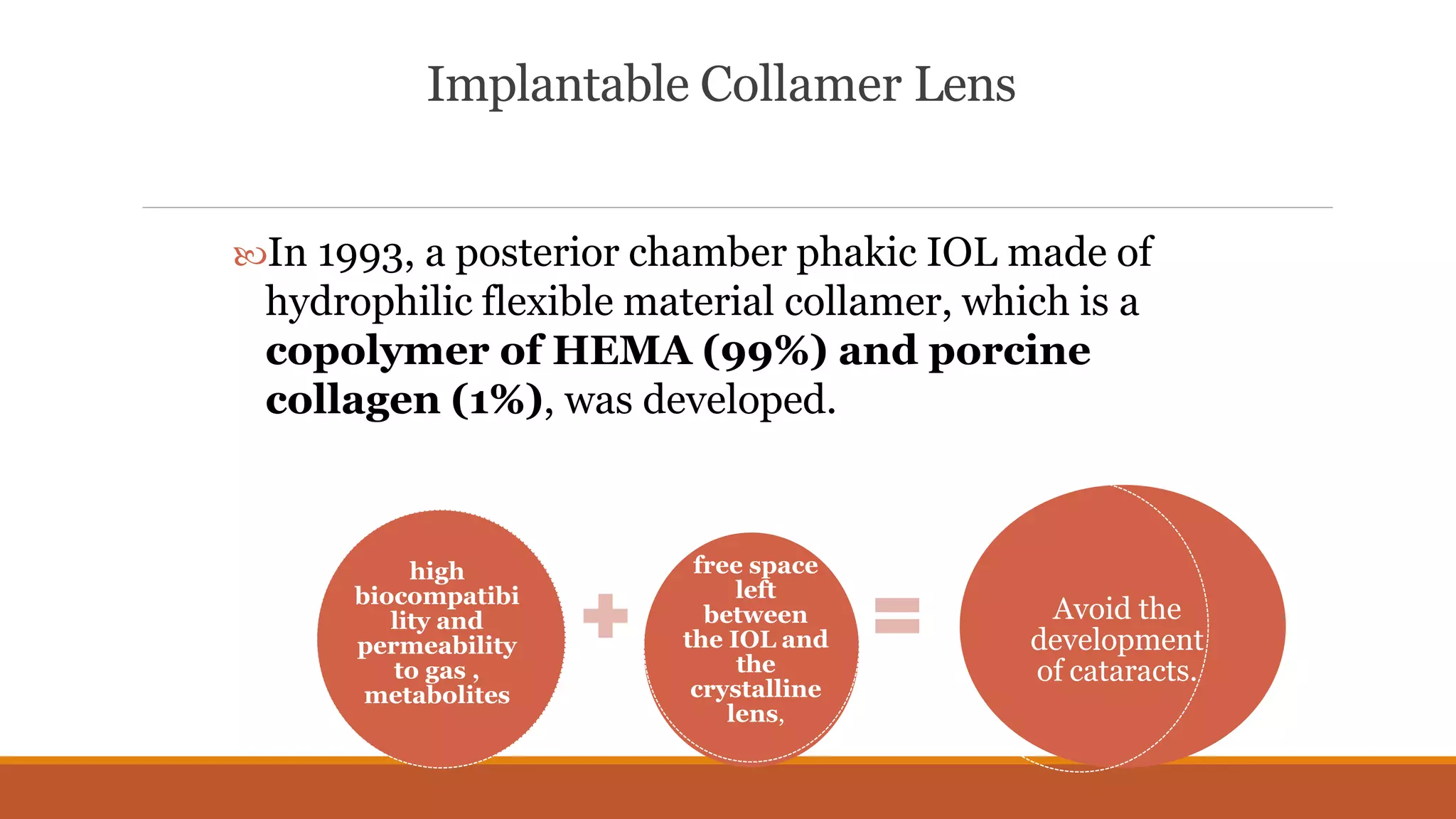
Implantable Collamer Lens
In 1993, a posterior chamber phakic IOL made of
hydrophilic flexible material collamer, which is a
copolymer of HEMA (99%) and porcine
collagen (1%), was developed.
high
biocompatibi
lity and
permeability
to gas ,
metabolites
free space
left
between
the IOL and
the
crystalline
lens,
Avoid the
development
of cataracts.
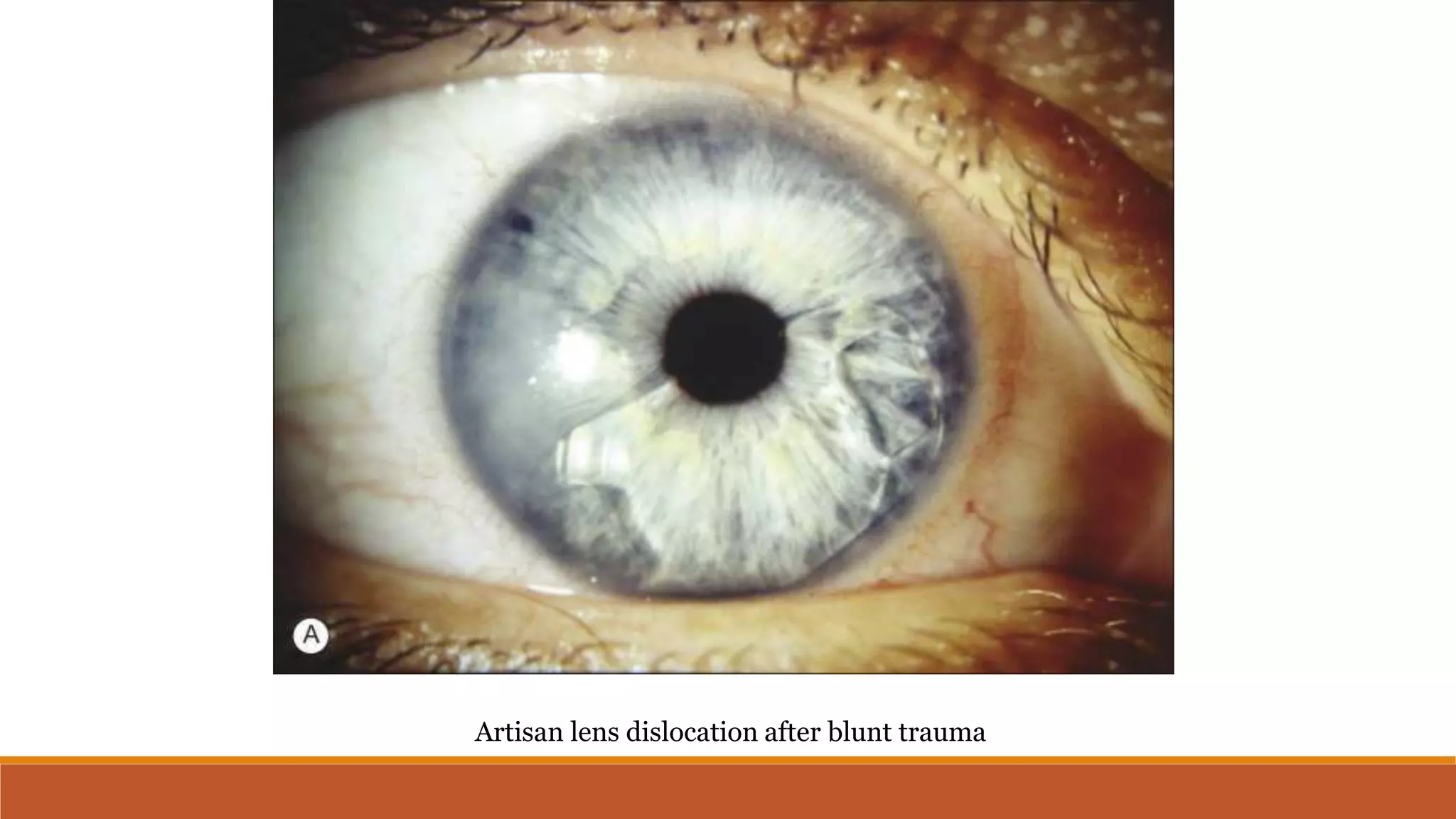
Procedure
Mydriasis
Topical or peribulbar anesthesia
temporal clear corneal tunnel
Viscoelastic
Foldable IOL insertion into AC (with an injector or
with forceps)
Check orientation
Placement of footplates below iris
Iridotomy
Closure of incision
A posterior chamber lens is folded
(A) and inserted through a small
incision (B) with a forceps.
Complications
Glare and haloes
Cataract
Pigmentary dispersion and elevated
intraocular pressure
Decentration
Endothelial cell damage
Advantages Of Phakic IOL
 Allows the crystalline lens to retain its function
Predictable outcome
Immediately stable,as refractive outcome is independent of healing process
Excelllent vision even in dim light
Reversible
Easily adjustable with complimentary corneal surgeries.
Less damage to cornea compared to LASIK.
DISADVANTAGES
 patient has to go through intraocular surgery
Postop astigmatism
Glare and haloes
Angle closure glaucoma.
Progressive endothelial loss
Chronic uveal inflammation
Lens displacement/decentration
Cataract (subcapsular)
Pigment dispersion .
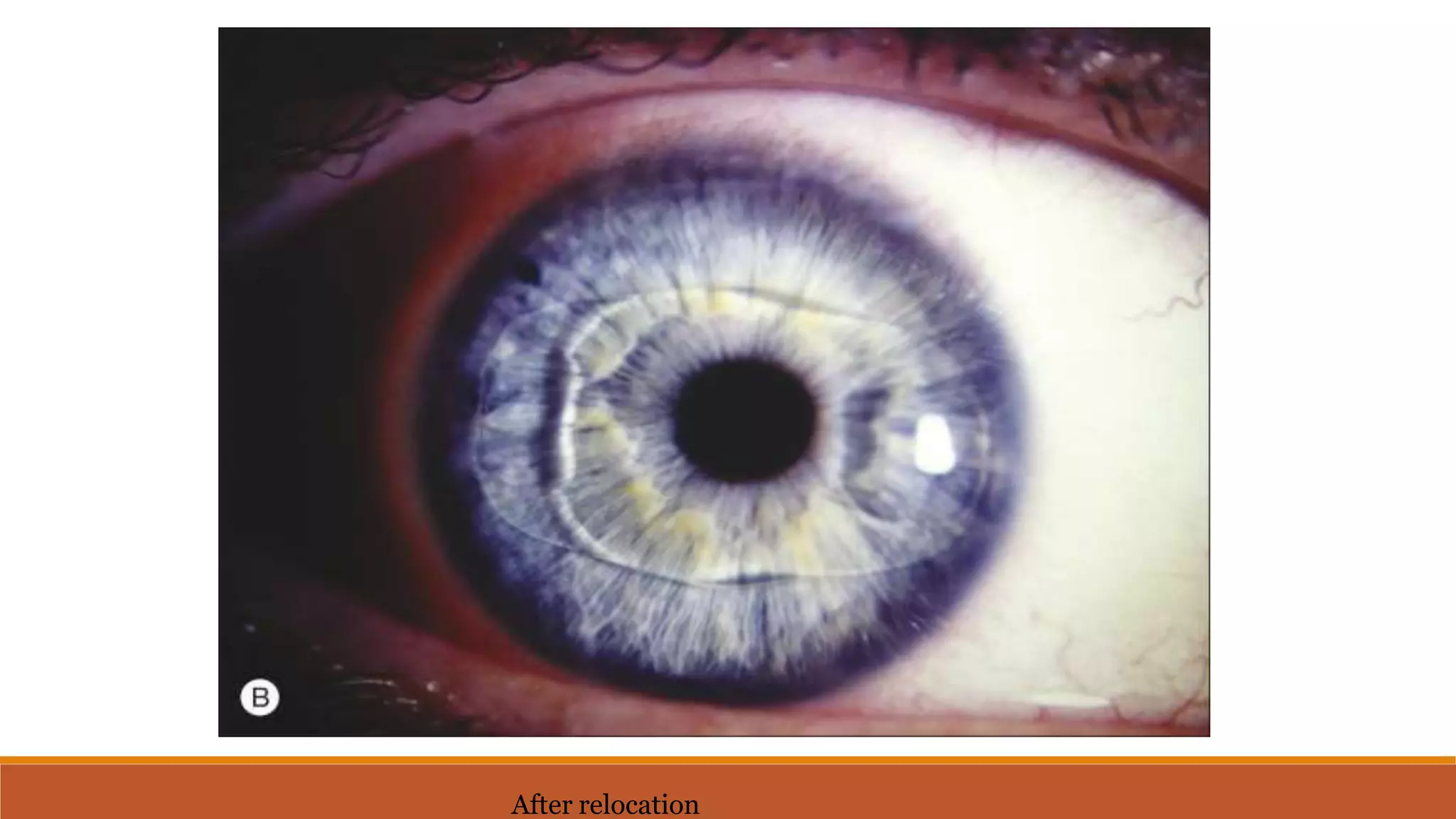
Bioptics
The combination of phakic IOL implantation followed by LASIK
in patients with extreme myopia or hypermetropia and high levels of
astigmatism.
When an anterior chamber phakic IOL is planned to be combined
with LASIK, the corneal flap can be created just prior to the insertion
of the lens; then, at a later time, usually after 1month, the flap is lifted
for laser correction of the residual ametropia. This two-step technique
was called adjustable refractive surgery (ARS) by Guell.
The rationale in performing the flap first is to avoid any possibility
of contact between the endothelium and the IOL during the
suction and cut for the LASIK procedure.
Foldable pIOLS – 3mm incision is only required.
Rigid IOLs – 5 to 6mm incision
Scleral incisions – less astigmatism
Length and distance to limbus(corneal incision) – increases the postop astigmatism.
Postop Astigmatism
 The incision size and location as one parameter for choosing
the appropriate phakic IOL.
For patients with preexisting astigmatism of less than 0.75 D,
foldable pIOLs are an advantage.
Corneal astigmatism between 1 and 2 D may be reduced by a
larger incision (5-6mm) on the steep corneal meridian and thus
rigid pIOLs can be implanted.
Even larger values of preexisting astigmatism should be
treated with toric pIOLs or a combination with other refractive
procedures.(LASIK)

Phakic iol ppt

  • 1.
    PHAKIC IOL BY DR. ARINOJOHN PG RESIDENT
  • 2.
    Introduction ` •Artificial lensesimplanted in the anterior or posterior chamber of the eye in the presence of the natural crystalline lens to correct high degree of refractive error.
  • 3.
  • 4.
    History ◦ Barraquer andStrampelli in the middle of the 20th century used an anterior chamber design 1950s ◦ correcting myopia by inserting a concave lens into the phakic eye 1988 ◦ Baikoff : anterior chamber angle-fixed IOL Mid 1980s ◦ Posterior chamber phakic IOLs : Fyodorov 1991 ◦ Artisan-Worst iris claw lens
  • 5.
    Angle -supported BaikoffZB5M (left) and the NuVita MA20 (right). Peripheral contact points are arcuate shaped And footplates broader
  • 6.
  • 7.
    Posterior chamber phakic refractivelens for myopia (top) and hyperopia (bottom ).
  • 8.
    Posterior chamber sulcussupported implantable contact lens.
  • 9.
    Ideal Candidate •Age >21years. •Stable refraction (less than 0.5D change for 1 year) •Clear crystalline lens •When initial corneal thickness is < 480μ. •Unsatisfactory vision with/intolerance of contact lenses or spectacles •Anterior chamber depth greater than or equal to ◦ 3.2mm for the iris-claw lens and angle-supported PIOLs ◦ 2.5mm for posterior chamber PIOLs
  • 10.
    •A minimum endothelialcell density of ◦ ≥3500 cells/mm2 at 21years of age ◦ ≥2800 cells/mm2 at 31years of age ◦ ≥2200 cells/mm2 at 41years of age ◦ ≥2000 cells/mm2 at 45years of age or more •No ocular pathology ( glaucoma, uveitis, maculopathy, etc.) •Stable keratoconus •Post PK.
  • 11.
    INVESTIGATIONS oUnaided and bestcorrected VA oAnterior and Posterior segment evaluation oWhite-to-white (w-w) measurement oHigh-frequency (50MHz) ultrasound biomicroscopy/AS-OCT oCorneal endothelial cell count
  • 12.
    Fig. 11.9 Pupildiameter measurement using infrared technologies (P2000, Procyon): 10 pictures in a 2-s sequence
  • 13.
    IOL Power Calculation • ACIOL Patientsrefraction Keratometry ACD PCIOL Patients spectacle refraction Corneal power ACD ,angle to angle distance VAN DER HEJDE formula BINKHORST formula
  • 14.
    IOL power calculation ACDand angle-to-angle distance are best-obtained using optical coherence tomography (OCT), but can also be measured using ultrasound biomicroscopy (UBM) or Scheimpflug imaging. ACD is measured from the corneal apex to the anterior surface of the crystalline lens, and is use to calculate effective lens position (ELP) in PCIOLs by substracting the distance between the pIOL and the crystalline lens from the ACD. The ELP is typically 0.8mm in the Artisan/Verisyse lens. White-to-white (WTW) measurement with an IOL-Master or calipers can be used to estimate angle-to-angle distance. Corneal power is calculated using keratometry or topography to measure the curvature of the cornea.
  • 15.
  • 17.
    Angle Supported ACIOL RIGIDpIOLs SPECIFICATIONS REFRACTIVE CORRECTION Phakic 6 IOL Rigid PMMA Heparin coated -2.0D to -25D +2.0D to +10 D ZSAL-4 Rigid PMMA -6.0 D to -20D FOLDABLE pIOLs Vivarte One piece IOL- Acrylate -7.0 to -22 D Kelman Duet Two piece Optic – SILICONE Haptic - PMMA (tripod) -8.0D to -20D Acrysof One piece - acrylate Icare (Corneal) One piece- acrylate -5D to -20D
  • 18.
    A. Phakic 6(Ophthalmic Innovations International). b ACRIOL (Soleko). c Vivarte (Ciba). d Kelman Duet (Tekia). e Acrysof (Alcon)
  • 19.
    c. Foldable I-Care(Corneal) . A. Rigid ZSLA-4 (Morcher) . B. Foldable AcrySof (Alcon).
  • 20.
    Foldable “two parts”(Silicone optic/PMMA haptics) Kelman-Duet lens (A). The haptics are implanted initially through a small incision (B), then the optic is injected (C). The complex optic-haptics is assembled inside the anterior chamber (D).
  • 21.
    Procedure Topical pilocarpine topical orperibulbar anesthesia Incision cohesive viscoelastic lens is introduced , footplate is inserted in the iridocorneal angle, second haptic is then placed, lens is then rotated in place peripheral iridectomy incision is closed
  • 22.
    Complications Haloes and glare Pupillaryovalization Endothelial damage Elevation of intraocular pressure Uveitis Cataract Retinal detachment Rarely - malignant glaucoma, endophthalmitis
  • 23.
    Pupil ovalization 2yearsafter implantation of an angle-supported phakic IOL (A).
  • 24.
    Iris fixated pIOL RigidIOLs Artisan/Verisyse IOL PMMA Flexible lobster claws FDA approved -1.0D to -23.5D +3D to +12 D Foldable IOLs Artiflex IOL Foldable optical – silicone Rigid haptic - PMMA -2D to -14.5 D
  • 25.
    . a RigidArtisan pIOL (Ophtec). b Foldable Artiflex pIOL (Ophthec)
  • 26.
    Indications of IrisClaw lens Treatment of refractive errors after penetrating keratoplasty. Treatment of refractive errors in patients with keratoconus. Correction of progressive high myopia in pseudophakic children, and postoperative anisometropia in unilateral cataract patients with bilateral high myopia
  • 27.
    Procedure topical pilocarpine Topical /peribulbar anaesthesia Incision, viscoelastics IOL insertion Enclavation Closure of incision
  • 28.
  • 29.
    Surgery A corneal orscleral incision is made along with two paracentesis for lens manipulation. OVD is injected into the AC followed by the pIOL, which is then fixated into the iris using an enclavation needle to hold the iris and an implantation forceps to depress the claw into the iris. Centration of the lens over the pupil is essential, and mild ovalization after the surgery is not uncommon due to the effect of the miotic agent. Intraoperative peripheral iridectomy (Vannas scissors) or two preoperative neodymium:YAG (Nd:YAG) laser iridotomy 2 weeks before should be done to prevent pupillary block. The incision is large enough to require 10-0 nylon sutures.
  • 30.
    Enclavation spots aremarked on the cornea to guide fixation.
  • 31.
    The incision isenlarged to the appropriate size.
  • 32.
    Blunt iris entrapmentneedles are used to create a fold of midperipheral iris tissue through vertical movement of the needle.
  • 33.
    B) The foldableArtiflex (Veryflex) lens is introduced vertically with a special spatula through a clear corneal incision.
  • 34.
    The foldable Artiflex(Veryflex) lens is introduced vertically with a special spatula through a clear corneal incision.
  • 35.
    Complications Glare and haloes Anteriorchamber inflammation/pigment dispersion Endothelial cell loss Glaucoma Iris atrophy or dislocation Cataract hyphema, retinal detachment rarely
  • 36.
    Poorly fixated Artisanlens with pseudophakodonesis causingchronic uveitis
  • 37.
    Note the ciliarycongestion
  • 38.
    Artisan lens dislocationafter blunt trauma
  • 39.
  • 40.
    PCIOLs specifications Fyodorov PCIOL Siliconehaptic IOL Adatomed IOL( Chiron) STAAR ICL Foldable ,one piece ,collamer PRL ( Phakic refractive lens) foldable one-piece plate haptic pIOL , hydrophobic silicone correction ICL model V4; –3 to –23 D), hyperopia (ICL model V3; +3 to +22 D), a toric myopic model with implemented cylinder (addition of cylinder +1 to +6 D) PRL models 100 and 101; –3 to –20 D) and hyperopia (PRL model 200; +3 to +15 D).
  • 41.
    INDICATIONS of PhakicTICL  correction of moderate to high myopia in patients with thin corneas. Hyperopia High myopic astigmatism Stable keratoconus Post radial keratotomy Post penetrating keratoplasty.
  • 42.
    a. ICL (Staar)b. PRL (IOL Tech)
  • 43.
    Implantable Collamer Lens In1993, a posterior chamber phakic IOL made of hydrophilic flexible material collamer, which is a copolymer of HEMA (99%) and porcine collagen (1%), was developed. high biocompatibi lity and permeability to gas , metabolites free space left between the IOL and the crystalline lens, Avoid the development of cataracts.
  • 44.
    Procedure Mydriasis Topical or peribulbaranesthesia temporal clear corneal tunnel Viscoelastic Foldable IOL insertion into AC (with an injector or with forceps) Check orientation Placement of footplates below iris Iridotomy Closure of incision
  • 45.
    A posterior chamberlens is folded (A) and inserted through a small incision (B) with a forceps.
  • 46.
    Complications Glare and haloes Cataract Pigmentarydispersion and elevated intraocular pressure Decentration Endothelial cell damage
  • 47.
    Advantages Of PhakicIOL  Allows the crystalline lens to retain its function Predictable outcome Immediately stable,as refractive outcome is independent of healing process Excelllent vision even in dim light Reversible Easily adjustable with complimentary corneal surgeries. Less damage to cornea compared to LASIK.
  • 48.
    DISADVANTAGES  patient hasto go through intraocular surgery Postop astigmatism Glare and haloes Angle closure glaucoma. Progressive endothelial loss Chronic uveal inflammation Lens displacement/decentration Cataract (subcapsular) Pigment dispersion .
  • 49.
    Bioptics The combination ofphakic IOL implantation followed by LASIK in patients with extreme myopia or hypermetropia and high levels of astigmatism. When an anterior chamber phakic IOL is planned to be combined with LASIK, the corneal flap can be created just prior to the insertion of the lens; then, at a later time, usually after 1month, the flap is lifted for laser correction of the residual ametropia. This two-step technique was called adjustable refractive surgery (ARS) by Guell. The rationale in performing the flap first is to avoid any possibility of contact between the endothelium and the IOL during the suction and cut for the LASIK procedure.
  • 51.
    Foldable pIOLS –3mm incision is only required. Rigid IOLs – 5 to 6mm incision Scleral incisions – less astigmatism Length and distance to limbus(corneal incision) – increases the postop astigmatism.
  • 52.
    Postop Astigmatism  Theincision size and location as one parameter for choosing the appropriate phakic IOL. For patients with preexisting astigmatism of less than 0.75 D, foldable pIOLs are an advantage. Corneal astigmatism between 1 and 2 D may be reduced by a larger incision (5-6mm) on the steep corneal meridian and thus rigid pIOLs can be implanted. Even larger values of preexisting astigmatism should be treated with toric pIOLs or a combination with other refractive procedures.(LASIK)