Types of IOL
Dr Rohit Rao
HISTORY OF IOL
• K
Primary vs secondary implantation
• Primary implantation – use of IOLs during
surgery for cataract
• Secondary implantation – implantation of IOL
to correct aphakia in a previosly operated eye
Parts of an IOL
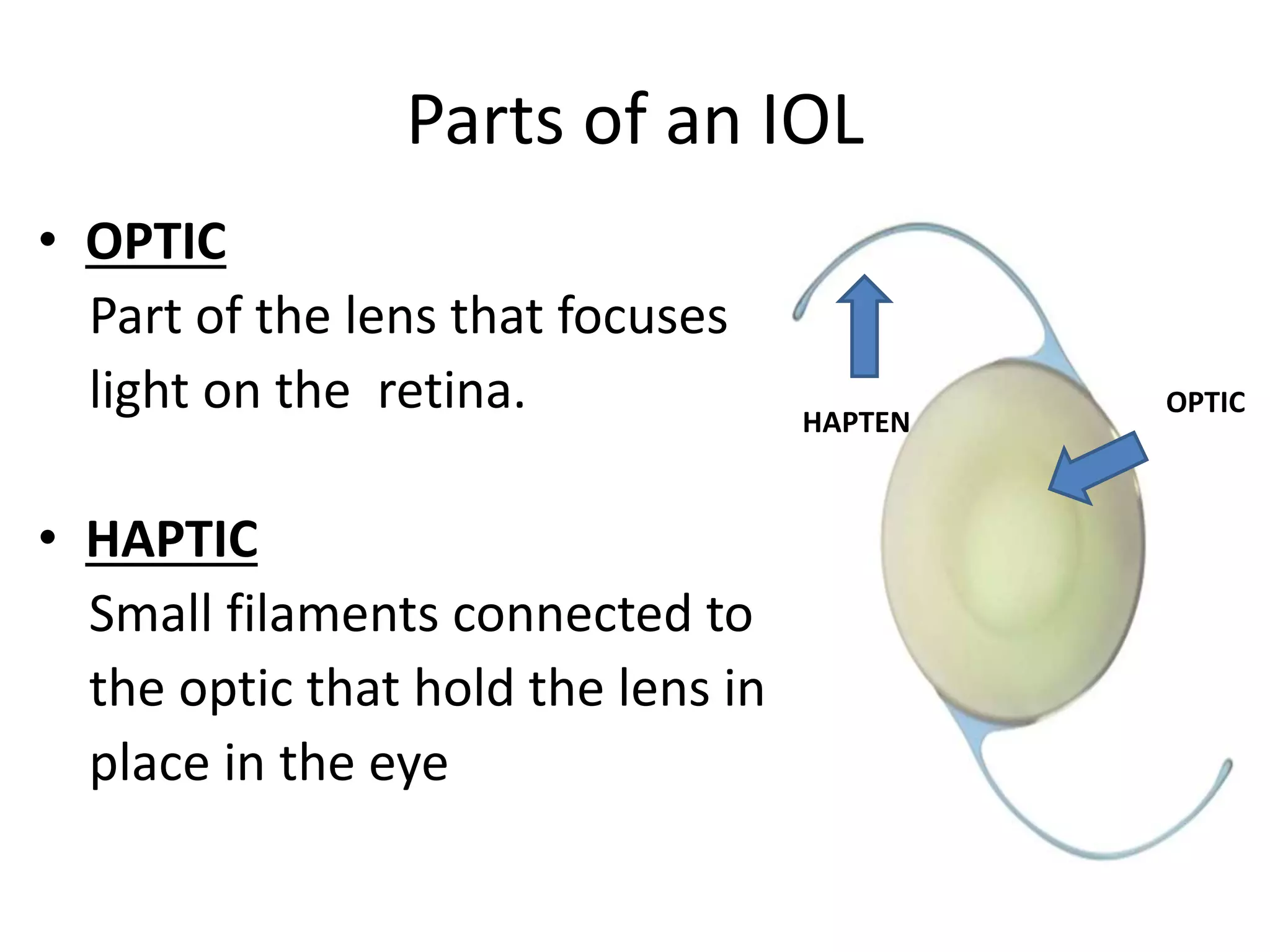
• OPTIC
Part of the lens that focuses
light on the retina.
• HAPTIC
Small filaments connected to
the optic that hold the lens in
place in the eye
HAPTEN
OPTIC
MATERIALS USED FOR INTRAOCULAR
LENSES
Optic materials
1.Non-foldable-rigid IOL
• Polymethyl
methacrylate(PMMA)
2.Foldable IOL
• Silicone
• Hydrophobic acrylic
• Hydrophilic acrylic
3.Rollable/Ultra-thin IOL
• Hydrogel
Haptic materials
• PMMA,
• Polyvinylidene fluoride
(PVDF),
• Polyimide (elastimide),
• Polypropylene
(prolene)
Polymethylmethacrylate
• Hard and rigid - Inert and non autoclavable.
• Hydrophobic – so causes adherence of cell
and bacteria
• Refractive Index 1.47 and1.55
Flexible Acrylic
• Hydrophilic
– Unfolds in controlled fashion
– Good uveal and excellent capsular biocompatibility
• Hydrophobic
– More prone to develop PCO
• Copolymer of phenyl ethylacrylate and
phenylethylmethacrylate.
• Good viscoelastic and three dimensional stability
• Viscoelasticity is temperature dependant with
increase elasticity at higher temperature
Silicone
• Elastomer Polydimethylsiloxane
• Capable of large and reversible deformations
• Good memory
• Surface deposits are common
• Additives in silicone IOL are
– UV chromophore
– Phenyl group to increase Refractive Index from
1.41 to 1.46
Hydrogels
• HEMA or 2 Hydroxyethylmethacrylate
• Polymerization in ethylene glycol medium
• Hydrate to form soft, swollen, rubbery mass
• Hydrophilic hence repel cells and microbes
• Refractive Index - 1.43 to 1.48
Truedge
• Truedge 360° Square Edge acts as a
mechanical barrier for cell proliferation
• 10° Angulation, steep vault of 0.4 mm
Aurofold lens
• negative aspheric hydrophilic acrylic foldable
intraocular lens made of p-HEMA material
• Truedge technology to prevent PCO
• Zero Degree Angulation
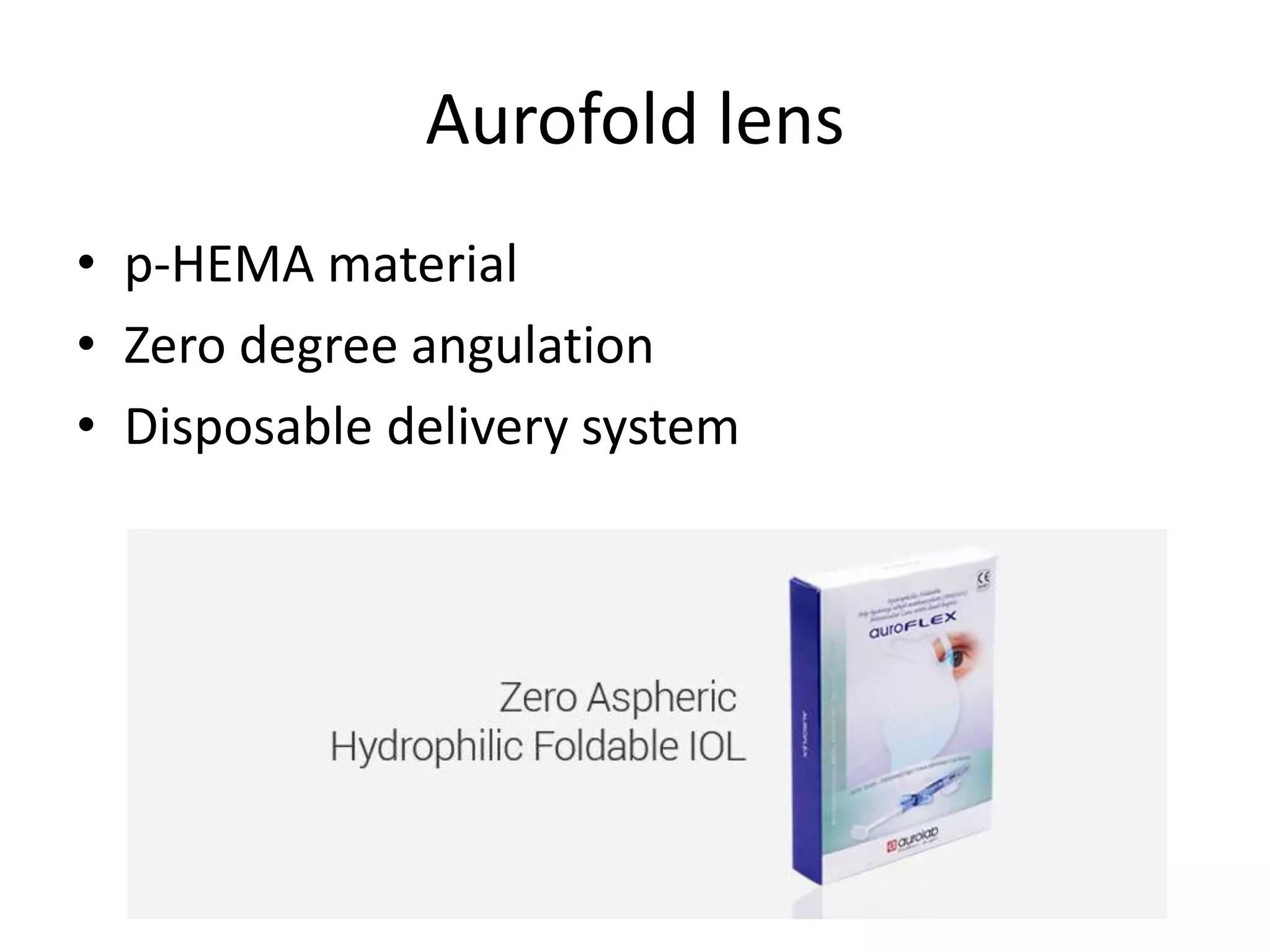
Aurofold lens
• p-HEMA material
• Zero degree angulation
• Disposable delivery system
Auro toric
• Auroflex Toric IOL has been carefully designed
with toricity on the anterior surface of the IOL.
• UV absorbing p-HEMA
• OptiCal an web based online service
www.aurolab.com/OptiCal.
Aurovue
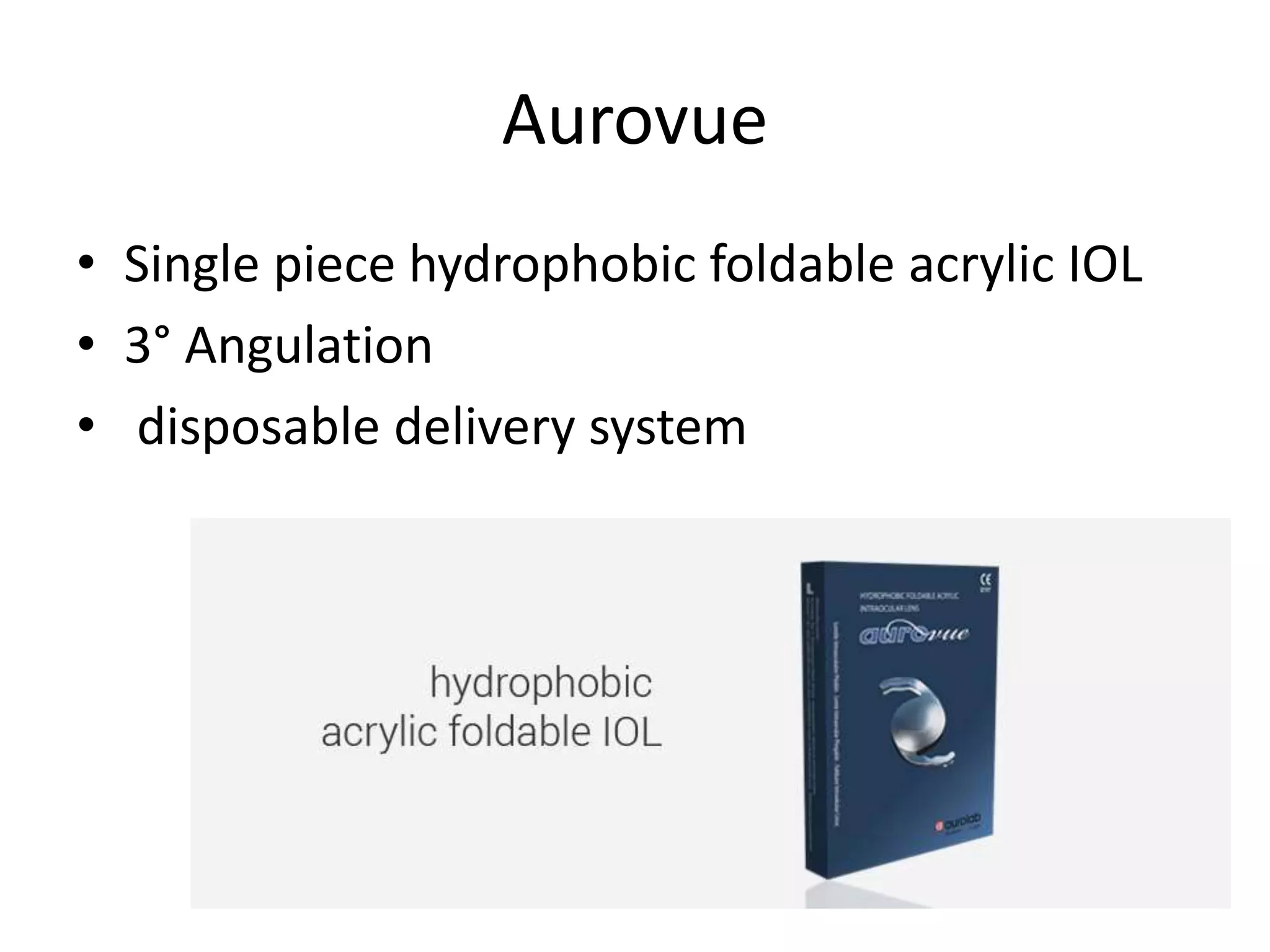
• Single piece hydrophobic foldable acrylic IOL
• 3° Angulation
• disposable delivery system
Aurovue
• Aspheric optic (negative spherical aberration),
preloaded hydrophobic acrylic IOL.
• 3° Angulation
Acrysoft IQ
• Hydrophobic Acrylic IOLs
• Aspheric
Sensar
• Single piece hydrophobic foldable acrylic IOL
• OptiEdge® with 360° square edge, and round
anterior edge
• 5˚ angulation
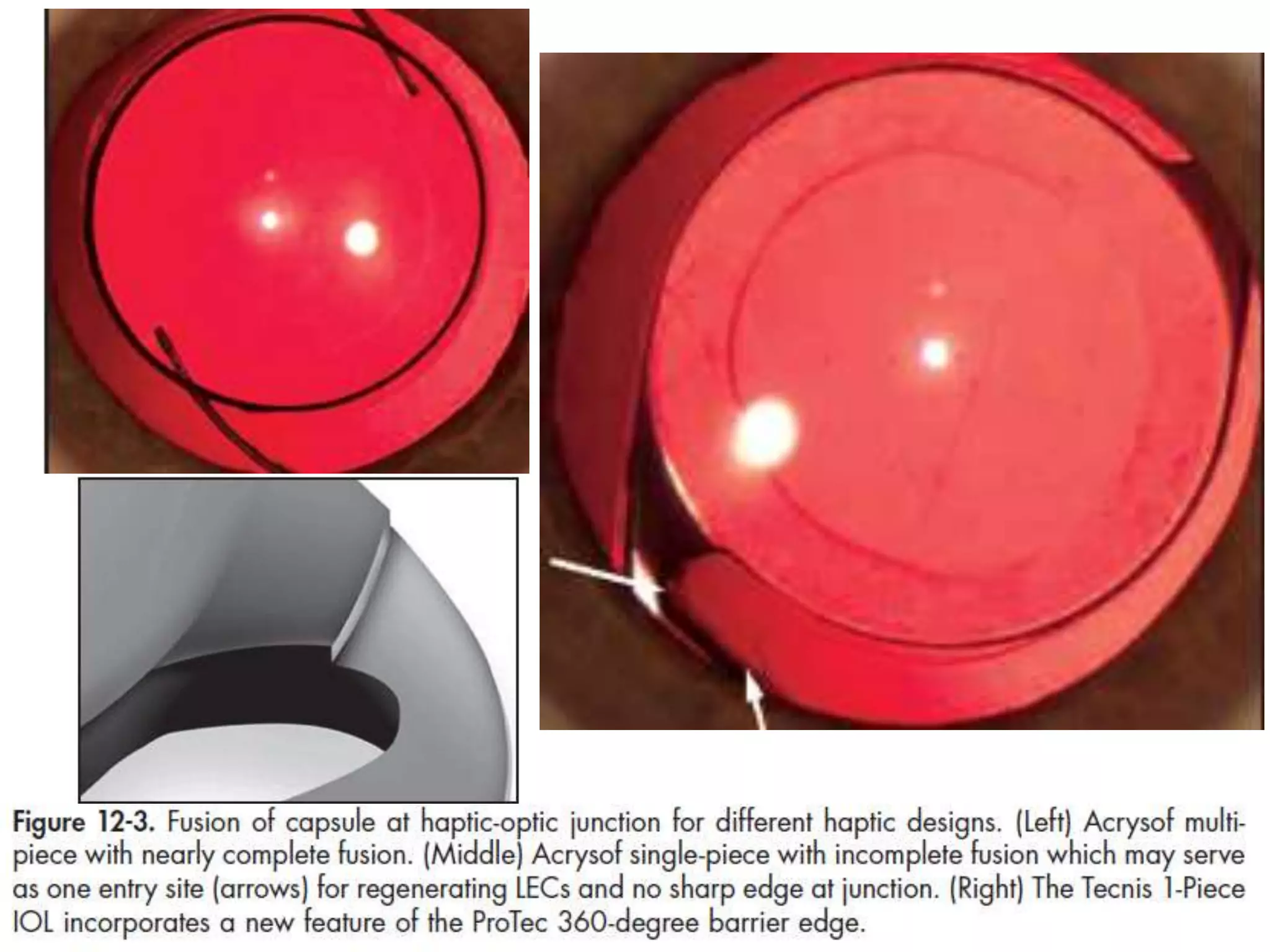
Tecnis
• Biconvex, anterior aspheric
surface, square optic edge
• ProTEC frosted, continuous
360° posterior square edge
• UV-blocking hydrophobic
acrylic
• Haptics offset from optic
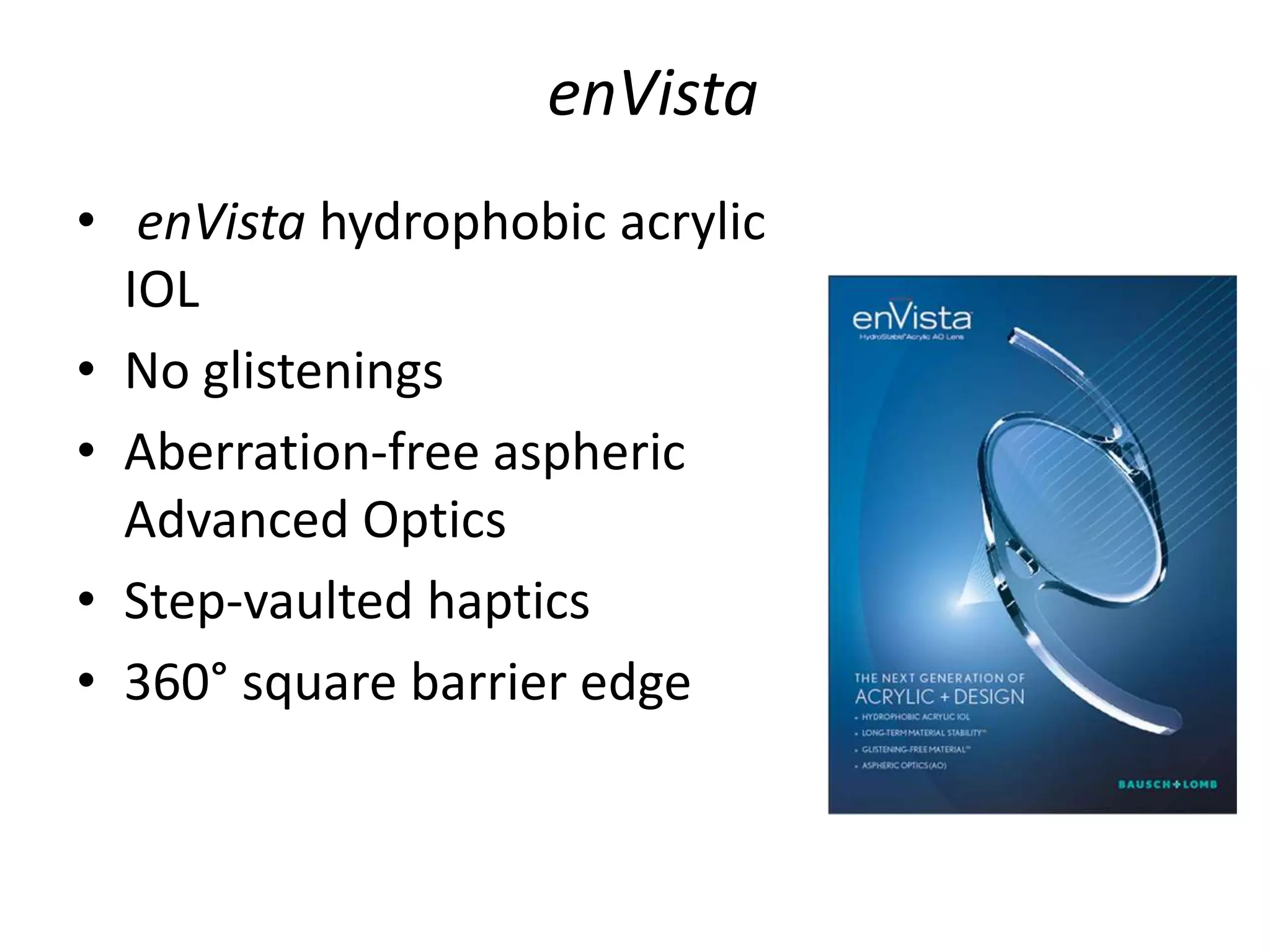
• enVista hydrophobic acrylic
IOL
• No glistenings
• Aberration-free aspheric
Advanced Optics
• Step-vaulted haptics
• 360° square barrier edge
enVista
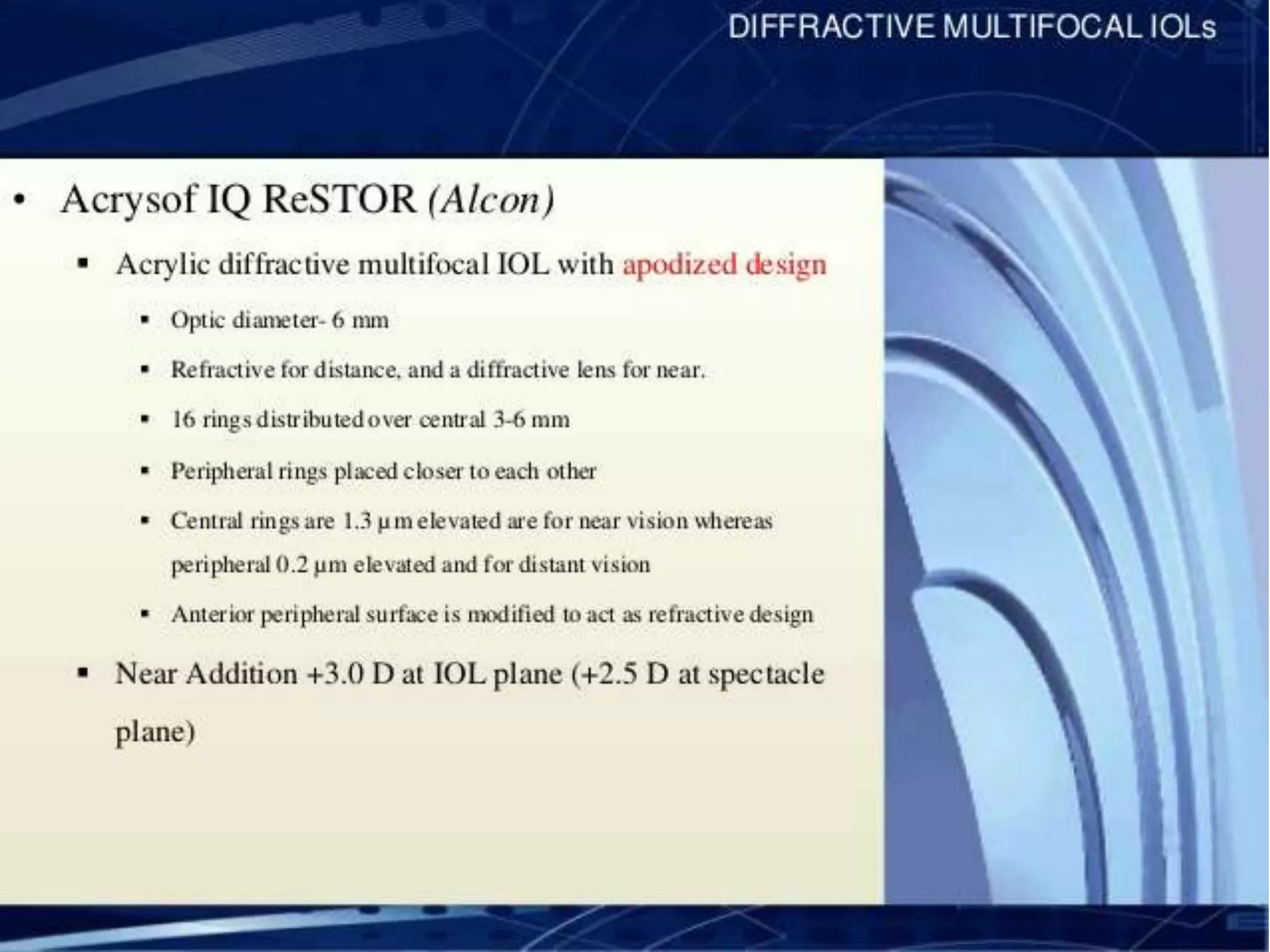
Restor
• Single piece foldable acrylic IOL
• Apodized Diffractive Technology
• Apodization is the gradual shortening of step
heights toward the periphery of the diffractive
zone.
Intraocular Lens Design
• multipiece or monobloc;
• plate or open-loop style;
• angulated or planar haptics;
• special haptics for certain indications such as
sulcus, anterior chamber angle, or iris fixation;
• optic shape and edge design;
• Optic geometry for certain indications such as
toric, aspheric, or multifocal IOLs
Open-Loop
• Multipiece
– IOLs are held in place by exerting centripetal pressure
on capsule bag fornix and or ciliary sulcus.
• Single-Piece
– IOLs are produced in a single step from one material
– More resistant to damage with injectors
– Production process is cheaper
– May have less of a PCO-inhibiting effect
Haptic Angulation
• Maximize the barrier effect to migrating LECs
by pushing the IOL backwards.
POSITIONING OF IOL
POSITIONING OF IOL
1. Posterior chamber
implantation
• Ciliary sulcus fixation
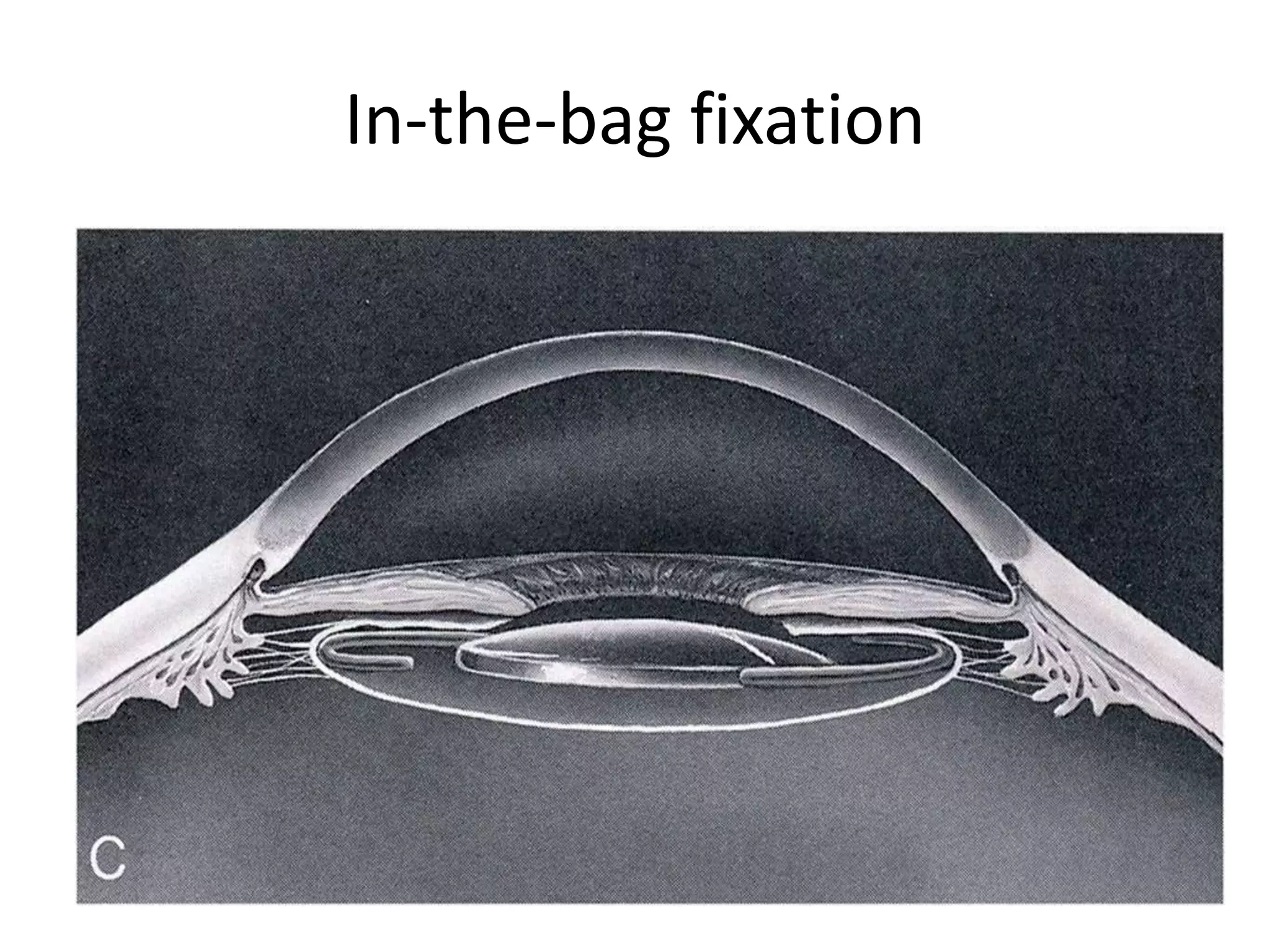
• In the bag fixation
• Scleral fixation
Eg:- modified C loop type
IOL
In-the-bag fixation
Intraocular Lenses for
Insufficient Capsule Support
• In cases of PCR where IOL placement is no
longer possible, but ALC is intact, the IOL can
be placed in sulcus. (optic capture if possible)
• 0.5 diopters should be deducted
• no capsule support is given,
– angle-supported ACIOL,
– Iris-supported IOLs
– Scleral-sutured IOLs
Ciliary sulcus fixation
2. Anterior chamber
implantation
• angle supported IOLs
• Kelman multiflex type
IOL
3. Iris- fixated lens
• Fixed on the iris with
claws,loops or sutures
• Eg- Singh and Worst’s
iris claw lens
Intraocular Lens
Optic Design
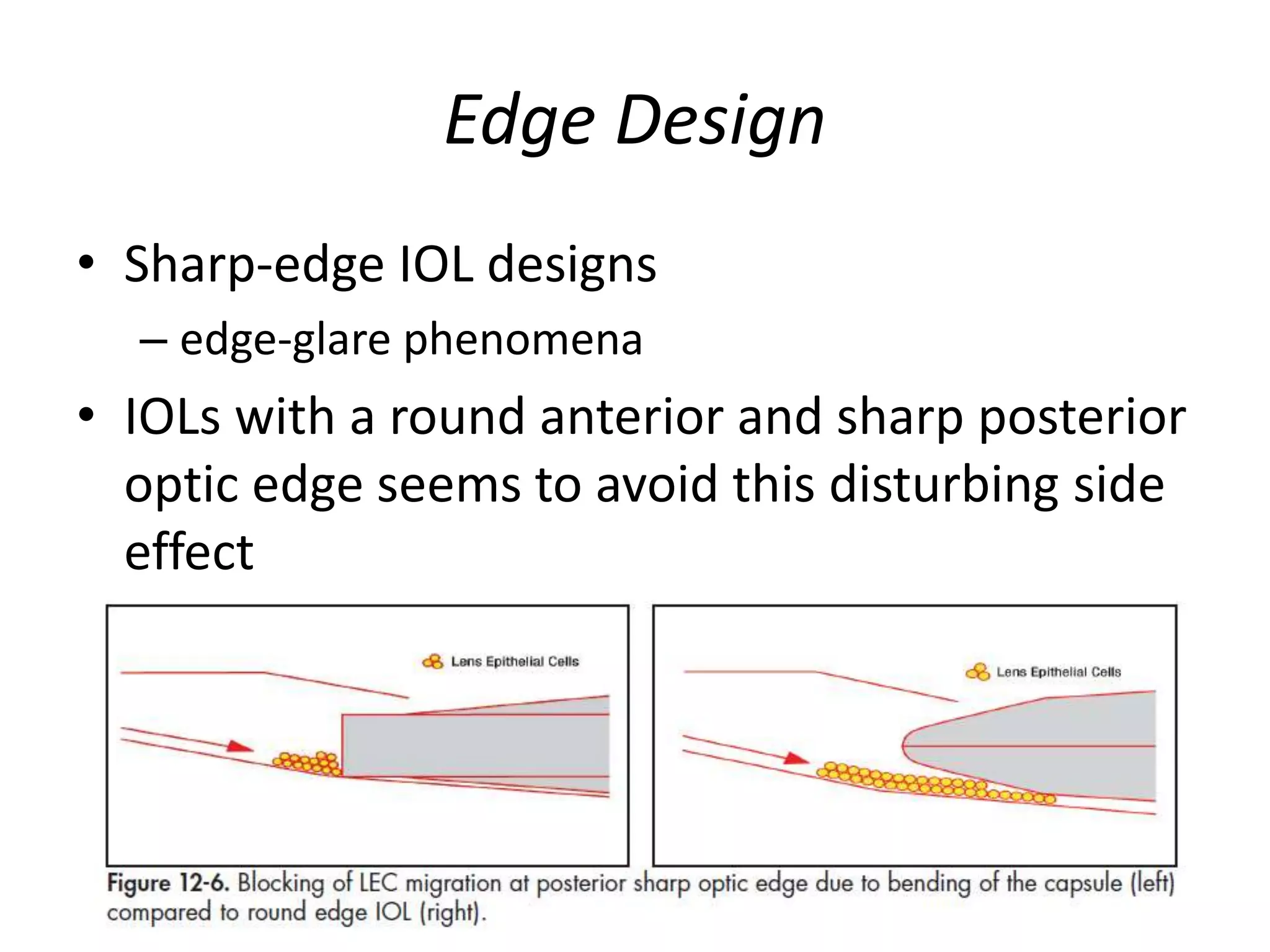
Edge Design
• Sharp-edge IOL designs
– edge-glare phenomena
• IOLs with a round anterior and sharp posterior
optic edge seems to avoid this disturbing side
effect
Optic Geometry
• Biconvexity
– Radius of curvature of the front and back surface
are identical.
• Asymmetric biconvex optic
– Back surface curvature is relatively flat and
constant throughout most of the power range and
anterior curvature is varied for IOL power.
Aspherical Intraocular Lenses
• IOL has prolate surface inducing negative SA,
which should neutralize positive SA of the
average cornea.
• The aim is to increase contrast sensitivity
under mesopic conditions where the pupil is
dilated.
• little to no effect when the pupil is small.
Toric Intraocular Lenses
• Correcting preexisiting corneal astigmatism using
incisional techniques,
– Corneal incision on the steep axis,
– Making limbal relaxing incisions (LRIs) on the steep
axis.
– Neutralizing corneal astigmatism is the use of toric
IOLs
• Accurate axis placement of the toric IOL is critical
• 3% of toric correction is lost for every degree off axis.
• Being 10 degrees off axis results in about 1/3 of toric
correction lost.
• Being 30 degrees off results in no toric correction
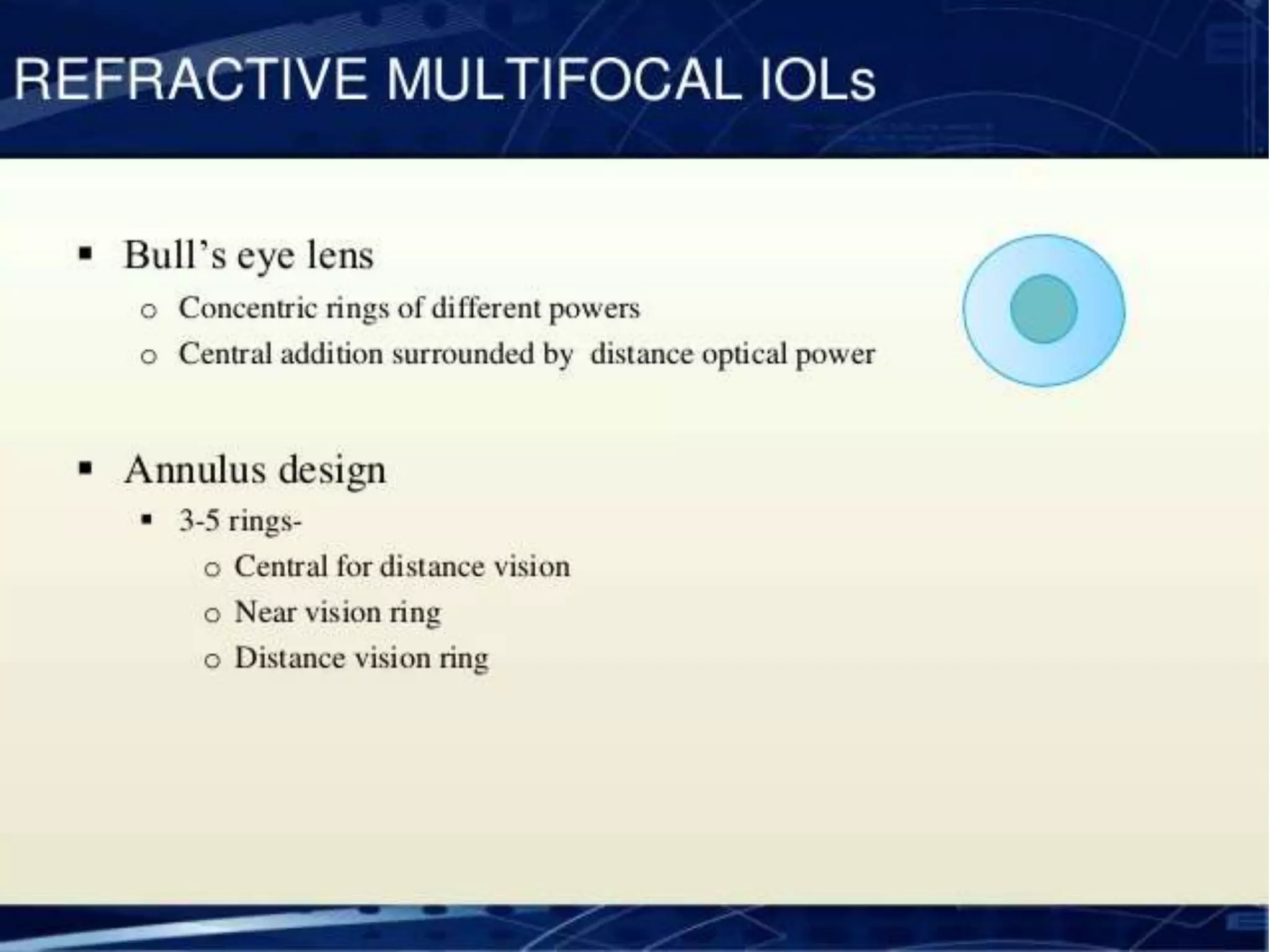
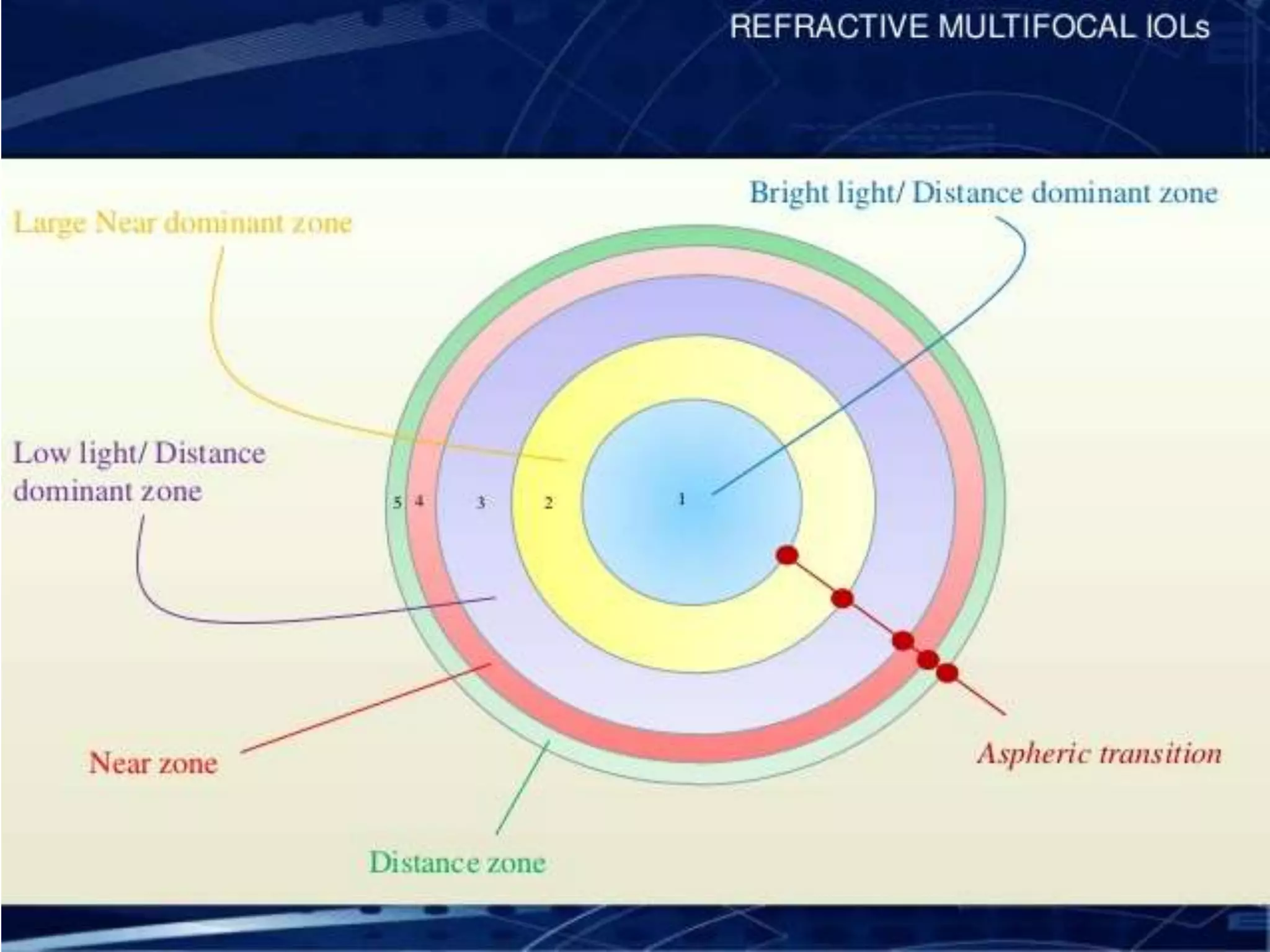
Multifocal Intraocular Lenses
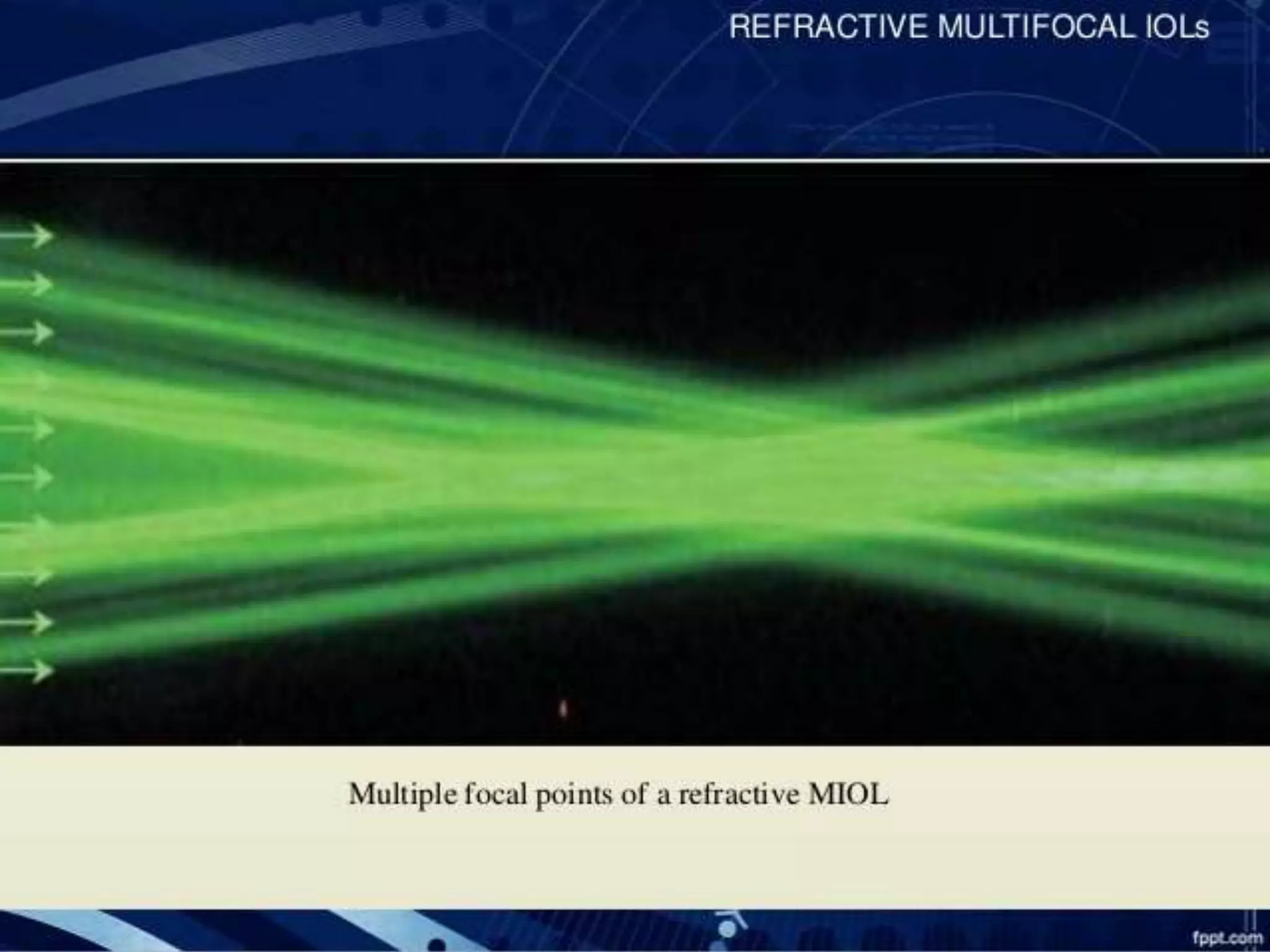
• Multifocal IOLs (mIOL) are designed to
overcome the postoperative lack of
accommodation by dividing the incoming light
onto two or more focal points.
• Two types of mIOLs:
– Diffractive
– Refractive
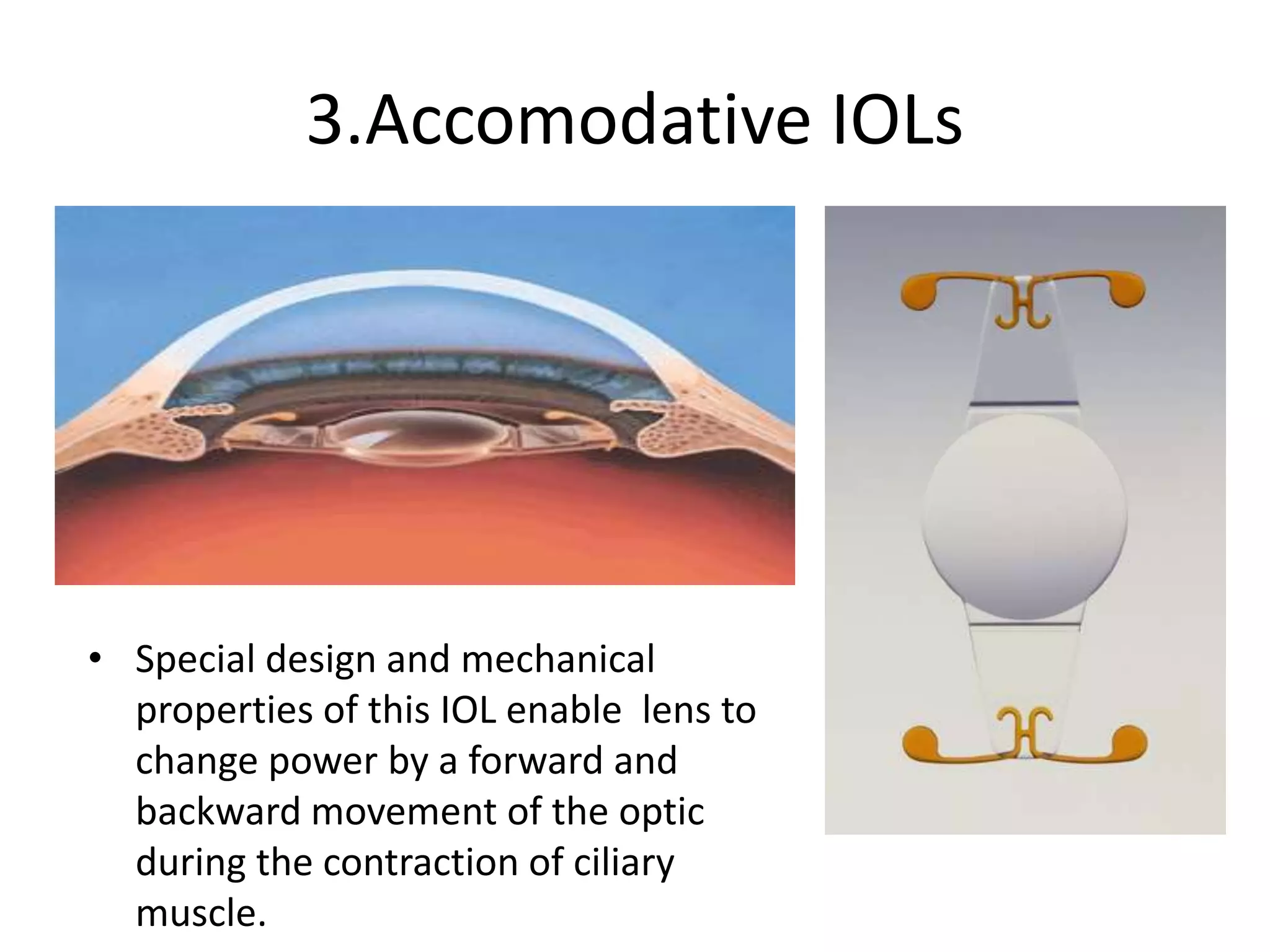
3.Accomodative IOLs
• Special design and mechanical
properties of this IOL enable lens to
change power by a forward and
backward movement of the optic
during the contraction of ciliary
muscle.
• Diameter of this lens optic is 5.5 mm with an overall
diameter of 9.8 mm.
• Four haptics which are connected to the optic with a pliable
joint.
• Single piece acrylic material.
• Hinge type haptics permit movement between haptics and
optic.
• Merits
– May eliminate the need of any kind of refractive correction.
– There is no incidence of glare, haloes, ghost images and loss of
contrast sensitivity.
• Demerits
– High incidence of contraction of capsular bag.
– Loss of pliability of material at the haptic- optic junction.
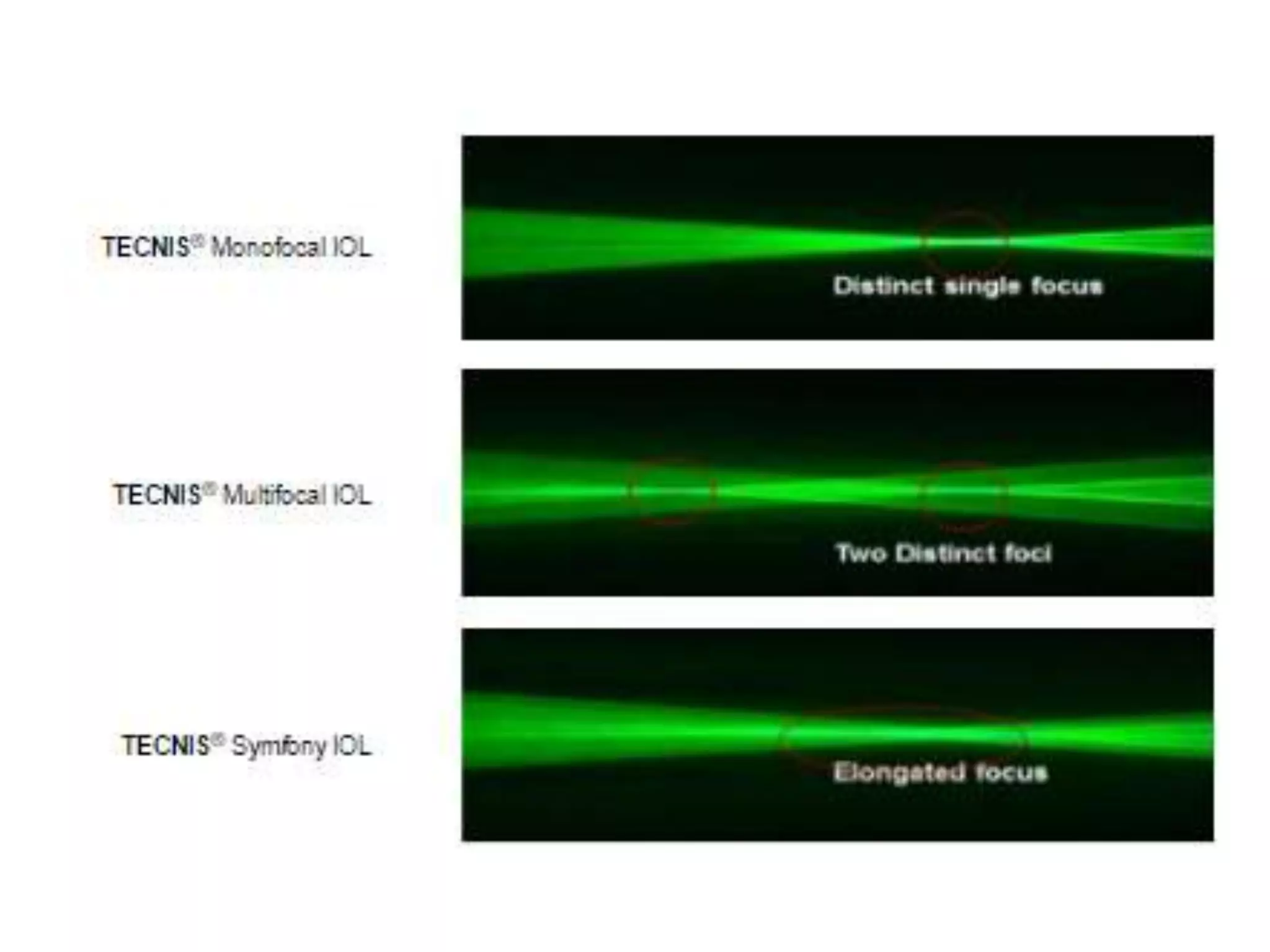
TECNIS® symfony IOL
• Proprietary diffractive echelette design feature
introduces a novel pattern of light diffraction that
elongates the focus of the eye resulting in an extended
range of vision.
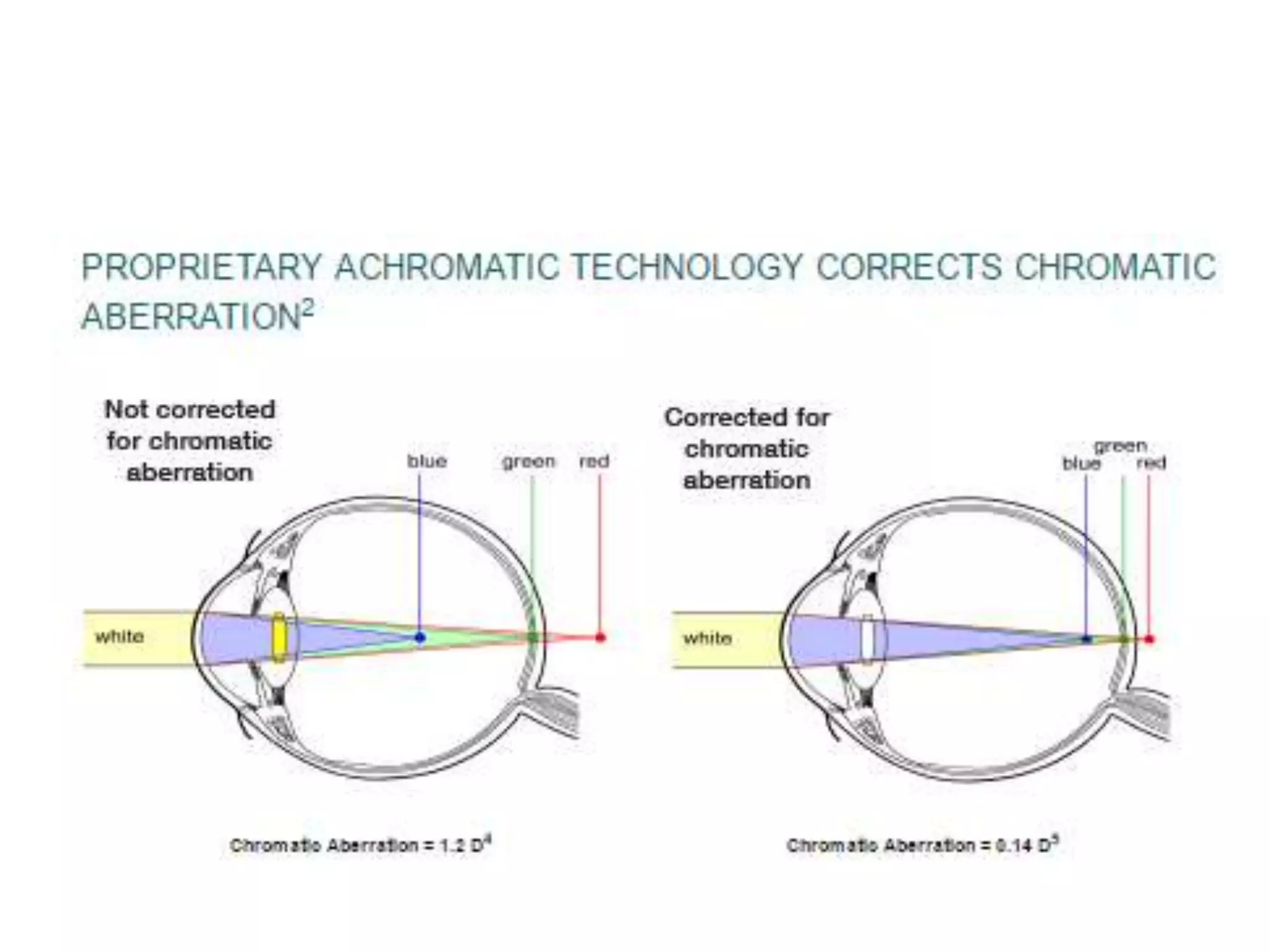
• TECNIS® symfony IOL merges two complementary
enabling technologies
– The proprietary diffractive echelette design feature
extends the range of vision.
– The proprietary achromatic technology corrects chromatic
aberration for enhanced contrast sensitivity.
Thank u

Types of iol

  • 1.
    Types of IOL DrRohit Rao
  • 2.
  • 3.
    Primary vs secondaryimplantation • Primary implantation – use of IOLs during surgery for cataract • Secondary implantation – implantation of IOL to correct aphakia in a previosly operated eye
  • 4.
    Parts of anIOL • OPTIC Part of the lens that focuses light on the retina. • HAPTIC Small filaments connected to the optic that hold the lens in place in the eye HAPTEN OPTIC
  • 5.
    MATERIALS USED FORINTRAOCULAR LENSES Optic materials 1.Non-foldable-rigid IOL • Polymethyl methacrylate(PMMA) 2.Foldable IOL • Silicone • Hydrophobic acrylic • Hydrophilic acrylic 3.Rollable/Ultra-thin IOL • Hydrogel Haptic materials • PMMA, • Polyvinylidene fluoride (PVDF), • Polyimide (elastimide), • Polypropylene (prolene)
  • 6.
    Polymethylmethacrylate • Hard andrigid - Inert and non autoclavable. • Hydrophobic – so causes adherence of cell and bacteria • Refractive Index 1.47 and1.55
  • 7.
    Flexible Acrylic • Hydrophilic –Unfolds in controlled fashion – Good uveal and excellent capsular biocompatibility • Hydrophobic – More prone to develop PCO • Copolymer of phenyl ethylacrylate and phenylethylmethacrylate. • Good viscoelastic and three dimensional stability • Viscoelasticity is temperature dependant with increase elasticity at higher temperature
  • 8.
    Silicone • Elastomer Polydimethylsiloxane •Capable of large and reversible deformations • Good memory • Surface deposits are common • Additives in silicone IOL are – UV chromophore – Phenyl group to increase Refractive Index from 1.41 to 1.46
  • 9.
    Hydrogels • HEMA or2 Hydroxyethylmethacrylate • Polymerization in ethylene glycol medium • Hydrate to form soft, swollen, rubbery mass • Hydrophilic hence repel cells and microbes • Refractive Index - 1.43 to 1.48
  • 10.
    Truedge • Truedge 360°Square Edge acts as a mechanical barrier for cell proliferation • 10° Angulation, steep vault of 0.4 mm
  • 11.
    Aurofold lens • negativeaspheric hydrophilic acrylic foldable intraocular lens made of p-HEMA material • Truedge technology to prevent PCO • Zero Degree Angulation
  • 12.
    Aurofold lens • p-HEMAmaterial • Zero degree angulation • Disposable delivery system
  • 13.
    Auro toric • AuroflexToric IOL has been carefully designed with toricity on the anterior surface of the IOL. • UV absorbing p-HEMA • OptiCal an web based online service www.aurolab.com/OptiCal.
  • 14.
    Aurovue • Single piecehydrophobic foldable acrylic IOL • 3° Angulation • disposable delivery system
  • 15.
    Aurovue • Aspheric optic(negative spherical aberration), preloaded hydrophobic acrylic IOL. • 3° Angulation
  • 16.
    Acrysoft IQ • HydrophobicAcrylic IOLs • Aspheric
  • 17.
    Sensar • Single piecehydrophobic foldable acrylic IOL • OptiEdge® with 360° square edge, and round anterior edge • 5˚ angulation
  • 18.
    Tecnis • Biconvex, anterioraspheric surface, square optic edge • ProTEC frosted, continuous 360° posterior square edge • UV-blocking hydrophobic acrylic • Haptics offset from optic
  • 19.
    • enVista hydrophobicacrylic IOL • No glistenings • Aberration-free aspheric Advanced Optics • Step-vaulted haptics • 360° square barrier edge enVista
  • 20.
    Restor • Single piecefoldable acrylic IOL • Apodized Diffractive Technology • Apodization is the gradual shortening of step heights toward the periphery of the diffractive zone.
  • 21.
    Intraocular Lens Design •multipiece or monobloc; • plate or open-loop style; • angulated or planar haptics; • special haptics for certain indications such as sulcus, anterior chamber angle, or iris fixation; • optic shape and edge design; • Optic geometry for certain indications such as toric, aspheric, or multifocal IOLs
  • 23.
    Open-Loop • Multipiece – IOLsare held in place by exerting centripetal pressure on capsule bag fornix and or ciliary sulcus. • Single-Piece – IOLs are produced in a single step from one material – More resistant to damage with injectors – Production process is cheaper – May have less of a PCO-inhibiting effect
  • 25.
    Haptic Angulation • Maximizethe barrier effect to migrating LECs by pushing the IOL backwards.
  • 26.
  • 27.
    POSITIONING OF IOL 1.Posterior chamber implantation • Ciliary sulcus fixation • In the bag fixation • Scleral fixation Eg:- modified C loop type IOL
  • 28.
  • 29.
    Intraocular Lenses for InsufficientCapsule Support • In cases of PCR where IOL placement is no longer possible, but ALC is intact, the IOL can be placed in sulcus. (optic capture if possible) • 0.5 diopters should be deducted • no capsule support is given, – angle-supported ACIOL, – Iris-supported IOLs – Scleral-sutured IOLs
  • 30.
  • 31.
    2. Anterior chamber implantation •angle supported IOLs • Kelman multiflex type IOL
  • 32.
    3. Iris- fixatedlens • Fixed on the iris with claws,loops or sutures • Eg- Singh and Worst’s iris claw lens
  • 33.
  • 34.
    Edge Design • Sharp-edgeIOL designs – edge-glare phenomena • IOLs with a round anterior and sharp posterior optic edge seems to avoid this disturbing side effect
  • 36.
    Optic Geometry • Biconvexity –Radius of curvature of the front and back surface are identical. • Asymmetric biconvex optic – Back surface curvature is relatively flat and constant throughout most of the power range and anterior curvature is varied for IOL power.
  • 37.
    Aspherical Intraocular Lenses •IOL has prolate surface inducing negative SA, which should neutralize positive SA of the average cornea. • The aim is to increase contrast sensitivity under mesopic conditions where the pupil is dilated. • little to no effect when the pupil is small.
  • 41.
    Toric Intraocular Lenses •Correcting preexisiting corneal astigmatism using incisional techniques, – Corneal incision on the steep axis, – Making limbal relaxing incisions (LRIs) on the steep axis. – Neutralizing corneal astigmatism is the use of toric IOLs • Accurate axis placement of the toric IOL is critical • 3% of toric correction is lost for every degree off axis. • Being 10 degrees off axis results in about 1/3 of toric correction lost. • Being 30 degrees off results in no toric correction
  • 43.
    Multifocal Intraocular Lenses •Multifocal IOLs (mIOL) are designed to overcome the postoperative lack of accommodation by dividing the incoming light onto two or more focal points. • Two types of mIOLs: – Diffractive – Refractive
  • 52.
    3.Accomodative IOLs • Specialdesign and mechanical properties of this IOL enable lens to change power by a forward and backward movement of the optic during the contraction of ciliary muscle.
  • 53.
    • Diameter ofthis lens optic is 5.5 mm with an overall diameter of 9.8 mm. • Four haptics which are connected to the optic with a pliable joint. • Single piece acrylic material. • Hinge type haptics permit movement between haptics and optic. • Merits – May eliminate the need of any kind of refractive correction. – There is no incidence of glare, haloes, ghost images and loss of contrast sensitivity. • Demerits – High incidence of contraction of capsular bag. – Loss of pliability of material at the haptic- optic junction.
  • 58.
    TECNIS® symfony IOL •Proprietary diffractive echelette design feature introduces a novel pattern of light diffraction that elongates the focus of the eye resulting in an extended range of vision. • TECNIS® symfony IOL merges two complementary enabling technologies – The proprietary diffractive echelette design feature extends the range of vision. – The proprietary achromatic technology corrects chromatic aberration for enhanced contrast sensitivity.
  • 62.