D R . G A U R E E G A T T A N I
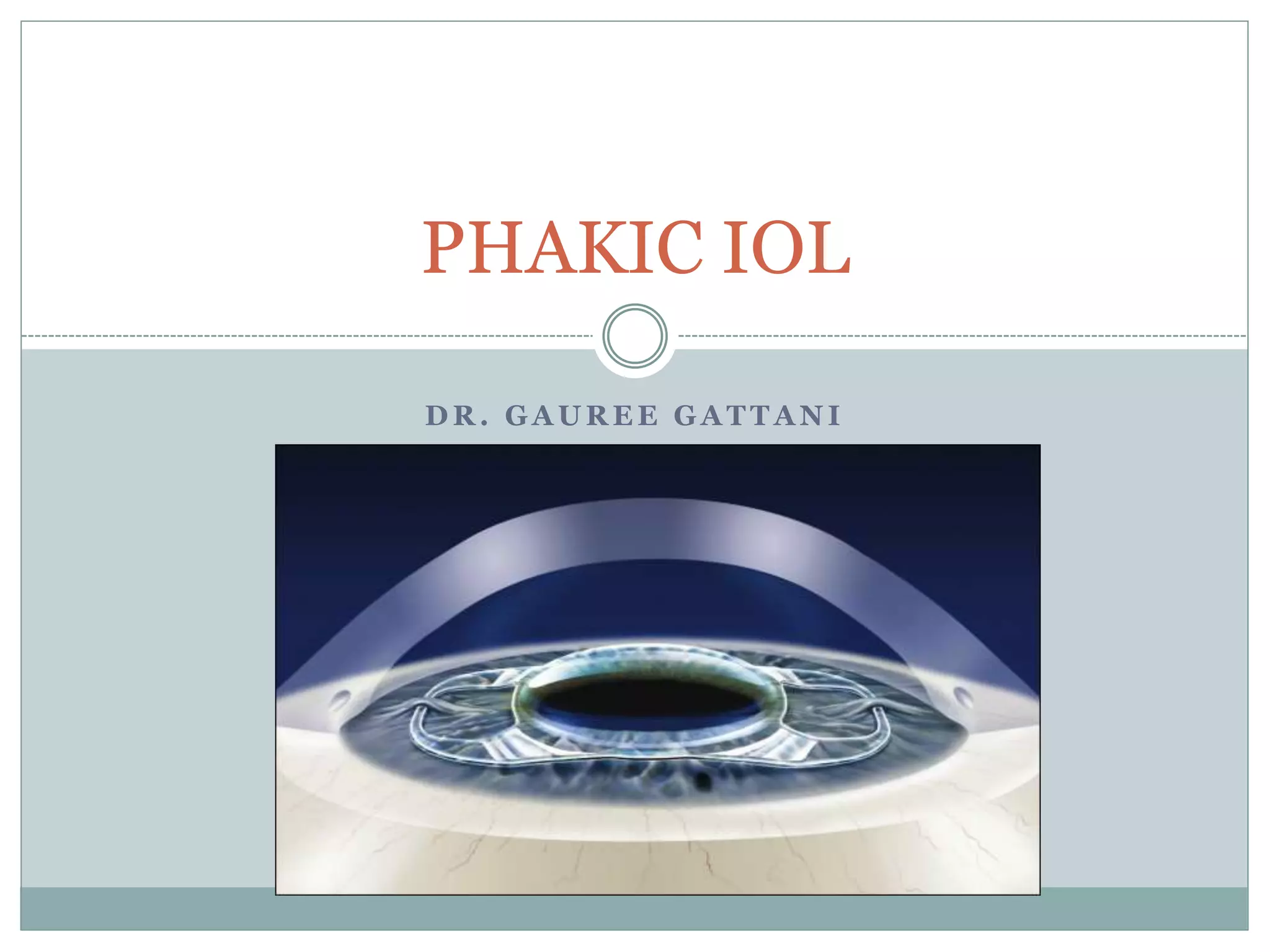
PHAKIC IOL
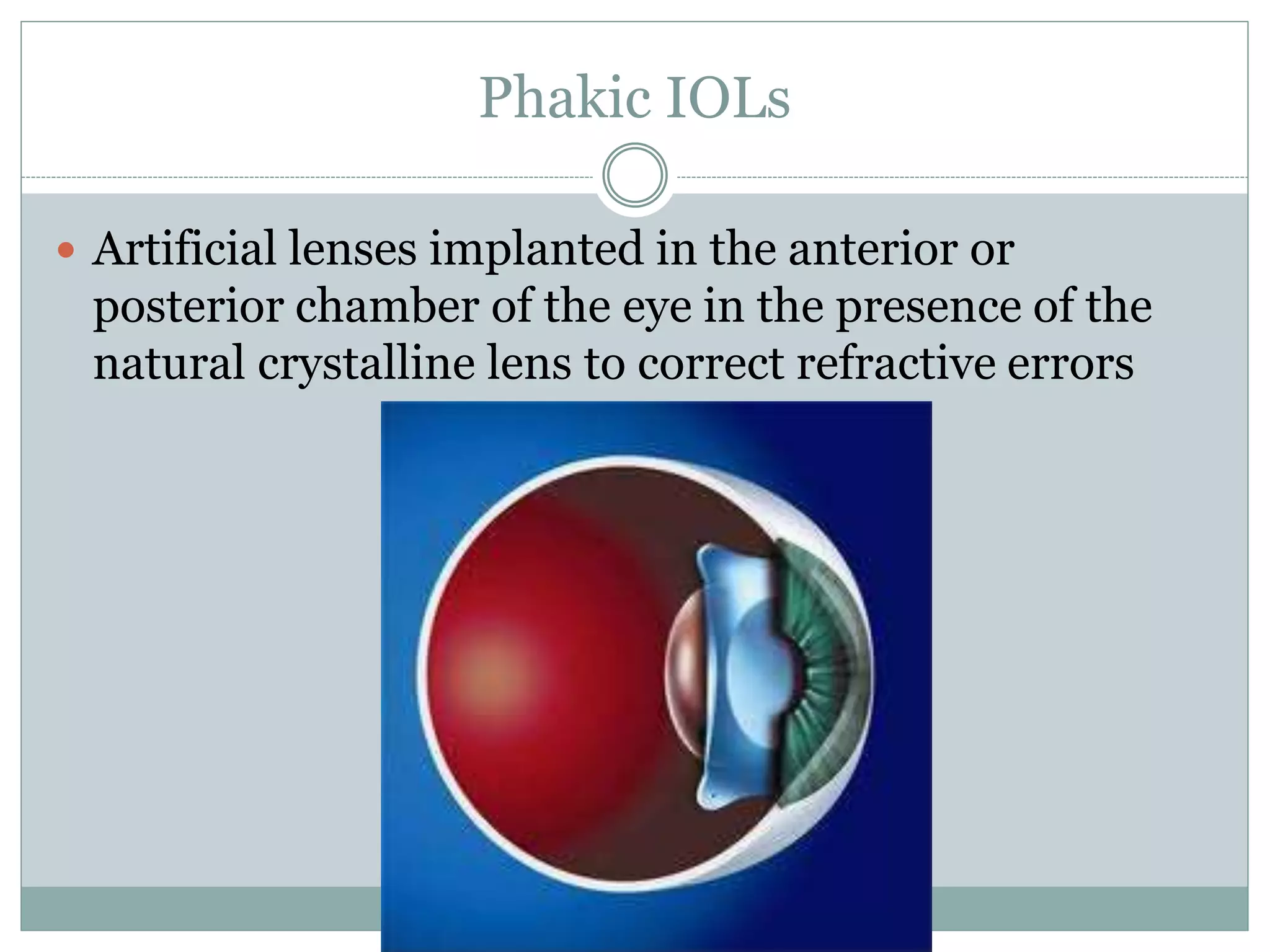
Phakic IOLs
 Artificial lenses implanted in the anterior or
posterior chamber of the eye in the presence of the
natural crystalline lens to correct refractive errors
 Limitations of laser refractive surgery
- high ametropia
- irreversibility
- permanent damage to cornea
History
 1889
- Clear lens extraction for the correction of myopia
- Fukala in Austria/Germany : “Fukala Surgery”
- abandoned due to complications
 1950s
- correcting myopia by inserting a concave
lens into the phakic eye
 1988
- Baikoff : anterior chamber angle-fixed IOL
 Mid 1980s
- Posterior chamber phakic IOLs : Fyodorov
 1991
- Artisan-Worst iris claw lens
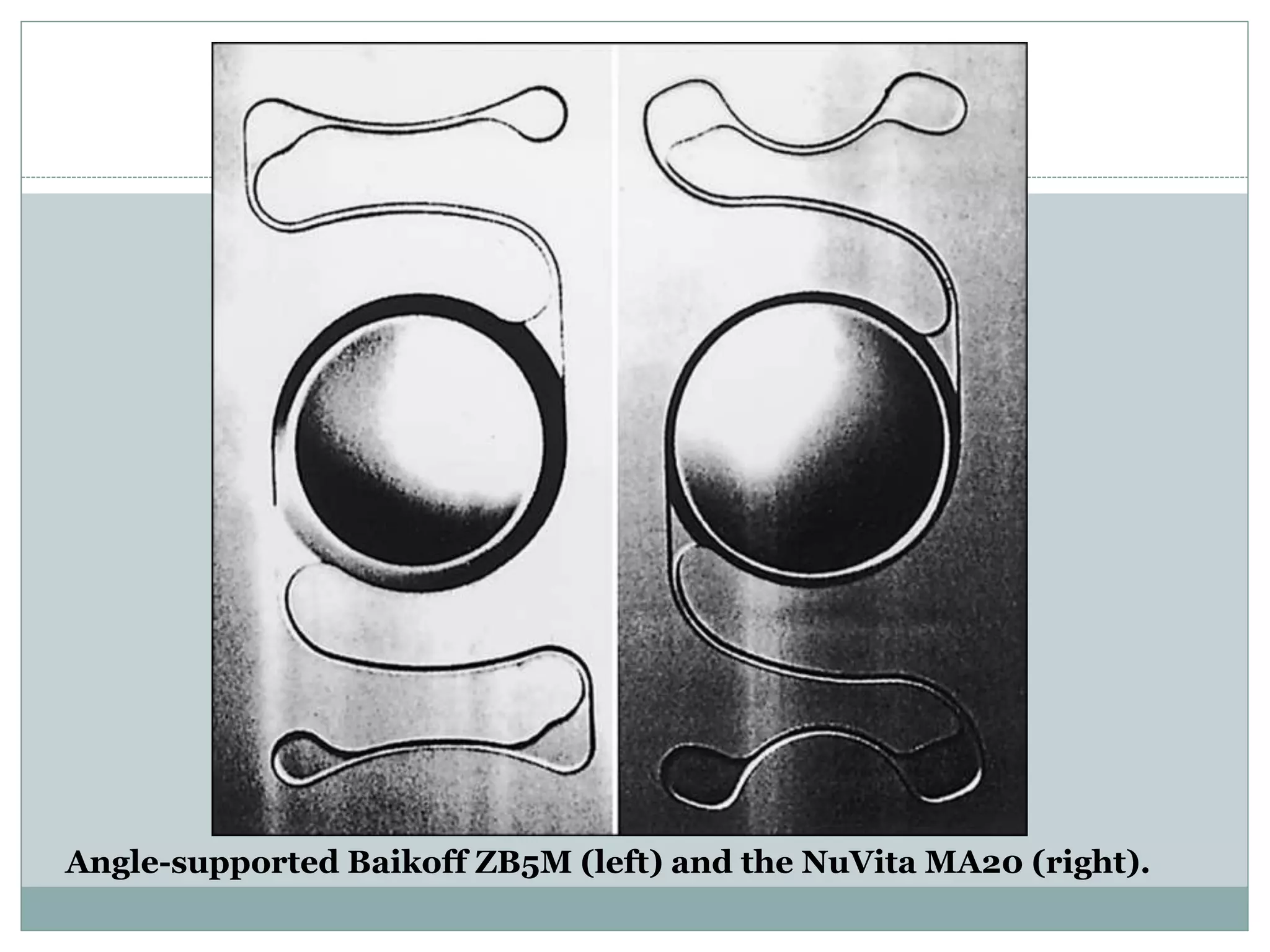
Angle-supported Baikoff ZB5M (left) and the NuVita MA20 (right).
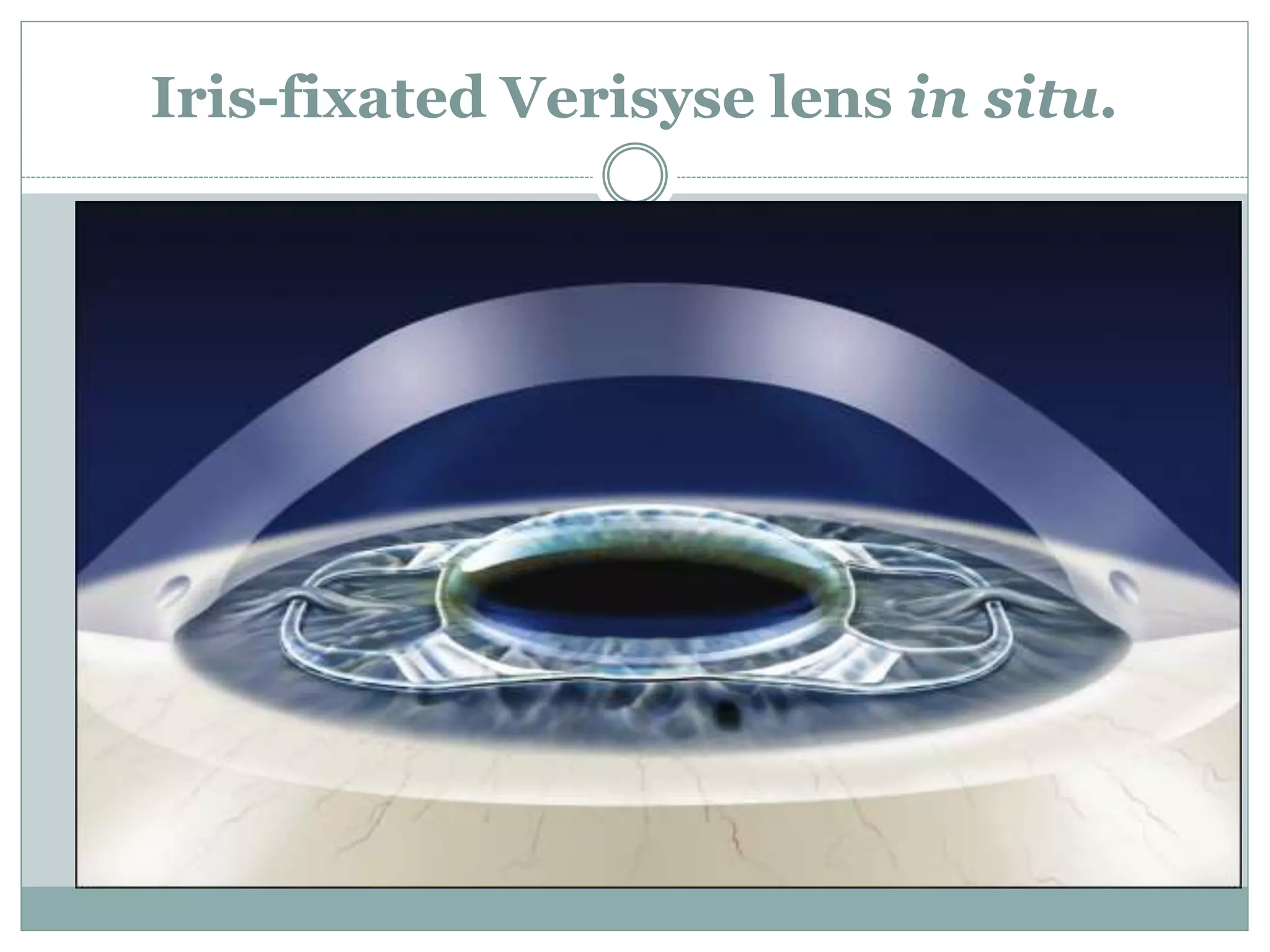
Iris-fixated Verisyse lens in situ.
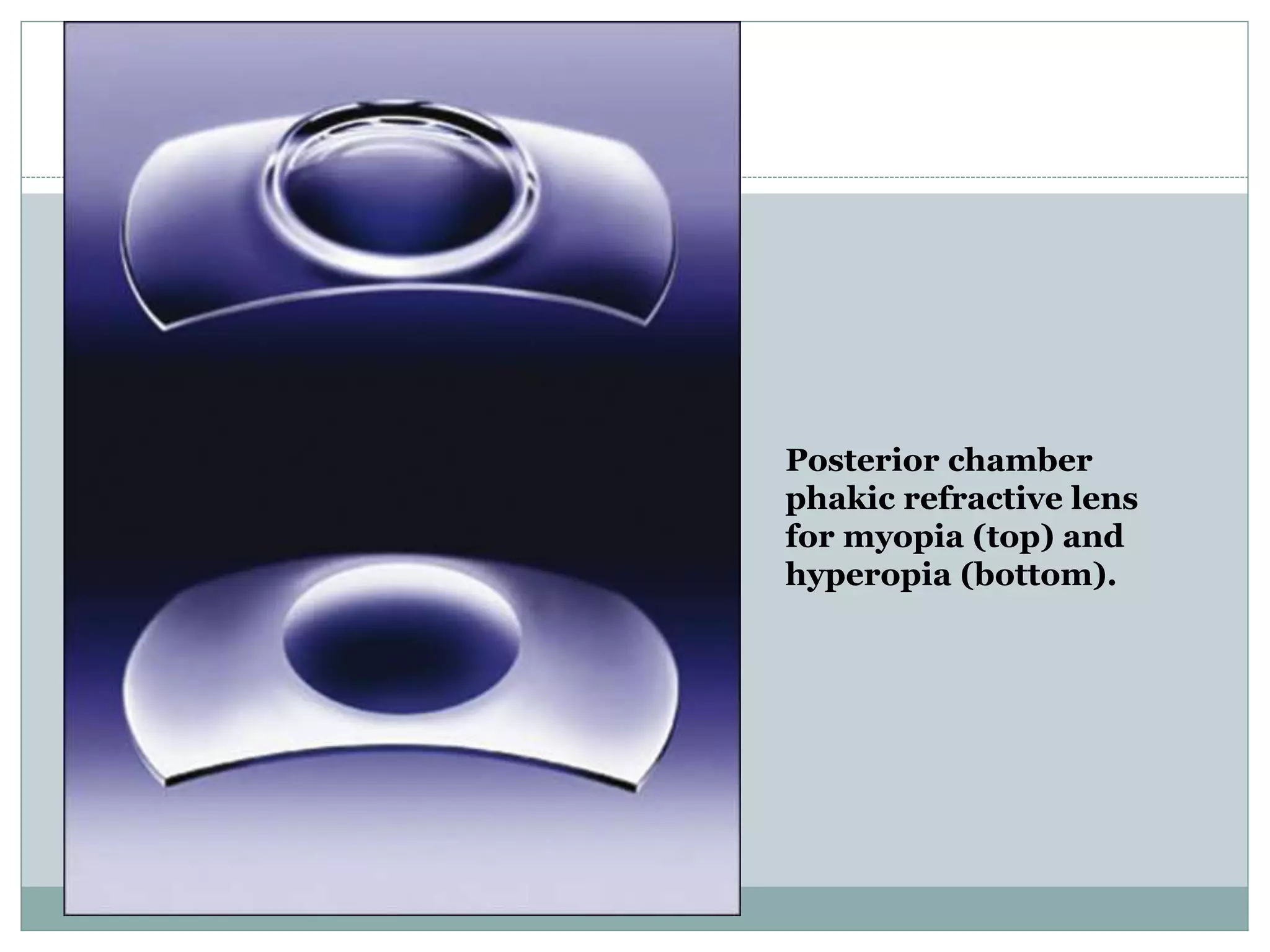
Posterior chamber
phakic refractive lens
for myopia (top) and
hyperopia (bottom).
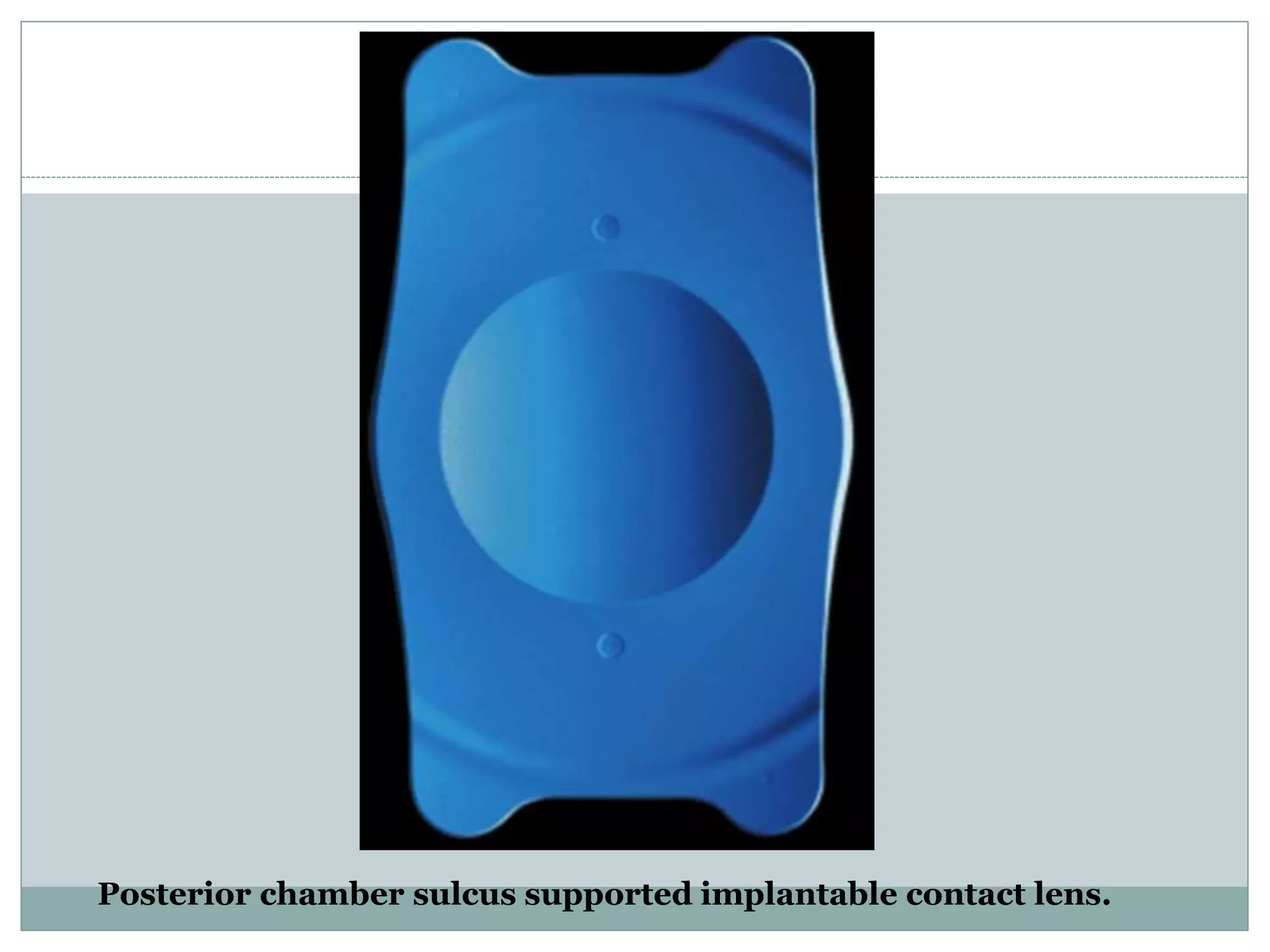
Posterior chamber sulcus supported implantable contact lens.
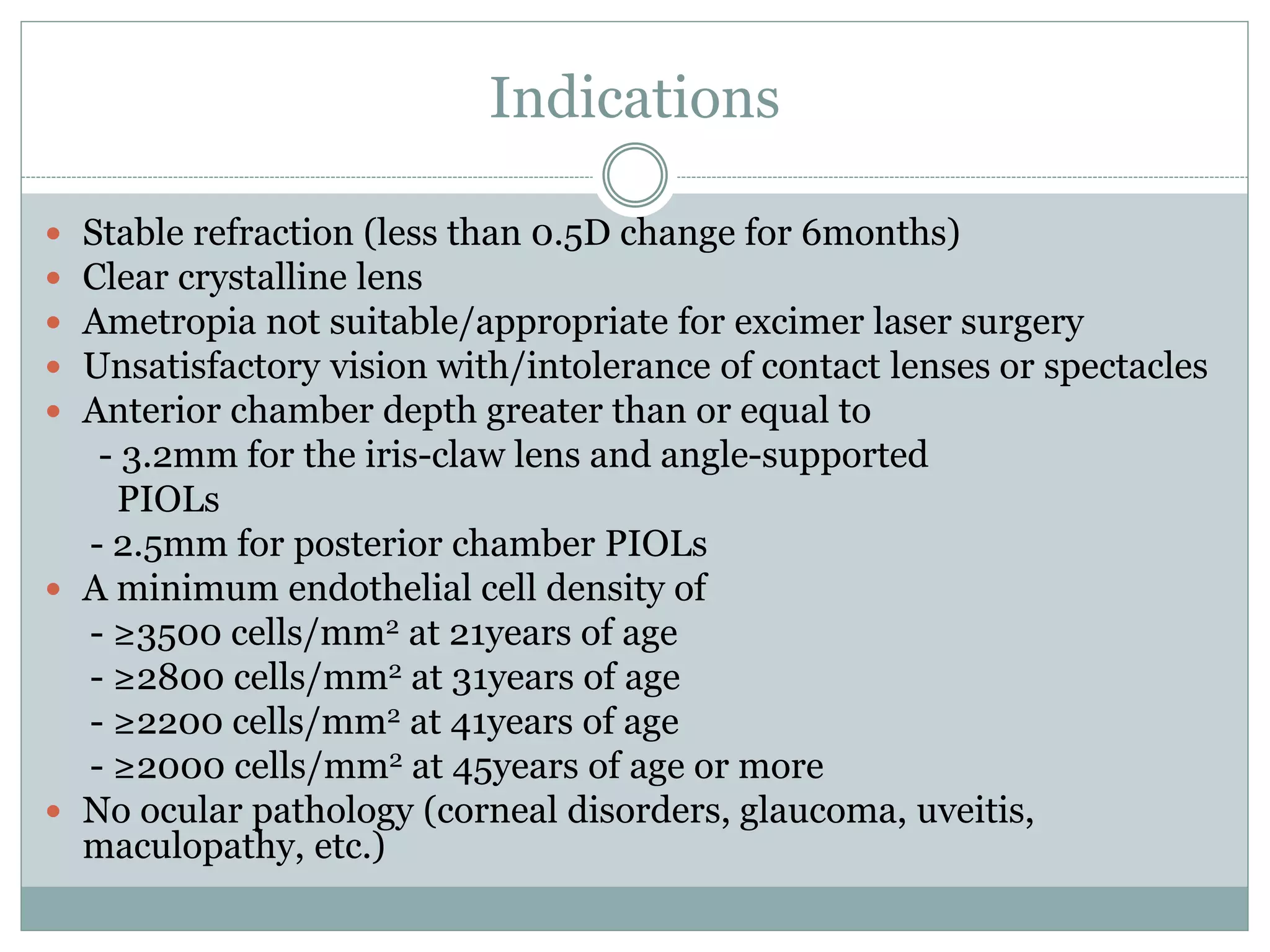
Indications
 Stable refraction (less than 0.5D change for 6months)
 Clear crystalline lens
 Ametropia not suitable/appropriate for excimer laser surgery
 Unsatisfactory vision with/intolerance of contact lenses or spectacles
 Anterior chamber depth greater than or equal to
- 3.2mm for the iris-claw lens and angle-supported
PIOLs
- 2.5mm for posterior chamber PIOLs
 A minimum endothelial cell density of
- ≥3500 cells/mm2 at 21years of age
- ≥2800 cells/mm2 at 31years of age
- ≥2200 cells/mm2 at 41years of age
- ≥2000 cells/mm2 at 45years of age or more
 No ocular pathology (corneal disorders, glaucoma, uveitis,
maculopathy, etc.)
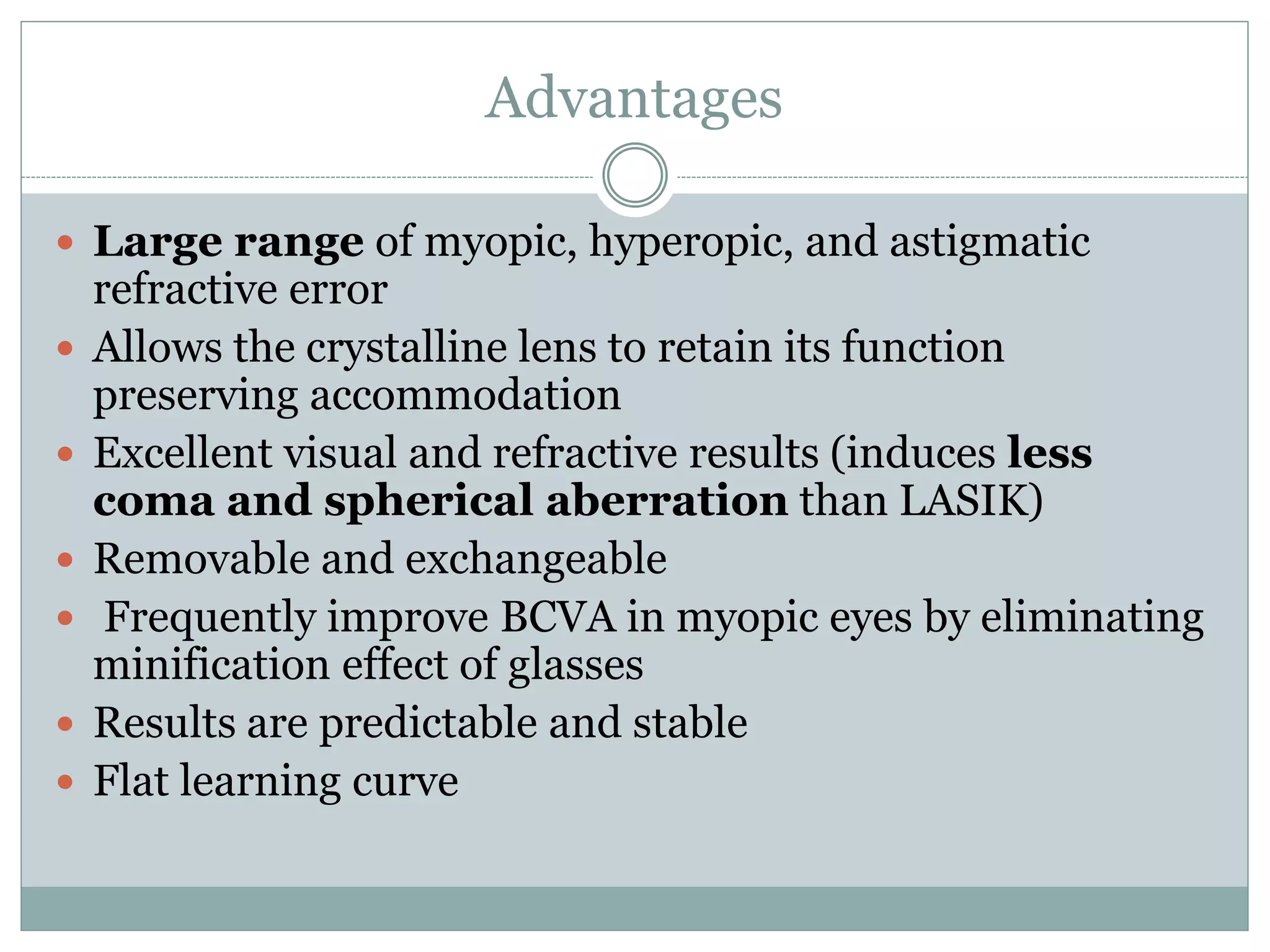
Advantages
 Large range of myopic, hyperopic, and astigmatic
refractive error
 Allows the crystalline lens to retain its function
preserving accommodation
 Excellent visual and refractive results (induces less
coma and spherical aberration than LASIK)
 Removable and exchangeable
 Frequently improve BCVA in myopic eyes by eliminating
minification effect of glasses
 Results are predictable and stable
 Flat learning curve
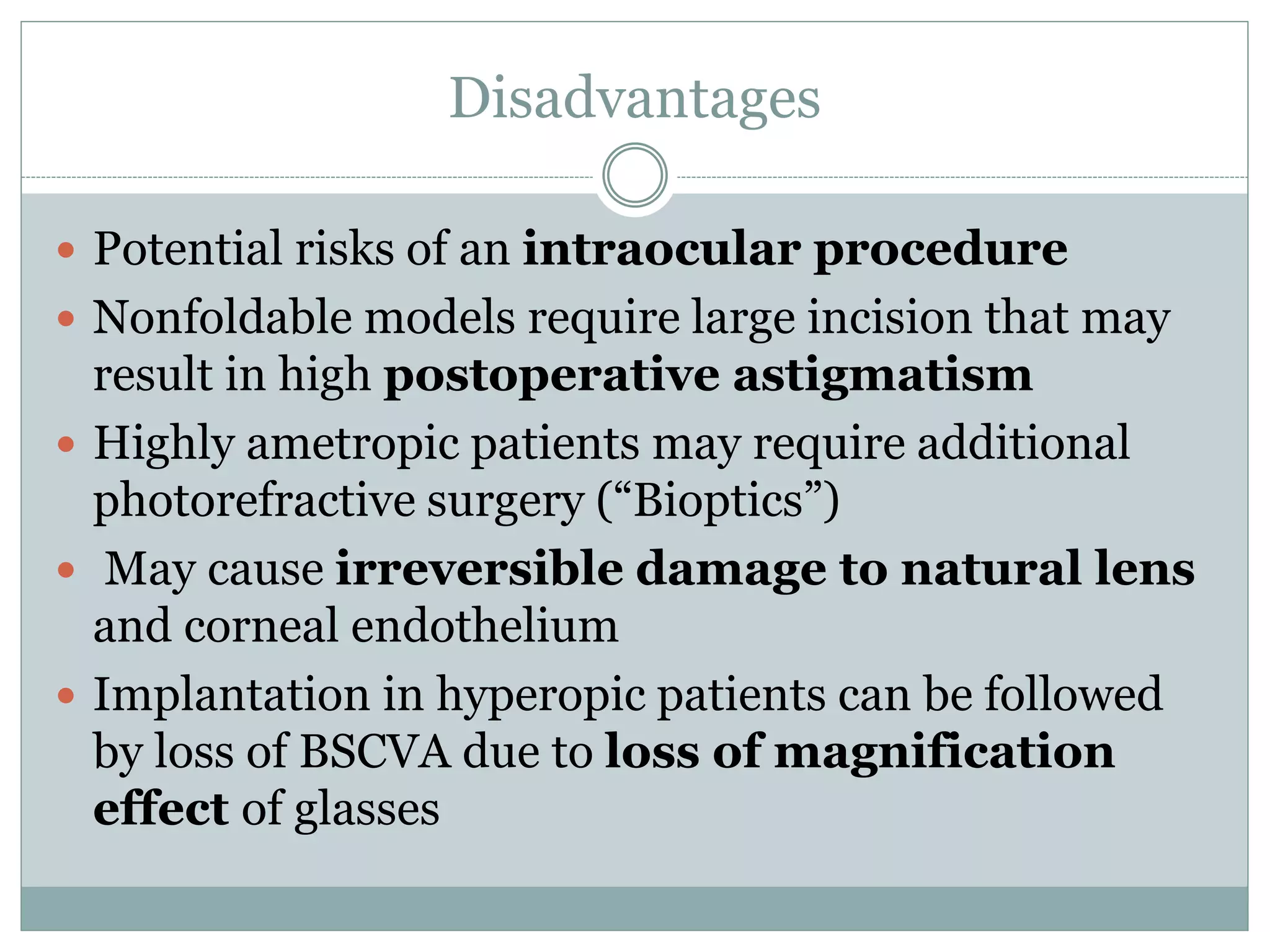
Disadvantages
 Potential risks of an intraocular procedure
 Nonfoldable models require large incision that may
result in high postoperative astigmatism
 Highly ametropic patients may require additional
photorefractive surgery (“Bioptics”)
 May cause irreversible damage to natural lens
and corneal endothelium
 Implantation in hyperopic patients can be followed
by loss of BSCVA due to loss of magnification
effect of glasses
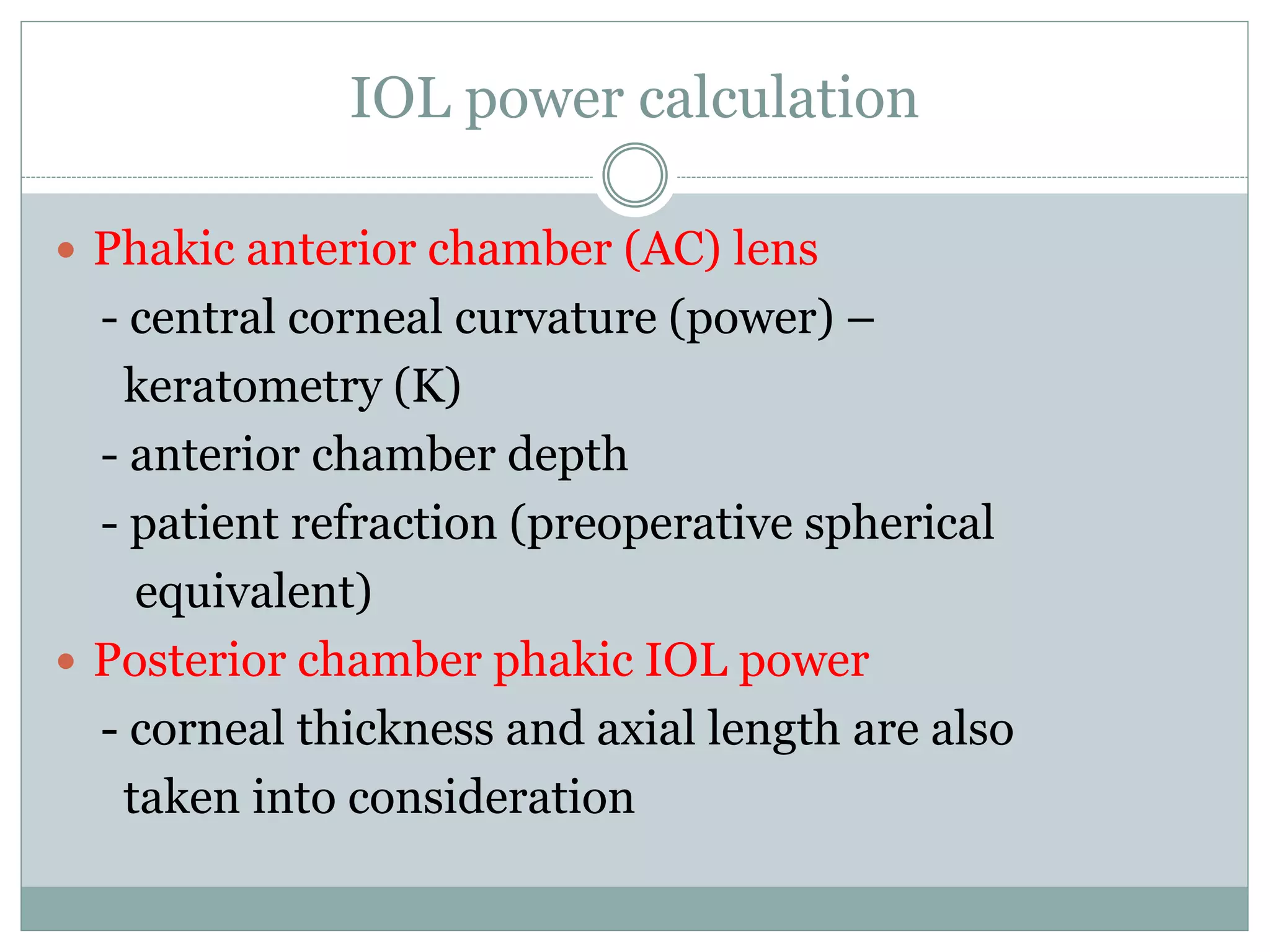
IOL power calculation
 Phakic anterior chamber (AC) lens
- central corneal curvature (power) –
keratometry (K)
- anterior chamber depth
- patient refraction (preoperative spherical
equivalent)
 Posterior chamber phakic IOL power
- corneal thickness and axial length are also
taken into consideration
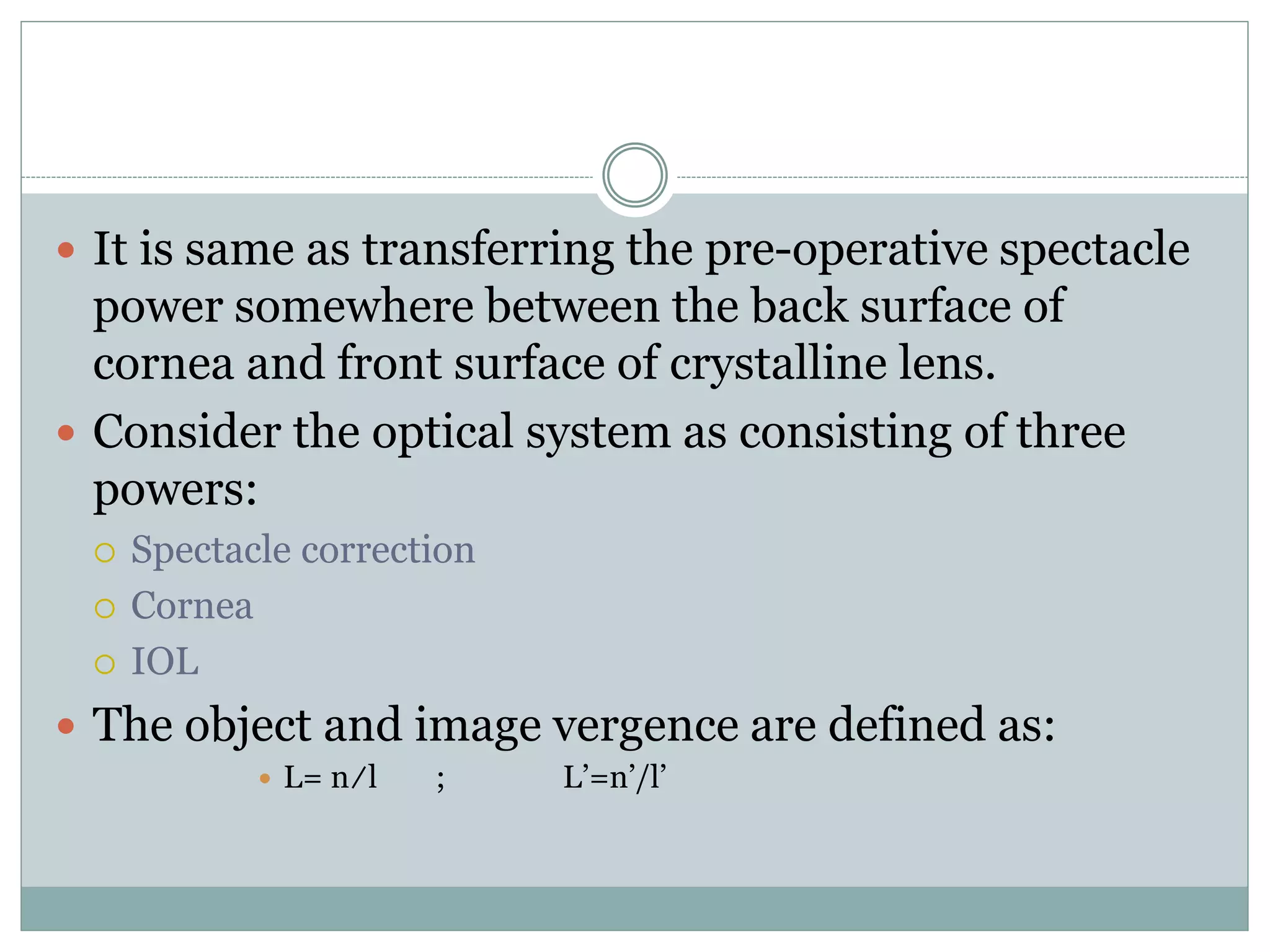
 It is same as transferring the pre-operative spectacle
power somewhere between the back surface of
cornea and front surface of crystalline lens.
 Consider the optical system as consisting of three
powers:
 Spectacle correction
 Cornea
 IOL
 The object and image vergence are defined as:
 L= n/l ; L’=n’/l’
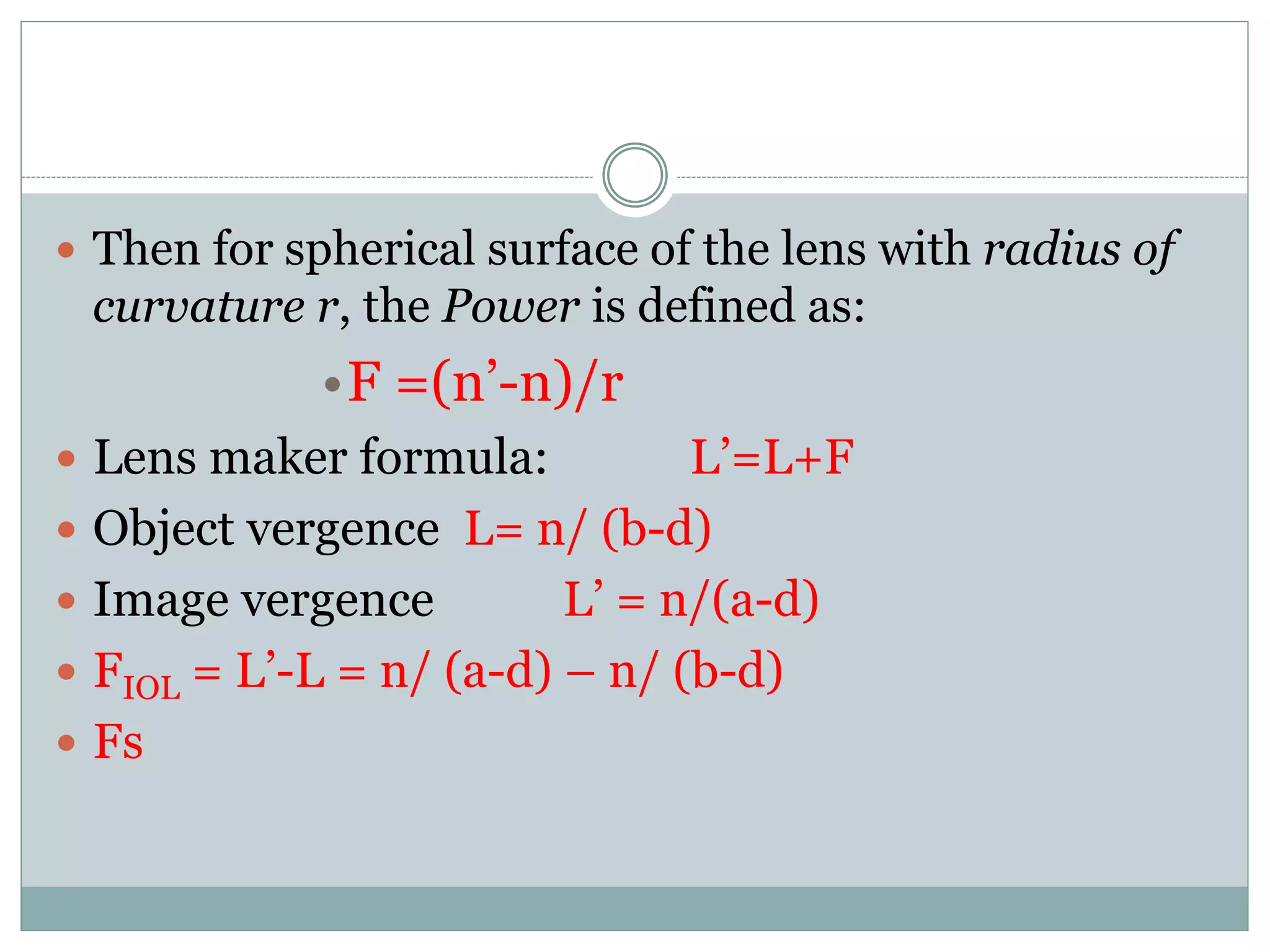
 Then for spherical surface of the lens with radius of
curvature r, the Power is defined as:
•F =(n’-n)/r
 Lens maker formula: L’=L+F
 Object vergence L= n/ (b-d)
 Image vergence L’ = n/(a-d)
 FIOL = L’-L = n/ (a-d) – n/ (b-d)
 Fs
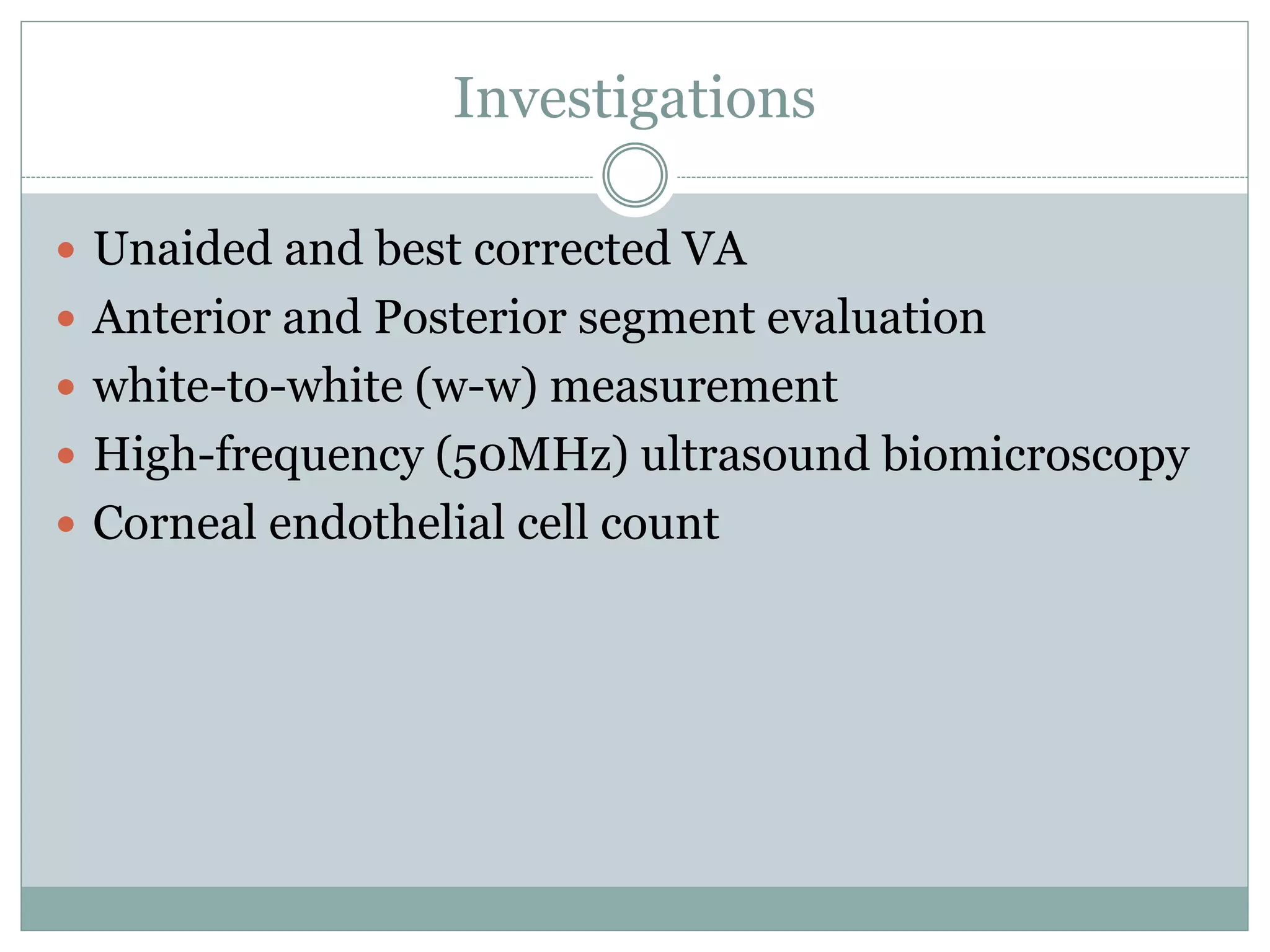
Investigations
 Unaided and best corrected VA
 Anterior and Posterior segment evaluation
 white-to-white (w-w) measurement
 High-frequency (50MHz) ultrasound biomicroscopy
 Corneal endothelial cell count
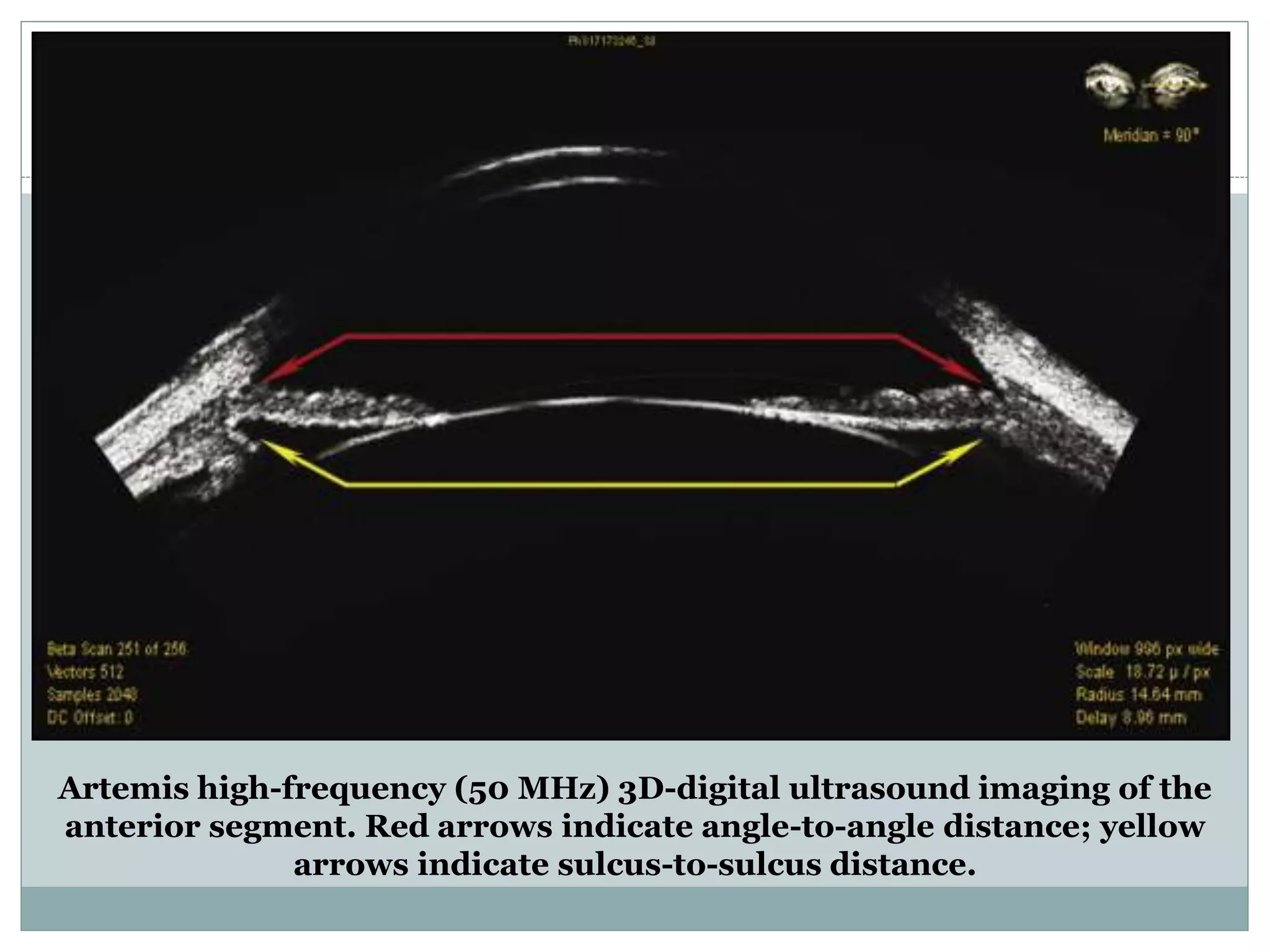
Artemis high-frequency (50 MHz) 3D-digital ultrasound imaging of the
anterior segment. Red arrows indicate angle-to-angle distance; yellow
arrows indicate sulcus-to-sulcus distance.
Deciding the size
 AC angle supported IOL
- length of IOL: 11.5 to 14 mm with 0.5mm
intervals
- w-w measurement - significant inaccuracies
- intraoperative AC sizer
- Anterior segment OCT
 AC Iris-Fixated Phakic IOLs
- one-size-fits-all length - 8.5 mm
 Posterior Chamber Phakic IOLs
- w-w measurement plus 0.5mm
- UBM and AS OCT to measure
- sulcus-to-sulcus distance
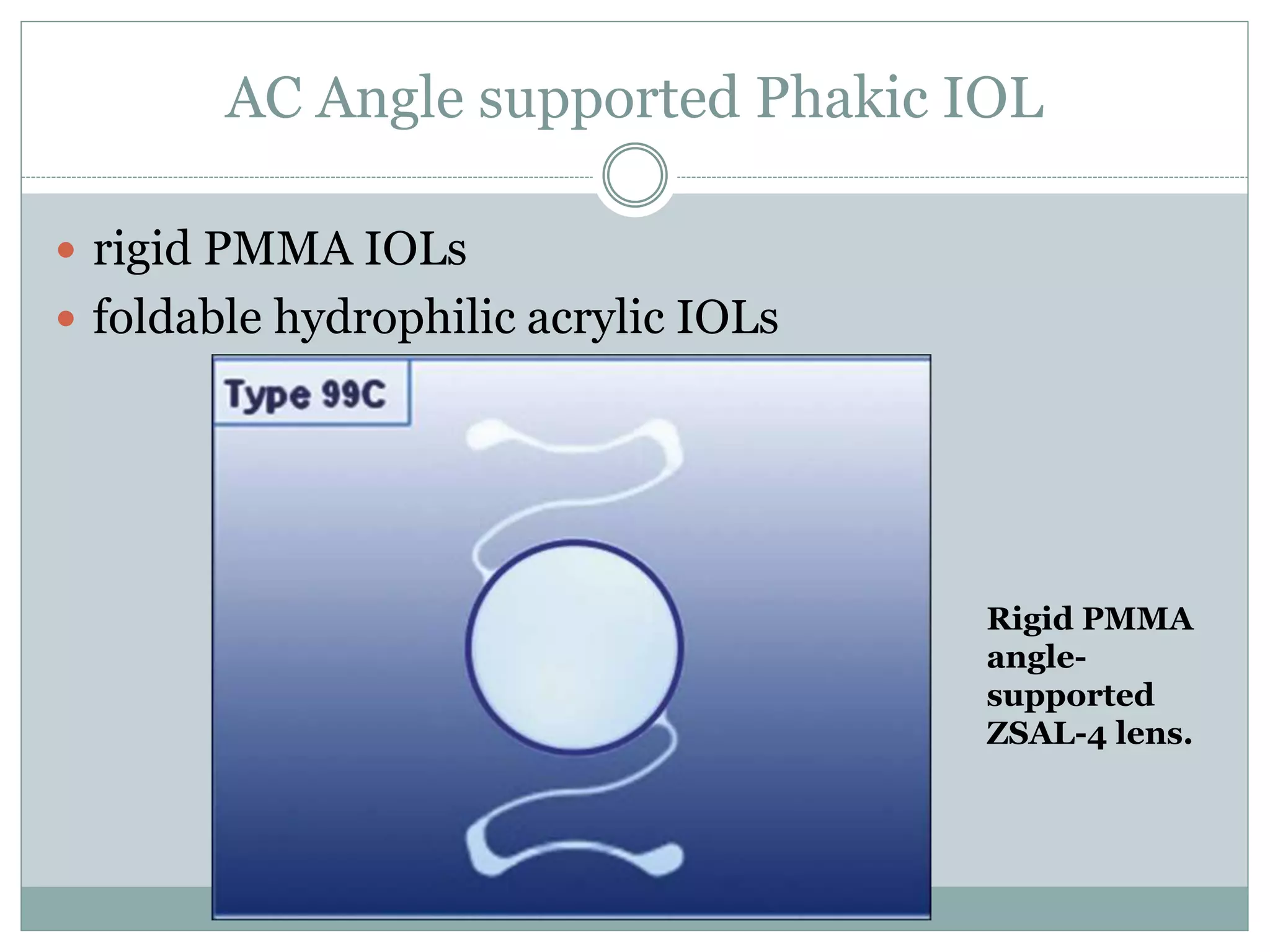
AC Angle supported Phakic IOL
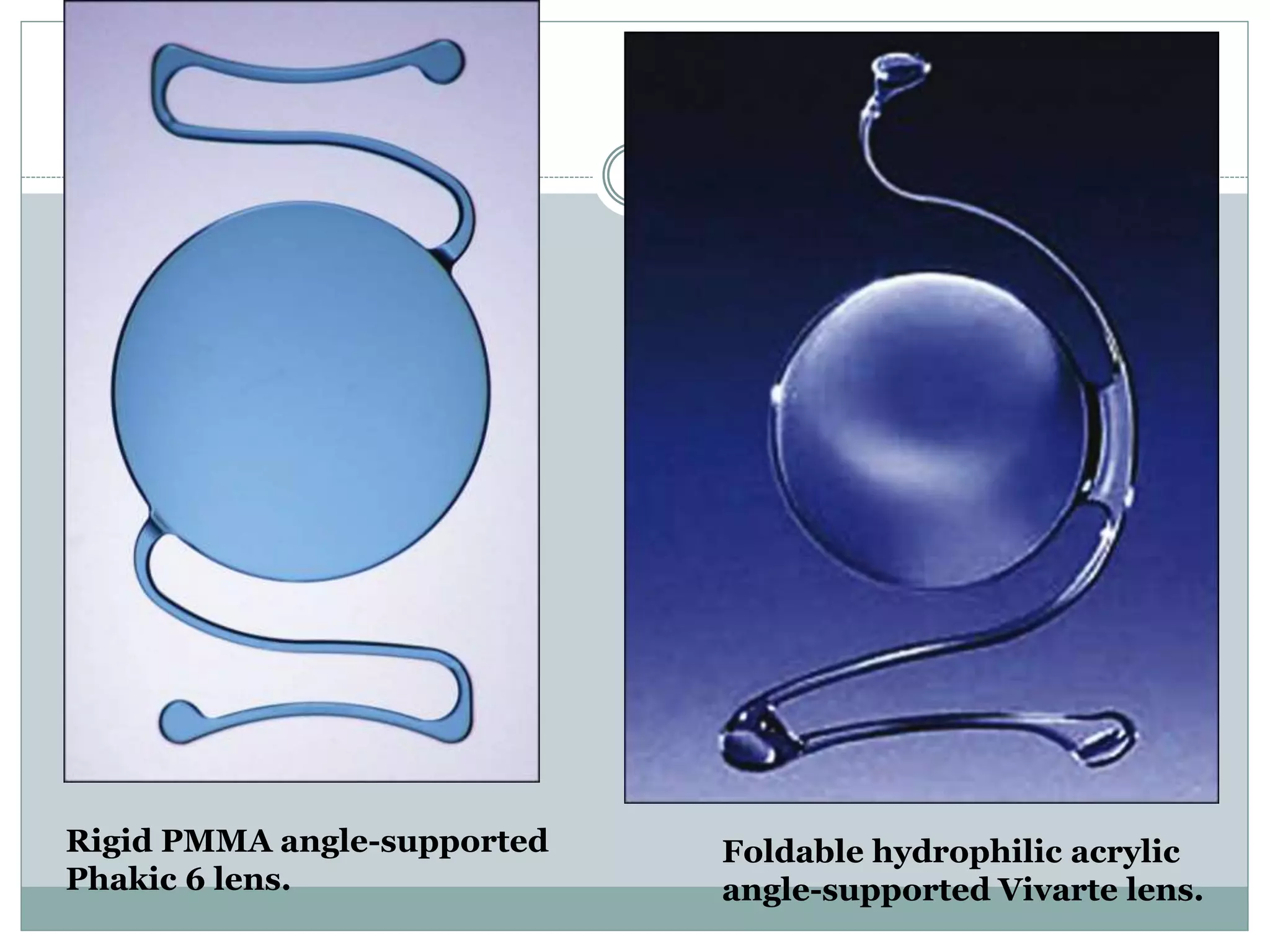
 rigid PMMA IOLs
 foldable hydrophilic acrylic IOLs
Rigid PMMA
angle-
supported
ZSAL-4 lens.
Foldable hydrophilic acrylic
angle-supported Vivarte lens.
Rigid PMMA angle-supported
Phakic 6 lens.
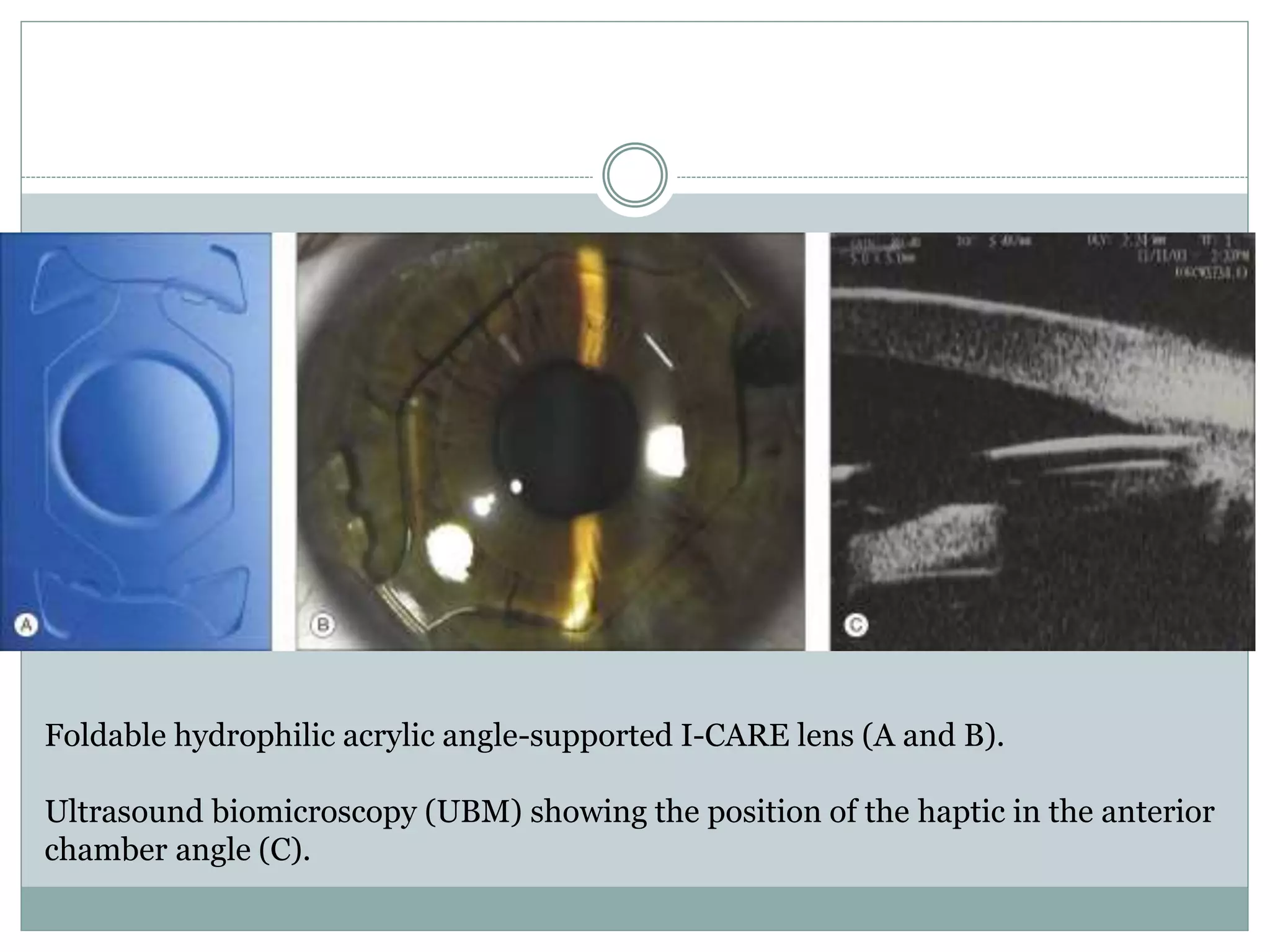
Foldable hydrophilic acrylic angle-supported I-CARE lens (A and B).
Ultrasound biomicroscopy (UBM) showing the position of the haptic in the anterior
chamber angle (C).
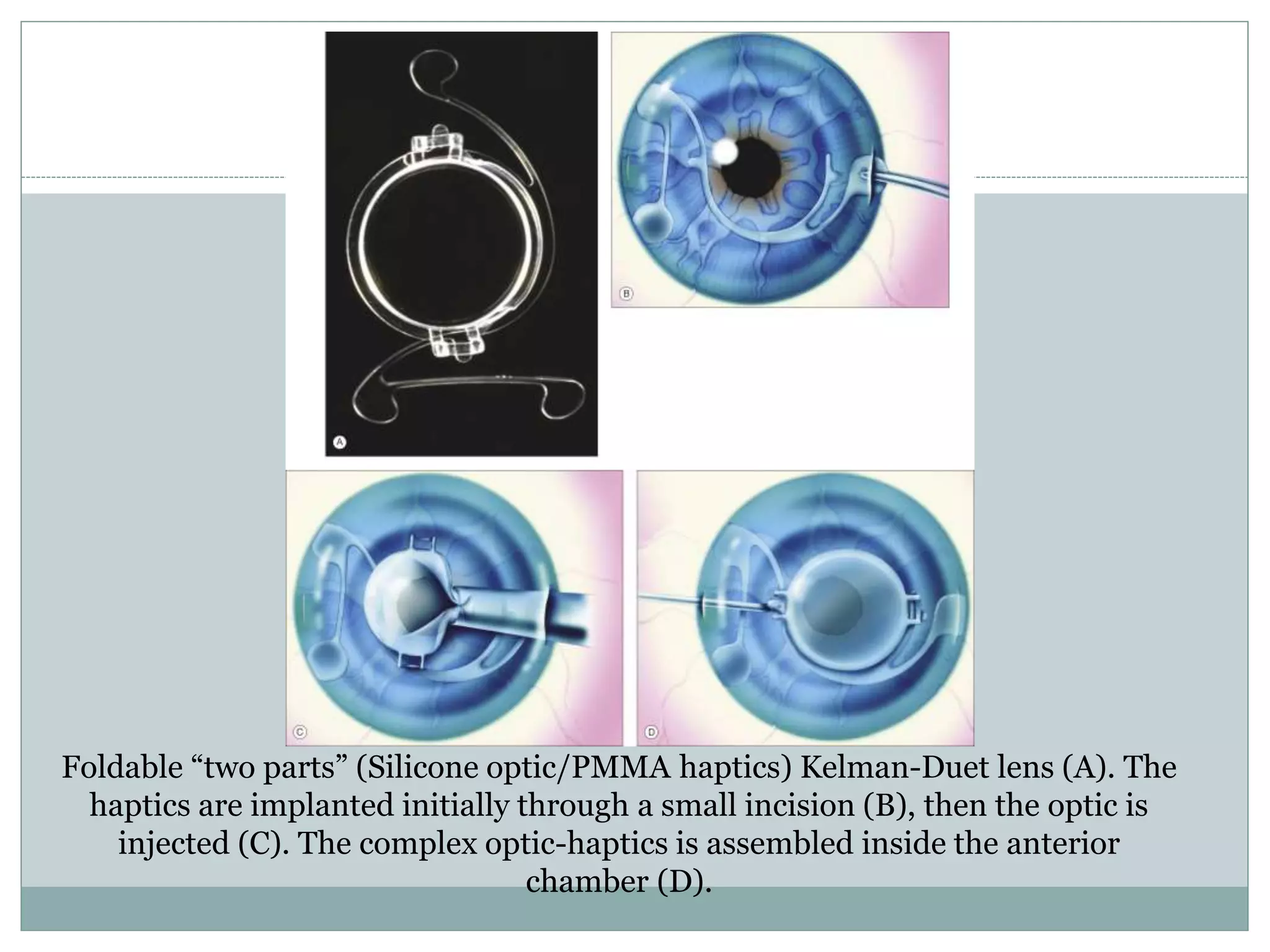
Foldable “two parts” (Silicone optic/PMMA haptics) Kelman-Duet lens (A). The
haptics are implanted initially through a small incision (B), then the optic is
injected (C). The complex optic-haptics is assembled inside the anterior
chamber (D).
Procedure
 Topical pilocarpine
 topical or peribulbar anesthesia
 Incision
 cohesive viscoelastic
 lens is introduced , footplate is inserted in
the iridocorneal angle, second haptic is then
placed, lens is then rotated in place
 peripheral iridectomy
 incision is closed
Complications
 Haloes and glare
 Pupillary ovalization
 Endothelial damage
 Elevation of intraocular pressure
 Uveitis
 Cataract
 Retinal detachment
 Rarely - Urrets-Zavalia syndrome, malignant
glaucoma, endophthalmitis
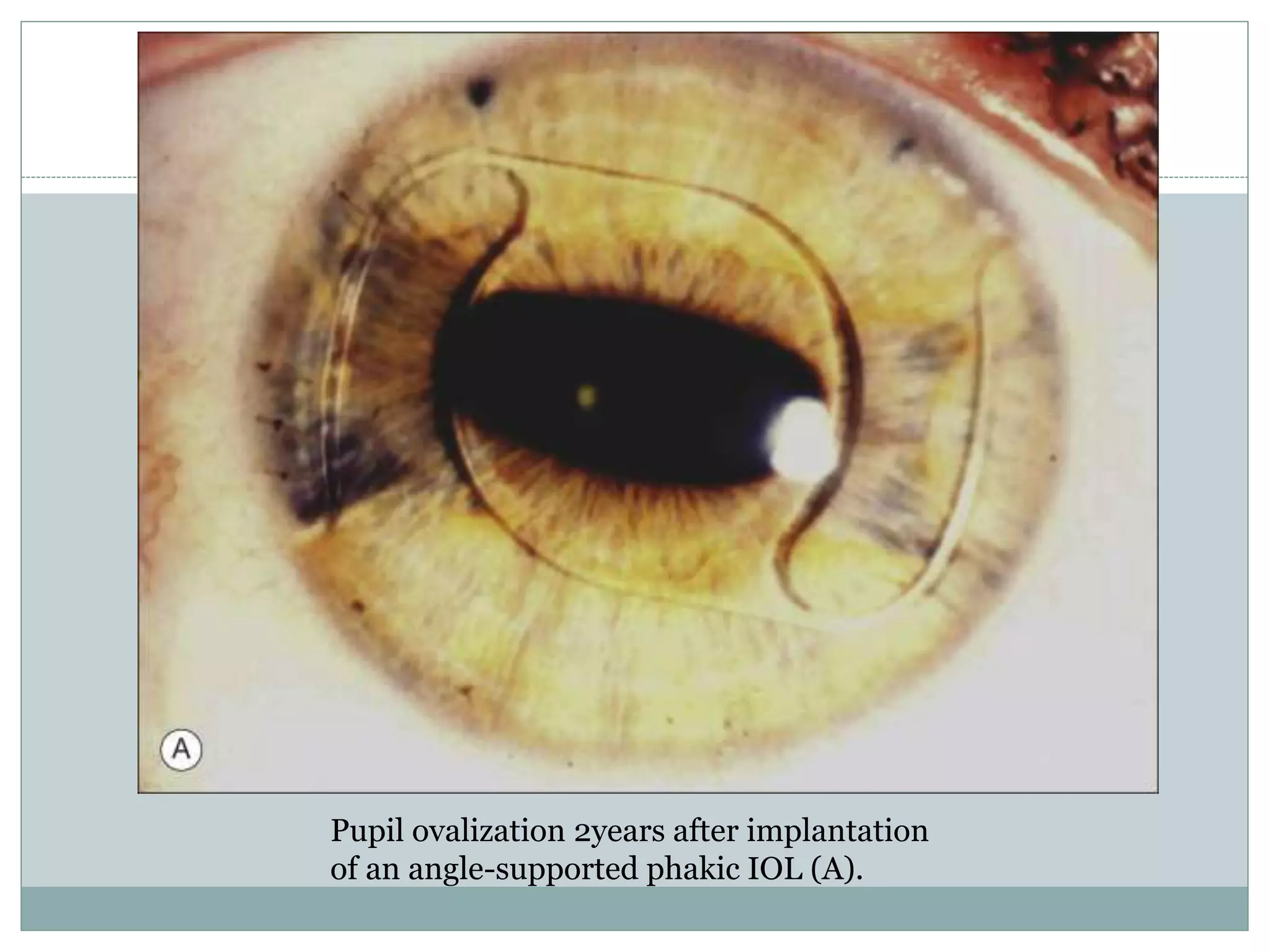
Pupil ovalization 2years after implantation
of an angle-supported phakic IOL (A).
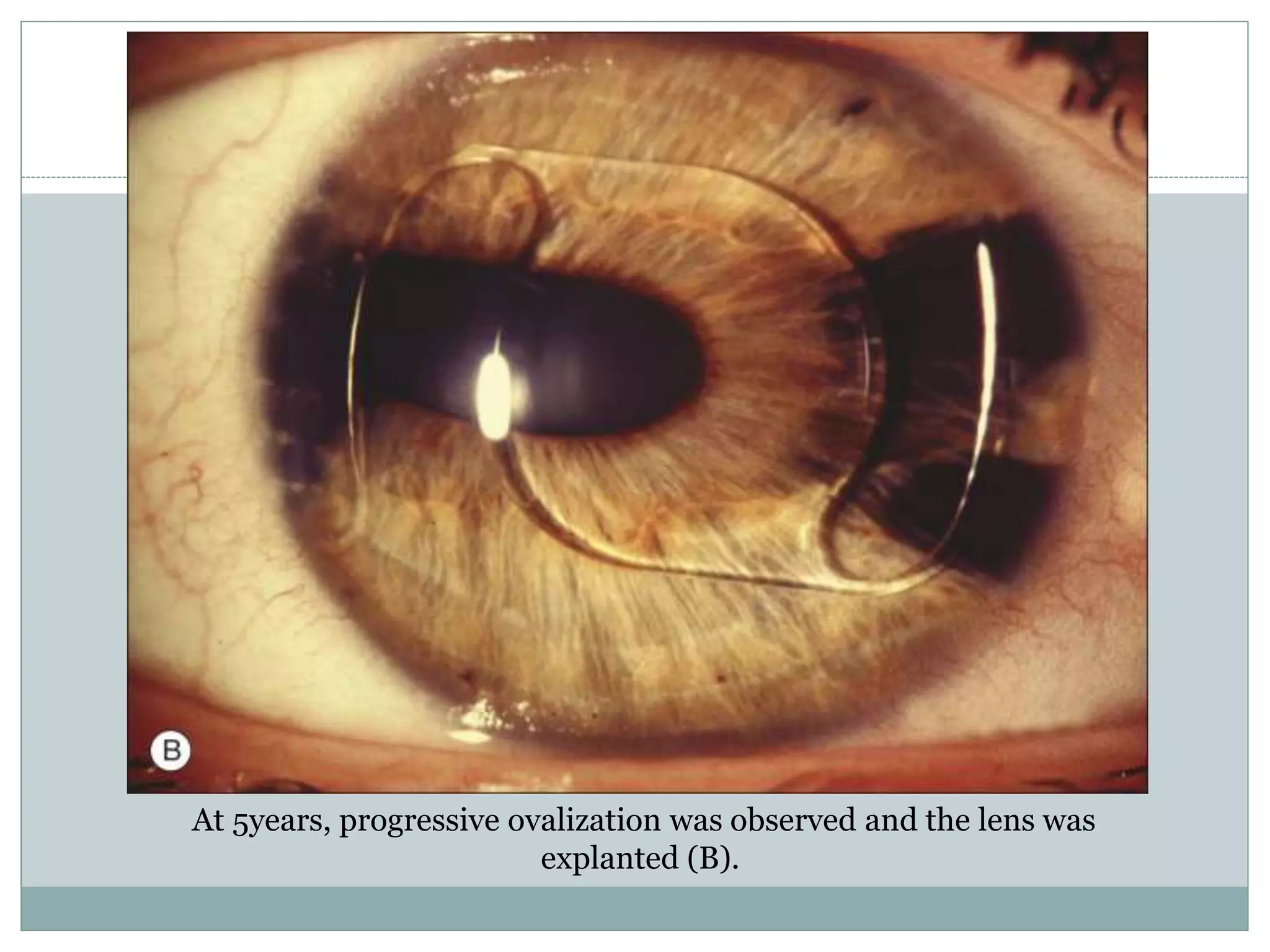
At 5years, progressive ovalization was observed and the lens was
explanted (B).
IRIS-FIXATED PHAKIC IOL
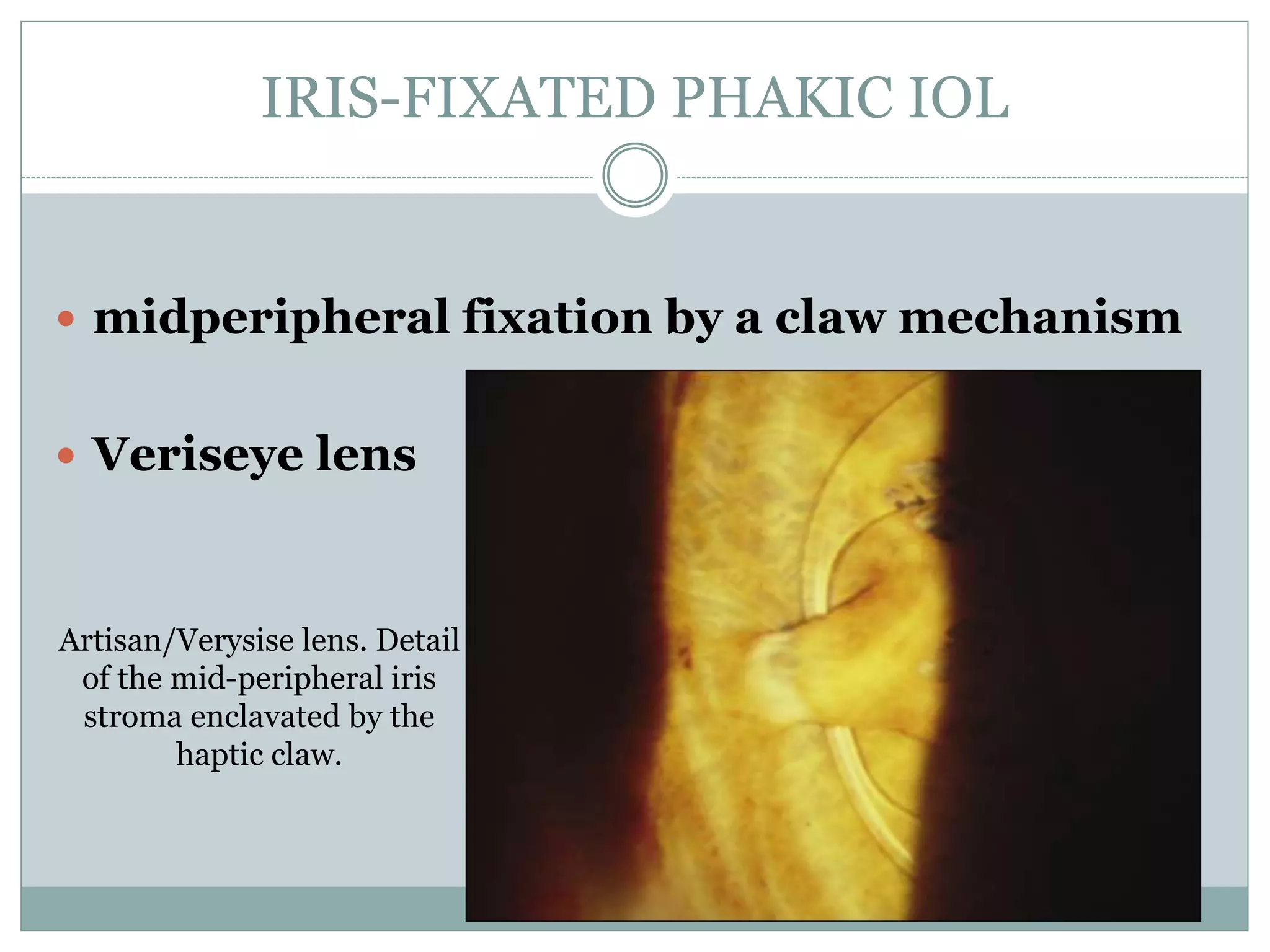
 midperipheral fixation by a claw mechanism
 Veriseye lens
Artisan/Verysise lens. Detail
of the mid-peripheral iris
stroma enclavated by the
haptic claw.
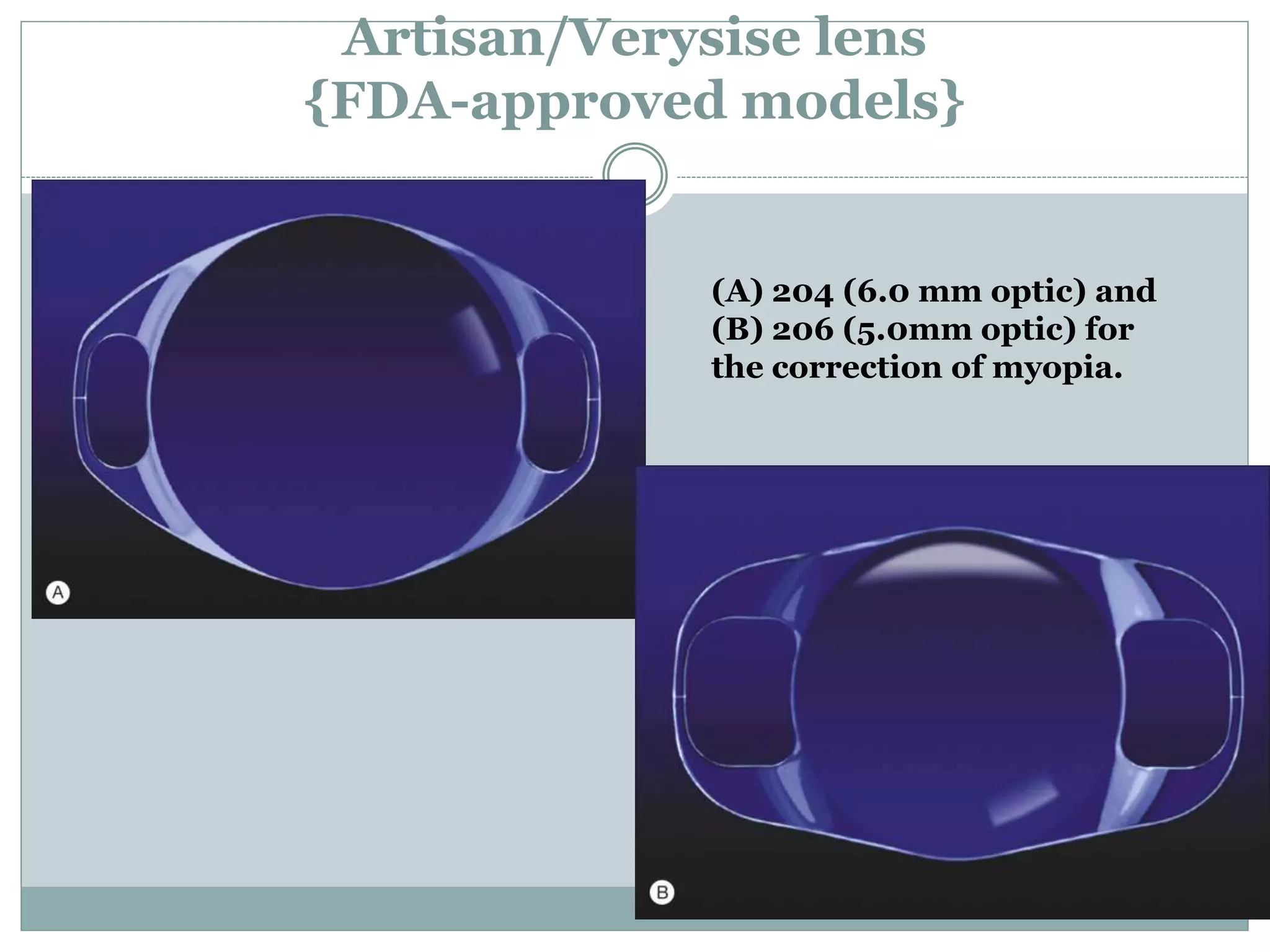
Artisan/Verysise lens
{FDA-approved models}
(A) 204 (6.0 mm optic) and
(B) 206 (5.0mm optic) for
the correction of myopia.
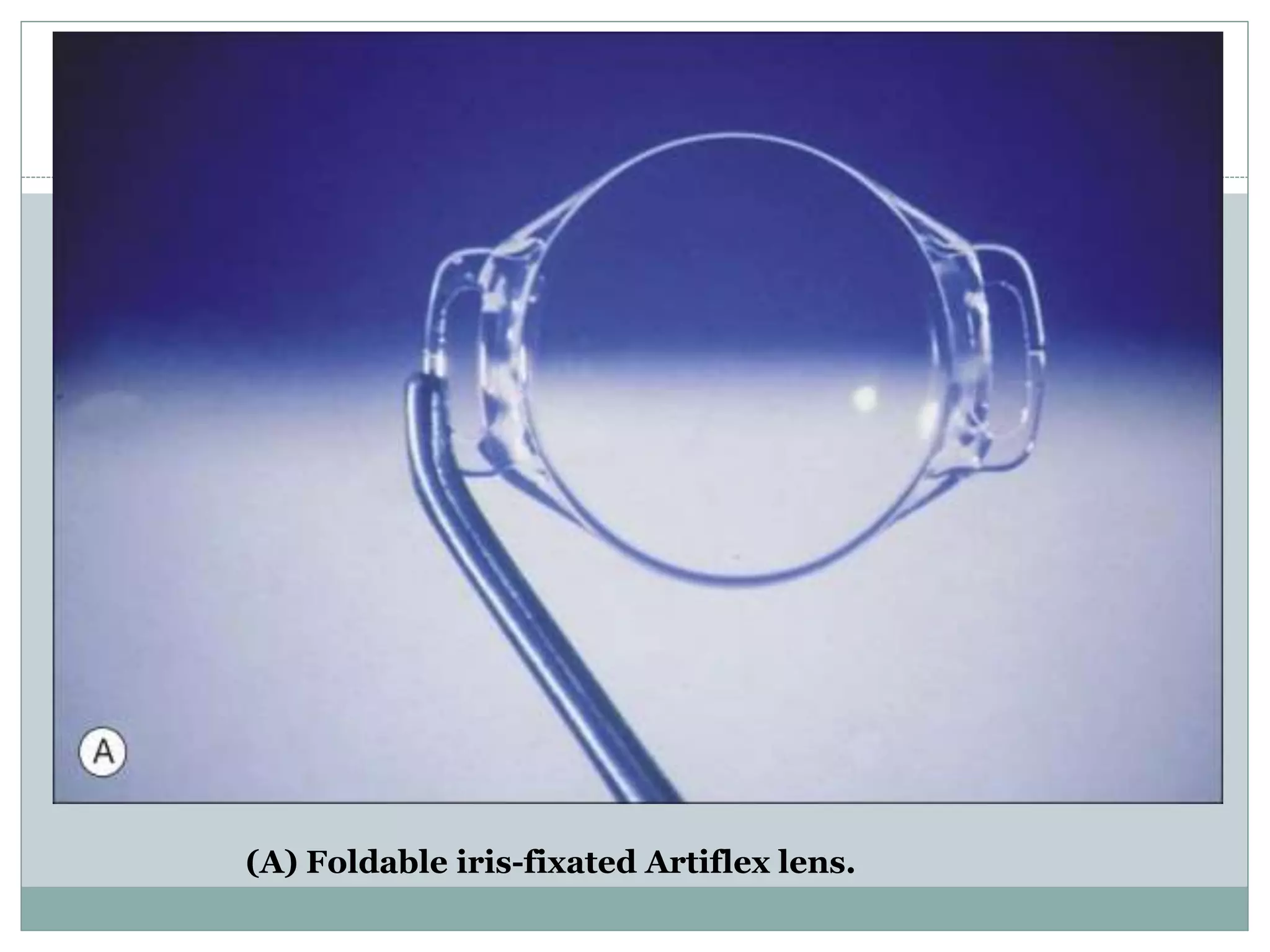
(A) Foldable iris-fixated Artiflex lens.
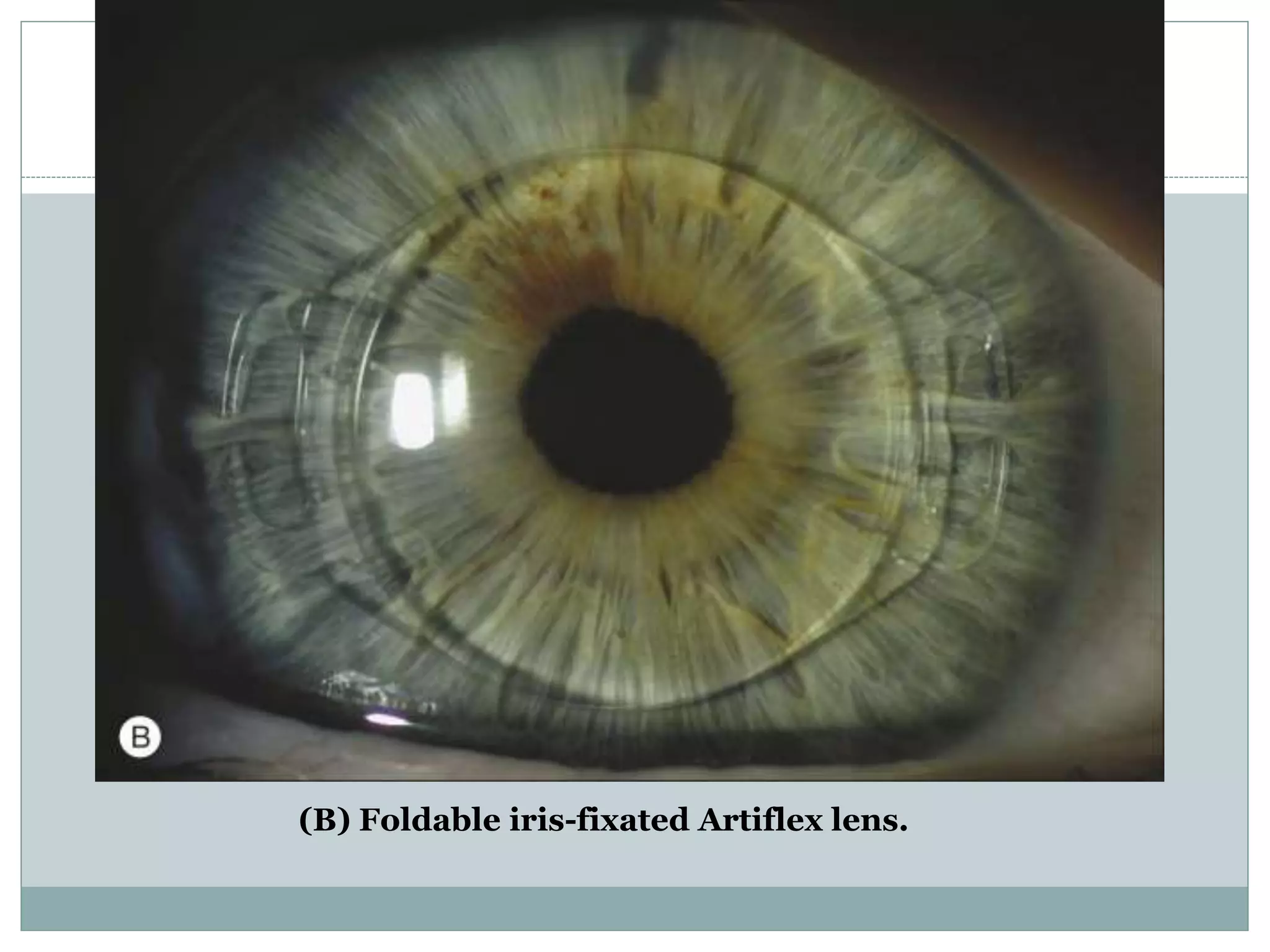
(B) Foldable iris-fixated Artiflex lens.
Indications of Iris Claw lens
 Treatment of refractive errors after penetrating
keratoplasty.
 Treatment of anisometropic amblyopia in children.
 Secondary implantation for aphakia correction.
 Treatment of refractive errors in patients with
keratoconus.
 Correction of progressive high myopia in
pseudophakic children, and
 postoperative anisometropia in unilateral cataract
patients with bilateral high myopia
Procedure
 topical pilocarpine
 Topical / peribulbar anaesthesia
 Incision, viscoelastics
 IOL insertion
 Enclavation
 Closure of incision
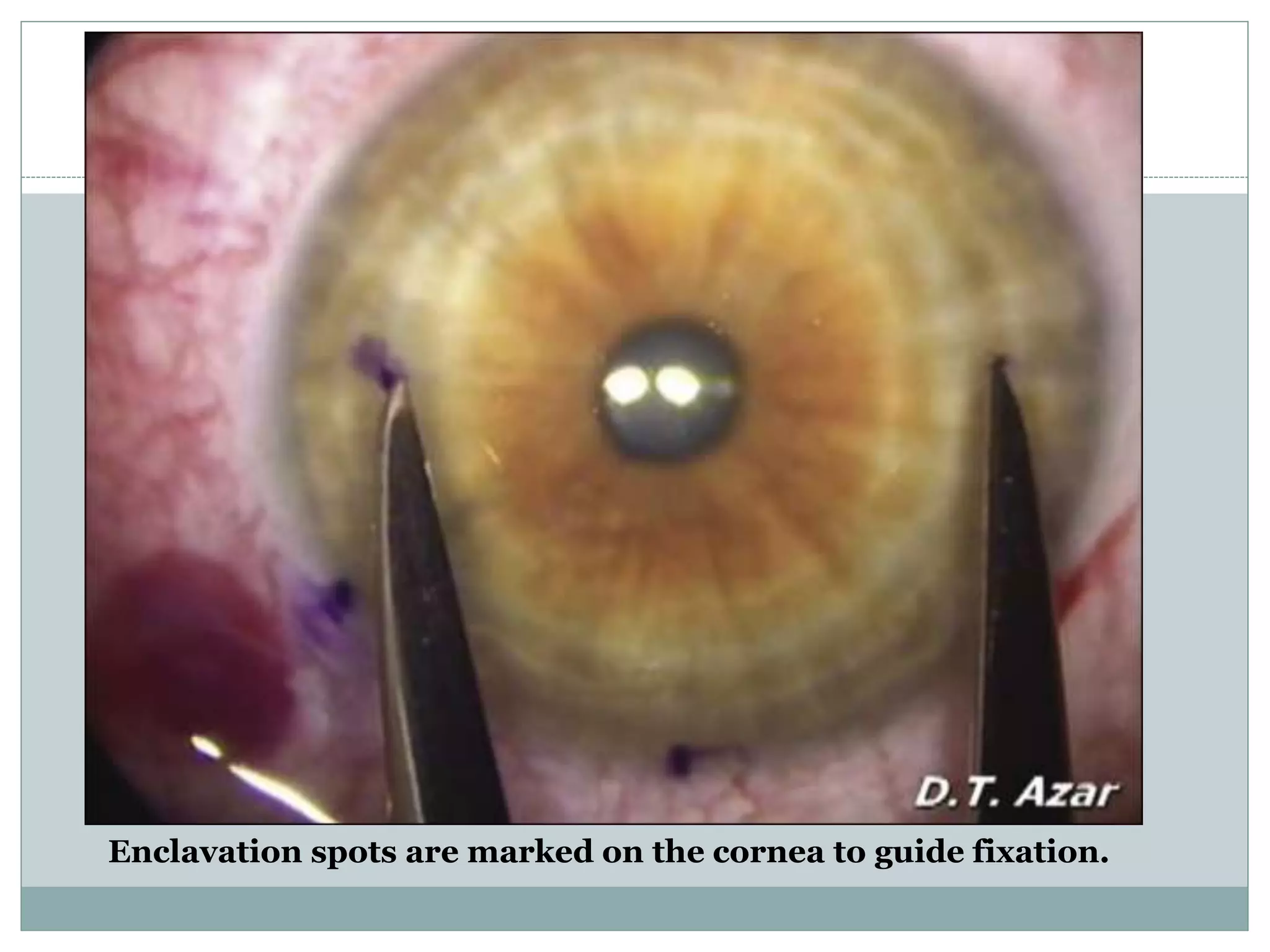
Enclavation spots are marked on the cornea to guide fixation.
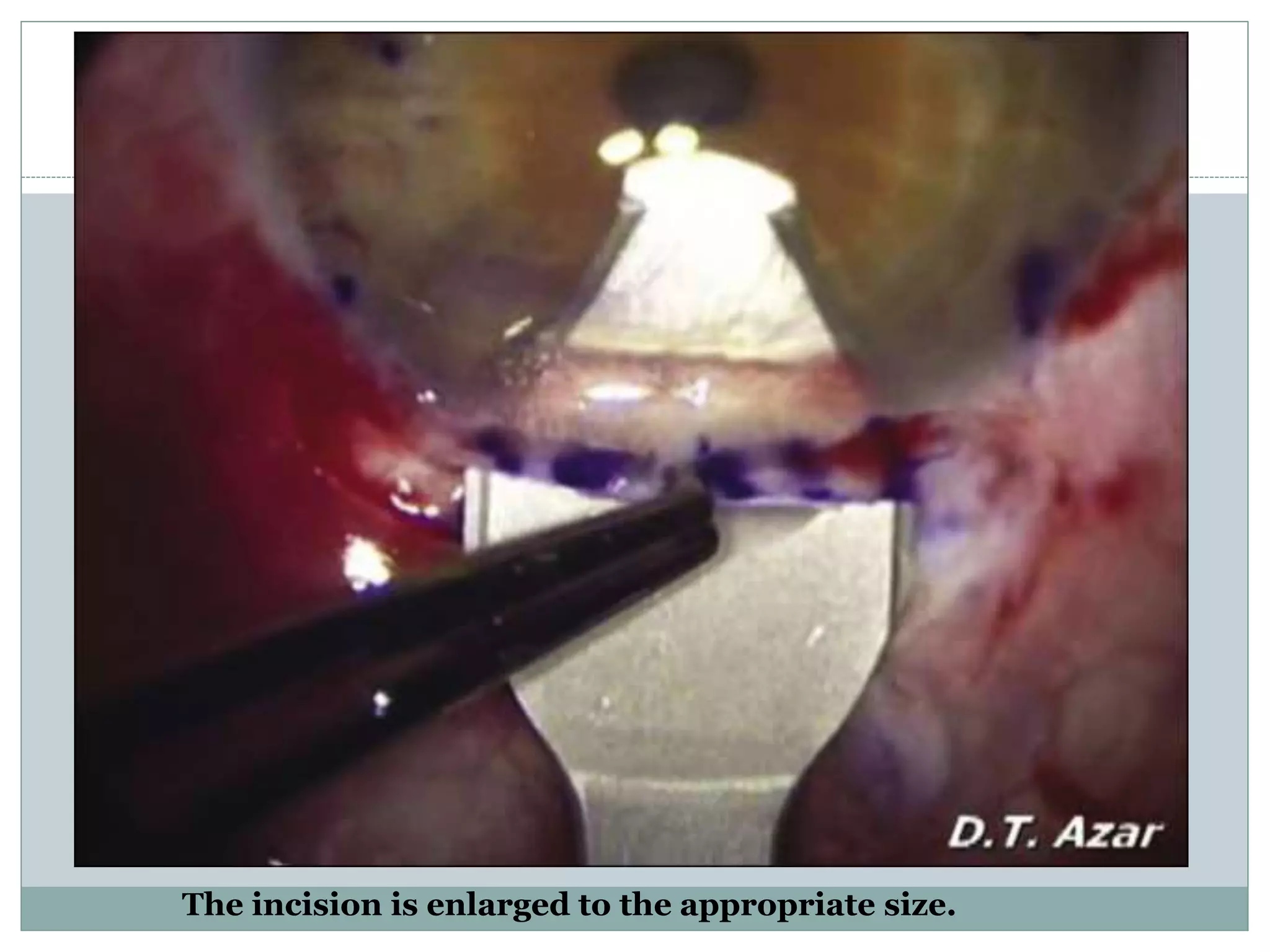
The incision is enlarged to the appropriate size.
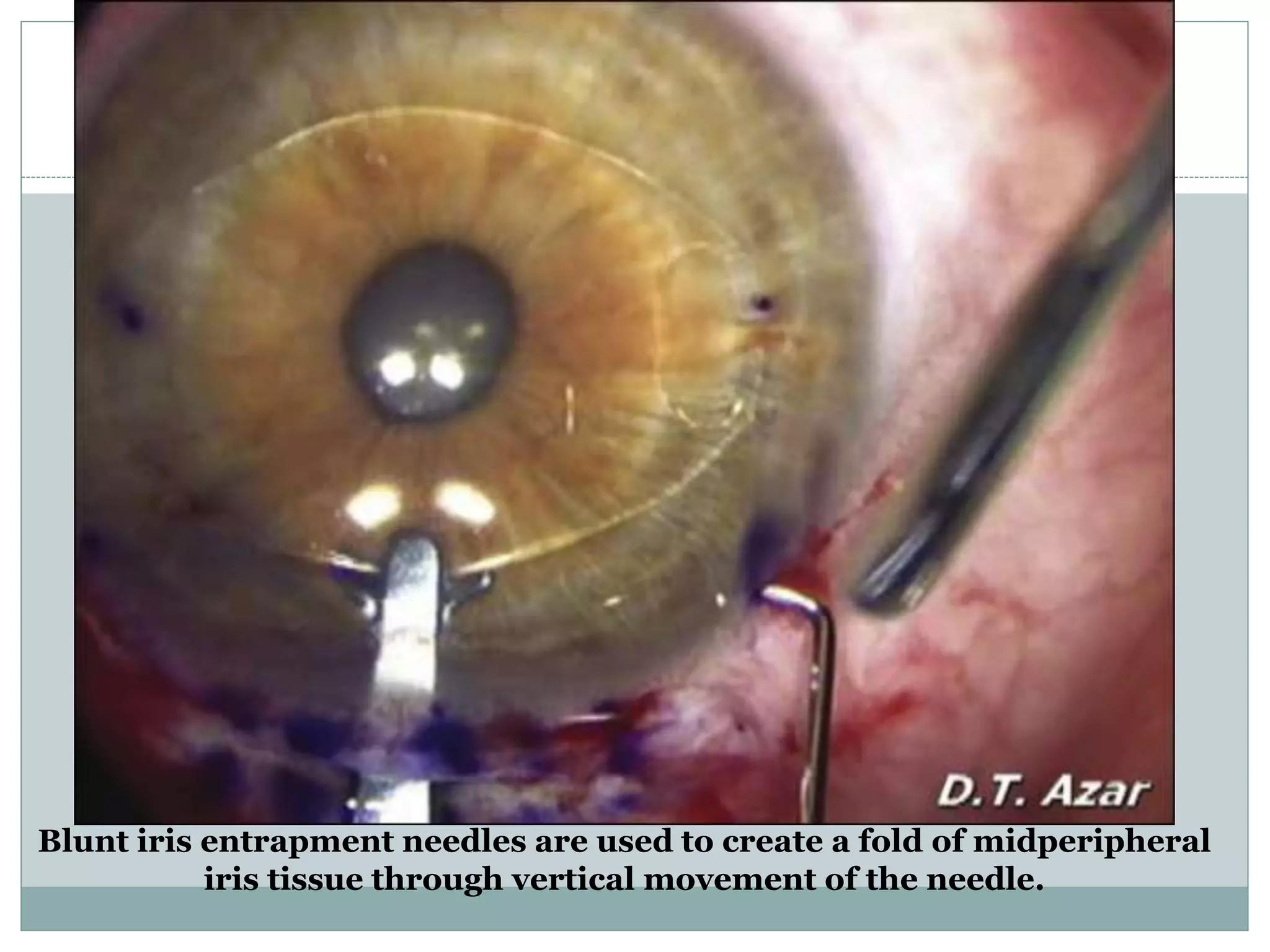
Blunt iris entrapment needles are used to create a fold of midperipheral
iris tissue through vertical movement of the needle.
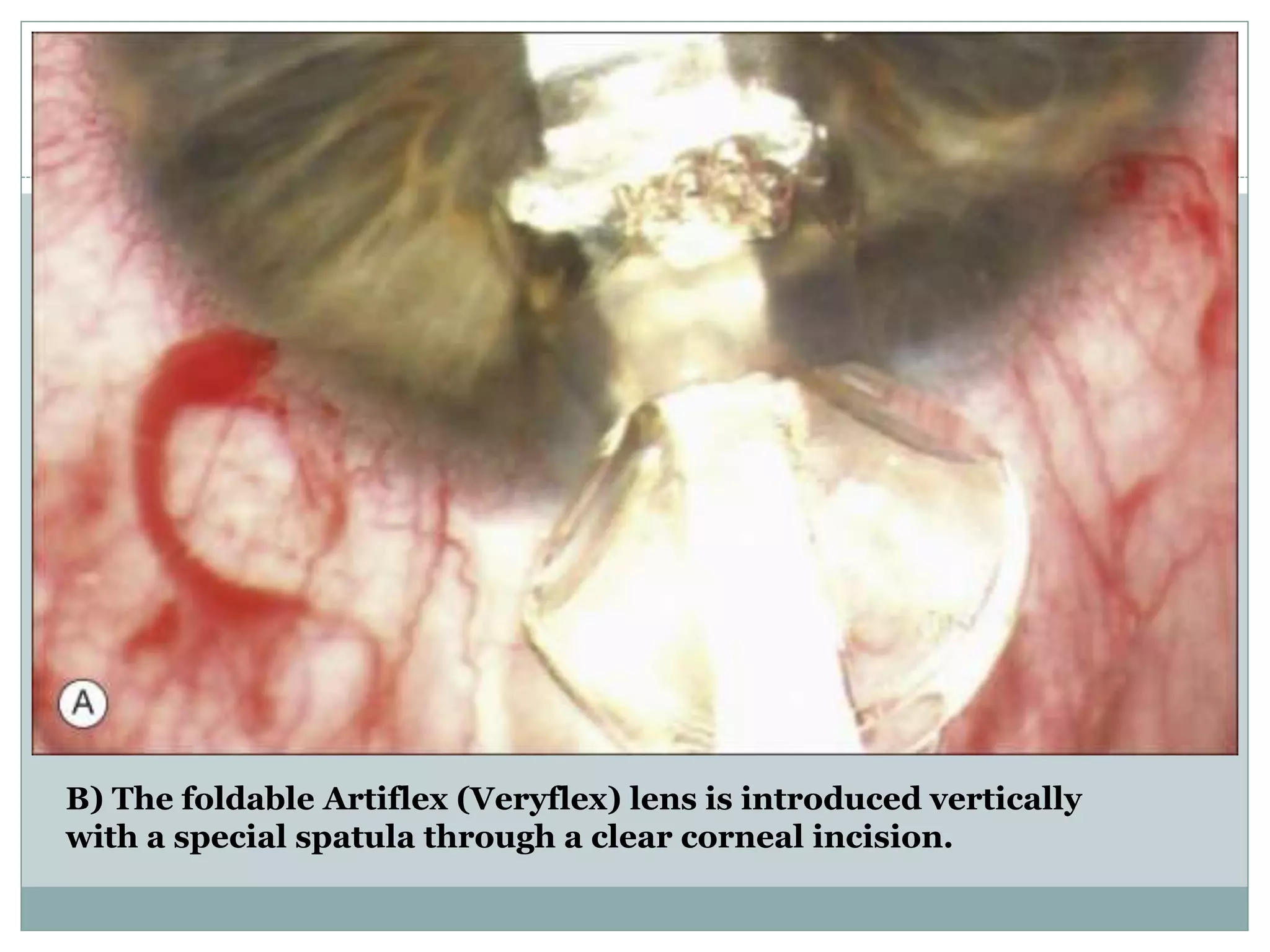
B) The foldable Artiflex (Veryflex) lens is introduced vertically
with a special spatula through a clear corneal incision.
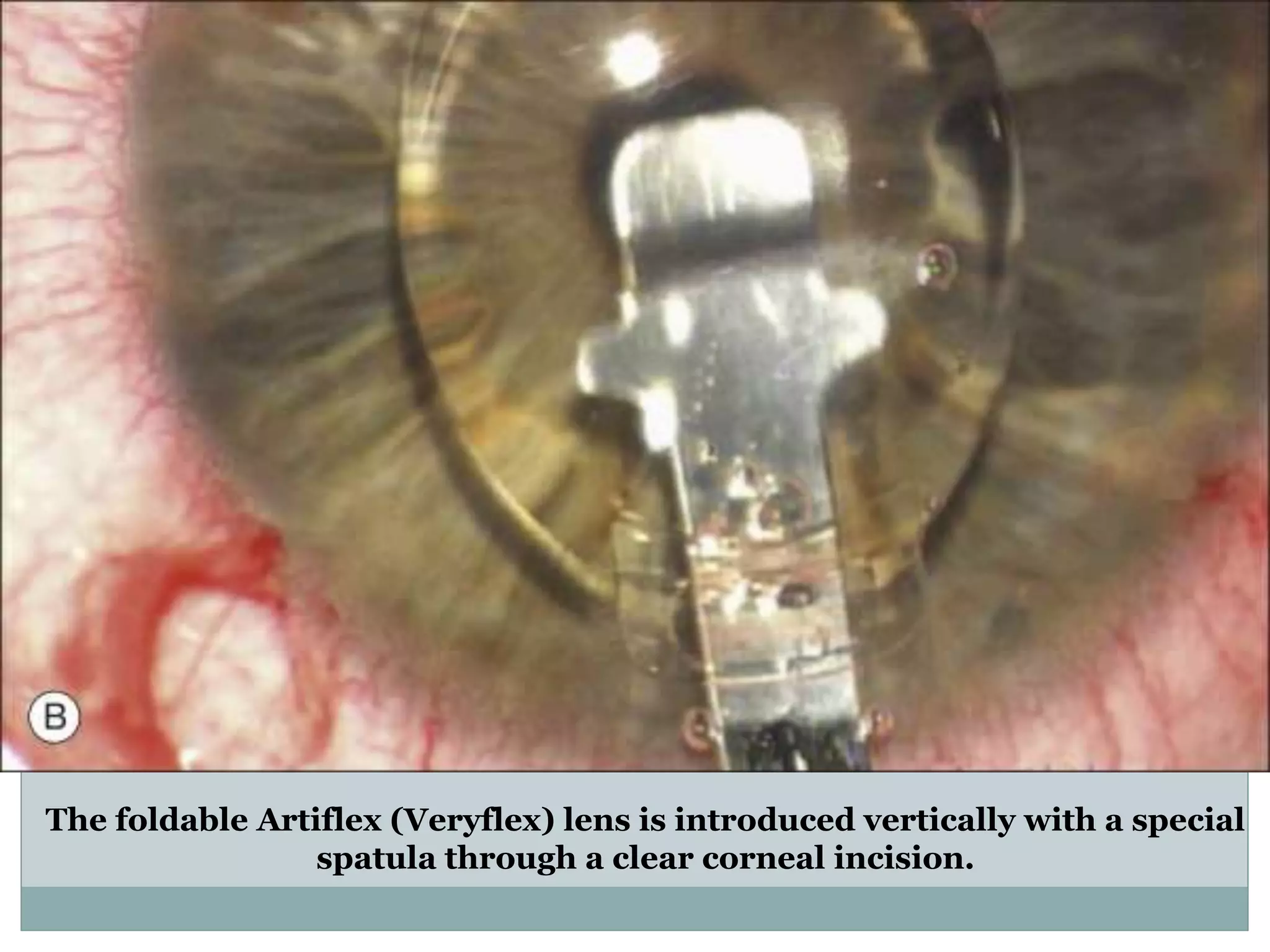
The foldable Artiflex (Veryflex) lens is introduced vertically with a special
spatula through a clear corneal incision.
Complications
 Glare and haloes
 Anterior chamber inflammation/pigment
dispersion
 Endothelial cell loss
 Glaucoma
 Iris atrophy or dislocation
 Cataract
 hyphema, retinal detachment rarely
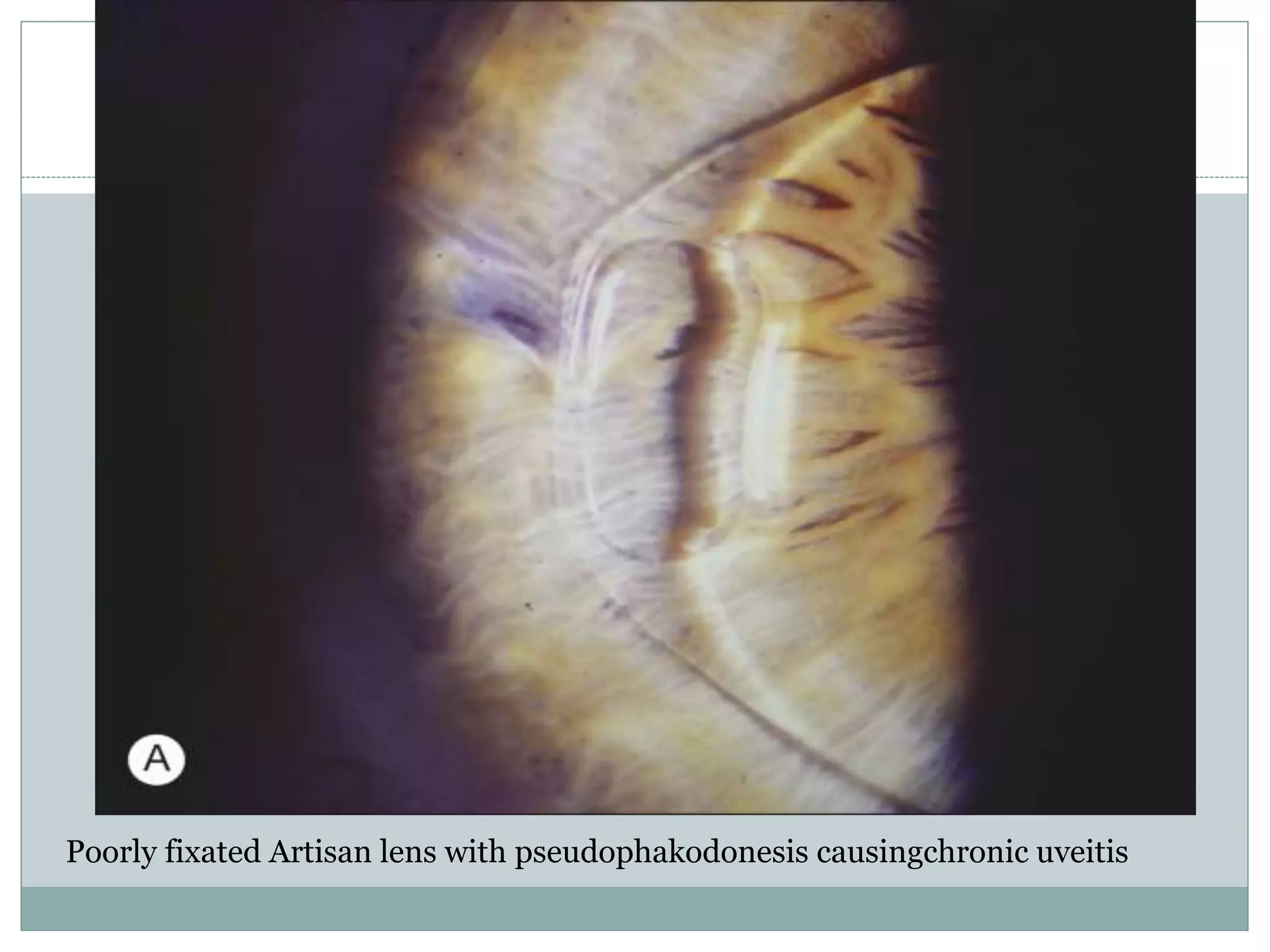
Poorly fixated Artisan lens with pseudophakodonesis causingchronic uveitis
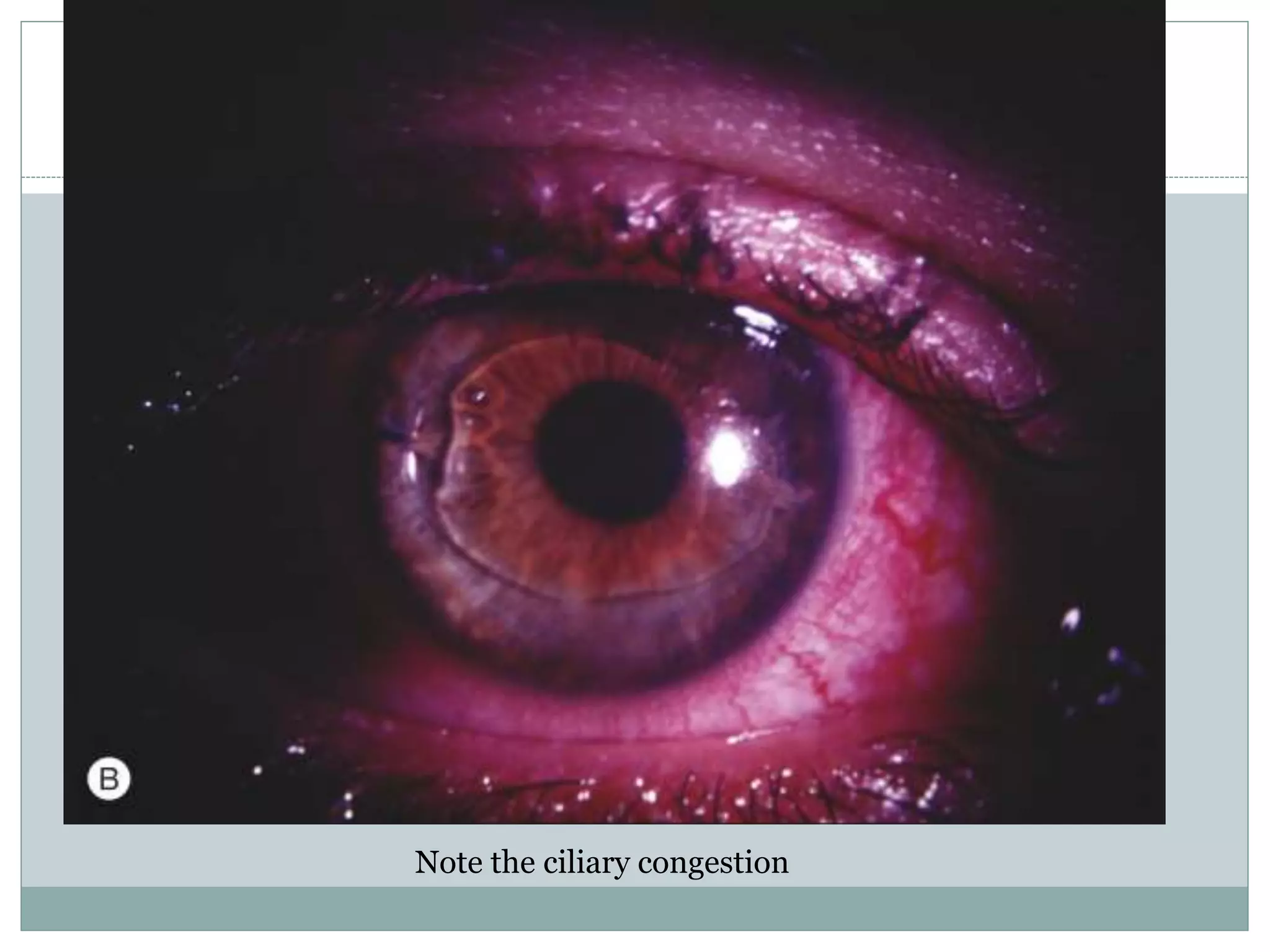
Note the ciliary congestion
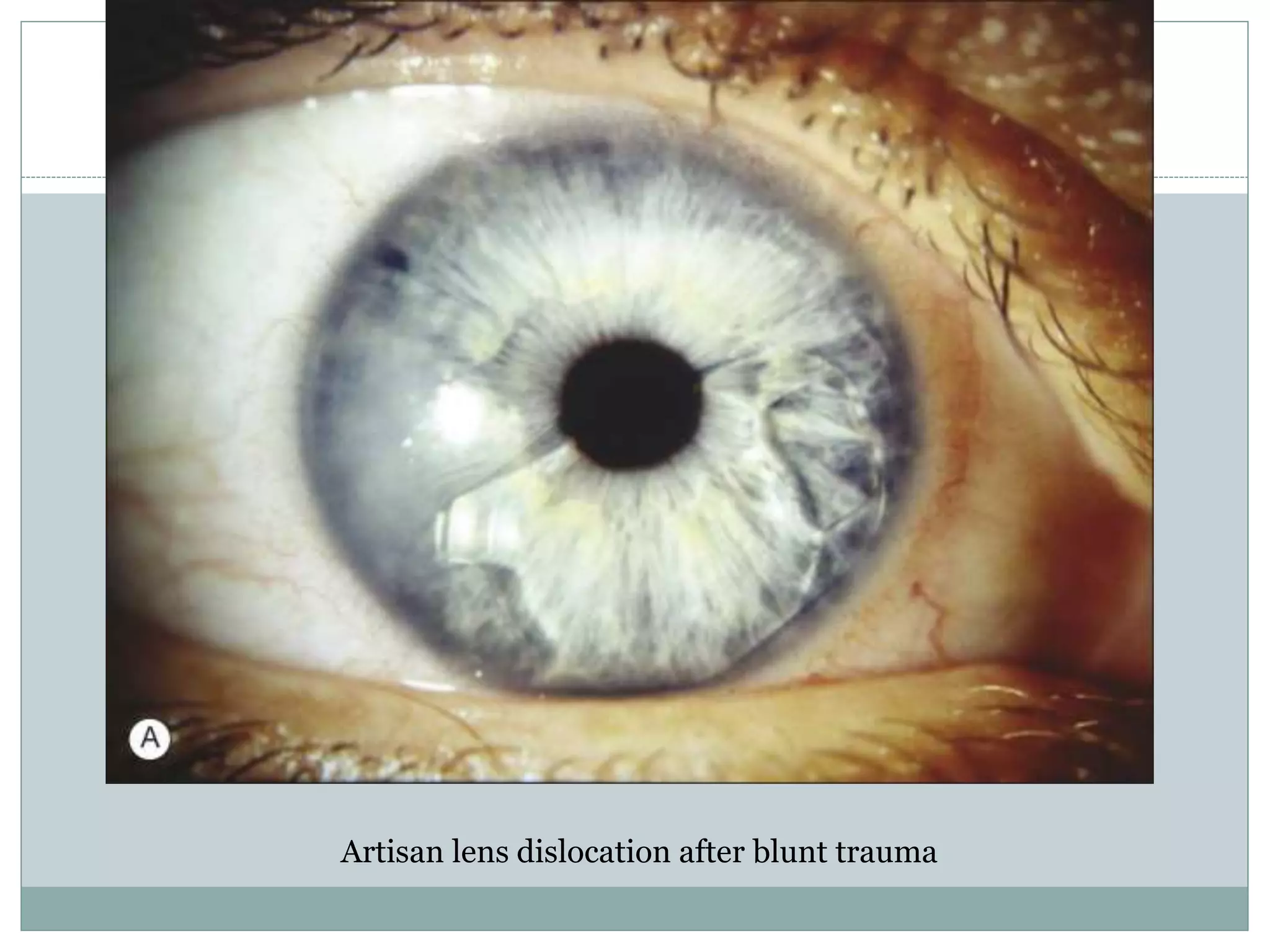
Artisan lens dislocation after blunt trauma
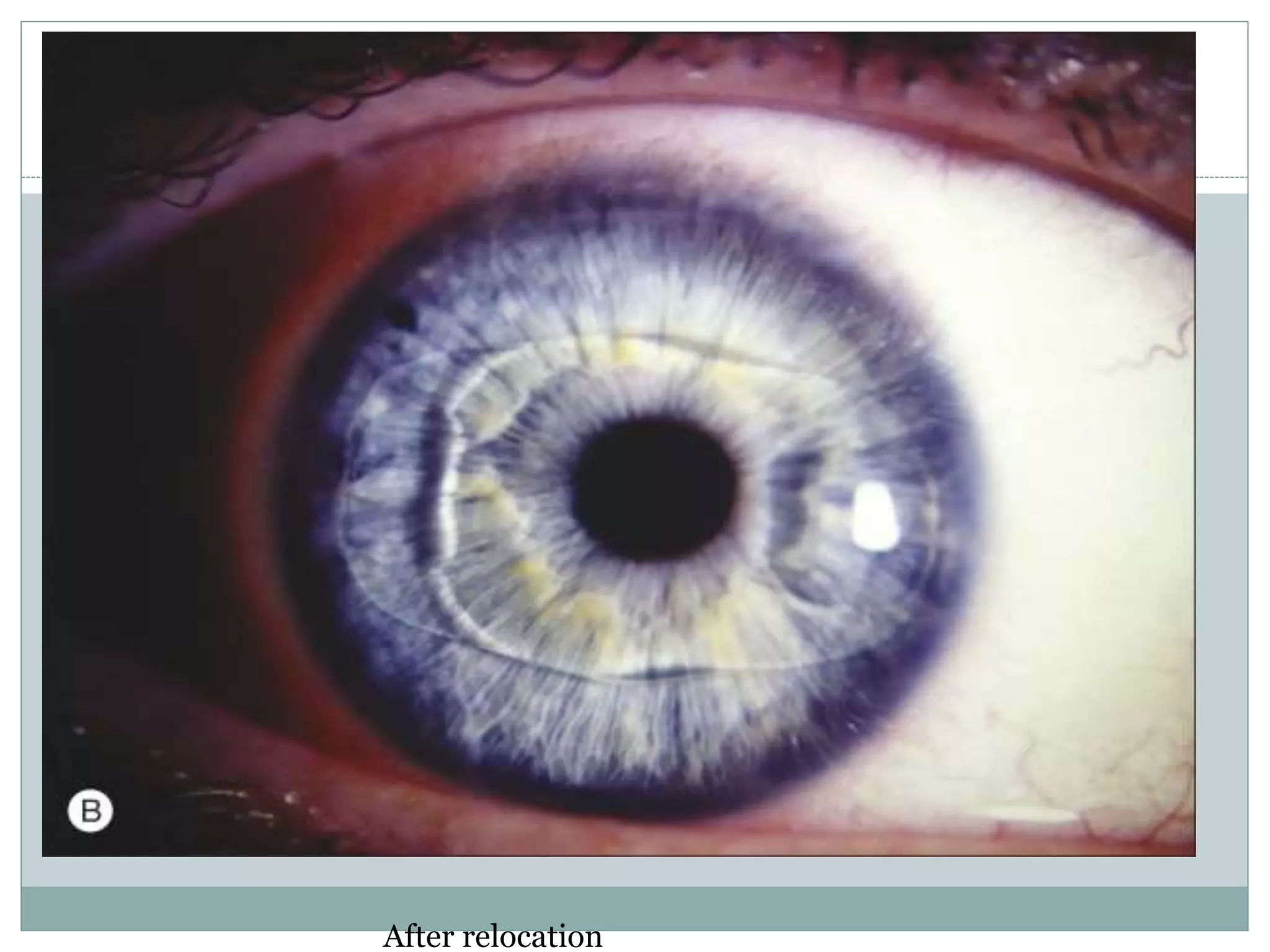
After relocation
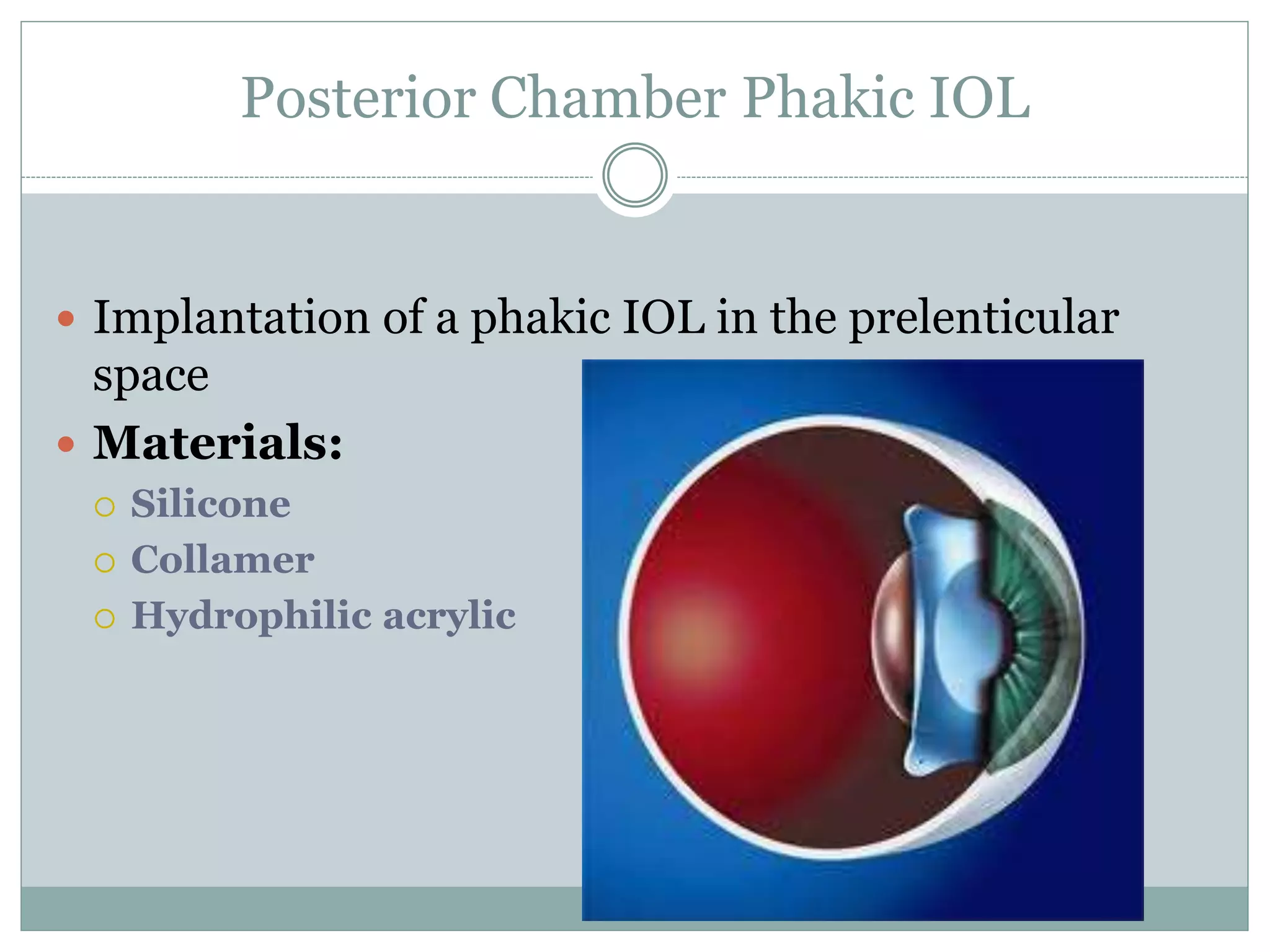
Posterior Chamber Phakic IOL
 Implantation of a phakic IOL in the prelenticular
space
 Materials:
 Silicone
 Collamer
 Hydrophilic acrylic
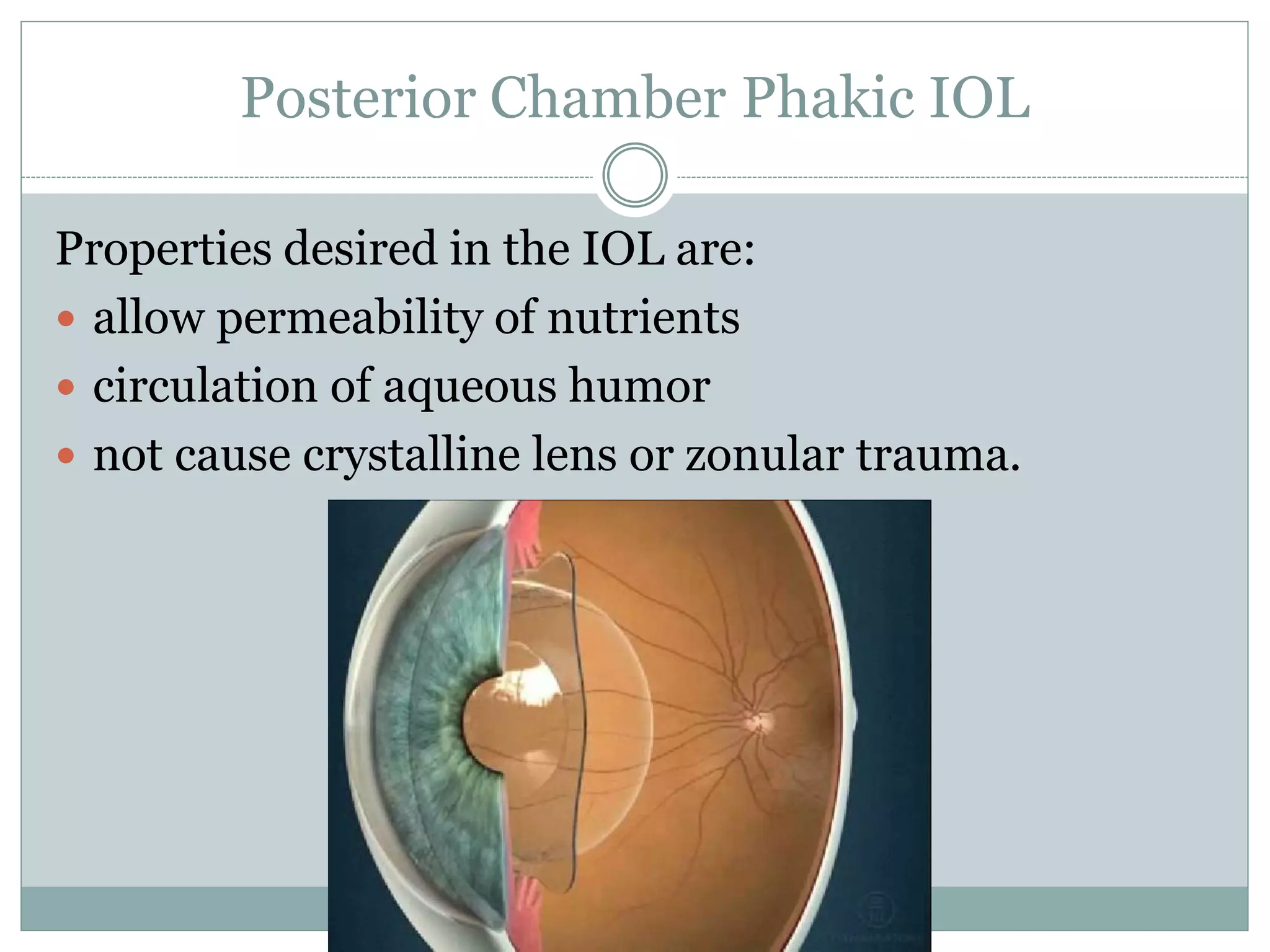
Posterior Chamber Phakic IOL
Properties desired in the IOL are:
 allow permeability of nutrients
 circulation of aqueous humor
 not cause crystalline lens or zonular trauma.
Silicone IOL
 The PRL is a hydrophobic silicone single-piece plate design
IOL with a refractive index of 1.46.
 Mechanical touch, impermeability of nutrients, and
stagnation of aqueous flow without the elimination of waste
products  cataract formation
 Changes its vaulting to avoid
 The new models (PRL-100 and 101 (myopia), and PRL-200
(hyperopia), which are claimed to float in the posterior
chamber with its haptics resting on the zonules, decreased the
incidence of cataract formation to almost zero.
 But complications, such as lens decentration and zonular
dehiscence with dislocation of the lens into the vitreous cavity.
Implantable Collamer Lens
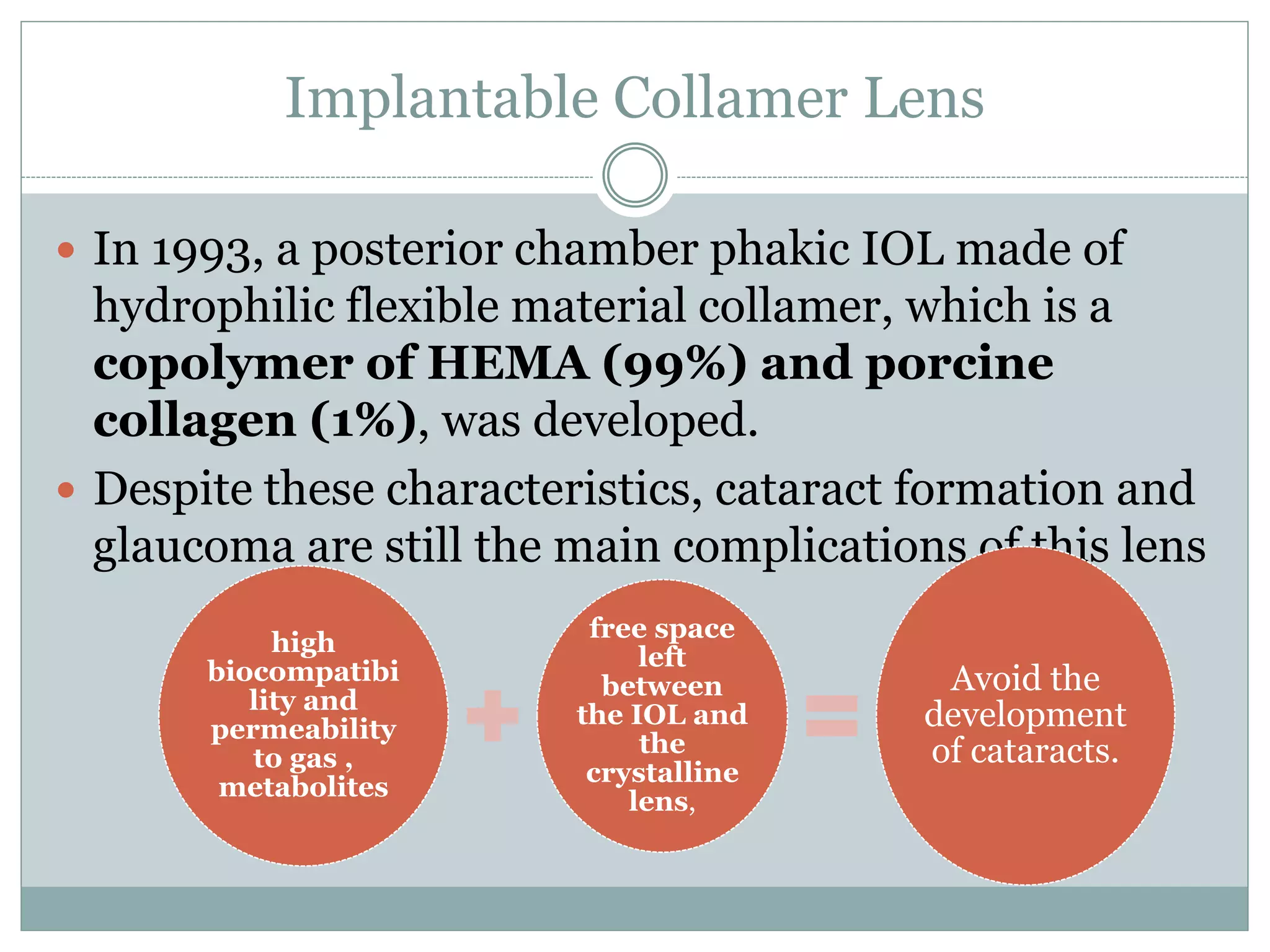
 In 1993, a posterior chamber phakic IOL made of
hydrophilic flexible material collamer, which is a
copolymer of HEMA (99%) and porcine
collagen (1%), was developed.
 Despite these characteristics, cataract formation and
glaucoma are still the main complications of this lens
high
biocompatibi
lity and
permeability
to gas ,
metabolites
free space
left
between
the IOL and
the
crystalline
lens,
Avoid the
development
of cataracts.
Procedure
 Mydriasis
 Topical or peribulbar anesthesia
 temporal clear corneal tunnel
 Viscoelastic
 Foldable IOL insertion into AC (with an injector or
with forceps)
 Check orientation
 Placement of footplates below iris
 Iridotomy
 Closure of incision
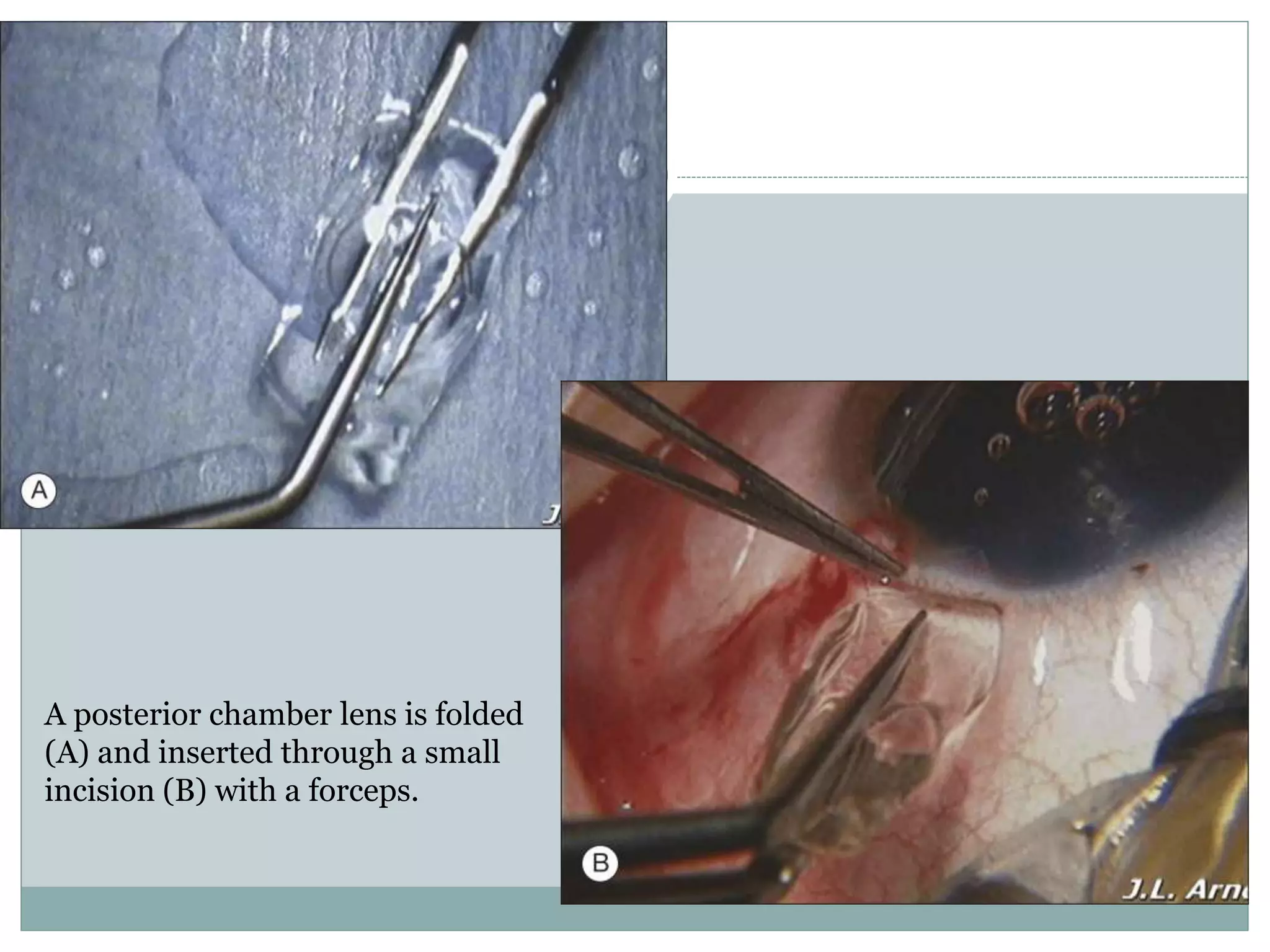
A posterior chamber lens is folded
(A) and inserted through a small
incision (B) with a forceps.
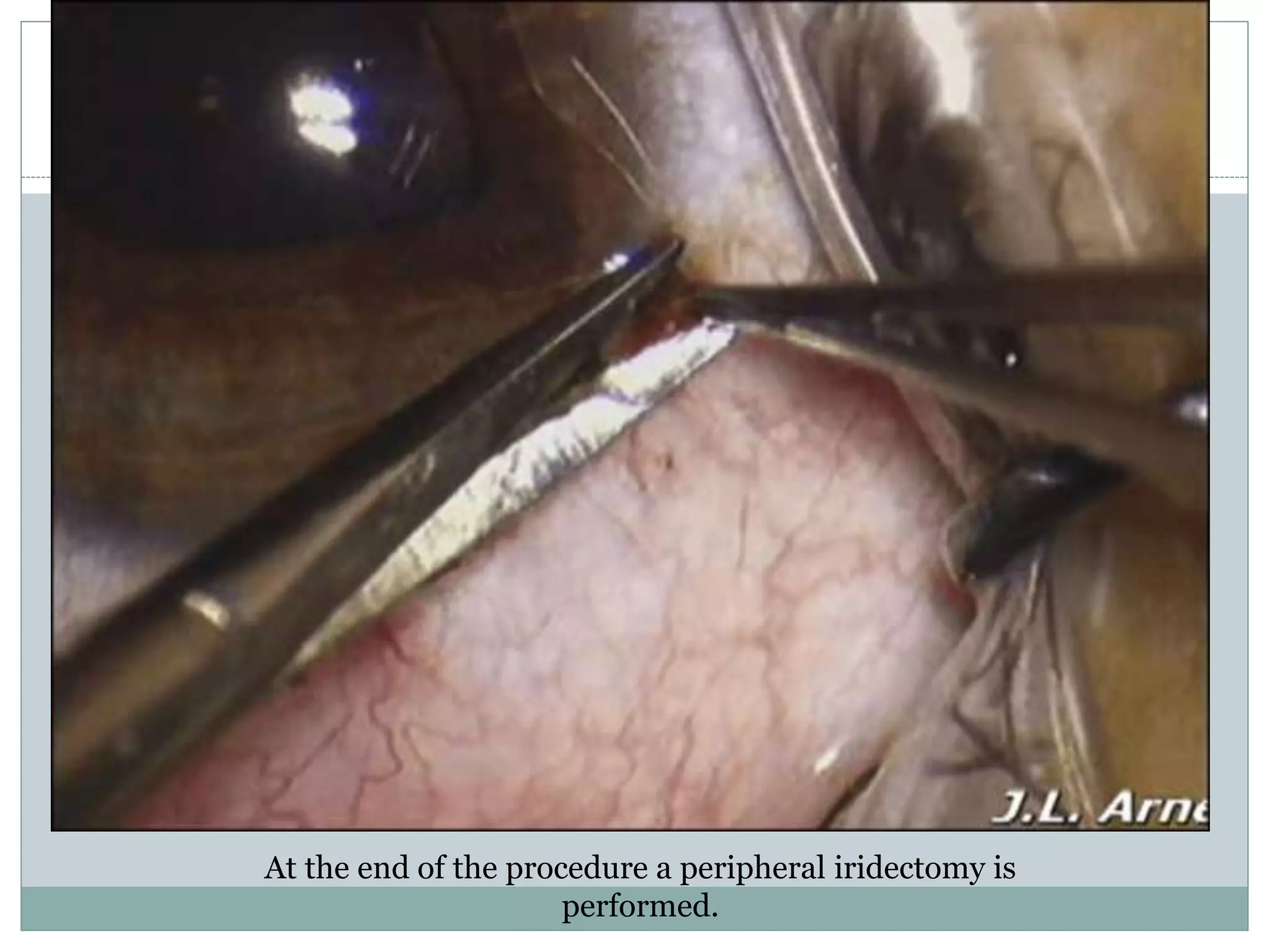
At the end of the procedure a peripheral iridectomy is
performed.
Complications
 Glare and haloes
 Cataract
 Pigmentary dispersion and elevated
intraocular pressure
 Decentration
 Endothelial cell damage
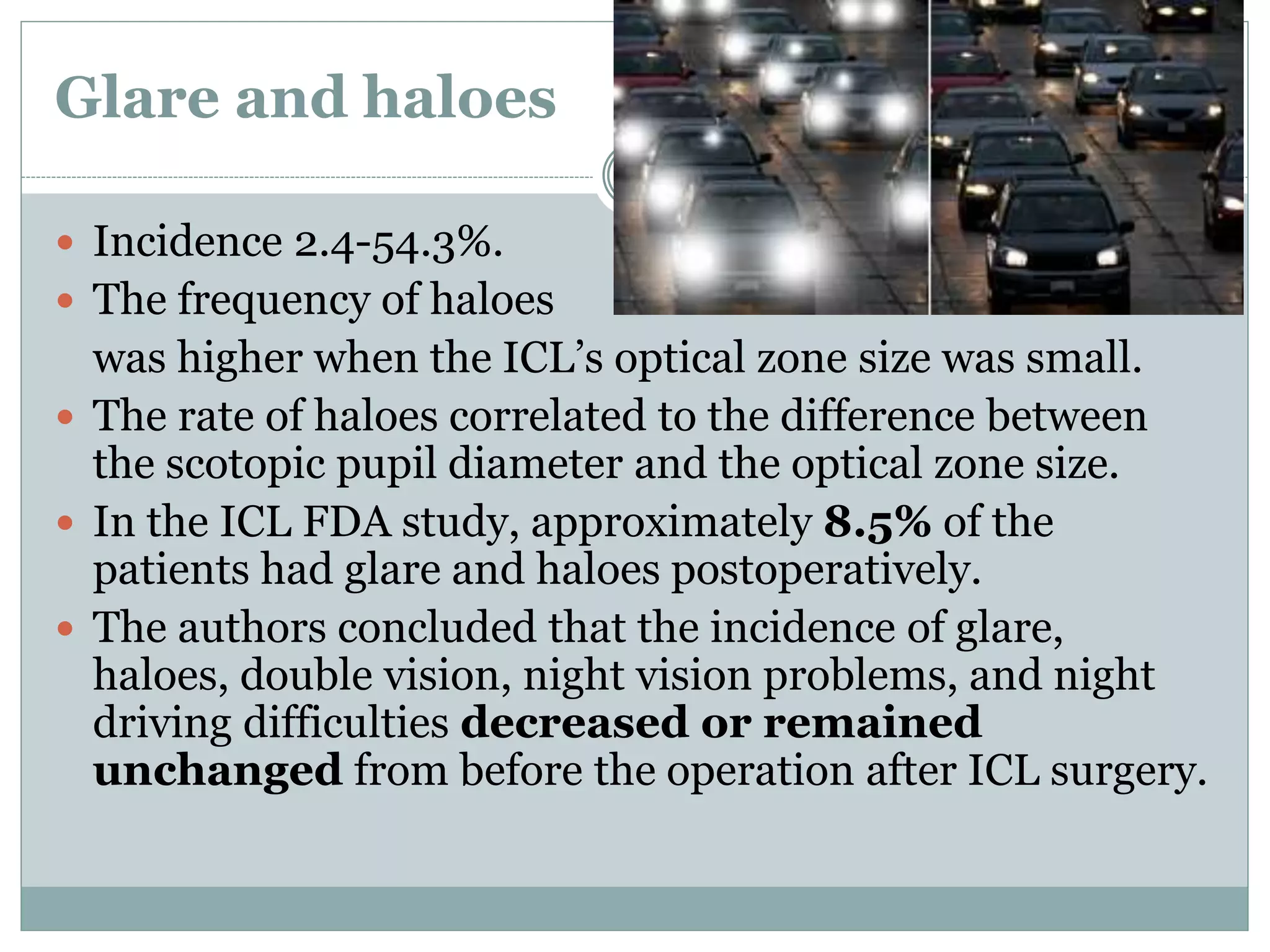
Glare and haloes
 Incidence 2.4-54.3%.
 The frequency of haloes
was higher when the ICL’s optical zone size was small.
 The rate of haloes correlated to the difference between
the scotopic pupil diameter and the optical zone size.
 In the ICL FDA study, approximately 8.5% of the
patients had glare and haloes postoperatively.
 The authors concluded that the incidence of glare,
haloes, double vision, night vision problems, and night
driving difficulties decreased or remained
unchanged from before the operation after ICL surgery.
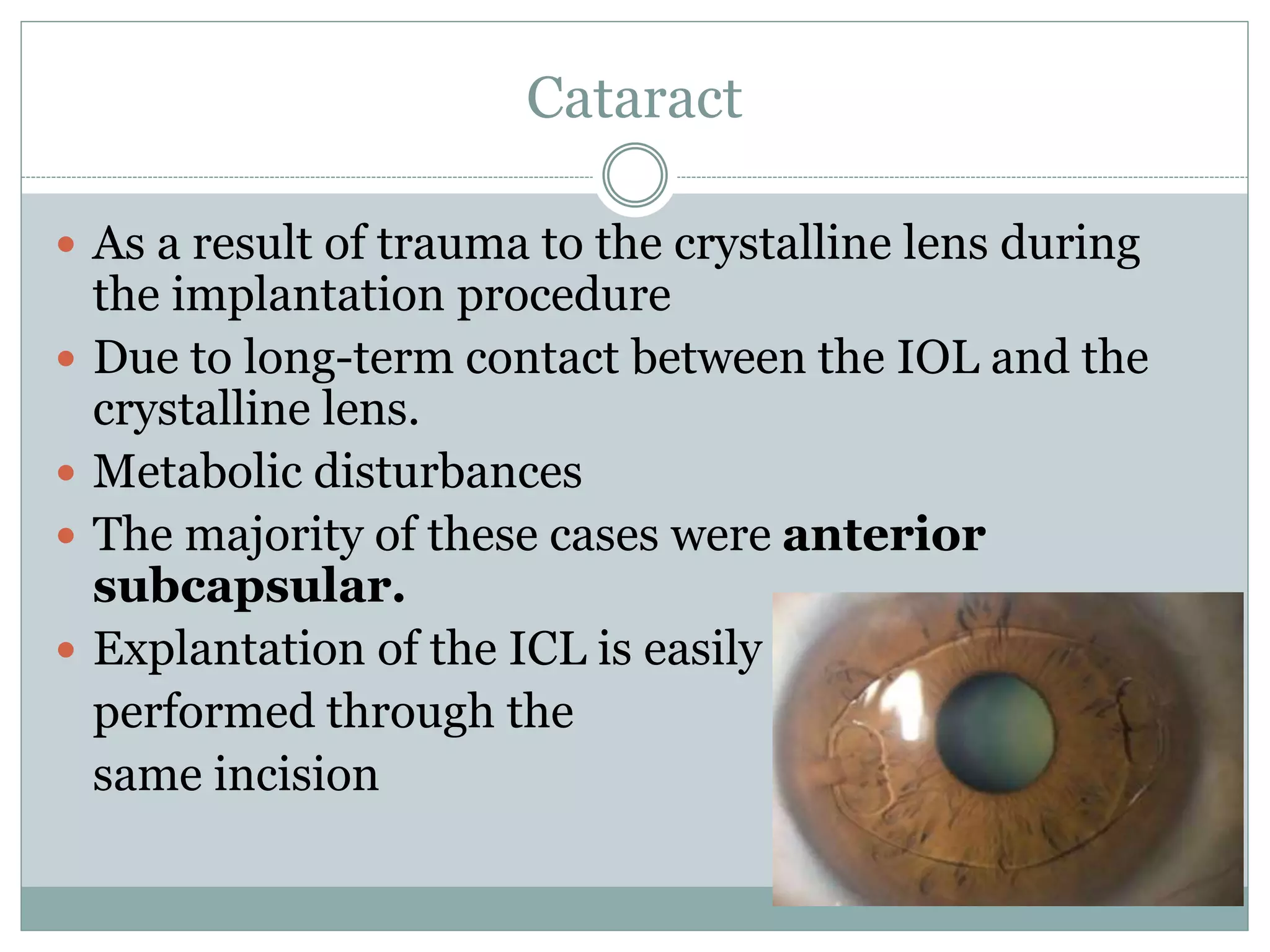
Cataract
 As a result of trauma to the crystalline lens during
the implantation procedure
 Due to long-term contact between the IOL and the
crystalline lens.
 Metabolic disturbances
 The majority of these cases were anterior
subcapsular.
 Explantation of the ICL is easily
performed through the
same incision
Piment Dispersion Syndrome
 Rubbing at the optic–haptic junction on the posterior
face of the iris  iris abrasion  release of pigments into
the aqueous humor.
 The pigment deposits had no visual consequences as they
were located at the optic–haptic junction rather than
the central optic.
 If PC phakic IOL is:
 Undersized decreased vaulting  contact between the IOL and the
crystalline lens
 Too large iris friction pigmentary dispersion
 This is one important reason for adequately measuring
the sulcus-to-sulcus distance.
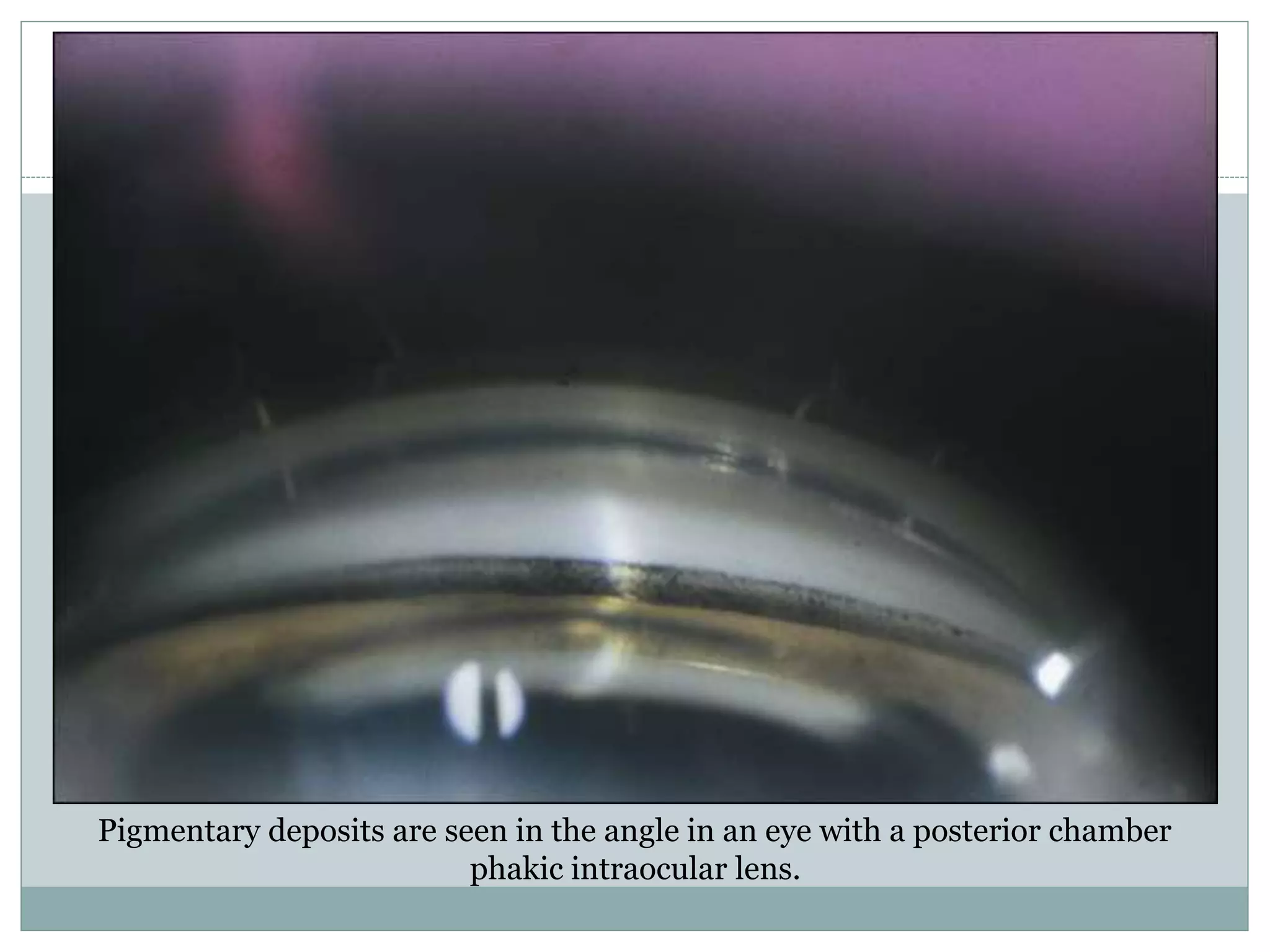
Pigmentary deposits are seen in the angle in an eye with a posterior chamber
phakic intraocular lens.
Decentration
 Since the PRL lens floats in the posterior chamber
with the haptics resting on the zonular
apparatus, zonular erosion by the IOL haptics
seems to be the main mechanism for IOL instability
and dislocation.
Bioptics
 The combination of phakic IOL implantation followed by
LASIK in patients with extreme myopia or hypermetropia
and high levels of astigmatism.
 When an anterior chamber phakic IOL is planned to be
combined with LASIK, the corneal flap can be created just
prior to the insertion of the lens; then, at a later time,
usually after 1month, the flap is lifted for laser correction of
the residual ametropia. This two-step technique was called
adjustable refractive surgery (ARS) by Guell.
 The rationale in performing the flap first is to avoid any
possibility of contact between the endothelium and
the IOL during the suction and cut for the LASIK
procedure.

Phakic IOL

  • 1.
    D R .G A U R E E G A T T A N I PHAKIC IOL
  • 2.
    Phakic IOLs  Artificiallenses implanted in the anterior or posterior chamber of the eye in the presence of the natural crystalline lens to correct refractive errors
  • 3.
     Limitations oflaser refractive surgery - high ametropia - irreversibility - permanent damage to cornea
  • 4.
    History  1889 - Clearlens extraction for the correction of myopia - Fukala in Austria/Germany : “Fukala Surgery” - abandoned due to complications  1950s - correcting myopia by inserting a concave lens into the phakic eye  1988 - Baikoff : anterior chamber angle-fixed IOL  Mid 1980s - Posterior chamber phakic IOLs : Fyodorov  1991 - Artisan-Worst iris claw lens
  • 5.
    Angle-supported Baikoff ZB5M(left) and the NuVita MA20 (right).
  • 6.
  • 7.
    Posterior chamber phakic refractivelens for myopia (top) and hyperopia (bottom).
  • 8.
    Posterior chamber sulcussupported implantable contact lens.
  • 9.
    Indications  Stable refraction(less than 0.5D change for 6months)  Clear crystalline lens  Ametropia not suitable/appropriate for excimer laser surgery  Unsatisfactory vision with/intolerance of contact lenses or spectacles  Anterior chamber depth greater than or equal to - 3.2mm for the iris-claw lens and angle-supported PIOLs - 2.5mm for posterior chamber PIOLs  A minimum endothelial cell density of - ≥3500 cells/mm2 at 21years of age - ≥2800 cells/mm2 at 31years of age - ≥2200 cells/mm2 at 41years of age - ≥2000 cells/mm2 at 45years of age or more  No ocular pathology (corneal disorders, glaucoma, uveitis, maculopathy, etc.)
  • 10.
    Advantages  Large rangeof myopic, hyperopic, and astigmatic refractive error  Allows the crystalline lens to retain its function preserving accommodation  Excellent visual and refractive results (induces less coma and spherical aberration than LASIK)  Removable and exchangeable  Frequently improve BCVA in myopic eyes by eliminating minification effect of glasses  Results are predictable and stable  Flat learning curve
  • 11.
    Disadvantages  Potential risksof an intraocular procedure  Nonfoldable models require large incision that may result in high postoperative astigmatism  Highly ametropic patients may require additional photorefractive surgery (“Bioptics”)  May cause irreversible damage to natural lens and corneal endothelium  Implantation in hyperopic patients can be followed by loss of BSCVA due to loss of magnification effect of glasses
  • 12.
    IOL power calculation Phakic anterior chamber (AC) lens - central corneal curvature (power) – keratometry (K) - anterior chamber depth - patient refraction (preoperative spherical equivalent)  Posterior chamber phakic IOL power - corneal thickness and axial length are also taken into consideration
  • 13.
     It issame as transferring the pre-operative spectacle power somewhere between the back surface of cornea and front surface of crystalline lens.  Consider the optical system as consisting of three powers:  Spectacle correction  Cornea  IOL  The object and image vergence are defined as:  L= n/l ; L’=n’/l’
  • 14.
     Then forspherical surface of the lens with radius of curvature r, the Power is defined as: •F =(n’-n)/r  Lens maker formula: L’=L+F  Object vergence L= n/ (b-d)  Image vergence L’ = n/(a-d)  FIOL = L’-L = n/ (a-d) – n/ (b-d)  Fs
  • 15.
    Investigations  Unaided andbest corrected VA  Anterior and Posterior segment evaluation  white-to-white (w-w) measurement  High-frequency (50MHz) ultrasound biomicroscopy  Corneal endothelial cell count
  • 16.
    Artemis high-frequency (50MHz) 3D-digital ultrasound imaging of the anterior segment. Red arrows indicate angle-to-angle distance; yellow arrows indicate sulcus-to-sulcus distance.
  • 17.
    Deciding the size AC angle supported IOL - length of IOL: 11.5 to 14 mm with 0.5mm intervals - w-w measurement - significant inaccuracies - intraoperative AC sizer - Anterior segment OCT
  • 18.
     AC Iris-FixatedPhakic IOLs - one-size-fits-all length - 8.5 mm  Posterior Chamber Phakic IOLs - w-w measurement plus 0.5mm - UBM and AS OCT to measure - sulcus-to-sulcus distance
  • 19.
  • 20.
    AC Angle supportedPhakic IOL  rigid PMMA IOLs  foldable hydrophilic acrylic IOLs Rigid PMMA angle- supported ZSAL-4 lens.
  • 21.
    Foldable hydrophilic acrylic angle-supportedVivarte lens. Rigid PMMA angle-supported Phakic 6 lens.
  • 22.
    Foldable hydrophilic acrylicangle-supported I-CARE lens (A and B). Ultrasound biomicroscopy (UBM) showing the position of the haptic in the anterior chamber angle (C).
  • 23.
    Foldable “two parts”(Silicone optic/PMMA haptics) Kelman-Duet lens (A). The haptics are implanted initially through a small incision (B), then the optic is injected (C). The complex optic-haptics is assembled inside the anterior chamber (D).
  • 24.
    Procedure  Topical pilocarpine topical or peribulbar anesthesia  Incision  cohesive viscoelastic  lens is introduced , footplate is inserted in the iridocorneal angle, second haptic is then placed, lens is then rotated in place  peripheral iridectomy  incision is closed
  • 25.
    Complications  Haloes andglare  Pupillary ovalization  Endothelial damage  Elevation of intraocular pressure  Uveitis  Cataract  Retinal detachment  Rarely - Urrets-Zavalia syndrome, malignant glaucoma, endophthalmitis
  • 26.
    Pupil ovalization 2yearsafter implantation of an angle-supported phakic IOL (A).
  • 27.
    At 5years, progressiveovalization was observed and the lens was explanted (B).
  • 28.
  • 29.
    IRIS-FIXATED PHAKIC IOL midperipheral fixation by a claw mechanism  Veriseye lens Artisan/Verysise lens. Detail of the mid-peripheral iris stroma enclavated by the haptic claw.
  • 30.
    Artisan/Verysise lens {FDA-approved models} (A)204 (6.0 mm optic) and (B) 206 (5.0mm optic) for the correction of myopia.
  • 31.
  • 32.
  • 33.
    Indications of IrisClaw lens  Treatment of refractive errors after penetrating keratoplasty.  Treatment of anisometropic amblyopia in children.  Secondary implantation for aphakia correction.  Treatment of refractive errors in patients with keratoconus.  Correction of progressive high myopia in pseudophakic children, and  postoperative anisometropia in unilateral cataract patients with bilateral high myopia
  • 34.
    Procedure  topical pilocarpine Topical / peribulbar anaesthesia  Incision, viscoelastics  IOL insertion  Enclavation  Closure of incision
  • 35.
    Enclavation spots aremarked on the cornea to guide fixation.
  • 36.
    The incision isenlarged to the appropriate size.
  • 37.
    Blunt iris entrapmentneedles are used to create a fold of midperipheral iris tissue through vertical movement of the needle.
  • 38.
    B) The foldableArtiflex (Veryflex) lens is introduced vertically with a special spatula through a clear corneal incision.
  • 39.
    The foldable Artiflex(Veryflex) lens is introduced vertically with a special spatula through a clear corneal incision.
  • 40.
    Complications  Glare andhaloes  Anterior chamber inflammation/pigment dispersion  Endothelial cell loss  Glaucoma  Iris atrophy or dislocation  Cataract  hyphema, retinal detachment rarely
  • 41.
    Poorly fixated Artisanlens with pseudophakodonesis causingchronic uveitis
  • 42.
    Note the ciliarycongestion
  • 43.
    Artisan lens dislocationafter blunt trauma
  • 44.
  • 45.
  • 46.
    Posterior Chamber PhakicIOL  Implantation of a phakic IOL in the prelenticular space  Materials:  Silicone  Collamer  Hydrophilic acrylic
  • 47.
    Posterior Chamber PhakicIOL Properties desired in the IOL are:  allow permeability of nutrients  circulation of aqueous humor  not cause crystalline lens or zonular trauma.
  • 48.
    Silicone IOL  ThePRL is a hydrophobic silicone single-piece plate design IOL with a refractive index of 1.46.  Mechanical touch, impermeability of nutrients, and stagnation of aqueous flow without the elimination of waste products  cataract formation  Changes its vaulting to avoid  The new models (PRL-100 and 101 (myopia), and PRL-200 (hyperopia), which are claimed to float in the posterior chamber with its haptics resting on the zonules, decreased the incidence of cataract formation to almost zero.  But complications, such as lens decentration and zonular dehiscence with dislocation of the lens into the vitreous cavity.
  • 49.
    Implantable Collamer Lens In 1993, a posterior chamber phakic IOL made of hydrophilic flexible material collamer, which is a copolymer of HEMA (99%) and porcine collagen (1%), was developed.  Despite these characteristics, cataract formation and glaucoma are still the main complications of this lens high biocompatibi lity and permeability to gas , metabolites free space left between the IOL and the crystalline lens, Avoid the development of cataracts.
  • 50.
    Procedure  Mydriasis  Topicalor peribulbar anesthesia  temporal clear corneal tunnel  Viscoelastic  Foldable IOL insertion into AC (with an injector or with forceps)  Check orientation  Placement of footplates below iris  Iridotomy  Closure of incision
  • 51.
    A posterior chamberlens is folded (A) and inserted through a small incision (B) with a forceps.
  • 52.
    At the endof the procedure a peripheral iridectomy is performed.
  • 53.
    Complications  Glare andhaloes  Cataract  Pigmentary dispersion and elevated intraocular pressure  Decentration  Endothelial cell damage
  • 54.
    Glare and haloes Incidence 2.4-54.3%.  The frequency of haloes was higher when the ICL’s optical zone size was small.  The rate of haloes correlated to the difference between the scotopic pupil diameter and the optical zone size.  In the ICL FDA study, approximately 8.5% of the patients had glare and haloes postoperatively.  The authors concluded that the incidence of glare, haloes, double vision, night vision problems, and night driving difficulties decreased or remained unchanged from before the operation after ICL surgery.
  • 55.
    Cataract  As aresult of trauma to the crystalline lens during the implantation procedure  Due to long-term contact between the IOL and the crystalline lens.  Metabolic disturbances  The majority of these cases were anterior subcapsular.  Explantation of the ICL is easily performed through the same incision
  • 56.
    Piment Dispersion Syndrome Rubbing at the optic–haptic junction on the posterior face of the iris  iris abrasion  release of pigments into the aqueous humor.  The pigment deposits had no visual consequences as they were located at the optic–haptic junction rather than the central optic.  If PC phakic IOL is:  Undersized decreased vaulting  contact between the IOL and the crystalline lens  Too large iris friction pigmentary dispersion  This is one important reason for adequately measuring the sulcus-to-sulcus distance.
  • 57.
    Pigmentary deposits areseen in the angle in an eye with a posterior chamber phakic intraocular lens.
  • 58.
    Decentration  Since thePRL lens floats in the posterior chamber with the haptics resting on the zonular apparatus, zonular erosion by the IOL haptics seems to be the main mechanism for IOL instability and dislocation.
  • 59.
    Bioptics  The combinationof phakic IOL implantation followed by LASIK in patients with extreme myopia or hypermetropia and high levels of astigmatism.  When an anterior chamber phakic IOL is planned to be combined with LASIK, the corneal flap can be created just prior to the insertion of the lens; then, at a later time, usually after 1month, the flap is lifted for laser correction of the residual ametropia. This two-step technique was called adjustable refractive surgery (ARS) by Guell.  The rationale in performing the flap first is to avoid any possibility of contact between the endothelium and the IOL during the suction and cut for the LASIK procedure.