Dr. Mohd Najmussadiq Khan
M. S.(Ophth)
3/18/2022
Dr. M N Khan
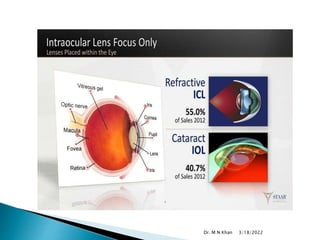
 Previously called "implantable contact lenses,"
the FDA prefers the term "implantable
collamer lenses" to avoid any confusion with
corneal contact lenses.
 Management of high refractive errors
especially with thin cornea is a refractive
challenge.
 Lasik for correcting high refractive errors has
the drawbacks of lack of predictability,
regression, corneal ectasia and induction of
high order aberrations.
3/18/2022
Dr. M N Khan
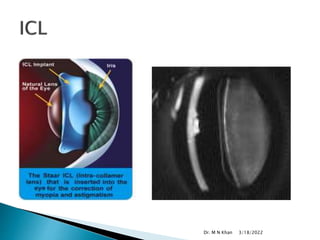
 The Implantable Contact lens (ICL) is a preferred
modality for correction of high myopia and for
patients with thin corneas. It was first developed
in the late 1980’s in Russia by Dr. S. Fyodorov
and the first implant was placed in Europe in
1993.
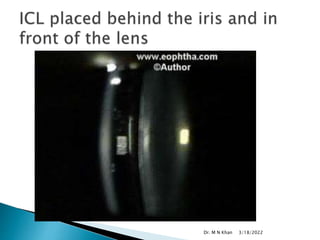
 Fyodorov introduced the concept of a soft phakic
lens in the space between the iris and the
anterior surface of the crystalline lens.
 Earlier, the material used was silicone; now, the
material used is collamer.
3/18/2022
Dr. M N Khan
3/18/2022
Dr. M N Khan
3/18/2022
Dr. M N Khan
 The trial focused on 526 eyes among some
294 people aged 22-45.
 After three years with an implantable
collamer lens, nearly 59% had 20/20 vision
(normal vision) or better, and nearly 95% had
at least 20/40 vision (near-normal vision) or
better.
3/18/2022
Dr. M N Khan
 When residual bed after LASIK is likely to be less
than 250µ
 When the initial corneal thickness is less than
480µ
 Refractive error between the ages of 21-45
 ACD greater than 2.8 mm
 Stable refraction (<0.5D change in previous 12
months)
 No ocular pathology (NSC, glaucoma, lid
pathology, etc)
 Mesopic pupil <6.0mm
3/18/2022
Dr. M N Khan
 Implantable contact lens is indicated for
placement in the posterior chamber of the
phakic eye for correction of moderate to high
myopia ranging –3.0 D to –20.0 D.
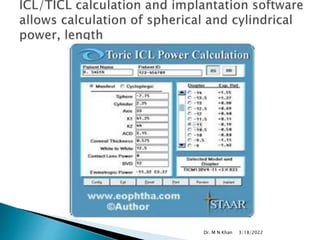
 Toric ICL (TICL) can correct up to -3 to -23 D
of sphere and + 1.0 to + 6.0 D of cyl.
 The toric ICL has the same overall design as
the spherical ICL with the addition of a toric
optic.
3/18/2022
Dr. M N Khan
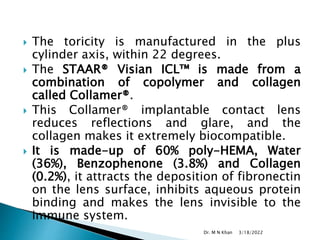
 The toricity is manufactured in the plus
cylinder axis, within 22 degrees.
 The STAAR® Visian ICL™ is made from a
combination of copolymer and collagen
called Collamer®.
 This Collamer® implantable contact lens
reduces reflections and glare, and the
collagen makes it extremely biocompatible.
 It is made-up of 60% poly-HEMA, Water
(36%), Benzophenone (3.8%) and Collagen
(0.2%), it attracts the deposition of fibronectin
on the lens surface, inhibits aqueous protein
binding and makes the lens invisible to the
immune system.
3/18/2022
Dr. M N Khan
3/18/2022
Dr. M N Khan
3/18/2022
Dr. M N Khan
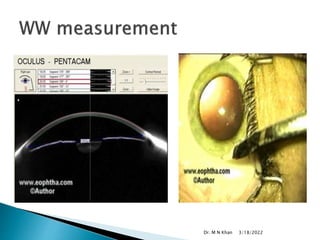
 In the pre-operative planning, the critical
parameter in sizing the ICL is the white-to-
white (WW) measurement.
 It can be measured with a Pentacam,
OrbScan, UBM or using calipers.
 In myopic eyes, to determine the overall
length (in mm) of the ICL, add 0.5 mm to the
horizontal WW measurement.
3/18/2022
Dr. M N Khan
3/18/2022
Dr. M N Khan
 If the ICL is too short for the sulcus, the lens
vault may be insufficient to clear the
crystalline lens, exposing it to the risk of an
anterior capsular cataract.
 If it is too long, the lens will vault excessively,
crowding the angle and possibly causing
closed angle glaucoma.
3/18/2022
Dr. M N Khan
 Ideal ICL vault is approximately 500 μm,
which is roughly one corneal thickness.
 There are concerns about high vault (1000
μm) leading to angle crowding and resulting
in angle closure or synechiae formation.
 High vault may also increase iris chaffing and
pigment dispersion, resulting in pigmentary
glaucoma.
 Furthermore, low vault (125 μm) may also
cause ICL contact with the crystalline lens and
increase the risk of cataract formation over
time.
3/18/2022
Dr. M N Khan
 New studies state that in sizing the ICL, a
formula that includes a direct measurement
of sulcus diameter by UBM improves vault
height predictability and hence the safety of
ICL implantation compared with the current
standard of using a white-to-white–based
sizing formula.
3/18/2022
Dr. M N Khan
 A peripheral iridotomy is performed 1-2
weeks before the surgery to provide an outlet
for the aqueous flow around the lens.
 Alternatively it may be performed intra-
operatively after ICL implantation with a
Vannas scissors or a vitrectomy cutter.
 It should be sufficiently wide (at least 500
μm), positioned superiorly (from 11 to 1
o'clock) and well away from the haptics
placement.
3/18/2022
Dr. M N Khan
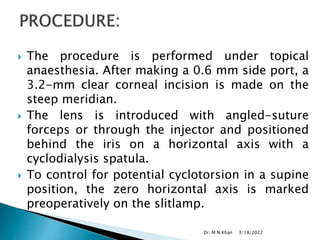
 The procedure is performed under topical
anaesthesia. After making a 0.6 mm side port, a
3.2-mm clear corneal incision is made on the
steep meridian.
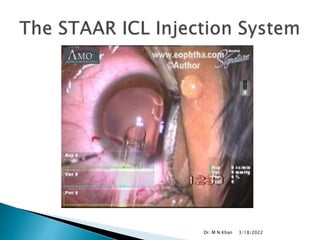
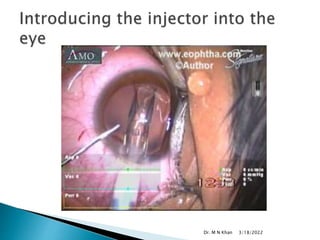
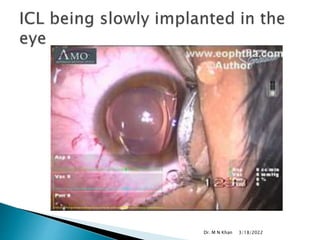
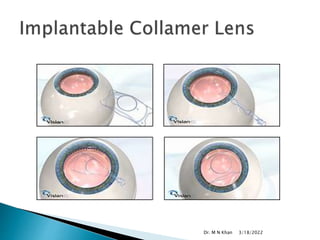
 The lens is introduced with angled-suture
forceps or through the injector and positioned
behind the iris on a horizontal axis with a
cyclodialysis spatula.
 To control for potential cyclotorsion in a supine
position, the zero horizontal axis is marked
preoperatively on the slitlamp.
3/18/2022
Dr. M N Khan
3/18/2022
Dr. M N Khan
3/18/2022
Dr. M N Khan
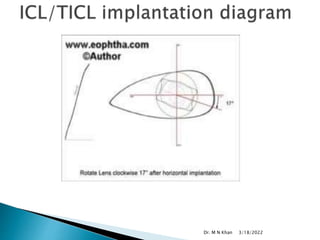
 The lens is implanted temporally and gently
rotated to align the axis with the cylindrical axis
of the patient.
 Complete removal of viscoelastic material is
essential.
 Presence of residual viscoelastic material behind
the implant may cause opacification of the
crystalline lens.
 A miotic agent is injected and the aspiration is
completed.
 The incision is closed by hydrating the corneal
incision.
3/18/2022
Dr. M N Khan
3/18/2022
Dr. M N Khan
3/18/2022
Dr. M N Khan
3/18/2022
Dr. M N Khan
 Intra-operatively, it is crucial to load the ICL
in the injector in a straight and smooth
manner to implant it correctly in the posterior
chamber.
 Improper loading may lead to an upside down
implantation.
 The visco-elastic material must also be
removed carefully and meticulously to
prevent a post operative IOP spike.
3/18/2022
Dr. M N Khan
3/18/2022
Dr. M N Khan
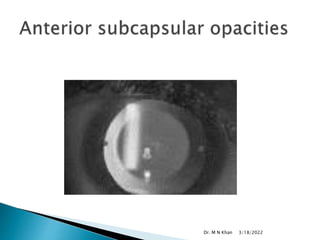
 Sanders et al studied incidence of anterior
subcapsular opacities and cataracts 5 years
after surgery in the Visian implantable
collamer lens FDA trial.
 Approximately 6% to 7% of eyes developed
anterior subcapsular opacities at 7+ years
following ICL implantation.
 but only 1% to 2% progressed to clinically
significant cataract during the same period,
especially very high myopes and older
patients.
3/18/2022
Dr. M N Khan
 The ICL can be removed or exchanged at any
time.
 Made from Collamer, a unique, organic lens
material
 Foldable, requiring a small incision
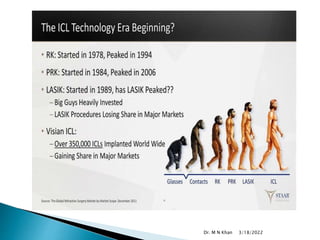
 Over 350,000 implants worldwide (as of
2012)
 FDA approved
3/18/2022
Dr. M N Khan
 The overall complication rate with ICL is low
and most patients have a good visual
recovery.
3/18/2022
Dr. M N Khan
Overcorrection and Undercorrection
 The most common complications with any
refractive procedure are overcorrection and
undercorrection.
 The measurements are not always perfect.
 No matter the refractive procedure,
undercorrection can be fixed with an
additional procedure, which could include a
second LASIK or PRK surgery or the removal
and replacement of the Visian ICL.
 Continued use of glasses or contact lenses is
also a possibility.
3/18/2022
Dr. M N Khan
Infection
 Because all of these procedures involve some
form of manipulation (no matter how slight),
there is a risk of an infection.
 Although it is not a common complication, it
is important to realize that an eye infection
may range from delaying the healing of the
eye to serious damage, including possible
loss of visual acuity.
3/18/2022
Dr. M N Khan
Halos and Night Glare
 The most common side effects of corneal
refractive surgery are halos and glare around
lights at night.
 These problems range in severity from being
barely noticeable to severely limiting a
person’s visual acuity.
 In many cases, severe halos and night glare
can be reduced with a second surgery, but it
is often difficult to eliminate these effects
completely.
3/18/2022
Dr. M N Khan
Damage to the Crystalline Lens
 Since the ICL is placed inside the eye,
potential risk touching the eye’s natural lens
may result.
 Damage to the natural lens may cause an
opacity of the lens, in the most serious case,
requiring removal and replacement of the
natural lens with a synthetic lens.
 These opacities, requiring surgical
intervention, occurred in less than 1 percent
of the ICL patients.
3/18/2022
Dr. M N Khan
3/18/2022
Dr. M N Khan
Complications of Iridotomy
 One to two weeks prior to the implantation of
the ICL, the surgeon will perform an
iridotomy using a YAG-laser.
 Complications from the iridotomy are rare,
but could possibly include natural lens or
corneal damage, inflammation, temporary
increase in intraocular pressure, bleeding,
and scar formation.
3/18/2022
Dr. M N Khan
Increase in Eye Pressure
 In some cases, there may be an increase in
eye pressure due to acute angle closure
glaucoma.
 If this occurs, a surgeon may quickly treat the
problem with additional medications or
surgical intervention.
3/18/2022
Dr. M N Khan
Other reported complications of ICL are—
 Pigment dispersion
 Lens deposits
 Late subluxation of ICL
 Endophthalmitis
 Retinal detachment
 Vision loss
3/18/2022
Dr. M N Khan
It is important to note that several of the ICL
risks listed above are potential complications
of all refractive procedures, including:
 Halos, glare, and double vision
 Infection
 Overcorrection
 Undercorrection
 Vision loss
3/18/2022
Dr. M N Khan
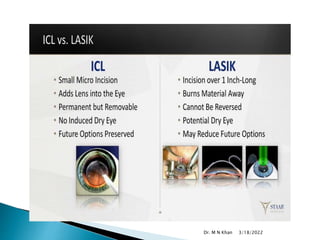
 In fact, ICL risks, such as halos, glare, and
double vision tend to occur less frequently
than the same laser eye surgery
complications.
 Also, unlike LASIK vision correction and PRK
surgery, overcorrection and undercorrection
of refractive errors can be corrected by
replacing the ICL with another implantable
contact lens.
3/18/2022
Dr. M N Khan
3/18/2022
Dr. M N Khan
 At Centre for Sight, New Delhi 110 eyes of 63
patients operated, of which 23% were males and
77% females.
 Spherical ICL was implanted in 25% and Toric ICL
in 75% of the eyes.
 Degree of myopia ranged from -2.5 to - 22.5 DS.
 The highest cylindrical power treated was -5.5 D.
Though most patients had a myopic refractive
error.
 3 eyes received ICL after C3R treatment for
keratoconus.
 2 eyes had hyperopia with astigmatism.
 95% recovered BCVA in 1-2 days.
 100% recovered BCVA by 1 week.
3/18/2022
Dr. M N Khan
Various studies have reported that phakic TICL
implantation is a good option for
 moderate to high myopia
 Hyperopia
 high myopic astigmatism in eyes with
keratoconus
 correction of hyperopia post radial
keratotomy and post penetrating
keratoplasty.
3/18/2022
Dr. M N Khan
 Kamiya et al studied long-term clinical
outcomes of implantation of Visian
implantable lens for moderate to high myopia
in 56 eyes of 34 patients with myopic
refractive errors of -4.00 to -15.25 diopters
(D).
 They concluded that implantation of ICLs is
safe and effective and provides predictable
and stable refractive results in the treatment
of moderate to high myopia during a 4-year
observation period.
3/18/2022
Dr. M N Khan
 Pesando et al evaluated ICL in 49 hyperopic
eyes of 34 patients.
 Preoperatively, the spherical equivalent (SE)
was between +2.75 D and +11.75 D and
astigmatism was between +0.50 D and +1.00
D.
 The mean postoperative SE of the manifest
refraction was +0.07 ± 0.54 D; refraction
stabilized quickly and remained stable
throughout the follow-up period.
 The results confirmed the long-term safety,
efficacy, accuracy, and predictability of ICL
for hyperopia.
3/18/2022
Dr. M N Khan
 Alfonso et al evaluated the efficacy, predictability
and safety of myopic phakic posterior chamber
ICL to correct myopia associated with
keratoconus.
 They showed that spherical equivalent refraction
was within ±1.00 D of the desired refraction in
all cases and 84% of cases were within ±0.50 D.
 Alfonso et al suggested that phakic intraocular
lens implantation is a viable treatment for
myopia and astigmatism after PKP in patients for
whom glasses, contact lenses, or corneal
refractive surgery is contraindicated.
3/18/2022
Dr. M N Khan
 Kamiya et al compared Collamer toric ICL
implantation and wavefront-guided laser in
situ keratomileusis for high myopic
astigmatism.
 All eyes in the ICL group and 71% of eyes in
the LASIK group were within ±1.00 D of the
targeted SE correction at 6 months.
 They suggested that Toric ICL implantation
was better than wavefront-guided LASIK in
eyes with high myopic astigmatism.
3/18/2022
Dr. M N Khan
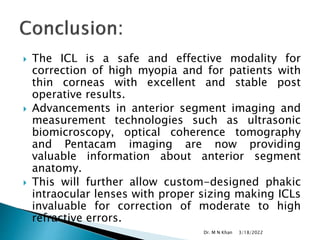
 The ICL is a safe and effective modality for
correction of high myopia and for patients with
thin corneas with excellent and stable post
operative results.
 Advancements in anterior segment imaging and
measurement technologies such as ultrasonic
biomicroscopy, optical coherence tomography
and Pentacam imaging are now providing
valuable information about anterior segment
anatomy.
 This will further allow custom-designed phakic
intraocular lenses with proper sizing making ICLs
invaluable for correction of moderate to high
refractive errors.
3/18/2022
Dr. M N Khan
3/18/2022
Dr. M N Khan
3/18/2022
Dr. M N Khan
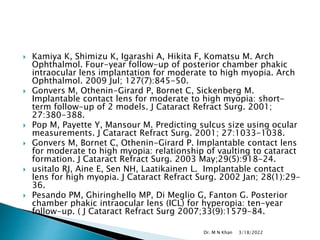
 Kamiya K, Shimizu K, Igarashi A, Hikita F, Komatsu M. Arch
Ophthalmol. Four-year follow-up of posterior chamber phakic
intraocular lens implantation for moderate to high myopia. Arch
Ophthalmol. 2009 Jul; 127(7):845-50.
 Gonvers M, Othenin-Girard P, Bornet C, Sickenberg M.
Implantable contact lens for moderate to high myopia: short-
term follow-up of 2 models. J Cataract Refract Surg. 2001;
27:380-388.
 Pop M, Payette Y, Mansour M. Predicting sulcus size using ocular
measurements. J Cataract Refract Surg. 2001; 27:1033-1038.
 Gonvers M, Bornet C, Othenin-Girard P. Implantable contact lens
for moderate to high myopia: relationship of vaulting to cataract
formation. J Cataract Refract Surg. 2003 May;29(5):918-24.
 usitalo RJ, Aine E, Sen NH, Laatikainen L. Implantable contact
lens for high myopia. J Cataract Refract Surg. 2002 Jan; 28(1):29-
36.
 Pesando PM, Ghiringhello MP, Di Meglio G, Fanton G. Posterior
chamber phakic intraocular lens (ICL) for hyperopia: ten-year
follow-up. ( J Cataract Refract Surg 2007;33(9):1579-84.
3/18/2022
Dr. M N Khan
 Alfonso JF, Palacios A, Montés-Micó R.Myopic phakic STAAR
collamer posterior chamber intraocular lenses for keratoconus. J
Refract Surg. 2008 Nov; 24(9):867-74.
 Kamiya K, Shimizu K, Ando W, Asato Y, Fujisawa T. Phakic toric
Implantable Collamer Lens implantation for the correction of
high myopic astigmatism in eyes with keratoconus. J Refract
Surg. 2008 Oct;24(8):840-2.
 Kamiya K, Shimizu K. Implantable Collamer lens for hyperopia
after radial keratotomy.J Cataract Refract Surg. 2008 Aug;
34(8):1403-4.
 Srinivasan S, Drake A, Herzig S. Early experience with
implantable collamer lens in the management of hyperopia after
radial keratotomy. Cornea. 2008 Apr;27(3):302-4.
 Alfonso JF, Lisa C, Abdelhamid A, Montés-Micó R, Poo-López A,
Ferrer-Blasco T. Posterior chamber phakic intraocular lenses
after penetrating keratoplasty. J Cataract Refract Surg. 2009 Jul;
35(7):1166-73.
 Igarashi A, Kamiya K, Shimizu K, Komatsu M Visual performance
after implantable collamer lens implantation and wavefront-
guided laser in situ keratomileusis for high myopia. Am J
Ophthalmol. 2009 Jul;148(1):164-70. 3/18/2022
Dr. M N Khan
 Kamiya K, Shimizu K, Igarashi A, Komatsu M. Comparison of Collamer
toric implantable [corrected] contact lens implantation and wavefront-
guided laser in situ keratomileusis for high myopic astigmatism. J
Cataract Refract Surg. 2008 Oct; 34(10):1687-93.
 Sanders DR. Anterior subcapsular opacities and cataracts 5 years after
surgery in the visian implantable collamer lens FDA trial. J Refract Surg.
2008 Jun; 24(6):566-70.
 Chung TY, Park SC, Lee MO, Ahn K, Chung ES. Changes in iridocorneal
angle structure and trabecular pigmentation with STAAR implantable
collamer lens during 2 years. J Refract Surg. 2009 Mar; 25(3):251-8.
 Chan KC, Birchall W, Gray TB, Wells AP. Acute angle closure after
implantable contact lens insertion unresponsive to surgical peripheral
iridectomy. J Cataract Refract Surg. 2008 Apr; 34(4):696-9.
 R. Kaufer, G. Kaufer. Late subluxation of an ICL Journal of Cataract &
Refractive Surgery, Volume 31, Issue 6, Pages 1254-1255.
 Allan BD, Argeles-Sabate I, Mamalis N. Endophthalmitis rates after
implantation of the intraocular Collamer lens: survey of users between
1998 and 2006. J Cataract Refract Surg. 2009 Apr; 35(4):766-9.
 Domènech NP, Arias L, Prades S, Pujol O, Rubio M, Caminal JM. Acute
onset of retinal detachment after posterior chamber phakic intraocular
lens implantation. Clin Ophthalmol. 2008 Mar; 2(1):227-31
3/18/2022
Dr. M N Khan

Implantable Collamer (Contact) Lens

  • 1.
    Dr. Mohd NajmussadiqKhan M. S.(Ophth) 3/18/2022 Dr. M N Khan
  • 2.
     Previously called"implantable contact lenses," the FDA prefers the term "implantable collamer lenses" to avoid any confusion with corneal contact lenses.  Management of high refractive errors especially with thin cornea is a refractive challenge.  Lasik for correcting high refractive errors has the drawbacks of lack of predictability, regression, corneal ectasia and induction of high order aberrations. 3/18/2022 Dr. M N Khan
  • 3.
     The ImplantableContact lens (ICL) is a preferred modality for correction of high myopia and for patients with thin corneas. It was first developed in the late 1980’s in Russia by Dr. S. Fyodorov and the first implant was placed in Europe in 1993.  Fyodorov introduced the concept of a soft phakic lens in the space between the iris and the anterior surface of the crystalline lens.  Earlier, the material used was silicone; now, the material used is collamer. 3/18/2022 Dr. M N Khan
  • 4.
  • 5.
  • 6.
     The trialfocused on 526 eyes among some 294 people aged 22-45.  After three years with an implantable collamer lens, nearly 59% had 20/20 vision (normal vision) or better, and nearly 95% had at least 20/40 vision (near-normal vision) or better. 3/18/2022 Dr. M N Khan
  • 7.
     When residualbed after LASIK is likely to be less than 250µ  When the initial corneal thickness is less than 480µ  Refractive error between the ages of 21-45  ACD greater than 2.8 mm  Stable refraction (<0.5D change in previous 12 months)  No ocular pathology (NSC, glaucoma, lid pathology, etc)  Mesopic pupil <6.0mm 3/18/2022 Dr. M N Khan
  • 8.
     Implantable contactlens is indicated for placement in the posterior chamber of the phakic eye for correction of moderate to high myopia ranging –3.0 D to –20.0 D.  Toric ICL (TICL) can correct up to -3 to -23 D of sphere and + 1.0 to + 6.0 D of cyl.  The toric ICL has the same overall design as the spherical ICL with the addition of a toric optic. 3/18/2022 Dr. M N Khan
  • 9.
     The toricityis manufactured in the plus cylinder axis, within 22 degrees.  The STAAR® Visian ICL™ is made from a combination of copolymer and collagen called Collamer®.  This Collamer® implantable contact lens reduces reflections and glare, and the collagen makes it extremely biocompatible.  It is made-up of 60% poly-HEMA, Water (36%), Benzophenone (3.8%) and Collagen (0.2%), it attracts the deposition of fibronectin on the lens surface, inhibits aqueous protein binding and makes the lens invisible to the immune system. 3/18/2022 Dr. M N Khan
  • 10.
  • 11.
  • 12.
     In thepre-operative planning, the critical parameter in sizing the ICL is the white-to- white (WW) measurement.  It can be measured with a Pentacam, OrbScan, UBM or using calipers.  In myopic eyes, to determine the overall length (in mm) of the ICL, add 0.5 mm to the horizontal WW measurement. 3/18/2022 Dr. M N Khan
  • 13.
  • 14.
     If theICL is too short for the sulcus, the lens vault may be insufficient to clear the crystalline lens, exposing it to the risk of an anterior capsular cataract.  If it is too long, the lens will vault excessively, crowding the angle and possibly causing closed angle glaucoma. 3/18/2022 Dr. M N Khan
  • 15.
     Ideal ICLvault is approximately 500 μm, which is roughly one corneal thickness.  There are concerns about high vault (1000 μm) leading to angle crowding and resulting in angle closure or synechiae formation.  High vault may also increase iris chaffing and pigment dispersion, resulting in pigmentary glaucoma.  Furthermore, low vault (125 μm) may also cause ICL contact with the crystalline lens and increase the risk of cataract formation over time. 3/18/2022 Dr. M N Khan
  • 16.
     New studiesstate that in sizing the ICL, a formula that includes a direct measurement of sulcus diameter by UBM improves vault height predictability and hence the safety of ICL implantation compared with the current standard of using a white-to-white–based sizing formula. 3/18/2022 Dr. M N Khan
  • 17.
     A peripheraliridotomy is performed 1-2 weeks before the surgery to provide an outlet for the aqueous flow around the lens.  Alternatively it may be performed intra- operatively after ICL implantation with a Vannas scissors or a vitrectomy cutter.  It should be sufficiently wide (at least 500 μm), positioned superiorly (from 11 to 1 o'clock) and well away from the haptics placement. 3/18/2022 Dr. M N Khan
  • 18.
     The procedureis performed under topical anaesthesia. After making a 0.6 mm side port, a 3.2-mm clear corneal incision is made on the steep meridian.  The lens is introduced with angled-suture forceps or through the injector and positioned behind the iris on a horizontal axis with a cyclodialysis spatula.  To control for potential cyclotorsion in a supine position, the zero horizontal axis is marked preoperatively on the slitlamp. 3/18/2022 Dr. M N Khan
  • 19.
  • 20.
  • 21.
     The lensis implanted temporally and gently rotated to align the axis with the cylindrical axis of the patient.  Complete removal of viscoelastic material is essential.  Presence of residual viscoelastic material behind the implant may cause opacification of the crystalline lens.  A miotic agent is injected and the aspiration is completed.  The incision is closed by hydrating the corneal incision. 3/18/2022 Dr. M N Khan
  • 22.
  • 23.
  • 24.
  • 25.
     Intra-operatively, itis crucial to load the ICL in the injector in a straight and smooth manner to implant it correctly in the posterior chamber.  Improper loading may lead to an upside down implantation.  The visco-elastic material must also be removed carefully and meticulously to prevent a post operative IOP spike. 3/18/2022 Dr. M N Khan
  • 26.
  • 27.
     Sanders etal studied incidence of anterior subcapsular opacities and cataracts 5 years after surgery in the Visian implantable collamer lens FDA trial.  Approximately 6% to 7% of eyes developed anterior subcapsular opacities at 7+ years following ICL implantation.  but only 1% to 2% progressed to clinically significant cataract during the same period, especially very high myopes and older patients. 3/18/2022 Dr. M N Khan
  • 28.
     The ICLcan be removed or exchanged at any time.  Made from Collamer, a unique, organic lens material  Foldable, requiring a small incision  Over 350,000 implants worldwide (as of 2012)  FDA approved 3/18/2022 Dr. M N Khan
  • 29.
     The overallcomplication rate with ICL is low and most patients have a good visual recovery. 3/18/2022 Dr. M N Khan
  • 30.
    Overcorrection and Undercorrection The most common complications with any refractive procedure are overcorrection and undercorrection.  The measurements are not always perfect.  No matter the refractive procedure, undercorrection can be fixed with an additional procedure, which could include a second LASIK or PRK surgery or the removal and replacement of the Visian ICL.  Continued use of glasses or contact lenses is also a possibility. 3/18/2022 Dr. M N Khan
  • 31.
    Infection  Because allof these procedures involve some form of manipulation (no matter how slight), there is a risk of an infection.  Although it is not a common complication, it is important to realize that an eye infection may range from delaying the healing of the eye to serious damage, including possible loss of visual acuity. 3/18/2022 Dr. M N Khan
  • 32.
    Halos and NightGlare  The most common side effects of corneal refractive surgery are halos and glare around lights at night.  These problems range in severity from being barely noticeable to severely limiting a person’s visual acuity.  In many cases, severe halos and night glare can be reduced with a second surgery, but it is often difficult to eliminate these effects completely. 3/18/2022 Dr. M N Khan
  • 33.
    Damage to theCrystalline Lens  Since the ICL is placed inside the eye, potential risk touching the eye’s natural lens may result.  Damage to the natural lens may cause an opacity of the lens, in the most serious case, requiring removal and replacement of the natural lens with a synthetic lens.  These opacities, requiring surgical intervention, occurred in less than 1 percent of the ICL patients. 3/18/2022 Dr. M N Khan
  • 34.
  • 35.
    Complications of Iridotomy One to two weeks prior to the implantation of the ICL, the surgeon will perform an iridotomy using a YAG-laser.  Complications from the iridotomy are rare, but could possibly include natural lens or corneal damage, inflammation, temporary increase in intraocular pressure, bleeding, and scar formation. 3/18/2022 Dr. M N Khan
  • 36.
    Increase in EyePressure  In some cases, there may be an increase in eye pressure due to acute angle closure glaucoma.  If this occurs, a surgeon may quickly treat the problem with additional medications or surgical intervention. 3/18/2022 Dr. M N Khan
  • 37.
    Other reported complicationsof ICL are—  Pigment dispersion  Lens deposits  Late subluxation of ICL  Endophthalmitis  Retinal detachment  Vision loss 3/18/2022 Dr. M N Khan
  • 38.
    It is importantto note that several of the ICL risks listed above are potential complications of all refractive procedures, including:  Halos, glare, and double vision  Infection  Overcorrection  Undercorrection  Vision loss 3/18/2022 Dr. M N Khan
  • 39.
     In fact,ICL risks, such as halos, glare, and double vision tend to occur less frequently than the same laser eye surgery complications.  Also, unlike LASIK vision correction and PRK surgery, overcorrection and undercorrection of refractive errors can be corrected by replacing the ICL with another implantable contact lens. 3/18/2022 Dr. M N Khan
  • 40.
  • 41.
     At Centrefor Sight, New Delhi 110 eyes of 63 patients operated, of which 23% were males and 77% females.  Spherical ICL was implanted in 25% and Toric ICL in 75% of the eyes.  Degree of myopia ranged from -2.5 to - 22.5 DS.  The highest cylindrical power treated was -5.5 D. Though most patients had a myopic refractive error.  3 eyes received ICL after C3R treatment for keratoconus.  2 eyes had hyperopia with astigmatism.  95% recovered BCVA in 1-2 days.  100% recovered BCVA by 1 week. 3/18/2022 Dr. M N Khan
  • 42.
    Various studies havereported that phakic TICL implantation is a good option for  moderate to high myopia  Hyperopia  high myopic astigmatism in eyes with keratoconus  correction of hyperopia post radial keratotomy and post penetrating keratoplasty. 3/18/2022 Dr. M N Khan
  • 43.
     Kamiya etal studied long-term clinical outcomes of implantation of Visian implantable lens for moderate to high myopia in 56 eyes of 34 patients with myopic refractive errors of -4.00 to -15.25 diopters (D).  They concluded that implantation of ICLs is safe and effective and provides predictable and stable refractive results in the treatment of moderate to high myopia during a 4-year observation period. 3/18/2022 Dr. M N Khan
  • 44.
     Pesando etal evaluated ICL in 49 hyperopic eyes of 34 patients.  Preoperatively, the spherical equivalent (SE) was between +2.75 D and +11.75 D and astigmatism was between +0.50 D and +1.00 D.  The mean postoperative SE of the manifest refraction was +0.07 ± 0.54 D; refraction stabilized quickly and remained stable throughout the follow-up period.  The results confirmed the long-term safety, efficacy, accuracy, and predictability of ICL for hyperopia. 3/18/2022 Dr. M N Khan
  • 45.
     Alfonso etal evaluated the efficacy, predictability and safety of myopic phakic posterior chamber ICL to correct myopia associated with keratoconus.  They showed that spherical equivalent refraction was within ±1.00 D of the desired refraction in all cases and 84% of cases were within ±0.50 D.  Alfonso et al suggested that phakic intraocular lens implantation is a viable treatment for myopia and astigmatism after PKP in patients for whom glasses, contact lenses, or corneal refractive surgery is contraindicated. 3/18/2022 Dr. M N Khan
  • 46.
     Kamiya etal compared Collamer toric ICL implantation and wavefront-guided laser in situ keratomileusis for high myopic astigmatism.  All eyes in the ICL group and 71% of eyes in the LASIK group were within ±1.00 D of the targeted SE correction at 6 months.  They suggested that Toric ICL implantation was better than wavefront-guided LASIK in eyes with high myopic astigmatism. 3/18/2022 Dr. M N Khan
  • 47.
     The ICLis a safe and effective modality for correction of high myopia and for patients with thin corneas with excellent and stable post operative results.  Advancements in anterior segment imaging and measurement technologies such as ultrasonic biomicroscopy, optical coherence tomography and Pentacam imaging are now providing valuable information about anterior segment anatomy.  This will further allow custom-designed phakic intraocular lenses with proper sizing making ICLs invaluable for correction of moderate to high refractive errors. 3/18/2022 Dr. M N Khan
  • 48.
  • 49.
  • 50.
     Kamiya K,Shimizu K, Igarashi A, Hikita F, Komatsu M. Arch Ophthalmol. Four-year follow-up of posterior chamber phakic intraocular lens implantation for moderate to high myopia. Arch Ophthalmol. 2009 Jul; 127(7):845-50.  Gonvers M, Othenin-Girard P, Bornet C, Sickenberg M. Implantable contact lens for moderate to high myopia: short- term follow-up of 2 models. J Cataract Refract Surg. 2001; 27:380-388.  Pop M, Payette Y, Mansour M. Predicting sulcus size using ocular measurements. J Cataract Refract Surg. 2001; 27:1033-1038.  Gonvers M, Bornet C, Othenin-Girard P. Implantable contact lens for moderate to high myopia: relationship of vaulting to cataract formation. J Cataract Refract Surg. 2003 May;29(5):918-24.  usitalo RJ, Aine E, Sen NH, Laatikainen L. Implantable contact lens for high myopia. J Cataract Refract Surg. 2002 Jan; 28(1):29- 36.  Pesando PM, Ghiringhello MP, Di Meglio G, Fanton G. Posterior chamber phakic intraocular lens (ICL) for hyperopia: ten-year follow-up. ( J Cataract Refract Surg 2007;33(9):1579-84. 3/18/2022 Dr. M N Khan
  • 51.
     Alfonso JF,Palacios A, Montés-Micó R.Myopic phakic STAAR collamer posterior chamber intraocular lenses for keratoconus. J Refract Surg. 2008 Nov; 24(9):867-74.  Kamiya K, Shimizu K, Ando W, Asato Y, Fujisawa T. Phakic toric Implantable Collamer Lens implantation for the correction of high myopic astigmatism in eyes with keratoconus. J Refract Surg. 2008 Oct;24(8):840-2.  Kamiya K, Shimizu K. Implantable Collamer lens for hyperopia after radial keratotomy.J Cataract Refract Surg. 2008 Aug; 34(8):1403-4.  Srinivasan S, Drake A, Herzig S. Early experience with implantable collamer lens in the management of hyperopia after radial keratotomy. Cornea. 2008 Apr;27(3):302-4.  Alfonso JF, Lisa C, Abdelhamid A, Montés-Micó R, Poo-López A, Ferrer-Blasco T. Posterior chamber phakic intraocular lenses after penetrating keratoplasty. J Cataract Refract Surg. 2009 Jul; 35(7):1166-73.  Igarashi A, Kamiya K, Shimizu K, Komatsu M Visual performance after implantable collamer lens implantation and wavefront- guided laser in situ keratomileusis for high myopia. Am J Ophthalmol. 2009 Jul;148(1):164-70. 3/18/2022 Dr. M N Khan
  • 52.
     Kamiya K,Shimizu K, Igarashi A, Komatsu M. Comparison of Collamer toric implantable [corrected] contact lens implantation and wavefront- guided laser in situ keratomileusis for high myopic astigmatism. J Cataract Refract Surg. 2008 Oct; 34(10):1687-93.  Sanders DR. Anterior subcapsular opacities and cataracts 5 years after surgery in the visian implantable collamer lens FDA trial. J Refract Surg. 2008 Jun; 24(6):566-70.  Chung TY, Park SC, Lee MO, Ahn K, Chung ES. Changes in iridocorneal angle structure and trabecular pigmentation with STAAR implantable collamer lens during 2 years. J Refract Surg. 2009 Mar; 25(3):251-8.  Chan KC, Birchall W, Gray TB, Wells AP. Acute angle closure after implantable contact lens insertion unresponsive to surgical peripheral iridectomy. J Cataract Refract Surg. 2008 Apr; 34(4):696-9.  R. Kaufer, G. Kaufer. Late subluxation of an ICL Journal of Cataract & Refractive Surgery, Volume 31, Issue 6, Pages 1254-1255.  Allan BD, Argeles-Sabate I, Mamalis N. Endophthalmitis rates after implantation of the intraocular Collamer lens: survey of users between 1998 and 2006. J Cataract Refract Surg. 2009 Apr; 35(4):766-9.  Domènech NP, Arias L, Prades S, Pujol O, Rubio M, Caminal JM. Acute onset of retinal detachment after posterior chamber phakic intraocular lens implantation. Clin Ophthalmol. 2008 Mar; 2(1):227-31 3/18/2022 Dr. M N Khan