09050610-049
 In physics and astronomy, the splitting of a spectral line 
into two or more components of slightly different 
frequency when the light source is placed in a magnetic 
field. 
 It was first observed in 1896 by the Dutch physicist Pieter 
Zeeman as a broadening of the yellow D-lines of sodium in 
a flame held between strong magnetic poles. 
 It is analogous to the Stark effect, the splitting of a spectral 
line into several components in the presence of an electric 
field
 Zeeman’s discovery earned him the 1902 Nobel Prize 
for Physics, which he shared with a former teacher, 
Hendrik Anton Lorentz, another Dutch physicist. 
Lorentz, who had earlier developed a theory 
concerning the effect of magnetism on light 
 This theory was confirmed by Zeeman’s research and 
later modified by quantum mechanics
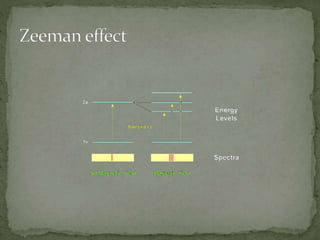
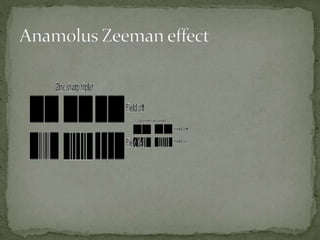
 The pattern and amount of splitting are a signature that a 
magnetic field is present, and of its strength. 
 The splitting is associated with what is called the orbital 
angular momentum quantum number L of the atomic level. 
 This quantum number can take non-negative integer 
values. 
 The number of split levels in the magnetic field is 2 * L + 1.
 "s" for a level with L=0 
 "p" for L=1 
 "d" for L=2, and so on 
 "2p" means a level that has n=2 and L=1 
 The Zeeman effect can be interpreted in terms of the 
precession of the orbital angular momentum vector 
in the magnetic field, similar to the precession of the 
axis of a spinning top in a gravitational field.
 The lines corresponding to Zeeman splitting also exhibit polarization 
effects. Polarization has to do with the direction in which the 
electromagnetic fields are vibrating. 
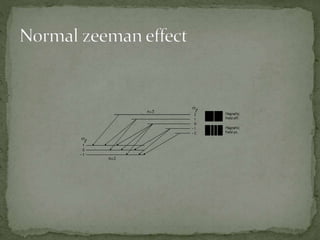
 One practical example in astronomy of such polarization effects is that 
in the preceding example the middle transition is polarized such that it 
cannot be easily be observed from directly over a surface perpendicular 
to the magnetic field 
 When looking directly down on a sunspot (which have strong 
magnetic fields) typically only two of the three transitions shown above 
can be seen and the line is observed to split into two rather than three 
lines (the missing transition could be observed from a different angle 
where its light would not be suppressed by the polarization effect, but 
it is very weak when observed from directly overhead).
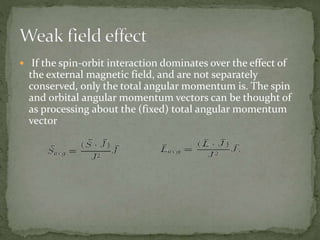
 If the spin-orbit interaction dominates over the effect of 
the external magnetic field, and are not separately 
conserved, only the total angular momentum is. The spin 
and orbital angular momentum vectors can be thought of 
as processing about the (fixed) total angular momentum 
vector
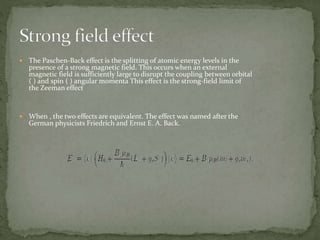
 The Paschen-Back effect is the splitting of atomic energy levels in the 
presence of a strong magnetic field. This occurs when an external 
magnetic field is sufficiently large to disrupt the coupling between orbital 
( ) and spin ( ) angular momenta This effect is the strong-field limit of 
the Zeeman effect 
 When , the two effects are equivalent. The effect was named after the 
German physicists Friedrich and Ernst E. A. Back.
 When the Zeeman effect was observed for hydrogen 
 Effects of electron spin were discovered by Goudsmit 
and Uhlenbeck, they found that the observed spectral 
features were matched by assigning to the electron 
spin a magnetic moment, then value of g is 
g = 2.002319304386
 To measure the magnetic field, e.g. that of the Sun and other stars or in 
laboratory plasmas 
 In nuclear magnetic resonance spectroscopy, electron spin resonance 
spectroscopy, magnetic resonance imaging (MRI) and Mossbauer 
spectroscopy. 
 It may also be utilized to improve accuracy in atomic absorption 
spectroscopy 
 A theory about the magnetic sense of birds assumes that a protein in 
the retina is changed due to the Zeeman effect 
 Measurement of pulsed magnetic field
 The Zeeman effect in molecular lines, the 
asymmetries observed in Stokes profiles from 
sunspots, and the interpretation of 
spectropolarimetric observations in the infrared. 
 To use the Zeeman effect for increasing the 
selectivity of laser isotope separation. 
 Zeeman effect is used to produce magneto grams 
showing the variation of magnetic field on the sun
Zeeman Effect

Zeeman Effect

  • 1.
  • 3.
     In physicsand astronomy, the splitting of a spectral line into two or more components of slightly different frequency when the light source is placed in a magnetic field.  It was first observed in 1896 by the Dutch physicist Pieter Zeeman as a broadening of the yellow D-lines of sodium in a flame held between strong magnetic poles.  It is analogous to the Stark effect, the splitting of a spectral line into several components in the presence of an electric field
  • 4.
     Zeeman’s discoveryearned him the 1902 Nobel Prize for Physics, which he shared with a former teacher, Hendrik Anton Lorentz, another Dutch physicist. Lorentz, who had earlier developed a theory concerning the effect of magnetism on light  This theory was confirmed by Zeeman’s research and later modified by quantum mechanics
  • 5.
     The patternand amount of splitting are a signature that a magnetic field is present, and of its strength.  The splitting is associated with what is called the orbital angular momentum quantum number L of the atomic level.  This quantum number can take non-negative integer values.  The number of split levels in the magnetic field is 2 * L + 1.
  • 7.
     "s" fora level with L=0  "p" for L=1  "d" for L=2, and so on  "2p" means a level that has n=2 and L=1  The Zeeman effect can be interpreted in terms of the precession of the orbital angular momentum vector in the magnetic field, similar to the precession of the axis of a spinning top in a gravitational field.
  • 8.
     The linescorresponding to Zeeman splitting also exhibit polarization effects. Polarization has to do with the direction in which the electromagnetic fields are vibrating.  One practical example in astronomy of such polarization effects is that in the preceding example the middle transition is polarized such that it cannot be easily be observed from directly over a surface perpendicular to the magnetic field  When looking directly down on a sunspot (which have strong magnetic fields) typically only two of the three transitions shown above can be seen and the line is observed to split into two rather than three lines (the missing transition could be observed from a different angle where its light would not be suppressed by the polarization effect, but it is very weak when observed from directly overhead).
  • 9.
     If thespin-orbit interaction dominates over the effect of the external magnetic field, and are not separately conserved, only the total angular momentum is. The spin and orbital angular momentum vectors can be thought of as processing about the (fixed) total angular momentum vector
  • 10.
     The Paschen-Backeffect is the splitting of atomic energy levels in the presence of a strong magnetic field. This occurs when an external magnetic field is sufficiently large to disrupt the coupling between orbital ( ) and spin ( ) angular momenta This effect is the strong-field limit of the Zeeman effect  When , the two effects are equivalent. The effect was named after the German physicists Friedrich and Ernst E. A. Back.
  • 13.
     When theZeeman effect was observed for hydrogen  Effects of electron spin were discovered by Goudsmit and Uhlenbeck, they found that the observed spectral features were matched by assigning to the electron spin a magnetic moment, then value of g is g = 2.002319304386
  • 14.
     To measurethe magnetic field, e.g. that of the Sun and other stars or in laboratory plasmas  In nuclear magnetic resonance spectroscopy, electron spin resonance spectroscopy, magnetic resonance imaging (MRI) and Mossbauer spectroscopy.  It may also be utilized to improve accuracy in atomic absorption spectroscopy  A theory about the magnetic sense of birds assumes that a protein in the retina is changed due to the Zeeman effect  Measurement of pulsed magnetic field
  • 15.
     The Zeemaneffect in molecular lines, the asymmetries observed in Stokes profiles from sunspots, and the interpretation of spectropolarimetric observations in the infrared.  To use the Zeeman effect for increasing the selectivity of laser isotope separation.  Zeeman effect is used to produce magneto grams showing the variation of magnetic field on the sun