NPTEL – Physics – Mathematical Physics - 1
Lecture 33
Cauchy Riemann (CR) conditions
CR conditions state that a necessary and a sufficient condition that a
function,
𝑓(𝑧) defined as,
𝑓(𝑧) = 𝑢(𝑥, 𝑦) + 𝑖𝑣(𝑥, 𝑦)
be analytic in a region  provides the following conditions (called CR conditions) on the
partial derivatives of 𝑢 𝑎𝑛𝑑 𝑣 are met,
𝜕𝑢
= 𝜕𝑣
and 𝜕𝑢
= − 𝜕𝑣
𝜕𝑥 𝜕𝑦 𝜕𝑦 𝜕𝑥
in . Additionally it is assumed that the partial derivatives are continuous in .
To arrive at the proof of the above equations, let us look at the necessary conditions. For
a function 𝑓(𝑧) to be analytic, it should be differentiable in a region , that is
𝐿𝑖𝑚
∆𝑧 → 0
𝑓(𝑧+∆(𝑧)−𝑓(𝑧)
∆𝑧
= 𝑓′ (𝑧)
𝑢(𝑥 + ∆𝑥, 𝑦 + ∆𝑦) + 𝑖𝑣 (𝑥 + ∆𝑥, 𝑦 + ∆𝑦) − 𝑢(𝑥, 𝑦) + 𝑖𝑣(𝑥, 𝑦)
∆𝑥 + 𝑖∆𝑦
∆𝑥→0
𝐿𝑖𝑚
∆𝑦→0
𝐿𝑖𝑚
must exist and should be independent of the manner in ∆𝑧 approaches zero. Two
possibilities are apparent for that to happen.
Case A
∆𝑦 = 0, ∆𝑥 → 0
For which 𝑓′(𝑧) is defined as,
𝑓′(𝑧) = ∆𝑥→0
𝐿𝑡 𝑢(𝑥 + ∆𝑥, 𝑦) − 𝑢(𝑥, 𝑦)
∆𝑥
+ 𝑖 [
𝑣(𝑥 + ∆𝑥, 𝑦)𝑣(𝑥, 𝑦)
∆𝑥
]
= + 𝑖
𝜕𝑢 𝜕𝑣
𝜕𝑥 𝜕𝑥
Assuming that the partial derivatives exist.
Joint initiative of IITs and IISc – Funded by MHRD Page 12 of 66
NPTEL – Physics – Mathematical Physics - 1
Case B
∆𝑦 → 0, ∆𝑥 = 0
In this case,
𝑓′(𝑧) = ∆𝑦→0
𝐿𝑖𝑚 𝑢(𝑥, 𝑦 + ∆𝑦) − 𝑢(𝑥, 𝑦)
𝑖∆𝑥
+
𝑣(𝑥, 𝑦 + ∆𝑦) − 𝑣(𝑥, 𝑦)
∆𝑦
= 𝜕𝑢
+ 𝑖𝜕𝑣
𝜕𝑦 𝜕𝑦
Of course, these two cases will have to yield identical results. Thus
𝜕𝑢 𝜕𝑣
𝜕𝑥
+ 𝑖
𝜕𝑥
𝜕𝑢 𝜕𝑣
= −𝑖
𝜕
𝑦
+
𝜕𝑦
Or, =
𝜕𝑢 𝜕𝑣
𝜕𝑥 𝜕𝑦 𝜕𝑥
and = −𝑖
𝜕𝑣 𝜕𝑢
𝜕𝑦
Next we look at the sufficiency conditions. Since and
𝜕𝑢
𝜕𝑥
𝜕𝑢
𝜕𝑦
are assumed to be
continuous, we have
∆𝑢 = 𝑢(𝑥 + ∆𝑥, 𝑦 + ∆𝑦) − 𝑢(𝑥, 𝑦)
= [𝑢(𝑥 + ∆𝑥, 𝑦 + ∆𝑦) − 𝑢(𝑥, 𝑦 + ∆𝑦)] + [𝑢(𝑥, 𝑦 + ∆𝑦) − 𝑢(𝑥, 𝑦)]
Where the second and third terms are subtracted and added.
Hence ∆𝑢 =
𝜕𝑢
∆𝑥 +
𝜕𝑢
∆𝑦
𝜕𝑥 𝜕𝑦
Similarly ∆𝑣 =
𝜕𝑣
∆𝑥 +
𝜕𝑣
∆𝑦
𝜕𝑥 𝜕𝑦
Thus ∆𝑤 = ∆𝑢 + 𝑖∆𝑣 = ( + 𝑖 ) ∆𝑥 + (
𝜕𝑢
𝜕𝑥 𝜕𝑦
𝜕𝑣 𝜕𝑢
𝜕𝑦
+ 𝑖 ) ∆𝑦
𝜕𝑣
𝜕𝑦
Changing the second bracket using CR conditions
∆𝑤 = ( + 𝑖 ) ∆𝑥 + (− + 𝑖 ) ∆𝑦
𝜕𝑢 𝜕𝑣
𝜕𝑥 𝜕𝑥 𝜕𝑥 𝜕𝑥
𝜕𝑣 𝜕𝑢
= ( + 𝑖 ) (𝑥 + 𝑖∆𝑦)
Joint initiative of IITs and IISc – Funded by MHRD Page 13 of 66
𝜕𝑢 𝜕𝑣
𝜕𝑥 𝜕𝑥
NPTEL – Physics – Mathematical Physics - 1
= ( + 𝑖 ) ∆𝑧
𝜕𝑢 𝜕𝑣
𝜕𝑥 𝜕𝑦
Hence
𝐿𝑖𝑚∆𝑤
∆𝑧→0 ∆
𝑧
=
𝑑𝑤
= 𝑓′(𝑧) =
𝜕𝑢
+ 𝑖
𝜕𝑣
𝑑𝑧 𝜕𝑥 𝜕
𝑥
proving that the derivative exists and so 𝑓(𝑧) is analytic . Examples
1. 𝑓(𝑧) = 𝑧2 = 𝑥2 − 𝑦2 + 𝑖2𝑥𝑦
𝑓′(𝑧) = 2𝑧
To verify CR condition,
𝑢(𝑥, 𝑦) = 𝑥2 − 𝑦2
𝑣(𝑥, 𝑦) = 2𝑥𝑦
𝑢𝑥 = 2𝑥 = 𝑣𝑦 , 𝑢𝑦 = −2𝑦 = −𝑣𝑥
𝑓′(𝑧) = 2𝑥 + 𝑖2𝑦 = 2𝑧
(where the suffix refers to the derivative taken with respect to that variable).
2. 𝑓(𝑧) = |𝑧|2, 𝑢(𝑥, 𝑦) = 𝑥2 + 𝑦2, 𝑣(𝑥, 𝑦) = 0
If the CR conditions hold at a point (𝑥, 𝑦) then the point would be,
2𝑥 = 0, 2𝑦 = 0 ⇒ (𝑥, 𝑦) = (0,0).
So 𝑓′(𝑧) does not exist at a non-zero point.
Exercise:
Check for the analyticity of the following functions.
𝑓(𝑧) = 𝑖|𝑧|3
|𝑧| = √𝑥2 + 𝑦2 |𝑧|3 = (𝑥2 + 𝑦2)2
3
3
𝑓(𝑧) = 𝑖(𝑥2 + 𝑦2)2
3
𝑢(𝑥, 𝑦) = 0, 𝑣(𝑥, 𝑦) = 𝑖(𝑥2 + 𝑦2)2
It is a purely complex function. It’s differentiable only at the origin and hence not an
analytic function.
Joint initiative of IITs and IISc – Funded by MHRD Page 14 of 66
Joint initiative of IITs and IISc – Funded by MHRD Page 15 of 66
NPTEL – Physics – Mathematical Physics - 1
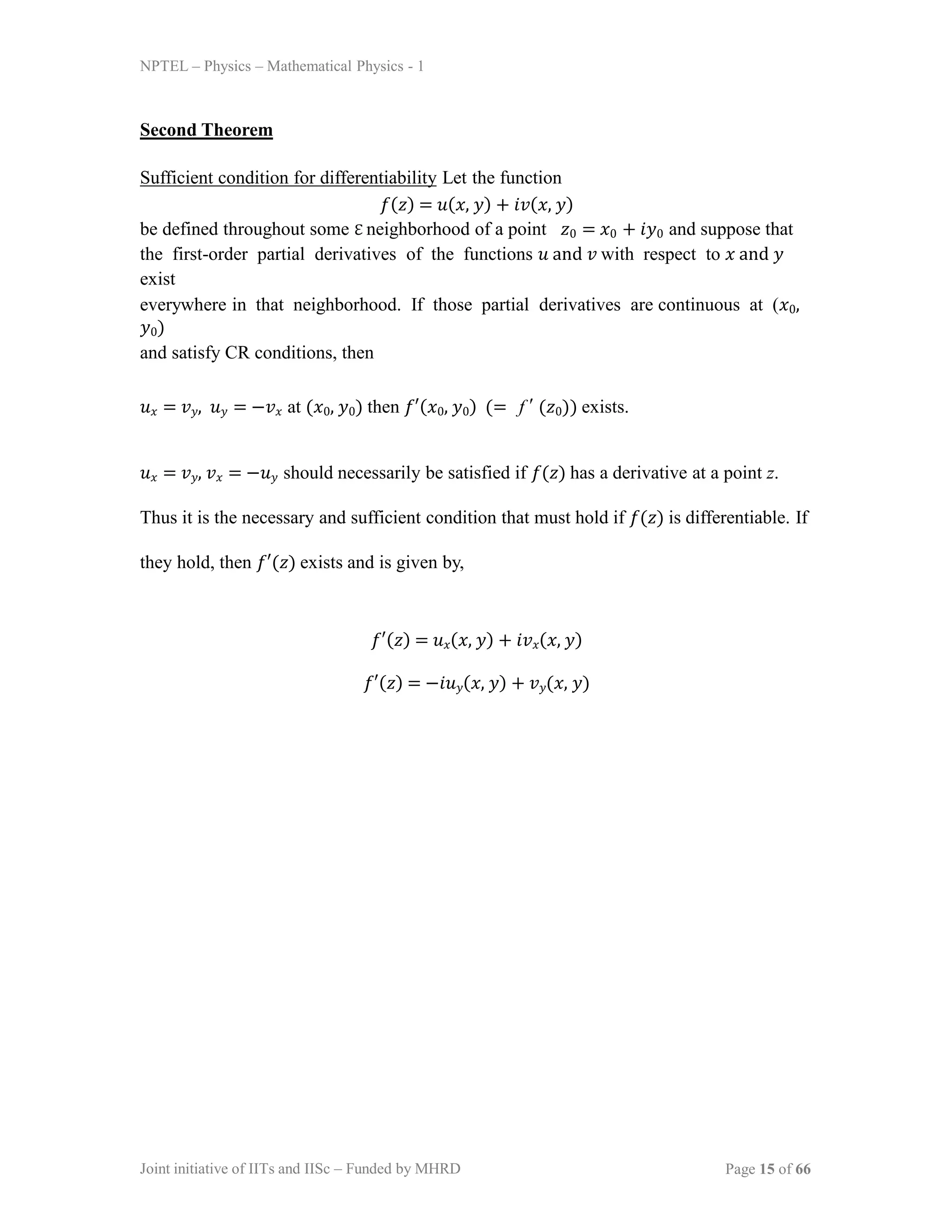
Second Theorem
Sufficient condition for differentiability Let the function
𝑓(𝑧) = 𝑢(𝑥, 𝑦) + 𝑖𝑣(𝑥, 𝑦)
be defined throughout some ℇ neighborhood of a point 𝑧0 = 𝑥0 + 𝑖𝑦0 and suppose that
the first-order partial derivatives of the functions 𝑢 and 𝑣 with respect to 𝑥 and 𝑦
exist
everywhere in that neighborhood. If those partial derivatives are continuous at (𝑥0,
𝑦0)
and satisfy CR conditions, then
𝑢𝑥 = 𝑣𝑦, 𝑢𝑦 = −𝑣𝑥 at (𝑥0, 𝑦0) then 𝑓′(𝑥0, 𝑦0) (= f  (𝑧0)) exists.
𝑢𝑥 = 𝑣𝑦, 𝑣𝑥 = −𝑢𝑦 should necessarily be satisfied if 𝑓(𝑧) has a derivative at a point z.
Thus it is the necessary and sufficient condition that must hold if 𝑓(𝑧) is differentiable. If
they hold, then 𝑓′(𝑧) exists and is given by,
𝑓′(𝑧) = 𝑢𝑥(𝑥, 𝑦) + 𝑖𝑣𝑥(𝑥, 𝑦)
𝑓′(𝑧) = −𝑖𝑢𝑦(𝑥, 𝑦) + 𝑣𝑦(𝑥, 𝑦)

lec33.ppt

  • 1.
    NPTEL – Physics– Mathematical Physics - 1 Lecture 33 Cauchy Riemann (CR) conditions CR conditions state that a necessary and a sufficient condition that a function, 𝑓(𝑧) defined as, 𝑓(𝑧) = 𝑢(𝑥, 𝑦) + 𝑖𝑣(𝑥, 𝑦) be analytic in a region  provides the following conditions (called CR conditions) on the partial derivatives of 𝑢 𝑎𝑛𝑑 𝑣 are met, 𝜕𝑢 = 𝜕𝑣 and 𝜕𝑢 = − 𝜕𝑣 𝜕𝑥 𝜕𝑦 𝜕𝑦 𝜕𝑥 in . Additionally it is assumed that the partial derivatives are continuous in . To arrive at the proof of the above equations, let us look at the necessary conditions. For a function 𝑓(𝑧) to be analytic, it should be differentiable in a region , that is 𝐿𝑖𝑚 ∆𝑧 → 0 𝑓(𝑧+∆(𝑧)−𝑓(𝑧) ∆𝑧 = 𝑓′ (𝑧) 𝑢(𝑥 + ∆𝑥, 𝑦 + ∆𝑦) + 𝑖𝑣 (𝑥 + ∆𝑥, 𝑦 + ∆𝑦) − 𝑢(𝑥, 𝑦) + 𝑖𝑣(𝑥, 𝑦) ∆𝑥 + 𝑖∆𝑦 ∆𝑥→0 𝐿𝑖𝑚 ∆𝑦→0 𝐿𝑖𝑚 must exist and should be independent of the manner in ∆𝑧 approaches zero. Two possibilities are apparent for that to happen. Case A ∆𝑦 = 0, ∆𝑥 → 0 For which 𝑓′(𝑧) is defined as, 𝑓′(𝑧) = ∆𝑥→0 𝐿𝑡 𝑢(𝑥 + ∆𝑥, 𝑦) − 𝑢(𝑥, 𝑦) ∆𝑥 + 𝑖 [ 𝑣(𝑥 + ∆𝑥, 𝑦)𝑣(𝑥, 𝑦) ∆𝑥 ] = + 𝑖 𝜕𝑢 𝜕𝑣 𝜕𝑥 𝜕𝑥 Assuming that the partial derivatives exist. Joint initiative of IITs and IISc – Funded by MHRD Page 12 of 66
  • 2.
    NPTEL – Physics– Mathematical Physics - 1 Case B ∆𝑦 → 0, ∆𝑥 = 0 In this case, 𝑓′(𝑧) = ∆𝑦→0 𝐿𝑖𝑚 𝑢(𝑥, 𝑦 + ∆𝑦) − 𝑢(𝑥, 𝑦) 𝑖∆𝑥 + 𝑣(𝑥, 𝑦 + ∆𝑦) − 𝑣(𝑥, 𝑦) ∆𝑦 = 𝜕𝑢 + 𝑖𝜕𝑣 𝜕𝑦 𝜕𝑦 Of course, these two cases will have to yield identical results. Thus 𝜕𝑢 𝜕𝑣 𝜕𝑥 + 𝑖 𝜕𝑥 𝜕𝑢 𝜕𝑣 = −𝑖 𝜕 𝑦 + 𝜕𝑦 Or, = 𝜕𝑢 𝜕𝑣 𝜕𝑥 𝜕𝑦 𝜕𝑥 and = −𝑖 𝜕𝑣 𝜕𝑢 𝜕𝑦 Next we look at the sufficiency conditions. Since and 𝜕𝑢 𝜕𝑥 𝜕𝑢 𝜕𝑦 are assumed to be continuous, we have ∆𝑢 = 𝑢(𝑥 + ∆𝑥, 𝑦 + ∆𝑦) − 𝑢(𝑥, 𝑦) = [𝑢(𝑥 + ∆𝑥, 𝑦 + ∆𝑦) − 𝑢(𝑥, 𝑦 + ∆𝑦)] + [𝑢(𝑥, 𝑦 + ∆𝑦) − 𝑢(𝑥, 𝑦)] Where the second and third terms are subtracted and added. Hence ∆𝑢 = 𝜕𝑢 ∆𝑥 + 𝜕𝑢 ∆𝑦 𝜕𝑥 𝜕𝑦 Similarly ∆𝑣 = 𝜕𝑣 ∆𝑥 + 𝜕𝑣 ∆𝑦 𝜕𝑥 𝜕𝑦 Thus ∆𝑤 = ∆𝑢 + 𝑖∆𝑣 = ( + 𝑖 ) ∆𝑥 + ( 𝜕𝑢 𝜕𝑥 𝜕𝑦 𝜕𝑣 𝜕𝑢 𝜕𝑦 + 𝑖 ) ∆𝑦 𝜕𝑣 𝜕𝑦 Changing the second bracket using CR conditions ∆𝑤 = ( + 𝑖 ) ∆𝑥 + (− + 𝑖 ) ∆𝑦 𝜕𝑢 𝜕𝑣 𝜕𝑥 𝜕𝑥 𝜕𝑥 𝜕𝑥 𝜕𝑣 𝜕𝑢 = ( + 𝑖 ) (𝑥 + 𝑖∆𝑦) Joint initiative of IITs and IISc – Funded by MHRD Page 13 of 66 𝜕𝑢 𝜕𝑣 𝜕𝑥 𝜕𝑥
  • 3.
    NPTEL – Physics– Mathematical Physics - 1 = ( + 𝑖 ) ∆𝑧 𝜕𝑢 𝜕𝑣 𝜕𝑥 𝜕𝑦 Hence 𝐿𝑖𝑚∆𝑤 ∆𝑧→0 ∆ 𝑧 = 𝑑𝑤 = 𝑓′(𝑧) = 𝜕𝑢 + 𝑖 𝜕𝑣 𝑑𝑧 𝜕𝑥 𝜕 𝑥 proving that the derivative exists and so 𝑓(𝑧) is analytic . Examples 1. 𝑓(𝑧) = 𝑧2 = 𝑥2 − 𝑦2 + 𝑖2𝑥𝑦 𝑓′(𝑧) = 2𝑧 To verify CR condition, 𝑢(𝑥, 𝑦) = 𝑥2 − 𝑦2 𝑣(𝑥, 𝑦) = 2𝑥𝑦 𝑢𝑥 = 2𝑥 = 𝑣𝑦 , 𝑢𝑦 = −2𝑦 = −𝑣𝑥 𝑓′(𝑧) = 2𝑥 + 𝑖2𝑦 = 2𝑧 (where the suffix refers to the derivative taken with respect to that variable). 2. 𝑓(𝑧) = |𝑧|2, 𝑢(𝑥, 𝑦) = 𝑥2 + 𝑦2, 𝑣(𝑥, 𝑦) = 0 If the CR conditions hold at a point (𝑥, 𝑦) then the point would be, 2𝑥 = 0, 2𝑦 = 0 ⇒ (𝑥, 𝑦) = (0,0). So 𝑓′(𝑧) does not exist at a non-zero point. Exercise: Check for the analyticity of the following functions. 𝑓(𝑧) = 𝑖|𝑧|3 |𝑧| = √𝑥2 + 𝑦2 |𝑧|3 = (𝑥2 + 𝑦2)2 3 3 𝑓(𝑧) = 𝑖(𝑥2 + 𝑦2)2 3 𝑢(𝑥, 𝑦) = 0, 𝑣(𝑥, 𝑦) = 𝑖(𝑥2 + 𝑦2)2 It is a purely complex function. It’s differentiable only at the origin and hence not an analytic function. Joint initiative of IITs and IISc – Funded by MHRD Page 14 of 66
  • 4.
    Joint initiative ofIITs and IISc – Funded by MHRD Page 15 of 66 NPTEL – Physics – Mathematical Physics - 1 Second Theorem Sufficient condition for differentiability Let the function 𝑓(𝑧) = 𝑢(𝑥, 𝑦) + 𝑖𝑣(𝑥, 𝑦) be defined throughout some ℇ neighborhood of a point 𝑧0 = 𝑥0 + 𝑖𝑦0 and suppose that the first-order partial derivatives of the functions 𝑢 and 𝑣 with respect to 𝑥 and 𝑦 exist everywhere in that neighborhood. If those partial derivatives are continuous at (𝑥0, 𝑦0) and satisfy CR conditions, then 𝑢𝑥 = 𝑣𝑦, 𝑢𝑦 = −𝑣𝑥 at (𝑥0, 𝑦0) then 𝑓′(𝑥0, 𝑦0) (= f  (𝑧0)) exists. 𝑢𝑥 = 𝑣𝑦, 𝑣𝑥 = −𝑢𝑦 should necessarily be satisfied if 𝑓(𝑧) has a derivative at a point z. Thus it is the necessary and sufficient condition that must hold if 𝑓(𝑧) is differentiable. If they hold, then 𝑓′(𝑧) exists and is given by, 𝑓′(𝑧) = 𝑢𝑥(𝑥, 𝑦) + 𝑖𝑣𝑥(𝑥, 𝑦) 𝑓′(𝑧) = −𝑖𝑢𝑦(𝑥, 𝑦) + 𝑣𝑦(𝑥, 𝑦)