NPTEL – Physics – Mathematical Physics - 1
Lecture 32
Properties of Complex numbers (contd)
1.Commutativity
𝑧1 + 𝑧2 = 𝑧2 + 𝑧1
𝑧1𝑧2 = 𝑧2𝑧1
2.Associativity
(𝑧1 + 𝑧2) + 𝑧3 = 𝑧1 + (𝑧2 + 𝑧3) (𝑧1𝑧2)𝑧3 = 𝑧1(𝑧2𝑧3)
3. Distributivity
𝑧(𝑧1 + 𝑧2) = 𝑧𝑧1 + 𝑧𝑧2
4. Additive and Multiplicative identity
𝑧 + 0 = 𝑧
𝑧. 1 = 𝑧
5. Additive and Multiplicative inverse
−𝑧 = (−𝑥, −𝑦)
𝑧−1 = (
𝑥 −𝑦
𝑥2+𝑦 2 𝑥2+𝑦2
, ) , 𝑧 ≠ 0
Subtraction and division
𝑧1 − 𝑧2 = 𝑧1 + (−𝑧2)
𝑧1
𝑧2
= 𝑧 𝑧
Joint initiative of IITs and IISc – Funded by MHRD Page 4 of 66
1 2
−1
NPTEL – Physics – Mathematical Physics - 1
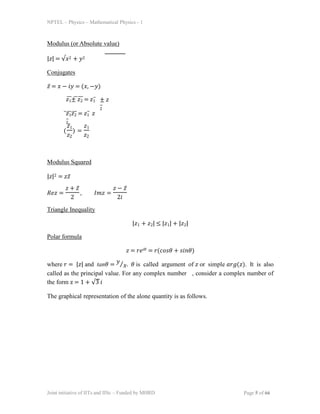
Modulus (or Absolute value)
|𝑧| = √𝑥2 + 𝑦2
Conjugates
𝑧̅ = 𝑥 − 𝑖𝑦 = (𝑥, −𝑦)
𝑧̅1̅±̅ ̅𝑧̅2̅ = 𝑧1̅
̅𝑧̅1̅𝑧̅2̅ = 𝑧1̅ 𝑧
2̅
± 𝑧
2̅
( ) =
𝑧̅1 𝑧1
𝑧2 𝑧2
Modulus Squared
|𝑧|2 = 𝑧𝑧̅
𝑅𝑒𝑧 =
𝑧 + 𝑧̅
2
, 𝐼𝑚𝑧 =
𝑧 − 𝑧̅
2𝑖
Triangle Inequality
|𝑧1 + 𝑧2| ≤ |𝑧1| + |𝑧2|
Polar formula
𝑧 = 𝑟𝑒𝑖𝜃 = 𝑟(𝑐𝑜𝑠𝜃 + 𝑠𝑖𝑛𝜃)
where 𝑟 = |𝑧| and tan𝜃 = 𝑦⁄𝑥. 𝜃 is called argument of 𝑧 or simple 𝑎𝑟𝑔(𝑧). It is also
called as the principal value. For any complex number , consider a complex number of
the form z = 1 + √3 𝑖
The graphical representation of the alone quantity is as follows.
Joint initiative of IITs and IISc – Funded by MHRD Page 5 of 66
NPTEL – Physics – Mathematical Physics - 1
The polar form is obtained by computing
𝑟 = |1 + √3𝑖| = √1 + 3 = 2
𝜃 = 60° = 𝜋⁄3
Thus 𝑧 = 1 + √3𝑖 = 2𝑒
𝑖𝜋⁄3
= 2(𝑐𝑜𝑠 𝜋⁄3 + 𝑖𝑠𝑖𝑛 𝜋⁄3)
These correspond to only one value of  in the interval [0,2𝜋]. This
range is called a principal range. Equivalently [−𝜋, 𝜋] can also be
considered as a principal range.
Products and quotients in exponential form
1. 𝑧1 = 𝑟1𝑒𝑖𝜃1
𝑧1𝑧2 = 𝑟1𝑟2𝑒𝑖(𝜃1+𝜃2)
𝑧2 = 𝑟2𝑒𝑖𝜃2
2. =
𝑧1 𝑟1
𝑧2 𝑟2
𝑒𝑖(𝜃1−𝜃2)
3. 𝑧 = 𝑟 𝑒
1 1 −𝑖𝜃
4. 𝑎𝑟𝑔 (𝑧1𝑧2) = 𝑎𝑟𝑔(𝑧1) + 𝑎𝑟𝑔(𝑧2)
𝑎𝑟𝑔(𝑧1𝑧2) = 𝜃1 + 𝜃2 + 2𝑛𝜋
𝑎𝑟𝑔 𝑧1 = 𝜃1 + 2𝑛𝜋
(n = 0, ±1, ±2 … … … . )
(𝑛1 = 0, ±1, ±2 … … … … …
)
(𝜃1 + 𝜃2) + 2𝑛𝜋 = (𝜃1 + 2𝑛1𝜋) + [𝜃2 + 2(𝑛 − 𝑛1)𝜋]
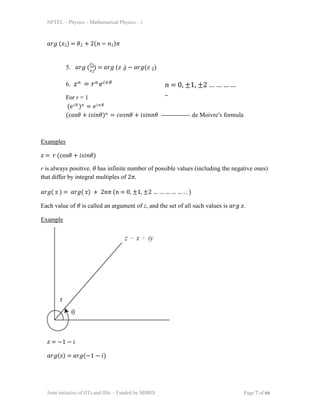
* It may be noted that 𝜃 + 2𝑛𝜋 where n
is an integer, is also an argument of z.
In general – 𝜋 < 𝜃 ≤ 𝜋. For 𝑧 = 0, the
argument of z is not defined.
The angle is given by,
𝑡𝑎𝑛−1 ( ) = 𝑡𝑎𝑛−1 √3
Joint initiative of IITs and IISc – Funded by MHRD Page 6 of 66
𝑦
𝑥
NPTEL – Physics – Mathematical Physics - 1
𝑎𝑟𝑔 (𝑧2) = 𝜃2 + 2(𝑛 − 𝑛1)𝜋
5. 𝑎𝑟𝑔 ( ) = 𝑎𝑟𝑔 (𝑧 ) − 𝑎𝑟𝑔(𝑧 )
𝑧1
𝑧2
1 2
6. 𝑧𝑛 = 𝑟𝑛 𝑒𝑖𝑛𝜃
For r = 1
(𝑒𝑖𝜃 )𝑛 = 𝑒𝑖𝑛𝜃
(cos𝜃 + 𝑖𝑠𝑖𝑛𝜃)𝑛 = 𝑐𝑜𝑠𝑛𝜃 + 𝑖𝑠𝑖𝑛𝑛𝜃 -------------- de Moivre’s formula
𝑛 = 0, ±1, ±2 … … … …
..
Examples
𝑧 = 𝑟 (cos𝜃 + 𝑖𝑠𝑖𝑛𝜃)
r is always positive. 𝜃 has infinite number of possible values (including the negative ones)
that differ by integral multiples of 2𝜋.
𝑎𝑟𝑔( z ) = 𝑎𝑟𝑔( z) + 2n𝜋 (n = 0, ±1, ±2 … … … … … . . )
Each value of 𝜃 is called an argument of z, and the set of all such values is 𝑎𝑟𝑔 𝑧.
Example
𝑧 = −1 − 𝑖
𝑎𝑟𝑔(z) = 𝑎𝑟𝑔(−1 − 𝑖)
Joint initiative of IITs and IISc – Funded by MHRD Page 7 of 66
NPTEL – Physics – Mathematical Physics - 1
1 𝑖
𝑧 = √2 (− − )
√2 √2
𝑡𝑎𝑛𝜃 = 1
𝜃 = 𝜋
. But since the complex number lies in the 3𝑟𝑑 quadrant, 𝑎𝑟𝑔( 𝑧) = −3𝜋
4
4
Since −𝜋 < 𝜃 < 𝜋, that’s why 𝑎𝑟𝑔(−1 – 𝑖) = 5𝜋
4
𝑎𝑟𝑔 (−1 – 𝑖) =
−3𝜋
4
+ 2𝑛𝜋 (𝑛 = 0, ±1, ±2 … … … .
)
−1 − 𝑖 = √2𝑒 [𝑖 (− 3𝜋
)]
4
This is one of the infinite possibilities for the exponential form,
−1 − 𝑖 = √2 exp [𝑖 (− 3𝜋
+ 2𝑛𝜋)]
4
(𝑛 = 0, ± 1, ±2 … … …
)
Roots of Complex numbers
Say 𝑧1 = 𝑟1𝑒𝑖𝜃1 , 𝑧2 = 𝑟2𝑒𝑖𝜃2
𝑧1 = 𝑧2 ⇒ 𝑟1 = 𝑟2, 𝜃1 = 𝜃2 + 2𝑘𝜋
Now find the nth root of 𝑧𝑛 = 𝑟𝑛𝑒𝑖𝑛𝜃
Say 𝑧𝑛 = 𝑧0
(𝑘 = 0, ±1, ±2 … … .
)
𝑟𝑛 𝑒𝑖𝜃𝑛 = 𝑟0𝑒𝑖𝜃
0
⇒ 𝑟𝑛 = 𝑟0 and 𝑛𝜃 = 𝜃0 + 2𝑘𝜋 (𝑘 = 0, ±1, ±2 … … …
)
So, 𝑟 = 𝑛
√𝑟0 and 𝜃
=
𝜃0 2𝑘𝜋
𝑛 𝑛
+
So, z = 𝑛
√𝑟0 exp [𝑖
(
𝜃0 2𝑘𝜋
𝑛 𝑛
+ )] (𝑘 = 0, ±1, ±2 … … .
)
are n roots of 𝑧0. All these roots lie on the circle |𝑧| = 𝑛
√𝑟0 about origin and are
equally spaced every 2𝜋⁄𝑛 radians, starting with 𝜃0⁄𝑛.
Joint initiative of IITs and IISc – Funded by MHRD Page 8 of 66
NPTEL – Physics – Mathematical Physics - 1
Example: 1.
Determine n roots of unity.
1 = 1 𝑒𝑥𝑝[𝑖(0 + 2𝑘𝜋)] 𝑘 = 0, ±1, ±2 … … …
..
1 = √1 𝑒𝑥𝑝 [𝑖 (
1⁄𝑛 𝑛 0 2𝑘𝜋
𝑛 𝑛
+ )] = 𝑒𝑥𝑝 (𝑖 )
2𝑘𝜋
𝑛
Thus for 𝑛 = 2, the roots are ±1
For 𝑛 = 3, the roots are 1, 𝜔, 𝜔2
where 𝜔𝑘 = 𝑒𝑥𝑝 (2𝜋𝑖𝑘
) 𝑛
Alternately, one can consider 𝑤 = 𝑢 + 𝑖𝑣 is the value of the function 𝑓 at
𝑧 = 𝑥 + 𝑖𝑦. ∴ 𝑢 + 𝑖𝑣 = 𝑓(𝑥 + 𝑖𝑦)
𝑓(𝑧) = 𝑢(𝑥, 𝑧) + 𝑖𝑣(𝑥, 𝑦)
In terms of 𝑟 and 𝜃
𝑢 + 𝑖𝑣 = 𝑓(𝑟𝑒𝜃)
𝑓(𝑧) = 𝑢(𝑟, 𝜃) + 𝑖𝑣(𝑟, 𝜃)
Joint initiative of IITs and IISc – Funded by MHRD Page 9 of 66
NPTEL – Physics – Mathematical Physics - 1
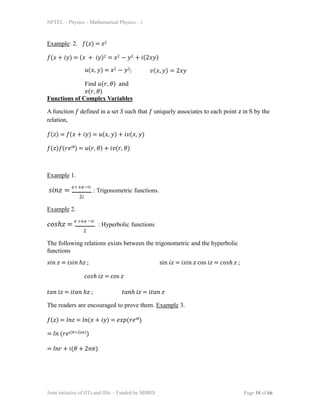
Example: 2. 𝑓(𝑧) = 𝑧2
𝑓(𝑥 + 𝑖𝑦) = (𝑥 + 𝑖𝑦)2 = 𝑥2 − 𝑦2 + 𝑖(2𝑥𝑦)
𝑢(𝑥, 𝑦) = 𝑥2 − 𝑦2;
Find 𝑢(𝑟, 𝜃) and
𝑣(𝑟, 𝜃)
𝑣(𝑥, 𝑦) = 2𝑥𝑦
Functions of Complex Variables
A function 𝑓 defined in a set S such that 𝑓 uniquely associates to each point 𝑧 in S by the
relation,
𝑓(𝑧) = 𝑓(𝑥 + 𝑖𝑦) = 𝑢(𝑥, 𝑦) + 𝑖𝑣(𝑥, 𝑦)
𝑓(𝑧)𝑓(𝑟𝑒𝑖𝜃) = 𝑢(𝑟, 𝜃) + 𝑖𝑣(𝑟, 𝜃)
Example 1.
𝑠𝑖𝑛𝑧 =
𝑒 +𝑒
: Trigonometric functions.
𝑧 −𝑖𝑧
2𝑖
Example 2.
𝑐𝑜𝑠ℎ𝑧 =
𝑒 +𝑒
: Hyperbolic functions
Joint initiative of IITs and IISc – Funded by MHRD Page 10 of 66
𝑧 −𝑖𝑧
2
The following relations exists between the trigonometric and the hyperbolic
functions
𝑠𝑖𝑛 𝑧 = 𝑖𝑠𝑖𝑛 ℎ𝑧 ; sin 𝑖𝑧 = 𝑖𝑠𝑖𝑛 𝑧 cos 𝑖𝑧 = 𝑐𝑜𝑠ℎ 𝑧 ;
𝑐𝑜𝑠ℎ 𝑖𝑧 = cos 𝑧
𝑡𝑎𝑛 𝑖𝑧 = 𝑖𝑡𝑎𝑛 ℎ𝑧 ; 𝑡𝑎𝑛ℎ 𝑖𝑧 = 𝑖𝑡𝑎𝑛 𝑧
The readers are encouraged to prove them. Example 3.
𝑓(𝑧) = 𝑙𝑛𝑧 = 𝑙𝑛(𝑥 + 𝑖𝑦) = 𝑒𝑥𝑝(𝑟𝑒𝑖𝜃)
= 𝑙𝑛 (𝑟𝑒𝑖(𝜃+2𝑛𝜋))
= 𝑙𝑛𝑟 + 𝑖(𝜃 + 2𝑛𝜋)
Joint initiative of IITs and IISc – Funded by MHRD Page 11 of 66
NPTEL – Physics – Mathematical Physics - 1
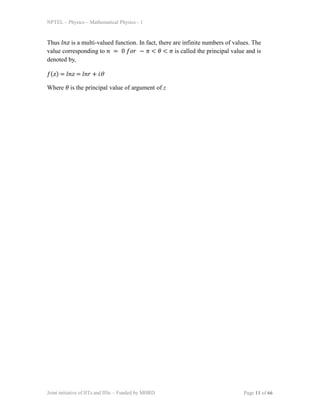
Thus 𝑙𝑛𝑧 is a multi-valued function. In fact, there are infinite numbers of values. The
value corresponding to 𝑛 = 0 𝑓𝑜𝑟 − 𝜋 < 𝜃 < 𝜋 is called the principal value and is
denoted by,
𝑓(𝑧) = 𝑙𝑛𝑧 = 𝑙𝑛𝑟 + 𝑖
Where 𝜃 is the principal value of argument of z

lec32.ppt

  • 1.
    NPTEL – Physics– Mathematical Physics - 1 Lecture 32 Properties of Complex numbers (contd) 1.Commutativity 𝑧1 + 𝑧2 = 𝑧2 + 𝑧1 𝑧1𝑧2 = 𝑧2𝑧1 2.Associativity (𝑧1 + 𝑧2) + 𝑧3 = 𝑧1 + (𝑧2 + 𝑧3) (𝑧1𝑧2)𝑧3 = 𝑧1(𝑧2𝑧3) 3. Distributivity 𝑧(𝑧1 + 𝑧2) = 𝑧𝑧1 + 𝑧𝑧2 4. Additive and Multiplicative identity 𝑧 + 0 = 𝑧 𝑧. 1 = 𝑧 5. Additive and Multiplicative inverse −𝑧 = (−𝑥, −𝑦) 𝑧−1 = ( 𝑥 −𝑦 𝑥2+𝑦 2 𝑥2+𝑦2 , ) , 𝑧 ≠ 0 Subtraction and division 𝑧1 − 𝑧2 = 𝑧1 + (−𝑧2) 𝑧1 𝑧2 = 𝑧 𝑧 Joint initiative of IITs and IISc – Funded by MHRD Page 4 of 66 1 2 −1
  • 2.
    NPTEL – Physics– Mathematical Physics - 1 Modulus (or Absolute value) |𝑧| = √𝑥2 + 𝑦2 Conjugates 𝑧̅ = 𝑥 − 𝑖𝑦 = (𝑥, −𝑦) 𝑧̅1̅±̅ ̅𝑧̅2̅ = 𝑧1̅ ̅𝑧̅1̅𝑧̅2̅ = 𝑧1̅ 𝑧 2̅ ± 𝑧 2̅ ( ) = 𝑧̅1 𝑧1 𝑧2 𝑧2 Modulus Squared |𝑧|2 = 𝑧𝑧̅ 𝑅𝑒𝑧 = 𝑧 + 𝑧̅ 2 , 𝐼𝑚𝑧 = 𝑧 − 𝑧̅ 2𝑖 Triangle Inequality |𝑧1 + 𝑧2| ≤ |𝑧1| + |𝑧2| Polar formula 𝑧 = 𝑟𝑒𝑖𝜃 = 𝑟(𝑐𝑜𝑠𝜃 + 𝑠𝑖𝑛𝜃) where 𝑟 = |𝑧| and tan𝜃 = 𝑦⁄𝑥. 𝜃 is called argument of 𝑧 or simple 𝑎𝑟𝑔(𝑧). It is also called as the principal value. For any complex number , consider a complex number of the form z = 1 + √3 𝑖 The graphical representation of the alone quantity is as follows. Joint initiative of IITs and IISc – Funded by MHRD Page 5 of 66
  • 3.
    NPTEL – Physics– Mathematical Physics - 1 The polar form is obtained by computing 𝑟 = |1 + √3𝑖| = √1 + 3 = 2 𝜃 = 60° = 𝜋⁄3 Thus 𝑧 = 1 + √3𝑖 = 2𝑒 𝑖𝜋⁄3 = 2(𝑐𝑜𝑠 𝜋⁄3 + 𝑖𝑠𝑖𝑛 𝜋⁄3) These correspond to only one value of  in the interval [0,2𝜋]. This range is called a principal range. Equivalently [−𝜋, 𝜋] can also be considered as a principal range. Products and quotients in exponential form 1. 𝑧1 = 𝑟1𝑒𝑖𝜃1 𝑧1𝑧2 = 𝑟1𝑟2𝑒𝑖(𝜃1+𝜃2) 𝑧2 = 𝑟2𝑒𝑖𝜃2 2. = 𝑧1 𝑟1 𝑧2 𝑟2 𝑒𝑖(𝜃1−𝜃2) 3. 𝑧 = 𝑟 𝑒 1 1 −𝑖𝜃 4. 𝑎𝑟𝑔 (𝑧1𝑧2) = 𝑎𝑟𝑔(𝑧1) + 𝑎𝑟𝑔(𝑧2) 𝑎𝑟𝑔(𝑧1𝑧2) = 𝜃1 + 𝜃2 + 2𝑛𝜋 𝑎𝑟𝑔 𝑧1 = 𝜃1 + 2𝑛𝜋 (n = 0, ±1, ±2 … … … . ) (𝑛1 = 0, ±1, ±2 … … … … … ) (𝜃1 + 𝜃2) + 2𝑛𝜋 = (𝜃1 + 2𝑛1𝜋) + [𝜃2 + 2(𝑛 − 𝑛1)𝜋] * It may be noted that 𝜃 + 2𝑛𝜋 where n is an integer, is also an argument of z. In general – 𝜋 < 𝜃 ≤ 𝜋. For 𝑧 = 0, the argument of z is not defined. The angle is given by, 𝑡𝑎𝑛−1 ( ) = 𝑡𝑎𝑛−1 √3 Joint initiative of IITs and IISc – Funded by MHRD Page 6 of 66 𝑦 𝑥
  • 4.
    NPTEL – Physics– Mathematical Physics - 1 𝑎𝑟𝑔 (𝑧2) = 𝜃2 + 2(𝑛 − 𝑛1)𝜋 5. 𝑎𝑟𝑔 ( ) = 𝑎𝑟𝑔 (𝑧 ) − 𝑎𝑟𝑔(𝑧 ) 𝑧1 𝑧2 1 2 6. 𝑧𝑛 = 𝑟𝑛 𝑒𝑖𝑛𝜃 For r = 1 (𝑒𝑖𝜃 )𝑛 = 𝑒𝑖𝑛𝜃 (cos𝜃 + 𝑖𝑠𝑖𝑛𝜃)𝑛 = 𝑐𝑜𝑠𝑛𝜃 + 𝑖𝑠𝑖𝑛𝑛𝜃 -------------- de Moivre’s formula 𝑛 = 0, ±1, ±2 … … … … .. Examples 𝑧 = 𝑟 (cos𝜃 + 𝑖𝑠𝑖𝑛𝜃) r is always positive. 𝜃 has infinite number of possible values (including the negative ones) that differ by integral multiples of 2𝜋. 𝑎𝑟𝑔( z ) = 𝑎𝑟𝑔( z) + 2n𝜋 (n = 0, ±1, ±2 … … … … … . . ) Each value of 𝜃 is called an argument of z, and the set of all such values is 𝑎𝑟𝑔 𝑧. Example 𝑧 = −1 − 𝑖 𝑎𝑟𝑔(z) = 𝑎𝑟𝑔(−1 − 𝑖) Joint initiative of IITs and IISc – Funded by MHRD Page 7 of 66
  • 5.
    NPTEL – Physics– Mathematical Physics - 1 1 𝑖 𝑧 = √2 (− − ) √2 √2 𝑡𝑎𝑛𝜃 = 1 𝜃 = 𝜋 . But since the complex number lies in the 3𝑟𝑑 quadrant, 𝑎𝑟𝑔( 𝑧) = −3𝜋 4 4 Since −𝜋 < 𝜃 < 𝜋, that’s why 𝑎𝑟𝑔(−1 – 𝑖) = 5𝜋 4 𝑎𝑟𝑔 (−1 – 𝑖) = −3𝜋 4 + 2𝑛𝜋 (𝑛 = 0, ±1, ±2 … … … . ) −1 − 𝑖 = √2𝑒 [𝑖 (− 3𝜋 )] 4 This is one of the infinite possibilities for the exponential form, −1 − 𝑖 = √2 exp [𝑖 (− 3𝜋 + 2𝑛𝜋)] 4 (𝑛 = 0, ± 1, ±2 … … … ) Roots of Complex numbers Say 𝑧1 = 𝑟1𝑒𝑖𝜃1 , 𝑧2 = 𝑟2𝑒𝑖𝜃2 𝑧1 = 𝑧2 ⇒ 𝑟1 = 𝑟2, 𝜃1 = 𝜃2 + 2𝑘𝜋 Now find the nth root of 𝑧𝑛 = 𝑟𝑛𝑒𝑖𝑛𝜃 Say 𝑧𝑛 = 𝑧0 (𝑘 = 0, ±1, ±2 … … . ) 𝑟𝑛 𝑒𝑖𝜃𝑛 = 𝑟0𝑒𝑖𝜃 0 ⇒ 𝑟𝑛 = 𝑟0 and 𝑛𝜃 = 𝜃0 + 2𝑘𝜋 (𝑘 = 0, ±1, ±2 … … … ) So, 𝑟 = 𝑛 √𝑟0 and 𝜃 = 𝜃0 2𝑘𝜋 𝑛 𝑛 + So, z = 𝑛 √𝑟0 exp [𝑖 ( 𝜃0 2𝑘𝜋 𝑛 𝑛 + )] (𝑘 = 0, ±1, ±2 … … . ) are n roots of 𝑧0. All these roots lie on the circle |𝑧| = 𝑛 √𝑟0 about origin and are equally spaced every 2𝜋⁄𝑛 radians, starting with 𝜃0⁄𝑛. Joint initiative of IITs and IISc – Funded by MHRD Page 8 of 66
  • 6.
    NPTEL – Physics– Mathematical Physics - 1 Example: 1. Determine n roots of unity. 1 = 1 𝑒𝑥𝑝[𝑖(0 + 2𝑘𝜋)] 𝑘 = 0, ±1, ±2 … … … .. 1 = √1 𝑒𝑥𝑝 [𝑖 ( 1⁄𝑛 𝑛 0 2𝑘𝜋 𝑛 𝑛 + )] = 𝑒𝑥𝑝 (𝑖 ) 2𝑘𝜋 𝑛 Thus for 𝑛 = 2, the roots are ±1 For 𝑛 = 3, the roots are 1, 𝜔, 𝜔2 where 𝜔𝑘 = 𝑒𝑥𝑝 (2𝜋𝑖𝑘 ) 𝑛 Alternately, one can consider 𝑤 = 𝑢 + 𝑖𝑣 is the value of the function 𝑓 at 𝑧 = 𝑥 + 𝑖𝑦. ∴ 𝑢 + 𝑖𝑣 = 𝑓(𝑥 + 𝑖𝑦) 𝑓(𝑧) = 𝑢(𝑥, 𝑧) + 𝑖𝑣(𝑥, 𝑦) In terms of 𝑟 and 𝜃 𝑢 + 𝑖𝑣 = 𝑓(𝑟𝑒𝜃) 𝑓(𝑧) = 𝑢(𝑟, 𝜃) + 𝑖𝑣(𝑟, 𝜃) Joint initiative of IITs and IISc – Funded by MHRD Page 9 of 66
  • 7.
    NPTEL – Physics– Mathematical Physics - 1 Example: 2. 𝑓(𝑧) = 𝑧2 𝑓(𝑥 + 𝑖𝑦) = (𝑥 + 𝑖𝑦)2 = 𝑥2 − 𝑦2 + 𝑖(2𝑥𝑦) 𝑢(𝑥, 𝑦) = 𝑥2 − 𝑦2; Find 𝑢(𝑟, 𝜃) and 𝑣(𝑟, 𝜃) 𝑣(𝑥, 𝑦) = 2𝑥𝑦 Functions of Complex Variables A function 𝑓 defined in a set S such that 𝑓 uniquely associates to each point 𝑧 in S by the relation, 𝑓(𝑧) = 𝑓(𝑥 + 𝑖𝑦) = 𝑢(𝑥, 𝑦) + 𝑖𝑣(𝑥, 𝑦) 𝑓(𝑧)𝑓(𝑟𝑒𝑖𝜃) = 𝑢(𝑟, 𝜃) + 𝑖𝑣(𝑟, 𝜃) Example 1. 𝑠𝑖𝑛𝑧 = 𝑒 +𝑒 : Trigonometric functions. 𝑧 −𝑖𝑧 2𝑖 Example 2. 𝑐𝑜𝑠ℎ𝑧 = 𝑒 +𝑒 : Hyperbolic functions Joint initiative of IITs and IISc – Funded by MHRD Page 10 of 66 𝑧 −𝑖𝑧 2 The following relations exists between the trigonometric and the hyperbolic functions 𝑠𝑖𝑛 𝑧 = 𝑖𝑠𝑖𝑛 ℎ𝑧 ; sin 𝑖𝑧 = 𝑖𝑠𝑖𝑛 𝑧 cos 𝑖𝑧 = 𝑐𝑜𝑠ℎ 𝑧 ; 𝑐𝑜𝑠ℎ 𝑖𝑧 = cos 𝑧 𝑡𝑎𝑛 𝑖𝑧 = 𝑖𝑡𝑎𝑛 ℎ𝑧 ; 𝑡𝑎𝑛ℎ 𝑖𝑧 = 𝑖𝑡𝑎𝑛 𝑧 The readers are encouraged to prove them. Example 3. 𝑓(𝑧) = 𝑙𝑛𝑧 = 𝑙𝑛(𝑥 + 𝑖𝑦) = 𝑒𝑥𝑝(𝑟𝑒𝑖𝜃) = 𝑙𝑛 (𝑟𝑒𝑖(𝜃+2𝑛𝜋)) = 𝑙𝑛𝑟 + 𝑖(𝜃 + 2𝑛𝜋)
  • 8.
    Joint initiative ofIITs and IISc – Funded by MHRD Page 11 of 66 NPTEL – Physics – Mathematical Physics - 1 Thus 𝑙𝑛𝑧 is a multi-valued function. In fact, there are infinite numbers of values. The value corresponding to 𝑛 = 0 𝑓𝑜𝑟 − 𝜋 < 𝜃 < 𝜋 is called the principal value and is denoted by, 𝑓(𝑧) = 𝑙𝑛𝑧 = 𝑙𝑛𝑟 + 𝑖 Where 𝜃 is the principal value of argument of z