NPTEL – Physics – Mathematical Physics - 1
Lecture 28
Algelraic properties of tensors
Like vectors, the tensors obey certain operations which are:
a) Addition
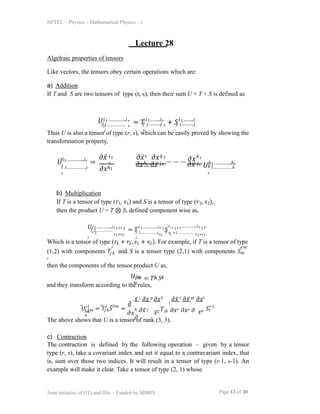
If T and S are two tensors of type (r, s), then their sum U = T + S is defined as
𝑈𝑗1………………
𝑗
𝑠
𝑖1…………..𝑖𝑟
= 𝑇𝑖1……..𝑖𝑟
+ 𝑆𝑖1……..𝑖
𝑟
𝑗 1………𝑗 𝑠 𝑗 1………𝑗
𝑠
Thus U is also a tensor of type (r, s), which can be easily proved by showing the
transformation property,
𝑈̅𝑖1…………..𝑖𝑟
=
𝜕𝑥̅
𝑗 1………………𝑗
𝑠
𝜕𝑥ℎ1
𝑖1 𝑖
𝑟
𝜕𝑥̅ 𝜕𝑥
… … …
𝜕𝑥ℎ𝑟 𝜕𝑥̅ 𝑗1
… … …
𝜕𝑥̅ 𝑗𝑠
𝑘1
𝜕𝑥𝑘𝑠
𝑈ℎ1…………..ℎ𝑟
Page 13 of 20
Joint initiative of IITs and IISc – Funded by MHRD
𝑘1………………𝑘
𝑟
b) Multiplication
If T is a tensor of type (𝑟1, 𝑠1) and S is a tensor of type (𝑟2, 𝑠2),
then the product U = T ⊗ S, defined component wise as,
𝑈𝑗 1………………
𝑗
𝑠1+𝑠2 𝑠1 1 𝑠1+𝑠2
𝑖1…………..𝑖𝑟 1+𝑟 2
= 𝑇
𝑖1…………..𝑖𝑟 1
𝑆
𝑖𝑖𝑟 1+1 …………..𝑖𝑟 1+
𝑟 2 𝑗 1………………𝑗 𝑗 𝑠 +1………………
𝑗
Which is a tensor of type (𝑟1 + 𝑟2, 𝑠1 + 𝑠2). For example, if T is a tensor of type
𝑖 𝑒𝑚
(1,2) with components 𝑇𝑗 𝑘 and S is a tensor type (2,1) with components 𝑆𝑚
,
then the components of the tensor product U as,
𝑈𝑗𝑙𝑚 𝑗𝑘 𝑛
and they transform according to the rules,
𝑖𝑙𝑚 = 𝑇𝑖 𝑆𝑙
𝑚
𝑈
̅ 𝑗 𝑙𝑚 𝑗 𝑘
𝑛
𝑖𝑙
𝑚
= 𝑇 𝑆 =
̅ ̅
𝑖 𝑙𝑚 𝜕
𝜕𝑥
𝑆𝑡
𝑟𝑠
The above shows that U is a tensor of rank (3, 3).
c) Contraction
The contraction is defined by the following operation – given by a tensor
type (r, s), take a covariant index and set it equal to a contravariant index, that
is, sum over those two indices. It will result in a tensor of type (r-1, s-1). An
example will make it clear. Take a tensor of type (2, 1) whose
𝑥̅ 𝑖 𝜕𝑥 𝑝 𝜕𝑥2 𝜕𝑥̅ 𝑙 𝜕𝑥̅ 𝑚 𝜕𝑥𝑡
𝑖
ℎ 𝜕𝑥̅ 𝑗
𝜕
𝑥̅2 𝑇𝑗𝑘 𝜕𝑥𝑟 𝜕𝑥𝑠 𝜕 𝑥𝑛
Page 14 of 20
Joint initiative of IITs and IISc – Funded by MHRD
NPTEL – Physics – Mathematical Physics - 1
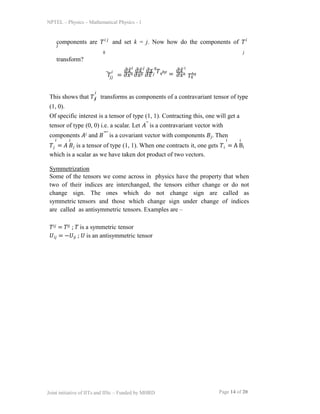
components are 𝑇𝑖 𝑗
and set k = j. Now how do the components of 𝑇𝑖
𝑗
𝑘 𝑗
transform?
𝑇 =
̅ 𝑗
𝑖
𝑗
𝜕𝑥̅ 𝜕𝑥̅ 𝜕𝑥 ℎ𝑝
=
𝜕𝑥̅
𝑖 𝑗 𝑞 𝑖
𝜕𝑥𝑛 𝜕𝑥𝑝 𝜕𝑥̅ 𝑗 𝑇𝑞
𝜕𝑥ℎ
𝑇ℎ𝑞
𝑞
This shows that 𝑇𝑗 transforms as components of a contravariant tensor of type
(1, 0).
Of specific interest is a tensor of type (1, 1). Contracting this, one will get a
tensor of type (0, 0) i.e. a scalar. Let 𝐴⃑ is a contravariant vector with
components 𝐴𝑖 and 𝐵⃗⃑ is a covariant vector with components 𝐵𝑗. Then
𝑇𝑗 = 𝐴 𝐵𝑗 is a tensor of type (1, 1). When one contracts it, one gets 𝑇𝑖 = A Bi
which is a scalar as we have taken dot product of two vectors.
𝑖
𝑗
𝑖 𝑖 𝑖 i
Symmetrization
Some of the tensors we come across in physics have the property that when
two of their indices are interchanged, the tensors either change or do not
change sign. The ones which do not change sign are called as
symmetric tensors and those which change sign under change of indices
are called as antisymmetric tensors. Examples are –
𝑇𝑖𝑗 = 𝑇ji ; 𝑇 is a symmetric tensor
𝑈𝑖𝑗 = −𝑈ji ; 𝑈 is an antisymmetric tensor

lec28.ppt

  • 1.
    NPTEL – Physics– Mathematical Physics - 1 Lecture 28 Algelraic properties of tensors Like vectors, the tensors obey certain operations which are: a) Addition If T and S are two tensors of type (r, s), then their sum U = T + S is defined as 𝑈𝑗1……………… 𝑗 𝑠 𝑖1…………..𝑖𝑟 = 𝑇𝑖1……..𝑖𝑟 + 𝑆𝑖1……..𝑖 𝑟 𝑗 1………𝑗 𝑠 𝑗 1………𝑗 𝑠 Thus U is also a tensor of type (r, s), which can be easily proved by showing the transformation property, 𝑈̅𝑖1…………..𝑖𝑟 = 𝜕𝑥̅ 𝑗 1………………𝑗 𝑠 𝜕𝑥ℎ1 𝑖1 𝑖 𝑟 𝜕𝑥̅ 𝜕𝑥 … … … 𝜕𝑥ℎ𝑟 𝜕𝑥̅ 𝑗1 … … … 𝜕𝑥̅ 𝑗𝑠 𝑘1 𝜕𝑥𝑘𝑠 𝑈ℎ1…………..ℎ𝑟 Page 13 of 20 Joint initiative of IITs and IISc – Funded by MHRD 𝑘1………………𝑘 𝑟 b) Multiplication If T is a tensor of type (𝑟1, 𝑠1) and S is a tensor of type (𝑟2, 𝑠2), then the product U = T ⊗ S, defined component wise as, 𝑈𝑗 1……………… 𝑗 𝑠1+𝑠2 𝑠1 1 𝑠1+𝑠2 𝑖1…………..𝑖𝑟 1+𝑟 2 = 𝑇 𝑖1…………..𝑖𝑟 1 𝑆 𝑖𝑖𝑟 1+1 …………..𝑖𝑟 1+ 𝑟 2 𝑗 1………………𝑗 𝑗 𝑠 +1……………… 𝑗 Which is a tensor of type (𝑟1 + 𝑟2, 𝑠1 + 𝑠2). For example, if T is a tensor of type 𝑖 𝑒𝑚 (1,2) with components 𝑇𝑗 𝑘 and S is a tensor type (2,1) with components 𝑆𝑚 , then the components of the tensor product U as, 𝑈𝑗𝑙𝑚 𝑗𝑘 𝑛 and they transform according to the rules, 𝑖𝑙𝑚 = 𝑇𝑖 𝑆𝑙 𝑚 𝑈 ̅ 𝑗 𝑙𝑚 𝑗 𝑘 𝑛 𝑖𝑙 𝑚 = 𝑇 𝑆 = ̅ ̅ 𝑖 𝑙𝑚 𝜕 𝜕𝑥 𝑆𝑡 𝑟𝑠 The above shows that U is a tensor of rank (3, 3). c) Contraction The contraction is defined by the following operation – given by a tensor type (r, s), take a covariant index and set it equal to a contravariant index, that is, sum over those two indices. It will result in a tensor of type (r-1, s-1). An example will make it clear. Take a tensor of type (2, 1) whose 𝑥̅ 𝑖 𝜕𝑥 𝑝 𝜕𝑥2 𝜕𝑥̅ 𝑙 𝜕𝑥̅ 𝑚 𝜕𝑥𝑡 𝑖 ℎ 𝜕𝑥̅ 𝑗 𝜕 𝑥̅2 𝑇𝑗𝑘 𝜕𝑥𝑟 𝜕𝑥𝑠 𝜕 𝑥𝑛
  • 2.
    Page 14 of20 Joint initiative of IITs and IISc – Funded by MHRD NPTEL – Physics – Mathematical Physics - 1 components are 𝑇𝑖 𝑗 and set k = j. Now how do the components of 𝑇𝑖 𝑗 𝑘 𝑗 transform? 𝑇 = ̅ 𝑗 𝑖 𝑗 𝜕𝑥̅ 𝜕𝑥̅ 𝜕𝑥 ℎ𝑝 = 𝜕𝑥̅ 𝑖 𝑗 𝑞 𝑖 𝜕𝑥𝑛 𝜕𝑥𝑝 𝜕𝑥̅ 𝑗 𝑇𝑞 𝜕𝑥ℎ 𝑇ℎ𝑞 𝑞 This shows that 𝑇𝑗 transforms as components of a contravariant tensor of type (1, 0). Of specific interest is a tensor of type (1, 1). Contracting this, one will get a tensor of type (0, 0) i.e. a scalar. Let 𝐴⃑ is a contravariant vector with components 𝐴𝑖 and 𝐵⃗⃑ is a covariant vector with components 𝐵𝑗. Then 𝑇𝑗 = 𝐴 𝐵𝑗 is a tensor of type (1, 1). When one contracts it, one gets 𝑇𝑖 = A Bi which is a scalar as we have taken dot product of two vectors. 𝑖 𝑗 𝑖 𝑖 𝑖 i Symmetrization Some of the tensors we come across in physics have the property that when two of their indices are interchanged, the tensors either change or do not change sign. The ones which do not change sign are called as symmetric tensors and those which change sign under change of indices are called as antisymmetric tensors. Examples are – 𝑇𝑖𝑗 = 𝑇ji ; 𝑇 is a symmetric tensor 𝑈𝑖𝑗 = −𝑈ji ; 𝑈 is an antisymmetric tensor