NPTEL – Physics – Mathematical Physics - 1
Lecture 39
TAYLOR & LAURENT SERIES
Taylor series: Let 𝑧 = 𝑧0 be a point in the region where 𝑓(𝑧) is analytic, then there is a
unique power series expansion of 𝑓(𝑧) given by,
𝑓(𝑧) = ∑∞ 𝑎𝑛(𝑧 − 𝑧0)𝑛 where the coefficients 𝑎 =
ℎ=0 𝑛
1 𝑑𝑛
𝑓
𝑛! 𝑑𝑧𝑛
𝑧=
𝑧
|
0
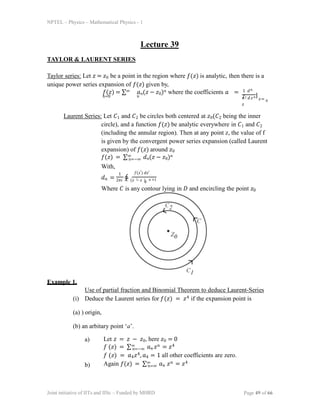
Laurent Series: Let 𝐶1 and 𝐶2 be circles both centered at 𝑧0(𝐶2 being the inner
circle), and a function 𝑓(𝑧) be analytic everywhere in 𝐶1 and 𝐶2
(including the annular region). Then at any point z, the value of f
is given by the convergent power series expansion (called Laurent
expansion) of 𝑓(𝑧) around 𝑧0
𝑓(𝑧) = ∑∞ 𝑑𝑛(𝑧 − 𝑧0)𝑛
𝑛=−∞
With,
𝑑 =
𝑛
1
2𝜋𝑖 𝐶 (𝑧 − 𝑧 )
∮
𝑓(𝑧′) 𝑑𝑧′
′
0
𝑛 +1
Where 𝐶 is any contour lying in 𝐷 and encircling the point 𝑧0
Example 1.
Use of partial fraction and Binomial Theorem to deduce Laurent-Series
(i) Deduce the Laurent series for 𝑓(𝑧) = 𝑧4 if the expansion point is
(a) ) origin,
(b) an arbitary point ‘a’.
a) Let 𝑧 = 𝑧 − 𝑧0, here 𝑧0 = 0
𝑓 (𝑧) = ∑∞ 𝑎𝑛 𝑧𝑛 = 𝑧4
𝑛=−∞
𝑓 (𝑧) = 𝑎4𝑧4, 𝑎4 = 1 all other coefficients are zero.
b) Again 𝑓(𝑧) = ∑∞ 𝑎𝑛 𝑧𝑛 = 𝑧4
𝑛=∞
Joint initiative of IITs and IISc – Funded by MHRD Page 49 of 66
NPTEL – Physics – Mathematical Physics - 1
About a point ‘a’
𝑧4 = (𝑧 − 𝑎 + 𝑎)4 = (𝑎 + 𝑧)4
= 𝑎4 + 4𝑎3𝑧 + 6𝑎2𝑧2 + 4𝑎𝑧3 + 𝑧4
Here 𝑎0 = 𝑎4, 𝑎1 = 4𝑎3, 𝑎2 = 6𝑎2, 𝑎3 = 4𝑎, 𝑎4 = 1
Thus all the coefficients are non zero.
(ii) Do the same as (𝑖) → (𝑏) for 𝑓(𝑧) =
for small |𝑧 − 𝑎|?
1
. What is the region of validity
𝑍4
𝑓(𝑧) = 1
= 1
(𝑍+𝑎−𝑎)𝑛 (𝑍+𝑎)𝑛
𝑍𝑛
1
=
1
= 𝑎𝑛(1+𝑍
𝑎
)
𝑛 = (1 + )
1
𝑎
𝑛
𝑧 −𝑛
𝑎
Then,
𝑓 (𝑧) = 1
[1 − 𝑛𝑧
+ 𝑛(𝑛+1)
(𝑧
) − 𝑛(𝑛+1)(𝑛+2)
(𝑧
)]
𝑎
𝑛
𝑎 2! 𝑎 3! 𝑎
2
𝑧 = 𝑧 – 𝑎
The region of validity is
|𝑧
| < 1
𝑎
The region of validity has to be specified, as
Otherwise we cannot do the binomial expansion.
For 𝑓 =
= 1
1
= 1 1
𝑧4 (𝑧+𝑎−𝑎)4 (𝑧+𝑎)4
=
𝑎4(1+𝑧
)
4
𝑎
5 𝑎4
= (1 − 4 + 10 − 20 + 35 )
1
𝑎4 𝑎2
𝑧 𝑧2 𝑧3
𝑎3
𝑧4
For small |𝑧 − 𝑎|, the region of validity is
|𝑍
| < 1
𝑎
Or, |𝑧 − 𝑎| < 𝑎
That is for a point inside a circle.
Example 2.
Derive the Laurent series by evaluating the coefficients 𝑎𝑛 via the residue
theorem for 𝑓(𝑧) = ∑∞ 𝑎𝑛𝑧𝑛 where 𝑧 = 𝑧 − 𝑧 , the point of expansion is 𝑧 and
𝑛=−∞ 0 0
the coefficients are given by,
𝑎 =
∮
𝑛
1
2𝜋𝑖 𝐶 (𝑧 −𝑧 )
Joint initiative of IITs and IISc – Funded by MHRD Page 50 of 66
𝑓(𝑧′)𝑑𝑧′
+ ′ 𝑛+1
0
Where 𝐶+ must enclose the point of expansion 𝑧0.
NPTEL – Physics – Mathematical Physics - 1
a) Take 𝑓(𝑧) = 𝑧, i.e. no singularity, 𝑧0 is finite
b) Take 𝑓(𝑧) = 1
i.e. has a singularity at the point of expansion and 𝑧 = 1
𝑧′ 0
Solution
a) 𝑧 = 𝑧0 + (𝑧 − 𝑧0) = 𝑧0 + 𝑎1𝑧 where 𝑧 = 𝑧 − 𝑧0
Laurent series is valid in an annular region. 𝑓(𝑧) is analytic inside the annular region and
on the boundary of the ring spaped region bounded by two concentric circles 𝑐1 𝑎𝑛𝑑 𝑐2 or
radii 𝑟1 and 𝑟2 respectively (𝑟1 > 𝑟2). Here the outer boundary may extend upto infinity
(or radius 𝑟1) and the inner region can be reduced to a small circle containing the point of
expansion point 𝑧0. We shall use the residue theorem to find the coefficients
𝑎 =
𝑛
1 𝑓(𝑧´ )𝑑𝑧´ 1
2𝜋𝑖 (𝑧´−𝑧 )
∮ = ∮ 𝐹(𝑧)𝑑𝑧
0
𝑛 +1 2𝜋
𝑐+ +
𝑐
𝐼 =
1
2𝜋𝑖
[2𝜋𝑖 × (sum of residue of 𝐹(𝑧))]
Now,
𝛼 =
−1
1
(𝑗−1)!
𝐿𝑡
𝑧′→𝑧0 𝑑𝑧
𝑑𝑗−1
′ 𝑗−1 [( − 𝑧 ) 𝐹(𝑧)]
𝑧′ 0
𝑗
Here j = n + 1
Thus,
𝑎−1 = 𝑛!
𝐿𝑡 𝑑𝑧′𝑛 [(𝑧′ − 𝑧0)
1
𝑧′→𝑧0
𝑑𝑛
𝑛+1 𝑧 ′
(𝑧−𝑧 )
0
𝑛 +1]
= 1
𝑛!
𝑧′→𝑧0 𝑑
𝐿𝑡
𝑑
z
𝑛
𝑧′ 𝑛
Hence it is clear that if 𝑛 > 1, 𝑎−1 = 0
For 𝑛 = −1
Residue =
1
∮ 𝑧′𝑑𝑧′ = 0
2𝜋𝑖
Joint initiative of IITs and IISc – Funded by MHRD Page 51 of 66
NPTEL – Physics – Mathematical Physics - 1
2𝜋𝑖
Similarly for 𝑛 = −2, Residue =
integral theorem)
1
∮ 𝑧′(𝑧′ − 𝑧 )
0 𝑑𝑧′
𝑐+ = 0 (by Cauchy’s
Thus Residue = 1 for 𝑛 = 1
Residue = 𝑧0 for 𝑛 = 0
b) 𝑓(𝑧) =
1
, 𝑧 = 1
𝑧 0
At the point of expression, there is no singularity
𝑎−1 = (𝑗−1)! 𝑑
1 𝑑𝑗−1
𝑧′
𝑗−1 [(𝑧′ − 𝑧0)
𝑗 𝑓(𝑧′)
(𝑧−𝑧0)𝑛+1]
Here the residue of the function 𝑓 = 1
has a (𝑛 + 1)𝑡ℎ order pole
𝑧
at 𝑧0
So 𝑗 = 𝑛 + 1
Example 3.
In dealing with a many particle system of bosons, the Greens function is written
as,
𝐺(𝑤0) = 2𝜋𝑖
∫𝑐 (𝑒𝛽𝑤𝑛−1)(𝑤 +𝑤
1 𝑑𝑤
𝑛
𝑛
2
0
2)
Where 𝑤0 is some characteristic frequency of the boson and 𝑤𝑛 is the Bosonic
Matsubara frequency.
𝑤𝑛 =
2𝜋𝑛
𝑖 𝛽
where 𝑛 = 0, ±1, ±2 … … … … and 𝛽 is the inverse temperature.
Compute the Greens function using an appropriate contour.
Solution
Write 𝑧 = 𝑖𝑤𝑛
𝐺(𝑤0) = 2𝜋𝑖
∫𝑐 (𝑒𝛽𝑧−1)(−𝑧2+𝑤
1 𝑑𝑧
02)
The integrand on the RHS has two simple poles on the real axis at ±𝑤0 and a
branch cut coming from the first bracket in the denominator. Thus the contour is
as follows-
Joint initiative of IITs and IISc – Funded by MHRD Page 52 of 66
NPTEL – Physics – Mathematical Physics - 1
𝐶1 is the contour in the complex w-plane encircling the poles of (𝑒𝛽𝑤−1)
which lie
1
on the imaginary axis at 𝑤 = 2𝜋𝑛𝑖
. 𝛽
We can obtain the Greens function in a closed form by deforming the contour 𝐶1
to a contour 𝐶2 encircle the simple poles ±𝑤0. The integrals over the large arcs
involved in the deformation vanish
Thus,
1 𝑑𝑧
2𝜋𝑖 𝑐 (𝑒𝛽𝑤0 −1)(−𝑧2+𝑤0
2)
∮
=
1 1
2𝑤0 𝑒𝛽𝑤0 −1
[ +
1
1−𝑒−𝛽𝑤0
]
=
1
2𝑤0
𝑐𝑜𝑡ℎ ( )
Joint initiative of IITs and IISc – Funded by MHRD Page 53 of 66
𝛽𝑤0
2

lec39.ppt

  • 1.
    NPTEL – Physics– Mathematical Physics - 1 Lecture 39 TAYLOR & LAURENT SERIES Taylor series: Let 𝑧 = 𝑧0 be a point in the region where 𝑓(𝑧) is analytic, then there is a unique power series expansion of 𝑓(𝑧) given by, 𝑓(𝑧) = ∑∞ 𝑎𝑛(𝑧 − 𝑧0)𝑛 where the coefficients 𝑎 = ℎ=0 𝑛 1 𝑑𝑛 𝑓 𝑛! 𝑑𝑧𝑛 𝑧= 𝑧 | 0 Laurent Series: Let 𝐶1 and 𝐶2 be circles both centered at 𝑧0(𝐶2 being the inner circle), and a function 𝑓(𝑧) be analytic everywhere in 𝐶1 and 𝐶2 (including the annular region). Then at any point z, the value of f is given by the convergent power series expansion (called Laurent expansion) of 𝑓(𝑧) around 𝑧0 𝑓(𝑧) = ∑∞ 𝑑𝑛(𝑧 − 𝑧0)𝑛 𝑛=−∞ With, 𝑑 = 𝑛 1 2𝜋𝑖 𝐶 (𝑧 − 𝑧 ) ∮ 𝑓(𝑧′) 𝑑𝑧′ ′ 0 𝑛 +1 Where 𝐶 is any contour lying in 𝐷 and encircling the point 𝑧0 Example 1. Use of partial fraction and Binomial Theorem to deduce Laurent-Series (i) Deduce the Laurent series for 𝑓(𝑧) = 𝑧4 if the expansion point is (a) ) origin, (b) an arbitary point ‘a’. a) Let 𝑧 = 𝑧 − 𝑧0, here 𝑧0 = 0 𝑓 (𝑧) = ∑∞ 𝑎𝑛 𝑧𝑛 = 𝑧4 𝑛=−∞ 𝑓 (𝑧) = 𝑎4𝑧4, 𝑎4 = 1 all other coefficients are zero. b) Again 𝑓(𝑧) = ∑∞ 𝑎𝑛 𝑧𝑛 = 𝑧4 𝑛=∞ Joint initiative of IITs and IISc – Funded by MHRD Page 49 of 66
  • 2.
    NPTEL – Physics– Mathematical Physics - 1 About a point ‘a’ 𝑧4 = (𝑧 − 𝑎 + 𝑎)4 = (𝑎 + 𝑧)4 = 𝑎4 + 4𝑎3𝑧 + 6𝑎2𝑧2 + 4𝑎𝑧3 + 𝑧4 Here 𝑎0 = 𝑎4, 𝑎1 = 4𝑎3, 𝑎2 = 6𝑎2, 𝑎3 = 4𝑎, 𝑎4 = 1 Thus all the coefficients are non zero. (ii) Do the same as (𝑖) → (𝑏) for 𝑓(𝑧) = for small |𝑧 − 𝑎|? 1 . What is the region of validity 𝑍4 𝑓(𝑧) = 1 = 1 (𝑍+𝑎−𝑎)𝑛 (𝑍+𝑎)𝑛 𝑍𝑛 1 = 1 = 𝑎𝑛(1+𝑍 𝑎 ) 𝑛 = (1 + ) 1 𝑎 𝑛 𝑧 −𝑛 𝑎 Then, 𝑓 (𝑧) = 1 [1 − 𝑛𝑧 + 𝑛(𝑛+1) (𝑧 ) − 𝑛(𝑛+1)(𝑛+2) (𝑧 )] 𝑎 𝑛 𝑎 2! 𝑎 3! 𝑎 2 𝑧 = 𝑧 – 𝑎 The region of validity is |𝑧 | < 1 𝑎 The region of validity has to be specified, as Otherwise we cannot do the binomial expansion. For 𝑓 = = 1 1 = 1 1 𝑧4 (𝑧+𝑎−𝑎)4 (𝑧+𝑎)4 = 𝑎4(1+𝑧 ) 4 𝑎 5 𝑎4 = (1 − 4 + 10 − 20 + 35 ) 1 𝑎4 𝑎2 𝑧 𝑧2 𝑧3 𝑎3 𝑧4 For small |𝑧 − 𝑎|, the region of validity is |𝑍 | < 1 𝑎 Or, |𝑧 − 𝑎| < 𝑎 That is for a point inside a circle. Example 2. Derive the Laurent series by evaluating the coefficients 𝑎𝑛 via the residue theorem for 𝑓(𝑧) = ∑∞ 𝑎𝑛𝑧𝑛 where 𝑧 = 𝑧 − 𝑧 , the point of expansion is 𝑧 and 𝑛=−∞ 0 0 the coefficients are given by, 𝑎 = ∮ 𝑛 1 2𝜋𝑖 𝐶 (𝑧 −𝑧 ) Joint initiative of IITs and IISc – Funded by MHRD Page 50 of 66 𝑓(𝑧′)𝑑𝑧′ + ′ 𝑛+1 0 Where 𝐶+ must enclose the point of expansion 𝑧0.
  • 3.
    NPTEL – Physics– Mathematical Physics - 1 a) Take 𝑓(𝑧) = 𝑧, i.e. no singularity, 𝑧0 is finite b) Take 𝑓(𝑧) = 1 i.e. has a singularity at the point of expansion and 𝑧 = 1 𝑧′ 0 Solution a) 𝑧 = 𝑧0 + (𝑧 − 𝑧0) = 𝑧0 + 𝑎1𝑧 where 𝑧 = 𝑧 − 𝑧0 Laurent series is valid in an annular region. 𝑓(𝑧) is analytic inside the annular region and on the boundary of the ring spaped region bounded by two concentric circles 𝑐1 𝑎𝑛𝑑 𝑐2 or radii 𝑟1 and 𝑟2 respectively (𝑟1 > 𝑟2). Here the outer boundary may extend upto infinity (or radius 𝑟1) and the inner region can be reduced to a small circle containing the point of expansion point 𝑧0. We shall use the residue theorem to find the coefficients 𝑎 = 𝑛 1 𝑓(𝑧´ )𝑑𝑧´ 1 2𝜋𝑖 (𝑧´−𝑧 ) ∮ = ∮ 𝐹(𝑧)𝑑𝑧 0 𝑛 +1 2𝜋 𝑐+ + 𝑐 𝐼 = 1 2𝜋𝑖 [2𝜋𝑖 × (sum of residue of 𝐹(𝑧))] Now, 𝛼 = −1 1 (𝑗−1)! 𝐿𝑡 𝑧′→𝑧0 𝑑𝑧 𝑑𝑗−1 ′ 𝑗−1 [( − 𝑧 ) 𝐹(𝑧)] 𝑧′ 0 𝑗 Here j = n + 1 Thus, 𝑎−1 = 𝑛! 𝐿𝑡 𝑑𝑧′𝑛 [(𝑧′ − 𝑧0) 1 𝑧′→𝑧0 𝑑𝑛 𝑛+1 𝑧 ′ (𝑧−𝑧 ) 0 𝑛 +1] = 1 𝑛! 𝑧′→𝑧0 𝑑 𝐿𝑡 𝑑 z 𝑛 𝑧′ 𝑛 Hence it is clear that if 𝑛 > 1, 𝑎−1 = 0 For 𝑛 = −1 Residue = 1 ∮ 𝑧′𝑑𝑧′ = 0 2𝜋𝑖 Joint initiative of IITs and IISc – Funded by MHRD Page 51 of 66
  • 4.
    NPTEL – Physics– Mathematical Physics - 1 2𝜋𝑖 Similarly for 𝑛 = −2, Residue = integral theorem) 1 ∮ 𝑧′(𝑧′ − 𝑧 ) 0 𝑑𝑧′ 𝑐+ = 0 (by Cauchy’s Thus Residue = 1 for 𝑛 = 1 Residue = 𝑧0 for 𝑛 = 0 b) 𝑓(𝑧) = 1 , 𝑧 = 1 𝑧 0 At the point of expression, there is no singularity 𝑎−1 = (𝑗−1)! 𝑑 1 𝑑𝑗−1 𝑧′ 𝑗−1 [(𝑧′ − 𝑧0) 𝑗 𝑓(𝑧′) (𝑧−𝑧0)𝑛+1] Here the residue of the function 𝑓 = 1 has a (𝑛 + 1)𝑡ℎ order pole 𝑧 at 𝑧0 So 𝑗 = 𝑛 + 1 Example 3. In dealing with a many particle system of bosons, the Greens function is written as, 𝐺(𝑤0) = 2𝜋𝑖 ∫𝑐 (𝑒𝛽𝑤𝑛−1)(𝑤 +𝑤 1 𝑑𝑤 𝑛 𝑛 2 0 2) Where 𝑤0 is some characteristic frequency of the boson and 𝑤𝑛 is the Bosonic Matsubara frequency. 𝑤𝑛 = 2𝜋𝑛 𝑖 𝛽 where 𝑛 = 0, ±1, ±2 … … … … and 𝛽 is the inverse temperature. Compute the Greens function using an appropriate contour. Solution Write 𝑧 = 𝑖𝑤𝑛 𝐺(𝑤0) = 2𝜋𝑖 ∫𝑐 (𝑒𝛽𝑧−1)(−𝑧2+𝑤 1 𝑑𝑧 02) The integrand on the RHS has two simple poles on the real axis at ±𝑤0 and a branch cut coming from the first bracket in the denominator. Thus the contour is as follows- Joint initiative of IITs and IISc – Funded by MHRD Page 52 of 66
  • 5.
    NPTEL – Physics– Mathematical Physics - 1 𝐶1 is the contour in the complex w-plane encircling the poles of (𝑒𝛽𝑤−1) which lie 1 on the imaginary axis at 𝑤 = 2𝜋𝑛𝑖 . 𝛽 We can obtain the Greens function in a closed form by deforming the contour 𝐶1 to a contour 𝐶2 encircle the simple poles ±𝑤0. The integrals over the large arcs involved in the deformation vanish Thus, 1 𝑑𝑧 2𝜋𝑖 𝑐 (𝑒𝛽𝑤0 −1)(−𝑧2+𝑤0 2) ∮ = 1 1 2𝑤0 𝑒𝛽𝑤0 −1 [ + 1 1−𝑒−𝛽𝑤0 ] = 1 2𝑤0 𝑐𝑜𝑡ℎ ( ) Joint initiative of IITs and IISc – Funded by MHRD Page 53 of 66 𝛽𝑤0 2