The document discusses the evolution of quantum physics from classical mechanics, detailing the challenges classical physics faced at high speeds and microscopic levels. It covers key developments in quantum theory, including Planck's quantum hypothesis, Einstein's photoelectric effect, and the work of Bohr, Heisenberg, and Schrödinger leading to the formation of quantum mechanics. The text emphasizes the wave-particle duality of matter and radiation, the implications of the uncertainty principle, and the impact of quantum mechanics on the understanding of atomic structure and behaviors.
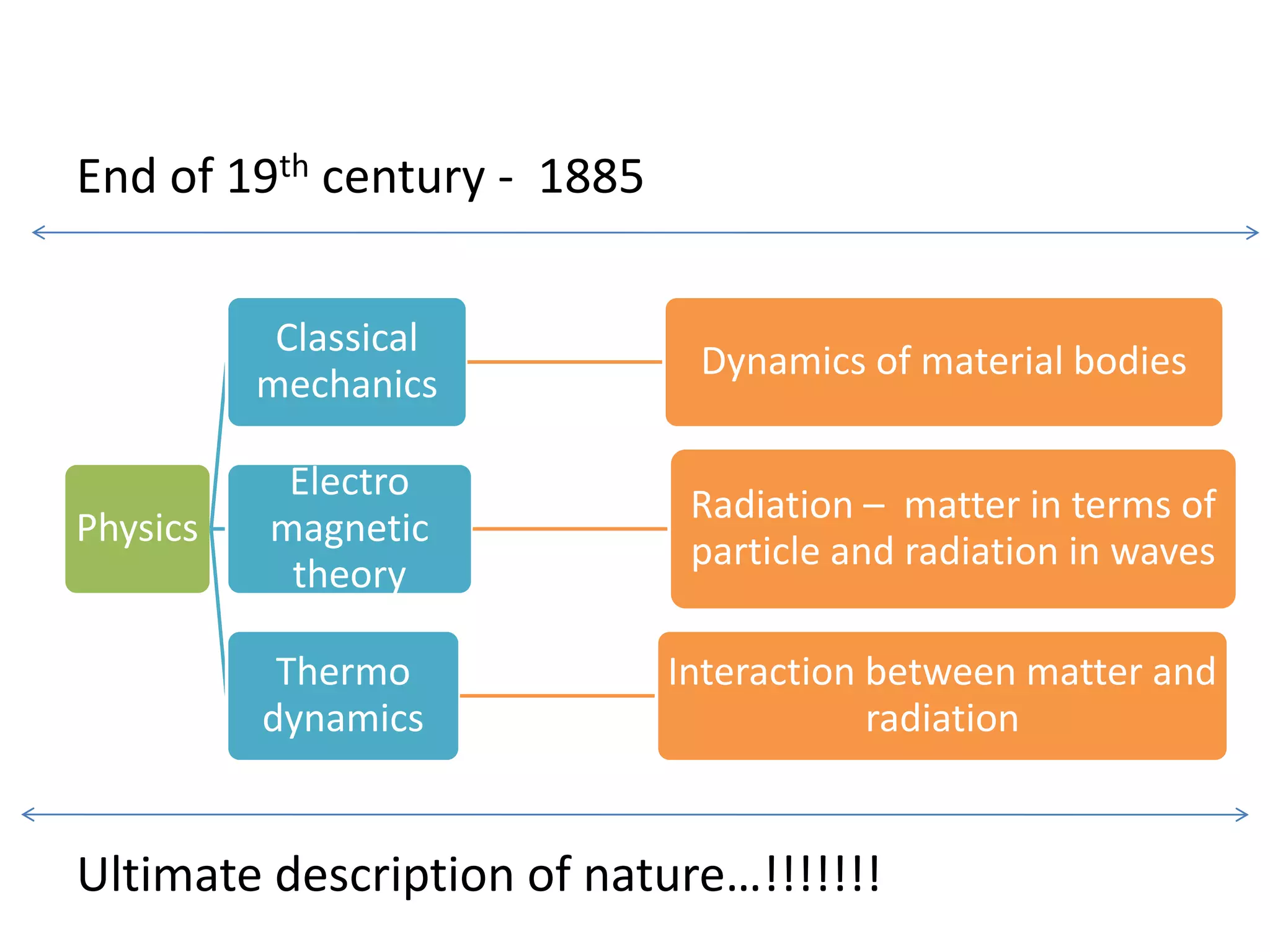
End of 19thcentury - 1885
Ultimate description of nature…!!!!!!!
Physics
Classical
mechanics
Dynamics of material bodies
Electro
magnetic
theory
Radiation – matter in terms of
particle and radiation in waves
Thermo
dynamics
Interaction between matter and
radiation
6.
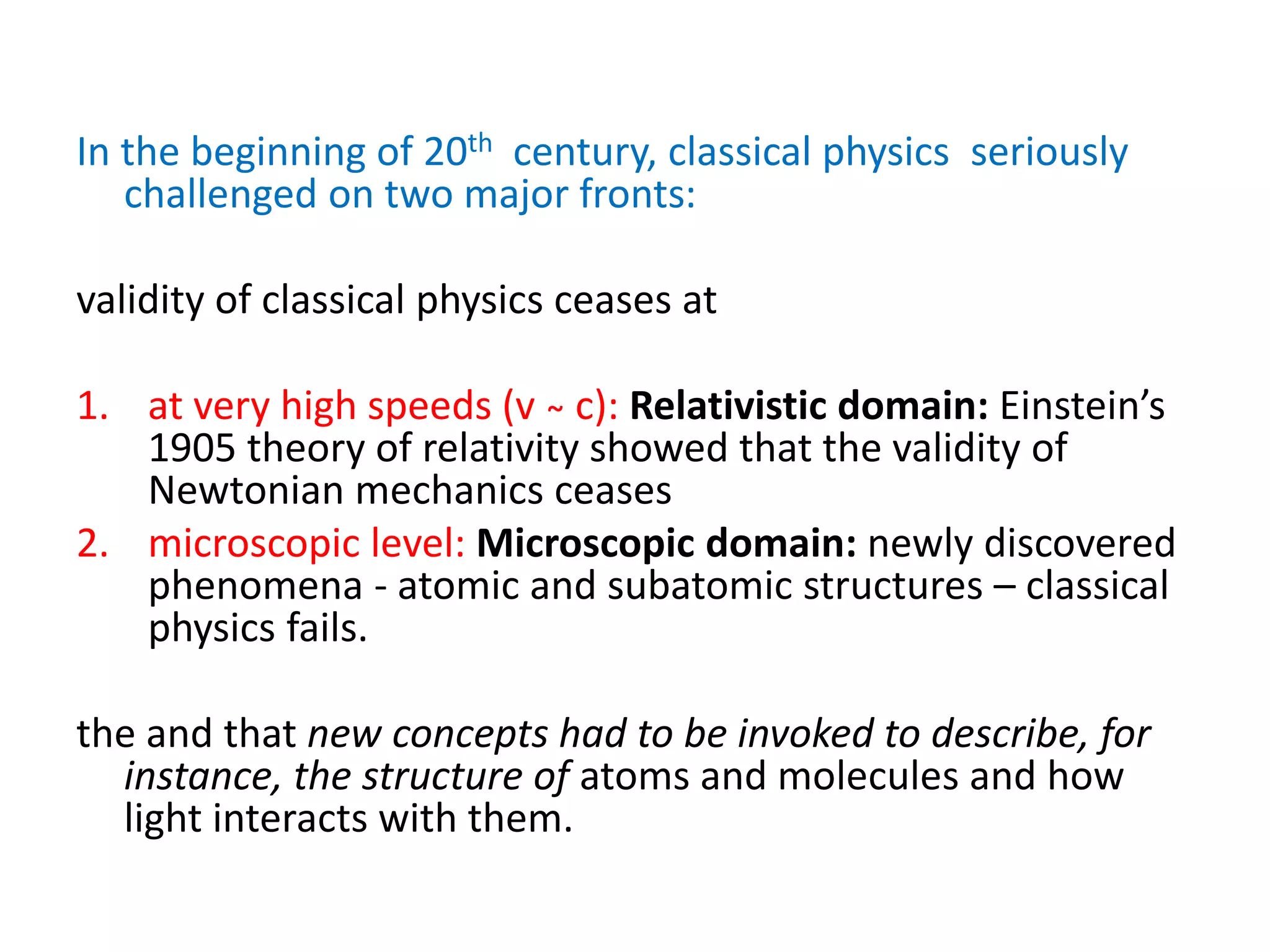
In the beginningof 20th century, classical physics seriously
challenged on two major fronts:
validity of classical physics ceases at
1. at very high speeds (v ̴ c): Relativistic domain: Einstein’s
1905 theory of relativity showed that the validity of
Newtonian mechanics ceases
2. microscopic level: Microscopic domain: newly discovered
phenomena - atomic and subatomic structures – classical
physics fails.
the and that new concepts had to be invoked to describe, for
instance, the structure of atoms and molecules and how
light interacts with them.
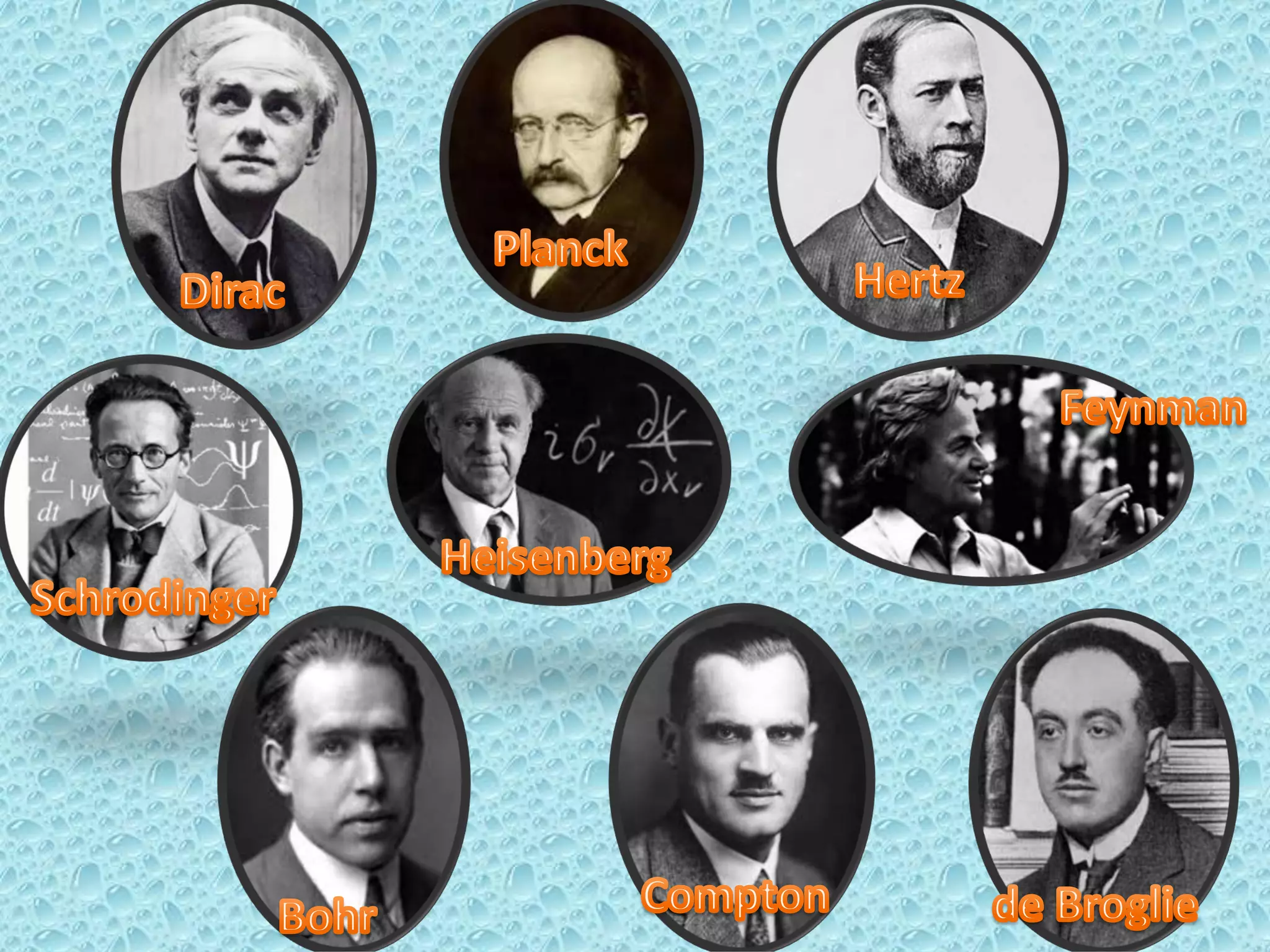
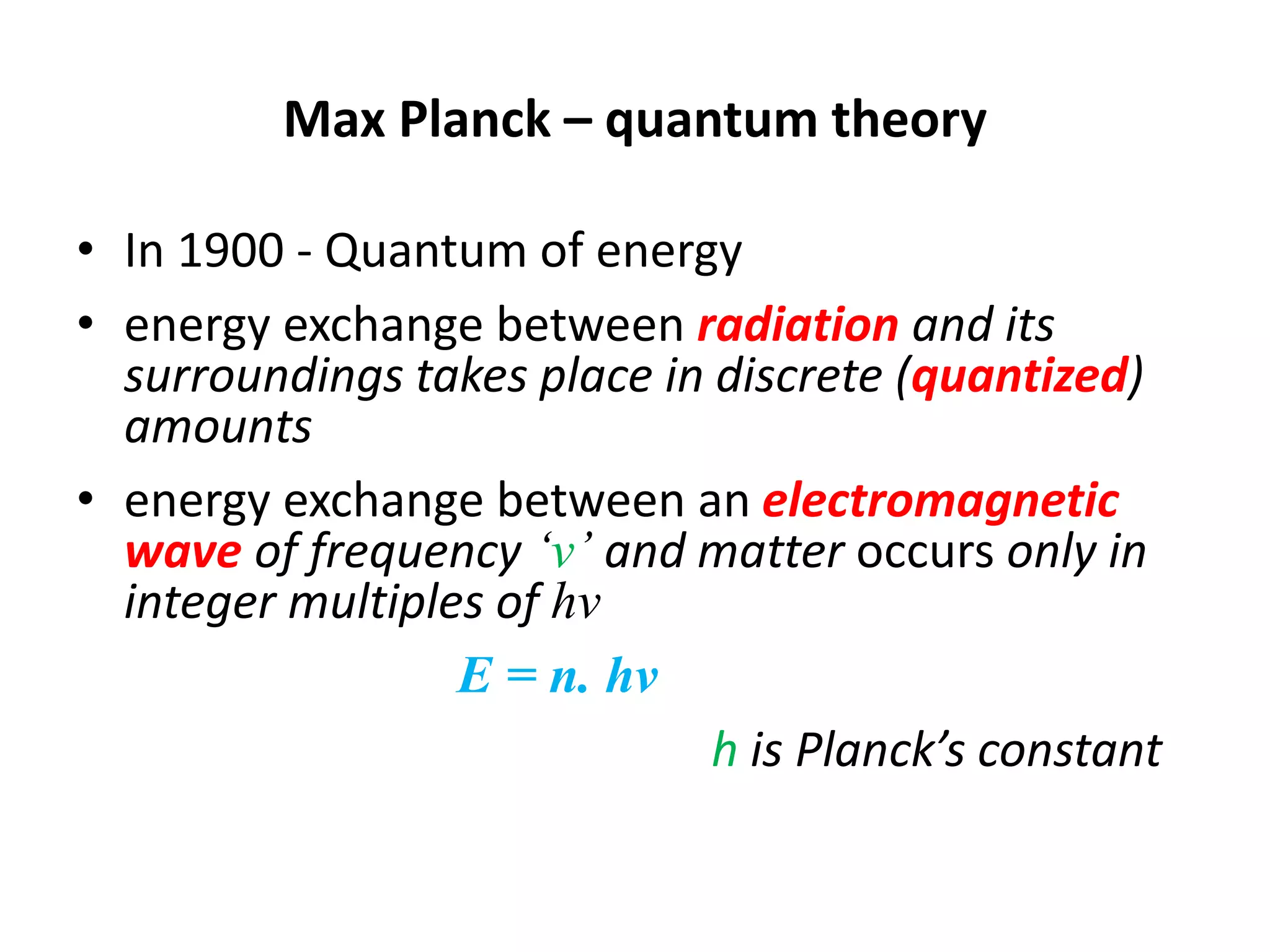
Max Planck –quantum theory
• In 1900 - Quantum of energy
• energy exchange between radiation and its
surroundings takes place in discrete (quantized)
amounts
• energy exchange between an electromagnetic
wave of frequency ‘ν’ and matter occurs only in
integer multiples of hν
E = n. hν
h is Planck’s constant
9.
• Planck’s Quantumtheory – provides an
accurate explanation of blackbody radiation
• Photoelectric effect – experiments by Hertz in
1887
• theoretical support by Einstein in 1905
Quantization of em waves – valid for light also
• light itself is made of discrete bits of energy
called photons, each of energy hν, ν frequency
of the light
10.
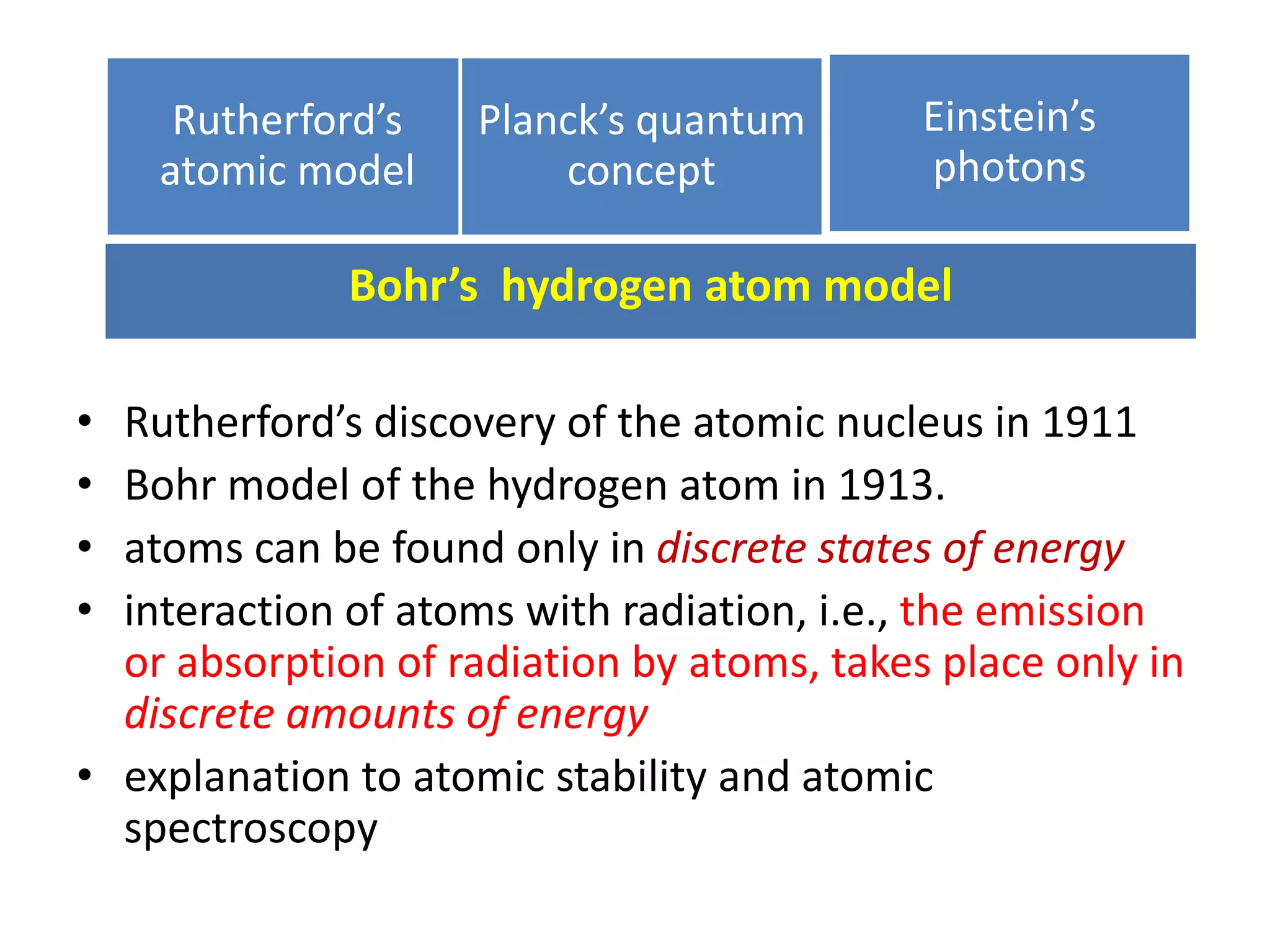
• Rutherford’s discoveryof the atomic nucleus in 1911
• Bohr model of the hydrogen atom in 1913.
• atoms can be found only in discrete states of energy
• interaction of atoms with radiation, i.e., the emission
or absorption of radiation by atoms, takes place only in
discrete amounts of energy
• explanation to atomic stability and atomic
spectroscopy
Bohr’s hydrogen atom model
Rutherford’s
atomic model
Planck’s quantum
concept
Einstein’s
photons
11.
• in 1923Compton scattering - confirmation for the
corpuscular aspect of light.
• series of breakthroughs—due to Planck, Einstein, Bohr, and
Compton—gave both the theoretical foundations as well as
the conclusive experimental confirmation for the particle
aspect of waves
• waves exhibit particle behavior at the microscopic scale.
• At this scale, classical physics fails not only quantitatively
but even qualitatively and conceptually.
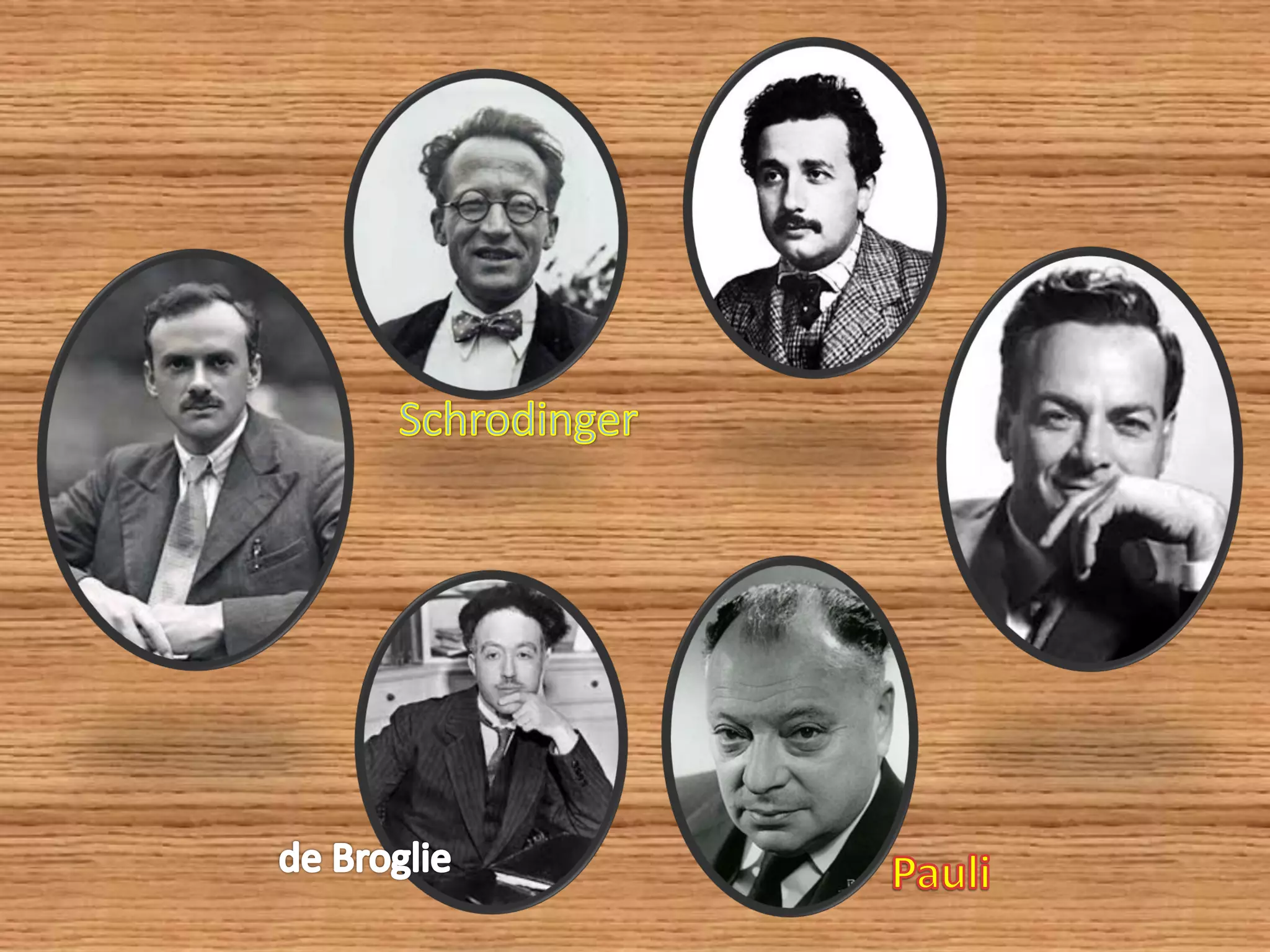
• de Broglie in 1923 -not only does radiation exhibit particle-
like behavior but, conversely, material particles themselves
display wave-like behavior.
• confirmed experimentally in 1927 by Davisson and Germer
12.
• Postulates ofPlanck and assumptions of Bohr
- lacking the ingredients of a theory
• do not follow from the first principles of a
theory.
• need to fit them within the context of a
consistent theory - lead Heisenberg and
Schrödinger to search for the theoretical
foundation underlying new ideas.
13.
• By 1925- welded the various experimental
findings as well as Bohr’s postulates into a
refined theory: quantum mechanics – old
quantum physics
• providing an accurate reproduction of the
existing experimental data
• theory turned out to explore and unravel many
uncharted areas of the microphysical world.
Heisenberg’s Matrix mechanics
describeatomic structure from the observed spectral lines
• Expressing dynamical quantities such as x, p, E, & L in terms
of matrices, he obtained an eigenvalue problem that
describes the dynamics of microscopic systems
• the diagonalization of the Hamiltonian matrix yields the
energy spectrum and the state vectors of the system.
• Matrix mechanics was very successful in accounting for the
discrete quanta of light emitted and absorbed by atoms
16.
Schrödinger’s wave mechanics
•generalization of the de Broglie postulate.
• more intuitive than matrix mechanics
• describes the dynamics of microscopic matter by
means of a wave equation, called the Schrödinger
equation
• instead of the matrix eigenvalue problem of
Heisenberg, Schrödinger obtained a differential
equation.
• The solutions of this equation yield the energy
spectrum and the wave function of the system under
consideration.
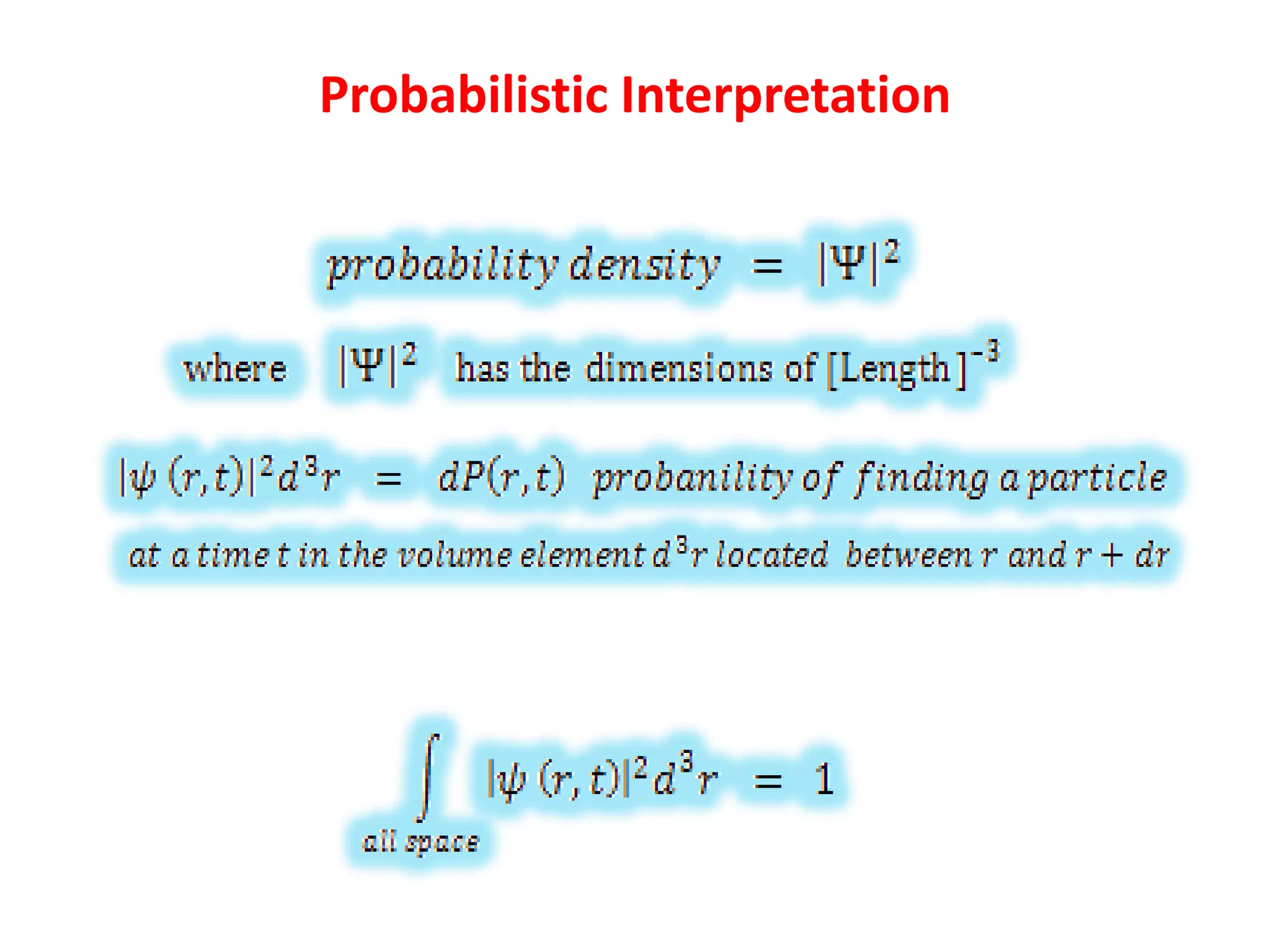
• square moduli of the wave functions are probability
densities.
17.
Dirac’s formulation
• Schrödinger’swave formulation and Heisenberg’s
matrix approach—were shown to be equivalent.
• P A M Dirac
• general formulation of QM - deals with kets (state
vectors), bras, and operators.
• The representation of Dirac’s formalism in a
continuous basis—the position or momentum
representations— Schrödinger’s wave mechanics.
• As for Heisenberg’s matrix formulation,
representing Dirac’s formalism in a discrete basis
18.
Quantum mechanics
• theorythat describes the dynamics of matter at the
microscopic scale.
• the only valid framework for describing the
microphysical world.
• It is vital for understanding the physics of solids, lasers,
semiconductor and superconductor devices, plasmas,
etc.
• founding basis of all modern physics: solid state,
molecular, atomic, nuclear, and particle physics, optics,
thermodynamics, statistical mechanics, and so on.
• the foundation of chemistry and biology also.
20.
Particle Aspect ofRadiation
• Classical physics:
• Particle: energy and momentum – E & p
• Wave: amplitude and wave vector – A & k
• How radiation interacts with matter…..
21.
Black body radiation
Howradiation interacts with matter…..
• When heated, a solid object glows and emits thermal
radiation. As T increases, the object becomes red, then
yellow, then white.
• The thermal radiation emitted by glowing solid objects
consists of a continuous…!!
• the radiation emitted by gases has a discrete distribution
spectrum.
• continuous character of the radiation emitted by a glowing
solid object constituted one of the major unsolved
problems
• ?- problem - specifying the proper theory of
thermodynamics that describes how energy gets
exchanged between radiation and matter
22.
• ideal “blackbody”– material object that absorbs all of
the radiation falling on it, and hence appears as black
• When an object is heated, it radiates electromagnetic
energy as a result of the thermal agitation of the
electrons in its surface.
• Intensity – function of frequency and temperature.
• An object in thermal equilibrium with its surroundings
radiates as much energy as it absorbs.
• blackbody - perfect absorber & perfect emitter
• radiation emitted by a blackbody when hot is called
blackbody radiation
23.
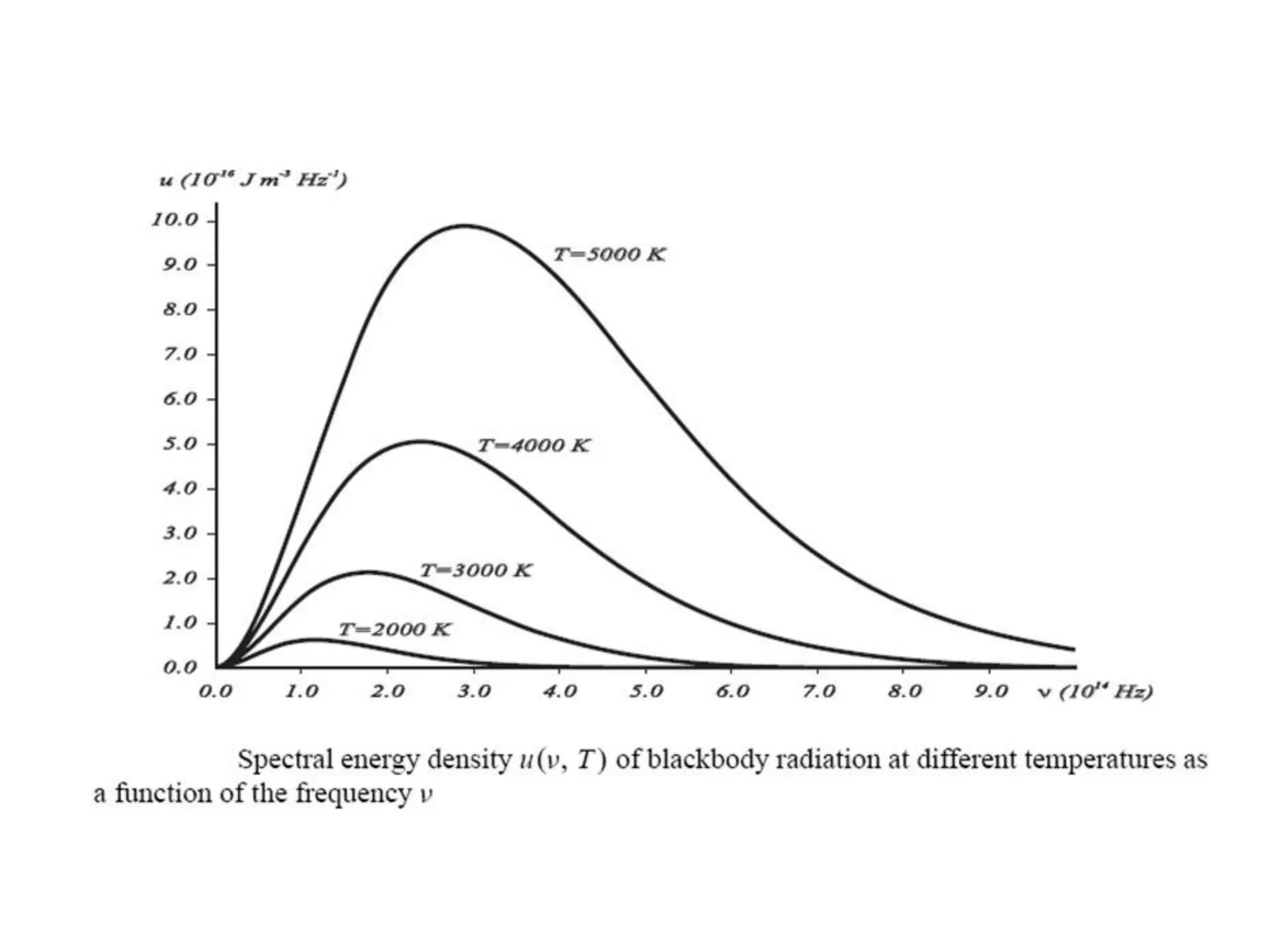
• By themid-1800s, number of experimental data
about blackbody radiation for various objects.
• at equilibrium, energy density shows a maximum
at a given frequency, which increases with T
• the peak of the radiation spectrum occurs at a
frequency that is proportional to the temperature
• blackbody spectrum was not so easy.
• Earlier work - Wilhelm Wien and Rayleigh
• total intensity the Stefan–Boltzmann law
25.
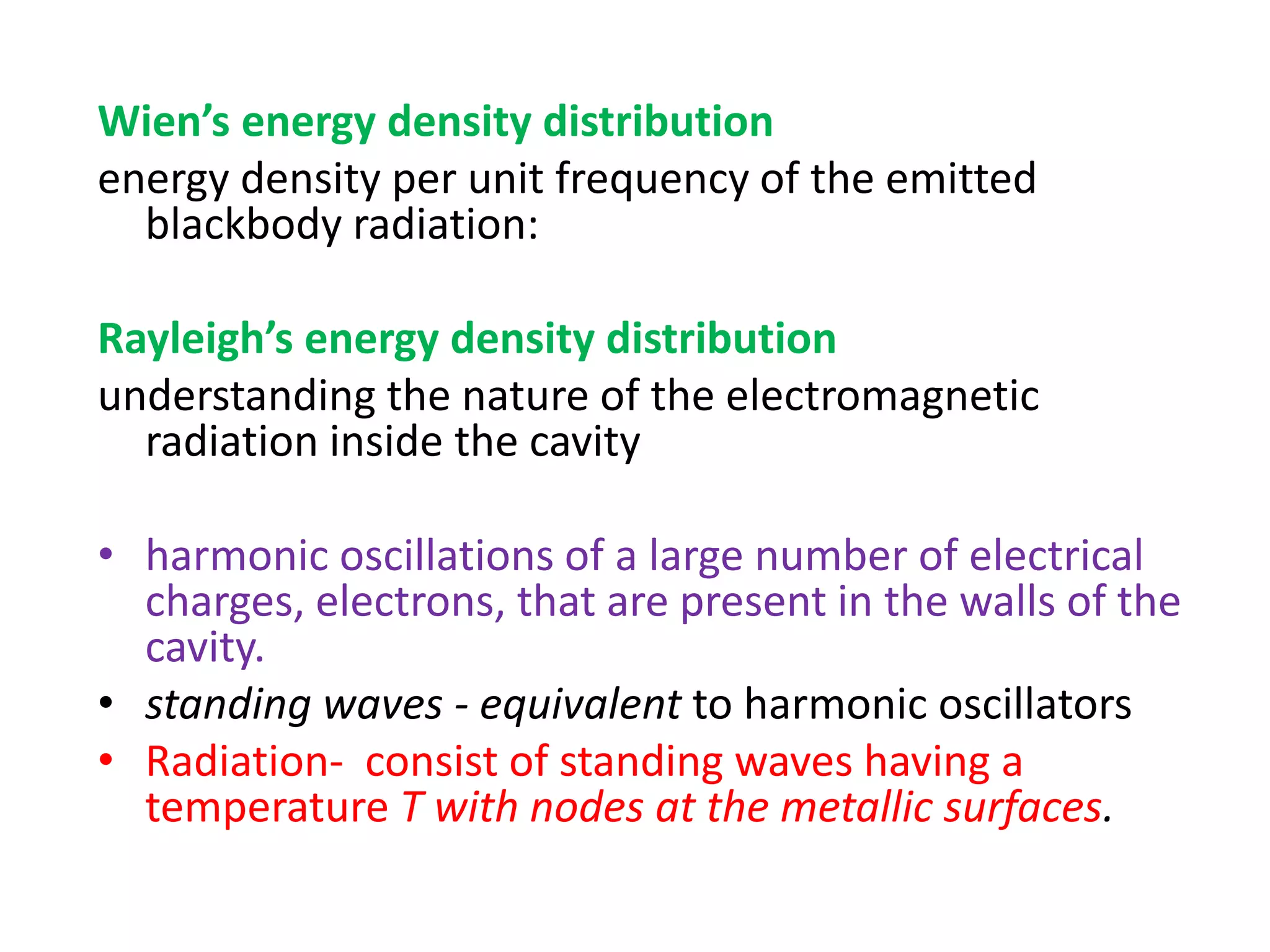
Wien’s energy densitydistribution
energy density per unit frequency of the emitted
blackbody radiation:
Rayleigh’s energy density distribution
understanding the nature of the electromagnetic
radiation inside the cavity
• harmonic oscillations of a large number of electrical
charges, electrons, that are present in the walls of the
cavity.
• standing waves - equivalent to harmonic oscillators
• Radiation- consist of standing waves having a
temperature T with nodes at the metallic surfaces.
27.
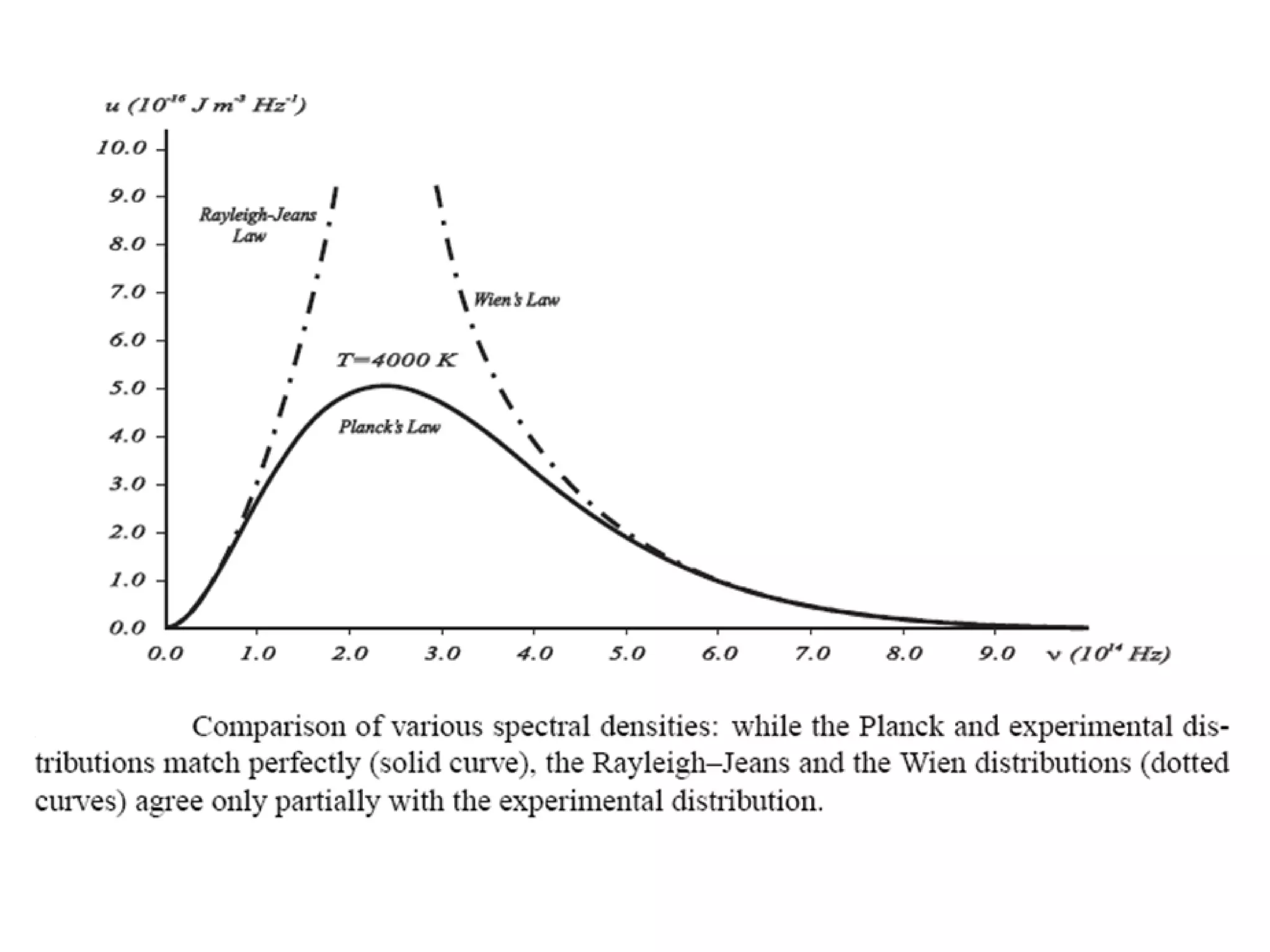
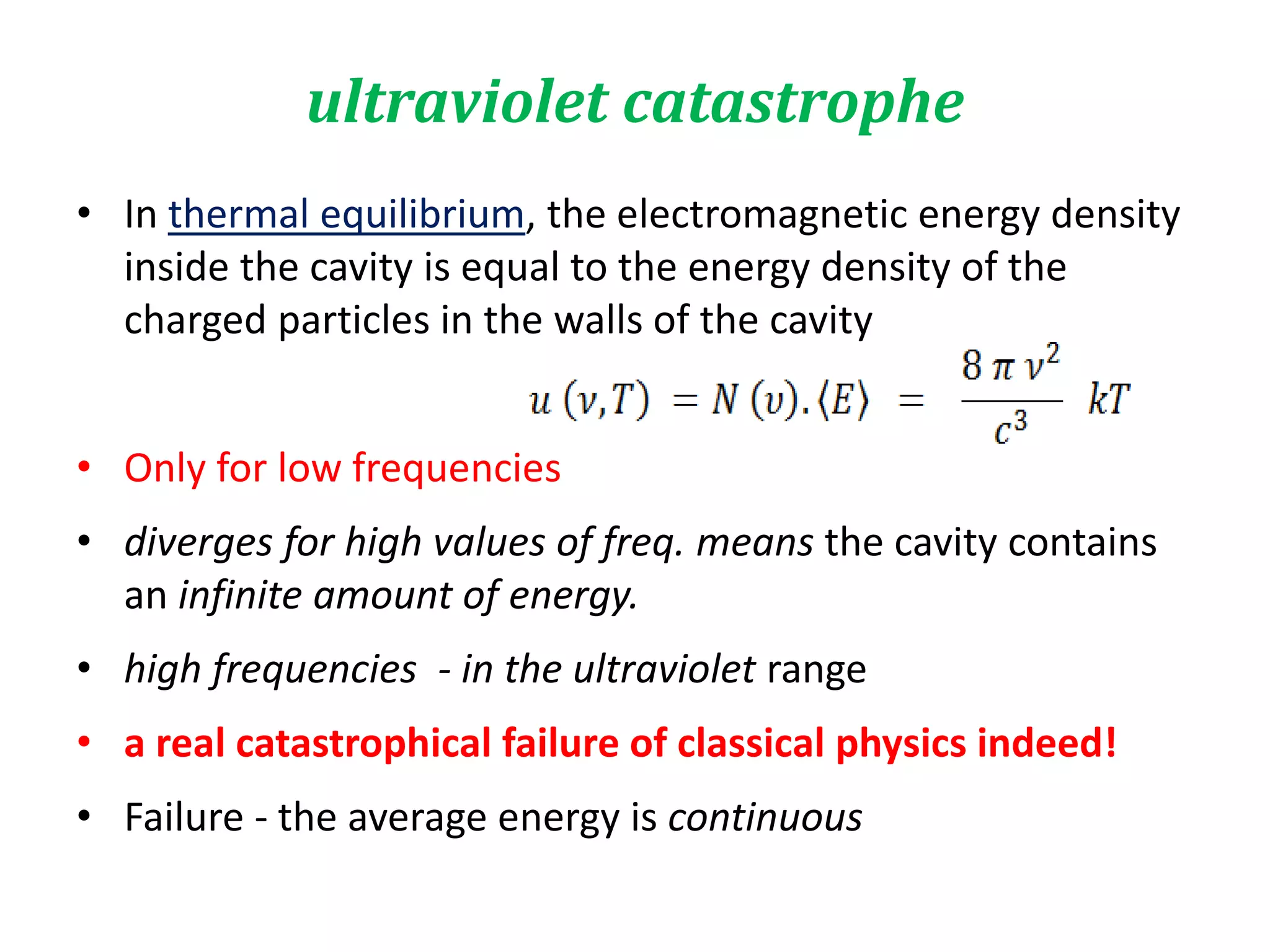
• In thermalequilibrium, the electromagnetic energy density
inside the cavity is equal to the energy density of the
charged particles in the walls of the cavity
• Only for low frequencies
• diverges for high values of freq. means the cavity contains
an infinite amount of energy.
• high frequencies - in the ultraviolet range
• a real catastrophical failure of classical physics indeed!
• Failure - the average energy is continuous
ultraviolet catastrophe
28.
• energy exchangebetween radiation and matter must be discrete.
Wien’s displacement law
• the wavelength that corresponds to the maximum of the Planck
energy density
• to determine the wavelength corresponding to the maximum
intensity if the temperature of the body is known.
• to determine the temperature of the radiating body if the
wavelength of greatest intensity is known.
• to estimate the temperature of stars (or of glowing objects) from
their radiation
Planck’s energy density distribution
29.
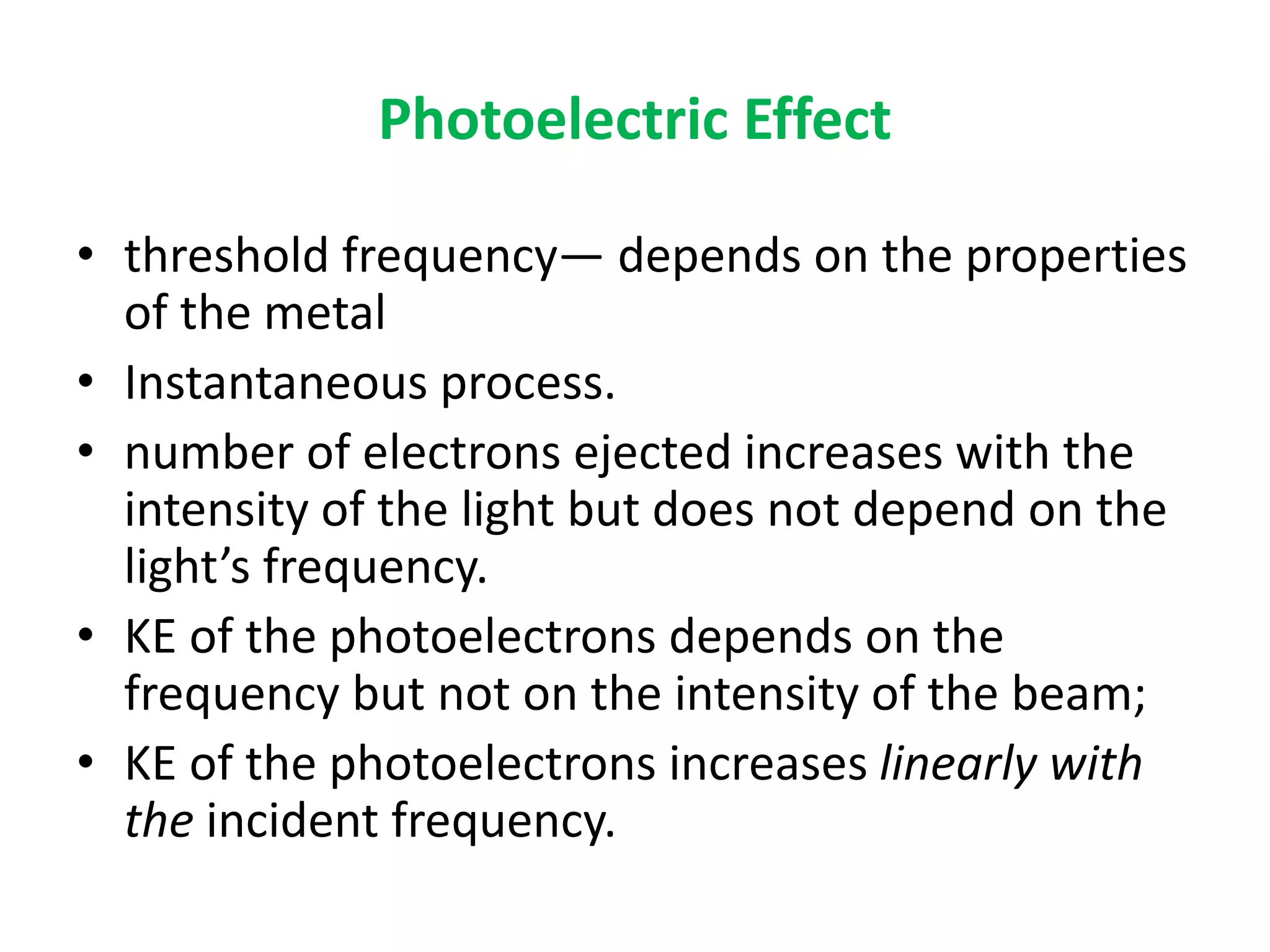
Photoelectric Effect
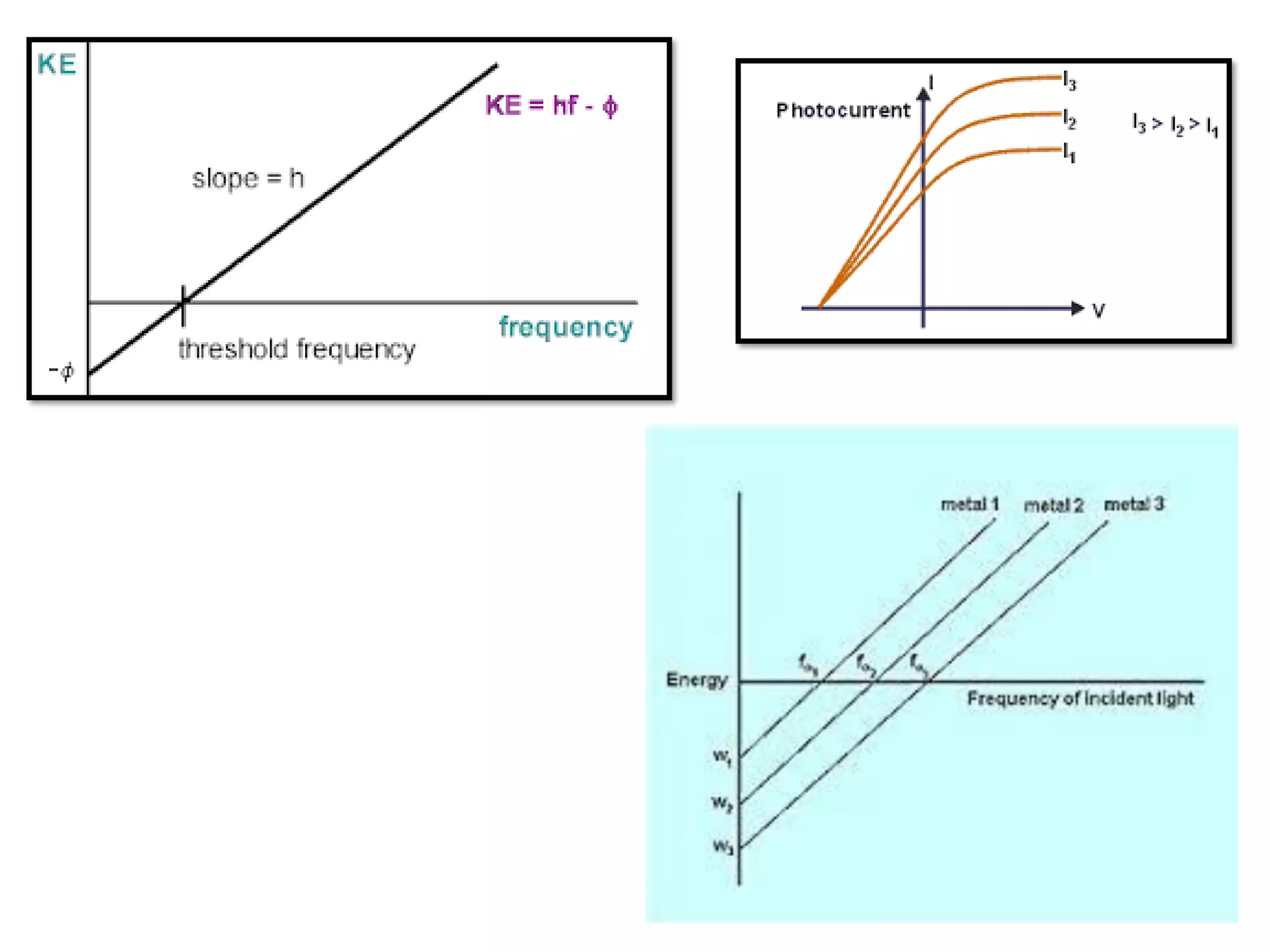
• thresholdfrequency— depends on the properties
of the metal
• Instantaneous process.
• number of electrons ejected increases with the
intensity of the light but does not depend on the
light’s frequency.
• KE of the photoelectrons depends on the
frequency but not on the intensity of the beam;
• KE of the photoelectrons increases linearly with
the incident frequency.
30.
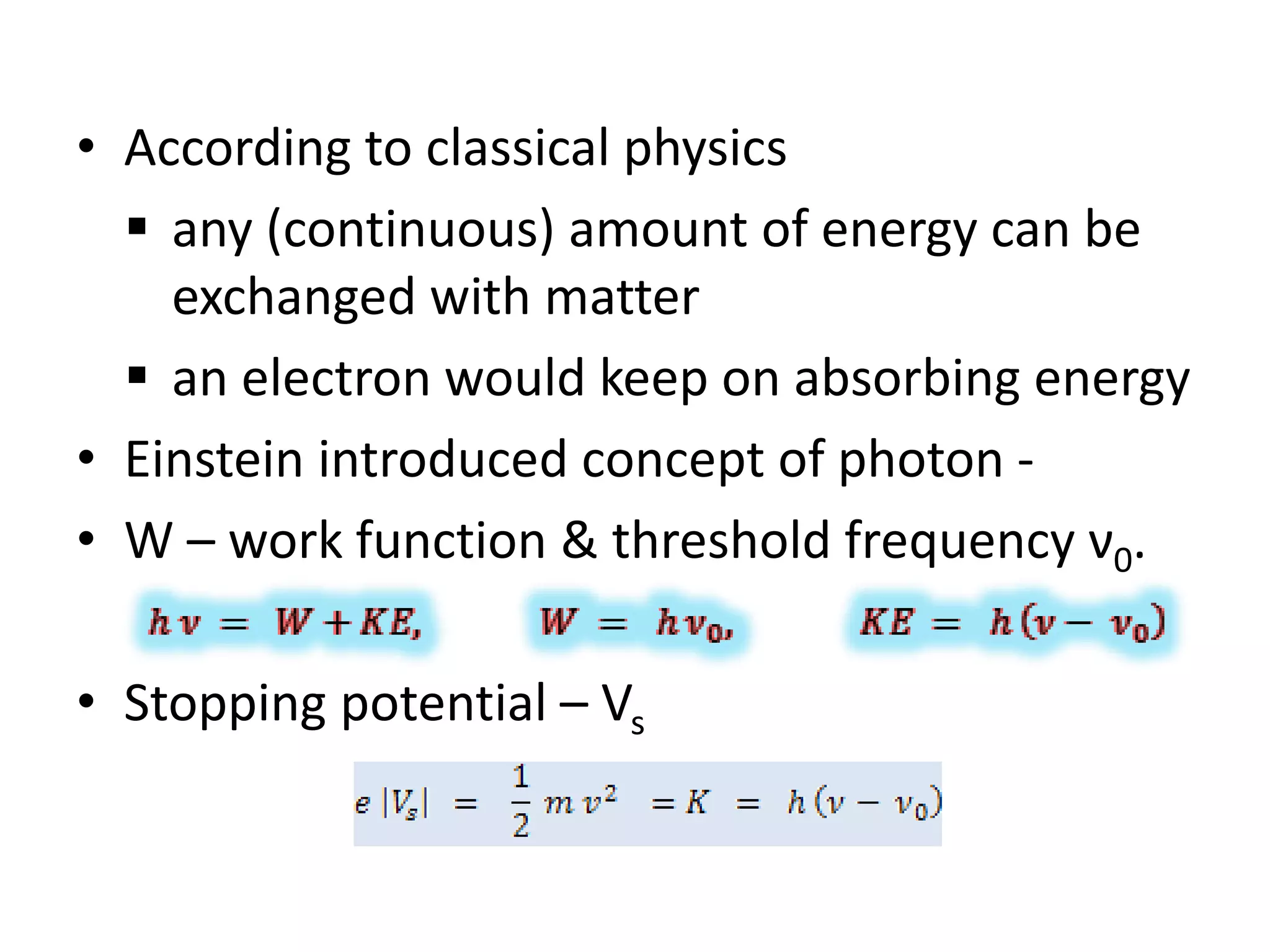
• According toclassical physics
any (continuous) amount of energy can be
exchanged with matter
an electron would keep on absorbing energy
• Einstein introduced concept of photon -
• W – work function & threshold frequency ν0.
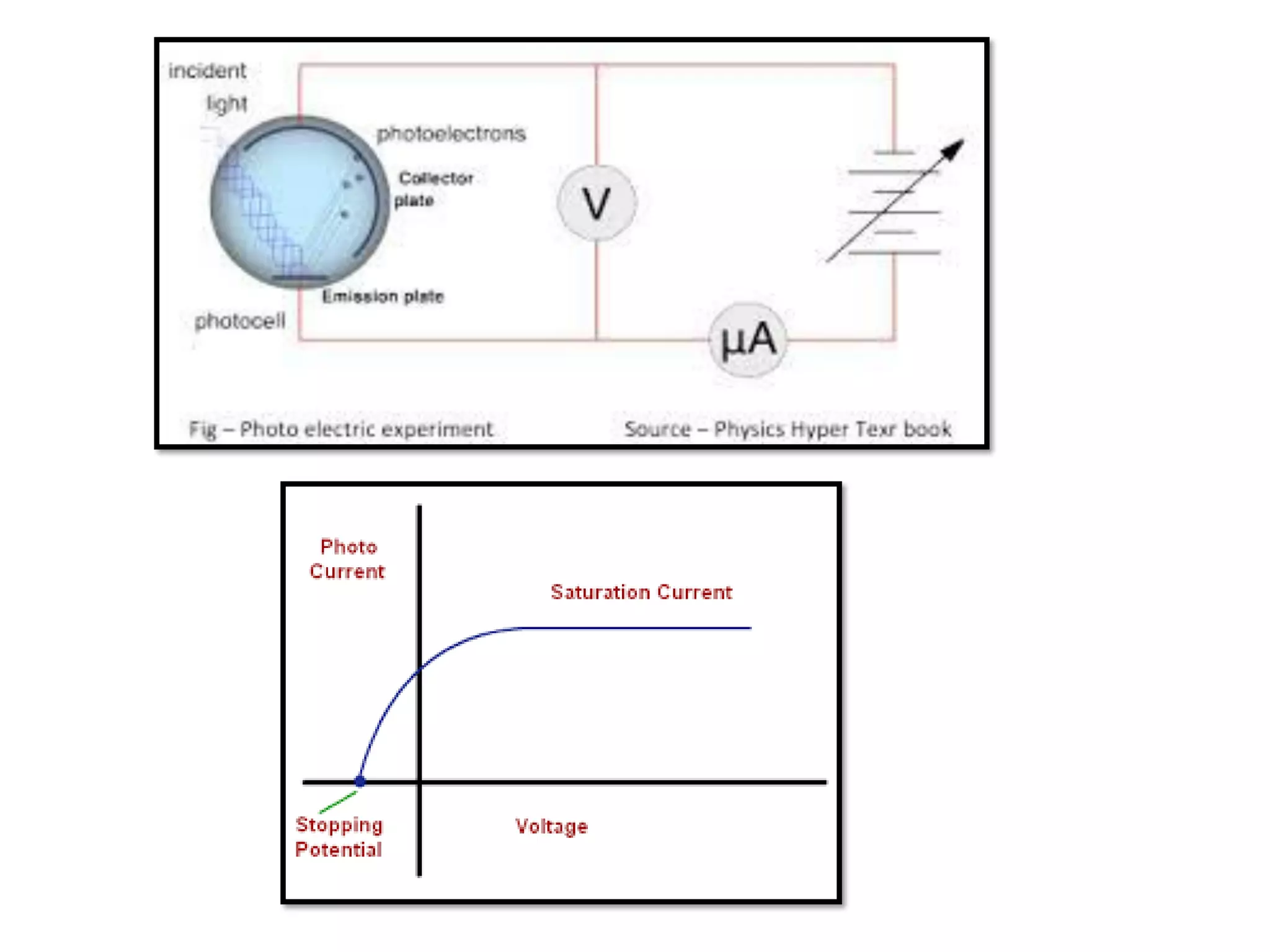
• Stopping potential – Vs
34.
Compton Effect
Scattering ofradiation as particles
• classical physics - the incident and scattered radiation
should have the same wavelength
• scattering of X-rays by free electrons –
Wavelength of the scattered radiation is larger than the
wavelength of the incident radiation.
This can be explained only by assuming that the X-ray
photons behave like particles.
• Incident radiation as a stream of particles—photons—
colliding elastically with individual electrons
• Elastic collision – conservation of energy and momentum
36.
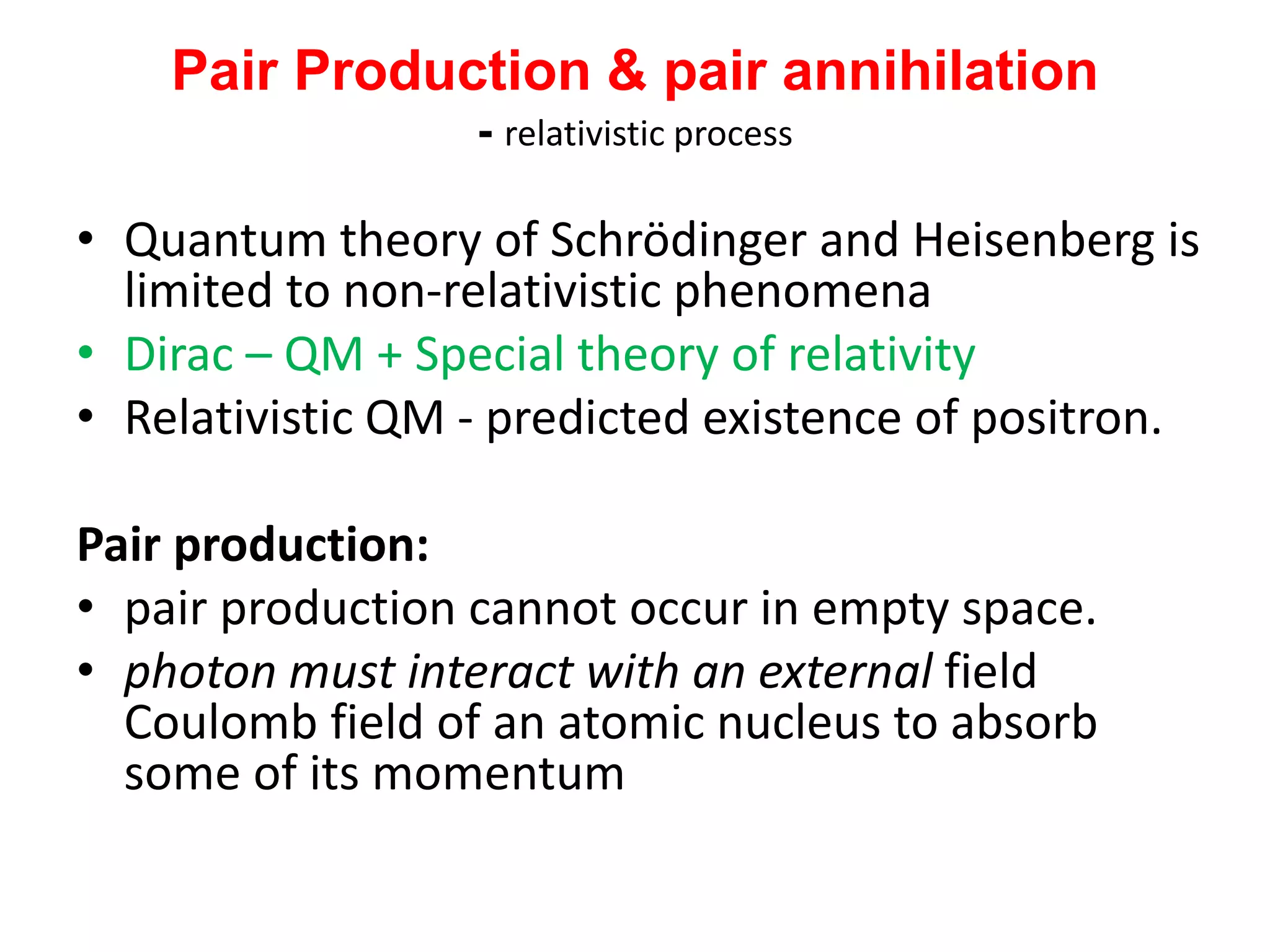
Pair Production &pair annihilation
- relativistic process
• Quantum theory of Schrödinger and Heisenberg is
limited to non-relativistic phenomena
• Dirac – QM + Special theory of relativity
• Relativistic QM - predicted existence of positron.
Pair production:
• pair production cannot occur in empty space.
• photon must interact with an external field
Coulomb field of an atomic nucleus to absorb
some of its momentum
37.
• pair annihilation- inverse of pair production,
• an electron and a positron collide, they
annihilate each other and give rise to
electromagnetic radiation
• collision of a positron with an electron
produces a positronium (hydrogen-like atom)
• direct consequence of the mass–energy
equation of Einstein E = mc2
• pure energy can be converted into mass and
vice versa
38.
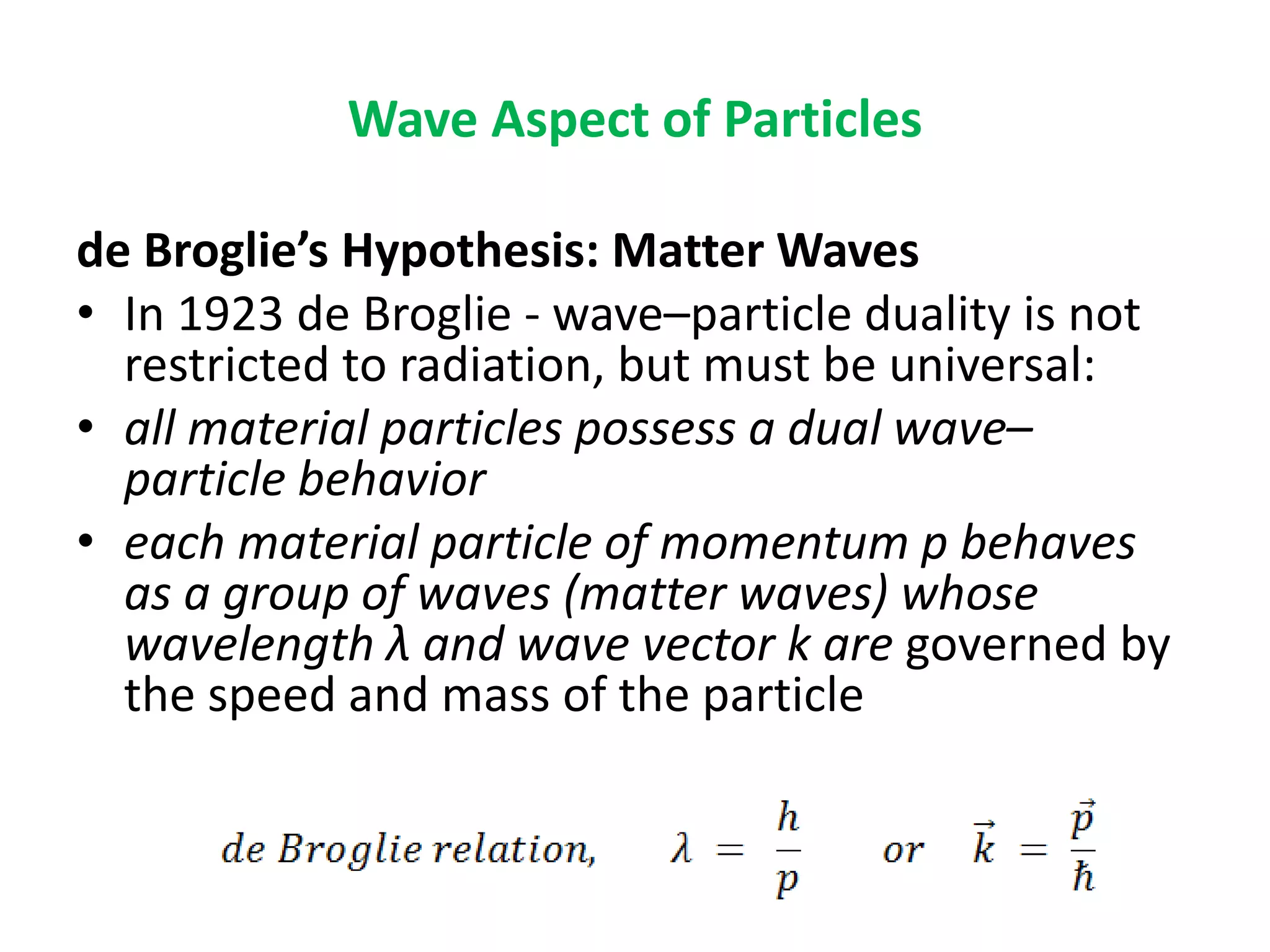
Wave Aspect ofParticles
de Broglie’s Hypothesis: Matter Waves
• In 1923 de Broglie - wave–particle duality is not
restricted to radiation, but must be universal:
• all material particles possess a dual wave–
particle behavior
• each material particle of momentum p behaves
as a group of waves (matter waves) whose
wavelength λ and wave vector k are governed by
the speed and mass of the particle
39.
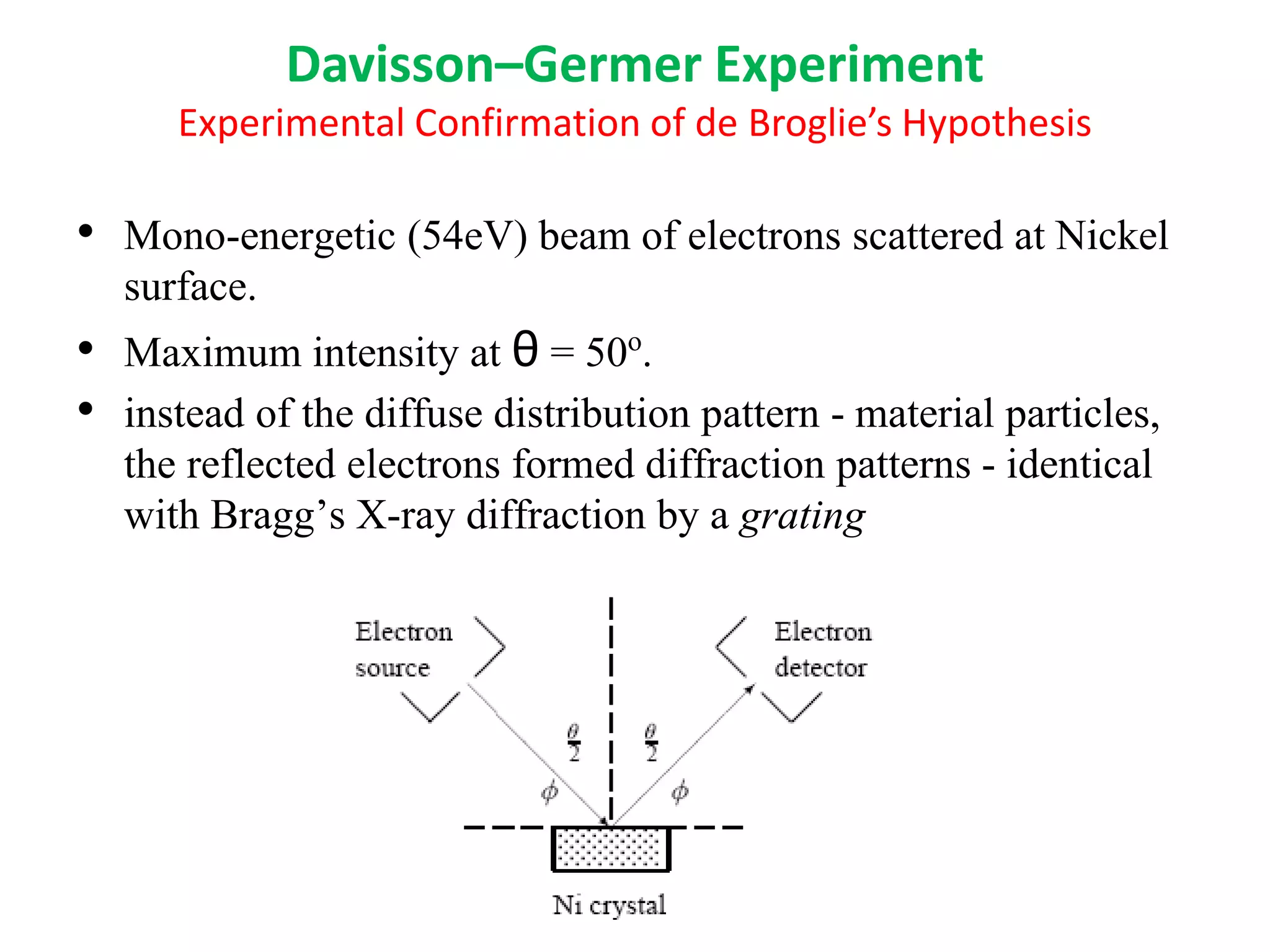
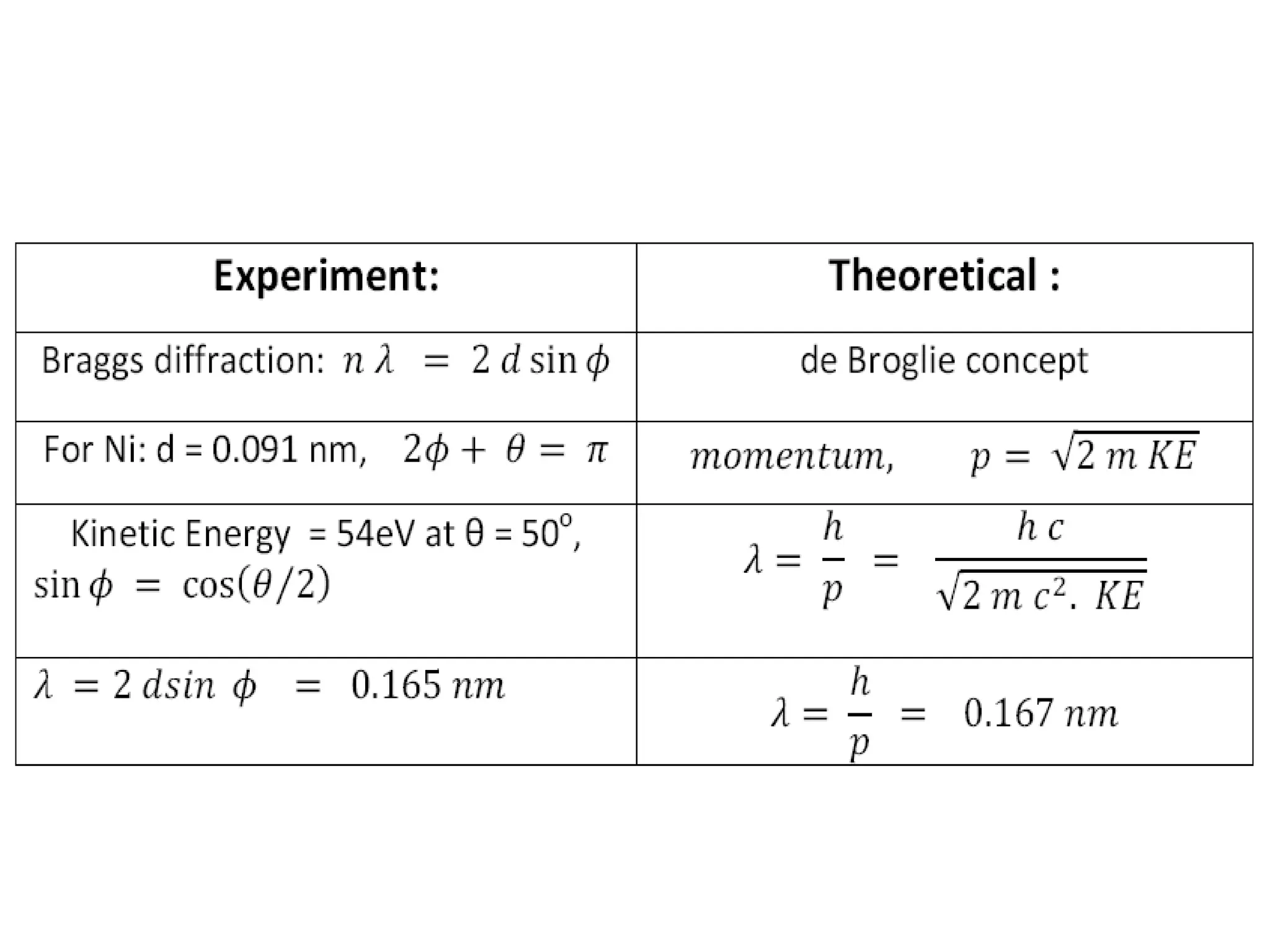
Davisson–Germer Experiment
Experimental Confirmationof de Broglie’s Hypothesis
• Mono-energetic (54eV) beam of electrons scattered at Nickel
surface.
• Maximum intensity at θ = 50o.
• instead of the diffuse distribution pattern - material particles,
the reflected electrons formed diffraction patterns - identical
with Bragg’s X-ray diffraction by a grating
41.
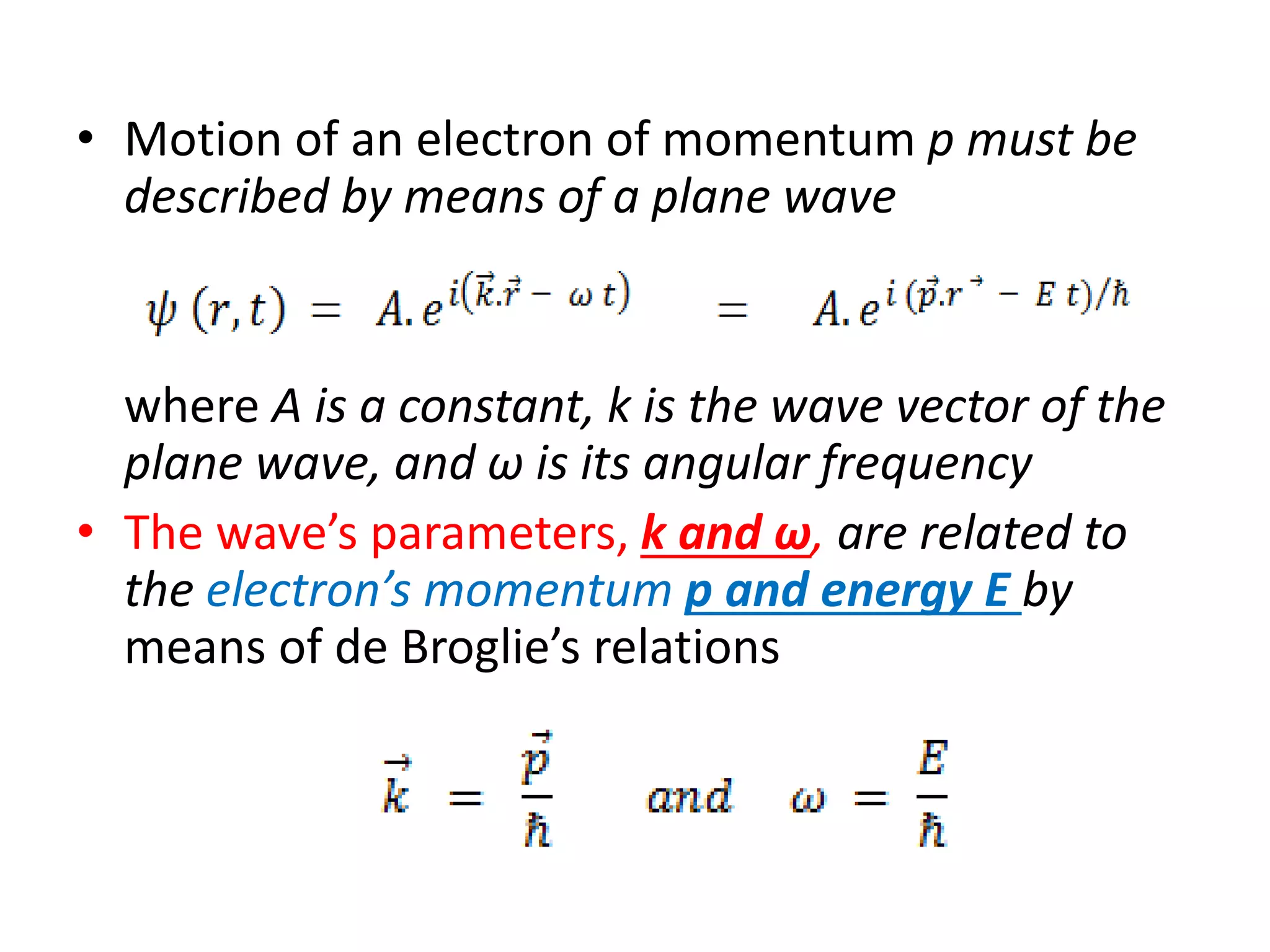
• Motion ofan electron of momentum p must be
described by means of a plane wave
where A is a constant, k is the wave vector of the
plane wave, and ω is its angular frequency
• The wave’s parameters, k and ω, are related to
the electron’s momentum p and energy E by
means of de Broglie’s relations
42.
Particles versus Waves
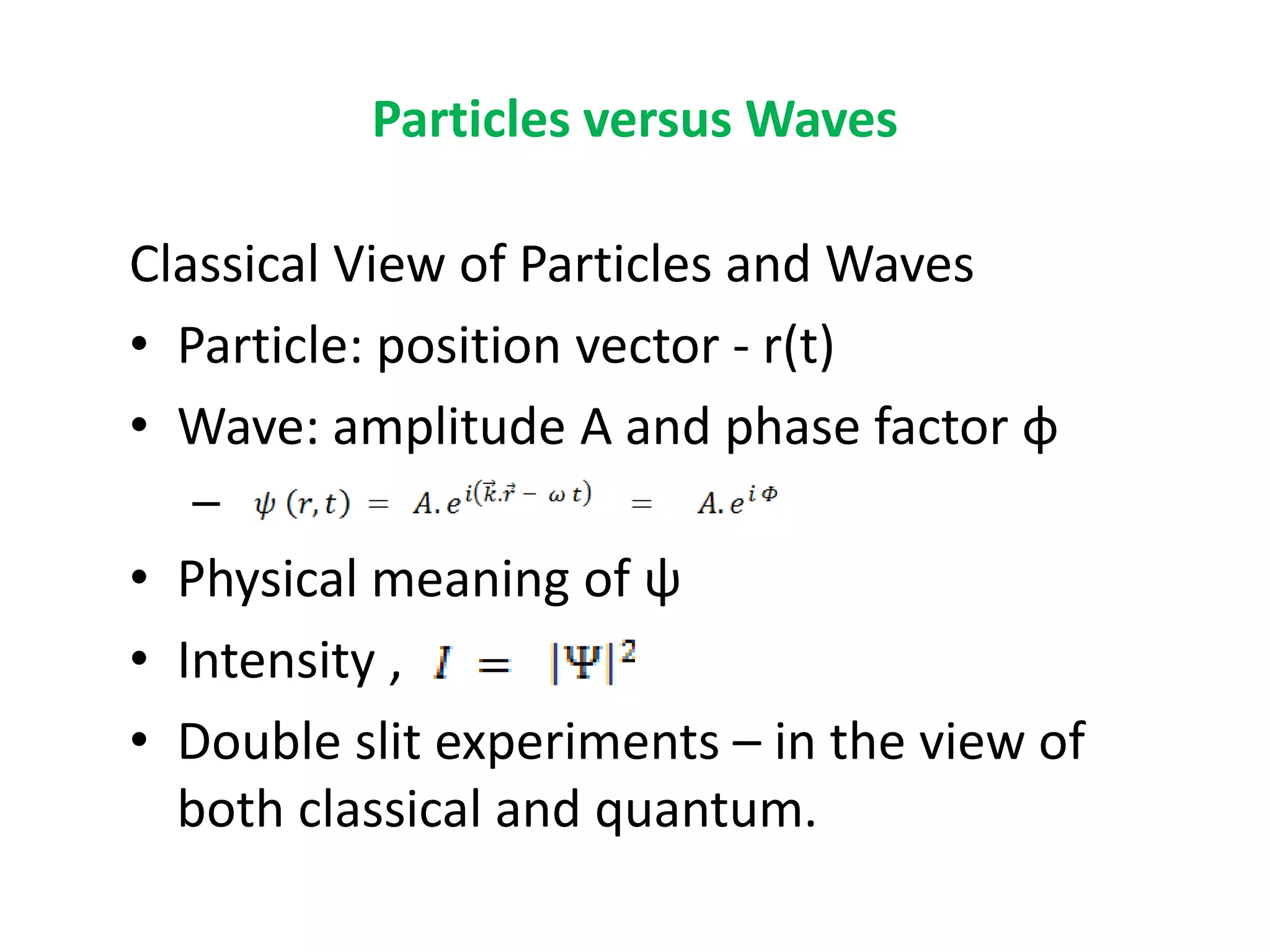
ClassicalView of Particles and Waves
• Particle: position vector - r(t)
• Wave: amplitude A and phase factor φ
–
• Physical meaning of ψ
• Intensity ,
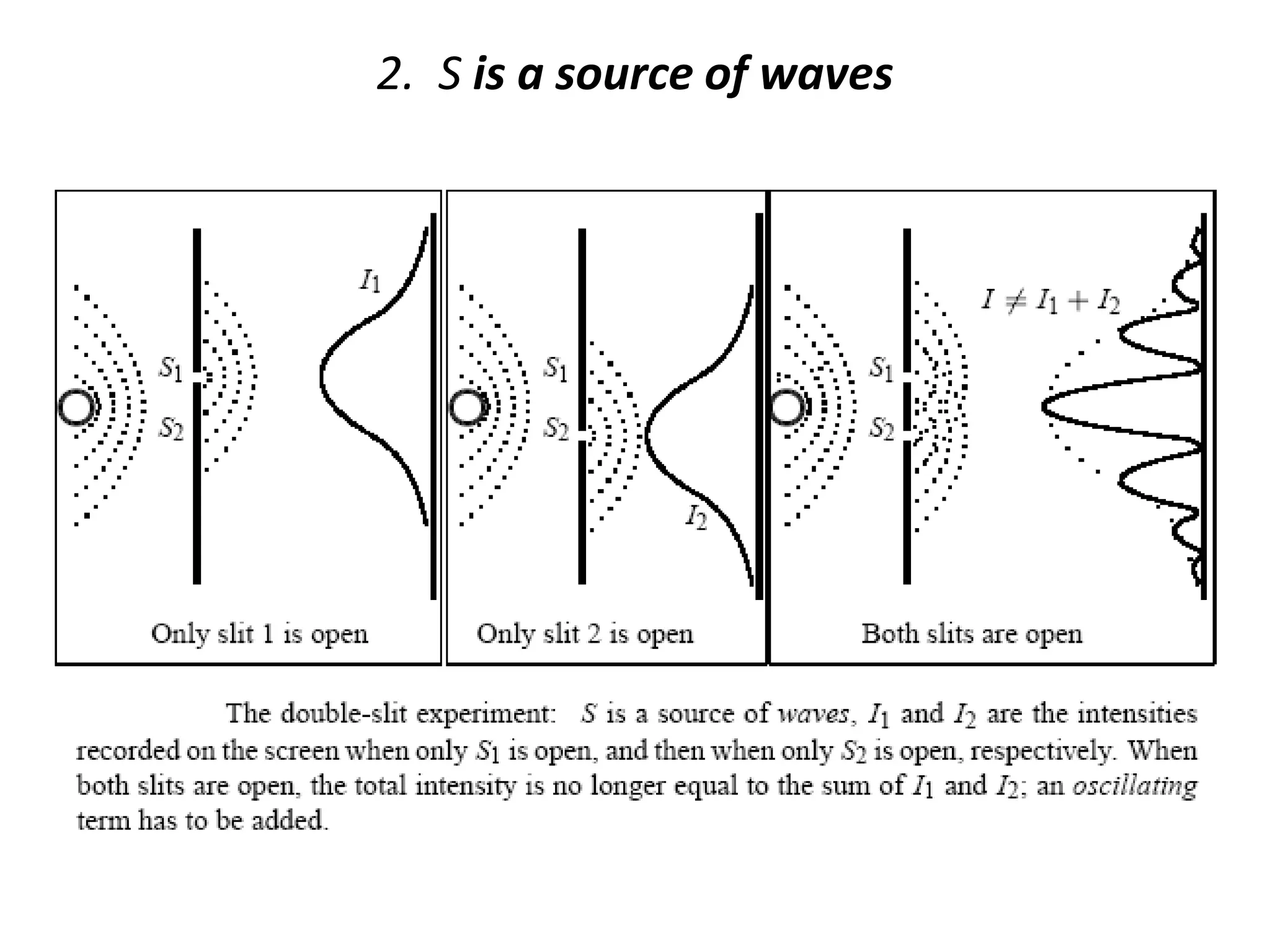
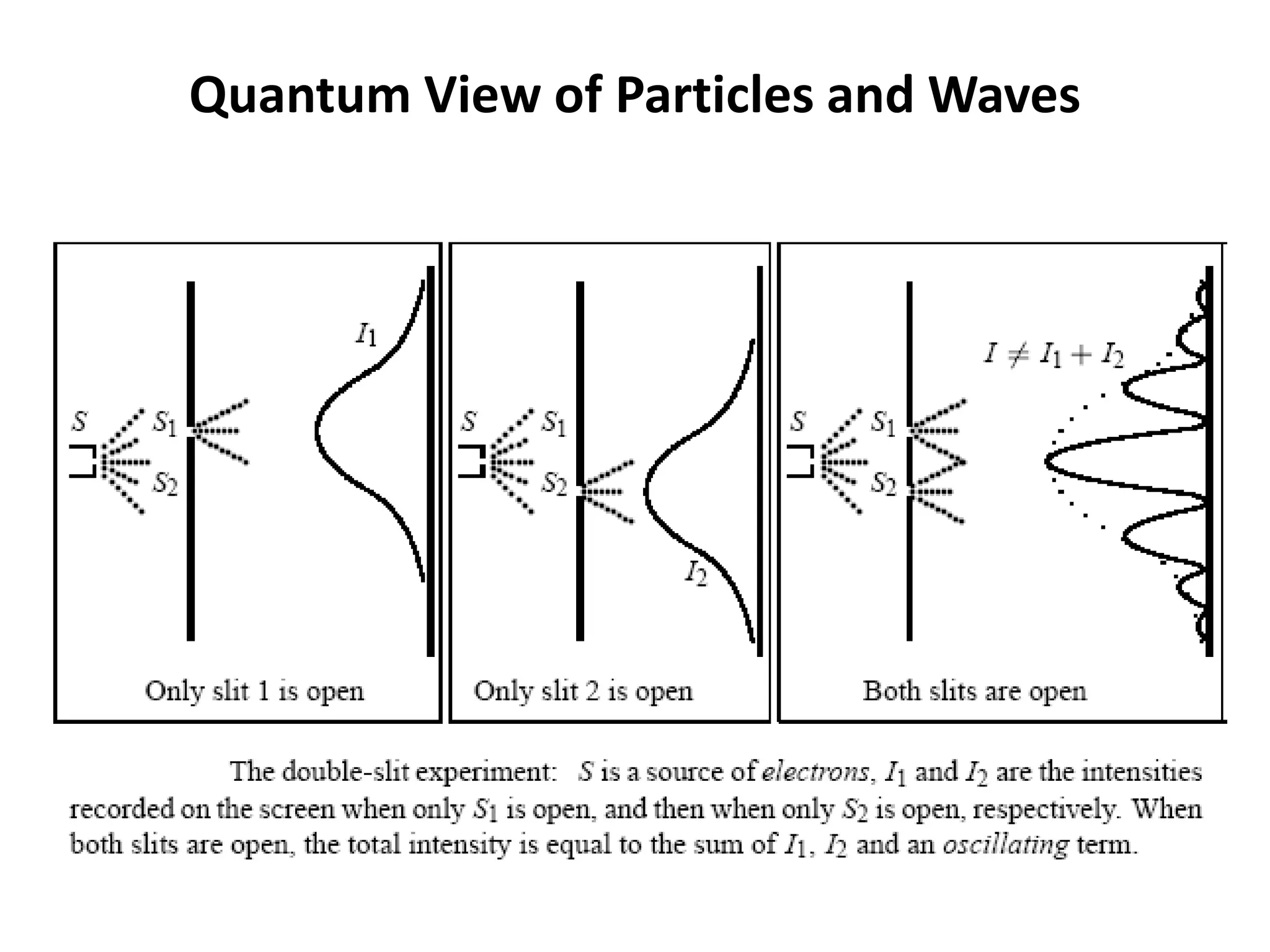
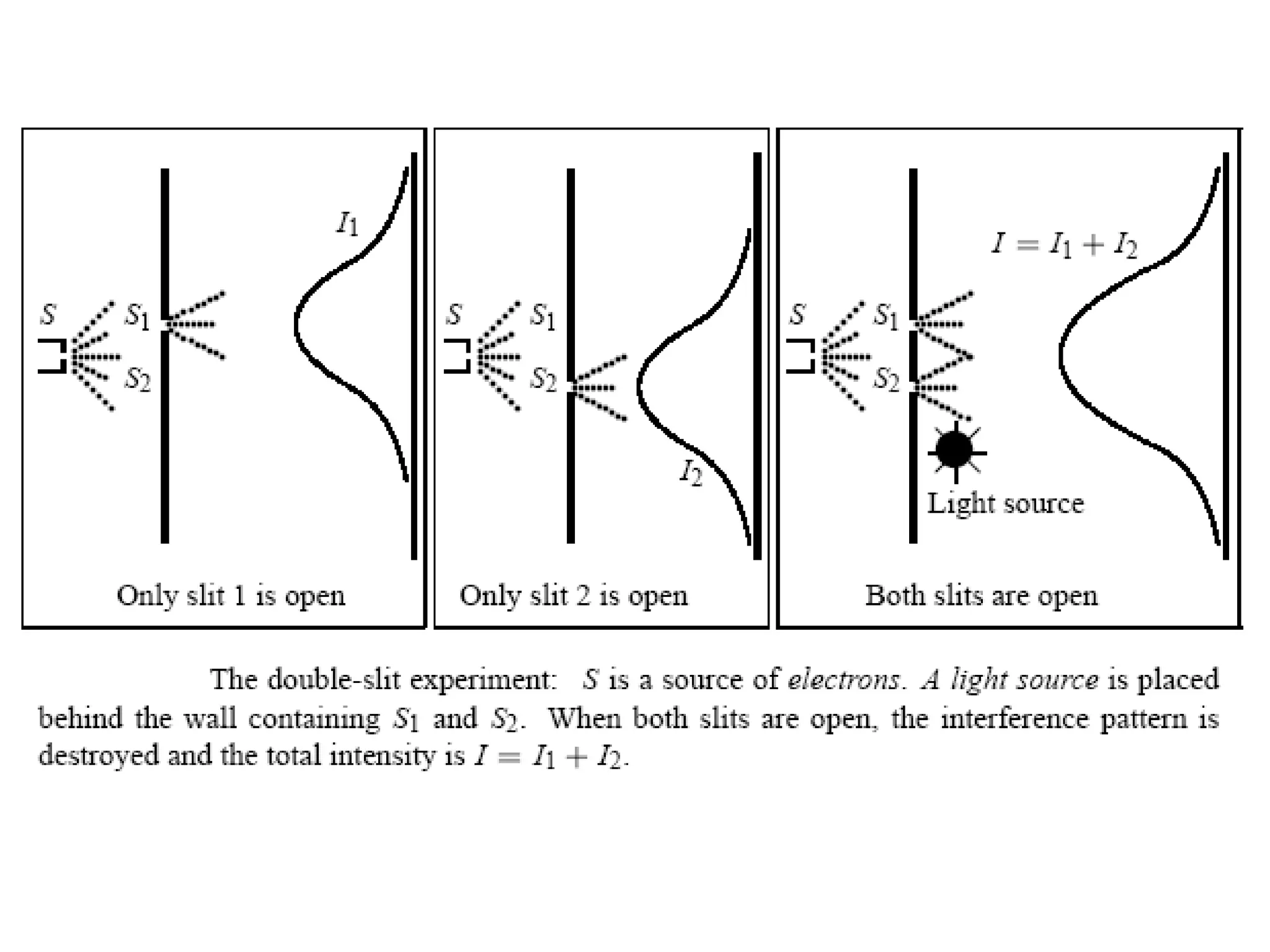
• Double slit experiments – in the view of
both classical and quantum.
• Phase term- responsible for the interference pattern
• Classically, waves exhibit interference patterns,
particles do not.
• When two non-interacting streams combine in the
same region of space,
for particle stream - intensities add;
for waves stream - amplitudes add
- but their intensities do not
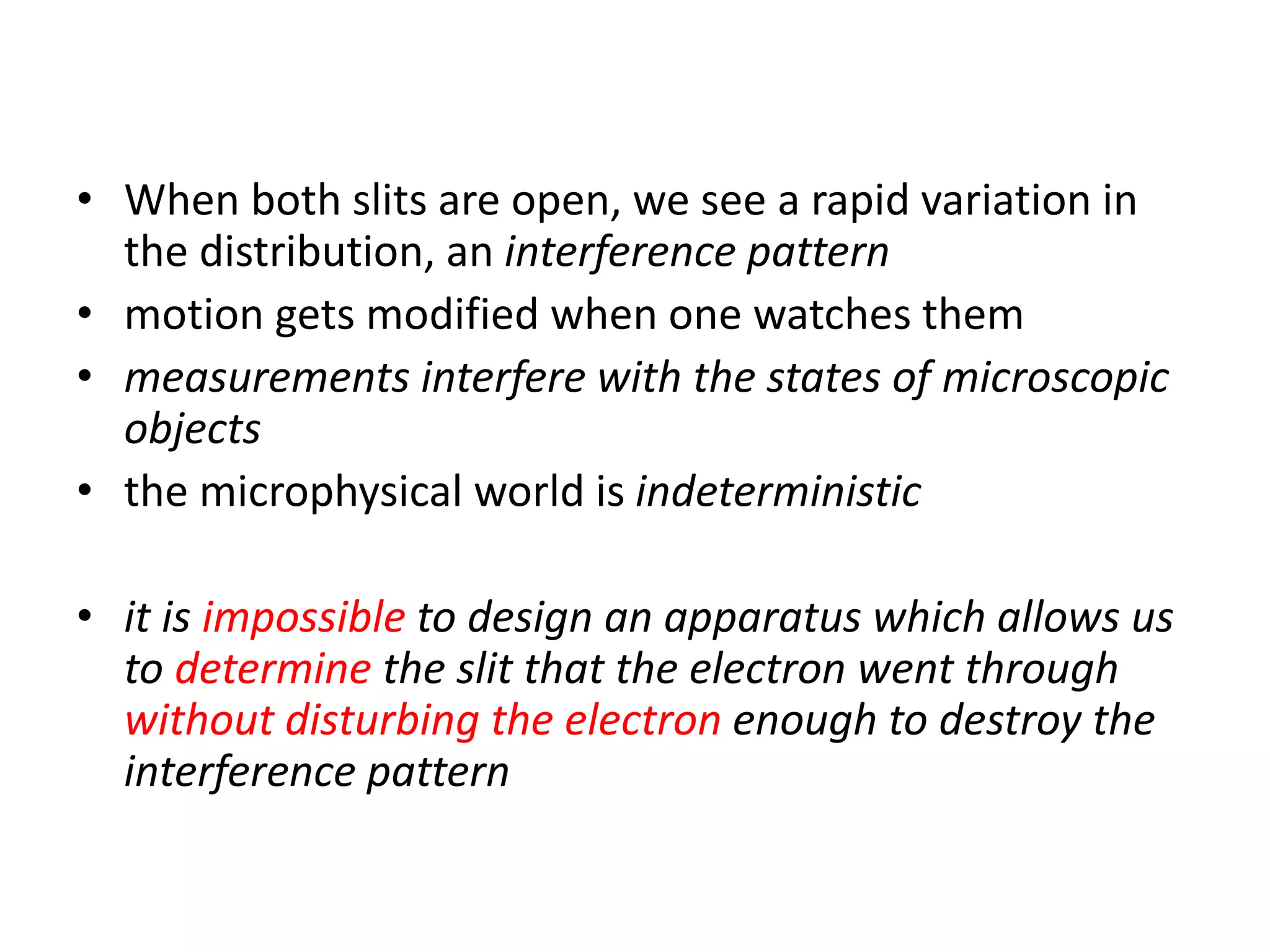
• When bothslits are open, we see a rapid variation in
the distribution, an interference pattern
• motion gets modified when one watches them
• measurements interfere with the states of microscopic
objects
• the microphysical world is indeterministic
• it is impossible to design an apparatus which allows us
to determine the slit that the electron went through
without disturbing the electron enough to destroy the
interference pattern
49.
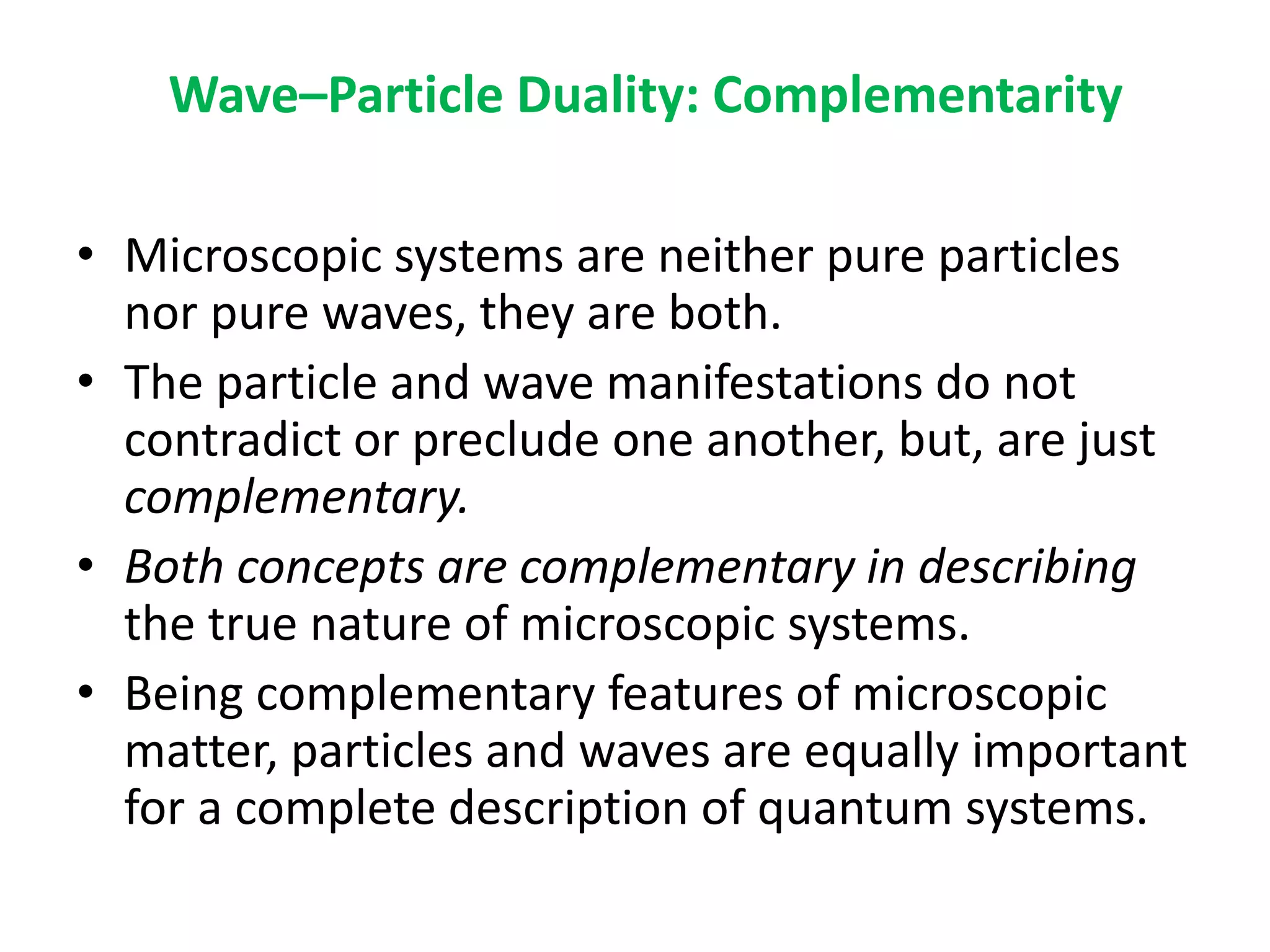
Wave–Particle Duality: Complementarity
•Microscopic systems are neither pure particles
nor pure waves, they are both.
• The particle and wave manifestations do not
contradict or preclude one another, but, are just
complementary.
• Both concepts are complementary in describing
the true nature of microscopic systems.
• Being complementary features of microscopic
matter, particles and waves are equally important
for a complete description of quantum systems.
50.
Heisenberg’s Uncertainty Principle
•Classical physics is thus completely deterministic
Δx . Δpx ≥ ћ/2
• If the x-component of the momentum of a particle is
measured with an uncertainty Δpx , then its x-position
cannot, at the same time, be measured more
accurately than Δx=ћ/(2.Δpx)
• Energy and time form a pair of complementary variable
ΔE . Δt ≥ ћ/2
• two measurements of the energy of a system and if
these measurements are separated by a time interval
Δt, the measured energies will differ by an amount ΔE
which can in no way be smaller than ћ/(2.Δt)
Atomic Transitions andSpectroscopy
Rutherford Planetary Model of the Atom
• Rutherford - atom consist of electrons orbiting
around a positively charged massive center - nucleus
• classical physics - two deficiencies:
– atoms are unstable - Maxwell’s electromagnetic theory –
electron accelerates - radiates energy - collapses onto the
nucleus
– atoms radiate energy over a continuous range of
frequencies - as the electron orbit collapses, its orbiting
frequency increases continuously – continuous spectra
• completely disagree with experiment……..
53.
Bohr Model ofthe Hydrogen Atom
• Rutherford’s planetary model, Planck’s quantum
hypothesis, and Einstein’s photon concept - Bohr
proposed H-atom model
• To account the observed spectrum of the hydrogen
atom and its stability.
• discrete set of circular stable orbits, stationary states,
are allowed
• The allowed orbits correspond to those for which the
orbital angular momentum of the electron is an integer
multiple of h L = nћ
Bohr quantization rule of the angular momentum
• The radiation corresponding to the electron’s transition
is carried out by a photon of energy hν
54.
Obtain En andradii rn ……
• Bohr’s quantization condition leads to a
discrete set of energies En and radii rn
• electrostatic force applied on electron by the
proton = centripetal force
• Bohr radius, a0 = 0.053 nm.
• Speed of electron is
55.
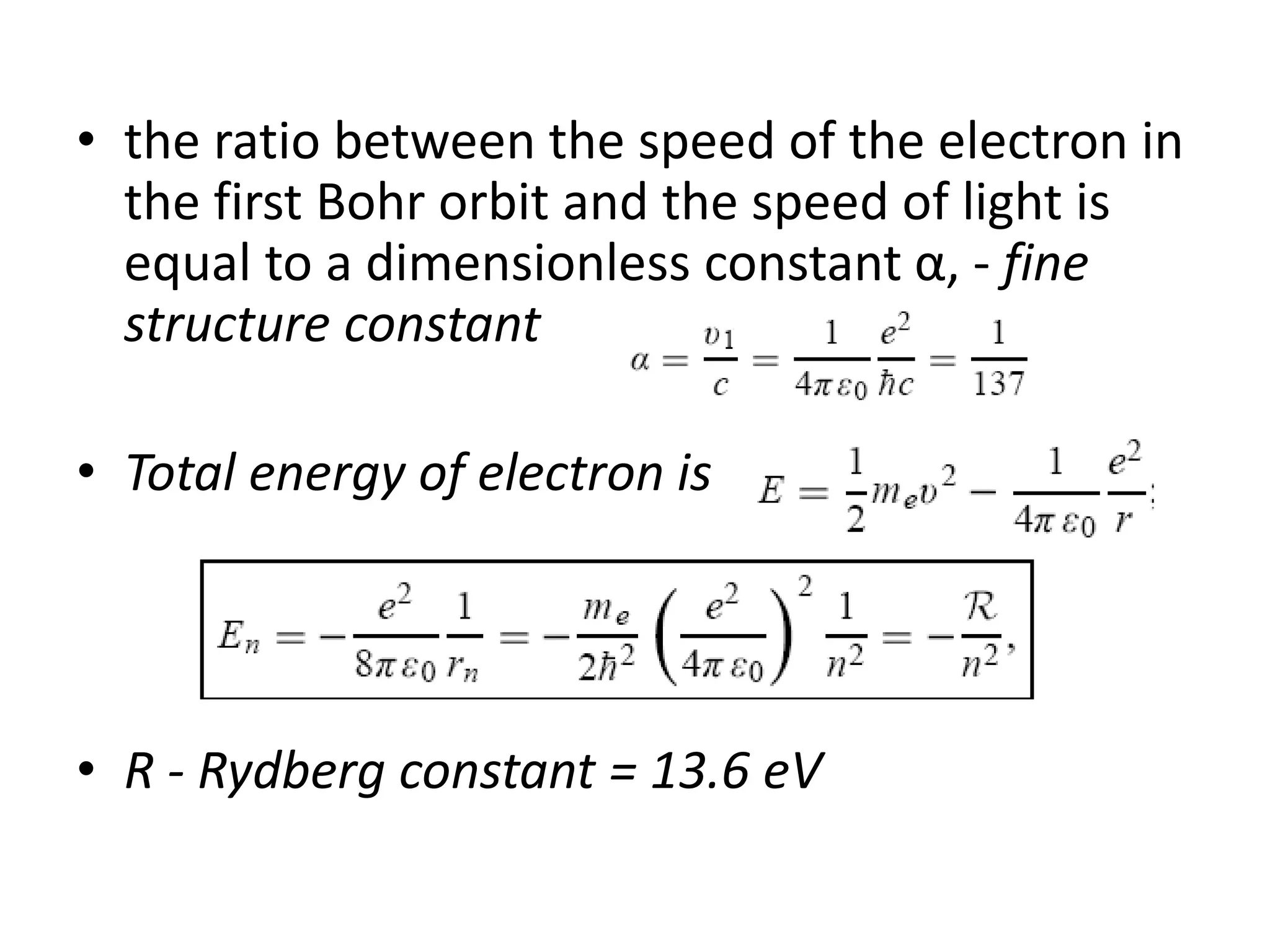
• the ratiobetween the speed of the electron in
the first Bohr orbit and the speed of light is
equal to a dimensionless constant α, - fine
structure constant
• Total energy of electron is
• R - Rydberg constant = 13.6 eV
56.
Spectroscopy of theHydrogen Atom
• radiation emitted or absorbed by
– glowing solid objects – Continuous
– gas - discrete spectrum
• Radiation - transition of the electron from a state n
to another m has a well defined (sharp) frequency
57.
• For instance,the Lyman series, which corresponds
to the emission of ultraviolet radiation -
transitions from excited states n = 2, 3, 4, 5, …to
the ground state n = 1
• Balmer series - transitions to the first excited
state, n = 2
• The atom emits visible radiation as a result of the
Balmer transitions.
• Paschen, n = 3 with n > 3; Brackett, n = 4 with n >
4; Pfund, n = 5 with n > 5; and so on. They
correspond to the emission of infrared radiation