SUPERCONDUCTORS
By-
Manish Sahu
M.Sc. Chemistry (Final)
Sp.- Physical Chemistry
SYNOPSIS
 Introduction
 Definition
 History
 Transition Temperature
 Important Factors
 Types of Superconductor
 Meissner Effect
 Applications
 Advantage
 Disadvantage
 Conclusion
 References
INTRODUCTION
 Some material offer zero resistance to the flow of current below a
specific temperature . They are called Superconductor.
 Mostly they are metal, alloys, and ceramics.
 This specific temperature is called critical temperature or the Transition
Temperature.
 This phenomenon is termed as Superconductivity.
DEFINITION
The substances which show Superconductivity at low temperature
are called Superconductors.
HISTORY
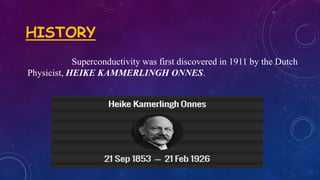
Superconductivity was first discovered in 1911 by the Dutch
Physicist, HEIKE KAMMERLINGH ONNES.
TRANSITION TEMPERATURE
 The temperature at which a material electrical resistivity drops to absolute zero is called the
Transition Temperature or Critical temperature.
 At and below TC , the material is said to be in the superconductivity state and above this
temperature, the material is said to be in the normal state.
 Figure shows the variation of electrical resistivity of a normal metal Silver(Ag) and
superconducting metal Mercury(Hg) versus temperature.
 It can be seen that the electrical resistivity of normal metal decreases steadily as the
temperature is decreased and reaches a low value at 0k called the residual (ρ) resistivity.
Fig :- Electrical Resistivity Vs Temperature
0
IMPORTANT FACTORS
The superconducting state is defined by three very important factors:-
 Critical Temperature (TC) :-
The temperature below which resistance of a
Superconductor become Zero.
 Critical Magnetic Field (HC) :-
Magnetic field required to destroy the superconducting
state.
 Critical Current Density (JC) :-
The minimum amount of current that can pass through a
superconductor without transitioning it back to the normal state.
TYPES
 Type – I Superconductors
 Type – II Superconductors
TYPE – I SUPERCONDUCTORS
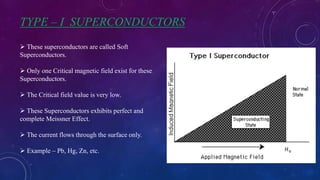
 These superconductors are called Soft
Superconductors.
 Only one Critical magnetic field exist for these
Superconductors.
 The Critical field value is very low.
 These Superconductors exhibits perfect and
complete Meissner Effect.
 The current flows through the surface only.
 Example – Pb, Hg, Zn, etc.
TYPE – II SUPERCONDUCTORS
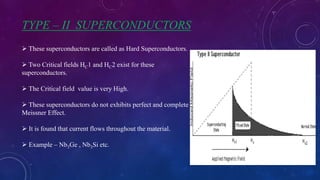
 These superconductors are called as Hard Superconductors.
 Two Critical fields HC1 and HC2 exist for these
superconductors.
 The Critical field value is very High.
 These superconductors do not exhibits perfect and complete
Meissner Effect.
 It is found that current flows throughout the material.
 Example – Nb3Ge , Nb3Si etc.
MEISSNER EFFECT
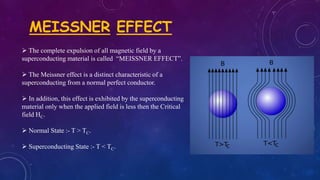
 The complete expulsion of all magnetic field by a
superconducting material is called “MEISSNER EFFECT”.
 The Meissner effect is a distinct characteristic of a
superconducting from a normal perfect conductor.
 In addition, this effect is exhibited by the superconducting
material only when the applied field is less then the Critical
field HC.
 Normal State :- T > TC.
 Superconducting State :- T < TC.
APPLICATIONS
 Electric motors and Generators.
 Superconducting Wire.
 Maglev Train.
 Magnetic Resonance Imaging (MRI).
ADVANTAGE
 Magnetic Levitation.
 Power & Cost Efficient
 Reduces the size & Weight of Motors Generators & Supporting equipments.
DISADVANTAGE
 Extremely Brittle.
 Very low Critical Temperature.
 Not applicable for Consumer electronics.
CONCLUSION
Today's motors are fundamentally similar to the electric motors
designed over a century ago. The advent of high temperature superconductivity has
created the opportunity in the technology of motors. The cost , size , weight and
efficiency benefits of superconducting machines will significantly change the
dynamics of the motor manufacturing industry and the motor user market.
REFERENCES
 Solid State Chemistry :
“D.K. CHAKRABARTY”
(Page No. 197 – 203)
 Solid State Physics :
“R.L. SINGHAL”
 Solid State Chemistry :
“ANTHONY WEST”
Superconductor

Superconductor

  • 1.
    SUPERCONDUCTORS By- Manish Sahu M.Sc. Chemistry(Final) Sp.- Physical Chemistry
  • 2.
    SYNOPSIS  Introduction  Definition History  Transition Temperature  Important Factors  Types of Superconductor  Meissner Effect  Applications  Advantage  Disadvantage  Conclusion  References
  • 3.
    INTRODUCTION  Some materialoffer zero resistance to the flow of current below a specific temperature . They are called Superconductor.  Mostly they are metal, alloys, and ceramics.  This specific temperature is called critical temperature or the Transition Temperature.  This phenomenon is termed as Superconductivity.
  • 4.
    DEFINITION The substances whichshow Superconductivity at low temperature are called Superconductors.
  • 5.
    HISTORY Superconductivity was firstdiscovered in 1911 by the Dutch Physicist, HEIKE KAMMERLINGH ONNES.
  • 6.
    TRANSITION TEMPERATURE  Thetemperature at which a material electrical resistivity drops to absolute zero is called the Transition Temperature or Critical temperature.  At and below TC , the material is said to be in the superconductivity state and above this temperature, the material is said to be in the normal state.  Figure shows the variation of electrical resistivity of a normal metal Silver(Ag) and superconducting metal Mercury(Hg) versus temperature.  It can be seen that the electrical resistivity of normal metal decreases steadily as the temperature is decreased and reaches a low value at 0k called the residual (ρ) resistivity.
  • 7.
    Fig :- ElectricalResistivity Vs Temperature 0
  • 8.
    IMPORTANT FACTORS The superconductingstate is defined by three very important factors:-  Critical Temperature (TC) :- The temperature below which resistance of a Superconductor become Zero.  Critical Magnetic Field (HC) :- Magnetic field required to destroy the superconducting state.  Critical Current Density (JC) :- The minimum amount of current that can pass through a superconductor without transitioning it back to the normal state.
  • 9.
    TYPES  Type –I Superconductors  Type – II Superconductors
  • 10.
    TYPE – ISUPERCONDUCTORS  These superconductors are called Soft Superconductors.  Only one Critical magnetic field exist for these Superconductors.  The Critical field value is very low.  These Superconductors exhibits perfect and complete Meissner Effect.  The current flows through the surface only.  Example – Pb, Hg, Zn, etc.
  • 11.
    TYPE – IISUPERCONDUCTORS  These superconductors are called as Hard Superconductors.  Two Critical fields HC1 and HC2 exist for these superconductors.  The Critical field value is very High.  These superconductors do not exhibits perfect and complete Meissner Effect.  It is found that current flows throughout the material.  Example – Nb3Ge , Nb3Si etc.
  • 12.
    MEISSNER EFFECT  Thecomplete expulsion of all magnetic field by a superconducting material is called “MEISSNER EFFECT”.  The Meissner effect is a distinct characteristic of a superconducting from a normal perfect conductor.  In addition, this effect is exhibited by the superconducting material only when the applied field is less then the Critical field HC.  Normal State :- T > TC.  Superconducting State :- T < TC.
  • 13.
    APPLICATIONS  Electric motorsand Generators.  Superconducting Wire.  Maglev Train.  Magnetic Resonance Imaging (MRI).
  • 14.
    ADVANTAGE  Magnetic Levitation. Power & Cost Efficient  Reduces the size & Weight of Motors Generators & Supporting equipments.
  • 15.
    DISADVANTAGE  Extremely Brittle. Very low Critical Temperature.  Not applicable for Consumer electronics.
  • 16.
    CONCLUSION Today's motors arefundamentally similar to the electric motors designed over a century ago. The advent of high temperature superconductivity has created the opportunity in the technology of motors. The cost , size , weight and efficiency benefits of superconducting machines will significantly change the dynamics of the motor manufacturing industry and the motor user market.
  • 17.
    REFERENCES  Solid StateChemistry : “D.K. CHAKRABARTY” (Page No. 197 – 203)  Solid State Physics : “R.L. SINGHAL”  Solid State Chemistry : “ANTHONY WEST”