WELCOME TO YOU ALL
PHYSICAL
CHEMISTRY
PRESENTATION
M.SC.-II –
(SEM. III )
2013–
 STATISTICAL 2014
MECHANICS
PAPER-III

Presented by :–
Dharmendra R. Prajapati
RAMNIRANJAN JHUNJHUNWALA
COLLEGE
Why do we study Statistical Mechanics?
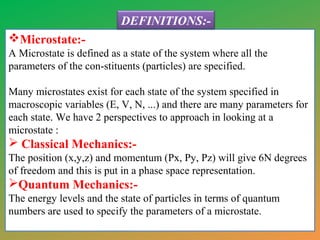
DEFINITIONS:Microstate:A Microstate is defined as a state of the system where all the
parameters of the con-stituents (particles) are specified.
Many microstates exist for each state of the system specified in
macroscopic variables (E, V, N, ...) and there are many parameters for
each state. We have 2 perspectives to approach in looking at a
microstate :

 Classical Mechanics:The position (x,y,z) and momentum (Px, Py, Pz) will give 6N degrees
of freedom and this is put in a phase space representation.

Quantum Mechanics:The energy levels and the state of particles in terms of quantum
numbers are used to specify the parameters of a microstate.
MACROSTATE
 A Macrostate is defined as a state of the system where the distribution
of particles over the energy levels is specified..
The macrostate includes what are the different energy levels and the
number of particles having particular energies. It contains many
microstates.
In the equilibrium thermodynamic state, we only need to specify 3
macroscopic variables (P,V,T) or (P,V,N) or (E,V,N),
where P : pressure, V : Volume, T : Temperature,
N : Number of particles and E : Energy. The equation of state for the
system relates the 3 variables to a fourth, for e.g. for an ideal gas.
PV = nRT
We also have examples of other systems like magnetic systems (where
we include M, the magnetization). However, the equilibrium macrostate
is unknown from thermodynamics.
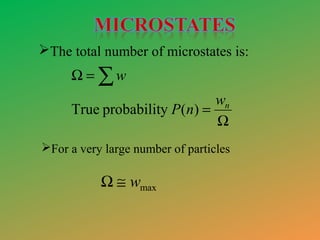
The total number of microstates is:

Ω = ∑w
wn
True probability P (n) =
Ω
For a very large number of particles

Ω ≅ wmax
“Probability theory is nothing but common sense reduced to calculations”
- Laplace (1819)
An event (very loosely defined) – any possible outcome of some
measurement.
An event is a statistical (random) quantity if the probability of its
occurrence, P, in the process of measurement is < 1.
The “sum” of two events: in the process of measurement, we observe
either one of the events.
Addition rule for independent events:

P (i or j) = P (i) + P (j)

(independent events – one event does not change the probability for the
occurrence of the other).
The “product” of two events: in the process of measurement, we observe both
events.
Multiplication rule for independent events:

P (i and j) = P (i) x P (j)
N!
wn =
n!( N − n)!
Boltzmann Statistical Distribution


–

1877,L. Boltzmann

– derived the distribution function when studying the
collisions of gas molecules owing to which the
distribution set in.
– In the thermodynamic system which is made up with
classical particles, if these particles have the same
mechanical properties, and they are independent, the
system’s most probable distribution is called
Boltzmann’s statistical Distribution.
The Boltzmann Distribution
The Austrian physicist
Boltzmann asked the following
question: in an assembly of
atoms, what is the probability
that an atom has total energy
between E and E+dE?
His answer:

where

Pr( E ) µ f B ( E )

f B ( E ) = Ae − E / kT
The Boltzmann Distribution
f B ( E ) = Ae − E / kT
is called the
Boltzmann distribution,
e-E/kT is the Boltzmann
factor and
k = 8.617 x 10⁻⁵ eV/K
is the Boltzmann constant
The Boltzmann distribution
applies to identical, but
distinguishable particles
The Boltzmann Distribution
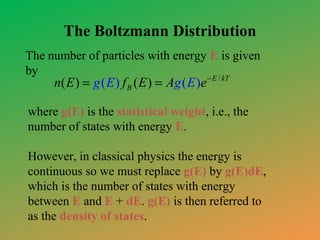
The number of particles with energy E is given
by

n( E ) = g ( E ) f B ( E ) = Ag ( E )e − E / kT

where g(E) is the statistical weight, i.e., the
number of states with energy E.
However, in classical physics the energy is
continuous so we must replace g(E) by g(E)dE,
which is the number of states with energy
between E and E + dE. g(E) is then referred to
as the density of states.
Maxwell-Boltzmann Statistics
We take another step back in time from quantum mechanics (1930’s)
to statistical mechanics (late 1800’s).
Classical particles which are identical but far enough apart to be
distinguishable obey Maxwell-Boltzmann statistics.
classical ⇔ “slow,” wave functions don’t overlap
distinguishable ⇔ you would know if two particles
changed places (you could put your finger on one and
follow it as it moves about)
Two particles can be considered distinguishable if their separation is
large compared to their de Broglie wavelength.
Example: ideal gas molecules.
Maxwell-Boltzmann distribution function is
fε )= A e -ε/kT
(
The number of particles having energy ε at temperature T is
nε
(

)=

A g ε )e
(

.

-ε/ kT

A is like a normalization constant; we integrate n(ε) over all
energies to get N, the total number of particles. A is fixed to
give the "right" answer for the number of particles. For some
calculations, we may not care exactly what the value of A is.
ε is the particle energy, k is Boltzmann's constant
(k = 1.38x10⁻²³ J/K), and T is the temperature in Kelvin.
Often k is written kB.
When k and T appear together, you can be sure that k is
Boltzmann's constant.
nε ) = A g ε )e
(
(

-ε/ kT

We still need g(ε), the number of states having energy ε.
We will find that g(ε) depends on the problem under
study.
Summary
• Statistical physics is the study of the collective
behavior of large assemblies of particles
• Ludwig Boltzmann derived the following
energy distribution for identical, but
− E / kT
distinguishable, particles
f B ( E ) = Ae
• The Maxwell distribution of molecular speeds
is a famous application of Boltzmann’s general
formula
RefeRenceS

Reference books:-

 phySical chemiStRy
- Skoog ,
holleR
 phySical chemiStRy
=Silbey &
albeRty
D. J. Griths, Introduction to Quantum
Mechanics, 2nd ed., Pearson Education, Inc.,
Upper Saddle River, NJ, 2005.
http://physics.nankai.edu.cn/grzy/fsong/in
dex.asp
http://www.wikipedia.org/wiki/Boltzmann_distribution
http://www.webchem.net/notes/how_far/kinetics/maxwell_boltzma
statistic mechanics

statistic mechanics

  • 1.
    WELCOME TO YOUALL PHYSICAL CHEMISTRY PRESENTATION M.SC.-II – (SEM. III ) 2013–  STATISTICAL 2014 MECHANICS PAPER-III Presented by :– Dharmendra R. Prajapati RAMNIRANJAN JHUNJHUNWALA COLLEGE
  • 3.
    Why do westudy Statistical Mechanics? Why do we study Statistical Mechanics?
  • 4.
    DEFINITIONS:Microstate:A Microstate isdefined as a state of the system where all the parameters of the con-stituents (particles) are specified. Many microstates exist for each state of the system specified in macroscopic variables (E, V, N, ...) and there are many parameters for each state. We have 2 perspectives to approach in looking at a microstate :  Classical Mechanics:The position (x,y,z) and momentum (Px, Py, Pz) will give 6N degrees of freedom and this is put in a phase space representation. Quantum Mechanics:The energy levels and the state of particles in terms of quantum numbers are used to specify the parameters of a microstate.
  • 5.
    MACROSTATE  A Macrostateis defined as a state of the system where the distribution of particles over the energy levels is specified.. The macrostate includes what are the different energy levels and the number of particles having particular energies. It contains many microstates. In the equilibrium thermodynamic state, we only need to specify 3 macroscopic variables (P,V,T) or (P,V,N) or (E,V,N), where P : pressure, V : Volume, T : Temperature, N : Number of particles and E : Energy. The equation of state for the system relates the 3 variables to a fourth, for e.g. for an ideal gas. PV = nRT We also have examples of other systems like magnetic systems (where we include M, the magnetization). However, the equilibrium macrostate is unknown from thermodynamics.
  • 6.
    The total numberof microstates is: Ω = ∑w wn True probability P (n) = Ω For a very large number of particles Ω ≅ wmax
  • 7.
    “Probability theory isnothing but common sense reduced to calculations” - Laplace (1819) An event (very loosely defined) – any possible outcome of some measurement. An event is a statistical (random) quantity if the probability of its occurrence, P, in the process of measurement is < 1. The “sum” of two events: in the process of measurement, we observe either one of the events. Addition rule for independent events: P (i or j) = P (i) + P (j) (independent events – one event does not change the probability for the occurrence of the other). The “product” of two events: in the process of measurement, we observe both events. Multiplication rule for independent events: P (i and j) = P (i) x P (j)
  • 8.
  • 9.
    Boltzmann Statistical Distribution  – 1877,L.Boltzmann – derived the distribution function when studying the collisions of gas molecules owing to which the distribution set in. – In the thermodynamic system which is made up with classical particles, if these particles have the same mechanical properties, and they are independent, the system’s most probable distribution is called Boltzmann’s statistical Distribution.
  • 11.
    The Boltzmann Distribution TheAustrian physicist Boltzmann asked the following question: in an assembly of atoms, what is the probability that an atom has total energy between E and E+dE? His answer: where Pr( E ) µ f B ( E ) f B ( E ) = Ae − E / kT
  • 12.
    The Boltzmann Distribution fB ( E ) = Ae − E / kT is called the Boltzmann distribution, e-E/kT is the Boltzmann factor and k = 8.617 x 10⁻⁵ eV/K is the Boltzmann constant The Boltzmann distribution applies to identical, but distinguishable particles
  • 13.
    The Boltzmann Distribution Thenumber of particles with energy E is given by n( E ) = g ( E ) f B ( E ) = Ag ( E )e − E / kT where g(E) is the statistical weight, i.e., the number of states with energy E. However, in classical physics the energy is continuous so we must replace g(E) by g(E)dE, which is the number of states with energy between E and E + dE. g(E) is then referred to as the density of states.
  • 14.
    Maxwell-Boltzmann Statistics Maxwell-Boltzmann Statistics Wetake another step back in time from quantum mechanics (1930’s) to statistical mechanics (late 1800’s). Classical particles which are identical but far enough apart to be distinguishable obey Maxwell-Boltzmann statistics. classical ⇔ “slow,” wave functions don’t overlap distinguishable ⇔ you would know if two particles changed places (you could put your finger on one and follow it as it moves about) Two particles can be considered distinguishable if their separation is large compared to their de Broglie wavelength. Example: ideal gas molecules.
  • 15.
    Maxwell-Boltzmann distribution functionis fε )= A e -ε/kT ( The number of particles having energy ε at temperature T is nε ( )= A g ε )e ( . -ε/ kT A is like a normalization constant; we integrate n(ε) over all energies to get N, the total number of particles. A is fixed to give the "right" answer for the number of particles. For some calculations, we may not care exactly what the value of A is. ε is the particle energy, k is Boltzmann's constant (k = 1.38x10⁻²³ J/K), and T is the temperature in Kelvin. Often k is written kB. When k and T appear together, you can be sure that k is Boltzmann's constant.
  • 16.
    nε ) =A g ε )e ( ( -ε/ kT We still need g(ε), the number of states having energy ε. We will find that g(ε) depends on the problem under study.
  • 17.
    Summary • Statistical physicsis the study of the collective behavior of large assemblies of particles • Ludwig Boltzmann derived the following energy distribution for identical, but − E / kT distinguishable, particles f B ( E ) = Ae • The Maxwell distribution of molecular speeds is a famous application of Boltzmann’s general formula
  • 18.
    RefeRenceS Reference books:-  phySicalchemiStRy - Skoog , holleR  phySical chemiStRy =Silbey & albeRty D. J. Griths, Introduction to Quantum Mechanics, 2nd ed., Pearson Education, Inc., Upper Saddle River, NJ, 2005. http://physics.nankai.edu.cn/grzy/fsong/in dex.asp http://www.wikipedia.org/wiki/Boltzmann_distribution http://www.webchem.net/notes/how_far/kinetics/maxwell_boltzma