POSTULATE OF QUANTUM
MECHANICS
HAJI KHALIL AHMED JATOI
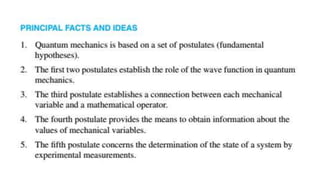
The First Two Postulates of Quantum
Mechanics
• The Schrödinger equation does not provide a complete theory of
quantum mechanics.
• Schrödinger, Heisenberg, and others devised several
postulates(unproved fundamental assumptions) that form a
consistent logical foundation for nonrelativistic quantum mechanics.
• In any theory based on postulates, the validity of the postulates is
tested by comparing the consequences of the postulates with
experimental fact. The postulates of quantum mechanics do pass this
test.
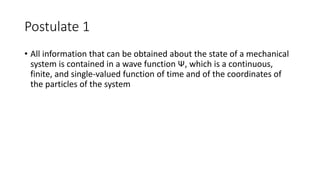
Postulate 1
• All information that can be obtained about the state of a mechanical
system is contained in a wave function Ψ, which is a continuous,
finite, and single-valued function of time and of the coordinates of
the particles of the system
Explanation
• This postulate implies that there is a one-to-one relationship between the
state of the system and a wave function. That is, each possible state
corresponds to one wave function, and each possible wave function
corresponds to one state.
• The terms “state function” and “wave function” are often used
interchangeably.
• Information about values of mechanical variables such as energy and
momentum must be obtained from the wave function, instead of from
values of coordinates and velocities as in classical mechanics.
• The fourth postulate will provide the method for obtaining this
information.
Postulate 2
• The wave function Ψ obeys the time-dependent Schrödinger
equation.
• where H is the Hamiltonian operator of the system.
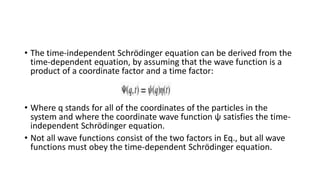
• The time-independent Schrödinger equation can be derived from the
time-dependent equation, by assuming that the wave function is a
product of a coordinate factor and a time factor:
• Where q stands for all of the coordinates of the particles in the
system and where the coordinate wave function ψ satisfies the time-
independent Schrödinger equation.
• Not all wave functions consist of the two factors in Eq., but all wave
functions must obey the time-dependent Schrödinger equation.
The Third Postulate. Mathematical Operators
and Mechanical Variables
• The time-independent Schrödinger equation determines the energy
eigenvalues for a given system.
• These eigenvalues are the possible values that the energy of the
system can take on.
• The third and fourth postulates must be used to obtain the possible
values of other mechanical variables such as the momentum and the
angular momentum.
• The third postulate is:
Postulates 3
• There is a linear hermitian mathematical operator in one-to-one correspondence with every mechanical
variable.
• This postulate states that for each operator there is one and only one variable, and
• for each variable there is one and only one mathematical operator.
• A mathematical operator is a symbol that stands for performing one or more
mathematical operations.
• When the symbol for an operator is written to the left of the symbol for a function, the
operation is to be applied to that function.
• For example, d/dx is a derivative operator, standing for differentiation of the function
with respect to x; c is a multiplication operator, standing for multiplication of the function
by the constant c; h(x) is also a multiplication operator, standing for multiplication by the
function h(x).
Cont:
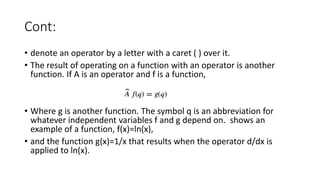
• denote an operator by a letter with a caret ( ) over it.
• The result of operating on a function with an operator is another
function. If A is an operator and f is a function,
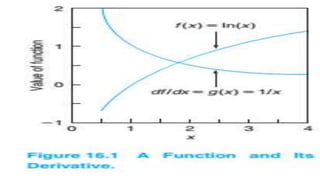
• Where g is another function. The symbol q is an abbreviation for
whatever independent variables f and g depend on. shows an
example of a function, f(x)=ln(x),
• and the function g(x)=1/x that results when the operator d/dx is
applied to ln(x).
Hermitian operator
• Hermitian operators have several important properties:
1. Hermitian operators are linear.
2. Two hermitian operators are not required to commute with each other.
3. A hermitian operator has a set of eigenfunctions and eigenvalues.
4. The eigenvalues of a hermitian operator are real.
5. Two eigenfunctions of a hermitian operator with different eigenvalues are
orthogonal to each other.
6. Two commuting hermitian operators can have a set of common
eigenfunctions.
7. The set of eigenfunctions of a hermitian operator form a complete set for
expansion of functions obeying the same boundary conditions.
Postulate 4 and Expectation Values
• The first postulate of quantum mechanics asserts that the wave
function of a system contains all available information about the
values of mechanical variables for the state corresponding to the
wave function.
• The third postulate provides a mathematical operator for each
mechanical variable.
• The fourth postulate provides the mathematical procedure for
obtaining the available information:
Postulate 4
• (a) If a mechanical variable A is measured without experimental error, the
only possible outcomes of the measurement are the eigenvalues of the
operator A that corresponds to A.
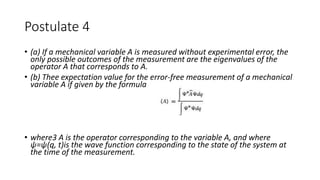
• (b) Thee expectation value for the error-free measurement of a mechanical
variable A if given by the formula
• where3 A is the operator corresponding to the variable A, and where
ψ=ψ(q, t)is the wave function corresponding to the state of the system at
the time of the measurement.
Postulate 5. Measurements and
the Determination of the State of a System
• The fifth and final postulate gives information about the state of a
system following a measurement.
• Postulate 5. Immediately after an error-free measurement of the
mechanical variable A in which the outcome was the eigenvalue aj,
the state of the system corresponds to a wave function that is an
eigenfunction of A with eigenvalue equal to aj.
Explanations
• This postulate says very little about the state of the system prior to a
single measurement of the variable A, because the act of
measurement can change the state of the system.
• To understand physically how a measurement can change the state of
a system consider the determination of the position of a particle by
the scattering of electromagnetic radiation. When an airplane reflects
a radar wave, the effect on the airplane is negligible because of the
large mass of the airplane. When an object of small mass such as an
electron scatters ultraviolet light or X-rays, the effect is not negligible.

Postulates of quantum mechanics

  • 1.
  • 3.
    The First TwoPostulates of Quantum Mechanics • The Schrödinger equation does not provide a complete theory of quantum mechanics. • Schrödinger, Heisenberg, and others devised several postulates(unproved fundamental assumptions) that form a consistent logical foundation for nonrelativistic quantum mechanics. • In any theory based on postulates, the validity of the postulates is tested by comparing the consequences of the postulates with experimental fact. The postulates of quantum mechanics do pass this test.
  • 4.
    Postulate 1 • Allinformation that can be obtained about the state of a mechanical system is contained in a wave function Ψ, which is a continuous, finite, and single-valued function of time and of the coordinates of the particles of the system
  • 5.
    Explanation • This postulateimplies that there is a one-to-one relationship between the state of the system and a wave function. That is, each possible state corresponds to one wave function, and each possible wave function corresponds to one state. • The terms “state function” and “wave function” are often used interchangeably. • Information about values of mechanical variables such as energy and momentum must be obtained from the wave function, instead of from values of coordinates and velocities as in classical mechanics. • The fourth postulate will provide the method for obtaining this information.
  • 6.
    Postulate 2 • Thewave function Ψ obeys the time-dependent Schrödinger equation. • where H is the Hamiltonian operator of the system.
  • 7.
    • The time-independentSchrödinger equation can be derived from the time-dependent equation, by assuming that the wave function is a product of a coordinate factor and a time factor: • Where q stands for all of the coordinates of the particles in the system and where the coordinate wave function ψ satisfies the time- independent Schrödinger equation. • Not all wave functions consist of the two factors in Eq., but all wave functions must obey the time-dependent Schrödinger equation.
  • 8.
    The Third Postulate.Mathematical Operators and Mechanical Variables • The time-independent Schrödinger equation determines the energy eigenvalues for a given system. • These eigenvalues are the possible values that the energy of the system can take on. • The third and fourth postulates must be used to obtain the possible values of other mechanical variables such as the momentum and the angular momentum. • The third postulate is:
  • 9.
    Postulates 3 • Thereis a linear hermitian mathematical operator in one-to-one correspondence with every mechanical variable. • This postulate states that for each operator there is one and only one variable, and • for each variable there is one and only one mathematical operator. • A mathematical operator is a symbol that stands for performing one or more mathematical operations. • When the symbol for an operator is written to the left of the symbol for a function, the operation is to be applied to that function. • For example, d/dx is a derivative operator, standing for differentiation of the function with respect to x; c is a multiplication operator, standing for multiplication of the function by the constant c; h(x) is also a multiplication operator, standing for multiplication by the function h(x).
  • 10.
    Cont: • denote anoperator by a letter with a caret ( ) over it. • The result of operating on a function with an operator is another function. If A is an operator and f is a function, • Where g is another function. The symbol q is an abbreviation for whatever independent variables f and g depend on. shows an example of a function, f(x)=ln(x), • and the function g(x)=1/x that results when the operator d/dx is applied to ln(x).
  • 12.
    Hermitian operator • Hermitianoperators have several important properties: 1. Hermitian operators are linear. 2. Two hermitian operators are not required to commute with each other. 3. A hermitian operator has a set of eigenfunctions and eigenvalues. 4. The eigenvalues of a hermitian operator are real. 5. Two eigenfunctions of a hermitian operator with different eigenvalues are orthogonal to each other. 6. Two commuting hermitian operators can have a set of common eigenfunctions. 7. The set of eigenfunctions of a hermitian operator form a complete set for expansion of functions obeying the same boundary conditions.
  • 13.
    Postulate 4 andExpectation Values • The first postulate of quantum mechanics asserts that the wave function of a system contains all available information about the values of mechanical variables for the state corresponding to the wave function. • The third postulate provides a mathematical operator for each mechanical variable. • The fourth postulate provides the mathematical procedure for obtaining the available information:
  • 14.
    Postulate 4 • (a)If a mechanical variable A is measured without experimental error, the only possible outcomes of the measurement are the eigenvalues of the operator A that corresponds to A. • (b) Thee expectation value for the error-free measurement of a mechanical variable A if given by the formula • where3 A is the operator corresponding to the variable A, and where ψ=ψ(q, t)is the wave function corresponding to the state of the system at the time of the measurement.
  • 15.
    Postulate 5. Measurementsand the Determination of the State of a System • The fifth and final postulate gives information about the state of a system following a measurement. • Postulate 5. Immediately after an error-free measurement of the mechanical variable A in which the outcome was the eigenvalue aj, the state of the system corresponds to a wave function that is an eigenfunction of A with eigenvalue equal to aj.
  • 16.
    Explanations • This postulatesays very little about the state of the system prior to a single measurement of the variable A, because the act of measurement can change the state of the system. • To understand physically how a measurement can change the state of a system consider the determination of the position of a particle by the scattering of electromagnetic radiation. When an airplane reflects a radar wave, the effect on the airplane is negligible because of the large mass of the airplane. When an object of small mass such as an electron scatters ultraviolet light or X-rays, the effect is not negligible.