NPTEL – Physics – Mathematical Physics - 1
Lecture 19
Example 2
Eigenvalues and eigenfunctions of a spin,
1
2
particle
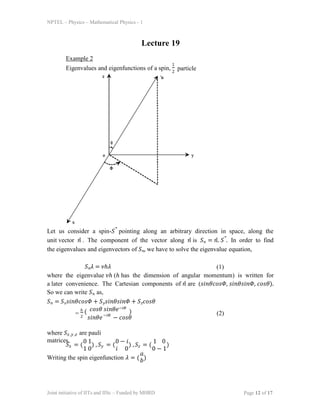
Let us consider a spin-𝑆⃗ pointing along an arbitrary direction in space, along the
unit vector 𝑛̂ . The component of the vector along 𝑛̂ is 𝑆𝑛 = 𝑛̂. 𝑆⃗. In order to find
the eigenvalues and eigenvectors of 𝑆𝑛, we have to solve the eigenvalue equation,
𝑆𝑛𝜆 = 𝜈ℎ𝜆 (1)
where the eigenvalue 𝜈ℎ (ℎ has the dimension of angular momentum) is written for
a later convenience. The Cartesian components of 𝑛̂ are (𝑠𝑖𝑛𝜃𝑐𝑜𝑠𝛷, 𝑠𝑖𝑛𝜃𝑠𝑖𝑛𝛷, 𝑐𝑜𝑠𝜃).
So we can write 𝑆𝑛 as,
𝑆𝑛 = 𝑆𝑥𝑠𝑖𝑛𝜃𝑐𝑜𝑠𝛷 + 𝑆𝑦𝑠𝑖𝑛𝜃𝑠𝑖𝑛𝛷 + 𝑆𝑧𝑐𝑜𝑠𝜃
=
ℎ
2
( 𝑐𝑜𝑠𝜃 𝑠𝑖𝑛𝜃𝑒−𝑖𝛷
)
𝑠𝑖𝑛𝜃𝑒 − 𝑐𝑜𝑠𝜃
−𝑖𝛷 (2)
where 𝑆𝑥,𝑦,𝑧 are pauli
matrices.
𝑆𝑥 = ( ) , 𝑆𝑦 = (
0 1 0 − 𝑖
1 0 𝑖 0
) , 𝑆𝑧 = (
1 0
0 − 1
)
Writing the spin eigenfunction 𝜆 = (𝑏)
𝑎
Joint initiative of IITs and IISc – Funded by MHRD Page 12 of 17
NPTEL – Physics – Mathematical Physics - 1
𝑆𝑛𝜆 = 2
(
𝑎𝑠𝑖𝑛𝜃𝑒𝑖𝛷 − 𝑏𝑐𝑜𝑠𝜃
)
ℎ 𝑎𝑐𝑜𝑠𝜃 + 𝑏𝑠𝑖𝑛𝜃𝑒−𝑖𝛷
(3)
The set of equations (4) and (5) have non-trivial solutions only if,
|
𝑐𝑜𝑠𝜃 − 2𝜈 𝑠𝑖𝑛𝜃𝑒−𝑖𝛷
𝑠𝑖𝑛𝜃𝑒𝑖𝛷 − (𝑐𝑜𝑠𝜃 + 2ν)
| = 0
The eigenvalues are obtained as,
−𝑖𝜙
| 𝑐𝑜𝑠𝜃 − 2𝜈 − 𝜆 𝑠𝑖𝑛𝜃𝑒
𝑠𝑖𝑛𝜃𝑒𝑖𝛷 – (𝑐𝑜𝑠𝜃 + 2𝜈) − 𝜆
| = 0
𝜆1 = + 2
, 𝜆2 = − 2
1 1
For 𝜆1 = 2 𝑎
= 𝑡𝑎𝑛 2
𝑒
1 𝑏 𝜃 𝑖𝛷
We shall not make a mistake, apart from an arbitrary phase factor, if we write the
eigenvector corresponding to this eigenvalues as,
𝜆1 = (
𝑐𝑜𝑠 𝜃⁄2
𝑠𝑖𝑛 𝜃⁄2 𝑒𝑖𝛷)
Similarly for 𝜆2 = − 2
1
𝑏
𝑎
= −𝑐𝑜𝑡
𝜃
2
𝑒𝑖𝛷
With a similar reasoning as above,
𝜆2 = (
𝑠𝑖𝑛 𝜃⁄2
−𝑐𝑜𝑠 𝜃⁄2 𝑒𝑖𝜃)
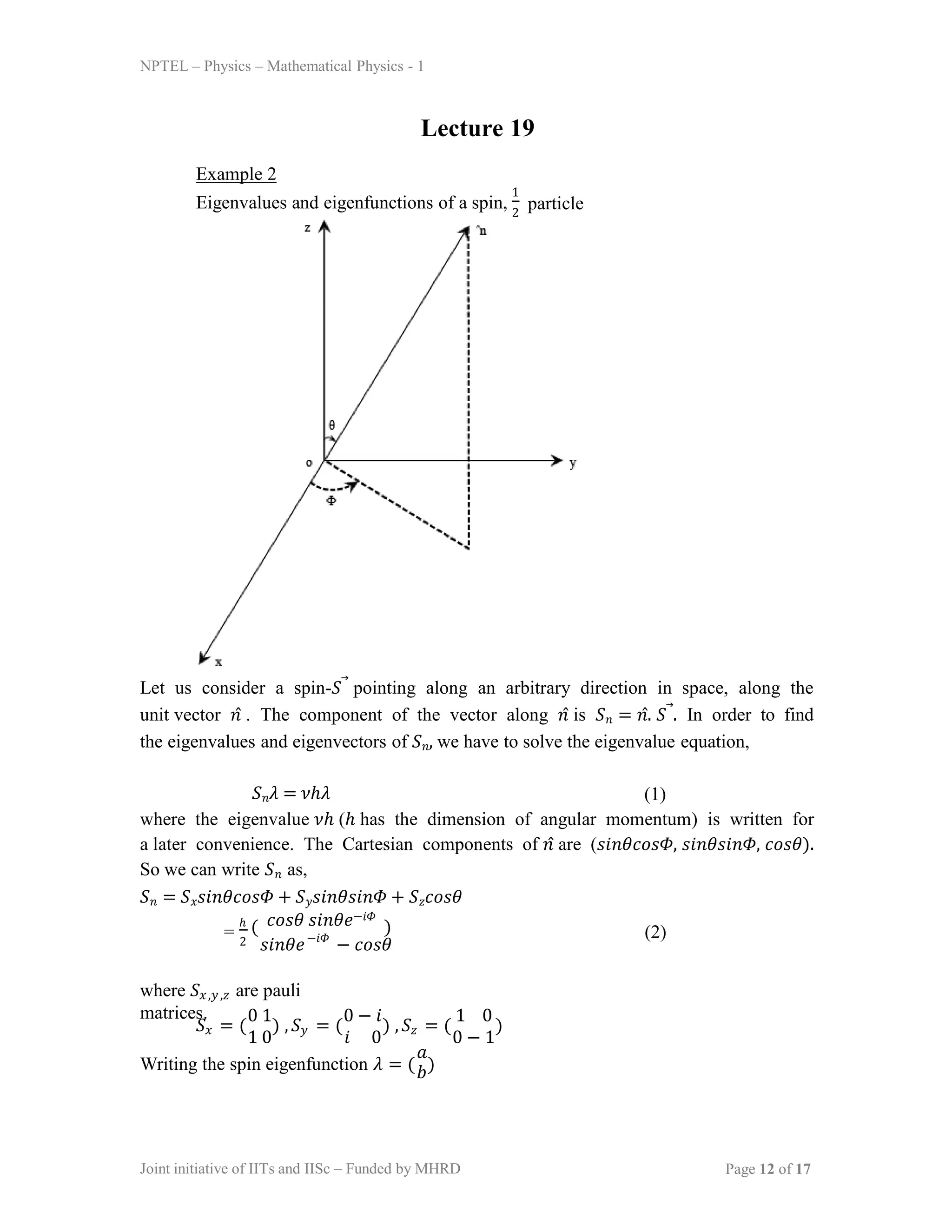
Thus the original eigenvalue equation (Eq.(1)) reduces to a set of two linear,
homogeneous equations,
(𝑐𝑜𝑠𝜃 − 2𝜈)𝑎 + 𝑠𝑖𝑛𝜃𝑒−𝑖𝛷𝑏 = 0
(4)
𝑠𝑖𝑛𝜃𝑒𝑖𝛷𝑎 − (𝑐𝑜𝑠𝜃 + 2𝜈)𝑏 = 0 (5)
One can easily check that for the spin oriented along + 𝑧 axis, i.e. 𝜃 = 0 and 𝜃 = 𝜋 will
reduce the eigenvectors to
𝜆1 = (1
)
0
𝜆2 = (0)
1
As are usually expected for a 𝑠 = 1
particle.
Joint initiative of IITs and IISc – Funded by MHRD Page 13 of 17
2
Joint initiative of IITs and IISc – Funded by MHRD Page 14 of 17
NPTEL – Physics – Mathematical Physics - 1
Numerical Evaluation of Eigenvalue problems
Gauss elimination method
The centre issue in the eigenvalue problem is the solution of the system of m
linear equations containing n unknowns denoted by 𝐴𝑥 = 𝑏. In expanded form it is
written as,
( 𝐴𝑚1 … … … … … 𝐴𝑚𝑛 ) ( 𝑥𝑚 )
𝐴11𝐴12 … … . 𝐴1𝑛
.
.
.
.
.
.
𝑥1
.
.
.
.
= .
.
.
( 𝑏𝑚 )
.
𝑏1
.
(1)
There are various ways of solving the above equation. Gauss Elimination method
or forward elimination method is one among them. It proceeds by reducing A to an upper
diagonal form.
𝐶11
0 𝐶22 … … .
. 𝐶2𝑛
.
0 … … …
… .
.
.
.
.
.
.
[ 0
𝐶12 … … . 𝐶1𝑛
.
.
.
.
.
.
0 𝐶𝑚𝑛 ]
We present an example here.
Example 1. Solve the system of equations using Gaussian elimination
2𝑥 + 𝑦 + 3𝑧 = 1
2𝑥 + 6𝑦 + 8𝑧 = 3
6𝑥 + 8𝑦 + 18𝑧 = 5
We shall try to achieve the upper diagonal nature via the following steps. Apply
𝑅2 → −𝑅1 + 𝑅2 (where 𝑅𝑖’s are each of the equations)
And 𝑅3 → −3𝑅1 + 𝑅3
This will transform the system of equation to
2𝑥 + 𝑦 + 3𝑧 = 1
5𝑦 + 5𝑧 = 2
5𝑦 + 9𝑧 = 2
Proceeding 𝑅3 → −𝑅2 + 𝑅3, the system of equation become,
2𝑥 + 𝑦 + 3𝑧 = 1
NPTEL – Physics – Mathematical Physics - 1
5𝑦 + 5𝑧 = 2
4𝑧 = 0
𝑅3 → 4
𝑅3
Next
1
Now,
1
1
2𝑥 + 𝑦 + 3𝑧 = 1
5𝑦 + 5𝑧 = 2
𝑧 = 0
𝑅1 → 2
𝑅1
𝑅2 → 5
𝑅2
𝑥 + 𝑦 + 𝑧 =
1 3 1
2 2 2
𝑦 + 𝑧 =
𝑧 = 0
2
5
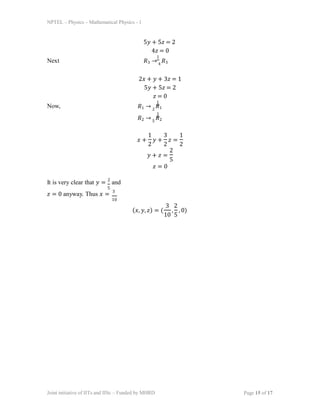
It is very clear that 𝑦 = 2
and
5
𝑧 = 0 anyway. Thus 𝑥 = 3
10
(𝑥, 𝑦, 𝑧) = ( , , 0)
Joint initiative of IITs and IISc – Funded by MHRD Page 15 of 17
3 2
10 5

lec19.ppt

  • 1.
    NPTEL – Physics– Mathematical Physics - 1 Lecture 19 Example 2 Eigenvalues and eigenfunctions of a spin, 1 2 particle Let us consider a spin-𝑆⃗ pointing along an arbitrary direction in space, along the unit vector 𝑛̂ . The component of the vector along 𝑛̂ is 𝑆𝑛 = 𝑛̂. 𝑆⃗. In order to find the eigenvalues and eigenvectors of 𝑆𝑛, we have to solve the eigenvalue equation, 𝑆𝑛𝜆 = 𝜈ℎ𝜆 (1) where the eigenvalue 𝜈ℎ (ℎ has the dimension of angular momentum) is written for a later convenience. The Cartesian components of 𝑛̂ are (𝑠𝑖𝑛𝜃𝑐𝑜𝑠𝛷, 𝑠𝑖𝑛𝜃𝑠𝑖𝑛𝛷, 𝑐𝑜𝑠𝜃). So we can write 𝑆𝑛 as, 𝑆𝑛 = 𝑆𝑥𝑠𝑖𝑛𝜃𝑐𝑜𝑠𝛷 + 𝑆𝑦𝑠𝑖𝑛𝜃𝑠𝑖𝑛𝛷 + 𝑆𝑧𝑐𝑜𝑠𝜃 = ℎ 2 ( 𝑐𝑜𝑠𝜃 𝑠𝑖𝑛𝜃𝑒−𝑖𝛷 ) 𝑠𝑖𝑛𝜃𝑒 − 𝑐𝑜𝑠𝜃 −𝑖𝛷 (2) where 𝑆𝑥,𝑦,𝑧 are pauli matrices. 𝑆𝑥 = ( ) , 𝑆𝑦 = ( 0 1 0 − 𝑖 1 0 𝑖 0 ) , 𝑆𝑧 = ( 1 0 0 − 1 ) Writing the spin eigenfunction 𝜆 = (𝑏) 𝑎 Joint initiative of IITs and IISc – Funded by MHRD Page 12 of 17
  • 2.
    NPTEL – Physics– Mathematical Physics - 1 𝑆𝑛𝜆 = 2 ( 𝑎𝑠𝑖𝑛𝜃𝑒𝑖𝛷 − 𝑏𝑐𝑜𝑠𝜃 ) ℎ 𝑎𝑐𝑜𝑠𝜃 + 𝑏𝑠𝑖𝑛𝜃𝑒−𝑖𝛷 (3) The set of equations (4) and (5) have non-trivial solutions only if, | 𝑐𝑜𝑠𝜃 − 2𝜈 𝑠𝑖𝑛𝜃𝑒−𝑖𝛷 𝑠𝑖𝑛𝜃𝑒𝑖𝛷 − (𝑐𝑜𝑠𝜃 + 2ν) | = 0 The eigenvalues are obtained as, −𝑖𝜙 | 𝑐𝑜𝑠𝜃 − 2𝜈 − 𝜆 𝑠𝑖𝑛𝜃𝑒 𝑠𝑖𝑛𝜃𝑒𝑖𝛷 – (𝑐𝑜𝑠𝜃 + 2𝜈) − 𝜆 | = 0 𝜆1 = + 2 , 𝜆2 = − 2 1 1 For 𝜆1 = 2 𝑎 = 𝑡𝑎𝑛 2 𝑒 1 𝑏 𝜃 𝑖𝛷 We shall not make a mistake, apart from an arbitrary phase factor, if we write the eigenvector corresponding to this eigenvalues as, 𝜆1 = ( 𝑐𝑜𝑠 𝜃⁄2 𝑠𝑖𝑛 𝜃⁄2 𝑒𝑖𝛷) Similarly for 𝜆2 = − 2 1 𝑏 𝑎 = −𝑐𝑜𝑡 𝜃 2 𝑒𝑖𝛷 With a similar reasoning as above, 𝜆2 = ( 𝑠𝑖𝑛 𝜃⁄2 −𝑐𝑜𝑠 𝜃⁄2 𝑒𝑖𝜃) Thus the original eigenvalue equation (Eq.(1)) reduces to a set of two linear, homogeneous equations, (𝑐𝑜𝑠𝜃 − 2𝜈)𝑎 + 𝑠𝑖𝑛𝜃𝑒−𝑖𝛷𝑏 = 0 (4) 𝑠𝑖𝑛𝜃𝑒𝑖𝛷𝑎 − (𝑐𝑜𝑠𝜃 + 2𝜈)𝑏 = 0 (5) One can easily check that for the spin oriented along + 𝑧 axis, i.e. 𝜃 = 0 and 𝜃 = 𝜋 will reduce the eigenvectors to 𝜆1 = (1 ) 0 𝜆2 = (0) 1 As are usually expected for a 𝑠 = 1 particle. Joint initiative of IITs and IISc – Funded by MHRD Page 13 of 17 2
  • 3.
    Joint initiative ofIITs and IISc – Funded by MHRD Page 14 of 17 NPTEL – Physics – Mathematical Physics - 1 Numerical Evaluation of Eigenvalue problems Gauss elimination method The centre issue in the eigenvalue problem is the solution of the system of m linear equations containing n unknowns denoted by 𝐴𝑥 = 𝑏. In expanded form it is written as, ( 𝐴𝑚1 … … … … … 𝐴𝑚𝑛 ) ( 𝑥𝑚 ) 𝐴11𝐴12 … … . 𝐴1𝑛 . . . . . . 𝑥1 . . . . = . . . ( 𝑏𝑚 ) . 𝑏1 . (1) There are various ways of solving the above equation. Gauss Elimination method or forward elimination method is one among them. It proceeds by reducing A to an upper diagonal form. 𝐶11 0 𝐶22 … … . . 𝐶2𝑛 . 0 … … … … . . . . . . . [ 0 𝐶12 … … . 𝐶1𝑛 . . . . . . 0 𝐶𝑚𝑛 ] We present an example here. Example 1. Solve the system of equations using Gaussian elimination 2𝑥 + 𝑦 + 3𝑧 = 1 2𝑥 + 6𝑦 + 8𝑧 = 3 6𝑥 + 8𝑦 + 18𝑧 = 5 We shall try to achieve the upper diagonal nature via the following steps. Apply 𝑅2 → −𝑅1 + 𝑅2 (where 𝑅𝑖’s are each of the equations) And 𝑅3 → −3𝑅1 + 𝑅3 This will transform the system of equation to 2𝑥 + 𝑦 + 3𝑧 = 1 5𝑦 + 5𝑧 = 2 5𝑦 + 9𝑧 = 2 Proceeding 𝑅3 → −𝑅2 + 𝑅3, the system of equation become, 2𝑥 + 𝑦 + 3𝑧 = 1
  • 4.
    NPTEL – Physics– Mathematical Physics - 1 5𝑦 + 5𝑧 = 2 4𝑧 = 0 𝑅3 → 4 𝑅3 Next 1 Now, 1 1 2𝑥 + 𝑦 + 3𝑧 = 1 5𝑦 + 5𝑧 = 2 𝑧 = 0 𝑅1 → 2 𝑅1 𝑅2 → 5 𝑅2 𝑥 + 𝑦 + 𝑧 = 1 3 1 2 2 2 𝑦 + 𝑧 = 𝑧 = 0 2 5 It is very clear that 𝑦 = 2 and 5 𝑧 = 0 anyway. Thus 𝑥 = 3 10 (𝑥, 𝑦, 𝑧) = ( , , 0) Joint initiative of IITs and IISc – Funded by MHRD Page 15 of 17 3 2 10 5