NPTEL – Physics – Mathematical Physics - 1
Lecture 18
Eigenvalue Problems
Example
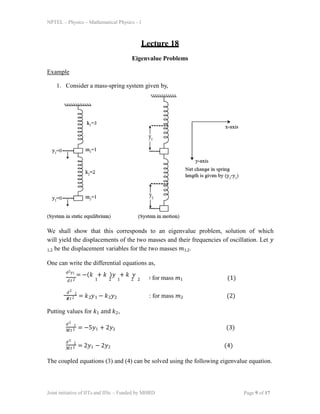
1. Consider a mass-spring system given by,
We shall show that this corresponds to an eigenvalue problem, solution of which
will yield the displacements of the two masses and their frequencies of oscillation. Let 𝑦
1,2 be the displacement variables for the two masses 𝑚1,2.
One can write the differential equations as,
𝑑𝑡 2
𝑑2𝑦1
= −(𝑘 + 𝑘 )𝑦 + 𝑘 𝑦
1 2 1 2 2 ∶ for mass 𝑚1 (1)
𝑑
𝑦
2
2
𝑑𝑡 2 = 𝑘 𝑦 − 𝑘 𝑦
2 1 2 2 : for mass 𝑚 (2)
2
Putting values for 𝑘1 and 𝑘2,
𝑑
𝑦
2
1
𝑑𝑡 2 = −5𝑦1 + 2𝑦2 (3)
𝑑
𝑦
2
2
𝑑𝑡 2 = 2𝑦1 − 2𝑦2 (4)
The coupled equations (3) and (4) can be solved using the following eigenvalue equation.
Joint initiative of IITs and IISc – Funded by MHRD Page 9 of 17
NPTEL – Physics – Mathematical Physics - 1
𝑑2𝑦 𝑦1
𝑑𝑡2 = 𝑦̈ = (𝑦̈2
) = 𝐴𝑦 = [
𝑦̈1 −5 2
2 − 2 2
] (𝑦 ) (5)
One may try a solution of the form,
𝑌 = 𝐴𝑒𝜔𝑡
(6)
Putting this in (5) leads to the eigenvalue equation,
𝐴𝑦 = 𝜆y where 𝜆 = 𝜔2
and 𝐴 = [ −5 2 ]
2 − 2
A has the
eigenvalues
-
[−5 − 𝜆 2
2 − 2 − 𝜆
] = 0
⇒ 𝜆1 = −1 and 𝜆2 = −6
So, 𝜔 = √−1 and √−6
= 𝑖 and √6𝑖 respectively. The
corresponding e-vectors are-
𝑦1 = ( ) corresponding to 𝑖
1
2
and 𝑦2 = ( 2 ) corresponding to √6𝑖
−1
Thus we obtain four complex solutions
𝑦1𝑒𝑖𝑡 = 𝑦1(𝑐𝑜𝑠𝑡 ± 𝑖𝑠𝑖𝑛𝑡)
𝑦2𝑒𝑖√6𝑡 = 𝑦2(𝑐𝑜𝑠√6𝑡 ± 𝑖𝑠𝑖𝑛√6𝑡)
Thus the real solutions are
𝑦1𝑐𝑜𝑠𝑡, 𝑦1𝑠𝑖𝑛𝑡, 𝑦2𝑐𝑜𝑠√6𝑡, 𝑦2𝑠𝑖𝑛√6𝑡
A general solution is obtained by taking a linear combination of all the above
solutions.
𝑦 = 𝑦1(𝑎1𝑐𝑜𝑠𝑡 + 𝑏1𝑠𝑖𝑛𝑡) + (𝑦2𝑎2𝑐𝑜𝑠√6𝑡 + 𝑏2𝑠𝑖𝑛√6𝑡)
with arbitrary constants 𝑎1, 𝑎2, 𝑏1, 𝑏2 which can be defined from the initial
conditions. From the structure of the vectors 𝑦1 and 𝑦2, one can write the final
solutions as-
Joint initiative of IITs and IISc – Funded by MHRD Page 10 of 17
NPTEL – Physics – Mathematical Physics - 1
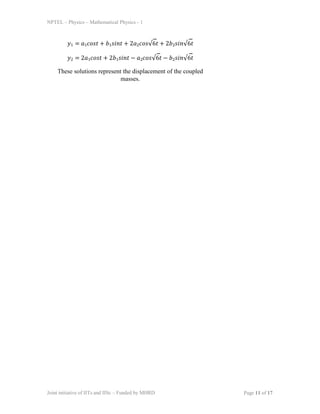
𝑦1 = 𝑎1𝑐𝑜𝑠𝑡 + 𝑏1𝑠𝑖𝑛𝑡 + 2𝑎2𝑐𝑜𝑠√6𝑡 + 2𝑏2𝑠𝑖𝑛√6𝑡
𝑦2 = 2𝑎1𝑐𝑜𝑠𝑡 + 2𝑏1𝑠𝑖𝑛𝑡 − 𝑎2𝑐𝑜𝑠√6𝑡 − 𝑏2𝑠𝑖𝑛√6𝑡
These solutions represent the displacement of the coupled
masses.
Joint initiative of IITs and IISc – Funded by MHRD Page 11 of 17

lec18.ppt

  • 1.
    NPTEL – Physics– Mathematical Physics - 1 Lecture 18 Eigenvalue Problems Example 1. Consider a mass-spring system given by, We shall show that this corresponds to an eigenvalue problem, solution of which will yield the displacements of the two masses and their frequencies of oscillation. Let 𝑦 1,2 be the displacement variables for the two masses 𝑚1,2. One can write the differential equations as, 𝑑𝑡 2 𝑑2𝑦1 = −(𝑘 + 𝑘 )𝑦 + 𝑘 𝑦 1 2 1 2 2 ∶ for mass 𝑚1 (1) 𝑑 𝑦 2 2 𝑑𝑡 2 = 𝑘 𝑦 − 𝑘 𝑦 2 1 2 2 : for mass 𝑚 (2) 2 Putting values for 𝑘1 and 𝑘2, 𝑑 𝑦 2 1 𝑑𝑡 2 = −5𝑦1 + 2𝑦2 (3) 𝑑 𝑦 2 2 𝑑𝑡 2 = 2𝑦1 − 2𝑦2 (4) The coupled equations (3) and (4) can be solved using the following eigenvalue equation. Joint initiative of IITs and IISc – Funded by MHRD Page 9 of 17
  • 2.
    NPTEL – Physics– Mathematical Physics - 1 𝑑2𝑦 𝑦1 𝑑𝑡2 = 𝑦̈ = (𝑦̈2 ) = 𝐴𝑦 = [ 𝑦̈1 −5 2 2 − 2 2 ] (𝑦 ) (5) One may try a solution of the form, 𝑌 = 𝐴𝑒𝜔𝑡 (6) Putting this in (5) leads to the eigenvalue equation, 𝐴𝑦 = 𝜆y where 𝜆 = 𝜔2 and 𝐴 = [ −5 2 ] 2 − 2 A has the eigenvalues - [−5 − 𝜆 2 2 − 2 − 𝜆 ] = 0 ⇒ 𝜆1 = −1 and 𝜆2 = −6 So, 𝜔 = √−1 and √−6 = 𝑖 and √6𝑖 respectively. The corresponding e-vectors are- 𝑦1 = ( ) corresponding to 𝑖 1 2 and 𝑦2 = ( 2 ) corresponding to √6𝑖 −1 Thus we obtain four complex solutions 𝑦1𝑒𝑖𝑡 = 𝑦1(𝑐𝑜𝑠𝑡 ± 𝑖𝑠𝑖𝑛𝑡) 𝑦2𝑒𝑖√6𝑡 = 𝑦2(𝑐𝑜𝑠√6𝑡 ± 𝑖𝑠𝑖𝑛√6𝑡) Thus the real solutions are 𝑦1𝑐𝑜𝑠𝑡, 𝑦1𝑠𝑖𝑛𝑡, 𝑦2𝑐𝑜𝑠√6𝑡, 𝑦2𝑠𝑖𝑛√6𝑡 A general solution is obtained by taking a linear combination of all the above solutions. 𝑦 = 𝑦1(𝑎1𝑐𝑜𝑠𝑡 + 𝑏1𝑠𝑖𝑛𝑡) + (𝑦2𝑎2𝑐𝑜𝑠√6𝑡 + 𝑏2𝑠𝑖𝑛√6𝑡) with arbitrary constants 𝑎1, 𝑎2, 𝑏1, 𝑏2 which can be defined from the initial conditions. From the structure of the vectors 𝑦1 and 𝑦2, one can write the final solutions as- Joint initiative of IITs and IISc – Funded by MHRD Page 10 of 17
  • 3.
    NPTEL – Physics– Mathematical Physics - 1 𝑦1 = 𝑎1𝑐𝑜𝑠𝑡 + 𝑏1𝑠𝑖𝑛𝑡 + 2𝑎2𝑐𝑜𝑠√6𝑡 + 2𝑏2𝑠𝑖𝑛√6𝑡 𝑦2 = 2𝑎1𝑐𝑜𝑠𝑡 + 2𝑏1𝑠𝑖𝑛𝑡 − 𝑎2𝑐𝑜𝑠√6𝑡 − 𝑏2𝑠𝑖𝑛√6𝑡 These solutions represent the displacement of the coupled masses. Joint initiative of IITs and IISc – Funded by MHRD Page 11 of 17