NPTEL – Physics – Mathematical Physics - 1
Lecture 27
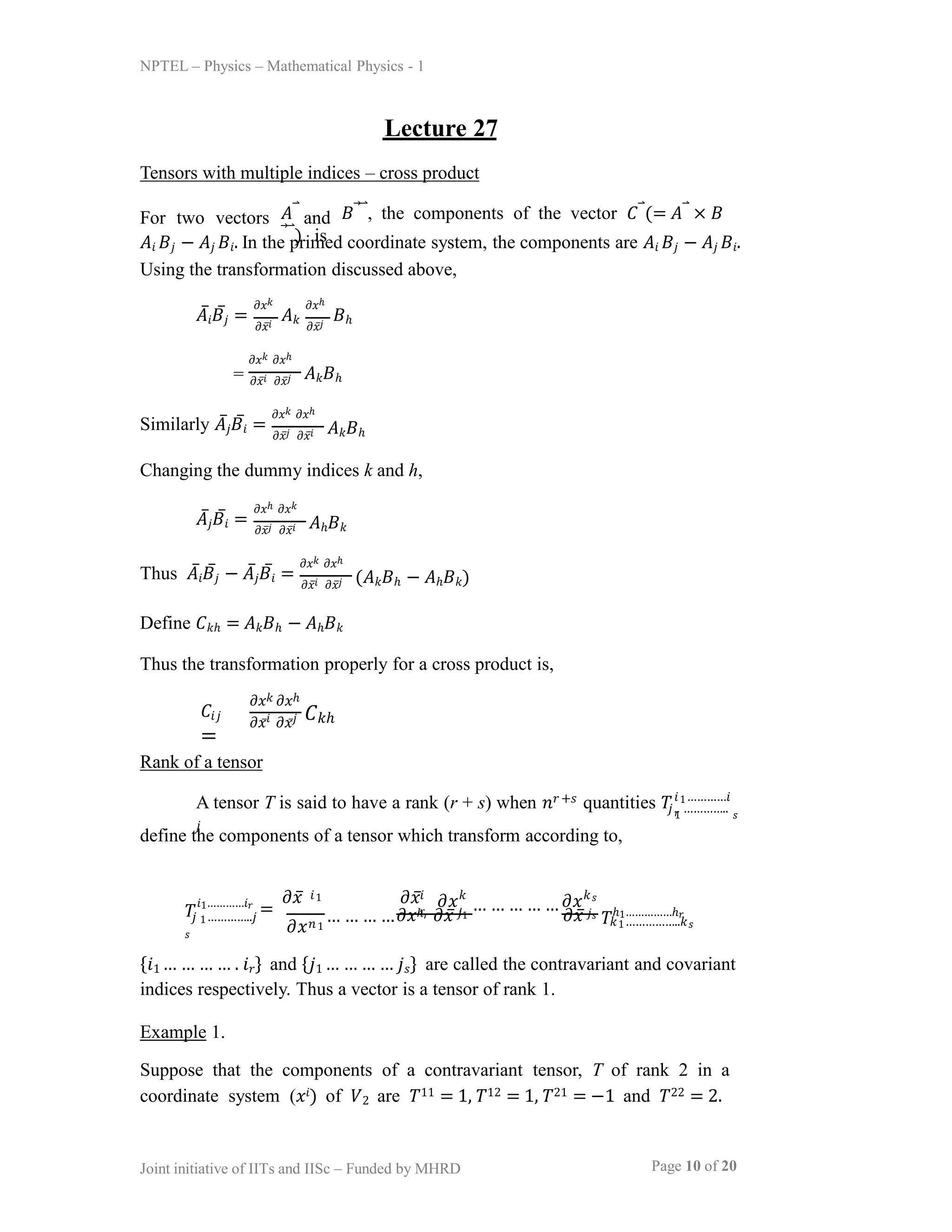
Tensors with multiple indices – cross product
For two vectors and
𝐴⃑ 𝐵⃗⃑, the components of the vector 𝐶⃑(= 𝐴⃑ × 𝐵
⃗⃑) is
𝐴𝑖 𝐵𝑗 − 𝐴𝑗 𝐵𝑖. In the primed coordinate system, the components are 𝐴𝑖 𝐵𝑗 − 𝐴𝑗 𝐵𝑖.
Using the transformation discussed above,
𝐴̅𝑖𝐵̅𝑗 = 𝐴𝑘 𝐵ℎ
𝜕𝑥𝑘 𝜕𝑥ℎ
𝜕𝑥̅𝑖 𝜕𝑥̅𝑗
=
𝜕𝑥𝑘 𝜕𝑥ℎ
𝜕𝑥̅𝑖 𝜕𝑥̅𝑗 𝐴𝑘𝐵ℎ
Similarly 𝐴̅𝑗𝐵̅𝑖 =
𝜕𝑥𝑘 𝜕𝑥ℎ
𝜕𝑥̅𝑗 𝜕𝑥̅𝑖 𝐴𝑘𝐵ℎ
Changing the dummy indices k and h,
𝐴̅𝑗𝐵̅𝑖 =
𝜕𝑥ℎ 𝜕𝑥𝑘
𝜕𝑥̅𝑗 𝜕𝑥̅𝑖 𝐴ℎ𝐵𝑘
Thus 𝐴̅𝑖𝐵̅𝑗 − 𝐴̅𝑗𝐵̅𝑖 =
𝜕𝑥𝑘 𝜕𝑥ℎ
𝜕𝑥̅𝑖 𝜕𝑥̅𝑗 (𝐴𝑘𝐵ℎ − 𝐴ℎ𝐵𝑘)
Define 𝐶𝑘ℎ = 𝐴𝑘𝐵ℎ − 𝐴ℎ𝐵𝑘
Thus the transformation properly for a cross product is,
𝐶𝑖𝑗
=
𝜕𝑥𝑘 𝜕𝑥ℎ
𝜕𝑥̅𝑖 𝜕𝑥̅𝑗 𝐶𝑘ℎ
Rank of a tensor
A tensor T is said to have a rank (r + s) when 𝑛𝑟+𝑠 quantities 𝑇
𝑗 …………..
𝑗
1 𝑠
𝑖1…………𝑖
𝑟
define the components of a tensor which transform according to,
𝑇
𝑗 1…………..𝑗
𝑠
𝑖1…………𝑖𝑟
=
𝜕𝑥̅ 𝑖1
𝜕𝑥𝑛1
𝜕𝑥̅
… … … …
𝑖
𝑟
𝜕𝑥ℎ𝑟 𝜕𝑥̅ 𝑗1
… … … … …
𝜕𝑥̅ 𝑗𝑠
𝜕𝑥 𝜕𝑥
𝑘
𝑖
𝑘𝑠
𝑇ℎ1……………ℎ𝑟
Page 10 of 20
Joint initiative of IITs and IISc – Funded by MHRD
𝑘1……………..𝑘𝑠
{𝑖1 … … … … . 𝑖𝑟} and {𝑗1 … … … … 𝑗𝑠} are called the contravariant and covariant
indices respectively. Thus a vector is a tensor of rank 1.
Example 1.
Suppose that the components of a contravariant tensor, T of rank 2 in a
coordinate system (𝑥𝑖) of 𝑉2 are 𝑇11 = 1, 𝑇12 = 1, 𝑇21 = −1 and 𝑇22 = 2.
NPTEL – Physics – Mathematical Physics - 1
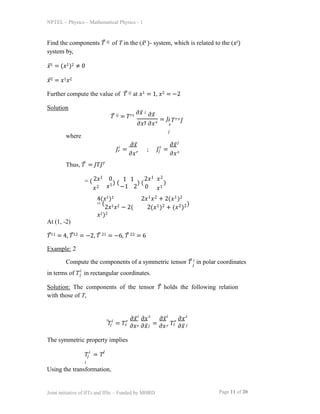
Find the components 𝑇̅ 𝑖𝑗 of T in the (𝑥̅𝑖 )- system, which is related to the (𝑥𝑖)
system by,
𝑥̅1 = (𝑥1)2 ≠ 0
𝑥̅2 = 𝑥1𝑥2
Further compute the value of 𝑇̅ 𝑖𝑗 at 𝑥1 = 1, 𝑥2 = −2
Solution
𝑇̅ 𝑖𝑗 = 𝑇𝑟𝑠 𝜕𝑥̅ 𝑖
𝑗
Page 11 of 20
Joint initiative of IITs and IISc – Funded by MHRD
𝜕𝑥 𝜕𝑥
𝑟 𝑠
𝜕𝑥̅
= 𝐽𝑟
𝑗
𝑖 𝑇𝑟𝑠𝐽
𝑠
where
𝐽 =
𝑟
𝑖 𝜕𝑥̅
𝜕𝑥𝑟 ; 𝐽 =
𝑗
𝑠 𝜕𝑥̅𝑗
𝜕𝑥𝑠
Thus, 𝑇̅ = 𝐽𝑇𝐽𝑇
= ( 2𝑥1 0
𝑥2 𝑥1) (
1 1
−1 2 0
) (
2𝑥1 𝑥2
𝑥1
)
4(𝑥1)2
= (
2𝑥1𝑥2 − 2(
𝑥1)2
2𝑥1𝑥2 + 2(𝑥1)2
2(𝑥1)2 + (𝑥2)2)
At (1, -2)
𝑇̅11 = 4, 𝑇̅12 = −2, 𝑇̅ 21 = −6, 𝑇̅ 22 = 6
Example: 2
Compute the components of a symmetric tensor 𝑇̅ 𝑖 in polar coordinates
𝑗
in terms of 𝑇𝑗 in rectangular coordinates.
Solution: The components of the tensor 𝑇̅ holds the following relation
with those of T,
𝑖
𝑇 = 𝑇
̅ 𝑗 𝑠
𝑖 𝑟 𝜕𝑥̅ 𝜕𝑥
𝑖 𝑠
𝜕𝑥 𝜕𝑥̅ 𝜕𝑥 𝑠
𝜕𝑥̅ 𝑗
𝑟 𝑗 𝑟
= 𝑇
𝜕𝑥̅𝑖 𝑠
𝑟 𝜕𝑥
The symmetric property implies
𝑇𝑗 = 𝑇
𝑖
𝑖 𝑗
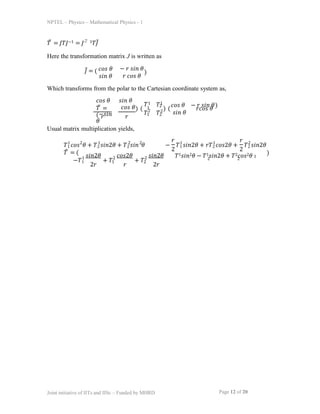
Using the transformation,
NPTEL – Physics – Mathematical Physics - 1
𝑇̅ = 𝐽𝑇𝐽−1 = 𝐽−̅ 1𝑇𝐽̅
Here the transformation matrix J is written as
𝐽̅ = ( 𝑐𝑜𝑠 𝜃 − 𝑟 𝑠𝑖𝑛 𝜃
𝑟 𝑐𝑜𝑠 𝜃
𝑠𝑖𝑛 𝜃
)
Which transforms from the polar to the Cartesian coordinate system as,
𝑐𝑜𝑠 𝜃
𝑇̅ =
(−𝑠𝑖𝑛
𝜃
𝑠𝑖𝑛 𝜃
𝑐𝑜𝑠 𝜃
𝑟 𝑟
Usual matrix multiplication yields,
) (
𝑇1 𝑇1
1 2
2
𝑇1 𝑇
2
2
) (
𝑐𝑜𝑠 𝜃 − 𝑟 𝑠𝑖𝑛 𝜃
𝑠𝑖𝑛 𝜃
𝑟𝑐𝑜𝑠 𝜃
)
𝑇1 𝑐𝑜𝑠 𝜃 + 𝑇2 𝑠𝑖𝑛2𝜃 + 𝑇2 𝑠𝑖𝑛 𝜃
𝑇̅ = (
1 2 1 2 2
− 𝑇1 𝑠𝑖𝑛2𝜃 + 𝑟𝑇2 𝑐𝑜𝑠2𝜃 + 𝑇2 𝑠𝑖𝑛2𝜃
Page 12 of 20
Joint initiative of IITs and IISc – Funded by MHRD
𝑟
2 2
1 1 2
𝑟
−𝑇1
1 𝑠𝑖𝑛2𝜃
2𝑟
+ 𝑇1
2 𝑐𝑜𝑠2𝜃 2 𝑠𝑖𝑛2𝜃
𝑟 2𝑟
+ 𝑇2
𝑇1𝑠𝑖𝑛2𝜃 − 𝑇1𝑠𝑖𝑛2𝜃 + 𝑇2𝑐𝑜𝑠2𝜃 1
2 2
)

lec27.ppt

  • 1.
    NPTEL – Physics– Mathematical Physics - 1 Lecture 27 Tensors with multiple indices – cross product For two vectors and 𝐴⃑ 𝐵⃗⃑, the components of the vector 𝐶⃑(= 𝐴⃑ × 𝐵 ⃗⃑) is 𝐴𝑖 𝐵𝑗 − 𝐴𝑗 𝐵𝑖. In the primed coordinate system, the components are 𝐴𝑖 𝐵𝑗 − 𝐴𝑗 𝐵𝑖. Using the transformation discussed above, 𝐴̅𝑖𝐵̅𝑗 = 𝐴𝑘 𝐵ℎ 𝜕𝑥𝑘 𝜕𝑥ℎ 𝜕𝑥̅𝑖 𝜕𝑥̅𝑗 = 𝜕𝑥𝑘 𝜕𝑥ℎ 𝜕𝑥̅𝑖 𝜕𝑥̅𝑗 𝐴𝑘𝐵ℎ Similarly 𝐴̅𝑗𝐵̅𝑖 = 𝜕𝑥𝑘 𝜕𝑥ℎ 𝜕𝑥̅𝑗 𝜕𝑥̅𝑖 𝐴𝑘𝐵ℎ Changing the dummy indices k and h, 𝐴̅𝑗𝐵̅𝑖 = 𝜕𝑥ℎ 𝜕𝑥𝑘 𝜕𝑥̅𝑗 𝜕𝑥̅𝑖 𝐴ℎ𝐵𝑘 Thus 𝐴̅𝑖𝐵̅𝑗 − 𝐴̅𝑗𝐵̅𝑖 = 𝜕𝑥𝑘 𝜕𝑥ℎ 𝜕𝑥̅𝑖 𝜕𝑥̅𝑗 (𝐴𝑘𝐵ℎ − 𝐴ℎ𝐵𝑘) Define 𝐶𝑘ℎ = 𝐴𝑘𝐵ℎ − 𝐴ℎ𝐵𝑘 Thus the transformation properly for a cross product is, 𝐶𝑖𝑗 = 𝜕𝑥𝑘 𝜕𝑥ℎ 𝜕𝑥̅𝑖 𝜕𝑥̅𝑗 𝐶𝑘ℎ Rank of a tensor A tensor T is said to have a rank (r + s) when 𝑛𝑟+𝑠 quantities 𝑇 𝑗 ………….. 𝑗 1 𝑠 𝑖1…………𝑖 𝑟 define the components of a tensor which transform according to, 𝑇 𝑗 1…………..𝑗 𝑠 𝑖1…………𝑖𝑟 = 𝜕𝑥̅ 𝑖1 𝜕𝑥𝑛1 𝜕𝑥̅ … … … … 𝑖 𝑟 𝜕𝑥ℎ𝑟 𝜕𝑥̅ 𝑗1 … … … … … 𝜕𝑥̅ 𝑗𝑠 𝜕𝑥 𝜕𝑥 𝑘 𝑖 𝑘𝑠 𝑇ℎ1……………ℎ𝑟 Page 10 of 20 Joint initiative of IITs and IISc – Funded by MHRD 𝑘1……………..𝑘𝑠 {𝑖1 … … … … . 𝑖𝑟} and {𝑗1 … … … … 𝑗𝑠} are called the contravariant and covariant indices respectively. Thus a vector is a tensor of rank 1. Example 1. Suppose that the components of a contravariant tensor, T of rank 2 in a coordinate system (𝑥𝑖) of 𝑉2 are 𝑇11 = 1, 𝑇12 = 1, 𝑇21 = −1 and 𝑇22 = 2.
  • 2.
    NPTEL – Physics– Mathematical Physics - 1 Find the components 𝑇̅ 𝑖𝑗 of T in the (𝑥̅𝑖 )- system, which is related to the (𝑥𝑖) system by, 𝑥̅1 = (𝑥1)2 ≠ 0 𝑥̅2 = 𝑥1𝑥2 Further compute the value of 𝑇̅ 𝑖𝑗 at 𝑥1 = 1, 𝑥2 = −2 Solution 𝑇̅ 𝑖𝑗 = 𝑇𝑟𝑠 𝜕𝑥̅ 𝑖 𝑗 Page 11 of 20 Joint initiative of IITs and IISc – Funded by MHRD 𝜕𝑥 𝜕𝑥 𝑟 𝑠 𝜕𝑥̅ = 𝐽𝑟 𝑗 𝑖 𝑇𝑟𝑠𝐽 𝑠 where 𝐽 = 𝑟 𝑖 𝜕𝑥̅ 𝜕𝑥𝑟 ; 𝐽 = 𝑗 𝑠 𝜕𝑥̅𝑗 𝜕𝑥𝑠 Thus, 𝑇̅ = 𝐽𝑇𝐽𝑇 = ( 2𝑥1 0 𝑥2 𝑥1) ( 1 1 −1 2 0 ) ( 2𝑥1 𝑥2 𝑥1 ) 4(𝑥1)2 = ( 2𝑥1𝑥2 − 2( 𝑥1)2 2𝑥1𝑥2 + 2(𝑥1)2 2(𝑥1)2 + (𝑥2)2) At (1, -2) 𝑇̅11 = 4, 𝑇̅12 = −2, 𝑇̅ 21 = −6, 𝑇̅ 22 = 6 Example: 2 Compute the components of a symmetric tensor 𝑇̅ 𝑖 in polar coordinates 𝑗 in terms of 𝑇𝑗 in rectangular coordinates. Solution: The components of the tensor 𝑇̅ holds the following relation with those of T, 𝑖 𝑇 = 𝑇 ̅ 𝑗 𝑠 𝑖 𝑟 𝜕𝑥̅ 𝜕𝑥 𝑖 𝑠 𝜕𝑥 𝜕𝑥̅ 𝜕𝑥 𝑠 𝜕𝑥̅ 𝑗 𝑟 𝑗 𝑟 = 𝑇 𝜕𝑥̅𝑖 𝑠 𝑟 𝜕𝑥 The symmetric property implies 𝑇𝑗 = 𝑇 𝑖 𝑖 𝑗 Using the transformation,
  • 3.
    NPTEL – Physics– Mathematical Physics - 1 𝑇̅ = 𝐽𝑇𝐽−1 = 𝐽−̅ 1𝑇𝐽̅ Here the transformation matrix J is written as 𝐽̅ = ( 𝑐𝑜𝑠 𝜃 − 𝑟 𝑠𝑖𝑛 𝜃 𝑟 𝑐𝑜𝑠 𝜃 𝑠𝑖𝑛 𝜃 ) Which transforms from the polar to the Cartesian coordinate system as, 𝑐𝑜𝑠 𝜃 𝑇̅ = (−𝑠𝑖𝑛 𝜃 𝑠𝑖𝑛 𝜃 𝑐𝑜𝑠 𝜃 𝑟 𝑟 Usual matrix multiplication yields, ) ( 𝑇1 𝑇1 1 2 2 𝑇1 𝑇 2 2 ) ( 𝑐𝑜𝑠 𝜃 − 𝑟 𝑠𝑖𝑛 𝜃 𝑠𝑖𝑛 𝜃 𝑟𝑐𝑜𝑠 𝜃 ) 𝑇1 𝑐𝑜𝑠 𝜃 + 𝑇2 𝑠𝑖𝑛2𝜃 + 𝑇2 𝑠𝑖𝑛 𝜃 𝑇̅ = ( 1 2 1 2 2 − 𝑇1 𝑠𝑖𝑛2𝜃 + 𝑟𝑇2 𝑐𝑜𝑠2𝜃 + 𝑇2 𝑠𝑖𝑛2𝜃 Page 12 of 20 Joint initiative of IITs and IISc – Funded by MHRD 𝑟 2 2 1 1 2 𝑟 −𝑇1 1 𝑠𝑖𝑛2𝜃 2𝑟 + 𝑇1 2 𝑐𝑜𝑠2𝜃 2 𝑠𝑖𝑛2𝜃 𝑟 2𝑟 + 𝑇2 𝑇1𝑠𝑖𝑛2𝜃 − 𝑇1𝑠𝑖𝑛2𝜃 + 𝑇2𝑐𝑜𝑠2𝜃 1 2 2 )