NPTEL – Physics – Mathematical Physics - 1
Lecture 23
Representation of the Dirac delta function in other coordinate systems
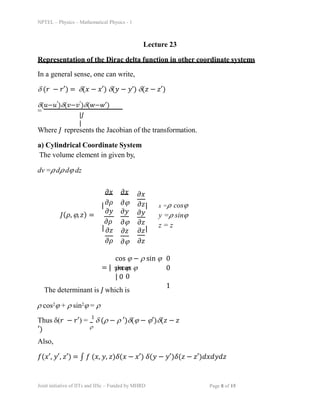
𝐽(𝜌, , 𝑧) =
In a general sense, one can write,
 (𝑟 − 𝑟′) = (𝑥 − 𝑥′) (𝑦 − 𝑦’) (𝑧 − 𝑧′)
(𝑢−𝑢′)(𝑣−𝑣′)(𝑤−𝑤′)
=
|𝐽
|
Where J represents the Jacobian of the transformation.
a) Cylindrical Coordinate System
The volume element in given by,
dv =𝜌 d𝜌 d dz
= | sin 
0
The determinant is J which is
 cos2 +  sin2 = 
cos  −  sin  0
 cos  0
| 0
1
Thus (𝑟 − 𝑟′) =
1
 ( −  ′)( − ′)(𝑧 − 𝑧
′) 
Also,
𝑓(𝑥′, 𝑦′, 𝑧′) = ∫ 𝑓 (𝑥, 𝑦, 𝑧)𝛿(𝑥 − 𝑥′) 𝛿(𝑦 − 𝑦′)𝛿(𝑧 − 𝑧′)𝑑𝑥𝑑𝑦𝑑𝑧
|𝜕𝜌
𝜕𝑦
𝜕𝜌
| 𝜕𝑧
𝜕𝜌
𝜕𝑥 𝜕𝑥
𝜕
𝜕𝑦
𝜕
𝜕𝑧
𝜕
𝜕𝑥
𝜕𝑧|
𝜕𝑦
Joint initiative of IITs and IISc – Funded by MHRD Page 8 of 15
𝜕𝑧
𝜕𝑧|
𝜕𝑧
x =𝜌 cos
y =𝜌 sin
z = z
NPTEL – Physics – Mathematical Physics - 1
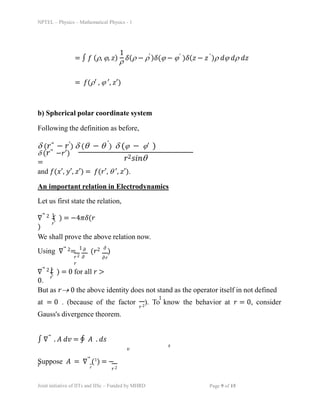
= ∫ 𝑓 (, , 𝑧)  𝛿( −  )𝛿( −  )𝛿(𝑧 − 𝑧 ) 𝑑 𝑑 𝑑𝑧
= 𝑓(′ ,  ′, 𝑧′)
1 ′ ′ ′
b) Spherical polar coordinate system
Following the definition as before,
 (𝑟⃗ − 𝑟′)  ( −  ′
)  ( − ′ )
 (𝑟⃗ −𝑟′)
= 𝑟2𝑠𝑖𝑛
and 𝑓(𝑥′, 𝑦′, 𝑧′) = 𝑓(𝑟′,  ′, 𝑧′).
An important relation in Electrodynamics
Let us first state the relation,
∇⃗ 2 ( ) = −4𝜋𝛿(𝑟
)
1
𝑟
We shall prove the above relation now.
Using ∇⃗ 2=
1
(𝑟2 𝜕
)
𝑟2 𝜕
𝑟
𝜕
𝜕𝑟
∇⃗ 2 ( ) = 0 for all 𝑟 >
0.
1
𝑟
But as 𝑟 0 the above identity does not stand as the operator itself in not defined
1
at = 0 . (because of the factor ). To know the behavior at 𝑟 = 0, consider
𝑟2
Gauss's divergence theorem.
∫ ∇⃗ . 𝐴 𝑑𝑣 = ∮ 𝐴 . 𝑑𝑠
𝑣
𝑠
Suppose 𝐴 = ∇⃗ (1
) = −
𝑟̂ 𝑟 𝑟2
Joint initiative of IITs and IISc – Funded by MHRD Page 9 of 15
NPTEL – Physics – Mathematical Physics - 1
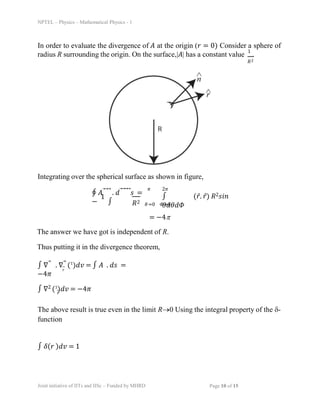
In order to evaluate the divergence of 𝐴 at the origin (𝑟 = 0) Consider a sphere of
radius R surrounding the origin. On the surface,|𝐴| has a constant value
1
.
𝑅2
Integrating over the spherical surface as shown in figure,
∮ 𝐴⃗⃗⃗ . 𝑑⃗⃗⃗⃗𝑠 =
−
1
∫ 𝑅2
2𝜋
∫ (𝑟̂. 𝑟̂) 𝑅2𝑠𝑖𝑛
𝜃𝑑𝜃𝑑𝛷
𝜃=0 𝛷=0
𝜋
= −4
The answer we have got is independent of R.
Thus putting it in the divergence theorem,
𝑟
∫ ∇⃗ . ∇⃗ (1
)𝑑𝑣 = ∫ 𝐴 . 𝑑𝑠 =
−4𝜋
∫ ∇2 (1
)𝑑𝑣 = −4𝜋
𝑟
The above result is true even in the limit R0 Using the integral property of the -
function
∫ 𝛿(𝑟 )𝑑𝑣 = 1
Joint initiative of IITs and IISc – Funded by MHRD Page 10 of 15
NPTEL – Physics – Mathematical Physics - 1
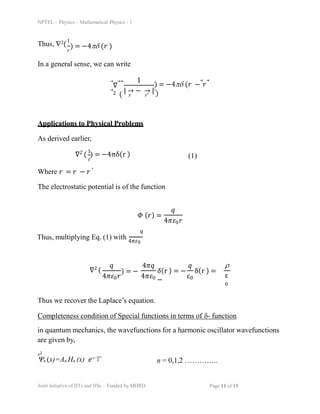
Thus, 2(
1
𝑟
) = −4 (𝑟 )
In a general sense, we can write
⃗∇⃗⃗
⃗2 (
1
| → − → |
𝑟 𝑟′
) = −4 (𝑟 −⃗𝑟⃗
′)
Applications to Physical Problems
As derived earlier,
∇2 ( ) = −4πδ(r )
1
r
(1)
Where 𝑟 = 𝑟 − 𝑟 ′
The electrostatic potential is of the function
𝛷 (𝑟) =
𝑞
4𝜋𝜀0𝑟
𝑞
Thus, multiplying Eq. (1) with 4𝜋𝜀0
∇2 (
𝑞
4𝜋𝜀0𝑟
) = −
4𝜋𝑞
4𝜋𝜀0
𝛿(r ) = − δ(r ) =
−
𝑞
ε0

ε
0
Thus we recover the Laplace’s equation.
Completeness condition of Special functions in terms of - function
in quantum mechanics, the wavefunctions for a harmonic oscillator wavefunctions
are given by,
𝑥2
n (x)=An Hn (x) 𝑒− 2 n = 0,1,2 …………..
Joint initiative of IITs and IISc – Funded by MHRD Page 11 of 15
NPTEL – Physics – Mathematical Physics - 1
Corresponding to an energy spectrum given by
𝐸𝑛 = (𝑛 + 2
) ℎ
 is the frequency and 𝐻𝑛(𝑥) represents a complete set of orthonormal functions in
the domain −∞ < 𝑥 < ∞. Hn's are called the Hermite polynomials and AN is the
normalization constant,
1
𝐴𝑛 =
1
√𝜋
1⁄2 2𝑛𝑛!
The orthogonality of the wave function is represented by,
∞
∗
Joint initiative of IITs and IISc – Funded by MHRD Page 12 of 15
∫  𝑚 (𝑥)𝑛 (𝑥)𝑑𝑥 = 𝑚𝑛
−∞
Since n(x) are assumed to form a complete set of functions, we can expand any
well behaved function  (𝑥) as
 (𝑥) = ∑ 𝑐𝑛 𝑛(𝑥)
𝑛
We multiply above by 𝑚∗ (𝑥) and integrated to obtain,
∫  𝑚 (𝑥) (𝑥)𝑑𝑥 = 𝑛𝑐𝑛 ∫  𝑚 (𝑥)𝑛(𝑥)𝑑𝑥
∗ ∗
∞ ∞
−∞ −∞
= ∑𝑛 𝑐𝑛 𝛿𝑛𝑚 = 𝑐𝑚
Thus, substituting for 𝑐𝑛
 (𝑥) = 𝑛 [∫  𝑛 (𝑥 ) (𝑥′)𝑑𝑥′] = 𝑛 (𝑥)
−∞
∗ ′
∞
Where the primed summation is used as a dummy variable. Interchanging the
summation and integration,
∞
 (𝑥) = ∫ 𝑑𝑥  (𝑥′)[ ′  (𝑥) (𝑥
)]
′ ∗ ′
𝑛 𝑛 𝑛
−∞
NPTEL – Physics – Mathematical Physics - 1
Since the wavefunction  forms an orthonormal set,
∑𝑛′  ∗ (𝑥′)𝑛 (𝑥) =  (𝑥 − 𝑥′): completeness condition.
𝑛
Thus plugging in the form forn (x) in terms of the Hermite polynomials,
√𝜋
1
𝑒̅(𝑥2+𝑥′2
)/2 ∑∞ 1
𝑛=0 2𝑛 𝑛
!
𝐻𝑛 (x)𝐻𝑛 (𝑥 ) = 𝛿 (𝑥 − 𝑥 ) For - < x, x’<
′ ′
Similarly for the Legendre polynomials, 𝑃𝑛 (𝑥)
1
∑∞
2
(2𝑛 + 1)𝑃 (𝑥′) = 𝛿(𝑥 − 𝑥′) − 1 ≤ 𝑥, 𝑥′ ≤ 1
𝑛=0 𝑛
Similarly for sinusoidal functions,
𝑓(𝑥) = 𝐴𝑠𝑖𝑛𝑘𝑥 = 𝐴𝑠𝑖𝑛
𝑛𝜋𝑥
; 0 ≤ 𝑥 ≤ 𝐿
𝐿
𝐴2 ∑ 𝑠𝑖𝑛 𝑛𝜋𝑥
𝑠𝑖𝑛 𝑛𝜋
𝑥 𝐿 𝐿
𝑛
′
𝛿(𝑥 − 𝑥′) For 0 ≤ x, x’≤ L
Tutorial
1. Evaluate the integral,
6
∫ (3𝑥2 − 2𝑥 − 1)𝛿(𝑥 − 3)𝑑
𝑥
2
∞
Solution: Using ∫ 𝑓(𝑥)𝛿(𝑥 − 𝑎)𝑑𝑥 =
𝑓(𝑎) −∞
Here 𝑓(𝑎) = 𝑓(𝑥 = 3) = 27 − 6 − 1 = 20
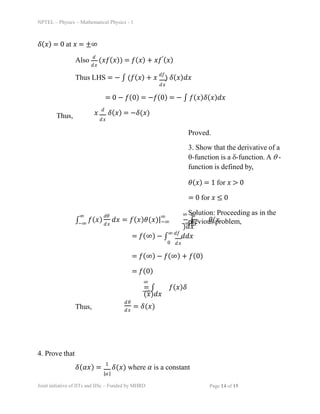
2. Show that 𝑥
𝑑
𝛿(𝑥) = −𝛿(𝑥)
𝑑𝑥
Solution: ∫ 𝑓(𝑥) [𝑥
𝑑
𝑑𝑥
𝛿(𝑥)] = 𝑥𝑓(𝑥)𝛿(𝑥)|
∞
−∞
∞
−∞
∞
− ∫
Joint initiative of IITs and IISc – Funded by MHRD Page 13 of 15
𝑑
(𝑥𝑓(𝑥))𝛿(𝑥)𝑑
𝑥
−∞ 𝑑𝑥
Where 𝑓(𝑥) is an arbitrary function.
The first term on the RHS is zero as
NPTEL – Physics – Mathematical Physics - 1
𝛿(𝑥) = 0 at 𝑥 = ±∞
Also (𝑥𝑓(𝑥)) = 𝑓(𝑥) + 𝑥𝑓′(𝑥)
𝑑
𝑑𝑥
Thus LHS = − ∫ (𝑓(𝑥) + 𝑥 𝑑𝑓
) 𝛿(𝑥)𝑑𝑥
𝑑𝑥
= 0 − 𝑓(0) = −𝑓(0) = − ∫ 𝑓(𝑥)𝛿(𝑥)𝑑𝑥
Thus, 𝑑𝑥
𝑥
𝑑
𝛿(𝑥) = −𝛿(𝑥)
Proved.
3. Show that the derivative of a
-function is a -function. A  -
function is defined by,
𝜃(𝑥) = 1 for 𝑥 > 0
= 0 for 𝑥 ≤ 0
Solution: Proceeding as in the
previous problem,
∫ 𝑓(𝑥) 𝑑𝑥 = 𝑓(𝑥)𝜃(𝑥)|
∞ 𝑑𝜃
𝑑𝑥
−∞
∞
−∞
∞ 𝑑𝑓
− ∫ 𝜃(𝑥
)𝑑𝑥
−∞ 𝑑𝑥
= 𝑓(∞) − ∫
∞ 𝑑𝑓
𝑑𝑑𝑥
𝑑𝑥
0
= 𝑓(∞) − 𝑓(∞) + 𝑓(0)
= 𝑓(0)
∞
= ∫ 𝑓(𝑥)𝛿
(𝑥)𝑑𝑥
−∞
Thus,
𝑑𝜃
𝑑𝑥
= 𝛿(𝑥)
4. Prove that
𝛿(𝛼𝑥) =
1
𝛿(𝑥) where 𝛼 is a constant
Joint initiative of IITs and IISc – Funded by MHRD Page 14 of 15
|𝛼|
NPTEL – Physics – Mathematical Physics - 1
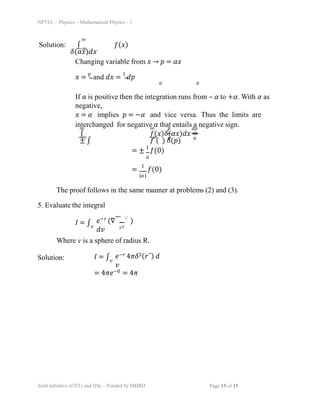
∞
Solution: ∫ 𝑓(𝑥)
𝛿(𝛼𝑥)𝑑𝑥
−∞
Changing variable from 𝑥 → 𝑝 = 𝛼𝑥
𝑥 =
𝑝
and 𝑑𝑥 =
1
𝑑𝑝
𝛼 𝛼
If 𝛼 is positive then the integration runs from – 𝛼 to +𝛼. With 𝛼 as
negative,
𝑥 = 𝛼 implies 𝑝 = −𝛼 and vice versa. Thus the limits are
interchanged for negative 𝛼 that entails a negative sign.
∞ ∞ 𝑝 𝑑𝑝
∫ 𝑓(𝑥)𝛿(𝛼𝑥)𝑑𝑥 =
± ∫ 𝑓 ( ) 𝛿(𝑝)
−∞ −∞ 𝛼 𝛼
= ±
1
𝑓(0)
𝛼
=
1
𝑓(0)
|𝛼|
The proof follows in the same manner at problems (2) and (3).
5. Evaluate the integral
𝐼 = ∫ 𝑒−𝑟 (∇⃗⃑.
rˆ
)
𝑑𝑣
Joint initiative of IITs and IISc – Funded by MHRD Page 15 of 15
r2
𝑣
Where v is a sphere of radius R.
Solution: 𝐼 = ∫ 𝑒−𝑟 4𝜋𝛿3(𝑟⃑) 𝑑
𝑣
𝑣
= 4𝜋𝑒−0 = 4𝜋

lec23.ppt

  • 1.
    NPTEL – Physics– Mathematical Physics - 1 Lecture 23 Representation of the Dirac delta function in other coordinate systems 𝐽(𝜌, , 𝑧) = In a general sense, one can write,  (𝑟 − 𝑟′) = (𝑥 − 𝑥′) (𝑦 − 𝑦’) (𝑧 − 𝑧′) (𝑢−𝑢′)(𝑣−𝑣′)(𝑤−𝑤′) = |𝐽 | Where J represents the Jacobian of the transformation. a) Cylindrical Coordinate System The volume element in given by, dv =𝜌 d𝜌 d dz = | sin  0 The determinant is J which is  cos2 +  sin2 =  cos  −  sin  0  cos  0 | 0 1 Thus (𝑟 − 𝑟′) = 1  ( −  ′)( − ′)(𝑧 − 𝑧 ′)  Also, 𝑓(𝑥′, 𝑦′, 𝑧′) = ∫ 𝑓 (𝑥, 𝑦, 𝑧)𝛿(𝑥 − 𝑥′) 𝛿(𝑦 − 𝑦′)𝛿(𝑧 − 𝑧′)𝑑𝑥𝑑𝑦𝑑𝑧 |𝜕𝜌 𝜕𝑦 𝜕𝜌 | 𝜕𝑧 𝜕𝜌 𝜕𝑥 𝜕𝑥 𝜕 𝜕𝑦 𝜕 𝜕𝑧 𝜕 𝜕𝑥 𝜕𝑧| 𝜕𝑦 Joint initiative of IITs and IISc – Funded by MHRD Page 8 of 15 𝜕𝑧 𝜕𝑧| 𝜕𝑧 x =𝜌 cos y =𝜌 sin z = z
  • 2.
    NPTEL – Physics– Mathematical Physics - 1 = ∫ 𝑓 (, , 𝑧)  𝛿( −  )𝛿( −  )𝛿(𝑧 − 𝑧 ) 𝑑 𝑑 𝑑𝑧 = 𝑓(′ ,  ′, 𝑧′) 1 ′ ′ ′ b) Spherical polar coordinate system Following the definition as before,  (𝑟⃗ − 𝑟′)  ( −  ′ )  ( − ′ )  (𝑟⃗ −𝑟′) = 𝑟2𝑠𝑖𝑛 and 𝑓(𝑥′, 𝑦′, 𝑧′) = 𝑓(𝑟′,  ′, 𝑧′). An important relation in Electrodynamics Let us first state the relation, ∇⃗ 2 ( ) = −4𝜋𝛿(𝑟 ) 1 𝑟 We shall prove the above relation now. Using ∇⃗ 2= 1 (𝑟2 𝜕 ) 𝑟2 𝜕 𝑟 𝜕 𝜕𝑟 ∇⃗ 2 ( ) = 0 for all 𝑟 > 0. 1 𝑟 But as 𝑟 0 the above identity does not stand as the operator itself in not defined 1 at = 0 . (because of the factor ). To know the behavior at 𝑟 = 0, consider 𝑟2 Gauss's divergence theorem. ∫ ∇⃗ . 𝐴 𝑑𝑣 = ∮ 𝐴 . 𝑑𝑠 𝑣 𝑠 Suppose 𝐴 = ∇⃗ (1 ) = − 𝑟̂ 𝑟 𝑟2 Joint initiative of IITs and IISc – Funded by MHRD Page 9 of 15
  • 3.
    NPTEL – Physics– Mathematical Physics - 1 In order to evaluate the divergence of 𝐴 at the origin (𝑟 = 0) Consider a sphere of radius R surrounding the origin. On the surface,|𝐴| has a constant value 1 . 𝑅2 Integrating over the spherical surface as shown in figure, ∮ 𝐴⃗⃗⃗ . 𝑑⃗⃗⃗⃗𝑠 = − 1 ∫ 𝑅2 2𝜋 ∫ (𝑟̂. 𝑟̂) 𝑅2𝑠𝑖𝑛 𝜃𝑑𝜃𝑑𝛷 𝜃=0 𝛷=0 𝜋 = −4 The answer we have got is independent of R. Thus putting it in the divergence theorem, 𝑟 ∫ ∇⃗ . ∇⃗ (1 )𝑑𝑣 = ∫ 𝐴 . 𝑑𝑠 = −4𝜋 ∫ ∇2 (1 )𝑑𝑣 = −4𝜋 𝑟 The above result is true even in the limit R0 Using the integral property of the - function ∫ 𝛿(𝑟 )𝑑𝑣 = 1 Joint initiative of IITs and IISc – Funded by MHRD Page 10 of 15
  • 4.
    NPTEL – Physics– Mathematical Physics - 1 Thus, 2( 1 𝑟 ) = −4 (𝑟 ) In a general sense, we can write ⃗∇⃗⃗ ⃗2 ( 1 | → − → | 𝑟 𝑟′ ) = −4 (𝑟 −⃗𝑟⃗ ′) Applications to Physical Problems As derived earlier, ∇2 ( ) = −4πδ(r ) 1 r (1) Where 𝑟 = 𝑟 − 𝑟 ′ The electrostatic potential is of the function 𝛷 (𝑟) = 𝑞 4𝜋𝜀0𝑟 𝑞 Thus, multiplying Eq. (1) with 4𝜋𝜀0 ∇2 ( 𝑞 4𝜋𝜀0𝑟 ) = − 4𝜋𝑞 4𝜋𝜀0 𝛿(r ) = − δ(r ) = − 𝑞 ε0  ε 0 Thus we recover the Laplace’s equation. Completeness condition of Special functions in terms of - function in quantum mechanics, the wavefunctions for a harmonic oscillator wavefunctions are given by, 𝑥2 n (x)=An Hn (x) 𝑒− 2 n = 0,1,2 ………….. Joint initiative of IITs and IISc – Funded by MHRD Page 11 of 15
  • 5.
    NPTEL – Physics– Mathematical Physics - 1 Corresponding to an energy spectrum given by 𝐸𝑛 = (𝑛 + 2 ) ℎ  is the frequency and 𝐻𝑛(𝑥) represents a complete set of orthonormal functions in the domain −∞ < 𝑥 < ∞. Hn's are called the Hermite polynomials and AN is the normalization constant, 1 𝐴𝑛 = 1 √𝜋 1⁄2 2𝑛𝑛! The orthogonality of the wave function is represented by, ∞ ∗ Joint initiative of IITs and IISc – Funded by MHRD Page 12 of 15 ∫  𝑚 (𝑥)𝑛 (𝑥)𝑑𝑥 = 𝑚𝑛 −∞ Since n(x) are assumed to form a complete set of functions, we can expand any well behaved function  (𝑥) as  (𝑥) = ∑ 𝑐𝑛 𝑛(𝑥) 𝑛 We multiply above by 𝑚∗ (𝑥) and integrated to obtain, ∫  𝑚 (𝑥) (𝑥)𝑑𝑥 = 𝑛𝑐𝑛 ∫  𝑚 (𝑥)𝑛(𝑥)𝑑𝑥 ∗ ∗ ∞ ∞ −∞ −∞ = ∑𝑛 𝑐𝑛 𝛿𝑛𝑚 = 𝑐𝑚 Thus, substituting for 𝑐𝑛  (𝑥) = 𝑛 [∫  𝑛 (𝑥 ) (𝑥′)𝑑𝑥′] = 𝑛 (𝑥) −∞ ∗ ′ ∞ Where the primed summation is used as a dummy variable. Interchanging the summation and integration, ∞  (𝑥) = ∫ 𝑑𝑥  (𝑥′)[ ′  (𝑥) (𝑥 )] ′ ∗ ′ 𝑛 𝑛 𝑛 −∞
  • 6.
    NPTEL – Physics– Mathematical Physics - 1 Since the wavefunction  forms an orthonormal set, ∑𝑛′  ∗ (𝑥′)𝑛 (𝑥) =  (𝑥 − 𝑥′): completeness condition. 𝑛 Thus plugging in the form forn (x) in terms of the Hermite polynomials, √𝜋 1 𝑒̅(𝑥2+𝑥′2 )/2 ∑∞ 1 𝑛=0 2𝑛 𝑛 ! 𝐻𝑛 (x)𝐻𝑛 (𝑥 ) = 𝛿 (𝑥 − 𝑥 ) For - < x, x’< ′ ′ Similarly for the Legendre polynomials, 𝑃𝑛 (𝑥) 1 ∑∞ 2 (2𝑛 + 1)𝑃 (𝑥′) = 𝛿(𝑥 − 𝑥′) − 1 ≤ 𝑥, 𝑥′ ≤ 1 𝑛=0 𝑛 Similarly for sinusoidal functions, 𝑓(𝑥) = 𝐴𝑠𝑖𝑛𝑘𝑥 = 𝐴𝑠𝑖𝑛 𝑛𝜋𝑥 ; 0 ≤ 𝑥 ≤ 𝐿 𝐿 𝐴2 ∑ 𝑠𝑖𝑛 𝑛𝜋𝑥 𝑠𝑖𝑛 𝑛𝜋 𝑥 𝐿 𝐿 𝑛 ′ 𝛿(𝑥 − 𝑥′) For 0 ≤ x, x’≤ L Tutorial 1. Evaluate the integral, 6 ∫ (3𝑥2 − 2𝑥 − 1)𝛿(𝑥 − 3)𝑑 𝑥 2 ∞ Solution: Using ∫ 𝑓(𝑥)𝛿(𝑥 − 𝑎)𝑑𝑥 = 𝑓(𝑎) −∞ Here 𝑓(𝑎) = 𝑓(𝑥 = 3) = 27 − 6 − 1 = 20 2. Show that 𝑥 𝑑 𝛿(𝑥) = −𝛿(𝑥) 𝑑𝑥 Solution: ∫ 𝑓(𝑥) [𝑥 𝑑 𝑑𝑥 𝛿(𝑥)] = 𝑥𝑓(𝑥)𝛿(𝑥)| ∞ −∞ ∞ −∞ ∞ − ∫ Joint initiative of IITs and IISc – Funded by MHRD Page 13 of 15 𝑑 (𝑥𝑓(𝑥))𝛿(𝑥)𝑑 𝑥 −∞ 𝑑𝑥 Where 𝑓(𝑥) is an arbitrary function. The first term on the RHS is zero as
  • 7.
    NPTEL – Physics– Mathematical Physics - 1 𝛿(𝑥) = 0 at 𝑥 = ±∞ Also (𝑥𝑓(𝑥)) = 𝑓(𝑥) + 𝑥𝑓′(𝑥) 𝑑 𝑑𝑥 Thus LHS = − ∫ (𝑓(𝑥) + 𝑥 𝑑𝑓 ) 𝛿(𝑥)𝑑𝑥 𝑑𝑥 = 0 − 𝑓(0) = −𝑓(0) = − ∫ 𝑓(𝑥)𝛿(𝑥)𝑑𝑥 Thus, 𝑑𝑥 𝑥 𝑑 𝛿(𝑥) = −𝛿(𝑥) Proved. 3. Show that the derivative of a -function is a -function. A  - function is defined by, 𝜃(𝑥) = 1 for 𝑥 > 0 = 0 for 𝑥 ≤ 0 Solution: Proceeding as in the previous problem, ∫ 𝑓(𝑥) 𝑑𝑥 = 𝑓(𝑥)𝜃(𝑥)| ∞ 𝑑𝜃 𝑑𝑥 −∞ ∞ −∞ ∞ 𝑑𝑓 − ∫ 𝜃(𝑥 )𝑑𝑥 −∞ 𝑑𝑥 = 𝑓(∞) − ∫ ∞ 𝑑𝑓 𝑑𝑑𝑥 𝑑𝑥 0 = 𝑓(∞) − 𝑓(∞) + 𝑓(0) = 𝑓(0) ∞ = ∫ 𝑓(𝑥)𝛿 (𝑥)𝑑𝑥 −∞ Thus, 𝑑𝜃 𝑑𝑥 = 𝛿(𝑥) 4. Prove that 𝛿(𝛼𝑥) = 1 𝛿(𝑥) where 𝛼 is a constant Joint initiative of IITs and IISc – Funded by MHRD Page 14 of 15 |𝛼|
  • 8.
    NPTEL – Physics– Mathematical Physics - 1 ∞ Solution: ∫ 𝑓(𝑥) 𝛿(𝛼𝑥)𝑑𝑥 −∞ Changing variable from 𝑥 → 𝑝 = 𝛼𝑥 𝑥 = 𝑝 and 𝑑𝑥 = 1 𝑑𝑝 𝛼 𝛼 If 𝛼 is positive then the integration runs from – 𝛼 to +𝛼. With 𝛼 as negative, 𝑥 = 𝛼 implies 𝑝 = −𝛼 and vice versa. Thus the limits are interchanged for negative 𝛼 that entails a negative sign. ∞ ∞ 𝑝 𝑑𝑝 ∫ 𝑓(𝑥)𝛿(𝛼𝑥)𝑑𝑥 = ± ∫ 𝑓 ( ) 𝛿(𝑝) −∞ −∞ 𝛼 𝛼 = ± 1 𝑓(0) 𝛼 = 1 𝑓(0) |𝛼| The proof follows in the same manner at problems (2) and (3). 5. Evaluate the integral 𝐼 = ∫ 𝑒−𝑟 (∇⃗⃑. rˆ ) 𝑑𝑣 Joint initiative of IITs and IISc – Funded by MHRD Page 15 of 15 r2 𝑣 Where v is a sphere of radius R. Solution: 𝐼 = ∫ 𝑒−𝑟 4𝜋𝛿3(𝑟⃑) 𝑑 𝑣 𝑣 = 4𝜋𝑒−0 = 4𝜋