NPTEL – Physics – Mathematical Physics - 1
Module 6
Lecture 31
Complex analysis
Complex Numbers
Consider an equation, 𝑥2 + 1 = 0. No real number satisfies this equation. To allow for a
solution of this equation, complex numbers can be introduced. They are not only
confined to the real axis. This complex numbers are pairs of numbers that denote
coordinates of points in the complex plane.
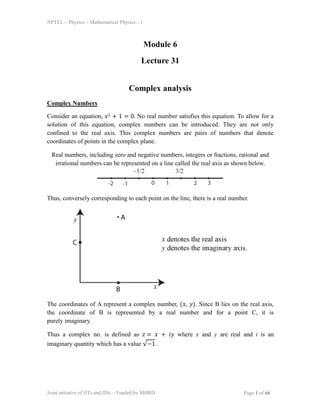
Real numbers, including zero and negative numbers, integers or fractions, rational and
irrational numbers can be represented on a line called the real axis as shown below.
Thus, conversely corresponding to each point on the line, there is a real number.
The coordinates of A represent a complex number, (𝑥, 𝑦). Since B lies on the real axis,
the coordinate of B is represented by a real number and for a point C, it is
purely imaginary.
Thus a complex no. is defined as 𝑧 = 𝑥 + 𝑖𝑦 where x and y are real and i is an
imaginary quantity which has a value √−1 .
Joint initiative of IITs and IISc – Funded by MHRD Page 1 of 66
NPTEL – Physics – Mathematical Physics - 1
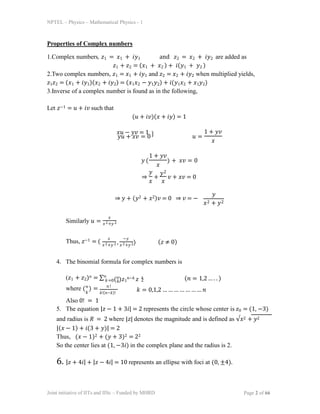
Properties of Complex numbers
1.Complex numbers, 𝑧1 = 𝑥1 + 𝑖𝑦1 and 𝑧2 = 𝑥2 + 𝑖𝑦2 are added as
𝑧1 + 𝑧2 = (𝑥1 + 𝑥2 ) + 𝑖(𝑦1 + 𝑦2 )
2.Two complex numbers, 𝑧1 = 𝑥1 + 𝑖𝑦1 and 𝑧2 = 𝑥2 + 𝑖𝑦2 when multiplied yields,
𝑧1𝑧2 = (𝑥1 + 𝑖𝑦1)(𝑥2 + 𝑖𝑦2) = (𝑥1𝑥2 − 𝑦1𝑦2) + 𝑖(𝑦1𝑥2 + 𝑥1𝑦2)
3.Inverse of a complex number is found as in the following,
Let 𝑧−1 = 𝑢 + 𝑖𝑣 such that
(𝑢 + 𝑖𝑣)(𝑥 + 𝑖𝑦) = 1
𝑥𝑢 − 𝑦𝑣 = 1
𝑦𝑢 + 𝑥𝑣 = 0} 𝑢 =
1 + 𝑦𝑣
𝑥
𝑦 (
1 + 𝑦𝑣
𝑥
) + 𝑥𝑣 = 0
⇒ + 𝑣 + 𝑥𝑣 = 0
𝑦
𝑥 𝑥
𝑦2
⇒ 𝑦 + (𝑦2 + 𝑥2)𝑣 = 0 ⇒ 𝑣 = −
𝑦
𝑥2 + 𝑦2
Similarly 𝑢 =
𝑥
𝑥2+𝑦 2
Thus, 𝑧−1 = (
𝑥 −𝑦
𝑥2+𝑦 2 𝑥2+𝑦2
, ) (𝑧 ≠ 0)
4. The binomial formula for complex numbers is
(𝑧1 + 𝑧2)𝑛 = ∑𝑛
(𝑛
)𝑧1
𝑛−𝑘 𝑧 𝑘
𝑘=0 𝑘
𝑛!
2 (𝑛 = 1,2… . . )
where (𝑛
) =
𝑘
Also 0! = 1
𝑘!(𝑛−𝑘)!
𝑘 = 0,1,2 … … … … … … … 𝑛
5. The equation |𝑧 − 1 + 3𝑖| = 2 represents the circle whose center is 𝑧0 = (1, −3)
and radius is 𝑅 = 2 where |𝑧| denotes the magnitude and is defined as √𝑥2 + 𝑦2
|(𝑥 − 1) + 𝑖(3 + 𝑦)| = 2
Thus, (𝑥 − 1)2 + (𝑦 + 3)2 = 22
So the center lies at (1, −3𝑖) in the complex plane and the radius is 2.
6. |𝑧 + 4𝑖| + |𝑧 − 4𝑖| = 10 represents an ellipse with foci at (0, ±4).
Joint initiative of IITs and IISc – Funded by MHRD Page 2 of 66
NPTEL – Physics – Mathematical Physics - 1
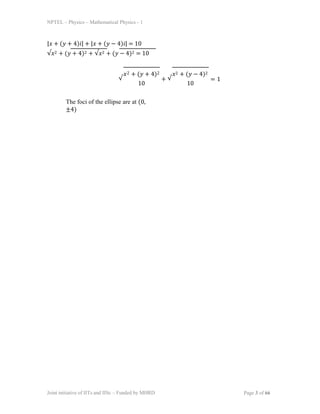
|𝑥 + (𝑦 + 4)𝑖| + |𝑥 + (𝑦 − 4)𝑖| = 10
√𝑥2 + (𝑦 + 4)2 + √𝑥2 + (𝑦 − 4)2 = 10
√
𝑥2 + (𝑦 + 4)2
10
+ √
𝑥2 + (𝑦 − 4)2
10
= 1
Joint initiative of IITs and IISc – Funded by MHRD Page 3 of 66
The foci of the ellipse are at (0,
±4)

lec31.ppt

  • 1.
    NPTEL – Physics– Mathematical Physics - 1 Module 6 Lecture 31 Complex analysis Complex Numbers Consider an equation, 𝑥2 + 1 = 0. No real number satisfies this equation. To allow for a solution of this equation, complex numbers can be introduced. They are not only confined to the real axis. This complex numbers are pairs of numbers that denote coordinates of points in the complex plane. Real numbers, including zero and negative numbers, integers or fractions, rational and irrational numbers can be represented on a line called the real axis as shown below. Thus, conversely corresponding to each point on the line, there is a real number. The coordinates of A represent a complex number, (𝑥, 𝑦). Since B lies on the real axis, the coordinate of B is represented by a real number and for a point C, it is purely imaginary. Thus a complex no. is defined as 𝑧 = 𝑥 + 𝑖𝑦 where x and y are real and i is an imaginary quantity which has a value √−1 . Joint initiative of IITs and IISc – Funded by MHRD Page 1 of 66
  • 2.
    NPTEL – Physics– Mathematical Physics - 1 Properties of Complex numbers 1.Complex numbers, 𝑧1 = 𝑥1 + 𝑖𝑦1 and 𝑧2 = 𝑥2 + 𝑖𝑦2 are added as 𝑧1 + 𝑧2 = (𝑥1 + 𝑥2 ) + 𝑖(𝑦1 + 𝑦2 ) 2.Two complex numbers, 𝑧1 = 𝑥1 + 𝑖𝑦1 and 𝑧2 = 𝑥2 + 𝑖𝑦2 when multiplied yields, 𝑧1𝑧2 = (𝑥1 + 𝑖𝑦1)(𝑥2 + 𝑖𝑦2) = (𝑥1𝑥2 − 𝑦1𝑦2) + 𝑖(𝑦1𝑥2 + 𝑥1𝑦2) 3.Inverse of a complex number is found as in the following, Let 𝑧−1 = 𝑢 + 𝑖𝑣 such that (𝑢 + 𝑖𝑣)(𝑥 + 𝑖𝑦) = 1 𝑥𝑢 − 𝑦𝑣 = 1 𝑦𝑢 + 𝑥𝑣 = 0} 𝑢 = 1 + 𝑦𝑣 𝑥 𝑦 ( 1 + 𝑦𝑣 𝑥 ) + 𝑥𝑣 = 0 ⇒ + 𝑣 + 𝑥𝑣 = 0 𝑦 𝑥 𝑥 𝑦2 ⇒ 𝑦 + (𝑦2 + 𝑥2)𝑣 = 0 ⇒ 𝑣 = − 𝑦 𝑥2 + 𝑦2 Similarly 𝑢 = 𝑥 𝑥2+𝑦 2 Thus, 𝑧−1 = ( 𝑥 −𝑦 𝑥2+𝑦 2 𝑥2+𝑦2 , ) (𝑧 ≠ 0) 4. The binomial formula for complex numbers is (𝑧1 + 𝑧2)𝑛 = ∑𝑛 (𝑛 )𝑧1 𝑛−𝑘 𝑧 𝑘 𝑘=0 𝑘 𝑛! 2 (𝑛 = 1,2… . . ) where (𝑛 ) = 𝑘 Also 0! = 1 𝑘!(𝑛−𝑘)! 𝑘 = 0,1,2 … … … … … … … 𝑛 5. The equation |𝑧 − 1 + 3𝑖| = 2 represents the circle whose center is 𝑧0 = (1, −3) and radius is 𝑅 = 2 where |𝑧| denotes the magnitude and is defined as √𝑥2 + 𝑦2 |(𝑥 − 1) + 𝑖(3 + 𝑦)| = 2 Thus, (𝑥 − 1)2 + (𝑦 + 3)2 = 22 So the center lies at (1, −3𝑖) in the complex plane and the radius is 2. 6. |𝑧 + 4𝑖| + |𝑧 − 4𝑖| = 10 represents an ellipse with foci at (0, ±4). Joint initiative of IITs and IISc – Funded by MHRD Page 2 of 66
  • 3.
    NPTEL – Physics– Mathematical Physics - 1 |𝑥 + (𝑦 + 4)𝑖| + |𝑥 + (𝑦 − 4)𝑖| = 10 √𝑥2 + (𝑦 + 4)2 + √𝑥2 + (𝑦 − 4)2 = 10 √ 𝑥2 + (𝑦 + 4)2 10 + √ 𝑥2 + (𝑦 − 4)2 10 = 1 Joint initiative of IITs and IISc – Funded by MHRD Page 3 of 66 The foci of the ellipse are at (0, ±4)