A ‘Stakeholder’ is:
Anyperson or organisation who can be
positively or negatively impacted by, or cause an
impact on the actions of a company. (Freeman,
1984)
The individuals and constituencies that
contribute, either voluntarily or involuntarily, to
its wealth-creating capacity and activities, and
are therefore its potential beneficiaries and / or
risk bearers. (Post, Preston & Sachs, 2002)
3.
Stakeholder theory inthe context of the
organisation:
1: The objective of a business is to make
profits for its shareholders. (The Shareholder
Value Perspective)
2: Companies are networks of parties
working towards a shared goal. Employees,
suppliers, shareholders, external interest
groups and customers co-operate to create
mutually beneficial results. (The Stakeholder
Value Perspective)
… or …
4.
Why use StakeholderAnalysis?
• Identify the stakeholders likely to be affected by
or influence the activities of the organisation
• Assess how those stakeholders could be
impacted or impact upon the organisation
• Anticipate the consequences of any change in
the organisation’s activities
• Identify stakeholders’ ‘success criteria’
• Assure a successful outcome for the
organisation by developing co-operation with
stakeholders (see: Customer Focus)
5.
Meeting stakeholder needs:
•Where does your organisation create stakeholder
value?
• How can you do that better?
• Can you eliminate or reduce focus on processes
which do not add stakeholder value?
• How do you communicate with stakeholders?
• Do your communications encourage stakeholder
exchange?
• Do you communicate the stakeholder value?
6.
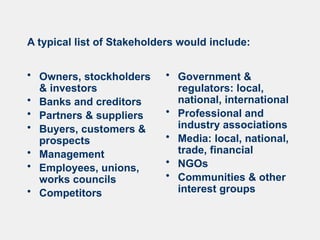
A typical listof Stakeholders would include:
• Owners, stockholders
& investors
• Banks and creditors
• Partners & suppliers
• Buyers, customers &
prospects
• Management
• Employees, unions,
works councils
• Competitors
• Government &
regulators: local,
national, international
• Professional and
industry associations
• Media: local, national,
trade, financial
• NGOs
• Communities & other
interest groups
7.
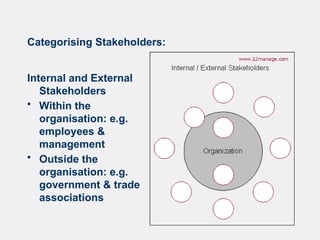
Categorising Stakeholders:
Internal andExternal
Stakeholders
• Within the
organisation: e.g.
employees &
management
• Outside the
organisation: e.g.
government & trade
associations
8.
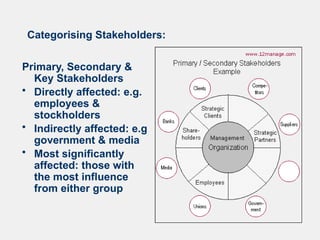
Categorising Stakeholders:
Primary, Secondary&
Key Stakeholders
• Directly affected: e.g.
employees &
stockholders
• Indirectly affected: e.g
government & media
• Most significantly
affected: those with
the most influence
from either group
9.
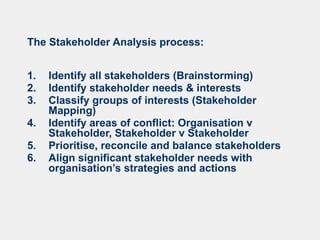
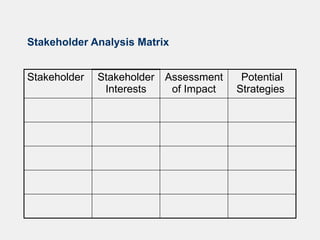
The Stakeholder Analysisprocess:
1. Identify all stakeholders (Brainstorming)
2. Identify stakeholder needs & interests
3. Classify groups of interests (Stakeholder
Mapping)
4. Identify areas of conflict: Organisation v
Stakeholder, Stakeholder v Stakeholder
5. Prioritise, reconcile and balance stakeholders
6. Align significant stakeholder needs with
organisation’s strategies and actions
Advantages of StakeholderAnalysis
• Get to know stakeholders better:
– Relative importance, power and interests
– Better managed relationships
– Risks identified
• Make better strategies and decisions
• Greater acceptance of organisation actions by
stakeholders
12.
Disadvantages of StakeholderAnalysis
• Best done on continuous basis
• Assessment of analysis may be subjective
• Maybe not all stakeholder interests can be met at
the same time
– Focus on most important stakeholder
– Balance & reconcile all interests according to
importance or urgency
13.
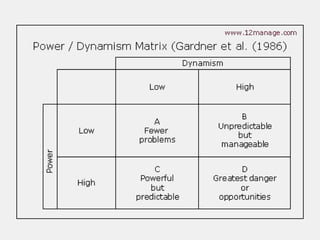
The Power /Dynamism Matrix
Classifies stakeholders in relation to the
power they hold and their aptitude for action
(dynamism)
Can be used to indicate where political effort
should be made before instigating change
15.
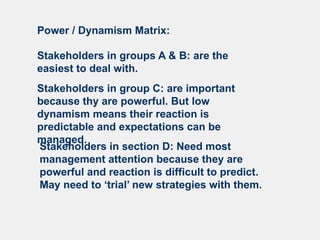
Power / DynamismMatrix:
Stakeholders in groups A & B: are the
easiest to deal with.
Stakeholders in group C: are important
because thy are powerful. But low
dynamism means their reaction is
predictable and expectations can be
managed.
Stakeholders in section D: Need most
management attention because they are
powerful and reaction is difficult to predict.
May need to ‘trial’ new strategies with them.
16.
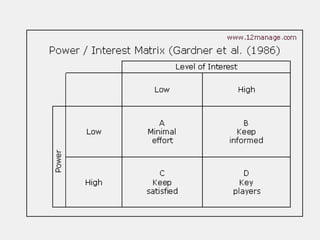
The Power /Interest Matrix
Classifies stakeholders in relation to their power and
the extent to which they are likely to show interest in
the actions of the organisation.
Can be used to indicate the nature of the
relationship which should be adopted with each
group
18.
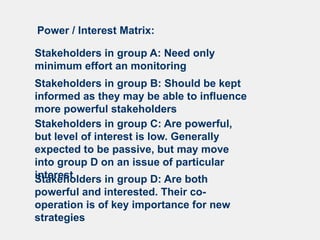
Power / InterestMatrix:
Stakeholders in group A: Need only
minimum effort an monitoring
Stakeholders in group B: Should be kept
informed as they may be able to influence
more powerful stakeholders
Stakeholders in group C: Are powerful,
but level of interest is low. Generally
expected to be passive, but may move
into group D on an issue of particular
interest
Stakeholders in group D: Are both
powerful and interested. Their co-
operation is of key importance for new
strategies
19.
The Power, Legitimacyand Urgency Model
Maps stakeholder behaviour according to its
balance of three characteristics:
Power: Of the stakeholder to influence the
organisation
Legitimacy: of the relationship in terms of
desirability or appropriateness
Urgency: The expectations of the stakeholder in
terms of criticality and time-sensitivity
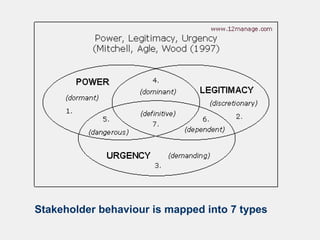
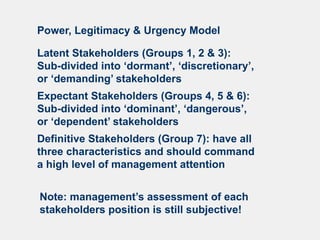
Power, Legitimacy &Urgency Model
Latent Stakeholders (Groups 1, 2 & 3):
Sub-divided into ‘dormant’, ‘discretionary’,
or ‘demanding’ stakeholders
Expectant Stakeholders (Groups 4, 5 & 6):
Sub-divided into ‘dominant’, ‘dangerous’,
or ‘dependent’ stakeholders
Definitive Stakeholders (Group 7): have all
three characteristics and should command
a high level of management attention
Note: management’s assessment of each
stakeholders position is still subjective!
22.
Introduction to StakeholderAnalysis in Evaluation
• Stakeholders play a crucial role in evaluation
processes.
• Effective stakeholder engagement ensures
evaluation relevance and usability.
• Objective: Identify, analyze, and engage
stakeholders effectively.
23.
Definition of Stakeholders
•Individuals, groups, or organizations affected by
an evaluation or its findings.
• Key Stakeholders: Those with significant
influence or stakes in the evaluation.
24.
Importance of EngagingStakeholders
• Enhances evaluation design and implementation.
• Improves credibility and applicability of findings.
• Aligns evaluation with the needs of primary
users.
25.
Guiding Principles forEvaluation & Stakeholder
Involvement
• Utility: Ensure usefulness for decision-making.
• Feasibility: Practical and cost-effective
approaches.
• Propriety: Ethical stakeholder engagement.
• Accuracy: Reliable and valid findings.
26.
Stakeholder Identification andAnalysis Techniques
• Identifying key stakeholders.
• Assessing stakeholder influence and interests.
• Mapping relationships between stakeholders.
27.
Basic Stakeholder AnalysisProcess
• 1. Identify stakeholders.
• 2. Categorize stakeholders based on influence
and interest.
• 3. Determine engagement strategies.
• 4. Continuously reassess and adjust
engagement.
28.
Frameworks for StakeholderAnalysis
• Power vs. Interest Grid: Categorizes stakeholders
based on influence and interest levels.
• Stakeholder Influence Diagrams: Maps
stakeholder relationships.
• Participation Planning Matrix: Guides
engagement approaches.
29.
Stakeholder Engagement Strategies
•Inform: Provide relevant information.
• Consult: Gather feedback and insights.
• Involve: Include in decision-making processes.
• Collaborate: Partner with stakeholders in
evaluation design.
• Empower: Grant decision-making authority to
stakeholders.
30.
Challenges in StakeholderEngagement
• Conflicting stakeholder interests.
• Power imbalances.
• Resistance to evaluation.
• Resource constraints.
31.
The Role ofAdaptability and Flexibility in Evaluation
• Stakeholder dynamics evolve over time.
• Evaluators must adjust engagement strategies.
• Continuous assessment improves relevance and
effectiveness.
32.
Best Practices inStakeholder Analysis
• Establish clear communication channels.
• Balance inclusivity with efficiency.
• Document stakeholder expectations and roles.
• Use visual tools for clarity (e.g., diagrams,
matrices).
33.
Case Examples ofEffective Stakeholder
Engagement
• Government policy evaluations.
• Nonprofit program assessments.
• Corporate sustainability evaluations.
• Community development initiatives.
34.
Visual Representation: StakeholderMatrix and
Diagrams
• Power vs. Interest Grid
• Stakeholder Influence Diagram
• Participation Planning Matrix
35.
Conclusion and KeyTakeaways
• Stakeholder engagement enhances evaluation
success.
• Use structured techniques for stakeholder
identification and analysis.
• Adapt strategies based on changing evaluation
contexts.
• Foster transparent communication and ethical
engagement.




![제 23회 보아즈(BOAZ) 빅데이터 컨퍼런스 - [MBOAX] : ABSA를 활용한 소비자 반응 분석 기반 운영 효율화 대시보드 설계](https://cdn.slidesharecdn.com/ss_thumbnails/3-1boaz23rdconferencemboax-260203102709-9d519923-thumbnail.jpg?width=640&height=640&fit=bounds)


![7.__Developing_a_Research_Proposal[1].pptx](https://cdn.slidesharecdn.com/ss_thumbnails/7-260131073037-df92dd7d-thumbnail.jpg?width=640&height=640&fit=bounds)


