
STAKEHOLDERS
IDENTIFICATION
OLIVER C. SISON
JOVELYN C. NAZARITA
MPA STUDENTS
DR. JO BITONIO
Professor
Stakeholders are persons, groups or
institutions with interests in a project or
program.
Primary stakeholders are those ultimately
affected either positively (beneficiaries) or
negatively (for example, for those
involuntarily resettled).
Secondary stakeholders are the
intermediaries. Those that are not directly
affected.
In every undertaking/project there
are parties with vested interest in
either the activities and / or the
result.
The World Bank (2000) defines
stakeholders as those effecting change
in the community and those affected by
it.
STAKEHOLDERS
 Customers/users
 Sponsor
 Portfolio manager/portfolio Review board
 Program managers
 Project Management Office
 Program Managers
 Project Team
 Functional managers
 Operations Management
 Vendors/business partners
 Performing Organization and the public
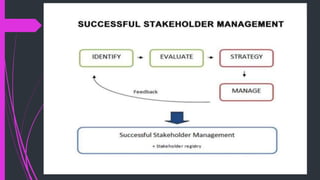
THE PROCESSES INVOLVE:
Identifying the stakeholders
Analyze them, and
Developing a strategy to manage
them
WHEN SHOULD IT BE DONE?
Stakeholder identification and analysis should always be done at
the beginning of a project, even if it is a quick list of stakeholders
and their interest.
OBJECTIVES OF STAKEHOLDER IDENTIFICATION
1. to get a clear understanding as to who the main
stakeholders are and
2. to understand their values, beliefs, problems and
attitudes towards the project.
IDENTIFYING STAKEHOLDERS
 Documenting relevant information regarding their:
 interests
 Involvement and
 Impact on project success
 Identifying stakeholders Increase likelihood of
project success, Identify them early and
make an analysis on their
- level of interest
- expectation
- importance
- attitude and influence
STAKEHOLDER CATEGORIZATION
Tuman J. (1993) categorized stakeholders into
four main groups. These include:
1. Project champions
2. Project participants
3. Community participants
3. Parasitic participants
1.PROJECT CHAMPIONS
Are those who have some reason to
bring a project into being. These
stakeholders include the developers,
investors, and entrepreneurs
motivated by profit.
2. PROJECT PARTICIPANTS
 The project participants group includes
organizations and individuals who are
responsible for planning and executing the
project. Typically this include the Project
manager and project team, engineers,
constructors, vendors, suppliers, crafts
people, and regulatory agencies at the
local, slate, and national levels.
3. COMMUNITY PARTICIPANTS
 Community participants include groups
or individuals who are directly affected
by the project. Community participants
create the environment that surrounds
the project. The group can materialize
because of environmental, social,
political, economic, health, or safety
concerns.
4. THE PASSIVE/PARASITIC PARTICIPANTS
 The parasitic participants presents
an interesting and vital works for
project managers. Parasitic
participants consist of organizations
and individuals who do not have a
direct stake in projects. In this
group we find the opportunities,
the activists and other who are
looking for a focal point for their
energies, internal drives and to
promote their personal
philosophies and views.
STAKEHOLDER CATEGORIZATION
PROJECT CHAMPION PROJECT
PARTICIPANT
COMMUNITY
PARTICIPANT
PARASITIC/PASSIVE
PARTICIPANT
- DEVELOPERS
- CLIENTS/CUTOMER
S
- POLITICIANS
- COMMUNITY
LEADERS-CHIEFS,
OPINION LEADERS
- VISIONARIES
- PROJECT MGT.
TEAM
- CONTRACTORS
- VENDORS
- CONSTRUCTORS
- The Community
- Special interest
groups-churches,
women and men’s
group
- environmentalist
- Media
- Activist
CHECKLIST FOR IDENTIFYING STAKEHOLDERS
1. Have all primary and secondary stakeholders been listed?
2. Have all categories been identified?
3. Have all potential supporters and opponents of the project been
identified?
4. Have primary stakeholders been divided into user, occupational
groups /income groups?
5. Are there any new primary or secondary stakeholders that are likely
to emerge as a result of the project?
IDENTIFYING STAKEHOLDERS
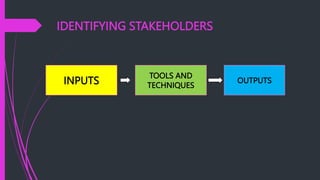
INPUTS
TOOLS AND
TECHNIQUES
OUTPUTS
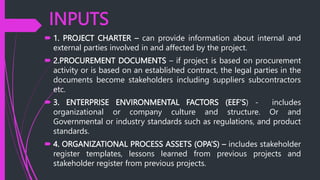
INPUTS
 1. PROJECT CHARTER – can provide information about internal and
external parties involved in and affected by the project.
 2.PROCUREMENT DOCUMENTS – if project is based on procurement
activity or is based on an established contract, the legal parties in the
documents become stakeholders including suppliers subcontractors
etc.
 3. ENTERPRISE ENVIRONMENTAL FACTORS (EEF’S) - includes
organizational or company culture and structure. Or and
Governmental or industry standards such as regulations, and product
standards.
 4. ORGANIZATIONAL PROCESS ASSETS (OPA’S) – includes stakeholder
register templates, lessons learned from previous projects and
stakeholder register from previous projects.
TOOLS AND TECHNIQUES
 Stakeholder analysis- a technique
to identify and analyze the
stakeholders surrounding a project.
 STAKEHOLDER ANALYSIS – is a
process of systemically gathering
and analyzing quantitative and
qualitative information to
determine whose interests should
be taken into accountability
throughout the project.
Process of Stakeholder Analysis
First, the project manager has to build a project team
that has the skill to address all stakeholder
requirements and concerns.
Second, the team must develop strategies for dealing
with the different levels of power.
Finally, resources must be obtained to deal with
stakeholder issues that are beyond normal project
demands.
Stakeholder analysis generally follow the steps
described below:
1. identify all potential project stakeholders and relevant
information.
2. identify the potential impact or support each stakeholder
could generate, and classify them so as to define an
approach strategy.
3. assess how key stakeholders are likely to react on the
respond in various situations, in order to plan how to win
or enhance their support an mitigate negative impacts.
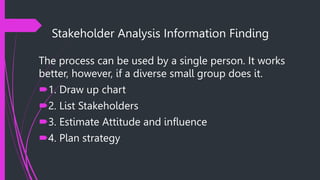
Stakeholder Analysis Information Finding
The process can be used by a single person. It works
better, however, if a diverse small group does it.
1. Draw up chart
2. List Stakeholders
3. Estimate Attitude and influence
4. Plan strategy
1. DRAW UP THE CHART
 Prepare a chart on electronic whiteboard, or perhaps butcher paper like this.
 Att- attitude Inf- influence E- estimate C-confidence
(Write goal here)
Stakeholders Att Inf Actions
E C E C
2. List Stakeholders
Identify and list the stakeholders. These may be individuals
or stakeholder groups, or some combination. If stakeholders
can be treated as a group or use groups. The most effective
way of doing this is to list as many stakeholders as you can
on a working sheet of paper. The transfer them to the left
hand column of the chart. It may help to list them in rough
order of importance.
3. ESTIMATE ATTITUDE & CONFIDENCE
For column 2 to 5 work across the page. Record you estimate of the four
columns. In order, they are:
Column 2- you best estimate of the stakeholder’s attitude from supportive
opposed. Usually find it is adequate to use a 5-category code.
Column 3- how confident you are about your estimate in column 2.
Column 4- your best estimate of the influence of the stakeholder. A three
code is usually enough.
Column 5- how confident you are about your estimate in column 4.
4. Plan Strategies
 I general, question marks indicate a need for more information. The
more question marks, and the more influence the person has, the
greater the need. On some occasions you will choose to approach the
person concerned. On the other occasions you may instead approach
someone else who can be assumed to know about the person’s attitude
pr influence. (on occasion, you may want to obtain some of this
information before completing the analysis).
 In general, high influence indicates a need to involve the person in
some way. (or, if you chose not to do this, and they are opposite, you
may choose to find some way to neutralize their influence).
USING THE FINDINGS OF A STAKEHOLDER ANALYSIS
 The Project Concept Note- the main findings of a stakeholder analysis should be
included in the project concept note. Such a summary needs to be brief because (a)
of the nature of concept notes, and (b) the analysis will probably be revised as the
project design develops, interest change, and more information becomes available.
 The Project Document- all project documents will need more details than the
concept note, drawing on both the stakeholder analysis and any revisions arising
out of appraisal. PAD submissions are likely to require more detail of key secondary
and primary stakeholders, their various interests, and their relative influence and
importance. This information should appear in summary form in the Social and
institutional section of the project document.
EXPERT JUDGMENT (TOOLS AND TECHNIQUES)
 To ensure comprehensive identification and listing of
stakeholders, judgment and expertise should be sought from
groups or individuals with specialized training or knowledge
on the subject area such as:
1. Senior management
2. Other units within the organization
3. Identified key stakeholders
OUTPUT
1. STAKEHOLDER REGISTER- the main output of the identify
stakeholder is the stakeholder register, which includes details
relative to identified stakeholders:
A. identification information- name, organizational position,
role in the project, contact information
B. assessment information- major requirements, main
expectations and potential influence in the project
C. stakeholder classification- internal / external, supporter,
neutral / resistor, etc.
2. STAKEHOLDER MANAGEMENT STRATEGY
 The stakeholder management strategy defines an
approach to increase the support and minimize negative
impacts of stakeholders throughout the entire project life
cycle. It includes elements such as:
 A. key stakeholders who can significantly impact the
project
 B. level of participation in the project desired for each
identified stakeholder
 C. stakeholder groups and their management (as
groups).
 D. a common way of representing the stakeholder
management strategy is a stakeholder analysis matrix
below
SAMPLE OF A BLANK STAKEHOLDER ANALYSIS
MATRIX
STAKEHOLDER STAKEHOLDER Interest
in the project
Assessment of impact Potential Strategies for
Gaining Support or
reducing obstacle
INITIATION PHASE OUTPUT CHARTER INPUT PLANNING PHASE
REFERENCE:
 Stakeholder identification analysis and management. Published by Josephine
Thornton
 Slideplayer.com
 Pdf doc.ifc.org

STAKEHOLDER-IDENTIFICATION.pptx

  • 1.
    STAKEHOLDERS IDENTIFICATION OLIVER C. SISON JOVELYNC. NAZARITA MPA STUDENTS DR. JO BITONIO Professor
  • 2.
    Stakeholders are persons,groups or institutions with interests in a project or program. Primary stakeholders are those ultimately affected either positively (beneficiaries) or negatively (for example, for those involuntarily resettled). Secondary stakeholders are the intermediaries. Those that are not directly affected. In every undertaking/project there are parties with vested interest in either the activities and / or the result. The World Bank (2000) defines stakeholders as those effecting change in the community and those affected by it.
  • 4.
    STAKEHOLDERS  Customers/users  Sponsor Portfolio manager/portfolio Review board  Program managers  Project Management Office  Program Managers  Project Team  Functional managers  Operations Management  Vendors/business partners  Performing Organization and the public THE PROCESSES INVOLVE: Identifying the stakeholders Analyze them, and Developing a strategy to manage them
  • 7.
    WHEN SHOULD ITBE DONE? Stakeholder identification and analysis should always be done at the beginning of a project, even if it is a quick list of stakeholders and their interest. OBJECTIVES OF STAKEHOLDER IDENTIFICATION 1. to get a clear understanding as to who the main stakeholders are and 2. to understand their values, beliefs, problems and attitudes towards the project.
  • 8.
    IDENTIFYING STAKEHOLDERS  Documentingrelevant information regarding their:  interests  Involvement and  Impact on project success  Identifying stakeholders Increase likelihood of project success, Identify them early and make an analysis on their - level of interest - expectation - importance - attitude and influence
  • 9.
    STAKEHOLDER CATEGORIZATION Tuman J.(1993) categorized stakeholders into four main groups. These include: 1. Project champions 2. Project participants 3. Community participants 3. Parasitic participants 1.PROJECT CHAMPIONS Are those who have some reason to bring a project into being. These stakeholders include the developers, investors, and entrepreneurs motivated by profit.
  • 10.
    2. PROJECT PARTICIPANTS The project participants group includes organizations and individuals who are responsible for planning and executing the project. Typically this include the Project manager and project team, engineers, constructors, vendors, suppliers, crafts people, and regulatory agencies at the local, slate, and national levels.
  • 11.
    3. COMMUNITY PARTICIPANTS Community participants include groups or individuals who are directly affected by the project. Community participants create the environment that surrounds the project. The group can materialize because of environmental, social, political, economic, health, or safety concerns.
  • 12.
    4. THE PASSIVE/PARASITICPARTICIPANTS  The parasitic participants presents an interesting and vital works for project managers. Parasitic participants consist of organizations and individuals who do not have a direct stake in projects. In this group we find the opportunities, the activists and other who are looking for a focal point for their energies, internal drives and to promote their personal philosophies and views.
  • 13.
    STAKEHOLDER CATEGORIZATION PROJECT CHAMPIONPROJECT PARTICIPANT COMMUNITY PARTICIPANT PARASITIC/PASSIVE PARTICIPANT - DEVELOPERS - CLIENTS/CUTOMER S - POLITICIANS - COMMUNITY LEADERS-CHIEFS, OPINION LEADERS - VISIONARIES - PROJECT MGT. TEAM - CONTRACTORS - VENDORS - CONSTRUCTORS - The Community - Special interest groups-churches, women and men’s group - environmentalist - Media - Activist
  • 14.
    CHECKLIST FOR IDENTIFYINGSTAKEHOLDERS 1. Have all primary and secondary stakeholders been listed? 2. Have all categories been identified? 3. Have all potential supporters and opponents of the project been identified? 4. Have primary stakeholders been divided into user, occupational groups /income groups? 5. Are there any new primary or secondary stakeholders that are likely to emerge as a result of the project?
  • 15.
  • 16.
    INPUTS  1. PROJECTCHARTER – can provide information about internal and external parties involved in and affected by the project.  2.PROCUREMENT DOCUMENTS – if project is based on procurement activity or is based on an established contract, the legal parties in the documents become stakeholders including suppliers subcontractors etc.  3. ENTERPRISE ENVIRONMENTAL FACTORS (EEF’S) - includes organizational or company culture and structure. Or and Governmental or industry standards such as regulations, and product standards.  4. ORGANIZATIONAL PROCESS ASSETS (OPA’S) – includes stakeholder register templates, lessons learned from previous projects and stakeholder register from previous projects.
  • 17.
    TOOLS AND TECHNIQUES Stakeholder analysis- a technique to identify and analyze the stakeholders surrounding a project.  STAKEHOLDER ANALYSIS – is a process of systemically gathering and analyzing quantitative and qualitative information to determine whose interests should be taken into accountability throughout the project.
  • 18.
    Process of StakeholderAnalysis First, the project manager has to build a project team that has the skill to address all stakeholder requirements and concerns. Second, the team must develop strategies for dealing with the different levels of power. Finally, resources must be obtained to deal with stakeholder issues that are beyond normal project demands.
  • 19.
    Stakeholder analysis generallyfollow the steps described below: 1. identify all potential project stakeholders and relevant information. 2. identify the potential impact or support each stakeholder could generate, and classify them so as to define an approach strategy. 3. assess how key stakeholders are likely to react on the respond in various situations, in order to plan how to win or enhance their support an mitigate negative impacts.
  • 20.
    Stakeholder Analysis InformationFinding The process can be used by a single person. It works better, however, if a diverse small group does it. 1. Draw up chart 2. List Stakeholders 3. Estimate Attitude and influence 4. Plan strategy
  • 21.
    1. DRAW UPTHE CHART  Prepare a chart on electronic whiteboard, or perhaps butcher paper like this.  Att- attitude Inf- influence E- estimate C-confidence (Write goal here) Stakeholders Att Inf Actions E C E C
  • 22.
    2. List Stakeholders Identifyand list the stakeholders. These may be individuals or stakeholder groups, or some combination. If stakeholders can be treated as a group or use groups. The most effective way of doing this is to list as many stakeholders as you can on a working sheet of paper. The transfer them to the left hand column of the chart. It may help to list them in rough order of importance.
  • 23.
    3. ESTIMATE ATTITUDE& CONFIDENCE For column 2 to 5 work across the page. Record you estimate of the four columns. In order, they are: Column 2- you best estimate of the stakeholder’s attitude from supportive opposed. Usually find it is adequate to use a 5-category code. Column 3- how confident you are about your estimate in column 2. Column 4- your best estimate of the influence of the stakeholder. A three code is usually enough. Column 5- how confident you are about your estimate in column 4.
  • 24.
    4. Plan Strategies I general, question marks indicate a need for more information. The more question marks, and the more influence the person has, the greater the need. On some occasions you will choose to approach the person concerned. On the other occasions you may instead approach someone else who can be assumed to know about the person’s attitude pr influence. (on occasion, you may want to obtain some of this information before completing the analysis).  In general, high influence indicates a need to involve the person in some way. (or, if you chose not to do this, and they are opposite, you may choose to find some way to neutralize their influence).
  • 25.
    USING THE FINDINGSOF A STAKEHOLDER ANALYSIS  The Project Concept Note- the main findings of a stakeholder analysis should be included in the project concept note. Such a summary needs to be brief because (a) of the nature of concept notes, and (b) the analysis will probably be revised as the project design develops, interest change, and more information becomes available.  The Project Document- all project documents will need more details than the concept note, drawing on both the stakeholder analysis and any revisions arising out of appraisal. PAD submissions are likely to require more detail of key secondary and primary stakeholders, their various interests, and their relative influence and importance. This information should appear in summary form in the Social and institutional section of the project document.
  • 26.
    EXPERT JUDGMENT (TOOLSAND TECHNIQUES)  To ensure comprehensive identification and listing of stakeholders, judgment and expertise should be sought from groups or individuals with specialized training or knowledge on the subject area such as: 1. Senior management 2. Other units within the organization 3. Identified key stakeholders
  • 27.
    OUTPUT 1. STAKEHOLDER REGISTER-the main output of the identify stakeholder is the stakeholder register, which includes details relative to identified stakeholders: A. identification information- name, organizational position, role in the project, contact information B. assessment information- major requirements, main expectations and potential influence in the project C. stakeholder classification- internal / external, supporter, neutral / resistor, etc.
  • 28.
    2. STAKEHOLDER MANAGEMENTSTRATEGY  The stakeholder management strategy defines an approach to increase the support and minimize negative impacts of stakeholders throughout the entire project life cycle. It includes elements such as:  A. key stakeholders who can significantly impact the project  B. level of participation in the project desired for each identified stakeholder  C. stakeholder groups and their management (as groups).  D. a common way of representing the stakeholder management strategy is a stakeholder analysis matrix below
  • 29.
    SAMPLE OF ABLANK STAKEHOLDER ANALYSIS MATRIX STAKEHOLDER STAKEHOLDER Interest in the project Assessment of impact Potential Strategies for Gaining Support or reducing obstacle
  • 30.
    INITIATION PHASE OUTPUTCHARTER INPUT PLANNING PHASE
  • 31.
    REFERENCE:  Stakeholder identificationanalysis and management. Published by Josephine Thornton  Slideplayer.com  Pdf doc.ifc.org