Stakeholder Theory and the Stakeholder
Management Approach Defined :Stakeholder theory is
best described by R. Edward Freeman—its modern
founder. “My thesis is that I can revitalize the concept of
managerial capitalism by replacing the notion that
managers have a duty to stockholders with the concept
that managers bear a fiduciary relationship to
stakeholders. Stake- holders are those groups who have a
stake in or claim on the firm. Specifically I include
suppliers, customers, employees, stockholders, and the
local commu-nity, as well as management in its role as
agent for these groups. . . . Each of these stakeholder
groups has a right not to be treated as a means to some
end, and therefore must participate in determining the
future direction of the firm in which they have a stake.”
The stakeholder management approach is based on a
related instrumental theory that argues “a subset of
ethical principles (trust, trustworthiness, and
cooperativeness) can result in significant
competitive advantage.”16 This ap- proach, then,
enables researchers and practitioners to use
analytical concepts and methods for identifying,
mapping, and evaluating corporate strategy with
stakeholders. We refer to the use of this
instrumental approach in stakeholder theory as
“stakeholder analysis.”
Stakeholders
A stakeholder is “any individual or group who can affect or is affected by the
actions, decisions, policies, practices, or goals of the organization.”19 We
begin by identifying the focal stakeholder. This is the company or group that
is the focus or central constituency of an analysis.
• The primary stakeholders of a firm include its owners, customers,
employees, and suppliers. Also of primary importance to a firm’s survival
are its stock- holders and board of directors. The CEO and other top-level
executives can be stakeholders, but in the stakeholder analysis they are
generally considered actors and representatives of the firm. In this chapter’s
opening case, BP’s CEO and top-level team are focal stakeholders.
Coalitional focal stakeholders that may also be connected to BP primar y
stakeholders include owners, customers, employees, and, in this case,
Chinese vendors and suppliers.
• Secondary stakeholders include all other interested groups, such as the
media, consumers, lobbyists, courts, governments, competitors, the public,
and society. Halliburton and Transocean were considered as “secondary
stakeholders” by then CEO and other officers; after the spill, these
collaborators became plain- tiffs. Control and quality of products and
services can be diminished and/or lost with outsourced and licensing
relationships if proper monitoring and man- agement is absent. One final
report on this case suggested that the real root of the problem was BP’s
own laissez-faire approach to safety, even though spokespersons from BP
denied this allegation.20
Stakes
• A stake is any interest, share, or claim that a group
or individual has in the out- come of a corporation’s
policies, procedures, or actions toward others.
Stakes may be based on any type of interest. The
stakes of stakeholders are not always obvious. The
economic viability of competing firms can be at
stake when one firm threatens entry into a market.
The physical environment, employees’ lives, and the
health and welfare of communities can be at stake
when corpo- rations like BP either relax or do not
have in place proper equipment, safety standards,
and emergency plans for crises.
• Why Use a Stakeholder Management Approach
for Business Ethics? A more familiar way of
understanding corporations is the stockholder
approach, which focuses on financial and economic
relationships. By contrast, a stakeholder
management approach is a normative and
instrumental approach that studies actors’ interests,
stakes, and actions.23 The stakeholder manage-
ment approach takes into account nonmarket forces
that affect organizations and individuals, such as
moral, political, legal, and technological interests, as
well as economic factors.
Underlying the stakeholder management approach is
the ethical imperative that mandates that
businesses in their fiduciary relationships to their
stockhold- ers: (1) act in the best interests of and
for the benefit of their customers, employ- ees,
suppliers, and stockholders; and (2) respect and
fulfill these stakeholders’ rights. One study
concluded that “multiple objectives—including both
eco- nomic and social considerations—can be and,
in fact, are simultaneously and successfully pursued
within large and complex organizations that
collectively account for a major part of all economic
activity within our society.
• Taking a Third-Party Objective Observer Perspective
In the following discussion, you are asked to assume the
role of a CEO of a company to execute a stakeholder
analysis. However, it is recommended that you take the
role of “third-party objective observer” when doing a
stake- holder analysis. Why? In this role, you will need
to suspend your belief and value judgments in order to
understand the strategies, motives, and actions of the
different stakeholders. You may not agree with the
focal organization or CEO whom you are studying.
Therefore, the point is to be able to see all sides of an
issue and then objectively evaluate the claims, actions,
and outcomes of all the parties. Being more objective
helps determine who acted responsibly, who won and
who lost, and at what costs.
• Role of the CEO in Stakeholder Analysis
• Assume for this exercise that you are the CEO,
working with your top man- agers, in a firm that has
just been involved in a major controversy of inter-
national proportions. The media, some consumer
groups, and several major customers have called
you. You want to get a handle on the situation
without reverting to unnecessar y “firefighting”
management methods. A couple of your trusted
staff members have advised you to adopt a
planning approach quickly while responding to
immediate concerns and to understand the “who
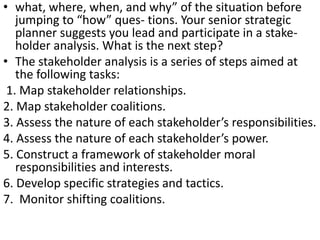
• what, where, when, and why” of the situation before
jumping to “how” ques- tions. Your senior strategic
planner suggests you lead and participate in a stake-
holder analysis. What is the next step?
• The stakeholder analysis is a series of steps aimed at
the following tasks:
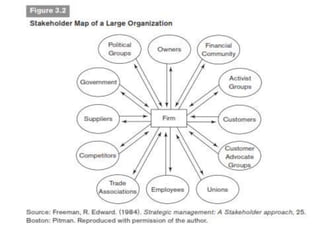
1. Map stakeholder relationships.
2. Map stakeholder coalitions.
3. Assess the nature of each stakeholder’s responsibilities.
4. Assess the nature of each stakeholder’s power.
5. Construct a framework of stakeholder moral
responsibilities and interests.
6. Develop specific strategies and tactics.
7. Monitor shifting coalitions.
• Figure 3.1
Sample Questions for Stakeholder Review
1. Who are our stakeholders currently?
2. Who are our potential stakeholders?
3. How does each stakeholder affect us?
4. How do we affect each stakeholder?
5. For each division and business, who are the stakeholders?
6. What assumptions does our current strategy make about
each important stakeholder
(at each level)?
7. What are the current “environmental variables” that affect
us and our stakeholders (ini- tiation, GNP, prime rate,
confidence in business [from polls], corporate identity, media
image, and so on)?
8. How do we measure each of these variables and their impact
on us and our stakehold- ers?
9. How do we keep score with our stakeholders?
• From the point of view of the focal stakeholder, if you were
CEO, you would develop specific strategies and keep the
following points in mind:
1. Your goal is to create a socially responsible, win–win set of
outcomes, if possible. However, this may mean economic
costs to your firm if, in fact, members of your firm are
responsible to certain groups for harm caused
• as a consequence of your actions.
2. Ask: “What is our business? Who are our customers? What
are our responsibilities to the stakeholders, to the public, and
to the firm?” Keep your values, mission, and responsibilities
in mind as you move forward.
3. Consider probable consequences of your actions. For whom?
At what costs? Over what period? Ask: “What does a win–win
situation look like for us?”
4. Keep in mind that the means you use can be important as the
ends you seek; that is, how you approach and treat each
stakeholder can be as important as what you do.
• Negotiation Methods: Resolving
• Stakeholder Disputes :Disputes are part of stakeholder
relationships. Most disputes are handled in the context of
mutual trusting relationships between stakeholders; others
move into the legal and regulatory system.34 Disputes occur
between different stake- holder levels: for example, between
professionals within an organization, consumers and
companies, business to business (B2B), governments and
businesses, and among coalitions and businesses. It is
estimated that Fortune 500 senior human resource (HR)
executives are involved in legal disputes 20% of their working
time. Also, managers generally spend 30% of their time
handling conflicts. The hidden cost of managing conflicts
between and among professionals in organizations can result
in absenteeism, turnover, legal costs, and loss of
productivity.35 U.S. retail e-commerce sales in the fourth
quarter of 2011 were $51.4 billion, up 15.5% from 2010. With
that volume, there will be business disputes. A study by the
American Arbitration Association surveying 100 senior
executives of Fortune 1000 companies found that:
1. Two out of three executives were concerned about
B2B e-commerce disputes with major suppliers and
50% of surveyed executives noted that this type of
dispute would significantly impact their business.
2. More than 50% noted that the shift to e-commerce
will create new and/or different types of stakeholder
disputes, with 64% of surveyed execu- tives reporting
their companies did not yet have a plan in place to deal
with these disputes.
3. 70% agreed that specific guidelines are needed in
order to manage e-commerce disputes, and one in four
executives noted that their company did nothing to
prevent e-commerce disputes.36
Stakeholder conflict and dispute resolution methods are
clearly necessary.
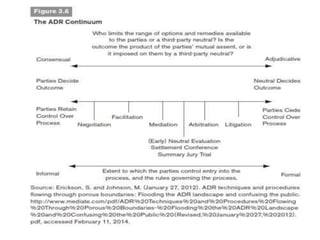
• Stakeholder Dispute Resolution Methods
Dispute resolution is an expertise also known as
alternative dispute resolution (ADR). Dispute
resolution techniques cover a variety of methods
intended to help potential litigants resolve conflicts.
The methods can be viewed on a continuum
ranging from face-to-face negotiation to litigation.
• The stakeholder management approach involves the full range of dispute
resolution techniques, although ideally more integrative and relational
rather than distributive or power-based methods would be attempted first.
(Power- based approaches are based on authoritarian and competition-
based methods where the more powerful group or individual “wins” and
the opposing group “loses.” This approach can cause other disputes to
arise.) Integrative approaches are characterized as follows:
• Problems are seen as having more potential solutions than are immediately
obvious.
• Resources are seen as expandable; the goal is to “expand the pie” before
dividing it.
• Parties attempting to create more potential solutions and processes are thus
said to be “value creating.”
• Parties attempt to accommodate as many interests of each of the parties as
possible.
• The so-called win–win or “all gain” approach.39
• Distributive approaches have the following characteristics:
• Problems are seen as zero sum.
• Resources are imagined as fixed: “divide the pie.”

Chapter 3

  • 1.
    Stakeholder Theory andthe Stakeholder Management Approach Defined :Stakeholder theory is best described by R. Edward Freeman—its modern founder. “My thesis is that I can revitalize the concept of managerial capitalism by replacing the notion that managers have a duty to stockholders with the concept that managers bear a fiduciary relationship to stakeholders. Stake- holders are those groups who have a stake in or claim on the firm. Specifically I include suppliers, customers, employees, stockholders, and the local commu-nity, as well as management in its role as agent for these groups. . . . Each of these stakeholder groups has a right not to be treated as a means to some end, and therefore must participate in determining the future direction of the firm in which they have a stake.”
  • 2.
    The stakeholder managementapproach is based on a related instrumental theory that argues “a subset of ethical principles (trust, trustworthiness, and cooperativeness) can result in significant competitive advantage.”16 This ap- proach, then, enables researchers and practitioners to use analytical concepts and methods for identifying, mapping, and evaluating corporate strategy with stakeholders. We refer to the use of this instrumental approach in stakeholder theory as “stakeholder analysis.”
  • 3.
    Stakeholders A stakeholder is“any individual or group who can affect or is affected by the actions, decisions, policies, practices, or goals of the organization.”19 We begin by identifying the focal stakeholder. This is the company or group that is the focus or central constituency of an analysis. • The primary stakeholders of a firm include its owners, customers, employees, and suppliers. Also of primary importance to a firm’s survival are its stock- holders and board of directors. The CEO and other top-level executives can be stakeholders, but in the stakeholder analysis they are generally considered actors and representatives of the firm. In this chapter’s opening case, BP’s CEO and top-level team are focal stakeholders. Coalitional focal stakeholders that may also be connected to BP primar y stakeholders include owners, customers, employees, and, in this case, Chinese vendors and suppliers. • Secondary stakeholders include all other interested groups, such as the media, consumers, lobbyists, courts, governments, competitors, the public, and society. Halliburton and Transocean were considered as “secondary stakeholders” by then CEO and other officers; after the spill, these collaborators became plain- tiffs. Control and quality of products and services can be diminished and/or lost with outsourced and licensing relationships if proper monitoring and man- agement is absent. One final report on this case suggested that the real root of the problem was BP’s own laissez-faire approach to safety, even though spokespersons from BP denied this allegation.20
  • 4.
    Stakes • A stakeis any interest, share, or claim that a group or individual has in the out- come of a corporation’s policies, procedures, or actions toward others. Stakes may be based on any type of interest. The stakes of stakeholders are not always obvious. The economic viability of competing firms can be at stake when one firm threatens entry into a market. The physical environment, employees’ lives, and the health and welfare of communities can be at stake when corpo- rations like BP either relax or do not have in place proper equipment, safety standards, and emergency plans for crises.
  • 5.
    • Why Usea Stakeholder Management Approach for Business Ethics? A more familiar way of understanding corporations is the stockholder approach, which focuses on financial and economic relationships. By contrast, a stakeholder management approach is a normative and instrumental approach that studies actors’ interests, stakes, and actions.23 The stakeholder manage- ment approach takes into account nonmarket forces that affect organizations and individuals, such as moral, political, legal, and technological interests, as well as economic factors.
  • 6.
    Underlying the stakeholdermanagement approach is the ethical imperative that mandates that businesses in their fiduciary relationships to their stockhold- ers: (1) act in the best interests of and for the benefit of their customers, employ- ees, suppliers, and stockholders; and (2) respect and fulfill these stakeholders’ rights. One study concluded that “multiple objectives—including both eco- nomic and social considerations—can be and, in fact, are simultaneously and successfully pursued within large and complex organizations that collectively account for a major part of all economic activity within our society.
  • 7.
    • Taking aThird-Party Objective Observer Perspective In the following discussion, you are asked to assume the role of a CEO of a company to execute a stakeholder analysis. However, it is recommended that you take the role of “third-party objective observer” when doing a stake- holder analysis. Why? In this role, you will need to suspend your belief and value judgments in order to understand the strategies, motives, and actions of the different stakeholders. You may not agree with the focal organization or CEO whom you are studying. Therefore, the point is to be able to see all sides of an issue and then objectively evaluate the claims, actions, and outcomes of all the parties. Being more objective helps determine who acted responsibly, who won and who lost, and at what costs.
  • 8.
    • Role ofthe CEO in Stakeholder Analysis • Assume for this exercise that you are the CEO, working with your top man- agers, in a firm that has just been involved in a major controversy of inter- national proportions. The media, some consumer groups, and several major customers have called you. You want to get a handle on the situation without reverting to unnecessar y “firefighting” management methods. A couple of your trusted staff members have advised you to adopt a planning approach quickly while responding to immediate concerns and to understand the “who
  • 9.
    • what, where,when, and why” of the situation before jumping to “how” ques- tions. Your senior strategic planner suggests you lead and participate in a stake- holder analysis. What is the next step? • The stakeholder analysis is a series of steps aimed at the following tasks: 1. Map stakeholder relationships. 2. Map stakeholder coalitions. 3. Assess the nature of each stakeholder’s responsibilities. 4. Assess the nature of each stakeholder’s power. 5. Construct a framework of stakeholder moral responsibilities and interests. 6. Develop specific strategies and tactics. 7. Monitor shifting coalitions.
  • 10.
    • Figure 3.1 SampleQuestions for Stakeholder Review 1. Who are our stakeholders currently? 2. Who are our potential stakeholders? 3. How does each stakeholder affect us? 4. How do we affect each stakeholder? 5. For each division and business, who are the stakeholders? 6. What assumptions does our current strategy make about each important stakeholder (at each level)? 7. What are the current “environmental variables” that affect us and our stakeholders (ini- tiation, GNP, prime rate, confidence in business [from polls], corporate identity, media image, and so on)? 8. How do we measure each of these variables and their impact on us and our stakehold- ers? 9. How do we keep score with our stakeholders?
  • 12.
    • From thepoint of view of the focal stakeholder, if you were CEO, you would develop specific strategies and keep the following points in mind: 1. Your goal is to create a socially responsible, win–win set of outcomes, if possible. However, this may mean economic costs to your firm if, in fact, members of your firm are responsible to certain groups for harm caused • as a consequence of your actions. 2. Ask: “What is our business? Who are our customers? What are our responsibilities to the stakeholders, to the public, and to the firm?” Keep your values, mission, and responsibilities in mind as you move forward. 3. Consider probable consequences of your actions. For whom? At what costs? Over what period? Ask: “What does a win–win situation look like for us?” 4. Keep in mind that the means you use can be important as the ends you seek; that is, how you approach and treat each stakeholder can be as important as what you do.
  • 13.
    • Negotiation Methods:Resolving • Stakeholder Disputes :Disputes are part of stakeholder relationships. Most disputes are handled in the context of mutual trusting relationships between stakeholders; others move into the legal and regulatory system.34 Disputes occur between different stake- holder levels: for example, between professionals within an organization, consumers and companies, business to business (B2B), governments and businesses, and among coalitions and businesses. It is estimated that Fortune 500 senior human resource (HR) executives are involved in legal disputes 20% of their working time. Also, managers generally spend 30% of their time handling conflicts. The hidden cost of managing conflicts between and among professionals in organizations can result in absenteeism, turnover, legal costs, and loss of productivity.35 U.S. retail e-commerce sales in the fourth quarter of 2011 were $51.4 billion, up 15.5% from 2010. With that volume, there will be business disputes. A study by the American Arbitration Association surveying 100 senior executives of Fortune 1000 companies found that:
  • 14.
    1. Two outof three executives were concerned about B2B e-commerce disputes with major suppliers and 50% of surveyed executives noted that this type of dispute would significantly impact their business. 2. More than 50% noted that the shift to e-commerce will create new and/or different types of stakeholder disputes, with 64% of surveyed execu- tives reporting their companies did not yet have a plan in place to deal with these disputes. 3. 70% agreed that specific guidelines are needed in order to manage e-commerce disputes, and one in four executives noted that their company did nothing to prevent e-commerce disputes.36 Stakeholder conflict and dispute resolution methods are clearly necessary.
  • 15.
    • Stakeholder DisputeResolution Methods Dispute resolution is an expertise also known as alternative dispute resolution (ADR). Dispute resolution techniques cover a variety of methods intended to help potential litigants resolve conflicts. The methods can be viewed on a continuum ranging from face-to-face negotiation to litigation.
  • 17.
    • The stakeholdermanagement approach involves the full range of dispute resolution techniques, although ideally more integrative and relational rather than distributive or power-based methods would be attempted first. (Power- based approaches are based on authoritarian and competition- based methods where the more powerful group or individual “wins” and the opposing group “loses.” This approach can cause other disputes to arise.) Integrative approaches are characterized as follows: • Problems are seen as having more potential solutions than are immediately obvious. • Resources are seen as expandable; the goal is to “expand the pie” before dividing it. • Parties attempting to create more potential solutions and processes are thus said to be “value creating.” • Parties attempt to accommodate as many interests of each of the parties as possible. • The so-called win–win or “all gain” approach.39 • Distributive approaches have the following characteristics: • Problems are seen as zero sum. • Resources are imagined as fixed: “divide the pie.”