StakeholderAnalysis
04-11-13
Lecturer Miss Khadija Ejaz
Ghulam Mehdi 0 1 CMS ID@23101
Stakeholder Analysis:
StakeholderAnalysisis a term used in:
 Conflictresolution.
 Project management.
 Businessadministration.
“Stakeholderanalysesdescribe a processwhere all the individualsor groups that are likelyto be
affectedby a proposed action are identifiedandthen sorted according to how much they can affect
the action and how much the action can affectthem. This informationis usedto assesshow the
interestsof those stakeholdersshould be addressedin a projectplan, policy,program, or other action.
In short, stakeholdersare those who have a stake in the project. There are two typesof Stakeholders.
 Direct stakeholder
 Indirectstakeholder
1-Direct stakeholders:
Direct stakeholdersare those people (developers,managers,customers) whose actions
can directlyimpact your project .They are involvedinthe projectlife cycle,or are impactedby the
project .Theyuse the system or output the project puts inplace.
2-IndirectStakeholders:
IndirectStakeholdersare those who have some political powerto influence the project
or those who are interestedinits outcomes.
Identifystakeholder:
Stakeholderidentificationandanalysis isbest conductedusing brainstormingtechniques.This
procedure is generallycarriedout ina workshop setting,with representativesofkeyparticipants in a
project.
The first stepis to list all parties which are likelyto be affectedby the development,bothpositivelyor
negatively,directlyor indirectly.
It sometimeshelpsto use categoriesand thinkof all the individualsandsub groups withinthat
category. Common categoriesinclude:Management,staff,customers,media,community, finance.
Through the brainstorm process capture all the names of stakeholderswhomight:
 Be concernedin any way withthe project
 Hold an influential position
 Be affectedby the problemsaddressedin the project
Whois the Keyof stakeholder?
StakeholderAnalysis
04-11-13
Lecturer Miss Khadija Ejaz
Ghulam Mehdi 0 2 CMS ID@23101
Primary Stakeholders:
The primarystakeholders are made upof communitymembersandfarmers whoare directlyaffectedby
the sanitationconditionswithinthe locality.Theirparticipationinthe projectisasa resultof the needto
identifyandmeettheirdemandsastheywill be the usersof the implementedsystem.
Secondary Stakeholders:
The secondarystakeholders are the municipality and local authorities responsible the planning
and implementing the sanitation projects. These stakeholders will be in charge of implementing
the project.
Tertiary Stakeholders:
The tertiarystakeholders are made up of NGOs, national authorities and financial institutions.
They generally assist in advocating for proper sanitation, raising awareness as well as providing
funds for the project.
The steps of Stakeholder Analysis are explained below:
Step 1 – Identify Your Stakeholders:
The first step in your Stakeholder Analysis is to brainstorm, who your stakeholders are. As part
of this, think of all the people who are affected by your work, who have influence or power over
it, or have an interest in its successful or unsuccessful conclusion.
The table below shows some of the people who might be stakeholders in your job or in your
projects:
Your boss Shareholders Government
Senior executives Alliance partners Trades associations
Your coworkers Suppliers The press
Your team Lenders Interest groups
Customers Analysts The public
Prospective customers Future recruits The community
Your family
Remember that although stakeholders may be both organizations and people, ultimately you
must communicate with people. Make sure that you identify the correct individual stakeholders
within a stakeholder organization.
Step 2 – Prioritize Your Stakeholders:
You may now have a long list of people and organizations that are affected by your work. Some
of these may have the power either to block or advance. Some may be interested in what you
are doing, others may not care.
Map out your stakeholders on a Power/Interest Grid and classify them by their power over your
work and by their interest in your work.
 Power/Interest Grid for Stakeholders Prioritization
StakeholderAnalysis
04-11-13
Lecturer Miss Khadija Ejaz
Ghulam Mehdi 0 3 CMS ID@23101
For example, your boss is likely to have high power and influence over your projects and high
interest. Your family may have high interest, but are unlikely to have power over it.
Someone's position on the grid shows you the actions you have to take with them:
 High power, interested people: these are the people you must fully engage and make the
greatest efforts to satisfy.
 High power, less interested people: put enough work in with these people to keep them
satisfied, but not so much that they become bored with your message.
 Low power, interested people: keep these people adequately informed, and talk to them to
ensure that no major issues are arising. These people can often be very helpful with the detail of
your project.
 Low power, less interested people: again, monitor these people, but do not bore them with
excessive communication.
Step 3 – Understand Your Key Stakeholders:
You now need to know more about your key stakeholders. You need to know how they are likely
to feel about and react to your project. You also need to know how best to engage them in your
project and how best to communicate with them.
Key questions that can help you understand your stakeholders are:
 What financial or emotional interest do they have in the outcome of your work? Is it positive or
negative?
 What motivates them most of all?
 What information do they want from you?
 How do they want to receive information from you? What is the best way of communicating your
message to them?
 What is their current opinion of your work? Is it based on good information?
 Who influences their opinions generally, and who influences their opinion of you? Do some of
these influencers therefore become important stakeholders in their own right?
 If they are not likely to be positive, what will win them around to support your project?
 If you don't think you will be able to win them around, how will you manage their opposition?
 Who else might be influenced by their opinions?
 Do these people become stakeholders in their own right?
StakeholderAnalysis
04-11-13
Lecturer Miss Khadija Ejaz
Ghulam Mehdi 0 4 CMS ID@23101
A very good way of answering these questions is to talk to your stakeholders directly – people
are often quite open about their views, and asking people's opinions is often the first step in
building a successful relationship with them.
You can summarize the understanding you have gained on the stakeholder map, so that you
can easily see which stakeholders are expected to be blockers or critics, and which
stakeholders are likely to be advocates and supporters or your project. A good way of doing this
is by color coding: showing advocates and supporters in green, blockers and critics in red, and
others who are neutral in orange.
 Example Power/Interest Grid With Stakeholders Marked
In this example, you can see that a lot of effort needs to be put into persuading Piers and
Michael of the benefits of the project – Janet and Amanda also need to manage well as
powerful supporters.
Example
You can create your own example of Stakeholder Analysis at work – whether for your current
role, a job you want to do, or a new project.
Conduct a full stakeholder analysis. Ask yourself whether you are communicating as effectively
as you should be with your stakeholders. What actions can you take to get more from your
supporters or win over your critics?
Generally there are seven steps of stakeholder analysis. These are:
1. Mapping stakeholder relationships.
2. Mapping stakeholder conditions.
3. Accessing the nature of each stakeholder’s interest.
4. Accessing the nature of each stakeholder’s power.
5. Constructing a matrix of stakeholder moral responsibilities.
6. Developing specific strategies and tactics.
7. Monitoring shifting coalitions.
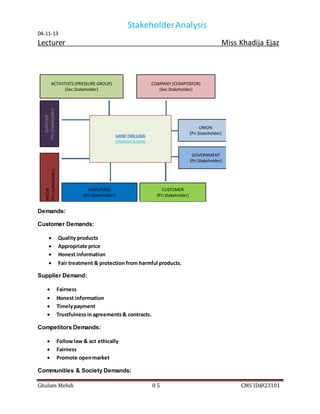
The stakeholderanalysisinMine Drillingisshowninbelow thatobviouslyshow the Primary&
Secondarystakeholders.
StakeholderAnalysis
04-11-13
Lecturer Miss Khadija Ejaz
Ghulam Mehdi 0 5 CMS ID@23101
MINE DRILLING
(STAKEHOLDER)
ACTIVITISTS (PRESSURE GROUP)
(Sec.Stakeholder)
COMPANY (COMPITATOR)
(Sec.Stakeholder)
UNION
(Pri.Stakeholder)
GOVERNMENT
(Pri.Stakeholder)
EMPLOYEES
(Pri.Stakeholder)
CUSTOMER
(Pri.Stakeholder)
MEDIA
(Pri.Stakeholder)
Demands:
Customer Demands:
 Quality products
 Appropriate price
 Honest information
 Fair treatment & protection from harmful products.
Supplier Demand:
 Fairness
 Honest information
 Timelypayment
 Trustfulnessinagreements& contracts.
Competitors Demands:
 Followlaw & act ethically
 Fairness
 Promote openmarket
Communities & Society Demands:
StakeholderAnalysis
04-11-13
Lecturer Miss Khadija Ejaz
Ghulam Mehdi 0 6 CMS ID@23101
 Respectvalues
 Be good citizen
 Respectlaws & rights
Govt. Demand:
 Abidinglaw
 Followfair procedures
 Provide health& safety
This is the mapping stakeholderrelationships.

Stakeholder analysis

  • 1.
    StakeholderAnalysis 04-11-13 Lecturer Miss KhadijaEjaz Ghulam Mehdi 0 1 CMS ID@23101 Stakeholder Analysis: StakeholderAnalysisis a term used in:  Conflictresolution.  Project management.  Businessadministration. “Stakeholderanalysesdescribe a processwhere all the individualsor groups that are likelyto be affectedby a proposed action are identifiedandthen sorted according to how much they can affect the action and how much the action can affectthem. This informationis usedto assesshow the interestsof those stakeholdersshould be addressedin a projectplan, policy,program, or other action. In short, stakeholdersare those who have a stake in the project. There are two typesof Stakeholders.  Direct stakeholder  Indirectstakeholder 1-Direct stakeholders: Direct stakeholdersare those people (developers,managers,customers) whose actions can directlyimpact your project .They are involvedinthe projectlife cycle,or are impactedby the project .Theyuse the system or output the project puts inplace. 2-IndirectStakeholders: IndirectStakeholdersare those who have some political powerto influence the project or those who are interestedinits outcomes. Identifystakeholder: Stakeholderidentificationandanalysis isbest conductedusing brainstormingtechniques.This procedure is generallycarriedout ina workshop setting,with representativesofkeyparticipants in a project. The first stepis to list all parties which are likelyto be affectedby the development,bothpositivelyor negatively,directlyor indirectly. It sometimeshelpsto use categoriesand thinkof all the individualsandsub groups withinthat category. Common categoriesinclude:Management,staff,customers,media,community, finance. Through the brainstorm process capture all the names of stakeholderswhomight:  Be concernedin any way withthe project  Hold an influential position  Be affectedby the problemsaddressedin the project Whois the Keyof stakeholder?
  • 2.
    StakeholderAnalysis 04-11-13 Lecturer Miss KhadijaEjaz Ghulam Mehdi 0 2 CMS ID@23101 Primary Stakeholders: The primarystakeholders are made upof communitymembersandfarmers whoare directlyaffectedby the sanitationconditionswithinthe locality.Theirparticipationinthe projectisasa resultof the needto identifyandmeettheirdemandsastheywill be the usersof the implementedsystem. Secondary Stakeholders: The secondarystakeholders are the municipality and local authorities responsible the planning and implementing the sanitation projects. These stakeholders will be in charge of implementing the project. Tertiary Stakeholders: The tertiarystakeholders are made up of NGOs, national authorities and financial institutions. They generally assist in advocating for proper sanitation, raising awareness as well as providing funds for the project. The steps of Stakeholder Analysis are explained below: Step 1 – Identify Your Stakeholders: The first step in your Stakeholder Analysis is to brainstorm, who your stakeholders are. As part of this, think of all the people who are affected by your work, who have influence or power over it, or have an interest in its successful or unsuccessful conclusion. The table below shows some of the people who might be stakeholders in your job or in your projects: Your boss Shareholders Government Senior executives Alliance partners Trades associations Your coworkers Suppliers The press Your team Lenders Interest groups Customers Analysts The public Prospective customers Future recruits The community Your family Remember that although stakeholders may be both organizations and people, ultimately you must communicate with people. Make sure that you identify the correct individual stakeholders within a stakeholder organization. Step 2 – Prioritize Your Stakeholders: You may now have a long list of people and organizations that are affected by your work. Some of these may have the power either to block or advance. Some may be interested in what you are doing, others may not care. Map out your stakeholders on a Power/Interest Grid and classify them by their power over your work and by their interest in your work.  Power/Interest Grid for Stakeholders Prioritization
  • 3.
    StakeholderAnalysis 04-11-13 Lecturer Miss KhadijaEjaz Ghulam Mehdi 0 3 CMS ID@23101 For example, your boss is likely to have high power and influence over your projects and high interest. Your family may have high interest, but are unlikely to have power over it. Someone's position on the grid shows you the actions you have to take with them:  High power, interested people: these are the people you must fully engage and make the greatest efforts to satisfy.  High power, less interested people: put enough work in with these people to keep them satisfied, but not so much that they become bored with your message.  Low power, interested people: keep these people adequately informed, and talk to them to ensure that no major issues are arising. These people can often be very helpful with the detail of your project.  Low power, less interested people: again, monitor these people, but do not bore them with excessive communication. Step 3 – Understand Your Key Stakeholders: You now need to know more about your key stakeholders. You need to know how they are likely to feel about and react to your project. You also need to know how best to engage them in your project and how best to communicate with them. Key questions that can help you understand your stakeholders are:  What financial or emotional interest do they have in the outcome of your work? Is it positive or negative?  What motivates them most of all?  What information do they want from you?  How do they want to receive information from you? What is the best way of communicating your message to them?  What is their current opinion of your work? Is it based on good information?  Who influences their opinions generally, and who influences their opinion of you? Do some of these influencers therefore become important stakeholders in their own right?  If they are not likely to be positive, what will win them around to support your project?  If you don't think you will be able to win them around, how will you manage their opposition?  Who else might be influenced by their opinions?  Do these people become stakeholders in their own right?
  • 4.
    StakeholderAnalysis 04-11-13 Lecturer Miss KhadijaEjaz Ghulam Mehdi 0 4 CMS ID@23101 A very good way of answering these questions is to talk to your stakeholders directly – people are often quite open about their views, and asking people's opinions is often the first step in building a successful relationship with them. You can summarize the understanding you have gained on the stakeholder map, so that you can easily see which stakeholders are expected to be blockers or critics, and which stakeholders are likely to be advocates and supporters or your project. A good way of doing this is by color coding: showing advocates and supporters in green, blockers and critics in red, and others who are neutral in orange.  Example Power/Interest Grid With Stakeholders Marked In this example, you can see that a lot of effort needs to be put into persuading Piers and Michael of the benefits of the project – Janet and Amanda also need to manage well as powerful supporters. Example You can create your own example of Stakeholder Analysis at work – whether for your current role, a job you want to do, or a new project. Conduct a full stakeholder analysis. Ask yourself whether you are communicating as effectively as you should be with your stakeholders. What actions can you take to get more from your supporters or win over your critics? Generally there are seven steps of stakeholder analysis. These are: 1. Mapping stakeholder relationships. 2. Mapping stakeholder conditions. 3. Accessing the nature of each stakeholder’s interest. 4. Accessing the nature of each stakeholder’s power. 5. Constructing a matrix of stakeholder moral responsibilities. 6. Developing specific strategies and tactics. 7. Monitoring shifting coalitions. The stakeholderanalysisinMine Drillingisshowninbelow thatobviouslyshow the Primary& Secondarystakeholders.
  • 5.
    StakeholderAnalysis 04-11-13 Lecturer Miss KhadijaEjaz Ghulam Mehdi 0 5 CMS ID@23101 MINE DRILLING (STAKEHOLDER) ACTIVITISTS (PRESSURE GROUP) (Sec.Stakeholder) COMPANY (COMPITATOR) (Sec.Stakeholder) UNION (Pri.Stakeholder) GOVERNMENT (Pri.Stakeholder) EMPLOYEES (Pri.Stakeholder) CUSTOMER (Pri.Stakeholder) MEDIA (Pri.Stakeholder) Demands: Customer Demands:  Quality products  Appropriate price  Honest information  Fair treatment & protection from harmful products. Supplier Demand:  Fairness  Honest information  Timelypayment  Trustfulnessinagreements& contracts. Competitors Demands:  Followlaw & act ethically  Fairness  Promote openmarket Communities & Society Demands:
  • 6.
    StakeholderAnalysis 04-11-13 Lecturer Miss KhadijaEjaz Ghulam Mehdi 0 6 CMS ID@23101  Respectvalues  Be good citizen  Respectlaws & rights Govt. Demand:  Abidinglaw  Followfair procedures  Provide health& safety This is the mapping stakeholderrelationships.