Buyer Behaviour The Individual, Risk and Involvement
Objectives of this session: Some factors affecting buying behaviour B2B buying behaviour ‘ Risk’ and Buying Behaviour ‘ Involvement’ and Buying Behaviour Buyer behaviour and the DMU Buyer behaviour and communication tasks
Factors affecting all buying behaviour Personal Factors Demographics: Age, Gender, Income, Education Situational: Lifestyle choices Experience: previous buying experience Social Factors Culture, Sub-Culture, Reference Groups Psychological Factors Personality Type Attitudes & Beliefs
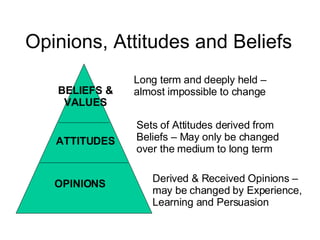
Opinions, Attitudes and Beliefs BELIEFS & VALUES ATTITUDES OPINIONS Long term and deeply held – almost impossible to change Sets of Attitudes derived from Beliefs – May only be changed over the medium to long term  Derived & Received Opinions – may be changed by Experience, Learning and Persuasion
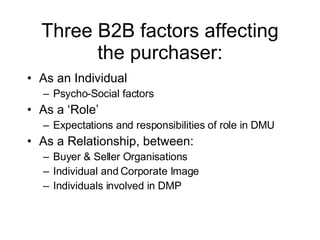
Three B2B factors affecting the purchaser: As an Individual Psycho-Social factors As a ‘Role’ Expectations and responsibilities of role in DMU As a Relationship, between: Buyer & Seller Organisations Individual and Corporate Image Individuals involved in DMP
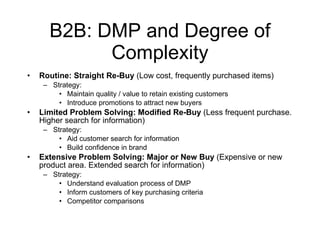
B2B: DMP and Degree of Complexity Routine: Straight Re-Buy  (Low cost, frequently purchased items) Strategy: Maintain quality / value to retain existing customers Introduce promotions to attract new buyers  Limited Problem Solving: Modified Re-Buy  (Less frequent purchase. Higher search for information) Strategy: Aid customer search for information Build confidence in brand Extensive Problem Solving: Major or New Buy  (Expensive or new product area. Extended search for information) Strategy: Understand evaluation process of DMP Inform customers of key purchasing criteria Competitor comparisons
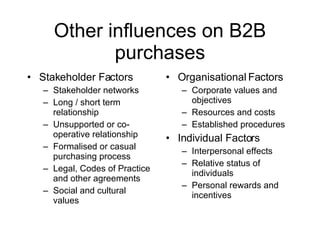
Other influences on B2B purchases Stakeholder Factors Stakeholder networks Long / short term relationship Unsupported or co-operative relationship Formalised or casual purchasing process Legal, Codes of Practice and other agreements Social and cultural values  Organisational Factors Corporate values and objectives Resources and costs Established procedures Individual Factors Interpersonal effects Relative status of individuals Personal rewards and incentives
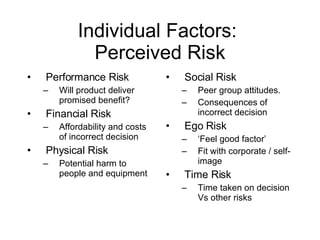
Individual Factors:  Perceived Risk Performance Risk Will product deliver promised benefit? Financial Risk Affordability and costs of incorrect decision Physical Risk Potential harm to people and equipment Social Risk Peer group attitudes.  Consequences of incorrect decision Ego Risk ‘ Feel good factor’ Fit with corporate / self-image Time Risk Time taken on decision Vs other risks
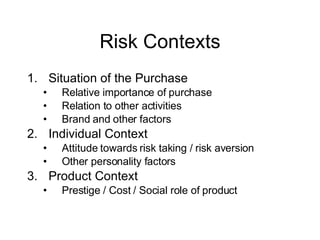
Risk Contexts Situation of the Purchase Relative importance of purchase Relation to other activities Brand and other factors Individual Context Attitude towards risk taking / risk aversion Other personality factors Product Context Prestige / Cost / Social role of product
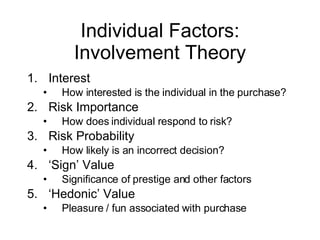
Individual Factors: Involvement Theory Interest How interested is the individual in the purchase? Risk Importance How does individual respond to risk? Risk Probability How likely is an incorrect decision? ‘ Sign’ Value Significance of prestige and other factors ‘ Hedonic’ Value Pleasure / fun associated with purchase
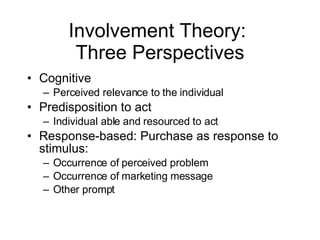
Involvement Theory:  Three Perspectives Cognitive Perceived relevance to the individual Predisposition to act Individual able and resourced to act Response-based: Purchase as response to stimulus: Occurrence of perceived problem Occurrence of marketing message Other prompt
Involvement Theory: Degree of Involvement High Level Involvement High perceived relevance or risk Involved search for information Trial of alternatives only after attitudes and intentions already set Low Level Involvement Low cost / risk purchases Less involved information search Trial of alternatives before attitudes and intentions established Zero Level Involvement
Reprise: Individuals’ concerns within the DMU The Gatekeeper The Initiator The Decider The Buyer The User The Financier Other Influencers
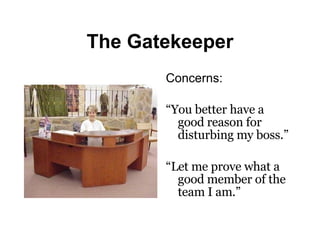
The Gatekeeper Concerns: “ You better have a good reason for disturbing my boss.” “ Let me prove what a good member of the team I am.”
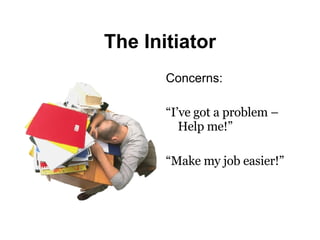
The Initiator Concerns: “ I’ve got a problem – Help me!” “ Make my job easier!”
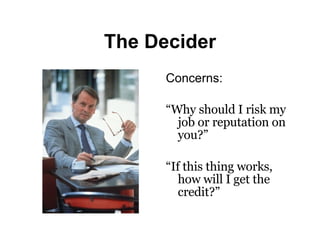
The Decider Concerns: “ Why should I risk my job or reputation on you?” “ If this thing works, how will I get the credit?”
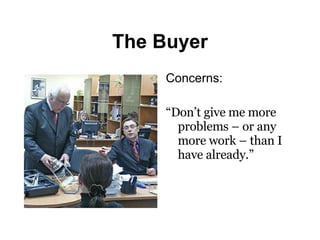
The Buyer Concerns: “ Don’t give me more problems – or any more work – than I have already.”
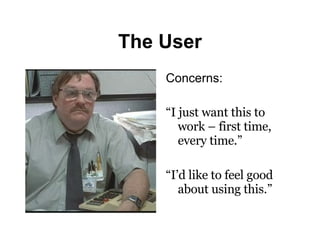
The User Concerns: “ I just want this to work – first time, every time.” “ I’d like to feel good about using this.”
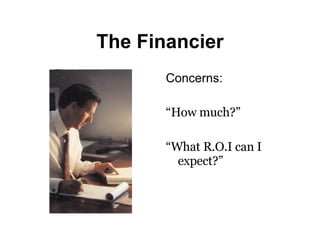
The Financier Concerns: “ How much?” “ What R.O.I can I expect?”
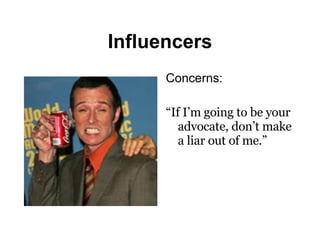
Influencers Concerns: “ If I’m going to be your advocate, don’t make a liar out of me.”
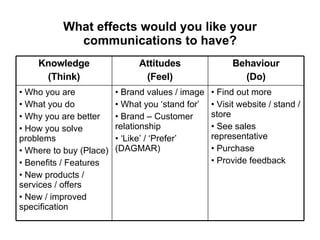
What effects would you like your communications to have? Find out more Visit website / stand / store See sales representative Purchase Provide feedback Brand values / image What you ‘stand for’ Brand – Customer relationship ‘ Like’ / ‘Prefer’ (DAGMAR) Who you are What you do Why you are better How you solve problems Where to buy (Place) Benefits / Features New products / services / offers New / improved specification Behaviour (Do) Attitudes (Feel) Knowledge (Think)
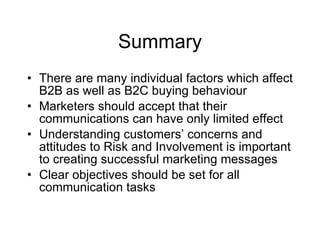
Summary There are many individual factors which affect B2B as well as B2C buying behaviour Marketers should accept that their communications can have only limited effect Understanding customers’ concerns and attitudes to Risk and Involvement is important to creating successful marketing messages Clear objectives should be set for all communication tasks

Buyer Behaviour

  • 1.
    Buyer Behaviour TheIndividual, Risk and Involvement
  • 2.
    Objectives of thissession: Some factors affecting buying behaviour B2B buying behaviour ‘ Risk’ and Buying Behaviour ‘ Involvement’ and Buying Behaviour Buyer behaviour and the DMU Buyer behaviour and communication tasks
  • 3.
    Factors affecting allbuying behaviour Personal Factors Demographics: Age, Gender, Income, Education Situational: Lifestyle choices Experience: previous buying experience Social Factors Culture, Sub-Culture, Reference Groups Psychological Factors Personality Type Attitudes & Beliefs
  • 4.
    Opinions, Attitudes andBeliefs BELIEFS & VALUES ATTITUDES OPINIONS Long term and deeply held – almost impossible to change Sets of Attitudes derived from Beliefs – May only be changed over the medium to long term Derived & Received Opinions – may be changed by Experience, Learning and Persuasion
  • 5.
    Three B2B factorsaffecting the purchaser: As an Individual Psycho-Social factors As a ‘Role’ Expectations and responsibilities of role in DMU As a Relationship, between: Buyer & Seller Organisations Individual and Corporate Image Individuals involved in DMP
  • 6.
    B2B: DMP andDegree of Complexity Routine: Straight Re-Buy (Low cost, frequently purchased items) Strategy: Maintain quality / value to retain existing customers Introduce promotions to attract new buyers Limited Problem Solving: Modified Re-Buy (Less frequent purchase. Higher search for information) Strategy: Aid customer search for information Build confidence in brand Extensive Problem Solving: Major or New Buy (Expensive or new product area. Extended search for information) Strategy: Understand evaluation process of DMP Inform customers of key purchasing criteria Competitor comparisons
  • 7.
    Other influences onB2B purchases Stakeholder Factors Stakeholder networks Long / short term relationship Unsupported or co-operative relationship Formalised or casual purchasing process Legal, Codes of Practice and other agreements Social and cultural values Organisational Factors Corporate values and objectives Resources and costs Established procedures Individual Factors Interpersonal effects Relative status of individuals Personal rewards and incentives
  • 8.
    Individual Factors: Perceived Risk Performance Risk Will product deliver promised benefit? Financial Risk Affordability and costs of incorrect decision Physical Risk Potential harm to people and equipment Social Risk Peer group attitudes. Consequences of incorrect decision Ego Risk ‘ Feel good factor’ Fit with corporate / self-image Time Risk Time taken on decision Vs other risks
  • 9.
    Risk Contexts Situationof the Purchase Relative importance of purchase Relation to other activities Brand and other factors Individual Context Attitude towards risk taking / risk aversion Other personality factors Product Context Prestige / Cost / Social role of product
  • 10.
    Individual Factors: InvolvementTheory Interest How interested is the individual in the purchase? Risk Importance How does individual respond to risk? Risk Probability How likely is an incorrect decision? ‘ Sign’ Value Significance of prestige and other factors ‘ Hedonic’ Value Pleasure / fun associated with purchase
  • 11.
    Involvement Theory: Three Perspectives Cognitive Perceived relevance to the individual Predisposition to act Individual able and resourced to act Response-based: Purchase as response to stimulus: Occurrence of perceived problem Occurrence of marketing message Other prompt
  • 12.
    Involvement Theory: Degreeof Involvement High Level Involvement High perceived relevance or risk Involved search for information Trial of alternatives only after attitudes and intentions already set Low Level Involvement Low cost / risk purchases Less involved information search Trial of alternatives before attitudes and intentions established Zero Level Involvement
  • 13.
    Reprise: Individuals’ concernswithin the DMU The Gatekeeper The Initiator The Decider The Buyer The User The Financier Other Influencers
  • 14.
    The Gatekeeper Concerns:“ You better have a good reason for disturbing my boss.” “ Let me prove what a good member of the team I am.”
  • 15.
    The Initiator Concerns:“ I’ve got a problem – Help me!” “ Make my job easier!”
  • 16.
    The Decider Concerns:“ Why should I risk my job or reputation on you?” “ If this thing works, how will I get the credit?”
  • 17.
    The Buyer Concerns:“ Don’t give me more problems – or any more work – than I have already.”
  • 18.
    The User Concerns:“ I just want this to work – first time, every time.” “ I’d like to feel good about using this.”
  • 19.
    The Financier Concerns:“ How much?” “ What R.O.I can I expect?”
  • 20.
    Influencers Concerns: “If I’m going to be your advocate, don’t make a liar out of me.”
  • 21.
    What effects wouldyou like your communications to have? Find out more Visit website / stand / store See sales representative Purchase Provide feedback Brand values / image What you ‘stand for’ Brand – Customer relationship ‘ Like’ / ‘Prefer’ (DAGMAR) Who you are What you do Why you are better How you solve problems Where to buy (Place) Benefits / Features New products / services / offers New / improved specification Behaviour (Do) Attitudes (Feel) Knowledge (Think)
  • 22.
    Summary There aremany individual factors which affect B2B as well as B2C buying behaviour Marketers should accept that their communications can have only limited effect Understanding customers’ concerns and attitudes to Risk and Involvement is important to creating successful marketing messages Clear objectives should be set for all communication tasks