Loyalty Based Management
    (The Loyalty Effect)
       Frederick F. Reichheld
‘The Loyalty Effect’ Harvard Business
        School Press, 1996.
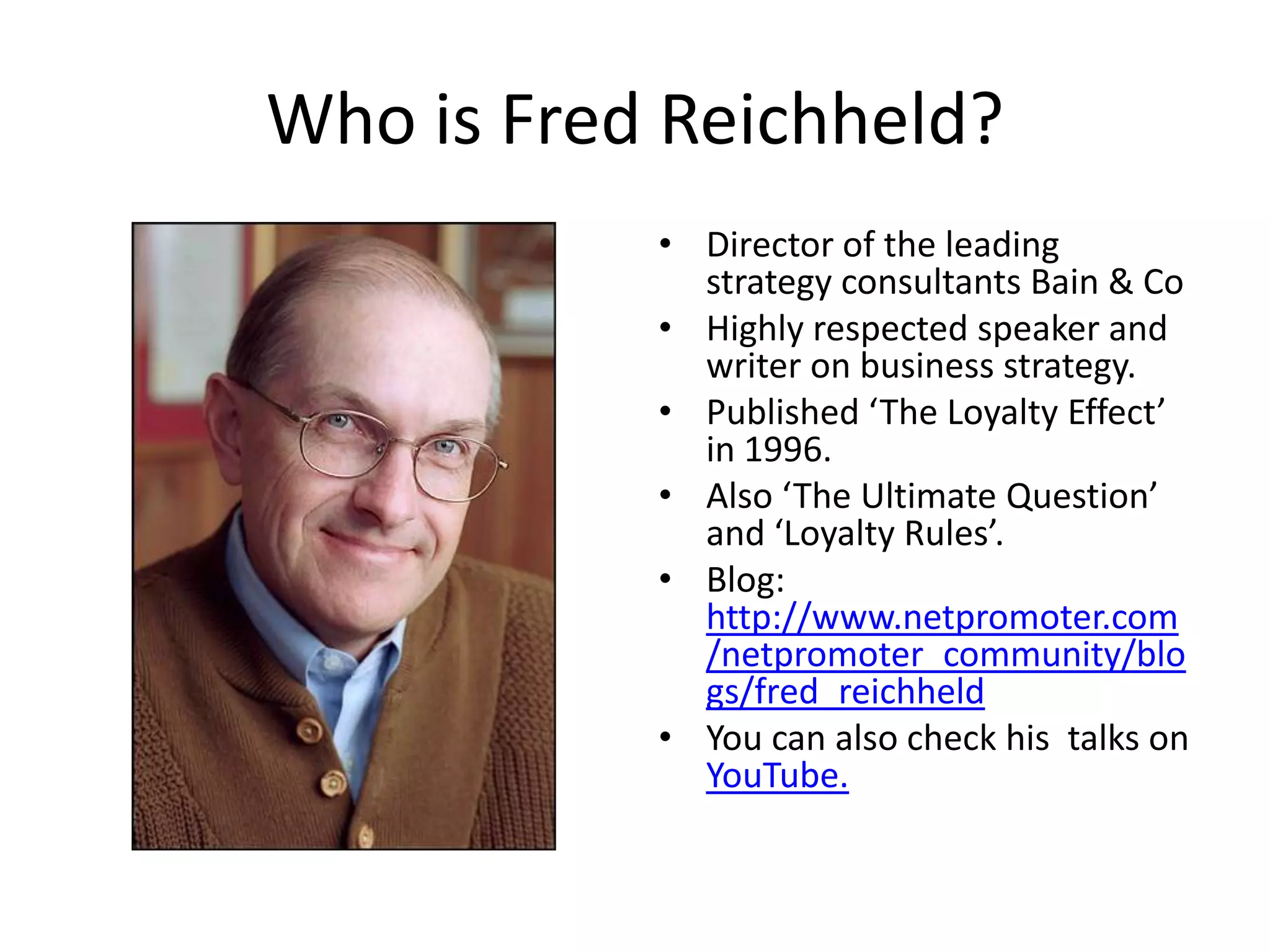
Who is Fred Reichheld?
           • Director of the leading
             strategy consultants Bain & Co
           • Highly respected speaker and
             writer on business strategy.
           • Published ‘The Loyalty Effect’
             in 1996.
           • Also ‘The Ultimate Question’
             and ‘Loyalty Rules’.
           • Blog:
             http://www.netpromoter.com
             /netpromoter_community/blo
             gs/fred_reichheld
           • You can also check his talks on
             YouTube.
The problem identified by Reichheld:
Most corporations lose:
• 50% of customers ever 5 years
• 50% of employees in 4 years
• 50% of investors in less than one year


   Disloyalty stunts company growth
             by 25% to 50%
Reichheld’s solution:
• Customer retention is the best way to
  measure how well a company creates value
• Creating value for customers builds loyalty
• Loyalty builds growth and profit


 The fundamental mission of business
    is not Profit but Value Creation
“Business must be
run at a profit , else
it will die. But when
anyone tries to run a
business solely for
profit, then also the
business must die,
for it no longer has a
reason for
existence.” Henry Ford
The benefits of Customer Loyalty:
• Increased          • Long term
  revenues and         employees reduce
  market share         costs and improve
• Sustainable          quality
  growth attracts    • Long term
  and keeps the best   customer relations
  employees            exclude
                       competitors
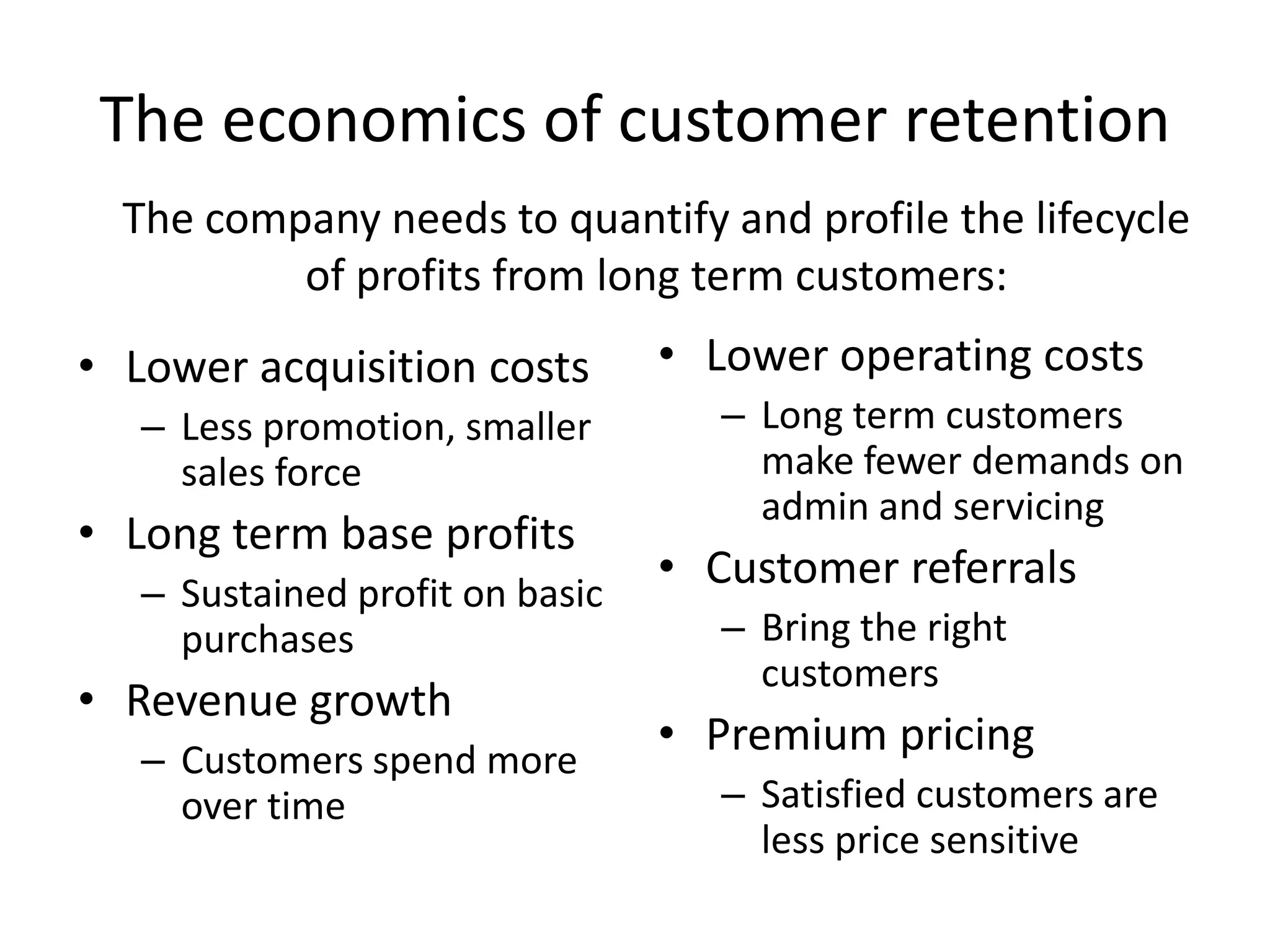
The economics of customer retention
  The company needs to quantify and profile the lifecycle
          of profits from long term customers:
• Lower acquisition costs        • Lower operating costs
   – Less promotion, smaller        – Long term customers
     sales force                      make fewer demands on
                                      admin and servicing
• Long term base profits
   – Sustained profit on basic
                                 • Customer referrals
     purchases                      – Bring the right
                                      customers
• Revenue growth
   – Customers spend more
                                 • Premium pricing
     over time                      – Satisfied customers are
                                      less price sensitive
Reichheld’s Loyalty Management
                Strategy
1. Build a superior   5. Earn employee
   customer value        loyalty
   proposition        6. Gain cost advantage
2. Find the right        through superior
                         productivity
   customers
                      7. Find the right
3. Earn customer         investors
   loyalty            8. Earn investor
4. Find the right        loyalty
   employees
1: Build a superior customer value
               proposition
Develop a value proposition that offers selected key
customers truly superior value in compared to the
competition
• Better quality products –
   – better performance / design
   – Zero defects
• Better quality service
   – at each point of customer contact
   – high performing retail intermediaries
   – don’t exploit ‘hostage’ customers
2: Find the right customers
Target customers. Look for:
• Inherently ‘loyal’ customers –
  – prefer stable, long term supplier relations
• Profitable customers
  – Spend more, prompt payers, need less service
• Customers that value your offering more than
  that of the competition
  – Fit your strengths with customer needs
3: Earn customer loyalty
Aim to retain customers to increase life time
value. Manage loyalty by designing customer-
value into:
• The product offer
• Pricing policies
• Employee incentives & bonuses
• Service level delivery
4: Find the right employees
Be selective in the people you employ. Look for
people who:
• Have character and share company values
• Have skills to achieve high productivity in
   long-term careers
  Develop policies which attract, hold, motivate,
 recognise, reward and serve people who deliver
                  customer value.
5: Earn employee loyalty
• Invest heavily in developing and training
  employees
• Career paths and company structures which
  enable staff to make the most of their abilities
• Share the ‘productivity surplus’ with staff

     Loyal employees build loyal customers
6: Gain cost advantage through
          superior productivity
• Better employee and customer loyalty grows a
  ‘productivity surplus’
• Employees earn better salaries, but bonuses take
  a lower percentage of revenues compared to
  competitors
• Correctly structured incentives also cut expense
  claims
Reduce costs by making it possible for employees to
  earn more by providing higher levels of customer
                  value and service
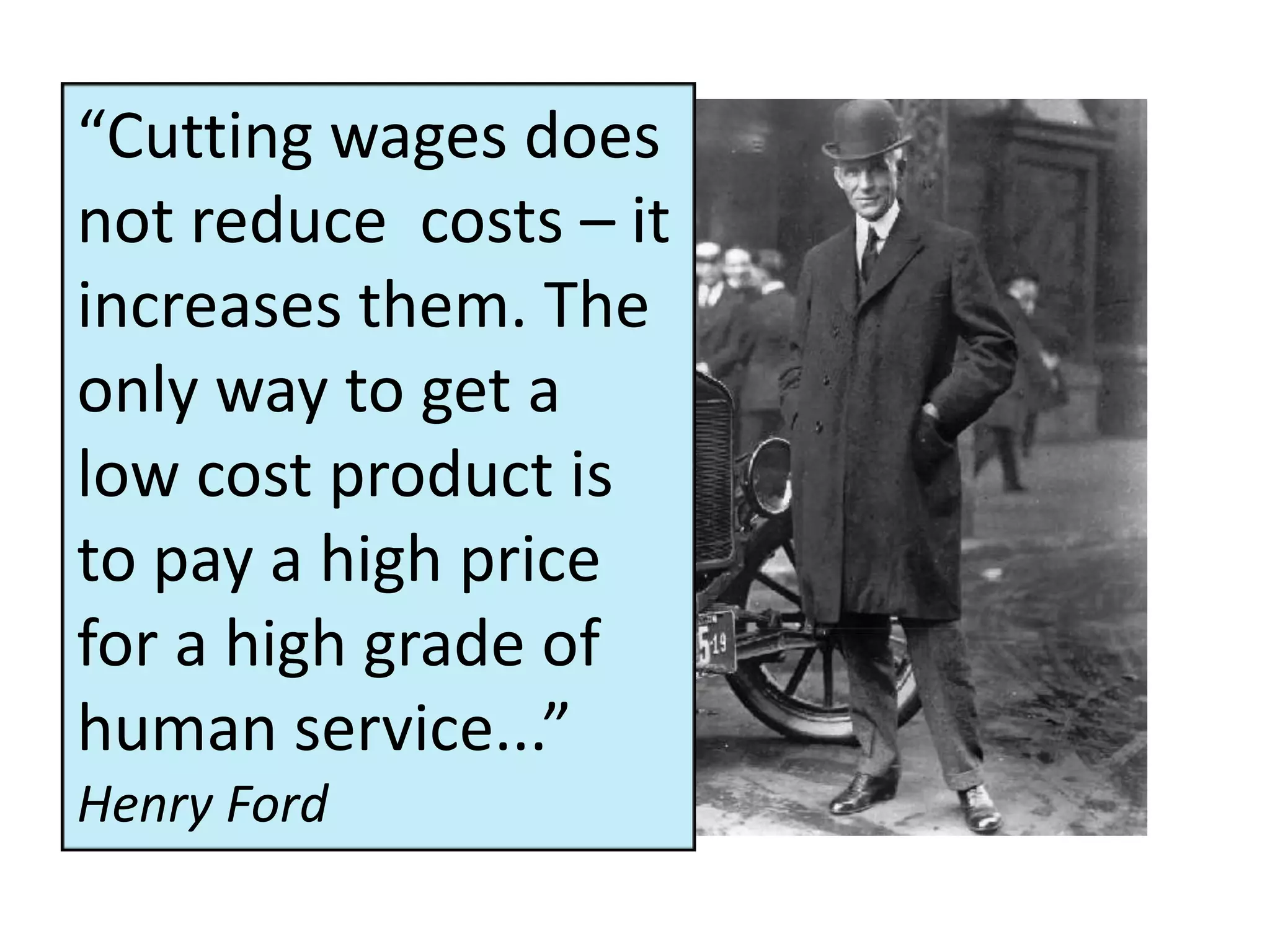
“Cutting wages does
not reduce costs – it
increases them. The
only way to get a
low cost product is
to pay a high price
for a high grade of
human service...”
Henry Ford
7: Find the right investors
• Mutual and private-owned companies are
  inherently more stable and focuses on the
  long term
• Public companies should target long-term
  investors / partners
• Investments based on stock market
  expectations do not foster long term growth
• Growth comes from delivering customer
  value, not shareholder value
8: Earn investor loyalty
• Investors should earn fair return before
  bonuses are paid to managers
• Managers are incentivised to re-invest profits
  where they will create maximum (customer)
  value
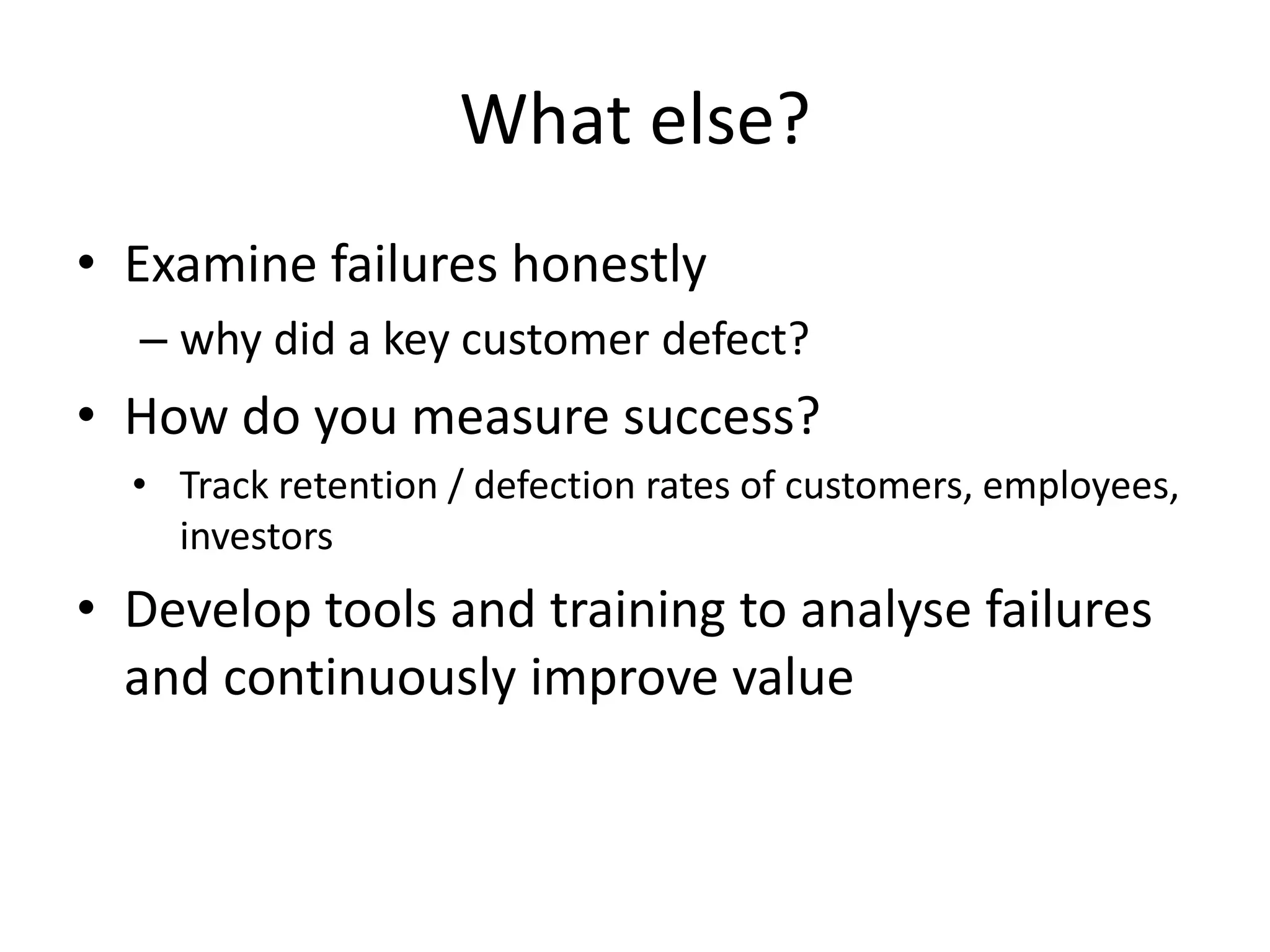
What else?
• Examine failures honestly
  – why did a key customer defect?
• How do you measure success?
  • Track retention / defection rates of customers, employees,
    investors
• Develop tools and training to analyse failures
  and continuously improve value
Strive to create so much value for
    customers that there is plenty
leftover for employees and investors
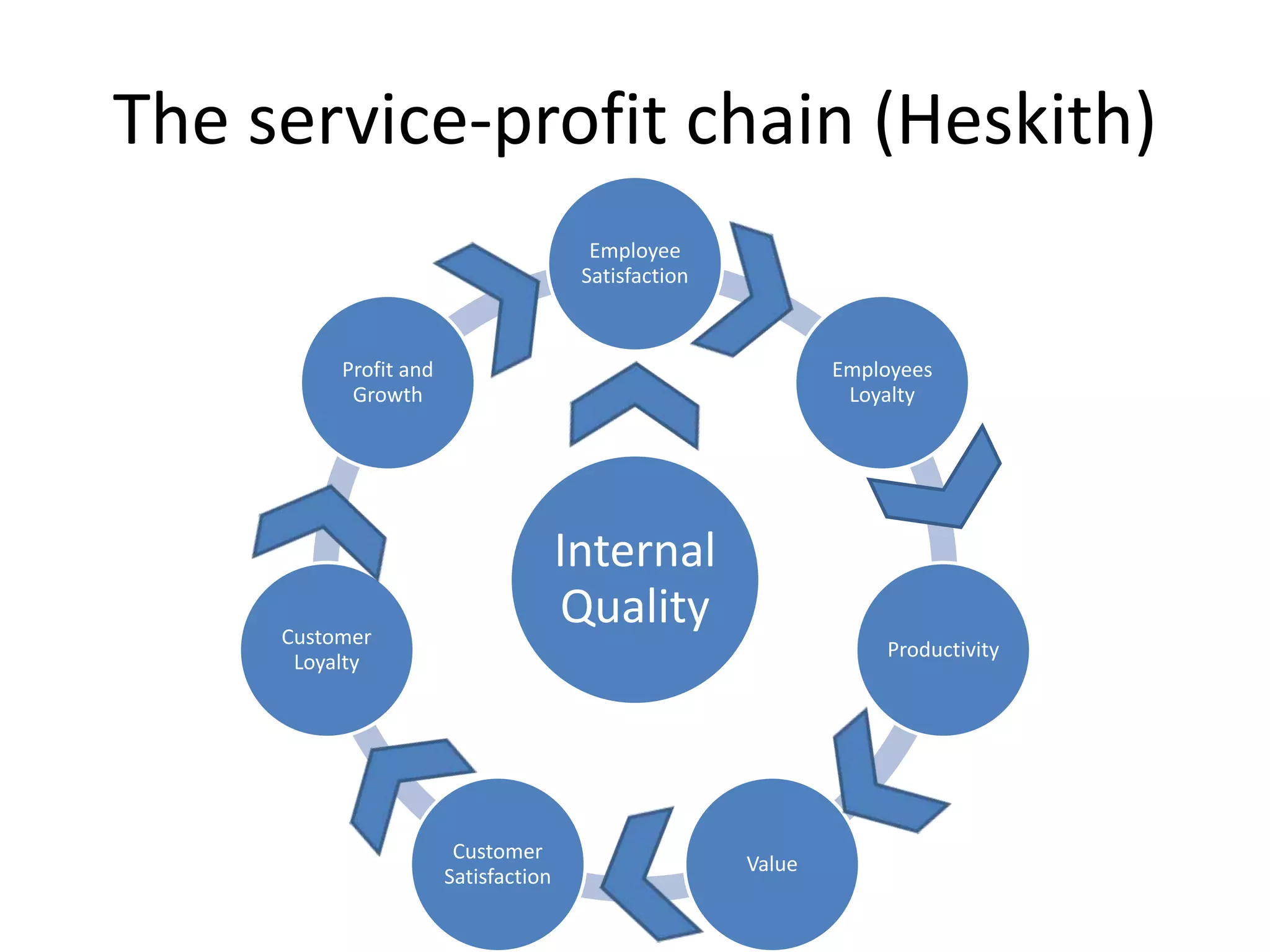
The service-profit chain (Heskith)
                                        Employee
                                       Satisfaction


          Profit and                                          Employees
           Growth                                              Loyalty


                                      Internal
     Customer
                                      Quality
                                                                  Productivity
      Loyalty


                        Customer
                                                      Value
                       Satisfaction
Other sources:
• Heskett, James L., Jones, Thomas O., Loveman, Gary
  W., Sasser, W. Earl, and Schelsinger, Leonard A. "Putting
  the Service Profit Chain to Work", Harvard Business
  Review, (March-April 1994) 164-174
• Heskett, James L., Sasser, W. Earl Jr., and Schlesinger,
  Leonard A. “The Service Profit Chain: How Leading
  Companies Link Profit and Growth to Loyalty,
  Satisfaction, and Value.” The Free Press, New York,
  1997.
• Reichheld, Fredrick and Sasser, W. Earl Jr. "Zero
  Defections: Quality Comes to Services." HBR
  September-October 1990

The Loyalty Effect

  • 1.
    Loyalty Based Management (The Loyalty Effect) Frederick F. Reichheld ‘The Loyalty Effect’ Harvard Business School Press, 1996.
  • 2.
    Who is FredReichheld? • Director of the leading strategy consultants Bain & Co • Highly respected speaker and writer on business strategy. • Published ‘The Loyalty Effect’ in 1996. • Also ‘The Ultimate Question’ and ‘Loyalty Rules’. • Blog: http://www.netpromoter.com /netpromoter_community/blo gs/fred_reichheld • You can also check his talks on YouTube.
  • 3.
    The problem identifiedby Reichheld: Most corporations lose: • 50% of customers ever 5 years • 50% of employees in 4 years • 50% of investors in less than one year Disloyalty stunts company growth by 25% to 50%
  • 4.
    Reichheld’s solution: • Customerretention is the best way to measure how well a company creates value • Creating value for customers builds loyalty • Loyalty builds growth and profit The fundamental mission of business is not Profit but Value Creation
  • 5.
    “Business must be runat a profit , else it will die. But when anyone tries to run a business solely for profit, then also the business must die, for it no longer has a reason for existence.” Henry Ford
  • 6.
    The benefits ofCustomer Loyalty: • Increased • Long term revenues and employees reduce market share costs and improve • Sustainable quality growth attracts • Long term and keeps the best customer relations employees exclude competitors
  • 7.
    The economics ofcustomer retention The company needs to quantify and profile the lifecycle of profits from long term customers: • Lower acquisition costs • Lower operating costs – Less promotion, smaller – Long term customers sales force make fewer demands on admin and servicing • Long term base profits – Sustained profit on basic • Customer referrals purchases – Bring the right customers • Revenue growth – Customers spend more • Premium pricing over time – Satisfied customers are less price sensitive
  • 8.
    Reichheld’s Loyalty Management Strategy 1. Build a superior 5. Earn employee customer value loyalty proposition 6. Gain cost advantage 2. Find the right through superior productivity customers 7. Find the right 3. Earn customer investors loyalty 8. Earn investor 4. Find the right loyalty employees
  • 9.
    1: Build asuperior customer value proposition Develop a value proposition that offers selected key customers truly superior value in compared to the competition • Better quality products – – better performance / design – Zero defects • Better quality service – at each point of customer contact – high performing retail intermediaries – don’t exploit ‘hostage’ customers
  • 10.
    2: Find theright customers Target customers. Look for: • Inherently ‘loyal’ customers – – prefer stable, long term supplier relations • Profitable customers – Spend more, prompt payers, need less service • Customers that value your offering more than that of the competition – Fit your strengths with customer needs
  • 11.
    3: Earn customerloyalty Aim to retain customers to increase life time value. Manage loyalty by designing customer- value into: • The product offer • Pricing policies • Employee incentives & bonuses • Service level delivery
  • 12.
    4: Find theright employees Be selective in the people you employ. Look for people who: • Have character and share company values • Have skills to achieve high productivity in long-term careers Develop policies which attract, hold, motivate, recognise, reward and serve people who deliver customer value.
  • 13.
    5: Earn employeeloyalty • Invest heavily in developing and training employees • Career paths and company structures which enable staff to make the most of their abilities • Share the ‘productivity surplus’ with staff Loyal employees build loyal customers
  • 14.
    6: Gain costadvantage through superior productivity • Better employee and customer loyalty grows a ‘productivity surplus’ • Employees earn better salaries, but bonuses take a lower percentage of revenues compared to competitors • Correctly structured incentives also cut expense claims Reduce costs by making it possible for employees to earn more by providing higher levels of customer value and service
  • 15.
    “Cutting wages does notreduce costs – it increases them. The only way to get a low cost product is to pay a high price for a high grade of human service...” Henry Ford
  • 16.
    7: Find theright investors • Mutual and private-owned companies are inherently more stable and focuses on the long term • Public companies should target long-term investors / partners • Investments based on stock market expectations do not foster long term growth • Growth comes from delivering customer value, not shareholder value
  • 17.
    8: Earn investorloyalty • Investors should earn fair return before bonuses are paid to managers • Managers are incentivised to re-invest profits where they will create maximum (customer) value
  • 18.
    What else? • Examinefailures honestly – why did a key customer defect? • How do you measure success? • Track retention / defection rates of customers, employees, investors • Develop tools and training to analyse failures and continuously improve value
  • 19.
    Strive to createso much value for customers that there is plenty leftover for employees and investors
  • 20.
    The service-profit chain(Heskith) Employee Satisfaction Profit and Employees Growth Loyalty Internal Customer Quality Productivity Loyalty Customer Value Satisfaction
  • 21.
    Other sources: • Heskett,James L., Jones, Thomas O., Loveman, Gary W., Sasser, W. Earl, and Schelsinger, Leonard A. "Putting the Service Profit Chain to Work", Harvard Business Review, (March-April 1994) 164-174 • Heskett, James L., Sasser, W. Earl Jr., and Schlesinger, Leonard A. “The Service Profit Chain: How Leading Companies Link Profit and Growth to Loyalty, Satisfaction, and Value.” The Free Press, New York, 1997. • Reichheld, Fredrick and Sasser, W. Earl Jr. "Zero Defections: Quality Comes to Services." HBR September-October 1990

Editor's Notes

  • #21 In the service-profit chain employee satisfaction is a result of ‘internal quality’ which is measured by the feelings that employees have toward their jobs, colleagues, and companies. This is related to a number of elements that have to be present to ensure employee satisfaction such as workplace design, job design, employee selection, training and development, rewards and recognition, and tools for serving customers.