Presented by
Ruffin Veal III, MSPM, PMP
Project Management Institute
La Crosse-Rochester Chapter
Rochester, Minnesota
September 16, 2014
Project Management
vs.
Program Management
Strategies for Transition Success
Outline
Presentation Overview
– Program Management Assumptions
– What is Program Management?
– Program Management vs. Project Management
– Project & Program Plan Integration
– Program Management Hierarchy
– Program Management Office Organizational Structure
– Program Management Office Business Benefits
– 5 Major Aspects of Program Management
– Program Management Competency Model
– Essentials of Effective PMO
– PMO Roles/PMO Models
– PMO Key Considerations/PMO Success Factors
– PMO Capability Maturity Models
– Key Goal and performance Indicators
Program Management Assumptions
Program Management = Simultaneous Project
Management
Program Management Plans = Combined Project
Management Plans
Program Management Scope = Combined Project
Management Scopes
Program Governance = Combined Project Governance
ARE ALL INCORRECT!
What is Program Management?
Program management
is the coordinated management of interdependent
projects over a finite period of time to achieve a set
of business goals.
Coordinated management of multiple projects means
that the activities of each project team are synchronized
through the framework of a common lifecycle executed at
the program level by the program core team.
Interdependent projects are those that have a mutual
dependence on the output of other projects in order to
achieve success. Program management ensures the
dependencies between the multiple projects are managed
in a concerted manner.
What is Program Management?
A finite period means that a program is a temporary
undertaking, having a point of beginning and the point of
ending. A program is of limited duration, a one-time
venture which begins with clearly defined business
objectives, and ends when the objectives are attained.
Accomplishment of the stated business goals is the
overriding objective of a program, and the ultimate
responsibility of the program manager. Business goals
include such things as capturing additional market share,
increasing profit through sales and gross margin growth,
and strengthening brand value through quality, features
and customer support.
Program Management vs.
Project Management
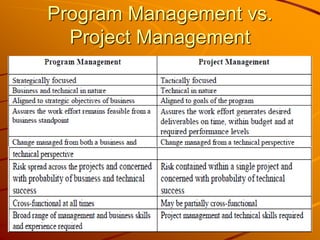
Program management is strategic in nature,
while project management is tactical in nature.
Program management is entirely cross-functional,
while project management focuses on a single
function, or limited cross-functional alignment at
best.
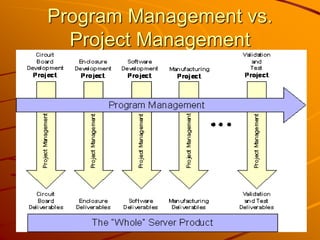
Program management integrates the individual
elements of the projects in order to achieve a
common objective.
Program Management vs.
Project Management
Program Management vs.
Project Management
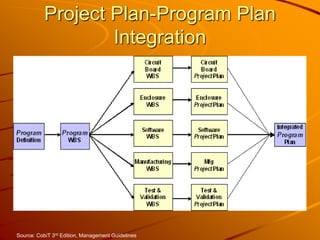
Project Plan-Program Plan
Integration
Source: CobiT 3rd Edition, Management Guidelines
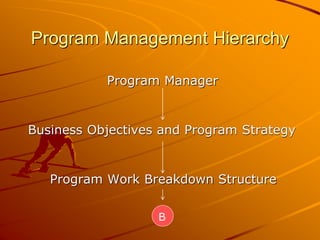
Program Management Hierarchy
Program Manager
Business Objectives and Program Strategy
Program Work Breakdown Structure
B
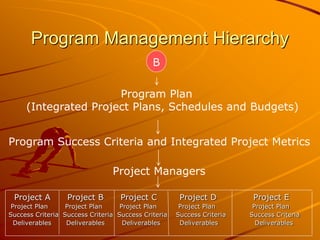
Program Management Hierarchy
Project A Project B Project C Project D Project E
Project Plan Project Plan Project Plan Project Plan Project Plan
Success Criteria Success Criteria Success Criteria Success Criteria Success Criteria
Deliverables Deliverables Deliverables Deliverables Deliverables
Project Managers
Program Success Criteria and Integrated Project Metrics
Program Plan
(Integrated Project Plans, Schedules and Budgets)
B
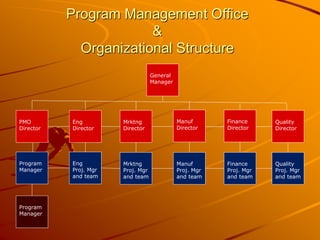
Program Management Office
&
Organizational Structure
General
Manager
PMO
Director
Eng
Director
Eng
Proj. Mgr
and team
Program
Manager
Program
Manager
Mrktng
Director
Manuf
Director
Finance
Director
Quality
Director
Mrktng
Proj. Mgr
and team
Manuf
Proj. Mgr
and team
Finance
Proj. Mgr
and team
Quality
Proj. Mgr
and team
Business Benefits of Program
Management
Program management provides a competitive
advantage for businesses that view and utilize it as a
critical business function within their organization.
Integration of business elements. Program
management is the mechanism by which the work of
various operating functions within a company is integrated
to create an effective business model, and executing
business strategies more effectively than an uncoordinated
approach.
Aligning business strategy to operational
execution. Program management can be viewed as the
organizational “glue” that translates strategic business
objectives into actionable plans and then manages the
tactics to achieve the desired business results.
Business Benefits of Program
Management
Managing return on investment. Program management
practices put a continual focus on the business aspects of
developing products, services and infrastructure.
Accelerating time-to-money. Time-to-money goals are
optimized. The program management model is built on the
identification and management of the cross-project
deliverables through an iterative and integrated
development process.
5 Major Aspects of Program
Management
Governance: Defining roles and responsibilities, and
providing oversight
Management: Planning and administering both projects
and the overall program
Financial management: Implementation of specific fiscal
practices and controls
Infrastructure: The program office, technology, and other
factors in the work environment supporting the program
effort
Planning: Activities that take place at multiple levels, with
different goals. The program plan is not a traditional plan
Program Management
Competency Model
Customer and Market. This involves having a full understanding
of the market or organization that the product, service or
infrastructure capability is being deployed in to, and how it will be
used by the customer and end user.
The better the program manager and his or her team can closely
align the final solution with the customer’s needs, the more it will
enhance the potential for customer satisfaction and the successful
achievement of the business results intended.
Business and Financial. This includes the ability to develop a
comprehensive program business case that supports the
company’s objectives and strategies, the ability to manage the
program within the business aspects of the company, and the
ability to understand and analyze the related financial measures
pertaining to the product, service or infrastructure capability
under development.
Program Management
Competency Model
Process and Project Management. The program manager
must possess operational competencies, including project
management methods and tools, to effectively manage the
tactical elements of the program.
Another important aspect of this core discipline set is that of
becoming proficient in the specific processes and practices of the
company that the program manager is a part of.
Knowing how things get done, the policies and procedures that
must be adhered to and who must be involved and approve
various aspects of their program are critical for the successful
completion of every program.
Program Management
Competency Model
Leadership. This is needed to effectively lead multiple cross-
disciplined project teams that are a part of the program.
The program manager needs to have the capability to build,
coalesce and champion the team to achieve product, service, and
infrastructure solutions that will satisfy the company’s customers.
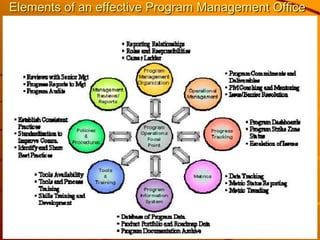
Elements of an effective Program Management Office
Program Management Office
Roles
Program office management
Resources coordination
Budget administration and procurement
Risk assessment
Work products tracking and review
Facilities administration
Contracts administration
Technical support liaison
Training coordination
Methodology and process support
Issues management
Communications management
Status reporting management
Program Management Office
Models
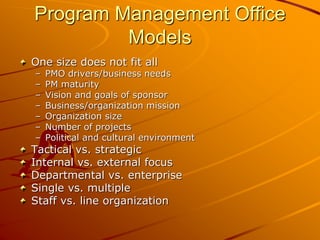
One size does not fit all
– PMO drivers/business needs
– PM maturity
– Vision and goals of sponsor
– Business/organization mission
– Organization size
– Number of projects
– Political and cultural environment
Tactical vs. strategic
Internal vs. external focus
Departmental vs. enterprise
Single vs. multiple
Staff vs. line organization
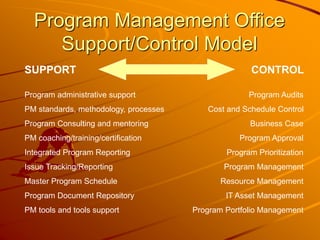
SUPPORT CONTROL
Program administrative support
PM standards, methodology, processes
Program Consulting and mentoring
PM coaching/training/certification
Integrated Program Reporting
Issue Tracking/Reporting
Master Program Schedule
Program Document Repository
PM tools and tools support
Program Audits
Cost and Schedule Control
Business Case
Program Approval
Program Prioritization
Program Management
Resource Management
IT Asset Management
Program Portfolio Management
Program Management Office
Support/Control Model
Program Management Office
Key Considerations
PMO charter
Culture change
Implementation strategy
Staffing
Metrics/Performance
Success factors
Maturity of Project Management
Practices
Program Management Office
Success Factors
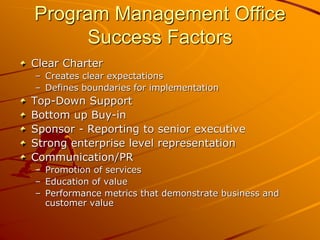
Clear Charter
– Creates clear expectations
– Defines boundaries for implementation
Top-Down Support
Bottom up Buy-in
Sponsor - Reporting to senior executive
Strong enterprise level representation
Communication/PR
– Promotion of services
– Education of value
– Performance metrics that demonstrate business and
customer value
Program Management
Capability Maturity Models
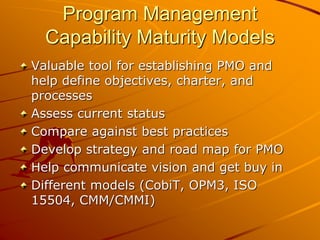
Valuable tool for establishing PMO and
help define objectives, charter, and
processes
Assess current status
Compare against best practices
Develop strategy and road map for PMO
Help communicate vision and get buy in
Different models (CobiT, OPM3, ISO
15504, CMM/CMMI)
Program Management
Capability Maturity Models
Capability Maturity Model (CMM)
Capability Maturity Model Integration
(CMMI)
Both CMM and CMMI define five distinct
levels of process maturity based on Key
Performance Areas (KPA’s). The KPA's of
CMMI levels overcome the inefficiency of
CMM levels to unearth significant
architectural flaws.
Program Management
Capability Maturity Models
Level 1 (Initial): The first level of both CMM and CMMI
describes an immature organization without any defined
processes, run in an ad hoc, uncontrolled, and reactive manner.
Level 2 (Repeat): Organizations that repeat some processes
attain Level 2 CMM. Level 2 of CMMI however requires
management of organizational requirements through planned,
performed, measured, and controlled processes.
Level 3 (Defined): CMM Level 3 mandates a set of documented
standard processes to establish consistency across the
organization. CMMI Level 3 is an improvement of CMMI Level 2
and describes the organizational processes in standards,
procedures, tools and methods.
Program Management
Capability Maturity Models
Level 4 (Manage): CMM Level 4 requires organizations to
attain control over processes by using quantitative
statistical techniques. CMMI Level 4 demands likewise, but
also identifies sub processes that significantly contribute to
overall process efficiency.
Level 5 (Optimized): CMM Level 5 mandates use of
quantitative tools and objectives to manage process
improvement. CMMI Level 5 on the other hand focuses on
continuously improving process performance through
incremental and innovative technological improvements.
Program Management Office
Key Goal Indicators
Increased number of programs completed on
time and on budget
Availability of accurate program schedule and
budget information
Decrease in systematic and common program
problems
Improved timeliness of program risk identification
Increased organization satisfaction with program
delivery services
Improved timeliness of program management
decisions
Program Management Office
Key Performance Indicators
Increased number of programs delivered in
accordance with defined methodology
Percent stakeholders participation in programs
Number of program management training days
per program team member
Number of program milestones and budget
reviews
Percent of programs with post-program reviews
Average number of years of experience of
program managers
Conclusion
Understanding Project/Program differences is
essential
Program Management maintains a enterprise
level perspective
One size does not fit all
PMO Support/Control model most useful
Clear charter, top down support, & bottom up
buy is key to PMO success
CMM valuable framework for establishing and
evolving PMO
Well established models and key considerations
are available
References
Russ Martinelli -Intel Corporation
Jim Waddell -Tektronix, Inc
Aligning Program Management to Business Strategy
Program Management: Linking Business Strategy to Product and IT
development
Program and Project Management: Understanding the Differences
The Program Strike Zone: Beyond the Bounding Box
Taming the Fuzzy Front End
Program Manager Roles, Responsibilities and Core Competencies
Achieving Common Leadership and Infrastructure through the
Program Management Office
References
IBM Developerworks Rational Library
Program Management: Different from Project Management
Michael F. Hanford, IBM Summit Ascendant Methodologies
Karen Y. Lucus (PgMP), The Effective Program Management Office
Setup, Management, Measure and Services
Oracle Corporation
An Oracle Whitepaper (May 2010) A Strategy for Governing IT Projects,
Programs and Portfolios Throughout the Enterprise
TD Jainendrukumar, (2008) The Project/Program Management Office
(PMO) Published in PM World Today - January 2008 (Vol. X, Issue I)
Q & A
Contact Information
Comments? Questions? Feedback?
Website:
http://www.ruffin-veal-and-associates.com
E-Mail:
principal@ruffin-veal-and-associates.com

Project Management vs. Program Management: Strategies for Transition Success

  • 1.
    Presented by Ruffin VealIII, MSPM, PMP Project Management Institute La Crosse-Rochester Chapter Rochester, Minnesota September 16, 2014 Project Management vs. Program Management Strategies for Transition Success
  • 2.
    Outline Presentation Overview – ProgramManagement Assumptions – What is Program Management? – Program Management vs. Project Management – Project & Program Plan Integration – Program Management Hierarchy – Program Management Office Organizational Structure – Program Management Office Business Benefits – 5 Major Aspects of Program Management – Program Management Competency Model – Essentials of Effective PMO – PMO Roles/PMO Models – PMO Key Considerations/PMO Success Factors – PMO Capability Maturity Models – Key Goal and performance Indicators
  • 3.
    Program Management Assumptions ProgramManagement = Simultaneous Project Management Program Management Plans = Combined Project Management Plans Program Management Scope = Combined Project Management Scopes Program Governance = Combined Project Governance ARE ALL INCORRECT!
  • 4.
    What is ProgramManagement? Program management is the coordinated management of interdependent projects over a finite period of time to achieve a set of business goals. Coordinated management of multiple projects means that the activities of each project team are synchronized through the framework of a common lifecycle executed at the program level by the program core team. Interdependent projects are those that have a mutual dependence on the output of other projects in order to achieve success. Program management ensures the dependencies between the multiple projects are managed in a concerted manner.
  • 5.
    What is ProgramManagement? A finite period means that a program is a temporary undertaking, having a point of beginning and the point of ending. A program is of limited duration, a one-time venture which begins with clearly defined business objectives, and ends when the objectives are attained. Accomplishment of the stated business goals is the overriding objective of a program, and the ultimate responsibility of the program manager. Business goals include such things as capturing additional market share, increasing profit through sales and gross margin growth, and strengthening brand value through quality, features and customer support.
  • 6.
    Program Management vs. ProjectManagement Program management is strategic in nature, while project management is tactical in nature. Program management is entirely cross-functional, while project management focuses on a single function, or limited cross-functional alignment at best. Program management integrates the individual elements of the projects in order to achieve a common objective.
  • 7.
  • 8.
  • 9.
    Project Plan-Program Plan Integration Source:CobiT 3rd Edition, Management Guidelines
  • 10.
    Program Management Hierarchy ProgramManager Business Objectives and Program Strategy Program Work Breakdown Structure B
  • 11.
    Program Management Hierarchy ProjectA Project B Project C Project D Project E Project Plan Project Plan Project Plan Project Plan Project Plan Success Criteria Success Criteria Success Criteria Success Criteria Success Criteria Deliverables Deliverables Deliverables Deliverables Deliverables Project Managers Program Success Criteria and Integrated Project Metrics Program Plan (Integrated Project Plans, Schedules and Budgets) B
  • 12.
    Program Management Office & OrganizationalStructure General Manager PMO Director Eng Director Eng Proj. Mgr and team Program Manager Program Manager Mrktng Director Manuf Director Finance Director Quality Director Mrktng Proj. Mgr and team Manuf Proj. Mgr and team Finance Proj. Mgr and team Quality Proj. Mgr and team
  • 13.
    Business Benefits ofProgram Management Program management provides a competitive advantage for businesses that view and utilize it as a critical business function within their organization. Integration of business elements. Program management is the mechanism by which the work of various operating functions within a company is integrated to create an effective business model, and executing business strategies more effectively than an uncoordinated approach. Aligning business strategy to operational execution. Program management can be viewed as the organizational “glue” that translates strategic business objectives into actionable plans and then manages the tactics to achieve the desired business results.
  • 14.
    Business Benefits ofProgram Management Managing return on investment. Program management practices put a continual focus on the business aspects of developing products, services and infrastructure. Accelerating time-to-money. Time-to-money goals are optimized. The program management model is built on the identification and management of the cross-project deliverables through an iterative and integrated development process.
  • 15.
    5 Major Aspectsof Program Management Governance: Defining roles and responsibilities, and providing oversight Management: Planning and administering both projects and the overall program Financial management: Implementation of specific fiscal practices and controls Infrastructure: The program office, technology, and other factors in the work environment supporting the program effort Planning: Activities that take place at multiple levels, with different goals. The program plan is not a traditional plan
  • 16.
    Program Management Competency Model Customerand Market. This involves having a full understanding of the market or organization that the product, service or infrastructure capability is being deployed in to, and how it will be used by the customer and end user. The better the program manager and his or her team can closely align the final solution with the customer’s needs, the more it will enhance the potential for customer satisfaction and the successful achievement of the business results intended. Business and Financial. This includes the ability to develop a comprehensive program business case that supports the company’s objectives and strategies, the ability to manage the program within the business aspects of the company, and the ability to understand and analyze the related financial measures pertaining to the product, service or infrastructure capability under development.
  • 17.
    Program Management Competency Model Processand Project Management. The program manager must possess operational competencies, including project management methods and tools, to effectively manage the tactical elements of the program. Another important aspect of this core discipline set is that of becoming proficient in the specific processes and practices of the company that the program manager is a part of. Knowing how things get done, the policies and procedures that must be adhered to and who must be involved and approve various aspects of their program are critical for the successful completion of every program.
  • 18.
    Program Management Competency Model Leadership.This is needed to effectively lead multiple cross- disciplined project teams that are a part of the program. The program manager needs to have the capability to build, coalesce and champion the team to achieve product, service, and infrastructure solutions that will satisfy the company’s customers.
  • 19.
    Elements of aneffective Program Management Office
  • 20.
    Program Management Office Roles Programoffice management Resources coordination Budget administration and procurement Risk assessment Work products tracking and review Facilities administration Contracts administration Technical support liaison Training coordination Methodology and process support Issues management Communications management Status reporting management
  • 21.
    Program Management Office Models Onesize does not fit all – PMO drivers/business needs – PM maturity – Vision and goals of sponsor – Business/organization mission – Organization size – Number of projects – Political and cultural environment Tactical vs. strategic Internal vs. external focus Departmental vs. enterprise Single vs. multiple Staff vs. line organization
  • 22.
    SUPPORT CONTROL Program administrativesupport PM standards, methodology, processes Program Consulting and mentoring PM coaching/training/certification Integrated Program Reporting Issue Tracking/Reporting Master Program Schedule Program Document Repository PM tools and tools support Program Audits Cost and Schedule Control Business Case Program Approval Program Prioritization Program Management Resource Management IT Asset Management Program Portfolio Management Program Management Office Support/Control Model
  • 23.
    Program Management Office KeyConsiderations PMO charter Culture change Implementation strategy Staffing Metrics/Performance Success factors Maturity of Project Management Practices
  • 24.
    Program Management Office SuccessFactors Clear Charter – Creates clear expectations – Defines boundaries for implementation Top-Down Support Bottom up Buy-in Sponsor - Reporting to senior executive Strong enterprise level representation Communication/PR – Promotion of services – Education of value – Performance metrics that demonstrate business and customer value
  • 25.
    Program Management Capability MaturityModels Valuable tool for establishing PMO and help define objectives, charter, and processes Assess current status Compare against best practices Develop strategy and road map for PMO Help communicate vision and get buy in Different models (CobiT, OPM3, ISO 15504, CMM/CMMI)
  • 26.
    Program Management Capability MaturityModels Capability Maturity Model (CMM) Capability Maturity Model Integration (CMMI) Both CMM and CMMI define five distinct levels of process maturity based on Key Performance Areas (KPA’s). The KPA's of CMMI levels overcome the inefficiency of CMM levels to unearth significant architectural flaws.
  • 27.
    Program Management Capability MaturityModels Level 1 (Initial): The first level of both CMM and CMMI describes an immature organization without any defined processes, run in an ad hoc, uncontrolled, and reactive manner. Level 2 (Repeat): Organizations that repeat some processes attain Level 2 CMM. Level 2 of CMMI however requires management of organizational requirements through planned, performed, measured, and controlled processes. Level 3 (Defined): CMM Level 3 mandates a set of documented standard processes to establish consistency across the organization. CMMI Level 3 is an improvement of CMMI Level 2 and describes the organizational processes in standards, procedures, tools and methods.
  • 28.
    Program Management Capability MaturityModels Level 4 (Manage): CMM Level 4 requires organizations to attain control over processes by using quantitative statistical techniques. CMMI Level 4 demands likewise, but also identifies sub processes that significantly contribute to overall process efficiency. Level 5 (Optimized): CMM Level 5 mandates use of quantitative tools and objectives to manage process improvement. CMMI Level 5 on the other hand focuses on continuously improving process performance through incremental and innovative technological improvements.
  • 29.
    Program Management Office KeyGoal Indicators Increased number of programs completed on time and on budget Availability of accurate program schedule and budget information Decrease in systematic and common program problems Improved timeliness of program risk identification Increased organization satisfaction with program delivery services Improved timeliness of program management decisions
  • 30.
    Program Management Office KeyPerformance Indicators Increased number of programs delivered in accordance with defined methodology Percent stakeholders participation in programs Number of program management training days per program team member Number of program milestones and budget reviews Percent of programs with post-program reviews Average number of years of experience of program managers
  • 31.
    Conclusion Understanding Project/Program differencesis essential Program Management maintains a enterprise level perspective One size does not fit all PMO Support/Control model most useful Clear charter, top down support, & bottom up buy is key to PMO success CMM valuable framework for establishing and evolving PMO Well established models and key considerations are available
  • 32.
    References Russ Martinelli -IntelCorporation Jim Waddell -Tektronix, Inc Aligning Program Management to Business Strategy Program Management: Linking Business Strategy to Product and IT development Program and Project Management: Understanding the Differences The Program Strike Zone: Beyond the Bounding Box Taming the Fuzzy Front End Program Manager Roles, Responsibilities and Core Competencies Achieving Common Leadership and Infrastructure through the Program Management Office
  • 33.
    References IBM Developerworks RationalLibrary Program Management: Different from Project Management Michael F. Hanford, IBM Summit Ascendant Methodologies Karen Y. Lucus (PgMP), The Effective Program Management Office Setup, Management, Measure and Services Oracle Corporation An Oracle Whitepaper (May 2010) A Strategy for Governing IT Projects, Programs and Portfolios Throughout the Enterprise TD Jainendrukumar, (2008) The Project/Program Management Office (PMO) Published in PM World Today - January 2008 (Vol. X, Issue I)
  • 34.
  • 35.
    Contact Information Comments? Questions?Feedback? Website: http://www.ruffin-veal-and-associates.com E-Mail: principal@ruffin-veal-and-associates.com