Psychometric Tests
What is a psychometric test? Aim to measure aspects of your mental ability, aptitude or your personality Used as part of the recruitment or selection process Provide employers with a method of selecting the most suitable job applicants or candidates for promotion Used by 80% of Fortune 500 and 75% of Times Top 100  companies
What do psychometric tests measure? How well you work with other people How well you handle stress Whether you will be able to cope with the intellectual demands of the job Your personality, preferences and abilities   Most do  not  analyze your emotional or psychological stability Best match of individual to occupation and working environment
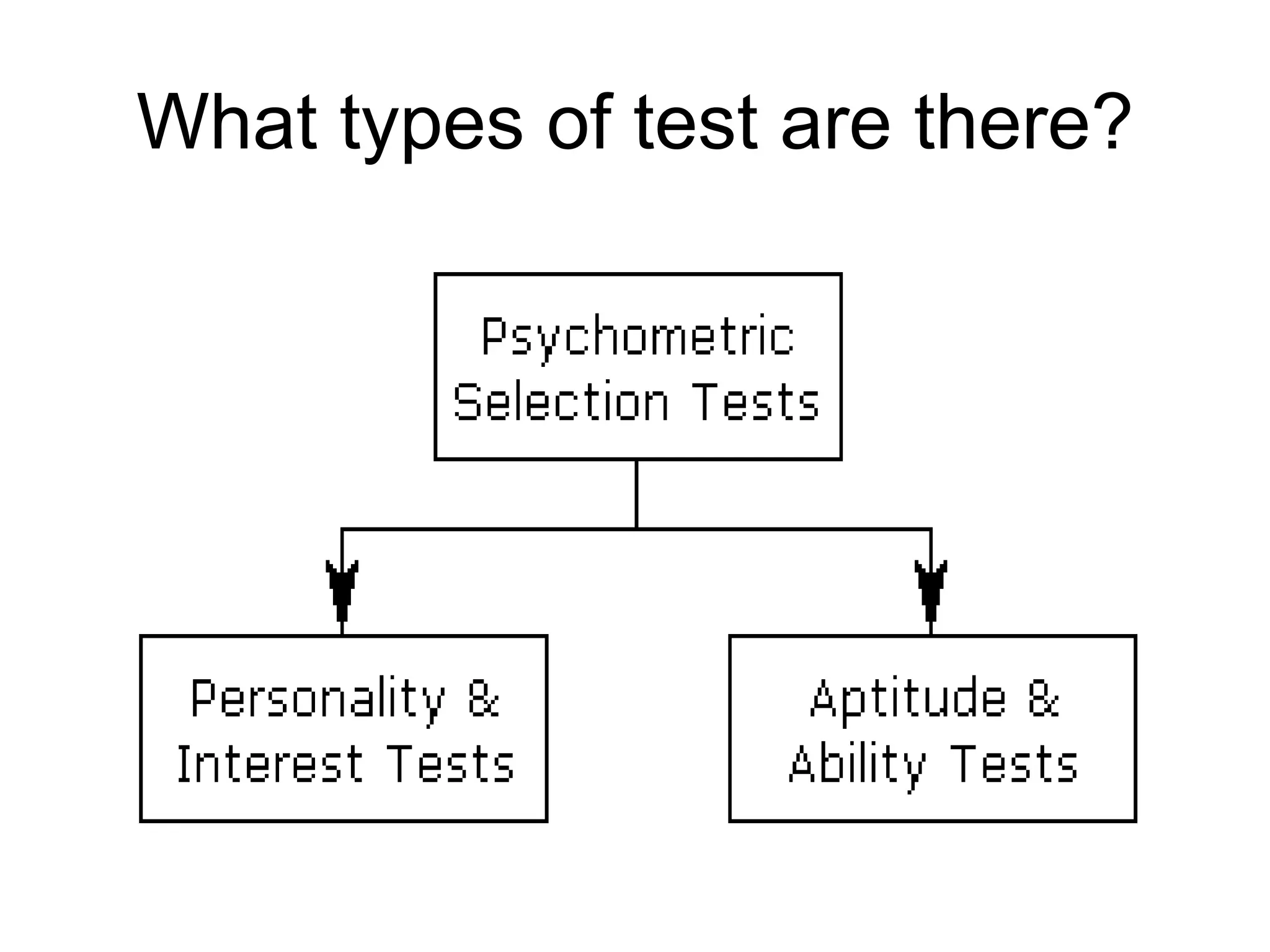
What types of test are there?
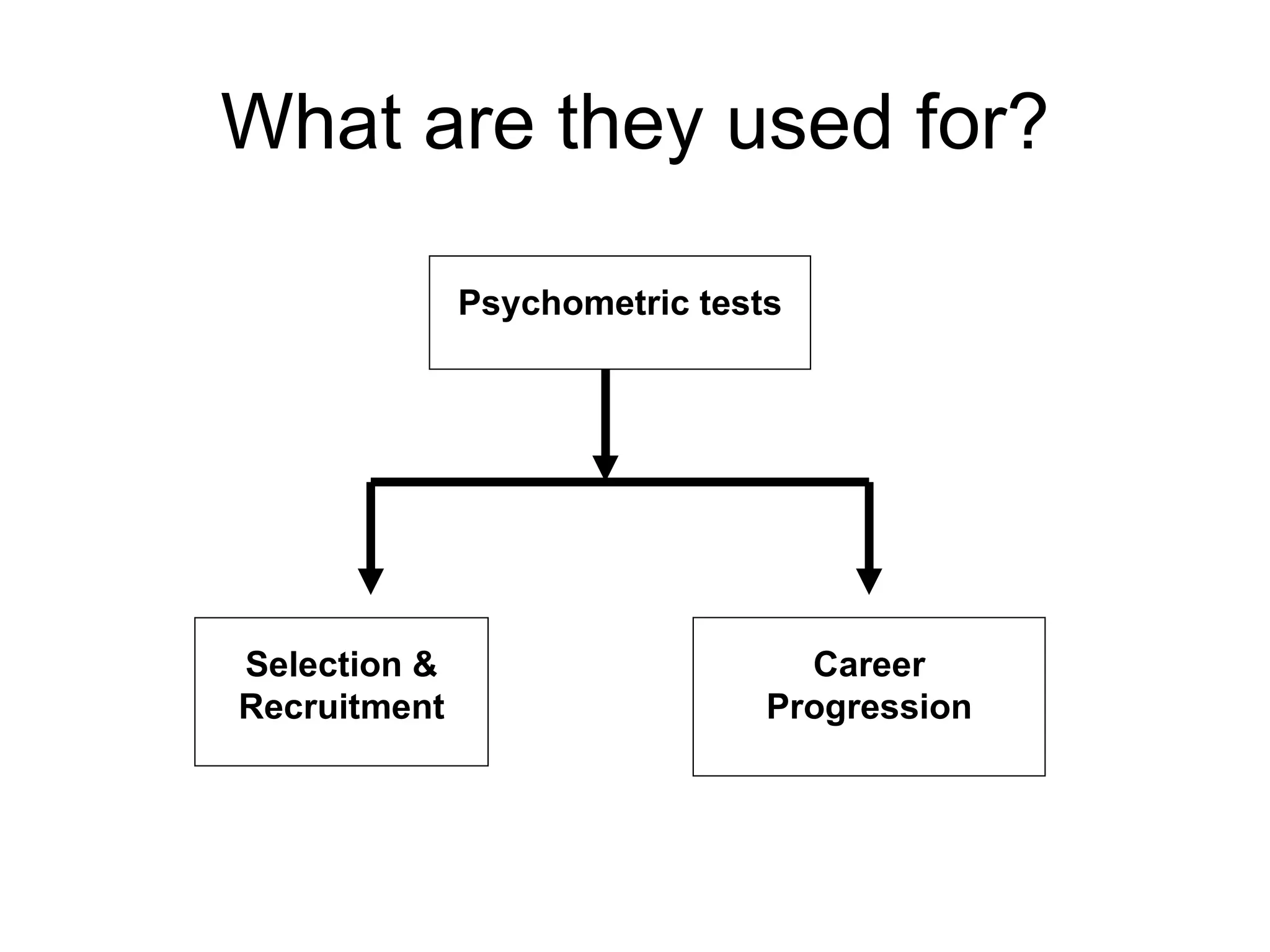
What are they used for? Psychometric tests Selection & Recruitment Career Progression
A psychometric test should be: Objective:   The score must not affected by the testers' beliefs or values Standardized:   Must be administered under controlled conditions Reliable:   Must minimize and quantify any intrinsic errors Predictive :  Must make an accurate prediction of performance Non Discriminatory :  Must not disadvantage any group on the basis of gender, culture, ethnicity, etc.
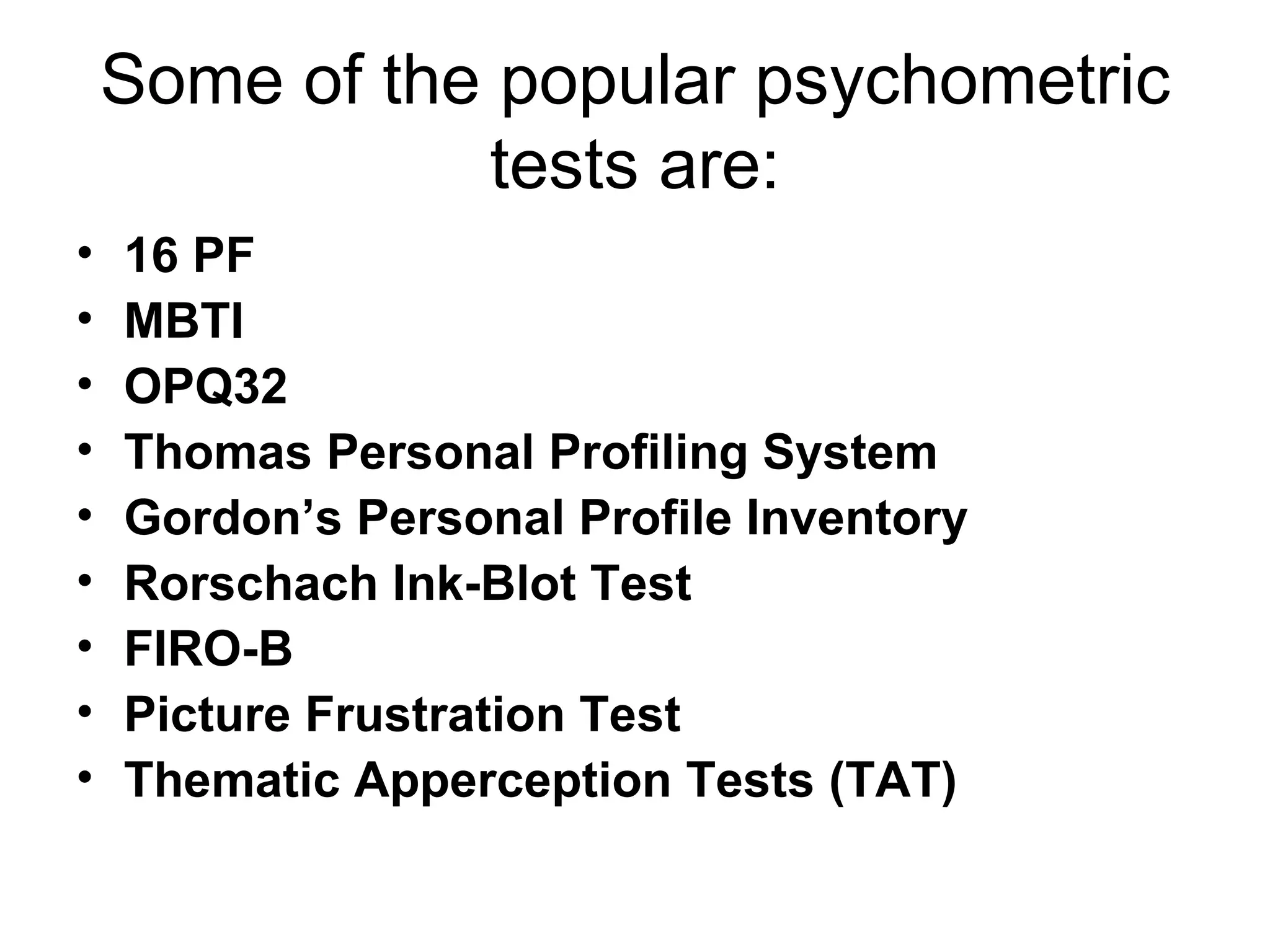
Some of the popular psychometric tests are: 16 PF MBTI OPQ32 Thomas Personal Profiling System Gordon’s Personal Profile Inventory Rorschach Ink-Blot Test FIRO-B Picture Frustration Test Thematic Apperception Tests (TAT)
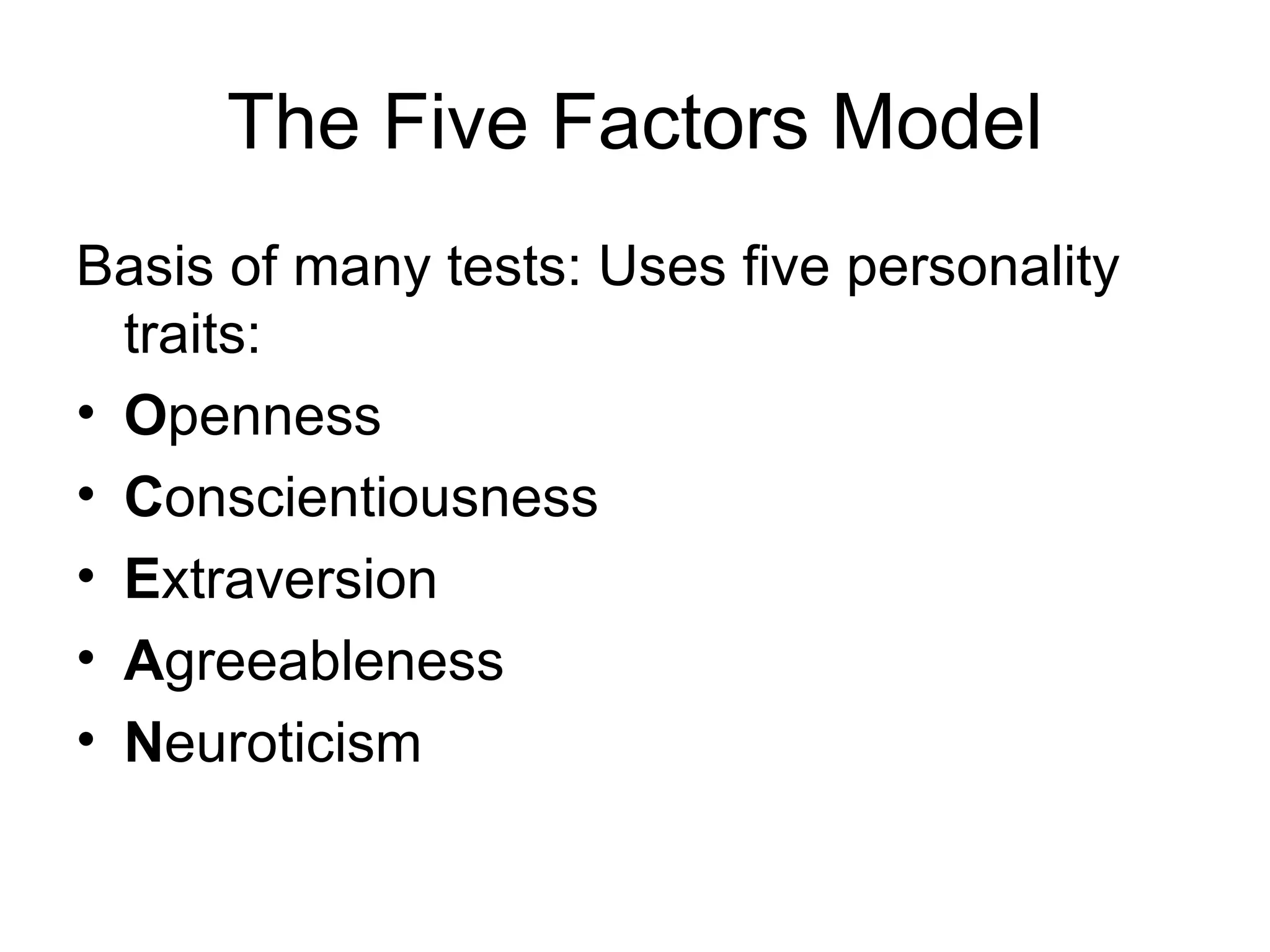
The Five Factors Model Basis of many tests: Uses five personality traits: O penness C onscientiousness E xtraversion A greeableness N euroticism
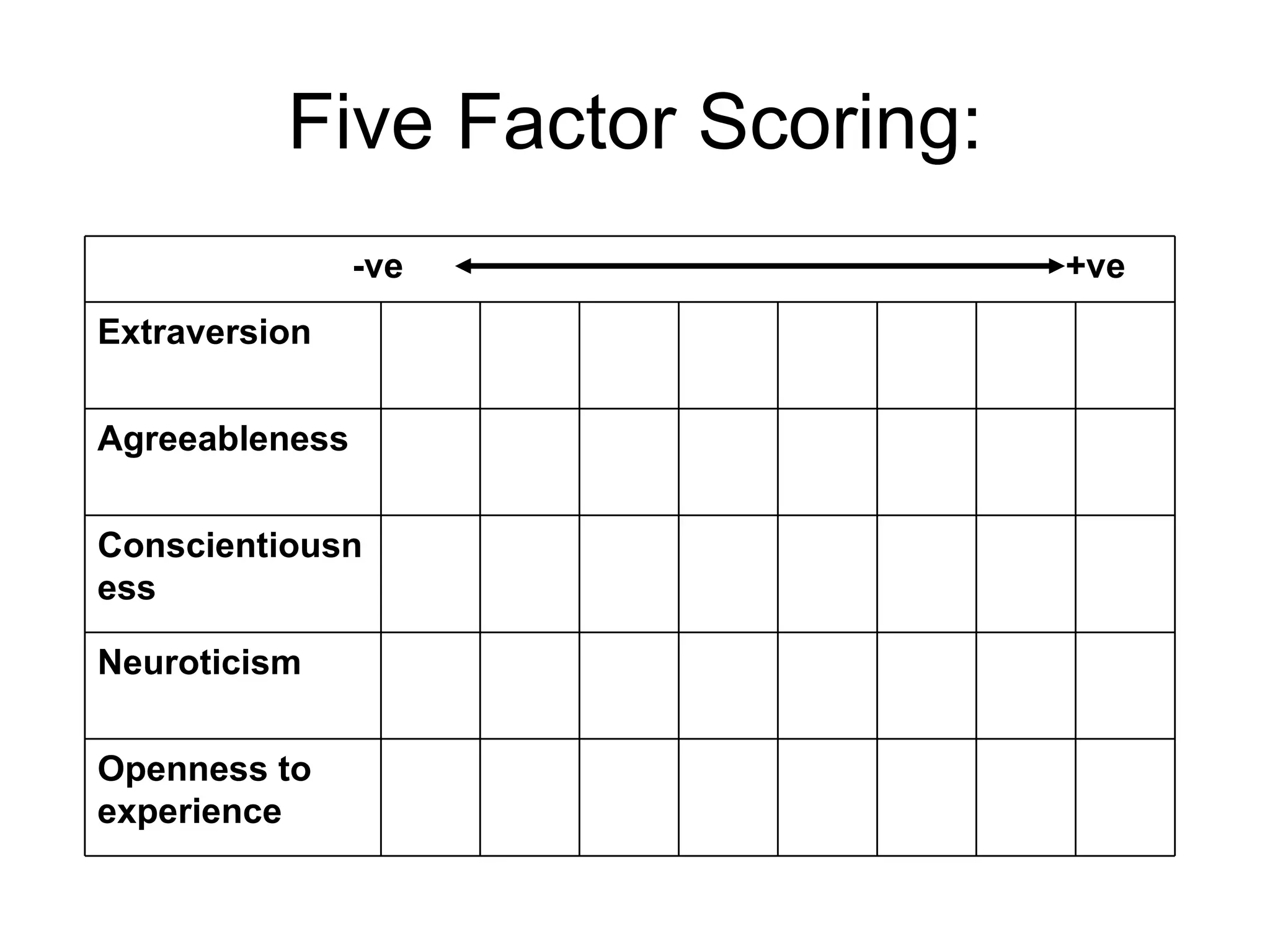
Five Factor Scoring: Openness to experience Neuroticism Conscientiousness Agreeableness Extraversion -ve  +ve
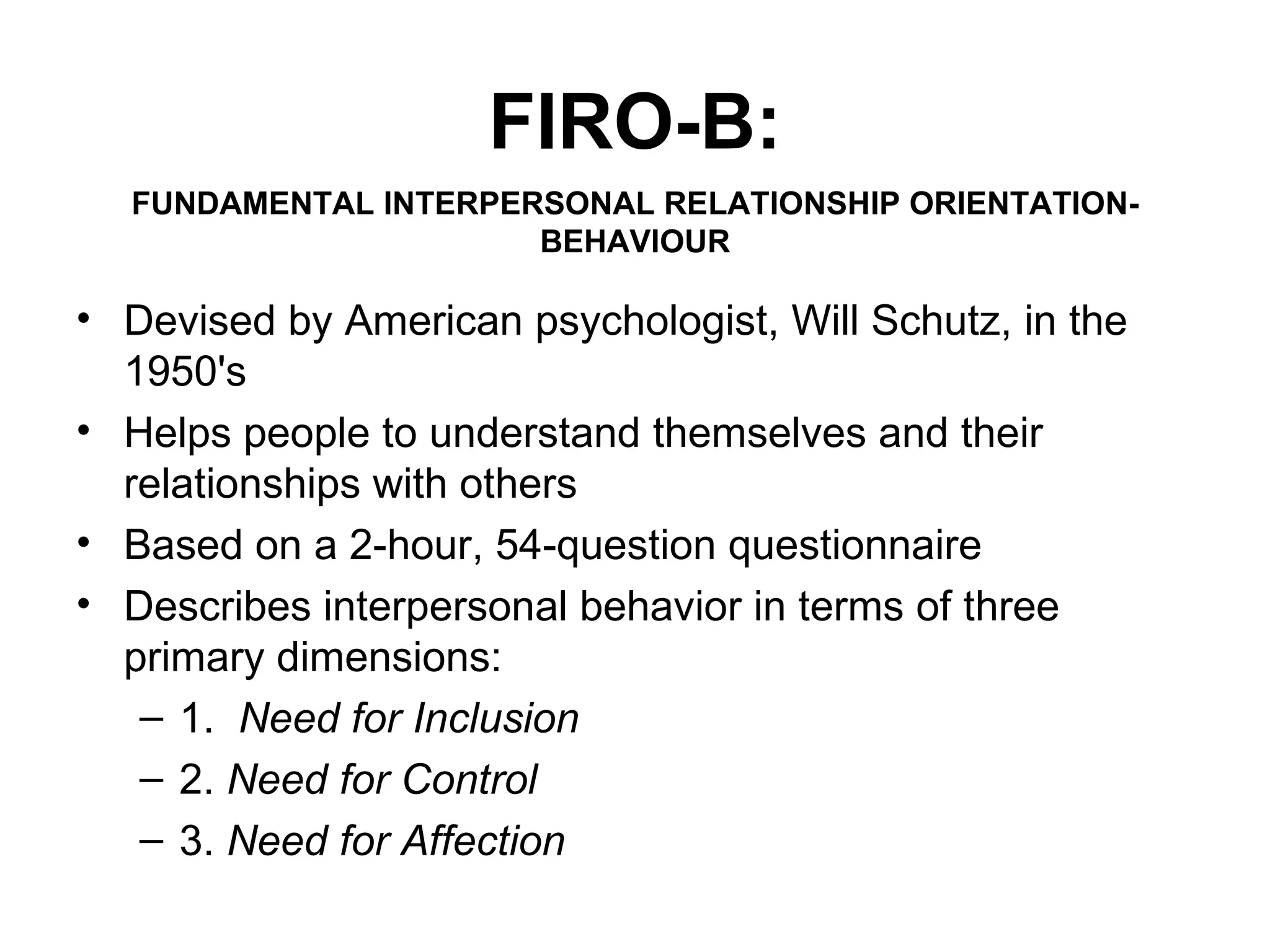
FIRO-B: Devised by American psychologist, Will Schutz, in the 1950's Helps people to understand themselves and their relationships with others Based on a 2-hour, 54-question questionnaire Describes interpersonal behavior in terms of three primary dimensions: 1.   Need for Inclusion   2.  Need for Control 3.  Need for Affection FUNDAMENTAL INTERPERSONAL RELATIONSHIP ORIENTATION-BEHAVIOUR
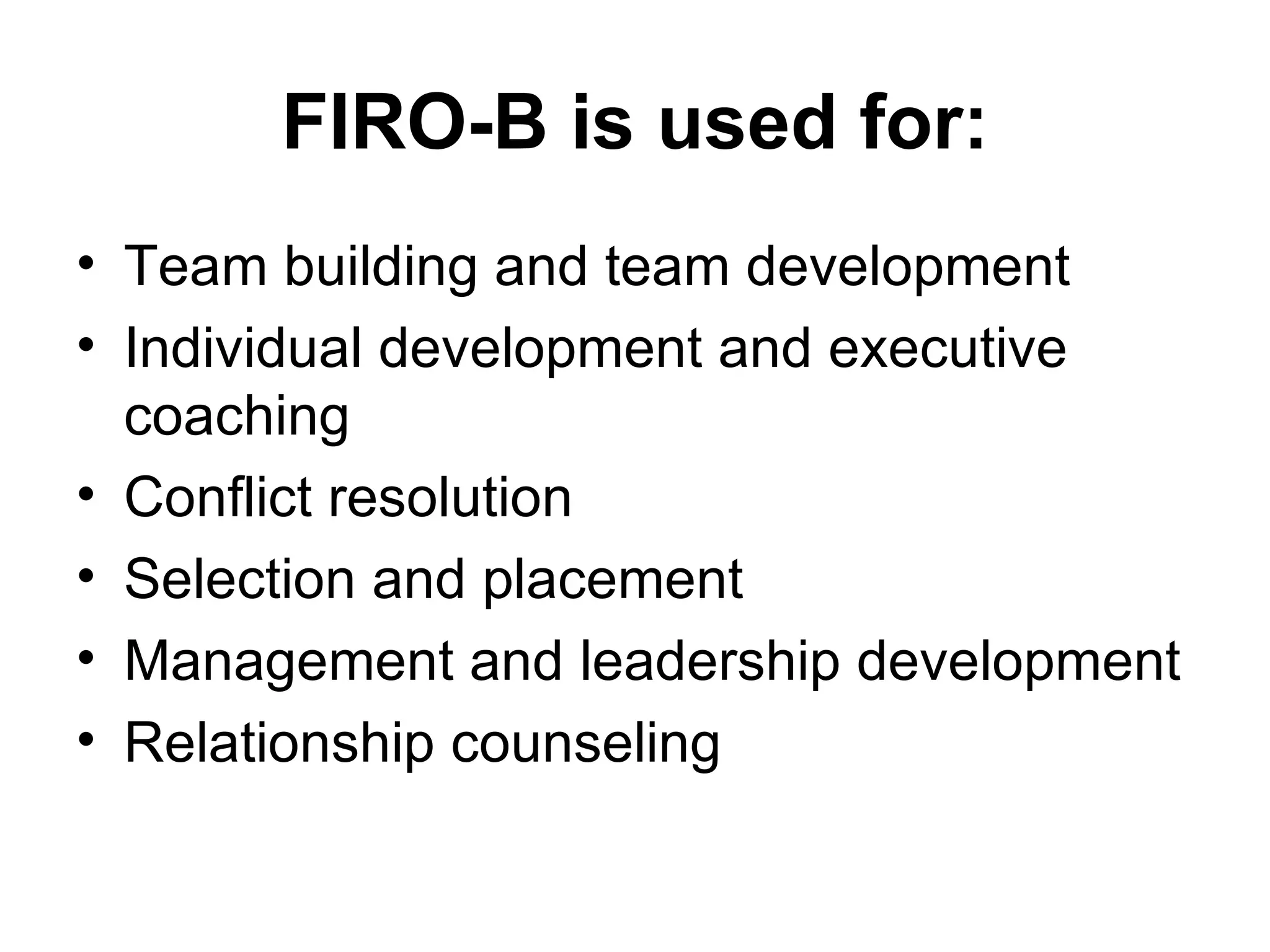
FIRO-B is used for: Team building and team development Individual development and executive coaching Conflict resolution Selection and placement Management and leadership development Relationship counseling
MBTI:  Myers-Briggs Type Indicator   Based on theories of Gustav Jung Most widely-used questionnaire based test Uses four bi-polar dimensions Sensing –Intuition  (SN) Thinking – Feeling  (TF) Extraversion-Introversion  (E-I) Judging-Perceiving  (J-P) To create 16 ‘Personality Types’
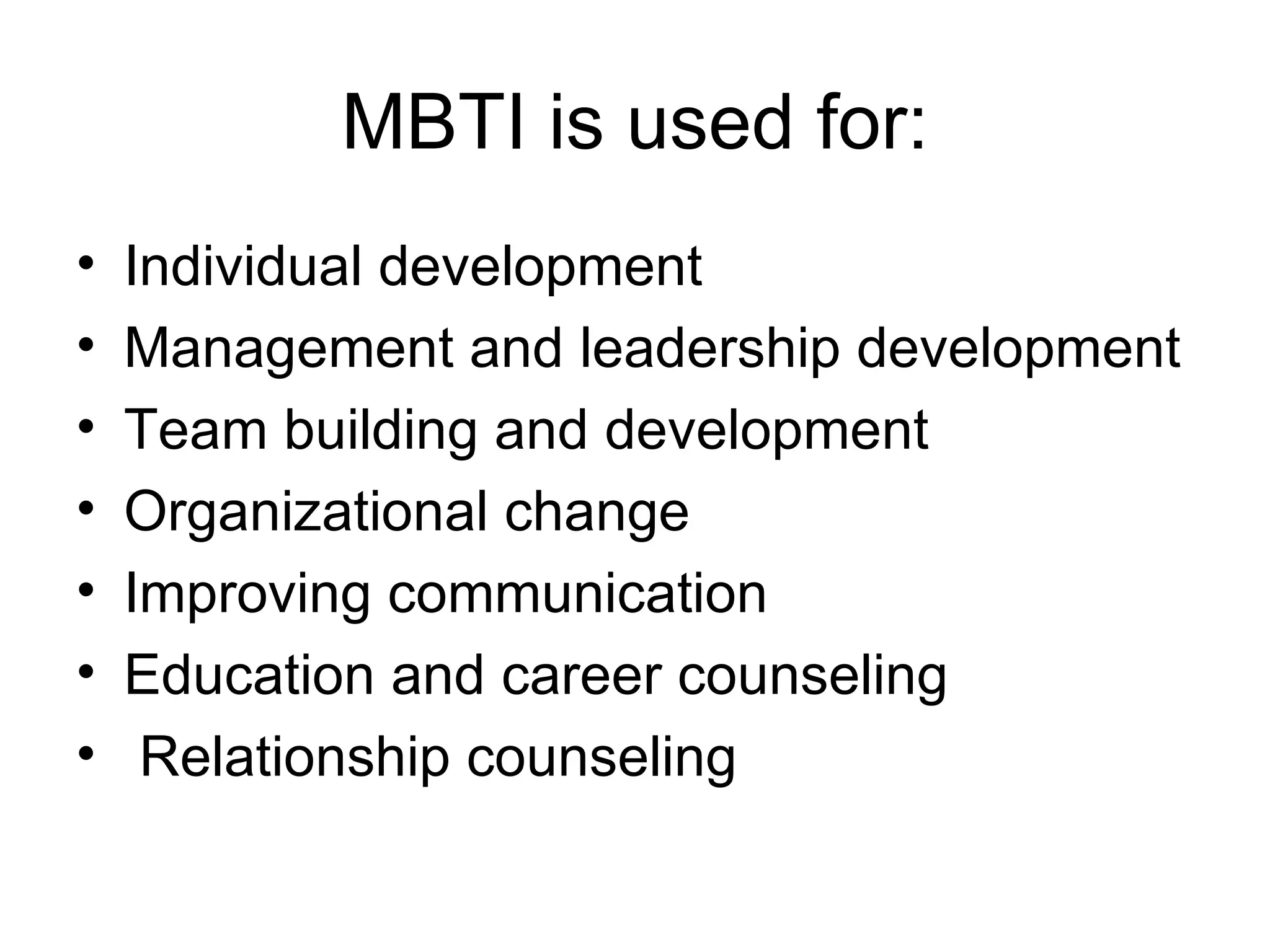
MBTI is used for: Individual development Management and leadership development Team building and development Organizational change Improving communication Education and career counseling   Relationship counseling
The DISC Personality Model   Developed in 1920s to understand ‘why people do what they do’ Simple questionnaire based Uses four categories of human behavioral styles "D" for Dominance-Drive-Direct,  "I" for Influence  "S" for Steadiness or Stability  "C" for Compliant, Conscientious, or Cautious  Direct, Influencing, Steady and Compliant behaviors.
The DISC Four Quadrant Model
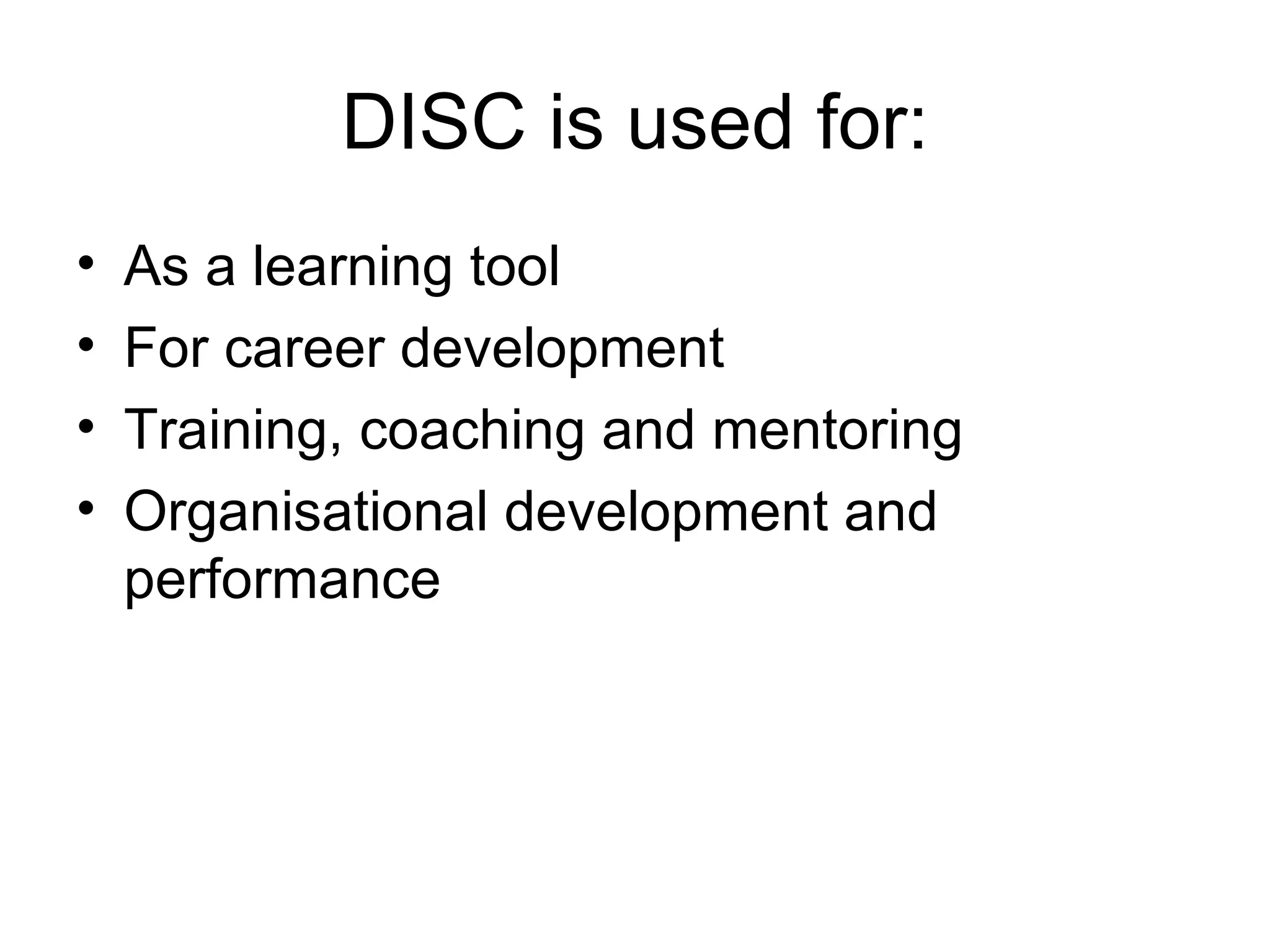
DISC is used for: As a learning tool For career development Training, coaching and mentoring Organisational development and performance
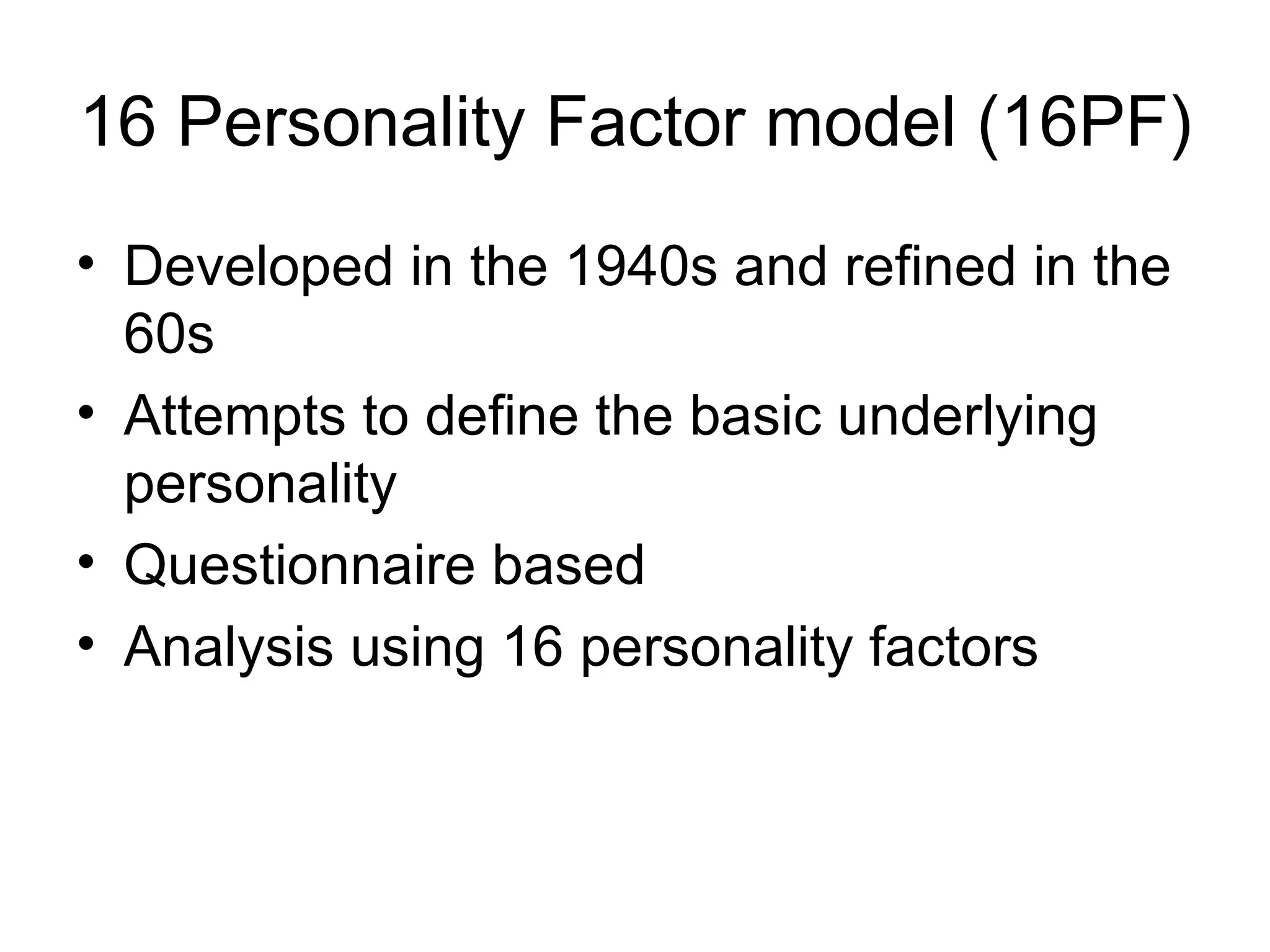
16 Personality Factor model (16PF) Developed in the 1940s and refined in the 60s Attempts to define the basic underlying personality Questionnaire based Analysis using 16 personality factors
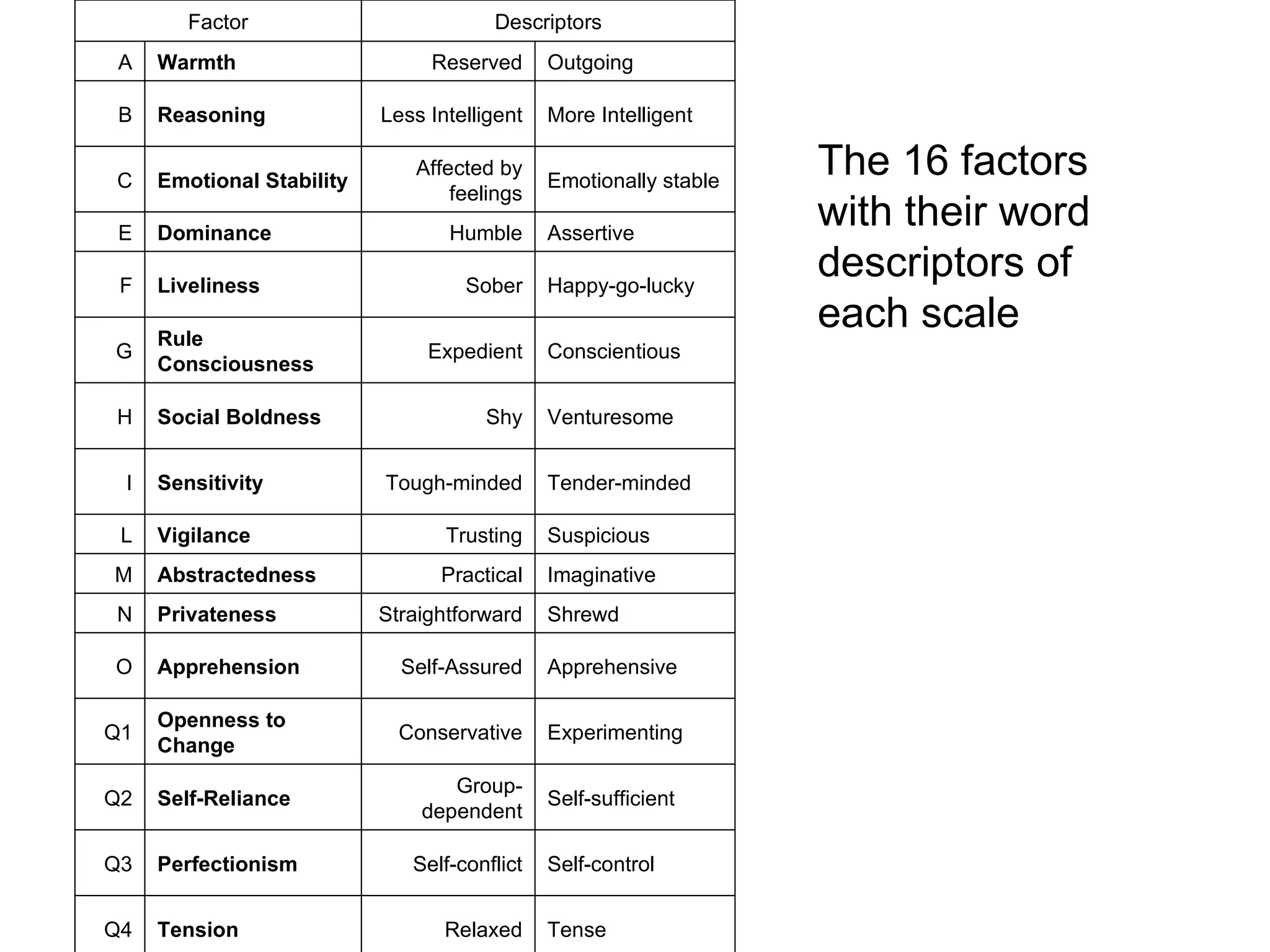
The 16 factors with their word descriptors of each scale Tense Relaxed Tension Q4 Self-control Self-conflict Perfectionism Q3 Self-sufficient Group-dependent Self-Reliance Q2 Experimenting Conservative Openness to Change Q1 Apprehensive Self-Assured Apprehension O Shrewd Straightforward Privateness N Imaginative Practical Abstractedness M Suspicious Trusting Vigilance L Tender-minded Tough-minded Sensitivity I Venturesome Shy Social Boldness H Conscientious Expedient Rule Consciousness G Happy-go-lucky Sober Liveliness F Assertive Humble Dominance E Emotionally stable Affected by feelings Emotional Stability C More Intelligent Less Intelligent Reasoning B Outgoing Reserved Warmth A Descriptors Factor
16 PF is used for: Selection Development Executive coaching Teambuilding
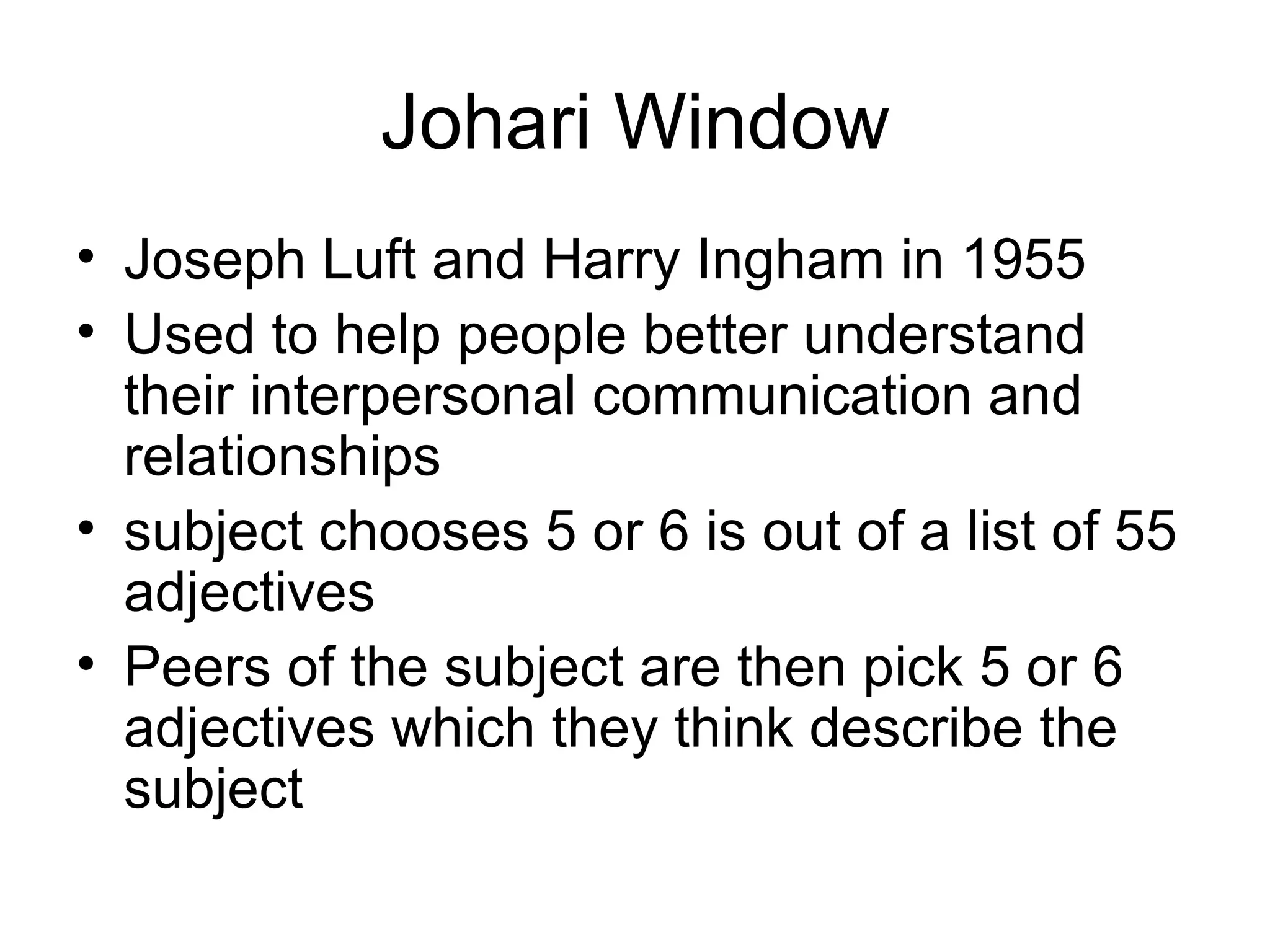
Johari Window Joseph Luft and Harry Ingham in 1955 U sed to help people better understand their interpersonal communication and relationships subject chooses 5 or 6 is out of a list of 55 adjectives Peers of the subject are then pick 5 or 6 adjectives which they think describe the subject
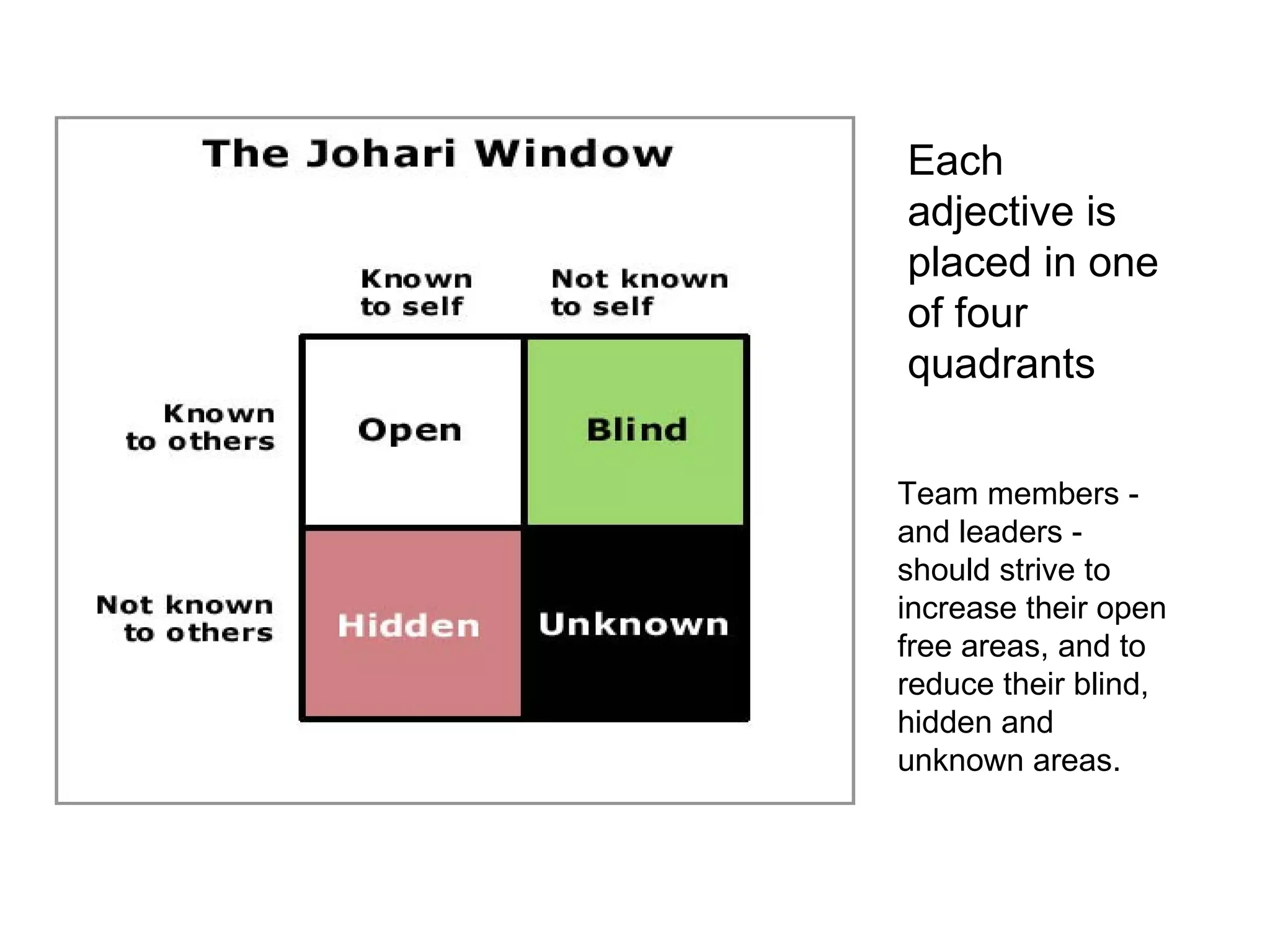
Each adjective is placed in one of four quadrants Team members - and leaders - should strive to increase their open free areas, and to reduce their blind, hidden and unknown areas.
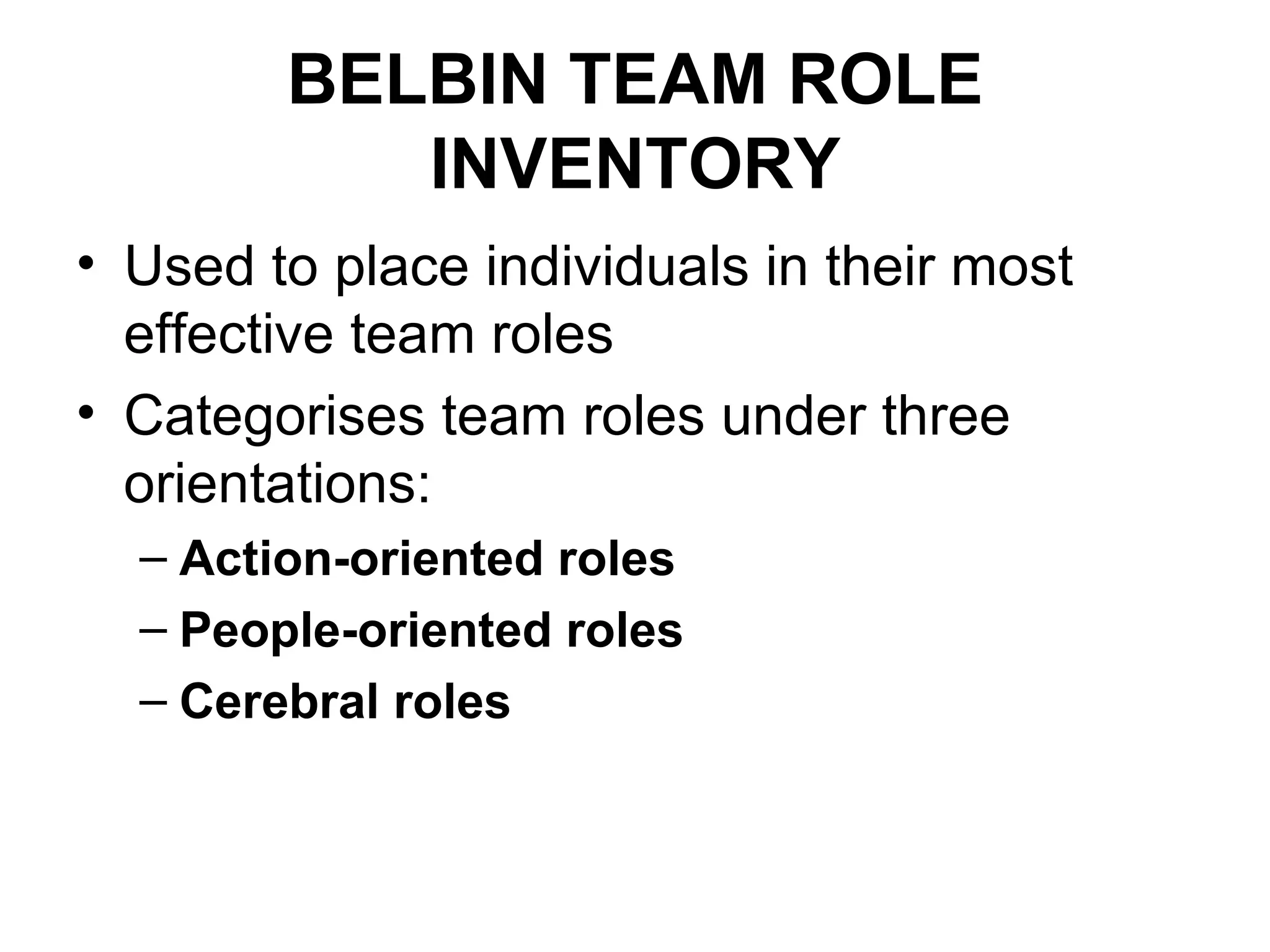
BELBIN TEAM ROLE INVENTORY Used to place individuals in their most effective team roles Categorises team roles under three orientations: Action-oriented roles People-oriented roles Cerebral roles
The 9 Belbin Team Roles Specialist Monitor/ Evaluator Plant Completer/ finisher Company Worker/ Implementer Shaper Team Worker Resource Investigator Co-coordinator
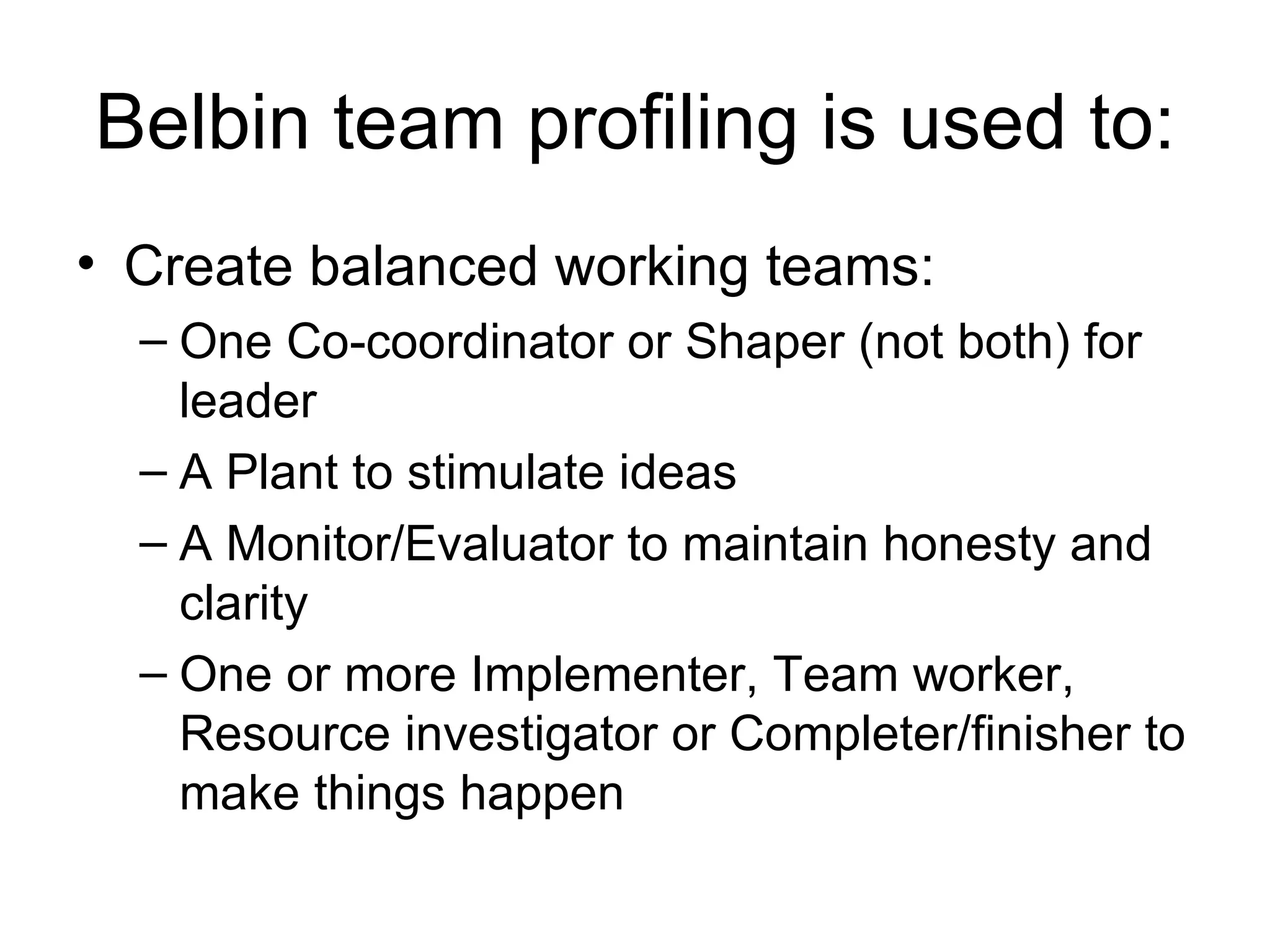
Belbin team profiling is used to: Create balanced working teams: One Co-coordinator or Shaper (not both) for leader  A Plant to stimulate ideas  A Monitor/Evaluator to maintain honesty and clarity  One or more Implementer, Team worker, Resource investigator or Completer/finisher to make things happen
Dr. Meredith  Belbin: "Nobody is perfect - but a team can be"
Aptitude and Ability Tests Designed to assess one’s logical reasoning or thinking performance Usually  consist of multiple choice questions, administered under exam conditions Typical test might allow 30 minutes for 30 or so questions At least 5000 aptitude and ability tests on the market On-line testing increasingly popular
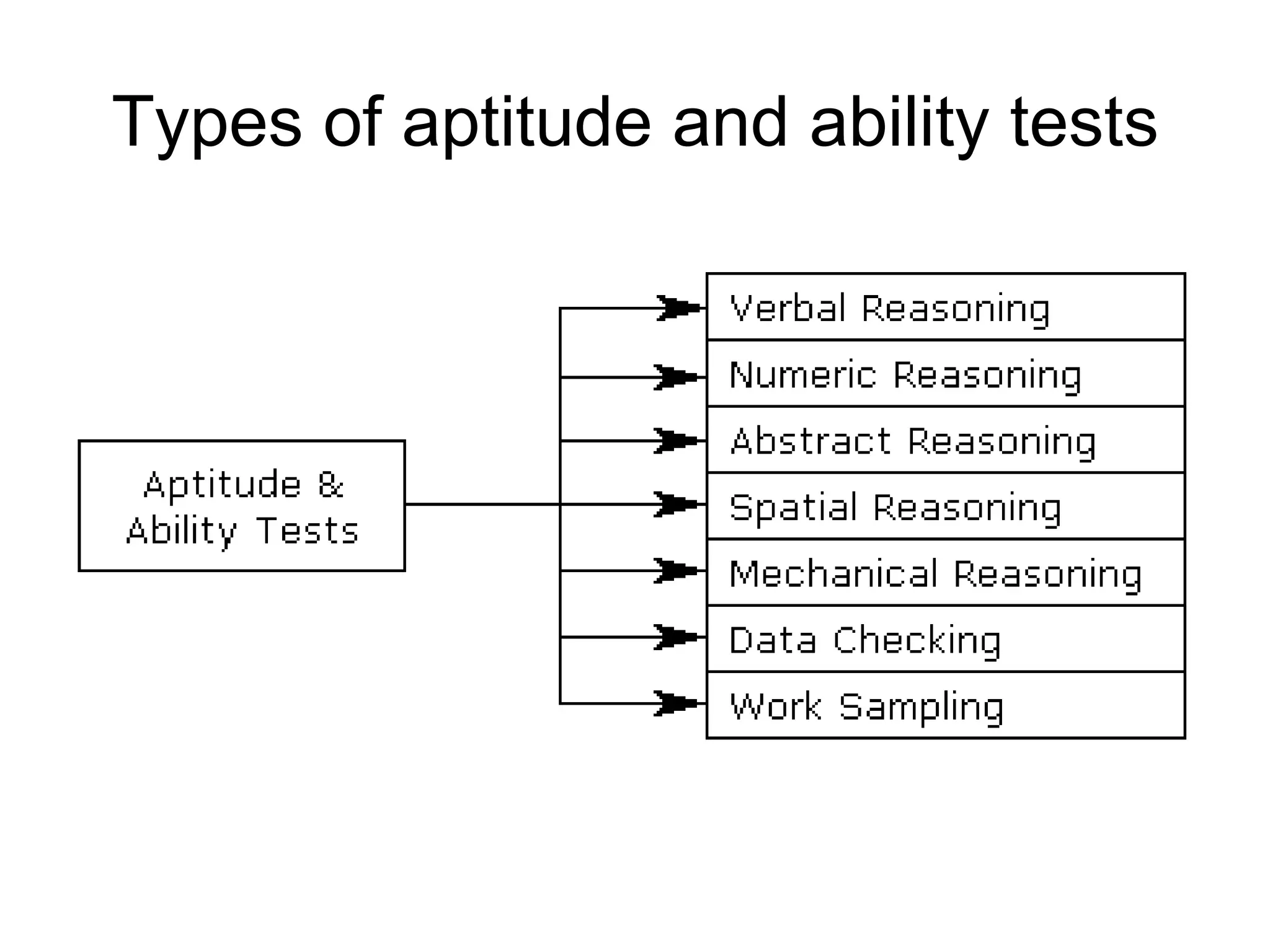
Types of aptitude and ability tests
For more information: BOOKS   Anastasi Anne, Urbina Susana,  Psychological Testing ,  Pearson Education, 2003. Mcshane S, Glinow A M, Sharma R,  Introduction to Organization  Behavior , Tata McGraw Hills, 2006. E-Books D.Constantine-Simms,  Everything you need to know to pass psychometric tests. Magazines HRM Review February 2007 Websites http://www.teamfocus.co.uk/different_types_of_psychometric_tests.htm http://changingminds.org/disciplines/hr/selection/psychometric.htm http://www.personalitypathways.com/type_inventory.html http://en.wikipedia.org www.humanmetrics.com http://www.opp.co.uk

Psychometric Tests

  • 1.
  • 2.
    What is apsychometric test? Aim to measure aspects of your mental ability, aptitude or your personality Used as part of the recruitment or selection process Provide employers with a method of selecting the most suitable job applicants or candidates for promotion Used by 80% of Fortune 500 and 75% of Times Top 100 companies
  • 3.
    What do psychometrictests measure? How well you work with other people How well you handle stress Whether you will be able to cope with the intellectual demands of the job Your personality, preferences and abilities Most do not analyze your emotional or psychological stability Best match of individual to occupation and working environment
  • 4.
    What types oftest are there?
  • 5.
    What are theyused for? Psychometric tests Selection & Recruitment Career Progression
  • 6.
    A psychometric testshould be: Objective: The score must not affected by the testers' beliefs or values Standardized: Must be administered under controlled conditions Reliable: Must minimize and quantify any intrinsic errors Predictive : Must make an accurate prediction of performance Non Discriminatory : Must not disadvantage any group on the basis of gender, culture, ethnicity, etc.
  • 7.
    Some of thepopular psychometric tests are: 16 PF MBTI OPQ32 Thomas Personal Profiling System Gordon’s Personal Profile Inventory Rorschach Ink-Blot Test FIRO-B Picture Frustration Test Thematic Apperception Tests (TAT)
  • 8.
    The Five FactorsModel Basis of many tests: Uses five personality traits: O penness C onscientiousness E xtraversion A greeableness N euroticism
  • 9.
    Five Factor Scoring:Openness to experience Neuroticism Conscientiousness Agreeableness Extraversion -ve +ve
  • 10.
    FIRO-B: Devised byAmerican psychologist, Will Schutz, in the 1950's Helps people to understand themselves and their relationships with others Based on a 2-hour, 54-question questionnaire Describes interpersonal behavior in terms of three primary dimensions: 1.   Need for Inclusion 2. Need for Control 3. Need for Affection FUNDAMENTAL INTERPERSONAL RELATIONSHIP ORIENTATION-BEHAVIOUR
  • 11.
    FIRO-B is usedfor: Team building and team development Individual development and executive coaching Conflict resolution Selection and placement Management and leadership development Relationship counseling
  • 12.
    MBTI: Myers-BriggsType Indicator Based on theories of Gustav Jung Most widely-used questionnaire based test Uses four bi-polar dimensions Sensing –Intuition (SN) Thinking – Feeling (TF) Extraversion-Introversion (E-I) Judging-Perceiving (J-P) To create 16 ‘Personality Types’
  • 13.
    MBTI is usedfor: Individual development Management and leadership development Team building and development Organizational change Improving communication Education and career counseling   Relationship counseling
  • 14.
    The DISC PersonalityModel Developed in 1920s to understand ‘why people do what they do’ Simple questionnaire based Uses four categories of human behavioral styles "D" for Dominance-Drive-Direct, "I" for Influence "S" for Steadiness or Stability "C" for Compliant, Conscientious, or Cautious Direct, Influencing, Steady and Compliant behaviors.
  • 15.
    The DISC FourQuadrant Model
  • 16.
    DISC is usedfor: As a learning tool For career development Training, coaching and mentoring Organisational development and performance
  • 17.
    16 Personality Factormodel (16PF) Developed in the 1940s and refined in the 60s Attempts to define the basic underlying personality Questionnaire based Analysis using 16 personality factors
  • 18.
    The 16 factorswith their word descriptors of each scale Tense Relaxed Tension Q4 Self-control Self-conflict Perfectionism Q3 Self-sufficient Group-dependent Self-Reliance Q2 Experimenting Conservative Openness to Change Q1 Apprehensive Self-Assured Apprehension O Shrewd Straightforward Privateness N Imaginative Practical Abstractedness M Suspicious Trusting Vigilance L Tender-minded Tough-minded Sensitivity I Venturesome Shy Social Boldness H Conscientious Expedient Rule Consciousness G Happy-go-lucky Sober Liveliness F Assertive Humble Dominance E Emotionally stable Affected by feelings Emotional Stability C More Intelligent Less Intelligent Reasoning B Outgoing Reserved Warmth A Descriptors Factor
  • 19.
    16 PF isused for: Selection Development Executive coaching Teambuilding
  • 20.
    Johari Window JosephLuft and Harry Ingham in 1955 U sed to help people better understand their interpersonal communication and relationships subject chooses 5 or 6 is out of a list of 55 adjectives Peers of the subject are then pick 5 or 6 adjectives which they think describe the subject
  • 21.
    Each adjective isplaced in one of four quadrants Team members - and leaders - should strive to increase their open free areas, and to reduce their blind, hidden and unknown areas.
  • 22.
    BELBIN TEAM ROLEINVENTORY Used to place individuals in their most effective team roles Categorises team roles under three orientations: Action-oriented roles People-oriented roles Cerebral roles
  • 23.
    The 9 BelbinTeam Roles Specialist Monitor/ Evaluator Plant Completer/ finisher Company Worker/ Implementer Shaper Team Worker Resource Investigator Co-coordinator
  • 24.
    Belbin team profilingis used to: Create balanced working teams: One Co-coordinator or Shaper (not both) for leader A Plant to stimulate ideas A Monitor/Evaluator to maintain honesty and clarity One or more Implementer, Team worker, Resource investigator or Completer/finisher to make things happen
  • 25.
    Dr. Meredith Belbin: "Nobody is perfect - but a team can be"
  • 26.
    Aptitude and AbilityTests Designed to assess one’s logical reasoning or thinking performance Usually consist of multiple choice questions, administered under exam conditions Typical test might allow 30 minutes for 30 or so questions At least 5000 aptitude and ability tests on the market On-line testing increasingly popular
  • 27.
    Types of aptitudeand ability tests
  • 28.
    For more information:BOOKS   Anastasi Anne, Urbina Susana, Psychological Testing , Pearson Education, 2003. Mcshane S, Glinow A M, Sharma R, Introduction to Organization Behavior , Tata McGraw Hills, 2006. E-Books D.Constantine-Simms, Everything you need to know to pass psychometric tests. Magazines HRM Review February 2007 Websites http://www.teamfocus.co.uk/different_types_of_psychometric_tests.htm http://changingminds.org/disciplines/hr/selection/psychometric.htm http://www.personalitypathways.com/type_inventory.html http://en.wikipedia.org www.humanmetrics.com http://www.opp.co.uk