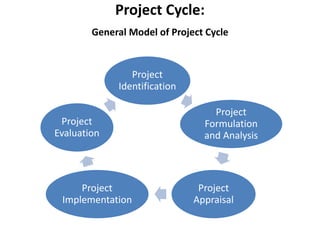
The document discusses the stages of a typical project cycle. It begins with project identification, then progresses to formulation and analysis, appraisal, implementation, and evaluation. Several examples of common project cycles are provided, including those used by the World Bank, Asian Development Bank, and UNIDO. A project cycle generally involves pre-investment, investment, and operation stages. Key steps within these stages include developing a project concept note, conducting feasibility studies, gaining approval or agreement, organization, implementation, operation and maintenance, monitoring, and evaluation.
Project Cycle:
• Everyproject passes through different stages
• The project passes through these stages from project initiation to
completion
• These stages are generally expressed in terms of cycles which is
known as project cycle
Hence,
• Project Cycle is the process of completing one stage after another
Or
• Project Cycle is a process of carrying out series of project activities at
different stages
• Whatever the project is, there tends to be a natural sequence in the
way the projects are planned and carried out and this sequence is
often called the 'Project Cycle'.
3.
Project Cycle:
General Modelof Project Cycle
Project
Identification
Project
Formulation
and Analysis
Project
Appraisal
Project
Implementation
Project
Evaluation
4.
Types of ProjectCycle
• World Bank Project Cycle
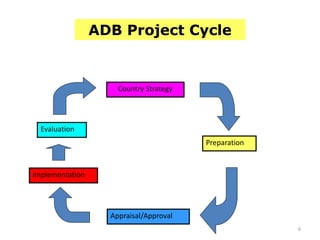
• ADB Project Cycle
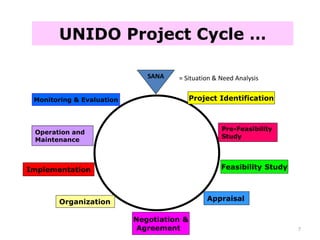
• UNIDO (United Nations Industrial
Development Organization) Project
Cycle etc
5.
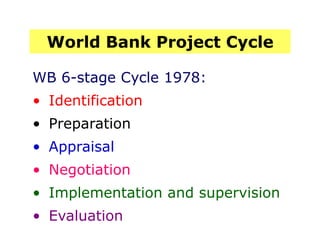
World Bank ProjectCycle
WB 6-stage Cycle 1978:
• Identification
• Preparation
• Appraisal
• Negotiation
• Implementation and supervision
• Evaluation
9
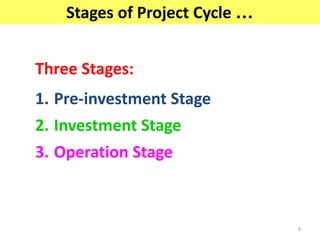
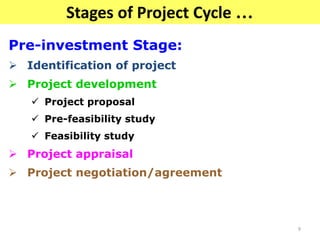
Pre-investment Stage:
Identificationof project
Project development
Project proposal
Pre-feasibility study
Feasibility study
Project appraisal
Project negotiation/agreement
Stages of Project Cycle …
10.
10
Identification of theProject
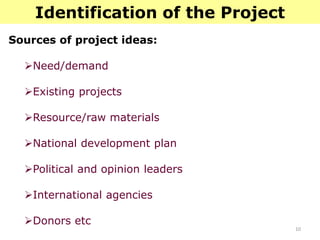
Sources of project ideas:
Need/demand
Existing projects
Resource/raw materials
National development plan
Political and opinion leaders
International agencies
Donors etc
11.
11
Identification of theProject
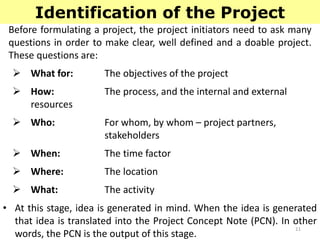
Before formulating a project, the project initiators need to ask many
questions in order to make clear, well defined and a doable project.
These questions are:
What for: The objectives of the project
How: The process, and the internal and external
resources
Who: For whom, by whom – project partners,
stakeholders
When: The time factor
Where: The location
What: The activity
• At this stage, idea is generated in mind. When the idea is generated
that idea is translated into the Project Concept Note (PCN). In other
words, the PCN is the output of this stage.
12.
12
Projcet development
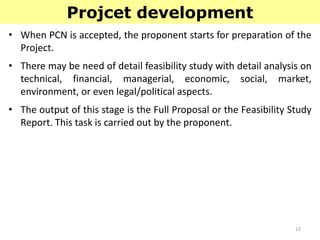
• WhenPCN is accepted, the proponent starts for preparation of the
Project.
• There may be need of detail feasibility study with detail analysis on
technical, financial, managerial, economic, social, market,
environment, or even legal/political aspects.
• The output of this stage is the Full Proposal or the Feasibility Study
Report. This task is carried out by the proponent.
13.
13
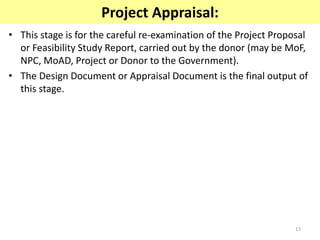
Project Appraisal:
• Thisstage is for the careful re-examination of the Project Proposal
or Feasibility Study Report, carried out by the donor (may be MoF,
NPC, MoAD, Project or Donor to the Government).
• The Design Document or Appraisal Document is the final output of
this stage.
14.
14
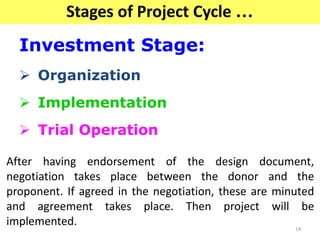
Investment Stage:
Organization
Implementation
Trial Operation
Stages of Project Cycle …
After having endorsement of the design document,
negotiation takes place between the donor and the
proponent. If agreed in the negotiation, these are minuted
and agreement takes place. Then project will be
implemented.
15.
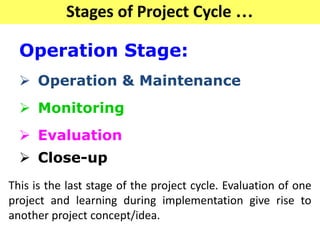
Operation Stage:
Operation& Maintenance
Monitoring
Evaluation
Close-up
Stages of Project Cycle …
This is the last stage of the project cycle. Evaluation of one
project and learning during implementation give rise to
another project concept/idea.