Stakeholder engagement and management Doing the right things effectively and efficiently
Knowledge Base Stakeholder engagement  is the process by which a firm's stakeholders engage in dialogue to improve a firm's decision-making and accountability. The company should initiate an open two-way dialogue seeking understanding and solutions to issues of mutual concern, combining their resources and competencies, sharing both risks and benefit Buy-in is essential for success in stakeholder engagement. 
Why is stakeholder engagement and management so important? The answer lies in the question...to get engagement and buy in from those needed in the change initiative or affected by it Question...
When is stakeholder engagement and management used? Stakeholder engagement and management is used when there is a change initiative, a programme or project. All of which will have an impact on peoples internally and / or externally Question...
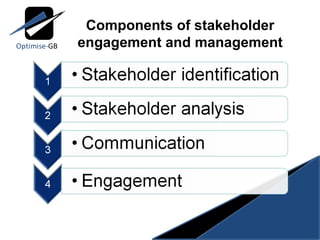
Components of stakeholder engagement and management
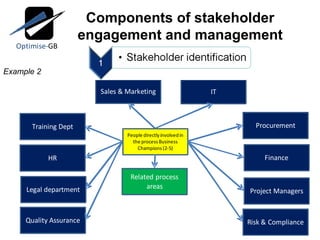
Components of stakeholder engagement and management Who is the initiative going to impact? Who will benefit from the initiative? Whose involvement is needed for the initiative? Who is driving the initiative? Who are the suppliers?
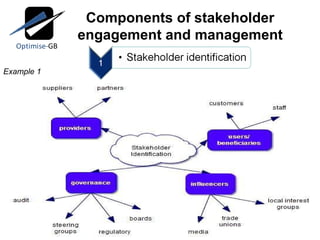
Components of stakeholder engagement and management Example 1
Components of stakeholder engagement and management Example 2
Components of stakeholder engagement and management Recognise and acknowledge stakeholder's needs, concerns, wants, authority, common relationships, interfaces and align this information within the Stakeholder Matrix First seek to understand peoples needs, concerns and issues before trying to be understood
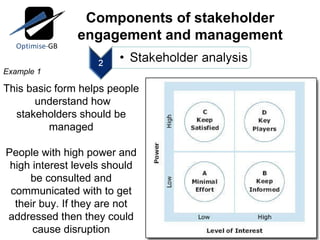
Components of stakeholder engagement and management This basic form helps people  understand how stakeholders should be managed People with high power and high interest levels should be consulted and communicated with to get their buy. If they are not addressed then they could cause disruption Example 1
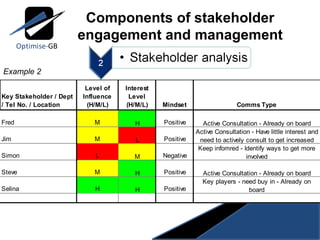
Components of stakeholder engagement and management Example 2
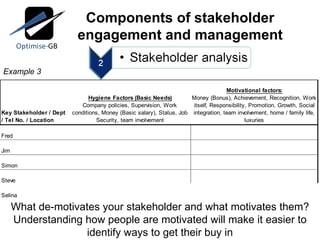
Components of stakeholder engagement and management Example 3 What de-motivates your stakeholder and what motivates them? Understanding how people are motivated will make it easier to identify ways to get their buy in
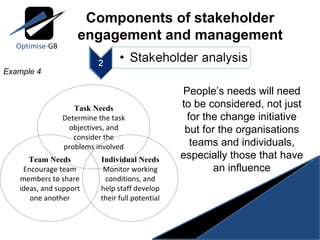
Team Needs Encourage team members to share ideas, and support one another Individual Needs Monitor working conditions, and help staff develop their full potential Task Needs Determine the task objectives, and consider the problems involved People’s needs will need to be considered, not just for the change initiative but for the organisations teams and individuals, especially those that have an influence Components of stakeholder engagement and management Example 4
Components of stakeholder engagement and management How should you communicate with your stakeholders? What will have the biggest impact? How can the communication be ever lasting?
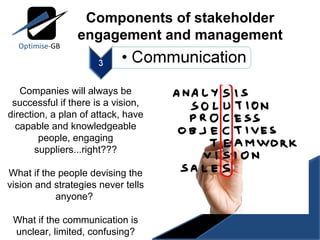
Companies will always be successful if there is a vision, direction, a plan of attack, have capable and knowledgeable people, engaging suppliers...right??? What if the people devising the vision and strategies never tells anyone?  What if the communication is unclear, limited, confusing? Components of stakeholder engagement and management
Communicate using: - Focus groups - Management meetings - Intranet - Use walls to communicate vision and results - Feedback boxes to generate new ideas - Newsletters - Build into employee appraisals Components of stakeholder engagement and management
Components of stakeholder engagement and management What do you need to do if people have high buy in, high interest and high power? These types of people will not need to motivated to be involved. That is not to say that they should be ignored, as this will de-motivate them
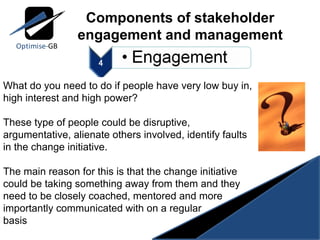
Components of stakeholder engagement and management What do you need to do if people have very low buy in, high interest and high power? These type of people could be disruptive, argumentative, alienate others involved, identify faults in the change initiative. The main reason for this is that the change initiative could be taking something away from them and they need to be closely coached, mentored and more importantly communicated with on a regular basis
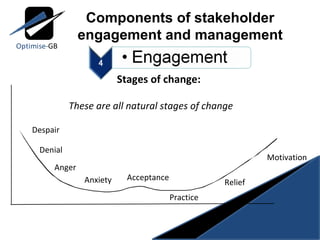
Components of stakeholder engagement and management Stages of change: Despair Denial Anger Anxiety Acceptance Practice Relief Motivation These are all natural stages of change
Components of stakeholder engagement and management Stages of change:
How do you feel when: - The person you are talking to is not looking at you, keeps looking elsewhere? - Speaks over when you are talking? - They provide solutions when you have not finished “What you should do”? - Considers how negative news affects them before considering your feelings? Components of stakeholder engagement and management
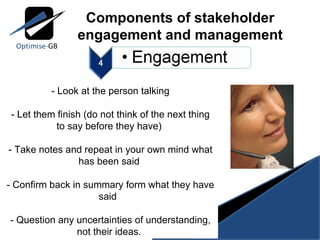
- Look at the person talking - Let them finish (do not think of the next thing to say before they have) - Take notes and repeat in your own mind what has been said - Confirm back in summary form what they have said  - Question any uncertainties of understanding, not their ideas. Components of stakeholder engagement and management
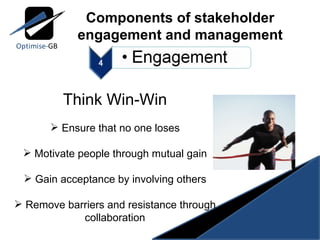
Think Win-Win Ensure that no one loses Motivate people through mutual gain Gain acceptance by involving others Remove barriers and resistance through collaboration Components of stakeholder engagement and management
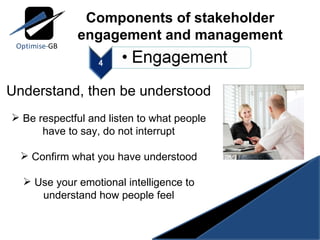
Understand, then be understood Be respectful and listen to what people have to say, do not interrupt Confirm what you have understood Use your emotional intelligence to understand how people feel Components of stakeholder engagement and management
Written References
Video References Stakeholder Management http://www.youtube.com/watch?v=8Qowj2GCLAs http://www.youtube.com/watch?v=I9NqyqhgJVc&feature=related http://www.youtube.com/watch?v=Ih5IBe1cnQw&feature=related
For other solutions Contact  Simon Misiewicz through  Web:  www.optimise-gb.com Email:  [email_address]  or

Stakeholder engagement and management

  • 1.
    Stakeholder engagement andmanagement Doing the right things effectively and efficiently
  • 2.
    Knowledge Base Stakeholderengagement  is the process by which a firm's stakeholders engage in dialogue to improve a firm's decision-making and accountability. The company should initiate an open two-way dialogue seeking understanding and solutions to issues of mutual concern, combining their resources and competencies, sharing both risks and benefit Buy-in is essential for success in stakeholder engagement. 
  • 3.
    Why is stakeholderengagement and management so important? The answer lies in the question...to get engagement and buy in from those needed in the change initiative or affected by it Question...
  • 4.
    When is stakeholderengagement and management used? Stakeholder engagement and management is used when there is a change initiative, a programme or project. All of which will have an impact on peoples internally and / or externally Question...
  • 5.
    Components of stakeholderengagement and management
  • 6.
    Components of stakeholderengagement and management Who is the initiative going to impact? Who will benefit from the initiative? Whose involvement is needed for the initiative? Who is driving the initiative? Who are the suppliers?
  • 7.
    Components of stakeholderengagement and management Example 1
  • 8.
    Components of stakeholderengagement and management Example 2
  • 9.
    Components of stakeholderengagement and management Recognise and acknowledge stakeholder's needs, concerns, wants, authority, common relationships, interfaces and align this information within the Stakeholder Matrix First seek to understand peoples needs, concerns and issues before trying to be understood
  • 10.
    Components of stakeholderengagement and management This basic form helps people understand how stakeholders should be managed People with high power and high interest levels should be consulted and communicated with to get their buy. If they are not addressed then they could cause disruption Example 1
  • 11.
    Components of stakeholderengagement and management Example 2
  • 12.
    Components of stakeholderengagement and management Example 3 What de-motivates your stakeholder and what motivates them? Understanding how people are motivated will make it easier to identify ways to get their buy in
  • 13.
    Team Needs Encourageteam members to share ideas, and support one another Individual Needs Monitor working conditions, and help staff develop their full potential Task Needs Determine the task objectives, and consider the problems involved People’s needs will need to be considered, not just for the change initiative but for the organisations teams and individuals, especially those that have an influence Components of stakeholder engagement and management Example 4
  • 14.
    Components of stakeholderengagement and management How should you communicate with your stakeholders? What will have the biggest impact? How can the communication be ever lasting?
  • 15.
    Companies will alwaysbe successful if there is a vision, direction, a plan of attack, have capable and knowledgeable people, engaging suppliers...right??? What if the people devising the vision and strategies never tells anyone? What if the communication is unclear, limited, confusing? Components of stakeholder engagement and management
  • 16.
    Communicate using: -Focus groups - Management meetings - Intranet - Use walls to communicate vision and results - Feedback boxes to generate new ideas - Newsletters - Build into employee appraisals Components of stakeholder engagement and management
  • 17.
    Components of stakeholderengagement and management What do you need to do if people have high buy in, high interest and high power? These types of people will not need to motivated to be involved. That is not to say that they should be ignored, as this will de-motivate them
  • 18.
    Components of stakeholderengagement and management What do you need to do if people have very low buy in, high interest and high power? These type of people could be disruptive, argumentative, alienate others involved, identify faults in the change initiative. The main reason for this is that the change initiative could be taking something away from them and they need to be closely coached, mentored and more importantly communicated with on a regular basis
  • 19.
    Components of stakeholderengagement and management Stages of change: Despair Denial Anger Anxiety Acceptance Practice Relief Motivation These are all natural stages of change
  • 20.
    Components of stakeholderengagement and management Stages of change:
  • 21.
    How do youfeel when: - The person you are talking to is not looking at you, keeps looking elsewhere? - Speaks over when you are talking? - They provide solutions when you have not finished “What you should do”? - Considers how negative news affects them before considering your feelings? Components of stakeholder engagement and management
  • 22.
    - Look atthe person talking - Let them finish (do not think of the next thing to say before they have) - Take notes and repeat in your own mind what has been said - Confirm back in summary form what they have said - Question any uncertainties of understanding, not their ideas. Components of stakeholder engagement and management
  • 23.
    Think Win-Win Ensurethat no one loses Motivate people through mutual gain Gain acceptance by involving others Remove barriers and resistance through collaboration Components of stakeholder engagement and management
  • 24.
    Understand, then beunderstood Be respectful and listen to what people have to say, do not interrupt Confirm what you have understood Use your emotional intelligence to understand how people feel Components of stakeholder engagement and management
  • 25.
  • 26.
    Video References StakeholderManagement http://www.youtube.com/watch?v=8Qowj2GCLAs http://www.youtube.com/watch?v=I9NqyqhgJVc&feature=related http://www.youtube.com/watch?v=Ih5IBe1cnQw&feature=related
  • 27.
    For other solutionsContact Simon Misiewicz through Web: www.optimise-gb.com Email: [email_address] or