PM CONCEPTS
What is a Project ?
 Projects are a group of activities that have to be
performed with limited resources to yield specific
objectives, in a specific time, and in a specific
locality. Thus, a project is a temporary endeavor
employed to create a unique product, service
or results.
 It is a unique process, consisting of a set of
coordinated and controlled activities with start and
finish dates, undertaken to achieve an objective
conforming to specific requirements, including the
constraints of time, cost and resources.
What is a Project? contd,….
 In simple terms, Project is a collection of
activities that are interrelated with a
specific over all purpose.
 It is a temporary endeavor to create a
unique product, service or result.
 A project is a complex , non-routine, one
time effort limited by time, budget,
resources, and performance specifications
designed to meet customer needs.
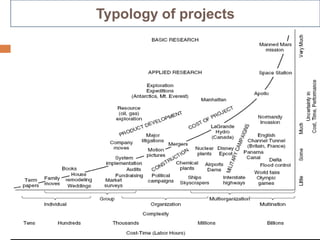
Typology of projects
Project Characteristics
 Project can have a number of starting points but one
end.
 Complexity
 Investment Decision
 Focus- Fixed set of objectives/ mission/goal
 Time Bound through schedules
 Unique
 Unity in diversity
Project Vs. Program
Management
 The coordinated management of a portfolio of
projects to achieve a set of business
objectives is called program management
 A program might refer to an ongoing set of
activities internal to the organization, for
example, a Total Quality Management
program, workplace safety program, supplier
development program, etc
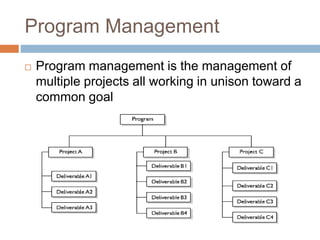
Program Management
 Program management is the management of
multiple projects all working in unison toward a
common goal
Program Management
 Project managers would manage each of the
projects within the program and report to the
Program Manager.
 The Program Manager would ensure that all of
the integrated projects worked together on
schedule, on budget, and ultimately towards
the completion of the program.
Project Management
 It is the application of knowledge , skills, tools and
techniques to project objectives to meet stake holders
needs and expectations.
 It is planning , monitoring and controlling of all aspects
of a project and motivation of all involved to achieve
project objectives of safety and within a defined time,
cost & performance.
 Project Management is both people and technical
oriented. It involve understanding the cause-effect
relationship and interactions among socio technical
dimensions of projects.
How does project management
benefit you?
 To have goal clarity and measurement
 resources will be coordinated
 risks will be identified and managed
 increase the possibilities of time savings
 increase the possibilities of cost savings
 increase the possibilities of achieving the agreed
outcome
 increase the possibilities to deliver projects
successfully
Project techniques and Improved
quality.. The link….
 Decision-making routes and processes are
clearly defined
 Deadlines, costs and resources are controlled
systematically
 All processes in the project management activity chain
are coordinated to ensure they remain in harmony with
one another
 The result will help you to get:
 more speed
 greater flexibility
 improved quality
NEED FOR PROJECT
MANAGEMENT
 To manage large investment opportunities in
different emerging sectors.
 Projects of increasingly complex sizes
 Aggressive competition
 Turbulent business environment
 Greater focus for operational effectiveness and
efficiency.
 Downsizing
NEED FOR PROJECT
MANAGEMENT
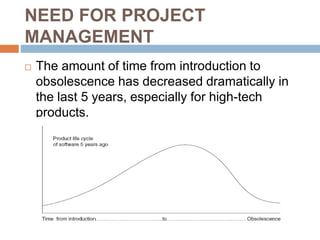
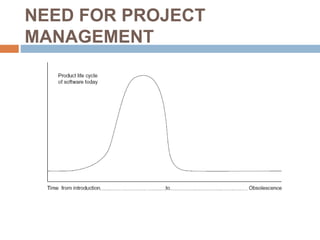
 The amount of time from introduction to
obsolescence has decreased dramatically in
the last 5 years, especially for high-tech
products.
NEED FOR PROJECT
MANAGEMENT
Project Functions
PMI has identified six basic functions :
1. Manage the project’s scope to define the goals
and the work to be done in sufficient details to
facilitate understanding and correct performance
by participants
2. Manage the Human Resources effectively
3. Manage communications for smooth running of the
project.
4. Managing time by planning and meeting
schedules
5. Manage Quality so that project results are
satisfactory
6. Manage Costs to see that project is performed at
the minimum possible cost and within the budget.
Common Pitfalls in Project
Management
• Not being aligned to organisational strategy
• Lack of top management or sponsor support
• Political discord or disagreement
• Poor or inadequate estimating
• Working backwards from a given date
• Inexperienced project management personnel
• Fragmented team and team values
Common Pitfalls in Project
Management
• Poorly/vaguely defined requirements (Scope)
• Lack of user (customer) involvement
• Unrealistic requirements or expectations
• Scope creep
• Poor communication or lack of communication
• Ignoring project warning signs
• Poor governance
Triple Constraints of Project
Management
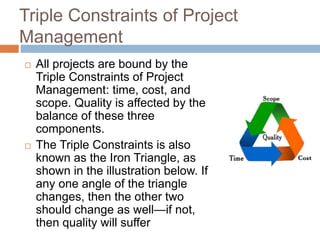
 All projects are bound by the
Triple Constraints of Project
Management: time, cost, and
scope. Quality is affected by the
balance of these three
components.
 The Triple Constraints is also
known as the Iron Triangle, as
shown in the illustration below. If
any one angle of the triangle
changes, then the other two
should change as well—if not,
then quality will suffer
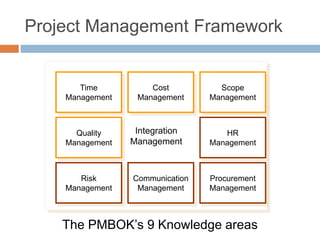
Project Management Framework
The PMBOK’s 9 Knowledge areas
Integration
Management
Time
Management
Cost
Management
Scope
Management
Quality
Management
HR
Management
Risk
Management
Communication
Management
Procurement
Management
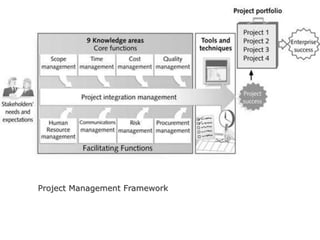
Project Management Framework
Nine knowledge areas in PM
 Project management is comprised of the
following nine knowledge areas.
 Project Integration Management
 Project Scope Management
 Project Time Management
 Project Cost Management
 Project Quality Management
 Project Human Resource Management
 Project Communications Management
 Project Risk Management
 Project Procurement Management
Project Integration
Management
 It is a subset of project management that includes the
processes required ensuring that the various elements
of the project are properly coordinated. It consists of
project plan development, project plan execution, and
overall change control.
 This knowledge area focuses on creating the project
charter, the project scope statement, and a viable
project plan.
 Once the project is in motion, then Project Integration
Management is all about monitoring and controlling
the work.
 If changes happen, and we know they will, then you
have to determine how that change may affect all of
the other knowledge areas.
Project Scope Management
 This knowledge area deals with the planning,
creation, protection, and fulfillment of the
project scope.
 One of the most important activities in all of
project management happens in this
knowledge area: viz. creation of the Work
Breakdown Structure.
Project Time Management
 Time management is crucial to project
success. This knowledge area covers
activities, their characteristics, and how they fit
into the project schedule.
 This is where you and the project team will
define the activities, plot out their sequence,
and calculate how long the project duration will
actually take.
Project Cost Management
 Cost is always a constraint in project
management. This knowledge area is
concerned with the planning, estimating,
budgeting, and control of costs.
 Cost management is tied to time and quality
management—screw either of these up and
the project costs will increase.
Project Quality Management
 A subset of project management that includes
the processes required ensuring that the
project will satisfy the needs for which it was
undertaken.
 It consists of quality planning, quality
assurance, and quality control.
Project Human Resource
Management
 This knowledge area focuses on
organizational planning, staff acquisition, and
team development.
 The project manager has to somehow acquire
the project team, develop this team, and then
lead them to the project results
Project Communications
Management
 This knowledge area details how
communication happens, outlines stakeholder
management, and shows how to plan for
communications within any project
 90 percent of a project manager’s time is
spent communicating.
Project Risk Management
 Every project has risks. This knowledge area
focuses on risk planning, analysis,
monitoring, and control.
 The project manager has to complete
qualitative analysis and then quantitative
analysis in order to adequately prepare for
project risks.
 Once the project moves forward, project
manager needs to monitor and react to
identified risks as planned.
Project Procurement
Management
 This knowledge area covers all the business of
project procurement, the processes to acquire
and select vendors, and contract negotiation.
 The contract between the vendor and the
project manager’s organization will guide all
interaction between the project manager and
the vendor.

project management concepts

  • 1.
  • 2.
    What is aProject ?  Projects are a group of activities that have to be performed with limited resources to yield specific objectives, in a specific time, and in a specific locality. Thus, a project is a temporary endeavor employed to create a unique product, service or results.  It is a unique process, consisting of a set of coordinated and controlled activities with start and finish dates, undertaken to achieve an objective conforming to specific requirements, including the constraints of time, cost and resources.
  • 3.
    What is aProject? contd,….  In simple terms, Project is a collection of activities that are interrelated with a specific over all purpose.  It is a temporary endeavor to create a unique product, service or result.  A project is a complex , non-routine, one time effort limited by time, budget, resources, and performance specifications designed to meet customer needs.
  • 4.
  • 5.
    Project Characteristics  Projectcan have a number of starting points but one end.  Complexity  Investment Decision  Focus- Fixed set of objectives/ mission/goal  Time Bound through schedules  Unique  Unity in diversity
  • 6.
    Project Vs. Program Management The coordinated management of a portfolio of projects to achieve a set of business objectives is called program management  A program might refer to an ongoing set of activities internal to the organization, for example, a Total Quality Management program, workplace safety program, supplier development program, etc
  • 7.
    Program Management  Programmanagement is the management of multiple projects all working in unison toward a common goal
  • 8.
    Program Management  Projectmanagers would manage each of the projects within the program and report to the Program Manager.  The Program Manager would ensure that all of the integrated projects worked together on schedule, on budget, and ultimately towards the completion of the program.
  • 9.
    Project Management  Itis the application of knowledge , skills, tools and techniques to project objectives to meet stake holders needs and expectations.  It is planning , monitoring and controlling of all aspects of a project and motivation of all involved to achieve project objectives of safety and within a defined time, cost & performance.  Project Management is both people and technical oriented. It involve understanding the cause-effect relationship and interactions among socio technical dimensions of projects.
  • 10.
    How does projectmanagement benefit you?  To have goal clarity and measurement  resources will be coordinated  risks will be identified and managed  increase the possibilities of time savings  increase the possibilities of cost savings  increase the possibilities of achieving the agreed outcome  increase the possibilities to deliver projects successfully
  • 11.
    Project techniques andImproved quality.. The link….  Decision-making routes and processes are clearly defined  Deadlines, costs and resources are controlled systematically  All processes in the project management activity chain are coordinated to ensure they remain in harmony with one another  The result will help you to get:  more speed  greater flexibility  improved quality
  • 12.
    NEED FOR PROJECT MANAGEMENT To manage large investment opportunities in different emerging sectors.  Projects of increasingly complex sizes  Aggressive competition  Turbulent business environment  Greater focus for operational effectiveness and efficiency.  Downsizing
  • 13.
    NEED FOR PROJECT MANAGEMENT The amount of time from introduction to obsolescence has decreased dramatically in the last 5 years, especially for high-tech products.
  • 14.
  • 15.
    Project Functions PMI hasidentified six basic functions : 1. Manage the project’s scope to define the goals and the work to be done in sufficient details to facilitate understanding and correct performance by participants 2. Manage the Human Resources effectively 3. Manage communications for smooth running of the project. 4. Managing time by planning and meeting schedules 5. Manage Quality so that project results are satisfactory 6. Manage Costs to see that project is performed at the minimum possible cost and within the budget.
  • 16.
    Common Pitfalls inProject Management • Not being aligned to organisational strategy • Lack of top management or sponsor support • Political discord or disagreement • Poor or inadequate estimating • Working backwards from a given date • Inexperienced project management personnel • Fragmented team and team values
  • 17.
    Common Pitfalls inProject Management • Poorly/vaguely defined requirements (Scope) • Lack of user (customer) involvement • Unrealistic requirements or expectations • Scope creep • Poor communication or lack of communication • Ignoring project warning signs • Poor governance
  • 18.
    Triple Constraints ofProject Management  All projects are bound by the Triple Constraints of Project Management: time, cost, and scope. Quality is affected by the balance of these three components.  The Triple Constraints is also known as the Iron Triangle, as shown in the illustration below. If any one angle of the triangle changes, then the other two should change as well—if not, then quality will suffer
  • 19.
    Project Management Framework ThePMBOK’s 9 Knowledge areas Integration Management Time Management Cost Management Scope Management Quality Management HR Management Risk Management Communication Management Procurement Management
  • 20.
  • 21.
    Nine knowledge areasin PM  Project management is comprised of the following nine knowledge areas.  Project Integration Management  Project Scope Management  Project Time Management  Project Cost Management  Project Quality Management  Project Human Resource Management  Project Communications Management  Project Risk Management  Project Procurement Management
  • 22.
    Project Integration Management  Itis a subset of project management that includes the processes required ensuring that the various elements of the project are properly coordinated. It consists of project plan development, project plan execution, and overall change control.  This knowledge area focuses on creating the project charter, the project scope statement, and a viable project plan.  Once the project is in motion, then Project Integration Management is all about monitoring and controlling the work.  If changes happen, and we know they will, then you have to determine how that change may affect all of the other knowledge areas.
  • 23.
    Project Scope Management This knowledge area deals with the planning, creation, protection, and fulfillment of the project scope.  One of the most important activities in all of project management happens in this knowledge area: viz. creation of the Work Breakdown Structure.
  • 24.
    Project Time Management Time management is crucial to project success. This knowledge area covers activities, their characteristics, and how they fit into the project schedule.  This is where you and the project team will define the activities, plot out their sequence, and calculate how long the project duration will actually take.
  • 25.
    Project Cost Management Cost is always a constraint in project management. This knowledge area is concerned with the planning, estimating, budgeting, and control of costs.  Cost management is tied to time and quality management—screw either of these up and the project costs will increase.
  • 26.
    Project Quality Management A subset of project management that includes the processes required ensuring that the project will satisfy the needs for which it was undertaken.  It consists of quality planning, quality assurance, and quality control.
  • 27.
    Project Human Resource Management This knowledge area focuses on organizational planning, staff acquisition, and team development.  The project manager has to somehow acquire the project team, develop this team, and then lead them to the project results
  • 28.
    Project Communications Management  Thisknowledge area details how communication happens, outlines stakeholder management, and shows how to plan for communications within any project  90 percent of a project manager’s time is spent communicating.
  • 29.
    Project Risk Management Every project has risks. This knowledge area focuses on risk planning, analysis, monitoring, and control.  The project manager has to complete qualitative analysis and then quantitative analysis in order to adequately prepare for project risks.  Once the project moves forward, project manager needs to monitor and react to identified risks as planned.
  • 30.
    Project Procurement Management  Thisknowledge area covers all the business of project procurement, the processes to acquire and select vendors, and contract negotiation.  The contract between the vendor and the project manager’s organization will guide all interaction between the project manager and the vendor.