

Stakeholder Analysis and Management
www.optimumfx.com
What is it?
• Stakeholder Management is an important discipline that
successful people use to win support from others. It helps
them ensure that their projects succeed where others fail.
• Stakeholder Analysis is the technique used to identify the
key people who have to be won over. You then use
Stakeholder Planning to build the support that helps you
succeed.
Benefits
The benefits of using a stakeholder-based approach are that:
• You can use the opinions of the most powerful stakeholders to shape your
projects at an early stage. Not only does this make it more likely that they will
support you, their input can also improve the quality of your project
• Gaining support from powerful stakeholders can help you to win more resources
– this makes it more likely that your projects will be successful
• By communicating with stakeholders early and frequently, you can ensure that
they fully understand what you are doing and understand the benefits of your
project – this means they can support you actively when necessary
• You can anticipate what people's reaction to your project may be, and build into
your plan the actions that will win people's support
How to Use the Tool
1. The first step in Stakeholder Analysis is to identify who your
stakeholders are
2. The next step is to work out their power, influence and interest, so you
know who you should focus on
3. The final step is to develop a good understanding of the most important
stakeholders so that you know how they are likely to respond, and so
that you can work out how to win their support
You can record this analysis on a stakeholder map
After you have used this tool and created a stakeholder map, you can use
the stakeholder planning tool to plan how you will communicate with each
stakeholder
Step 1 – Identify Your Stakeholders
• The first step in your stakeholder analysis is to brainstorm who your
stakeholders are. As part of this, think of all the people who are affected
by your project, who have influence or power over it, or have an interest
in its successful or unsuccessful conclusion.
Step 2 – Prioritise Your Stakeholders
• You may now have a long list of people and organisations that are
affected by your project. Some of these may have the power either to
block or advance. Some may be interested in what you are doing,
others may not care.
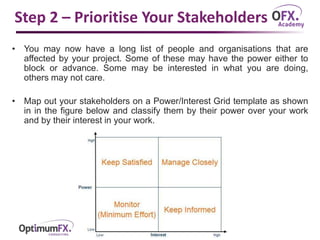
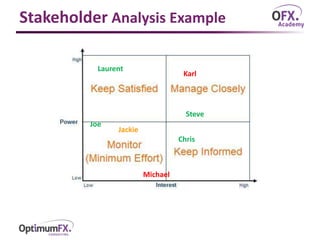
• Map out your stakeholders on a Power/Interest Grid template as shown
in in the figure below and classify them by their power over your work
and by their interest in your work.
Step 2 – Prioritise Your Stakeholders
For example, your boss is likely to have high power and influence over your projects and
high interest. Another department may have high interest, but maybe they may no have
power over it.
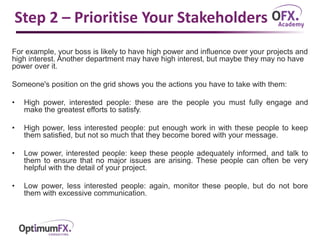
Someone's position on the grid shows you the actions you have to take with them:
• High power, interested people: these are the people you must fully engage and
make the greatest efforts to satisfy.
• High power, less interested people: put enough work in with these people to keep
them satisfied, but not so much that they become bored with your message.
• Low power, interested people: keep these people adequately informed, and talk to
them to ensure that no major issues are arising. These people can often be very
helpful with the detail of your project.
• Low power, less interested people: again, monitor these people, but do not bore
them with excessive communication.
Step 3 – Understand Your Key Stakeholders
• You now need to know more about your key stakeholders. You need to know how
they are likely to feel about and react to your project. You also need to know how
best to engage them in your project and how best to communicate with them.
• Key questions that can help you understand your stakeholders are:
– What financial or emotional interest do they have in the outcome of your work? Is it positive
or negative?
– What motivates them most of all?
– What information do they want from you?
– How do they want to receive information from you? What is the best way of communicating
your message to them?
– What is their current opinion of your project? Is it based on good information?
– Who influences their opinions generally, and who influences their opinion of you? Do some
of these influencers therefore become important stakeholders in their own right?
– If they are not likely to be positive, what will win them around to support your project?
– If you don't think you will be able to win them around, how will you manage their
opposition?
– Who else might be influenced by their opinions? Do these people become stakeholders in
their own right?
Step 3 – Understand Your Key Stakeholders
• A very good way of answering these questions is to talk
to your stakeholders directly – people are often quite
open about their views, and asking people's opinions is
often the first step in building a successful relationship
with them.
• You can summarise the understanding you have gained
on the stakeholder map, so that you can easily see
– which stakeholders are expected to be blockers or critics and
– which stakeholders are likely to be advocates and supporters or your
project.
A good way of doing this is by colour coding: showing advocates and
supporters in green, blockers and critics in red, and others who are neutral
in orange.
Stakeholder Analysis Example
Laurent
Chris
Karl
Jackie
Steve
Michael
Joe
Key Points
• As your projects become more important, you will affect more
and more people. Some of these people have the power to
undermine your projects and your position. Others may be strong
supporters of your work.
• Stakeholder Management is the process by which you identify
your key stakeholders and win their support.
• Stakeholder Analysis is the first stage of this, where you identify
and start to understand your most important stakeholders.
• The first stage of this is brainstorm who your stakeholders are.
The next step is to prioritise them by power and interest, and to
plot this on a Power/Interest grid. The final stage is to get an
understanding of what motivates your stakeholders and how you
need to win them around.
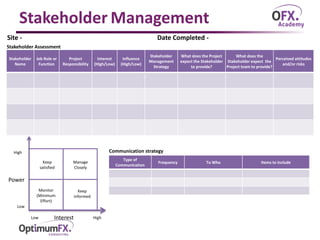
Stakeholder Management
Stakeholder
Name
Job Role or
Function
Project
Responsibility
Interest
(High/Low)
Influence
(High/Low)
Stakeholder
Management
Strategy
What does the Project
expect the Stakeholder
to provide?
What does the
Stakeholder expect the
Project team to provide?
Perceived attitudes
and/or risks
Site - Date Completed -
Interest
Power
High
HighLow
Low
Keep
satisfied
Manage
Closely
Monitor
(Minimum
Effort)
Keep
Informed
Type of
Communication
Frequency To Who Items to include
Communication strategy
Stakeholder Assessment

Stakeholder management

  • 1.
    Stakeholder Analysis andManagement www.optimumfx.com
  • 2.
    What is it? •Stakeholder Management is an important discipline that successful people use to win support from others. It helps them ensure that their projects succeed where others fail. • Stakeholder Analysis is the technique used to identify the key people who have to be won over. You then use Stakeholder Planning to build the support that helps you succeed.
  • 3.
    Benefits The benefits ofusing a stakeholder-based approach are that: • You can use the opinions of the most powerful stakeholders to shape your projects at an early stage. Not only does this make it more likely that they will support you, their input can also improve the quality of your project • Gaining support from powerful stakeholders can help you to win more resources – this makes it more likely that your projects will be successful • By communicating with stakeholders early and frequently, you can ensure that they fully understand what you are doing and understand the benefits of your project – this means they can support you actively when necessary • You can anticipate what people's reaction to your project may be, and build into your plan the actions that will win people's support
  • 4.
    How to Usethe Tool 1. The first step in Stakeholder Analysis is to identify who your stakeholders are 2. The next step is to work out their power, influence and interest, so you know who you should focus on 3. The final step is to develop a good understanding of the most important stakeholders so that you know how they are likely to respond, and so that you can work out how to win their support You can record this analysis on a stakeholder map After you have used this tool and created a stakeholder map, you can use the stakeholder planning tool to plan how you will communicate with each stakeholder
  • 5.
    Step 1 –Identify Your Stakeholders • The first step in your stakeholder analysis is to brainstorm who your stakeholders are. As part of this, think of all the people who are affected by your project, who have influence or power over it, or have an interest in its successful or unsuccessful conclusion.
  • 6.
    Step 2 –Prioritise Your Stakeholders • You may now have a long list of people and organisations that are affected by your project. Some of these may have the power either to block or advance. Some may be interested in what you are doing, others may not care. • Map out your stakeholders on a Power/Interest Grid template as shown in in the figure below and classify them by their power over your work and by their interest in your work.
  • 7.
    Step 2 –Prioritise Your Stakeholders For example, your boss is likely to have high power and influence over your projects and high interest. Another department may have high interest, but maybe they may no have power over it. Someone's position on the grid shows you the actions you have to take with them: • High power, interested people: these are the people you must fully engage and make the greatest efforts to satisfy. • High power, less interested people: put enough work in with these people to keep them satisfied, but not so much that they become bored with your message. • Low power, interested people: keep these people adequately informed, and talk to them to ensure that no major issues are arising. These people can often be very helpful with the detail of your project. • Low power, less interested people: again, monitor these people, but do not bore them with excessive communication.
  • 8.
    Step 3 –Understand Your Key Stakeholders • You now need to know more about your key stakeholders. You need to know how they are likely to feel about and react to your project. You also need to know how best to engage them in your project and how best to communicate with them. • Key questions that can help you understand your stakeholders are: – What financial or emotional interest do they have in the outcome of your work? Is it positive or negative? – What motivates them most of all? – What information do they want from you? – How do they want to receive information from you? What is the best way of communicating your message to them? – What is their current opinion of your project? Is it based on good information? – Who influences their opinions generally, and who influences their opinion of you? Do some of these influencers therefore become important stakeholders in their own right? – If they are not likely to be positive, what will win them around to support your project? – If you don't think you will be able to win them around, how will you manage their opposition? – Who else might be influenced by their opinions? Do these people become stakeholders in their own right?
  • 9.
    Step 3 –Understand Your Key Stakeholders • A very good way of answering these questions is to talk to your stakeholders directly – people are often quite open about their views, and asking people's opinions is often the first step in building a successful relationship with them. • You can summarise the understanding you have gained on the stakeholder map, so that you can easily see – which stakeholders are expected to be blockers or critics and – which stakeholders are likely to be advocates and supporters or your project. A good way of doing this is by colour coding: showing advocates and supporters in green, blockers and critics in red, and others who are neutral in orange.
  • 10.
  • 11.
    Key Points • Asyour projects become more important, you will affect more and more people. Some of these people have the power to undermine your projects and your position. Others may be strong supporters of your work. • Stakeholder Management is the process by which you identify your key stakeholders and win their support. • Stakeholder Analysis is the first stage of this, where you identify and start to understand your most important stakeholders. • The first stage of this is brainstorm who your stakeholders are. The next step is to prioritise them by power and interest, and to plot this on a Power/Interest grid. The final stage is to get an understanding of what motivates your stakeholders and how you need to win them around.
  • 12.
    Stakeholder Management Stakeholder Name Job Roleor Function Project Responsibility Interest (High/Low) Influence (High/Low) Stakeholder Management Strategy What does the Project expect the Stakeholder to provide? What does the Stakeholder expect the Project team to provide? Perceived attitudes and/or risks Site - Date Completed - Interest Power High HighLow Low Keep satisfied Manage Closely Monitor (Minimum Effort) Keep Informed Type of Communication Frequency To Who Items to include Communication strategy Stakeholder Assessment