Service and Loyalty Models


         Prepared by Steve Raybould   1
Service / Loyalty Models:
• Jones and Sasser: Apostle Model
• Christopher, Payne and Ballantyne:
  Segmented Service Strategy
• HBR’s Service-Profit Chain (Heskett & Sasser)
• Gallup’s ‘Human Sigma’ © Chain
• Hay Group’s 7-circle business model


                   Prepared by Steve Raybould     2
The ‘Apostle’ Model


                        Source:
           "Why Satisfied Customers Defect"
       by Thomas O. Jones and W. Earl Sasser, Jr.
in Harvard Business Review, November-December 1995.


             Prepared by Steve Raybould               3
Is every ‘loyal’ customer a satisfied
               customer?
• Is customer loyalty always a product of
  customer satisfaction and the successful
  handling of complaints?
• Jones and Sasser say it’s not necessarily so.
• Their model suggests that we need to
  understand a customer’s real reason for
  staying with us.
• Their idea has become known as the ‘Apostle
  Model’
                   Prepared by Steve Raybould     4
Customer types in the ‘Apostle Model’
                          Satisfaction

            High


                                         Loyalist /
                   Hostage
                                          Apostle
  Loyalty


                   Defector /
                                       Mercenary
                    Terrorist


            Low                                       High

                       Prepared by Steve Raybould            5
Customer Types:

• Loyalist/Apostle - high loyalty, high satisfaction -
  "staying and supportive"
• Mercenary - low to medium loyalty, high
  satisfaction - "coming and going; low
  commitment"
• Defector/Terrorist - low to medium loyalty, low
  to medium satisfaction - "leaving or having left
  and unhappy"
• Hostage - high loyalty, low to medium satisfaction
  - "unable to switch; trapped"
                     Prepared by Steve Raybould      6
Some examples:
• Loyalist/Apostle – Customers that keep coming
  back, even though they may try others.
• Mercenary – Customers may be ‘satisfied’, but
  are still on the look out for a better deal.
• Defector/Terrorist – Customers with higher
  expectations or generally not happy and
  constantly change product / brand.
• Hostage – Customers tolerating ‘the best of a bad
  lot’, or high costs of changing supplier.
                    Prepared by Steve Raybould    7
For which products do you fit the
           customer types?
• Loyalist/Apostle –

• Mercenary –

• Defector/Terrorist –

• Hostage –

                  Prepared by Steve Raybould   8
The segmented service strategy


                                Source:
   : ‘Relationship Marketing’ by Christopher, Payne and Ballantyne.
                 Published by Butterworth Heinemann


                      Prepared by Steve Raybould                      9
What is the segmented service
               strategy?
• It is a way of identifying, prioritising customer
  requirements.
• The segmented service strategy consists of
  four stages


                    Prepared by Steve Raybould        10
The four stages of the segmented
         service strategy
               1: Define the market
                     structure


           2: Segment customer base
          and determine segment value


           3: Identify segments’ service
                        needs


             4: Implement segmental
                  service strategy

            Prepared by Steve Raybould     11
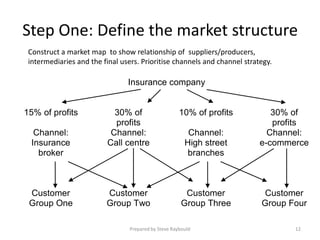
Step One: Define the market structure
 Construct a market map to show relationship of suppliers/producers,
 intermediaries and the final users. Prioritise channels and channel strategy.

                                Insurance company


15% of profits              30% of                    10% of profits         30% of
                            profits                                          profits
   Channel:                Channel:                      Channel:           Channel:
  Insurance               Call centre                   High street       e-commerce
    broker                                               branches


 Customer                Customer                       Customer          Customer
 Group One               Group Two                     Group Three        Group Four

                                 Prepared by Steve Raybould                      12
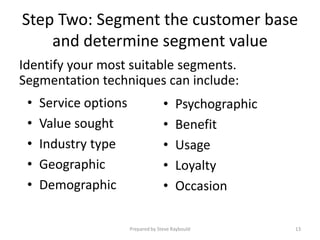
Step Two: Segment the customer base
    and determine segment value
Identify your most suitable segments.
Segmentation techniques can include:
 •   Service options                 •    Psychographic
 •   Value sought                    •    Benefit
 •   Industry type                   •    Usage
 •   Geographic                      •    Loyalty
 •   Demographic                     •    Occasion

                       Prepared by Steve Raybould         13
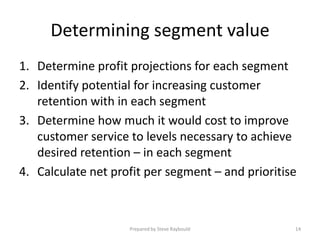
Determining segment value
1. Determine profit projections for each segment
2. Identify potential for increasing customer
   retention with in each segment
3. Determine how much it would cost to improve
   customer service to levels necessary to achieve
   desired retention – in each segment
4. Calculate net profit per segment – and prioritise


                    Prepared by Steve Raybould     14
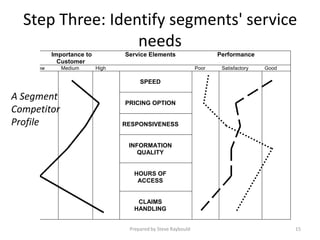
Step Three: Identify segments' service
                  needs
          Importance to          Service Elements                     Performance
            Customer
    Low      Medium       High                                 Poor    Satisfactory   Good

                                      SPEED

A Segment
                                 PRICING OPTION
Competitor
Profile                          RESPONSIVENESS


                                  INFORMATION
                                     QUALITY


                                   HOURS OF
                                    ACCESS


                                    CLAIMS
                                   HANDLING


                                  Prepared by Steve Raybould                                 15
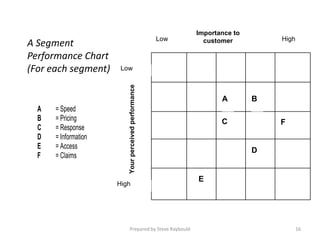
Importance to
                                                      Low     customer          High
A Segment
Performance Chart
(For each segment)     Low


                         Your perceived performance
                                                                   A        B
  A   = Speed
  B   = Pricing                                                    C            F
  C   = Response
  D   = Information
  E   = Access
                                                                            D
  F   = Claims

                                                            E
                      High


                          Prepared by Steve Raybould                                   16
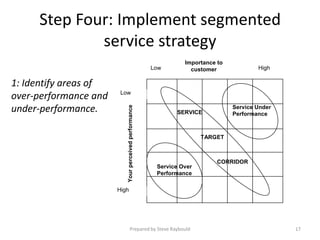
Step Four: Implement segmented
             service strategy
                                                                 Importance to
                                                       Low         customer              High

1: Identify areas of
                        Low
over-performance and
under-performance.
                          Your perceived performance
                                                                                 Service Under
                                                              SERVICE            Performance


                                                                       TARGET


                                                                            CORRIDOR
                                                        Service Over
                                                        Performance

                       High


                                  Prepared by Steve Raybould                                     17
2: Identify costs of improving
selective service levels and fit with
organisation’s capabilities.

 Five areas for developing strategies:
 1. Good performance in services valued by
    attractive customer segments
 2. Invest in potentially profitable areas
 3. Reduce investment in less attractive segments
 4. Withdraw from areas of poor performance in
    low profitable segments
 5. Decide whether to commit in areas of poor
    performance in attractive segments

                             Prepared by Steve Raybould   18
Factors to consider:
• Matching segment performance to the organisation's
  capabilities
• Identify savings by reducing levels of service in areas of
  over-performance
• Re-allocate expenditure to improve levels of service in
  areas of under performance
• Estimate the additional costs required to achieve the
  customer retention targets identified in Step Two
• Identify potential lifetime profits of segments in 'net'
  terms. (Potential 'gross' profits minus the expenditure
  needed to improve customer retention)
• Determine segment prioritisation

                       Prepared by Steve Raybould         19
3: Finalise the segmented service
strategy
 Identify:
 • Your organisation's 'offer' in strategic terms, and
 the rationale behind it.
 • Which segments are you going to focus on, within
 each channel
 • The overall lifetime profit improvement based on
 the selective improvement of service, and the
 resulting improved customer retention
 • A clear way of measuring your service
 performance, so that levels of customer service can
 be monitored and reviewed

                           Prepared by Steve Raybould   20
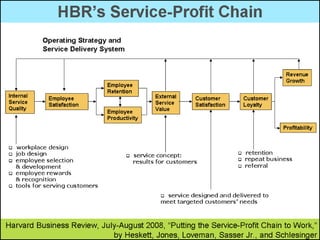
Harvard Business Review
Article “Putting the Service-Profit Chain to
Work” published in 1994 and 1998.
(Authors: James L. Heskett, Thomas O. Jones,
Gary W. Loveman, W. Earl Sasser, Jr., and
Leonard A. Schlesinger)
Emphasises value of designing a workplace
environment that creates satisfied, productive
employees.

                   Prepared by Steve Raybould    21
Prepared by Steve Raybould   22
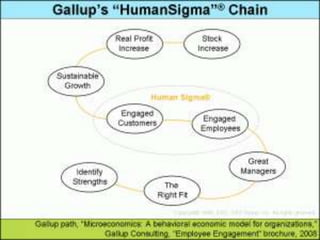
The Gallup ‘Employee Engagement’
• Great managers contribute to engaged
  employees
• Emphasizes the human / employee element as
  the gate to stronger profits.
• Uses Gallup’s ‘Human Sigma’© concept which
  focuses on managing the employee-customer
  encounter


                 Prepared by Steve Raybould   23
Prepared by Steve Raybould   24
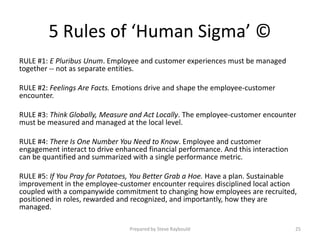
5 Rules of ‘Human Sigma’ ©
RULE #1: E Pluribus Unum. Employee and customer experiences must be managed
together -- not as separate entities.

RULE #2: Feelings Are Facts. Emotions drive and shape the employee-customer
encounter.

RULE #3: Think Globally, Measure and Act Locally. The employee-customer encounter
must be measured and managed at the local level.

RULE #4: There Is One Number You Need to Know. Employee and customer
engagement interact to drive enhanced financial performance. And this interaction
can be quantified and summarized with a single performance metric.

RULE #5: If You Pray for Potatoes, You Better Grab a Hoe. Have a plan. Sustainable
improvement in the employee-customer encounter requires disciplined local action
coupled with a companywide commitment to changing how employees are recruited,
positioned in roles, rewarded and recognized, and importantly, how they are
managed.

                                 Prepared by Steve Raybould                         25
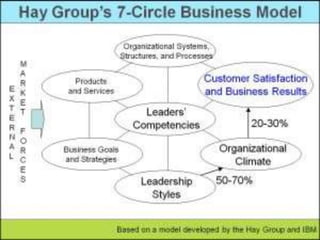
The Hay Group 7-circle business model
• Reinforces the importance of leaders’ styles
  and competencies when creating an engaging
  organizational climate for employees.
• Hay Group’s research shows that 20 to 30% of
  the variance in revenue and profit in
  organizations can be attributed to the
  differences in organizational climate.
  (Leadership competencies, leadership styles,
  etc.)

                  Prepared by Steve Raybould   26
Prepared by Steve Raybould   27

Service-Loyalty models

  • 1.
    Service and LoyaltyModels Prepared by Steve Raybould 1
  • 2.
    Service / LoyaltyModels: • Jones and Sasser: Apostle Model • Christopher, Payne and Ballantyne: Segmented Service Strategy • HBR’s Service-Profit Chain (Heskett & Sasser) • Gallup’s ‘Human Sigma’ © Chain • Hay Group’s 7-circle business model Prepared by Steve Raybould 2
  • 3.
    The ‘Apostle’ Model Source: "Why Satisfied Customers Defect" by Thomas O. Jones and W. Earl Sasser, Jr. in Harvard Business Review, November-December 1995. Prepared by Steve Raybould 3
  • 4.
    Is every ‘loyal’customer a satisfied customer? • Is customer loyalty always a product of customer satisfaction and the successful handling of complaints? • Jones and Sasser say it’s not necessarily so. • Their model suggests that we need to understand a customer’s real reason for staying with us. • Their idea has become known as the ‘Apostle Model’ Prepared by Steve Raybould 4
  • 5.
    Customer types inthe ‘Apostle Model’ Satisfaction High Loyalist / Hostage Apostle Loyalty Defector / Mercenary Terrorist Low High Prepared by Steve Raybould 5
  • 6.
    Customer Types: • Loyalist/Apostle- high loyalty, high satisfaction - "staying and supportive" • Mercenary - low to medium loyalty, high satisfaction - "coming and going; low commitment" • Defector/Terrorist - low to medium loyalty, low to medium satisfaction - "leaving or having left and unhappy" • Hostage - high loyalty, low to medium satisfaction - "unable to switch; trapped" Prepared by Steve Raybould 6
  • 7.
    Some examples: • Loyalist/Apostle– Customers that keep coming back, even though they may try others. • Mercenary – Customers may be ‘satisfied’, but are still on the look out for a better deal. • Defector/Terrorist – Customers with higher expectations or generally not happy and constantly change product / brand. • Hostage – Customers tolerating ‘the best of a bad lot’, or high costs of changing supplier. Prepared by Steve Raybould 7
  • 8.
    For which productsdo you fit the customer types? • Loyalist/Apostle – • Mercenary – • Defector/Terrorist – • Hostage – Prepared by Steve Raybould 8
  • 9.
    The segmented servicestrategy Source: : ‘Relationship Marketing’ by Christopher, Payne and Ballantyne. Published by Butterworth Heinemann Prepared by Steve Raybould 9
  • 10.
    What is thesegmented service strategy? • It is a way of identifying, prioritising customer requirements. • The segmented service strategy consists of four stages Prepared by Steve Raybould 10
  • 11.
    The four stagesof the segmented service strategy 1: Define the market structure 2: Segment customer base and determine segment value 3: Identify segments’ service needs 4: Implement segmental service strategy Prepared by Steve Raybould 11
  • 12.
    Step One: Definethe market structure Construct a market map to show relationship of suppliers/producers, intermediaries and the final users. Prioritise channels and channel strategy. Insurance company 15% of profits 30% of 10% of profits 30% of profits profits Channel: Channel: Channel: Channel: Insurance Call centre High street e-commerce broker branches Customer Customer Customer Customer Group One Group Two Group Three Group Four Prepared by Steve Raybould 12
  • 13.
    Step Two: Segmentthe customer base and determine segment value Identify your most suitable segments. Segmentation techniques can include: • Service options • Psychographic • Value sought • Benefit • Industry type • Usage • Geographic • Loyalty • Demographic • Occasion Prepared by Steve Raybould 13
  • 14.
    Determining segment value 1.Determine profit projections for each segment 2. Identify potential for increasing customer retention with in each segment 3. Determine how much it would cost to improve customer service to levels necessary to achieve desired retention – in each segment 4. Calculate net profit per segment – and prioritise Prepared by Steve Raybould 14
  • 15.
    Step Three: Identifysegments' service needs Importance to Service Elements Performance Customer Low Medium High Poor Satisfactory Good SPEED A Segment PRICING OPTION Competitor Profile RESPONSIVENESS INFORMATION QUALITY HOURS OF ACCESS CLAIMS HANDLING Prepared by Steve Raybould 15
  • 16.
    Importance to Low customer High A Segment Performance Chart (For each segment) Low Your perceived performance A B A = Speed B = Pricing C F C = Response D = Information E = Access D F = Claims E High Prepared by Steve Raybould 16
  • 17.
    Step Four: Implementsegmented service strategy Importance to Low customer High 1: Identify areas of Low over-performance and under-performance. Your perceived performance Service Under SERVICE Performance TARGET CORRIDOR Service Over Performance High Prepared by Steve Raybould 17
  • 18.
    2: Identify costsof improving selective service levels and fit with organisation’s capabilities. Five areas for developing strategies: 1. Good performance in services valued by attractive customer segments 2. Invest in potentially profitable areas 3. Reduce investment in less attractive segments 4. Withdraw from areas of poor performance in low profitable segments 5. Decide whether to commit in areas of poor performance in attractive segments Prepared by Steve Raybould 18
  • 19.
    Factors to consider: •Matching segment performance to the organisation's capabilities • Identify savings by reducing levels of service in areas of over-performance • Re-allocate expenditure to improve levels of service in areas of under performance • Estimate the additional costs required to achieve the customer retention targets identified in Step Two • Identify potential lifetime profits of segments in 'net' terms. (Potential 'gross' profits minus the expenditure needed to improve customer retention) • Determine segment prioritisation Prepared by Steve Raybould 19
  • 20.
    3: Finalise thesegmented service strategy Identify: • Your organisation's 'offer' in strategic terms, and the rationale behind it. • Which segments are you going to focus on, within each channel • The overall lifetime profit improvement based on the selective improvement of service, and the resulting improved customer retention • A clear way of measuring your service performance, so that levels of customer service can be monitored and reviewed Prepared by Steve Raybould 20
  • 21.
    Harvard Business Review Article“Putting the Service-Profit Chain to Work” published in 1994 and 1998. (Authors: James L. Heskett, Thomas O. Jones, Gary W. Loveman, W. Earl Sasser, Jr., and Leonard A. Schlesinger) Emphasises value of designing a workplace environment that creates satisfied, productive employees. Prepared by Steve Raybould 21
  • 22.
    Prepared by SteveRaybould 22
  • 23.
    The Gallup ‘EmployeeEngagement’ • Great managers contribute to engaged employees • Emphasizes the human / employee element as the gate to stronger profits. • Uses Gallup’s ‘Human Sigma’© concept which focuses on managing the employee-customer encounter Prepared by Steve Raybould 23
  • 24.
    Prepared by SteveRaybould 24
  • 25.
    5 Rules of‘Human Sigma’ © RULE #1: E Pluribus Unum. Employee and customer experiences must be managed together -- not as separate entities. RULE #2: Feelings Are Facts. Emotions drive and shape the employee-customer encounter. RULE #3: Think Globally, Measure and Act Locally. The employee-customer encounter must be measured and managed at the local level. RULE #4: There Is One Number You Need to Know. Employee and customer engagement interact to drive enhanced financial performance. And this interaction can be quantified and summarized with a single performance metric. RULE #5: If You Pray for Potatoes, You Better Grab a Hoe. Have a plan. Sustainable improvement in the employee-customer encounter requires disciplined local action coupled with a companywide commitment to changing how employees are recruited, positioned in roles, rewarded and recognized, and importantly, how they are managed. Prepared by Steve Raybould 25
  • 26.
    The Hay Group7-circle business model • Reinforces the importance of leaders’ styles and competencies when creating an engaging organizational climate for employees. • Hay Group’s research shows that 20 to 30% of the variance in revenue and profit in organizations can be attributed to the differences in organizational climate. (Leadership competencies, leadership styles, etc.) Prepared by Steve Raybould 26
  • 27.
    Prepared by SteveRaybould 27