PUBLIC PARTICIPATION
AND COMMUNITY
DEVELOPMENT
Submitted to
MS Rumana Khan Shirwani
(Assistant Professor)
Submitted By
Asra Hafeez
(F2017214008)
Department of City and Regional Planning
School of Architecture and Planning
University of Management and Technology, Lahore
Spring, 2019
1
TABLE OF CONTENTS
1. Definition…………………………………...………………………………2
2. Aim………………………………………………………………………….2
3. Types……………………………………………………………………...3-5
4. Methodology……………………………………………………………….6
5. Identification of Stakeholder……………………………………………...7
6. Benefits of Stakeholder Analysis……………………………………....7-8
7. Stakeholder Analysis Power Interest Matrix………………………….8-9
8. Stakeholder Analysis and Change Management……………………....10
9. Disadvantages………………………………………………………....10-11
10.Stakeholder Analysis of Allama Iqbal Town Project……………….12-13
2
STAKEHOLDER ANALYSIS
DEFINITION
 A stakeholder analysis is a process of identifying these people before the project
begins; grouping them according to their levels of participation, interest, and
influence in the project; and determining how best to involve and communicate
each of these stakeholder groups throughout.
 Stakeholder analysis is the process of assessing a system and potential changes
to it as they relate to relevant and interested parties. This information is used to
assess how the interests of those stakeholders should be addressed in a project
plan, policy, program, or other action.
AIM
Stakeholder analysis aims to evaluate and understand stakeholders from the
perspective of an organization, or to determine their relevance to a project or
policy. In carrying out the analysis, questions are asked about the position,
interest, influence, interrelations, networks and other characteristics of
stakeholders, with reference to their past, present positions and future potential.
3
TYPES
There are 3 types of stakeholders which are the followings:
1. Primary Stakeholders
2. Secondary Stakeholders
3. Tertiary Stakeholders
PRIMARY STAKEHOLDERS
Primary stakeholders may include customers, employees, stockholders, creditors,
suppliers, or anyone else with a functional or financial interest in the product or
situation. Also called market stakeholder.
SECONDARY STAKEHOLLDER
Secondary stakeholders are usually external stakeholders, although they do not
engage in direct economic exchange with the business – are affected by or can
affect its actions (for example the general public, communities, activist groups,
business support groups, and the media).
TERTIARY STAKEHOLDER
Tertiary stakeholders are external actors who neither make business decisions
nor benefit directly from the operations or products of the business, but
nonetheless have the ability to influence these decisions.
4
FACILITATING STAKEHOLDER
Facilitation means enabling members of a group to take part in a process in
an effective way. Facilitation process brings together different stakeholders
who have an interest in a problem situation and engages them in processes
of dialogue and collective learning that can improve innovation, decision-
making and action.
EXTERNAL STAKEHOLDERS
External stakeholders are groups outside a business or people who don't
work inside the business but are affected in some way by the decisions and
actions of the business. Examples of external stakeholders are customers,
suppliers, creditors, the local community, society, and the government.
INTERNAL STAKEHOLDERS
Internal stakeholders are entities within a business (e.g., employees,
managers, the board of directors, investors). External stakeholders are
entities not within a business itself but who care about or are affected by its
performance (e.g., consumers, regulators, investors, suppliers).
5
Figure 1: Stakeholders Types
Figure 2: Stakeholder Types
Figure 3: Stakeholder Types
6
METHODOLOGY
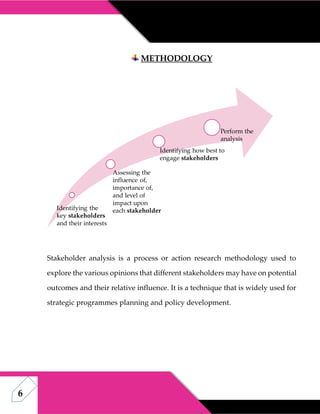
Stakeholder analysis is a process or action research methodology used to
explore the various opinions that different stakeholders may have on potential
outcomes and their relative influence. It is a technique that is widely used for
strategic programmes planning and policy development.
Identifying the
key stakeholders
and their interests
Assessing the
influence of,
importance of,
and level of
impact upon
each stakeholder
Identifying how best to
engage stakeholders
Perform the
analysis
7
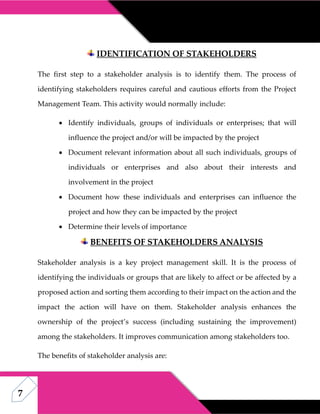
IDENTIFICATION OF STAKEHOLDERS
The first step to a stakeholder analysis is to identify them. The process of
identifying stakeholders requires careful and cautious efforts from the Project
Management Team. This activity would normally include:
 Identify individuals, groups of individuals or enterprises; that will
influence the project and/or will be impacted by the project
 Document relevant information about all such individuals, groups of
individuals or enterprises and also about their interests and
involvement in the project
 Document how these individuals and enterprises can influence the
project and how they can be impacted by the project
 Determine their levels of importance
BENEFITS OF STAKEHOLDERS ANALYSIS
Stakeholder analysis is a key project management skill. It is the process of
identifying the individuals or groups that are likely to affect or be affected by a
proposed action and sorting them according to their impact on the action and the
impact the action will have on them. Stakeholder analysis enhances the
ownership of the project’s success (including sustaining the improvement)
among the stakeholders. It improves communication among stakeholders too.
The benefits of stakeholder analysis are:
8
 You can identify the most powerful stakeholders and have them help
shape your project in its early stages. This will ensure their buy-in,
secure their support, not to mention the valuable input they could give.
 When you gain support from your most powerful stakeholders, you will
win more resources – making your project more successful.
 Communicating frequently with your stakeholders will help them to
fully understand what’s going on with the project and how they can
support you.
 A good stakeholder analysis will show you how people will react to
changes due to your project and will guide you to win over difficult
stakeholders.
 A Project Stakeholder Analysis Worksheet should be used early on in a
project, to help the team develop a communication strategy and ideas
for keeping those outside the team informed of the team’s progress.
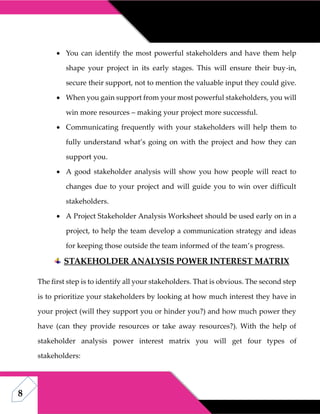
STAKEHOLDER ANALYSIS POWER INTEREST MATRIX
The first step is to identify all your stakeholders. That is obvious. The second step
is to prioritize your stakeholders by looking at how much interest they have in
your project (will they support you or hinder you?) and how much power they
have (can they provide resources or take away resources?). With the help of
stakeholder analysis power interest matrix you will get four types of
stakeholders:
9
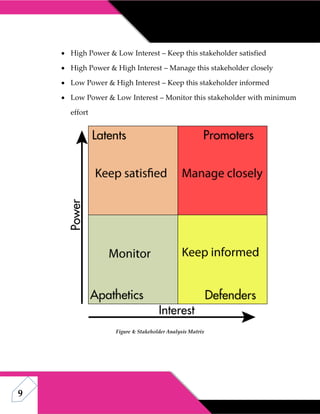
 High Power & Low Interest – Keep this stakeholder satisfied
 High Power & High Interest – Manage this stakeholder closely
 Low Power & High Interest – Keep this stakeholder informed
 Low Power & Low Interest – Monitor this stakeholder with minimum
effort
Figure 4: Stakeholder Analysis Matrix
10
STAKEHOLDER ANALYSIS CHANGE MAANGEMENT
The most important outcome of a stakeholder analysis is to know which
stakeholders will support you and which stakeholders are likely to block you. If
you know this, you can manage your stakeholders accordingly. Based on your
stakeholder analysis you will be able to anticipate which stakeholders will
require some change management as you progress through your project. Not
everyone is open to improvement projects, and not everyone believes that the
improvement will really better your results. Embarking on a Six Sigma project is
not to be laughed at, Pand many stakeholders might disagree with the resources
allocated to the project. If you have done a proper stakeholder analysis, you will
know who the important nay-sayers are and how to appeal to them.
DISADVANTAGES OF STAKEHOLDER ANALYSIS
Ideally, a Stakeholder Analysis should be performed regularly or even
continuously, since the relevant stakeholders, their power and associations may
change quickly. Note that the management of an organization has to assess the
position of each stakeholder. It is the subjective perception of management that
will ultimately decide the way in which the organization will act towards its
stakeholders. It is normally impossible for management to satisfy all demands
of all stakeholders completely. Therefore managing becomes a balancing act or
even a reconciliation or synthesizing act, with the following options:
11
 Focusing on one leading stakeholder group, and satisfying all others to
the extent which is necessary or possible. The leading stakeholder
group could be the owners or stockholders (Shareholder Value
Perspective) or even the managers themselves.
 Trying to balance or reconcile or synthesize all interests according to
their weight, importance or urgency (Stakeholder Value Perspective).
12
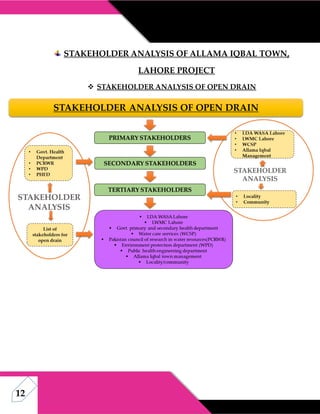
STAKEHOLDER ANALYSIS OF ALLAMA IQBAL TOWN,
LAHORE PROJECT
 STAKEHOLDER ANALYSIS OF OPEN DRAIN
13
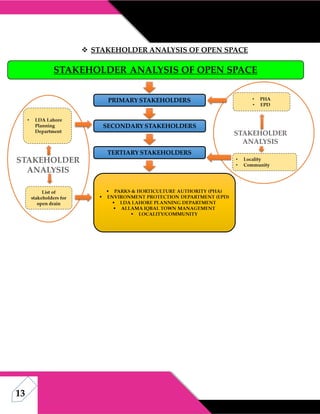
 STAKEHOLDER ANALYSIS OF OPEN SPACE

Stakeholder Analysis

  • 1.
    PUBLIC PARTICIPATION AND COMMUNITY DEVELOPMENT Submittedto MS Rumana Khan Shirwani (Assistant Professor) Submitted By Asra Hafeez (F2017214008) Department of City and Regional Planning School of Architecture and Planning University of Management and Technology, Lahore Spring, 2019
  • 2.
    1 TABLE OF CONTENTS 1.Definition…………………………………...………………………………2 2. Aim………………………………………………………………………….2 3. Types……………………………………………………………………...3-5 4. Methodology……………………………………………………………….6 5. Identification of Stakeholder……………………………………………...7 6. Benefits of Stakeholder Analysis……………………………………....7-8 7. Stakeholder Analysis Power Interest Matrix………………………….8-9 8. Stakeholder Analysis and Change Management……………………....10 9. Disadvantages………………………………………………………....10-11 10.Stakeholder Analysis of Allama Iqbal Town Project……………….12-13
  • 3.
    2 STAKEHOLDER ANALYSIS DEFINITION  Astakeholder analysis is a process of identifying these people before the project begins; grouping them according to their levels of participation, interest, and influence in the project; and determining how best to involve and communicate each of these stakeholder groups throughout.  Stakeholder analysis is the process of assessing a system and potential changes to it as they relate to relevant and interested parties. This information is used to assess how the interests of those stakeholders should be addressed in a project plan, policy, program, or other action. AIM Stakeholder analysis aims to evaluate and understand stakeholders from the perspective of an organization, or to determine their relevance to a project or policy. In carrying out the analysis, questions are asked about the position, interest, influence, interrelations, networks and other characteristics of stakeholders, with reference to their past, present positions and future potential.
  • 4.
    3 TYPES There are 3types of stakeholders which are the followings: 1. Primary Stakeholders 2. Secondary Stakeholders 3. Tertiary Stakeholders PRIMARY STAKEHOLDERS Primary stakeholders may include customers, employees, stockholders, creditors, suppliers, or anyone else with a functional or financial interest in the product or situation. Also called market stakeholder. SECONDARY STAKEHOLLDER Secondary stakeholders are usually external stakeholders, although they do not engage in direct economic exchange with the business – are affected by or can affect its actions (for example the general public, communities, activist groups, business support groups, and the media). TERTIARY STAKEHOLDER Tertiary stakeholders are external actors who neither make business decisions nor benefit directly from the operations or products of the business, but nonetheless have the ability to influence these decisions.
  • 5.
    4 FACILITATING STAKEHOLDER Facilitation meansenabling members of a group to take part in a process in an effective way. Facilitation process brings together different stakeholders who have an interest in a problem situation and engages them in processes of dialogue and collective learning that can improve innovation, decision- making and action. EXTERNAL STAKEHOLDERS External stakeholders are groups outside a business or people who don't work inside the business but are affected in some way by the decisions and actions of the business. Examples of external stakeholders are customers, suppliers, creditors, the local community, society, and the government. INTERNAL STAKEHOLDERS Internal stakeholders are entities within a business (e.g., employees, managers, the board of directors, investors). External stakeholders are entities not within a business itself but who care about or are affected by its performance (e.g., consumers, regulators, investors, suppliers).
  • 6.
    5 Figure 1: StakeholdersTypes Figure 2: Stakeholder Types Figure 3: Stakeholder Types
  • 7.
    6 METHODOLOGY Stakeholder analysis isa process or action research methodology used to explore the various opinions that different stakeholders may have on potential outcomes and their relative influence. It is a technique that is widely used for strategic programmes planning and policy development. Identifying the key stakeholders and their interests Assessing the influence of, importance of, and level of impact upon each stakeholder Identifying how best to engage stakeholders Perform the analysis
  • 8.
    7 IDENTIFICATION OF STAKEHOLDERS Thefirst step to a stakeholder analysis is to identify them. The process of identifying stakeholders requires careful and cautious efforts from the Project Management Team. This activity would normally include:  Identify individuals, groups of individuals or enterprises; that will influence the project and/or will be impacted by the project  Document relevant information about all such individuals, groups of individuals or enterprises and also about their interests and involvement in the project  Document how these individuals and enterprises can influence the project and how they can be impacted by the project  Determine their levels of importance BENEFITS OF STAKEHOLDERS ANALYSIS Stakeholder analysis is a key project management skill. It is the process of identifying the individuals or groups that are likely to affect or be affected by a proposed action and sorting them according to their impact on the action and the impact the action will have on them. Stakeholder analysis enhances the ownership of the project’s success (including sustaining the improvement) among the stakeholders. It improves communication among stakeholders too. The benefits of stakeholder analysis are:
  • 9.
    8  You canidentify the most powerful stakeholders and have them help shape your project in its early stages. This will ensure their buy-in, secure their support, not to mention the valuable input they could give.  When you gain support from your most powerful stakeholders, you will win more resources – making your project more successful.  Communicating frequently with your stakeholders will help them to fully understand what’s going on with the project and how they can support you.  A good stakeholder analysis will show you how people will react to changes due to your project and will guide you to win over difficult stakeholders.  A Project Stakeholder Analysis Worksheet should be used early on in a project, to help the team develop a communication strategy and ideas for keeping those outside the team informed of the team’s progress. STAKEHOLDER ANALYSIS POWER INTEREST MATRIX The first step is to identify all your stakeholders. That is obvious. The second step is to prioritize your stakeholders by looking at how much interest they have in your project (will they support you or hinder you?) and how much power they have (can they provide resources or take away resources?). With the help of stakeholder analysis power interest matrix you will get four types of stakeholders:
  • 10.
    9  High Power& Low Interest – Keep this stakeholder satisfied  High Power & High Interest – Manage this stakeholder closely  Low Power & High Interest – Keep this stakeholder informed  Low Power & Low Interest – Monitor this stakeholder with minimum effort Figure 4: Stakeholder Analysis Matrix
  • 11.
    10 STAKEHOLDER ANALYSIS CHANGEMAANGEMENT The most important outcome of a stakeholder analysis is to know which stakeholders will support you and which stakeholders are likely to block you. If you know this, you can manage your stakeholders accordingly. Based on your stakeholder analysis you will be able to anticipate which stakeholders will require some change management as you progress through your project. Not everyone is open to improvement projects, and not everyone believes that the improvement will really better your results. Embarking on a Six Sigma project is not to be laughed at, Pand many stakeholders might disagree with the resources allocated to the project. If you have done a proper stakeholder analysis, you will know who the important nay-sayers are and how to appeal to them. DISADVANTAGES OF STAKEHOLDER ANALYSIS Ideally, a Stakeholder Analysis should be performed regularly or even continuously, since the relevant stakeholders, their power and associations may change quickly. Note that the management of an organization has to assess the position of each stakeholder. It is the subjective perception of management that will ultimately decide the way in which the organization will act towards its stakeholders. It is normally impossible for management to satisfy all demands of all stakeholders completely. Therefore managing becomes a balancing act or even a reconciliation or synthesizing act, with the following options:
  • 12.
    11  Focusing onone leading stakeholder group, and satisfying all others to the extent which is necessary or possible. The leading stakeholder group could be the owners or stockholders (Shareholder Value Perspective) or even the managers themselves.  Trying to balance or reconcile or synthesize all interests according to their weight, importance or urgency (Stakeholder Value Perspective).
  • 13.
    12 STAKEHOLDER ANALYSIS OFALLAMA IQBAL TOWN, LAHORE PROJECT  STAKEHOLDER ANALYSIS OF OPEN DRAIN
  • 14.