DR.MD SHAHID IQUBAL
Deptt of Medicine
NMCH,PATNA
INTRODUCTION
Definition-
Pulmonary hypertension (PH) is a spectrum of diseases
involving the pulmonary vasculature, and is defined as an
elevation in pulmonary arterial pressures (mean pulmonary
artery pressure >22 mmHg).
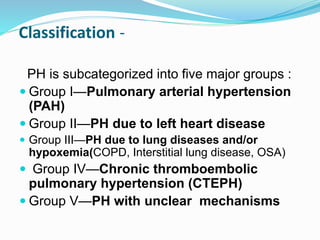
Classification -
PH is subcategorized into five major groups :
 Group I—Pulmonary arterial hypertension
(PAH)
 Group II—PH due to left heart disease
 Group III—PH due to lung diseases and/or
hypoxemia(COPD, Interstitial lung disease, OSA)
 Group IV—Chronic thromboembolic
pulmonary hypertension (CTEPH)
 Group V—PH with unclear mechanisms
Pulmonary Arterial Hypertension
 PAH is defined as a sustained elevation in resting
mPAP ≥25 mmHg, and PCWP or left ventricle end-
diastolic pressure of ≤15 mmHg based on a right heart
catheterization.
 Idiopathic pulmonary arterial hypertension (IPAH) is a
progressive disease that leads to right heart failure and
death
 PAH associated with HIV, connective tissue
disease(systemic sclerosis),and portal hypertension.
DIAGNOSIS
Clinical presentation-
Symptoms of PH-
 The symptoms of PH are often nonspecific and variable
 include dyspnea (most common),
 exercise intolerance,
 fatigue,
 palpitations,
 syncope,
 chest pain,
 lower extremity swelling,
DIAGNOSIS contd….
On examination-
evidence of right heart failure-
 elevated jugular venous pressure,
 lower extremity edema, and
 ascites.
cardiovascular examination-
 prominent second heart sound (loud S2) with loud P2
componentound, a right-sided S3 or S4, and a
holosystolic tricuspid regurgitant murmur
 clubbing in chronic lung diseases,
 sclerodactyly and telangiectasia in scleroderma, and
 crackles and systemic hypertension in left-sided systolic
or diastolic heart failure
Diagnostic Testing-
echocardiogram –(TTE)
 Is screening test
 Shows hypertrophied and dilated right ventricle with
elevated estimated pulmonary artery systolic
pressure
 Identify causes of PH -left ventricular systolic and
diastolic dysfunction, valvular disease
right heart catheterization -
 for definitive diagnosis
 Measure cardiac output and mean right atrial
pressure (RAP) and asses severity condition
Diagnostic Testing contd…
Chest x-ray-
 Large central pulmonary arteries with “vascular pruning,”
 Cardiomegaly due to enlarged RA ,RV
 Regional oligemia of pulmonary vasculature (chronic
thromboembolic disease)
 Interstitial infiltrates (ILD)
 Hyperinflated lungs(chronic obstructive lung disease).
HRCT-
 Enlarged pulmonary arteries ,
 peripheral pruning of the small vessels,and
 enlarged right ventricle and atrium
 Centrilobular ground-glass infiltrate
Ventilation–Perfusion (V/Q) lung scan-
 Used for excluding chronic thromboembolic disease
Diagnostic Testing contd…
 Pulmonary Function Testing-
Spirometry and lung volumes to assess for COPD or
restrictive- interstitial lung disease [ILD])
Diffusing capacity for carbon monoxide (DLCO)
reduced in parenchymal
 lung diseases
Arterial blood gas (ABG): Elevated PaCO2 is found in
hypoventilation syndrome.
Six-minute walk (6MW) or simple exercise test-
 to evaluate the degree of exertional hypoxemia and
 to monitor progression and response to therapy
Nocturnal oximetry:.
 Nocturnal desaturations is common finding in PH
 Nocturnal desaturations can be find in OSAS
Diagnostic Testing contd…
ECG-
 RVH,
 right atrial enlargement,
 right bundle branch block, and
 right ventricular strain pattern
Acute vasodilator testing.-
 Performed with a short-acting vasodilator, such as
intravenous adenosine, intravenous epoprostenol, or
inhaled nitric oxide
 Definition of a responder is decrease in mPAP by ≥10
mm Hg to an absolute level ≤ 40 mm Hg without a
decrese in CO.
 responders are considered for long-term treatment with
CCBs.
Diagnostic Testing contd…
Laboratories
 Complete blood counts (CBCs)
 Blood urea nitrogen, serum creatinine
 Hepatic function tests
 B-type natriuretic peptide (BNP)
 Human immunodeficiency virus (HIV) serology
 Thyroid-stimulating hormone (TSH)
 Antinuclear antibody (ANA)
 Antitopoisomerase antibodies and anticentromere
antibodies
 hepatitis B and C serologies
TREATMENT
General measures-
 Avoid pregnancy
 Immunization for respiratory illness
influenza and pneumovax vaccination
 Minimize valsalva maneuvers-increase risk of
syncope
cough, constipation,heavy lifting
 Should stop cigarette smoking
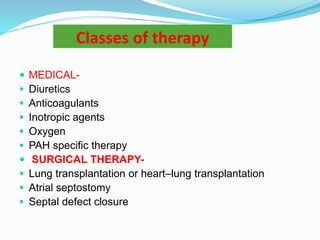
Classes of therapy
 MEDICAL-
 Diuretics
 Anticoagulants
 Inotropic agents
 Oxygen
 PAH specific therapy
 SURGICAL THERAPY-
 Lung transplantation or heart–lung transplantation
 Atrial septostomy
 Septal defect closure
Treatment contd…
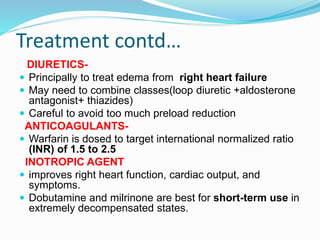
DIURETICS-
 Principally to treat edema from right heart failure
 May need to combine classes(loop diuretic +aldosterone
antagonist+ thiazides)
 Careful to avoid too much preload reduction
ANTICOAGULANTS-
 Warfarin is dosed to target international normalized ratio
(INR) of 1.5 to 2.5
INOTROPIC AGENT
 improves right heart function, cardiac output, and
symptoms.
 Dobutamine and milrinone are best for short-term use in
extremely decompensated states.
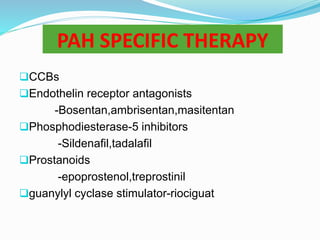
PAH SPECIFIC THERAPY
CCBs
Endothelin receptor antagonists
-Bosentan,ambrisentan,masitentan
Phosphodiesterase-5 inhibitors
-Sildenafil,tadalafil
Prostanoids
-epoprostenol,treprostinil
guanylyl cyclase stimulator-riociguat
Treatment contd….
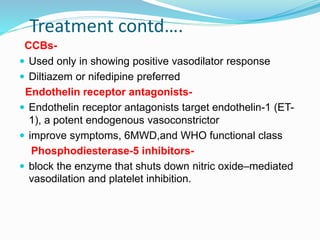
CCBs-
 Used only in showing positive vasodilator response
 Diltiazem or nifedipine preferred
Endothelin receptor antagonists-
 Endothelin receptor antagonists target endothelin-1 (ET-
1), a potent endogenous vasoconstrictor
 improve symptoms, 6MWD,and WHO functional class
Phosphodiesterase-5 inhibitors-
 block the enzyme that shuts down nitric oxide–mediated
vasodilation and platelet inhibition.
Treatment contd….
Prostanoids-
 epoprostenol,treprostinil
 Epoprostenol - continuous intravenous infusion improves
functional capacity and survival in PAH.
 Inhaled prostacycline has no risk of infection and infusion
site reaction
guanylyl cyclase stimulator-
 Stimulator of nitric oxide receptor
 Riociguat is an oral soluble guanylyl cyclase stimulator-
approved for the treatment of both PAH and CTEPH
FOLLOWING RESPONSE TO THERAPY
 Six minute walk test
 Echocardiogram
 Right heart catheterisation
 BNP
 Funtional class
Take home message-
 Idiopathic pulmonary arterial hypertension is a
progressive disease
 Transthoracic Echocardiography is screening test
 Definitive diagnosis by right heart catheterization
 there is no cure for PAH, current pharmacologic therapies
improve morbidity and, in some cases mortality
 Improved awareness among clinicians and patients could
lead to more timely diagnosis that will affect the response
to therapy and survival.
Pulmonary hypertension

Pulmonary hypertension

  • 1.
    DR.MD SHAHID IQUBAL Depttof Medicine NMCH,PATNA
  • 2.
    INTRODUCTION Definition- Pulmonary hypertension (PH)is a spectrum of diseases involving the pulmonary vasculature, and is defined as an elevation in pulmonary arterial pressures (mean pulmonary artery pressure >22 mmHg).
  • 3.
    Classification - PH issubcategorized into five major groups :  Group I—Pulmonary arterial hypertension (PAH)  Group II—PH due to left heart disease  Group III—PH due to lung diseases and/or hypoxemia(COPD, Interstitial lung disease, OSA)  Group IV—Chronic thromboembolic pulmonary hypertension (CTEPH)  Group V—PH with unclear mechanisms
  • 4.
    Pulmonary Arterial Hypertension PAH is defined as a sustained elevation in resting mPAP ≥25 mmHg, and PCWP or left ventricle end- diastolic pressure of ≤15 mmHg based on a right heart catheterization.  Idiopathic pulmonary arterial hypertension (IPAH) is a progressive disease that leads to right heart failure and death  PAH associated with HIV, connective tissue disease(systemic sclerosis),and portal hypertension.
  • 5.
    DIAGNOSIS Clinical presentation- Symptoms ofPH-  The symptoms of PH are often nonspecific and variable  include dyspnea (most common),  exercise intolerance,  fatigue,  palpitations,  syncope,  chest pain,  lower extremity swelling,
  • 6.
    DIAGNOSIS contd…. On examination- evidenceof right heart failure-  elevated jugular venous pressure,  lower extremity edema, and  ascites. cardiovascular examination-  prominent second heart sound (loud S2) with loud P2 componentound, a right-sided S3 or S4, and a holosystolic tricuspid regurgitant murmur  clubbing in chronic lung diseases,  sclerodactyly and telangiectasia in scleroderma, and  crackles and systemic hypertension in left-sided systolic or diastolic heart failure
  • 7.
    Diagnostic Testing- echocardiogram –(TTE) Is screening test  Shows hypertrophied and dilated right ventricle with elevated estimated pulmonary artery systolic pressure  Identify causes of PH -left ventricular systolic and diastolic dysfunction, valvular disease right heart catheterization -  for definitive diagnosis  Measure cardiac output and mean right atrial pressure (RAP) and asses severity condition
  • 8.
    Diagnostic Testing contd… Chestx-ray-  Large central pulmonary arteries with “vascular pruning,”  Cardiomegaly due to enlarged RA ,RV  Regional oligemia of pulmonary vasculature (chronic thromboembolic disease)  Interstitial infiltrates (ILD)  Hyperinflated lungs(chronic obstructive lung disease). HRCT-  Enlarged pulmonary arteries ,  peripheral pruning of the small vessels,and  enlarged right ventricle and atrium  Centrilobular ground-glass infiltrate Ventilation–Perfusion (V/Q) lung scan-  Used for excluding chronic thromboembolic disease
  • 9.
    Diagnostic Testing contd… Pulmonary Function Testing- Spirometry and lung volumes to assess for COPD or restrictive- interstitial lung disease [ILD]) Diffusing capacity for carbon monoxide (DLCO) reduced in parenchymal  lung diseases Arterial blood gas (ABG): Elevated PaCO2 is found in hypoventilation syndrome. Six-minute walk (6MW) or simple exercise test-  to evaluate the degree of exertional hypoxemia and  to monitor progression and response to therapy Nocturnal oximetry:.  Nocturnal desaturations is common finding in PH  Nocturnal desaturations can be find in OSAS
  • 10.
    Diagnostic Testing contd… ECG- RVH,  right atrial enlargement,  right bundle branch block, and  right ventricular strain pattern Acute vasodilator testing.-  Performed with a short-acting vasodilator, such as intravenous adenosine, intravenous epoprostenol, or inhaled nitric oxide  Definition of a responder is decrease in mPAP by ≥10 mm Hg to an absolute level ≤ 40 mm Hg without a decrese in CO.  responders are considered for long-term treatment with CCBs.
  • 11.
    Diagnostic Testing contd… Laboratories Complete blood counts (CBCs)  Blood urea nitrogen, serum creatinine  Hepatic function tests  B-type natriuretic peptide (BNP)  Human immunodeficiency virus (HIV) serology  Thyroid-stimulating hormone (TSH)  Antinuclear antibody (ANA)  Antitopoisomerase antibodies and anticentromere antibodies  hepatitis B and C serologies
  • 12.
    TREATMENT General measures-  Avoidpregnancy  Immunization for respiratory illness influenza and pneumovax vaccination  Minimize valsalva maneuvers-increase risk of syncope cough, constipation,heavy lifting  Should stop cigarette smoking
  • 13.
    Classes of therapy MEDICAL-  Diuretics  Anticoagulants  Inotropic agents  Oxygen  PAH specific therapy  SURGICAL THERAPY-  Lung transplantation or heart–lung transplantation  Atrial septostomy  Septal defect closure
  • 14.
    Treatment contd… DIURETICS-  Principallyto treat edema from right heart failure  May need to combine classes(loop diuretic +aldosterone antagonist+ thiazides)  Careful to avoid too much preload reduction ANTICOAGULANTS-  Warfarin is dosed to target international normalized ratio (INR) of 1.5 to 2.5 INOTROPIC AGENT  improves right heart function, cardiac output, and symptoms.  Dobutamine and milrinone are best for short-term use in extremely decompensated states.
  • 15.
    PAH SPECIFIC THERAPY CCBs Endothelinreceptor antagonists -Bosentan,ambrisentan,masitentan Phosphodiesterase-5 inhibitors -Sildenafil,tadalafil Prostanoids -epoprostenol,treprostinil guanylyl cyclase stimulator-riociguat
  • 16.
    Treatment contd…. CCBs-  Usedonly in showing positive vasodilator response  Diltiazem or nifedipine preferred Endothelin receptor antagonists-  Endothelin receptor antagonists target endothelin-1 (ET- 1), a potent endogenous vasoconstrictor  improve symptoms, 6MWD,and WHO functional class Phosphodiesterase-5 inhibitors-  block the enzyme that shuts down nitric oxide–mediated vasodilation and platelet inhibition.
  • 17.
    Treatment contd…. Prostanoids-  epoprostenol,treprostinil Epoprostenol - continuous intravenous infusion improves functional capacity and survival in PAH.  Inhaled prostacycline has no risk of infection and infusion site reaction guanylyl cyclase stimulator-  Stimulator of nitric oxide receptor  Riociguat is an oral soluble guanylyl cyclase stimulator- approved for the treatment of both PAH and CTEPH
  • 18.
    FOLLOWING RESPONSE TOTHERAPY  Six minute walk test  Echocardiogram  Right heart catheterisation  BNP  Funtional class
  • 19.
    Take home message- Idiopathic pulmonary arterial hypertension is a progressive disease  Transthoracic Echocardiography is screening test  Definitive diagnosis by right heart catheterization  there is no cure for PAH, current pharmacologic therapies improve morbidity and, in some cases mortality  Improved awareness among clinicians and patients could lead to more timely diagnosis that will affect the response to therapy and survival.