Pulmonary Function
Vida C. Salcedo RRT, RTRP
Spirometry
For now, spirometry is best test to:
• Monitor asthma status
• Look for evidence of asthma
• Look for evidence of other diagnoses
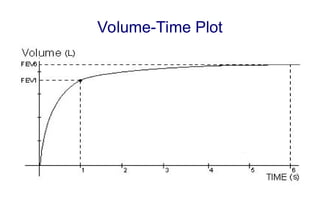
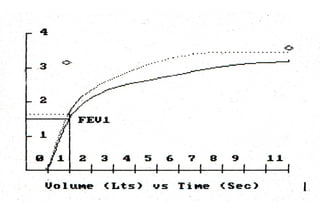
Volume-Time Plot
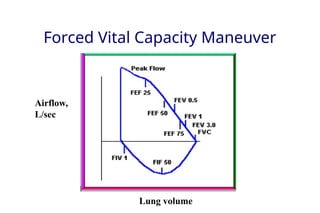
Forced Vital Capacity Maneuver
Airflow,
L/sec
Lung volume
Definitions
 FVC – Forced Vital Capacity
Volume of air exhaled after a maximal inspiration to total lung capacity. This
volume is expressed in Liters
 FEV1 – Forced Expiratory Volume in 1 second
Volume of air exhaled in the first second of expiration.
This volume is expressed in Liters
 FEF 25-75%
Mean expiratory flow during the middle half of the FVC maneuver; reflects
flow through later emptying airways, not necessarily the small airways
 FEV1/FVC – Ratio (%)
Volume of air expired in the first second, expressed as a percent of FVC
Performance of FVC maneuver
Patient assumes the position (typically standing)
• Puts nose clip on
• Inhales maximally
• Puts mouthpiece in mouth and closes lips around mouthpiece
(open circuit)
• Exhales as hard and fast and long as possible
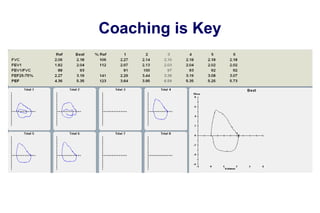
• Repeat instructions if necessary – effective coaching is essential
• Give simple instructions
• Repeat minimum of three times (check for repeatability)
Special Considerations in Pediatric
Patients
Ability to perform spirometry dependent on
developmental age of child, personality, and interest.
Patients need a calm, relaxed environment and
good coaching. Patience is key.
Be creative
Use incentives
Even with the best of environments and coaching, a
child may not be able to perform spirometry.
ATS Acceptable Criteria
Within Maneuver
 Free from artifacts, such as
• Cough during the first second of exhalation
• Glottis closure that influences the measurement
• Early termination or cut-off
• Effort that is not maximal throughout
• Leak
• Obstructed mouthpiece
 Good starts
• Extrapolated volume < 5% of FVC or 0.15 L, whichever is greater
 Satisfactory exhalation
• Duration of ≥ 6 s (3 s for children < 10) or a plateau in the volume–
time curve or
• If the subject cannot or should not continue to exhale
ATS Acceptable Criteria
Within Maneuver
 After three acceptable spirograms have been obtained, apply the
following tests
• The two largest values of FVC must be within 0.150 L of each other
• The two largest values of FEV1 must be within 0.150 L of each other
 If both of these criteria are met, the test session may be
concluded
 If both of these criteria are not met, continue testing until
• Both of the criteria are met with analysis of additional acceptable
spirograms
 or
• A total of eight tests have been performed (optional) or
• The patient/subject cannot or should not continue
 Save, as a minimum, the three satisfactory maneuvers
Spirometry Interpretation: So what
constitutes normal?
Normal values vary and depend on:
• Height
• Age
• Gender
• Ethnicity
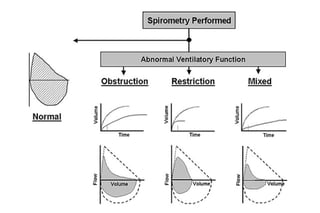
Spirometry Interpretation:
Obstructive vs. Restrictive Defect
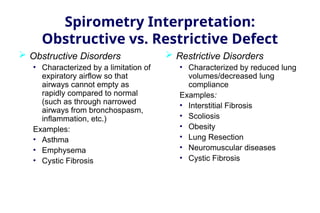
 Obstructive Disorders
• Characterized by a limitation of
expiratory airflow so that
airways cannot empty as
rapidly compared to normal
(such as through narrowed
airways from bronchospasm,
inflammation, etc.)
Examples:
• Asthma
• Emphysema
• Cystic Fibrosis
 Restrictive Disorders
• Characterized by reduced lung
volumes/decreased lung
compliance
Examples:
• Interstitial Fibrosis
• Scoliosis
• Obesity
• Lung Resection
• Neuromuscular diseases
• Cystic Fibrosis
Spirometry Interpretation:
Obstructive vs. Restrictive Defect
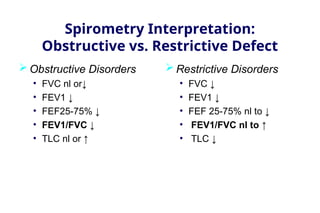
 Obstructive Disorders
• FVC nl or↓
• FEV1 ↓
• FEF25-75% ↓
• FEV1/FVC ↓
• TLC nl or ↑
 Restrictive Disorders
• FVC ↓
• FEV1 ↓
• FEF 25-75% nl to ↓
• FEV1/FVC nl to ↑
• TLC ↓
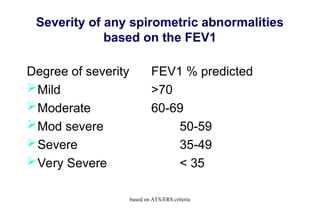
Severity of any spirometric abnormalities
based on the FEV1
Degree of severity FEV1 % predicted
Mild >70
Moderate 60-69
Mod severe 50-59
Severe 35-49
Very Severe < 35
based on ATS/ERS criteria
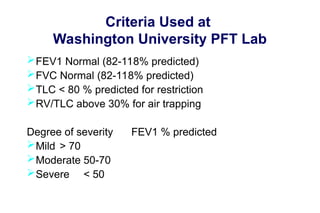
Criteria Used at
Washington University PFT Lab
FEV1 Normal (82-118% predicted)
FVC Normal (82-118% predicted)
TLC < 80 % predicted for restriction
RV/TLC above 30% for air trapping
Degree of severity FEV1 % predicted
Mild > 70
Moderate 50-70
Severe < 50
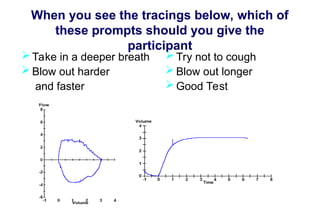
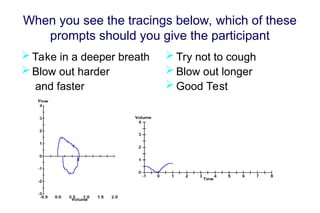
When you see the tracings below, which of
these prompts should you give the
participant
 Take in a deeper breath
 Blow out harder
and faster
 Try not to cough
 Blow out longer
 Good Test
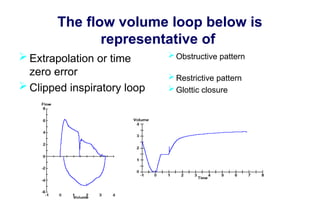
The flow volume loop below is
representative of
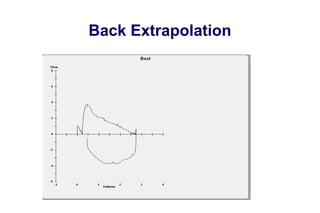
 Extrapolation or time
zero error
 Clipped inspiratory loop
 Obstructive pattern
 Restrictive pattern
 Glottic closure
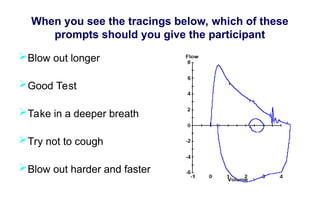
When you see the tracings below, which of these
prompts should you give the participant
Blow out longer
Good Test
Take in a deeper breath
Try not to cough
Blow out harder and faster
When you see the tracings below, which of these
prompts should you give the participant
 Take in a deeper breath
 Blow out harder
and faster
 Try not to cough
 Blow out longer
 Good Test
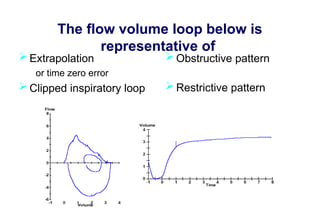
The flow volume loop below is
representative of
 Extrapolation
or time zero error
 Clipped inspiratory loop
 Obstructive pattern
 Restrictive pattern
 Glottic closure
Back Extrapolation
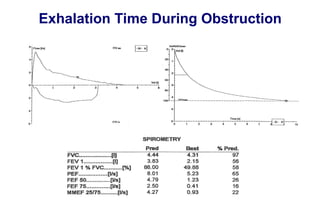
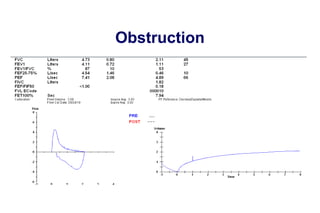
Exhalation Time During Obstruction
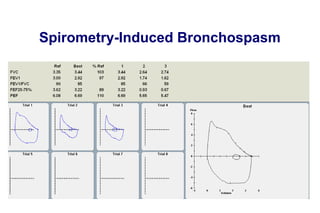
Spirometry-Induced Bronchospasm
Coaching is Key
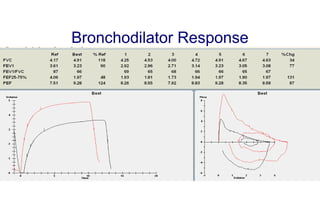
Bronchodilator Response
Obstruction
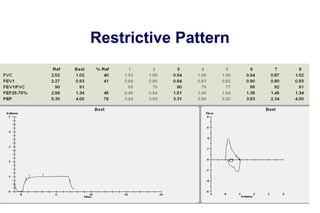
Restrictive Pattern
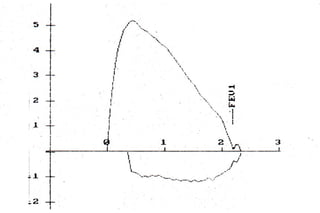
Patient example
Child with inspiratory stridor
-
-
Vocal Cord Dysfunction
Patient example
12 year old boy presents with exercise-
induced wheeze for 1 year
Not responsive to bronchodilator used pre-
exercise, ICS, OCS
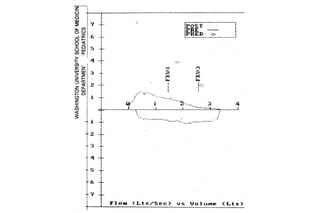
Fixed airway obstruction
Obstruction due to abnormalities of the vocal
cords after trauma of intubation and
prolonged intubation
Additional history
Automobile accident at age 11 years
Intubated at scene of accident
Comatose for 1 month, followed by complete
neurologic recovery
FEF 25-75%
What is it?
What does it measure?
Is it a measure of small airways?
FEF 25-75%
 What is it?
• Mean expiratory flow during middle half of FVC maneuver
 What does it measure?
• Flow from airways that empty in the middle half of FVC
maneuver
 Is it a measure of small airways?
• Maybe in normals
• In asthma, or obstructive disease, it measures flow from
more obstructed airways which could be small or larger
with more obstruction
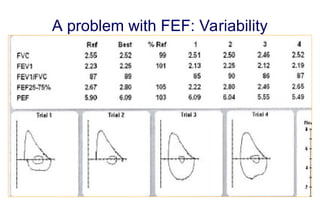
A problem with FEF: Variability
Dysanapsis
 Green, Mead, Turner. Variability of maximum expiratory
flow-volume curves. J Appl Physiol 1974 37:67-74
• Variability in flows among healthy adults not altered when
flows were corrected for vital capacity
• Lung static recoil and bronchomotor tone contributed little
to variability
Concluded that variability in flows between individuals
due to differences in airway size independent of
lung/parenchyma size
Differences may have embryological basis, reflecting
disproportionate but physiologically normal growth within
an organ
Dysanapsis
Mead. Dysanapsis in normal lungs assessed by the
relationship between maximal flow, static recoil, and vital
capacity. Am Rev Respir Dis 1980 121:339-342
• “There is no association whatsoever between
airway diameter and lung size.”
• There are differences between men and women
(men 17% larger than women) and between boys
and men (boys in late teens similar to girls,
suggesting that growth in males occurs late)
Measures Of Dysanapsis
Mead used maximal expiratory flow/static recoil
pressure at 50% VC
Weiss and coworkers have used
FEF25-75/FVC as a surrogate
FEF25-75/FVC is correlated with
FEV-1/FVC
FEV-1/FVC is the best measure: obtained from
spirometry and normal values available
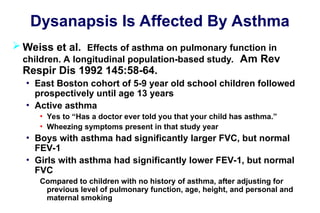
Dysanapsis Is Affected By Asthma
 Weiss et al. Effects of asthma on pulmonary function in
children. A longitudinal population-based study. Am Rev
Respir Dis 1992 145:58-64.
• East Boston cohort of 5-9 year old school children followed
prospectively until age 13 years
• Active asthma
• Yes to “Has a doctor ever told you that your child has asthma.”
• Wheezing symptoms present in that study year
• Boys with asthma had significantly larger FVC, but normal
FEV-1
• Girls with asthma had significantly lower FEV-1, but normal
FVC
Compared to children with no history of asthma, after adjusting for
previous level of pulmonary function, age, height, and personal and
maternal smoking
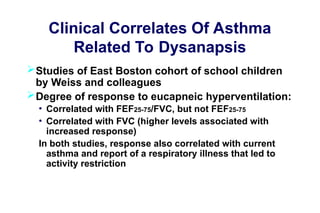
Clinical Correlates Of Asthma
Related To Dysanapsis
Studies of East Boston cohort of school children
by Weiss and colleagues
Degree of response to eucapneic hyperventilation:
• Correlated with FEF25-75/FVC, but not FEF25-75
• Correlated with FVC (higher levels associated with
increased response)
In both studies, response also correlated with current
asthma and report of a respiratory illness that led to
activity restriction
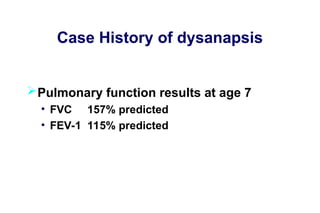
Case History of dysanapsis
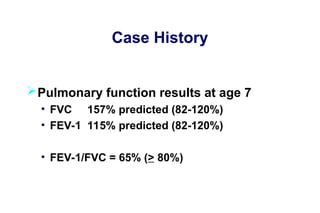
Pulmonary function results at age 7
• FVC 157% predicted
• FEV-1 115% predicted
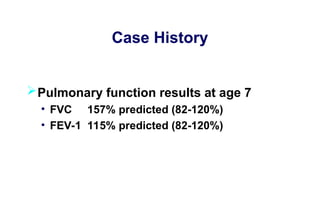
Case History
Pulmonary function results at age 7
• FVC 157% predicted (82-120%)
• FEV-1 115% predicted (82-120%)
Case History
Pulmonary function results at age 7
• FVC 157% predicted (82-120%)
• FEV-1 115% predicted (82-120%)
• FEV-1/FVC = 65% (> 80%)
Case History
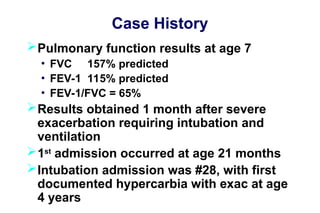
Pulmonary function results at age 7
• FVC 157% predicted
• FEV-1 115% predicted
• FEV-1/FVC = 65%
Results obtained 1 month after severe
exacerbation requiring intubation and
ventilation
1st
admission occurred at age 21 months
Intubation admission was #28, with first
documented hypercarbia with exac at age
4 years
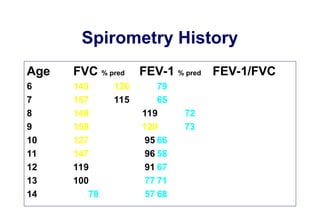
Spirometry History
Age FVC % pred FEV-1 % pred FEV-1/FVC
6 143 126 79
7 157 115 65
8 149 119 72
9 159 129 73
10 127 95 66
11 147 96 58
12 119 91 67
13 100 77 71
14 78 57 68
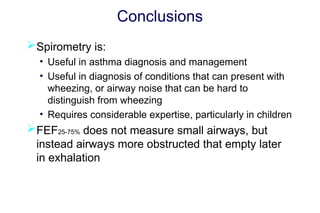
Conclusions
Spirometry is:
• Useful in asthma diagnosis and management
• Useful in diagnosis of conditions that can present with
wheezing, or airway noise that can be hard to
distinguish from wheezing
• Requires considerable expertise, particularly in children
FEF25-75% does not measure small airways, but
instead airways more obstructed that empty later
in exhalation

PFT LECTURE - SIMPLIFIED FOR TEACHING AND STUDENTS

  • 1.
    Pulmonary Function Vida C.Salcedo RRT, RTRP
  • 2.
    Spirometry For now, spirometryis best test to: • Monitor asthma status • Look for evidence of asthma • Look for evidence of other diagnoses
  • 3.
  • 4.
    Forced Vital CapacityManeuver Airflow, L/sec Lung volume
  • 5.
    Definitions  FVC –Forced Vital Capacity Volume of air exhaled after a maximal inspiration to total lung capacity. This volume is expressed in Liters  FEV1 – Forced Expiratory Volume in 1 second Volume of air exhaled in the first second of expiration. This volume is expressed in Liters  FEF 25-75% Mean expiratory flow during the middle half of the FVC maneuver; reflects flow through later emptying airways, not necessarily the small airways  FEV1/FVC – Ratio (%) Volume of air expired in the first second, expressed as a percent of FVC
  • 6.
    Performance of FVCmaneuver Patient assumes the position (typically standing) • Puts nose clip on • Inhales maximally • Puts mouthpiece in mouth and closes lips around mouthpiece (open circuit) • Exhales as hard and fast and long as possible • Repeat instructions if necessary – effective coaching is essential • Give simple instructions • Repeat minimum of three times (check for repeatability)
  • 7.
    Special Considerations inPediatric Patients Ability to perform spirometry dependent on developmental age of child, personality, and interest. Patients need a calm, relaxed environment and good coaching. Patience is key. Be creative Use incentives Even with the best of environments and coaching, a child may not be able to perform spirometry.
  • 8.
    ATS Acceptable Criteria WithinManeuver  Free from artifacts, such as • Cough during the first second of exhalation • Glottis closure that influences the measurement • Early termination or cut-off • Effort that is not maximal throughout • Leak • Obstructed mouthpiece  Good starts • Extrapolated volume < 5% of FVC or 0.15 L, whichever is greater  Satisfactory exhalation • Duration of ≥ 6 s (3 s for children < 10) or a plateau in the volume– time curve or • If the subject cannot or should not continue to exhale
  • 9.
    ATS Acceptable Criteria WithinManeuver  After three acceptable spirograms have been obtained, apply the following tests • The two largest values of FVC must be within 0.150 L of each other • The two largest values of FEV1 must be within 0.150 L of each other  If both of these criteria are met, the test session may be concluded  If both of these criteria are not met, continue testing until • Both of the criteria are met with analysis of additional acceptable spirograms  or • A total of eight tests have been performed (optional) or • The patient/subject cannot or should not continue  Save, as a minimum, the three satisfactory maneuvers
  • 10.
    Spirometry Interpretation: Sowhat constitutes normal? Normal values vary and depend on: • Height • Age • Gender • Ethnicity
  • 11.
    Spirometry Interpretation: Obstructive vs.Restrictive Defect  Obstructive Disorders • Characterized by a limitation of expiratory airflow so that airways cannot empty as rapidly compared to normal (such as through narrowed airways from bronchospasm, inflammation, etc.) Examples: • Asthma • Emphysema • Cystic Fibrosis  Restrictive Disorders • Characterized by reduced lung volumes/decreased lung compliance Examples: • Interstitial Fibrosis • Scoliosis • Obesity • Lung Resection • Neuromuscular diseases • Cystic Fibrosis
  • 12.
    Spirometry Interpretation: Obstructive vs.Restrictive Defect  Obstructive Disorders • FVC nl or↓ • FEV1 ↓ • FEF25-75% ↓ • FEV1/FVC ↓ • TLC nl or ↑  Restrictive Disorders • FVC ↓ • FEV1 ↓ • FEF 25-75% nl to ↓ • FEV1/FVC nl to ↑ • TLC ↓
  • 13.
    Severity of anyspirometric abnormalities based on the FEV1 Degree of severity FEV1 % predicted Mild >70 Moderate 60-69 Mod severe 50-59 Severe 35-49 Very Severe < 35 based on ATS/ERS criteria
  • 14.
    Criteria Used at WashingtonUniversity PFT Lab FEV1 Normal (82-118% predicted) FVC Normal (82-118% predicted) TLC < 80 % predicted for restriction RV/TLC above 30% for air trapping Degree of severity FEV1 % predicted Mild > 70 Moderate 50-70 Severe < 50
  • 16.
    When you seethe tracings below, which of these prompts should you give the participant  Take in a deeper breath  Blow out harder and faster  Try not to cough  Blow out longer  Good Test
  • 17.
    The flow volumeloop below is representative of  Extrapolation or time zero error  Clipped inspiratory loop  Obstructive pattern  Restrictive pattern  Glottic closure
  • 18.
    When you seethe tracings below, which of these prompts should you give the participant Blow out longer Good Test Take in a deeper breath Try not to cough Blow out harder and faster
  • 19.
    When you seethe tracings below, which of these prompts should you give the participant  Take in a deeper breath  Blow out harder and faster  Try not to cough  Blow out longer  Good Test
  • 20.
    The flow volumeloop below is representative of  Extrapolation or time zero error  Clipped inspiratory loop  Obstructive pattern  Restrictive pattern  Glottic closure
  • 21.
  • 22.
  • 23.
  • 24.
  • 25.
  • 26.
  • 27.
  • 28.
    Patient example Child withinspiratory stridor
  • 29.
  • 30.
  • 31.
    Patient example 12 yearold boy presents with exercise- induced wheeze for 1 year Not responsive to bronchodilator used pre- exercise, ICS, OCS
  • 34.
    Fixed airway obstruction Obstructiondue to abnormalities of the vocal cords after trauma of intubation and prolonged intubation
  • 35.
    Additional history Automobile accidentat age 11 years Intubated at scene of accident Comatose for 1 month, followed by complete neurologic recovery
  • 36.
    FEF 25-75% What isit? What does it measure? Is it a measure of small airways?
  • 37.
    FEF 25-75%  Whatis it? • Mean expiratory flow during middle half of FVC maneuver  What does it measure? • Flow from airways that empty in the middle half of FVC maneuver  Is it a measure of small airways? • Maybe in normals • In asthma, or obstructive disease, it measures flow from more obstructed airways which could be small or larger with more obstruction
  • 38.
    A problem withFEF: Variability
  • 39.
    Dysanapsis  Green, Mead,Turner. Variability of maximum expiratory flow-volume curves. J Appl Physiol 1974 37:67-74 • Variability in flows among healthy adults not altered when flows were corrected for vital capacity • Lung static recoil and bronchomotor tone contributed little to variability Concluded that variability in flows between individuals due to differences in airway size independent of lung/parenchyma size Differences may have embryological basis, reflecting disproportionate but physiologically normal growth within an organ
  • 40.
    Dysanapsis Mead. Dysanapsis innormal lungs assessed by the relationship between maximal flow, static recoil, and vital capacity. Am Rev Respir Dis 1980 121:339-342 • “There is no association whatsoever between airway diameter and lung size.” • There are differences between men and women (men 17% larger than women) and between boys and men (boys in late teens similar to girls, suggesting that growth in males occurs late)
  • 41.
    Measures Of Dysanapsis Meadused maximal expiratory flow/static recoil pressure at 50% VC Weiss and coworkers have used FEF25-75/FVC as a surrogate FEF25-75/FVC is correlated with FEV-1/FVC FEV-1/FVC is the best measure: obtained from spirometry and normal values available
  • 42.
    Dysanapsis Is AffectedBy Asthma  Weiss et al. Effects of asthma on pulmonary function in children. A longitudinal population-based study. Am Rev Respir Dis 1992 145:58-64. • East Boston cohort of 5-9 year old school children followed prospectively until age 13 years • Active asthma • Yes to “Has a doctor ever told you that your child has asthma.” • Wheezing symptoms present in that study year • Boys with asthma had significantly larger FVC, but normal FEV-1 • Girls with asthma had significantly lower FEV-1, but normal FVC Compared to children with no history of asthma, after adjusting for previous level of pulmonary function, age, height, and personal and maternal smoking
  • 43.
    Clinical Correlates OfAsthma Related To Dysanapsis Studies of East Boston cohort of school children by Weiss and colleagues Degree of response to eucapneic hyperventilation: • Correlated with FEF25-75/FVC, but not FEF25-75 • Correlated with FVC (higher levels associated with increased response) In both studies, response also correlated with current asthma and report of a respiratory illness that led to activity restriction
  • 44.
    Case History ofdysanapsis Pulmonary function results at age 7 • FVC 157% predicted • FEV-1 115% predicted
  • 45.
    Case History Pulmonary functionresults at age 7 • FVC 157% predicted (82-120%) • FEV-1 115% predicted (82-120%)
  • 46.
    Case History Pulmonary functionresults at age 7 • FVC 157% predicted (82-120%) • FEV-1 115% predicted (82-120%) • FEV-1/FVC = 65% (> 80%)
  • 47.
    Case History Pulmonary functionresults at age 7 • FVC 157% predicted • FEV-1 115% predicted • FEV-1/FVC = 65% Results obtained 1 month after severe exacerbation requiring intubation and ventilation 1st admission occurred at age 21 months Intubation admission was #28, with first documented hypercarbia with exac at age 4 years
  • 48.
    Spirometry History Age FVC% pred FEV-1 % pred FEV-1/FVC 6 143 126 79 7 157 115 65 8 149 119 72 9 159 129 73 10 127 95 66 11 147 96 58 12 119 91 67 13 100 77 71 14 78 57 68
  • 49.
    Conclusions Spirometry is: • Usefulin asthma diagnosis and management • Useful in diagnosis of conditions that can present with wheezing, or airway noise that can be hard to distinguish from wheezing • Requires considerable expertise, particularly in children FEF25-75% does not measure small airways, but instead airways more obstructed that empty later in exhalation

Editor's Notes

  • #10 Height varies directly with vc VC increases with age up to age 20 years then becomes inversely proportion to age Women usually with lower vc than men
  • #29 C. steiger, VCD
  • #32 Brian Wagner, fixed obstruction at glottis
  • #33 Brian Wagner, fixed obstruction at glottis